REVIEW 3 major objections 5 minor 36 references
Overcoming Quadratic Hardware Scaling for a Fully Connected Digital Oscillatory Neural Network
T0 review · 3 major / 5 minor · reviewed 2026-08-16 · deepseek-v4-flash
Pith's one-line read Serialized couplings make digital oscillator networks scale nearly linearly
desk verdict A real 10.5x scaling demo for ONN arithmetic logic, but the 'quadratic hardware scaling' claim overreaches because weight memory and DSP are still the limiting resources. read the letter →
The pith
A machine-rendered reading of the paper's core claim, the machinery that carries it, and where it could break.
The reading
What carries the argument
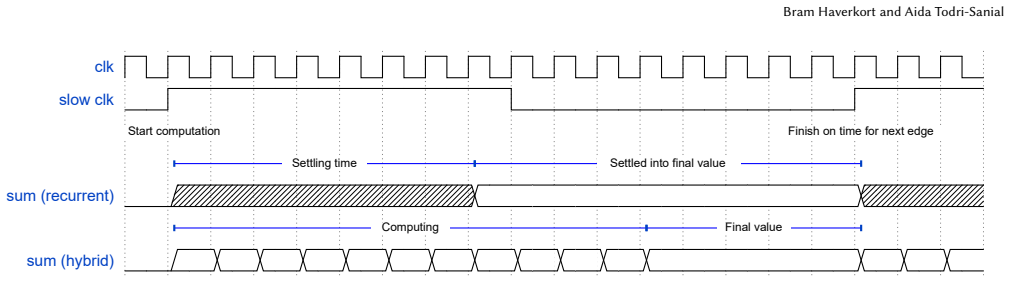
The load-bearing mechanism is time-multiplexed serial accumulation of the weighted sum. For each oscillator, instead of a combinatorial tree of $N-1$ adders, one adder with feedback accumulates the products of the $N$ stored weights with the time-multiplexed oscillator amplitudes over $N$ fast-clock cycles; a counter selects the memory address and the multiplexer, and the final sum is latched in time for the next phase update on the slow clock. The multiply-accumulate maps onto DSP slices and the weight matrix onto block RAM, trading arithmetic logic for memory and a faster clock domain. Its cost is the requirement that the fast clock run at least $N$ times the phase clock, which is the trade that limits the largest demonstrable network.
What would settle it
Synthesize the hybrid architecture at 1024 oscillators on an FPGA with enough BRAM and DSP slices and measure the LUT/FF counts and the achievable fast-clock frequency. If the resource counts leave the fitted near-1.2 exponent, or if the fast clock cannot run at least $N$ times the phase clock while meeting timing, the near-linear scaling claim fails; similarly, the claim weakens if pattern retrieval accuracy degrades materially when the design is actually run at that size.
Extended reading notes
Core claim
The central discovery is that a fully connected digital ONN does not need $N^2$ arithmetic circuits. By storing the $N \times N$ coupling matrix in block RAM and feeding oscillator amplitudes through a multiplexer into one accumulator per oscillator, the hardware cost of the couplings drops from quadratic to near-linear: measured LUT scaling order 1.2231, FF scaling order 1.1092, versus 2.0770 and 2.3859 for the recurrent architecture. This raises the maximum fully connected network on the test FPGA from 48 to 506 oscillators at the same precision, at the price of an oscillation frequency that falls with order about -1.35 in network size. The paper verifies that the serialized arithmetic reproduces the dynamics of the recurrent design on pattern retrieval tasks at multiple corruption levels.
Load-bearing premise
The serialized design must finish all $N$ weighted additions inside one phase-update period, which requires a fast clock at least $N$ times the phase clock and all $N^2$ weights resident in on-chip memory; the paper demonstrates this only up to 506 oscillators, where BRAM and DSP slices are already at 100% utilization.
Editorial extensions
If this is right
- At 5-bit weights and 4-bit phases, the hybrid architecture runs 506 fully connected oscillators on a Zynq-7020, 10.5x the recurrent baseline's 48, and is the largest fully connected digital ONN reported in the paper.
- Hardware usage for the coupling logic scales approximately linearly: LUTs at exponent about 1.22 and flip-flops at about 1.11, versus about 2.08 and 2.39 for the recurrent architecture.
- The hybrid architecture matches the recurrent architecture in pattern retrieval accuracy and settling time on small patterns, and retains near-100% accuracy on 10x10 and 22x22 patterns at 10% and 25% corruption.
- Scaling comes at the cost of oscillation frequency, which drops with exponent about -1.35 in network size, so applications that need fast oscillation must use fewer oscillators.
- Because the network remains all-to-all, problems that need dense embedding, such as graph max-cut, do not require sparse-topology mapping tricks.
Reading between the lines
- The same accumulator-per-node serialization could be applied to other fully connected recurrent FPGA designs, and the measured exponents suggest that the practical ceiling will move from logic cells to on-chip memory and DSP capacity.
- The 100% BRAM and 100% DSP utilization at 506 oscillators implies that the architecture could likely exceed 506 nodes on a larger FPGA or with external memory, but the paper's near-linear scaling claim is only demonstrated up to that size.
- A natural testable extension is to run combinatorial optimization benchmarks, such as max-cut or MaxSAT, at the newly reachable all-to-all scale; the paper leaves this to future work.
- The frequency penalty could be reduced by processing several oscillators' weighted sums concurrently when spare DSP slices exist, giving a tunable parallelism-versus-serialization tradeoff that the paper does not explore.
Signed reviews
Editorial analysis
A structured set of objections, weighed in public.
Referee Report
Summary. The paper proposes a hybrid architecture for digital oscillatory neural networks (ONNs) in which the coupling arithmetic is partially serialized: rather than using N parallel adders per oscillator, a single multiply-accumulate unit per oscillator is time-multiplexed across all N weights, operating on a faster clock domain. The authors compare this against a previously reported recurrent digital ONN on a Zynq-7020 FPGA, reporting LUT/FF scaling exponents of about 1.2 for the hybrid architecture versus about 2.0–2.4 for the recurrent baseline, and a 10.5× increase in maximum oscillator count (48 to 506) at 5-bit weights and 4-bit phases. They also report pattern-retrieval benchmarks showing similar retrieval accuracy and settling time between the two architectures, and high accuracy on larger patterns up to 22×22. The central claim is that the hybrid architecture overcomes quadratic hardware scaling.
Significance. If properly qualified, this is a useful engineering contribution: it demonstrates the largest fully connected digital ONN implemented on an FPGA to date, and it shows that the dominant logic cost of the coupling network can be reduced from O(N^2) adders to O(N) adders by time-multiplexing, with measured resource usage fitting the claimed near-linear trend (R² above 0.99 for LUTs and FFs). The use of an external learning rule (Diederich-Opper) and standard corruption benchmarks strengthens the functional validation. The strength of the paper is the concrete FPGA synthesis data across network sizes, not just a conceptual proposal. However, the significance is limited by the fact that the near-linear scaling applies only to LUT/FF logic, while on-chip weight storage and DSP usage remain quadratic and are the actual binding constraints at the maximum demonstrated size.
major comments (3)
- [§2.1 and Table 4] The headline claim of 'overcoming quadratic hardware scaling' is contradicted by the paper's own account: §2.1 states that the number of memory cells for weights cannot be reduced and remains O(N²), and Table 4 shows that at 506 oscillators the hybrid design uses 100% of BRAM and 100% of DSP slices, while LUTs are at 78% and FFs at 42%. Thus the binding resource constraints at the maximum demonstrated size are the quadratic weight memory and the DSP count, not the LUT/FF logic whose exponent is fitted as 1.2. The paper should qualify the claim as near-linear scaling of the coupling arithmetic logic (LUTs/FFs), and should explicitly state that total resource scaling, including on-chip storage, remains quadratic.
- [§4.2] The scaling analysis is incomplete because it excludes BRAM and DSP utilization. The methodology states that only LUTs and FFs were recorded because 'these are the two components determining the amount of logic hardware', but BRAM and DSP are also hardware resources and they saturate at the maximum network size. To support the claim of near-linear hardware scaling, the authors should report BRAM and DSP usage per network size, and either fit scaling exponents for those resources or justify their exclusion with a clear argument that they are not part of the architecture's scaling bottleneck. Without this, the paper's conclusion that 'hardware resource usage scales nearly linear' is only demonstrated for a subset of the resources.
- [§5.2 and Figure 11] The frequency trade-off is not incorporated into the scaling claim. Figure 11 and the text report that the hybrid architecture's oscillation frequency scales as N^(-1.35), which is slightly faster than inversely linear. Because the serialized arithmetic requires at least N fast-clock cycles per phase update, the phase clock must be slowed down by a factor of N; at N=506 with a 50 MHz fast clock the oscillation frequency is already only 6.1 kHz. For larger N, the required fast clock becomes increasingly impractical or the oscillation frequency falls to levels that undermine the utility of the architecture. This is acknowledged in the discussion but is not reflected in the title or the 'near-linear hardware scaling' framing; the paper should present the result as an area-time trade-off rather than as a wholesale overcoming of quadratic scaling.
minor comments (5)
- [§5.2] The flip-flop data point for the recurrent architecture at 16 oscillators is acknowledged as a possible outlier, but the fit is still reported without a sensitivity analysis. A short robustness note (e.g., refitting without that point) would make the scaling exponent more credible.
- [§5.3] The paper states in one paragraph that 'the oscillator dynamics of the hybrid architecture are the same as the recurrent architecture', while the immediately preceding discussion of the 3×3/50% anomaly hypothesizes that 'the additional synchronization required in the hybrid architecture slightly changes the system dynamics'. These statements are in tension and should be reconciled, for example by saying the dynamics are approximately equivalent for practical purposes with a possible small deviation at small sizes and high noise.
- [Table 2] The footnotes containing '⁄pilcrow' and '§' are rendered cryptically (e.g., '1008⁄pilcrow'); the table should use standard footnote symbols or superscript numbers that are clearly explained in the caption.
- [§4.3] The benchmark section explicitly states that 'exhaustive benchmarking is not required' and that only functionality is verified. This is fine, but the conclusion that the architectures have 'similar dynamics' would be strengthened by reporting the standard deviation or confidence intervals of the retrieval accuracy across the 1000 runs, rather than only the mean.
- [§5.2 and Figure 12] The 'maximum frequency (100%)≈ 325KHz' annotation in Figure 12 refers only to the hybrid architecture, but the figure caption does not make this explicit; the text should clarify that the frequency axis is relative to the hybrid architecture's own maximum.
Circularity Check
No circular step found: scaling exponents are descriptive fits, and the only self-citations are non-load-bearing baselines.
full rationale
The paper's central claims are empirical characterizations, not predictions derived from fitted parameters. The near-linear hardware scaling exponents (1.22 for LUTs, 1.11 for FFs) are obtained by 'a standard linear regression ... fitted on the base 10 logarithm of the data points ... the slope ... equals the order of scaling'; they are descriptive outputs of the authors' own synthesis measurements, not parameters injected to force the conclusion. The pattern-retrieval validation uses the external Diederich-Opper learning rule and independent pixel-corruption benchmarks, and the hybrid architecture is compared against the recurrent design as a baseline rather than as evidence for the new architecture's scaling. The recurrent baseline and the 5-bit/4-bit precision choice are cited from the authors' prior work, but these are design choices and comparison points, not load-bearing justifications; no uniqueness theorem or ansatz is imported from those citations. The paper itself states that 'the number of memory cells cannot be reduced' and Table 4 shows BRAM and DSP slices at 100% utilization at 506 oscillators, so the 'overcoming quadratic hardware scaling' headline is limited to LUT/FF arithmetic logic rather than total resources. That limitation is a scope/overstatement concern, not a circularity: the claimed LUT/FF exponent is a fit to data and is not equivalent to the architecture's inputs by construction. No circular step can be quoted.
Assumptions & free parameters
free parameters (4)
- LUT scaling exponent (recurrent architecture) =
2.08
- LUT scaling exponent (hybrid architecture) =
1.22
- FF scaling exponent (hybrid architecture) =
1.11
- Oscillation frequency scaling exponent (hybrid architecture) =
-1.35
assumptions (5)
- domain assumption The network minimizes the Ising Hamiltonian H = -sum J_ij sigma_i sigma_j - mu sum h_i sigma_i (Eq. 1), and oscillator phases evolve according to the Hoppensteadt-Izhikevich dynamics (Eq. 2).
- domain assumption The weighted sum for each oscillator must be computed and applied within one phase-update period, i.e., before the next clock edge that updates the phase.
- ad hoc to paper The fast clock domain can be made at least N times faster than the phase-update clock for all network sizes considered, and this remains feasible beyond 506 oscillators.
- ad hoc to paper The oscillator dynamics of the hybrid architecture are equivalent to the recurrent architecture (same phase evolution for the same inputs), apart from minor synchronization jitter.
- domain assumption All N^2 coupling weights are stored on-chip in block RAM.
Cite this review
Pith. "Pith review of Overcoming Quadratic Hardware Scaling for a Fully Connected Digital Oscillatory Neural Network." pith.science (2026). https://pith.science/paper/2ZNU7TRY
@misc{pith2026250420680,
  author       = {Pith},
  title        = {Pith review of: Overcoming Quadratic Hardware Scaling for a Fully Connected Digital Oscillatory Neural Network},
  year         = {2026},
  howpublished = {\url{https://pith.science/paper/2ZNU7TRY}},
  note         = {Machine review of arXiv:2504.20680}
}
abstract
Computing with coupled oscillators or oscillatory neural networks (ONNs) has recently attracted a lot of interest due to their potential for massive parallelism and energy-efficient computing. However, to date, ONNs have primarily been explored either analytically or through analog circuit implementations. This paper shifts the focus to the digital implementation of ONNs, examining various design architectures. We first report on an existing digital ONN design based on a recurrent architecture. The major challenge for scaling such recurrent architectures is the quadratic increase in coupling hardware with the network size. To overcome this challenge, we introduce a novel hybrid architecture that balances serialization and parallelism in the coupling elements that shows near-linear hardware scaling, on the order of about 1.2 with the network size. Furthermore, we evaluate the benefits and costs of these different digital ONN architectures in terms time to solution and resource usage on FPGA emulation. The proposed hybrid architecture allows for a 10.5$\times$ increase in the number of oscillators while using 5-bits to represent the coupling weights and 4-bits to represent the oscillator phase on a Zynq-7020 FPGA board. The near-linear scaling is a major step towards implementing large scale ONN architectures. To the best of our knowledge, this work presents the largest fully connected digital ONN architecture implemented thus far with a total of 506 fully connected oscillators.
Figures


Figures from the paper (7 more)



Reference graph
Works this paper leans on
-
[1]
Madeleine Abernot and Todri-Sanial Aida. 2023. Simulation and implementation of two-layer oscillatory neural networks for image edge detection: bidirectional and feedforward architectures. Neuromorphic Computing and Engineering 3, 1 (Feb. 2023), 014006. https://doi.org/10.1088/2634-4386/acb2ef Publisher: IOP Publishing
-
[2]
Madeleine Abernot, Nadine Azemard, and Aida Todri-Sanial. 2023. Oscillatory neural network learning for pattern recognition: an on-chip learning perspective and implementation. Frontiers in Neuroscience 17 (June 2023). https://doi.org/10. 3389/fnins.2023.1196796 Publisher: Frontiers
arXiv 2023
-
[3]
Avellido, Bernabé Linares-Barranco, Théophile Gonos, Tanguy Hardelin, and Aida Todri- Sanial
Madeleine Abernot, Thierry Gil, Manuel Jiménez, Juan Núñez, María J. Avellido, Bernabé Linares-Barranco, Théophile Gonos, Tanguy Hardelin, and Aida Todri- Sanial. 2021. Digital Implementation of Oscillatory Neural Network for Image Recognition Applications. Frontiers in Neuroscience 15 (Aug. 2021). https: //doi.org/10.3389/fnins.2021.713054 Publisher: Frontiers
-
[4]
Madeleine Abernot and Aida Todri-Sanial. 2023. Training energy-based single- layer Hopfield and oscillatory networks with unsupervised and supervised algo- rithms for image classification. Neural Computing and Applications 35, 25 (Sept. 2023), 18505–18518. https://doi.org/10.1007/s00521-023-08672-0
-
[5]
Mohammad Khairul Bashar, Zheyu Li, Vijaykrishnan Narayanan, and Nikhil Shukla. 2024. An FPGA-based Max-K-Cut Accelerator Exploiting Oscillator Syn- chronization Model. In 2024 25th International Symposium on Quality Electronic Design (ISQED). IEEE, San Francisco, CA, USA, 1–8. https://doi.org/10.1109/ ISQED60706.2024.10528742 ISSN: 1948-3295
arXiv 2024
-
[6]
Mohammad Khairul Bashar and Nikhil Shukla. 2023. Designing Ising machines with higher order spin interactions and their application in solving combinatorial optimization. Scientific Reports 13, 1 (June 2023), 9558. https://doi.org/10.1038/ s41598-023-36531-4 Publisher: Nature Publishing Group
work page 2023
-
[7]
Mohammad Khairul Bashar, Jaykumar Vaidya, Antik Mallick, R. S. Surya Kanthi, Shamiul Alam, Nazmul Amin, Chonghan Lee, Feng Shi, Ahmedullah Aziz, Vi- jaykrishnan Narayanan, and Nikhil Shukla. 2021. An Oscillator-based MaxSAT solver. https://doi.org/10.48550/arXiv.2109.09897 arXiv:2109.09897 [physics]
work page Pith review arXiv doi:10.48550/arxiv.2109.09897 2021
-
[8]
Adam Byerly, Tatiana Kalganova, and Ian Dear. 2021. No Routing Needed Between Capsules. https://doi.org/10.48550/arXiv.2001.09136 arXiv:2001.09136 10 Overcoming Quadratic Hardware Scaling for a Fully Connected Digital Oscillatory Neural Network [cs]
work page Pith review arXiv doi:10.48550/arxiv.2001.09136 2021
Show all 36 references
-
[9]
Kim, Ulya R
Hüsrev Cılasun, Ziqing Zeng, Ramprasath S, Abhimanyu Kumar, Hao Lo, William Cho, William Moy, Chris H. Kim, Ulya R. Karpuzcu, and Sachin S. Sapatnekar
-
[10]
Corentin Delacour, Stefania Carapezzi, Madeleine Abernot, Gabriele Boschetto, Nadine Azemard, Jeremie Salles, Thierry Gil, and Aida Todri-Sanial. 2021. Os- cillatory Neural Networks for Edge AI Computing. In 2021 IEEE Computer Society Annual Symposium on VLSI (ISVLSI) . IEEE, ...
2021 arXiv
-
[11]
Corentin Delacour, Stefania Carapezzi, Gabriele Boschetto, Madeleine Abernot, Thierry Gil, Nadine Azemard, and Aida Todri-Sanial. 2023. A mixed-signal oscillatory neural network for scalable analog computations in phase domain. Neuromorphic Computing and Engineering 3, 3 (Aug....
2023 doi
-
[12]
Sigurd Diederich and Manfred Opper. 1987. Learning of correlated patterns in spin-glass networks by local learning rules. Physical Review Letters 58, 9 (March 1987), 949–952. https://doi.org/10.1103/PhysRevLett.58.949 Publisher: American Physical Society
1987 doi
-
[13]
J J Hopfield. 1982. Neural networks and physical systems with emergent collective computational abilities. Proceedings of the National Academy of Sciences 79, 8 (April 1982), 2554–2558. https://doi.org/10.1073/pnas.79.8.2554 Publisher: Proceedings of the National Academy of Sciences
1982 doi
-
[14]
Hoppensteadt and E.M
F.C. Hoppensteadt and E.M. Izhikevich. 2000. Pattern recognition via synchro- nization in phase-locked loop neural networks. IEEE Transactions on Neural Networks 11, 3 (May 2000), 734–738. https://doi.org/10.1109/72.846744 Confer- ence Name: IEEE Transactions on Neural Networks
2000 doi
-
[15]
Ernst Ising. 1925. Beitrag zur Theorie des Ferromagnetismus. Zeitschrift für Physik 31, 1 (Feb. 1925), 253–258. https://doi.org/10.1007/BF02980577
1925 doi
-
[16]
Thomas Jackson, Samuel Pagliarini, and Lawrence Pileggi. 2018. An Oscillatory Neural Network with Programmable Resistive Synapses in 28 Nm CMOS. In 2018 IEEE International Conference on Rebooting Computing (ICRC) . 1–7. https: //doi.org/10.1109/ICRC.2018.8638600
2018
-
[17]
Yixuan Liu, Zhongze Han, Qiqiao Wu, Honghu Yang, Yue Cao, Yongkang Han, Haijun Jiang, Xiaoyong Xue, Jianguo Yang, and Xiaoyang Zeng. 2024. A 1024-Spin Scalable Ising Machine With Capacitive Coupling and Progressive Annealing Method for Combination Optimization Problems. IEEE T...
2024 doi
-
[18]
Edgar Luhulima, Madeleine Abernot, Federico Corradi, and Aida Todri-Sanial
-
[19]
Wolfgang Maass. 1997. Networks of spiking neurons: The third generation of neural network models. Neural Networks 10, 9 (Dec. 1997), 1659–1671. https: //doi.org/10.1016/S0893-6080(97)00011-7
1997 doi
-
[20]
Sapatnekar, and Chris H
William Moy, Ibrahim Ahmed, Po-wei Chiu, John Moy, Sachin S. Sapatnekar, and Chris H. Kim. 2022. A 1,968-node coupled ring oscillator circuit for combinatorial optimization problem solving. Nature Electronics 5, 5 (May 2022), 310–317. https://doi.org/10.1038/s41928-022-00749-3...
2022 doi
-
[21]
Srijan Nikhar, Sidharth Kannan, Navid Anjum Aadit, Shuvro Chowdhury, and Kerem Y. Camsari. 2024. All-to-all reconfigurability with sparse and higher- order Ising machines. Nature Communications 15, 1 (Oct. 2024), 8977. https: //doi.org/10.1038/s41467-024-53270-w Publisher: Nat...
2024 doi
- [22]
-
[23]
Filip Sabo and Aida Todri-Sanial. 2024. ClassONN: Classification with Oscillatory Neural Networks Using the Kuramoto Model. In 2024 Design, Automation & Test in Europe Conference & Exhibition (DATE) . IEEE, Valencia, Spain, 1–2. https: //ieeexplore.ieee.org/abstract/document/1...
2024
- [24]
-
[25]
Ana Stanojevic, Stanisław Woźniak, Guillaume Bellec, Giovanni Cherubini, Ange- liki Pantazi, and Wulfram Gerstner. 2024. High-performance deep spiking neural networks with 0.3 spikes per neuron. Nature Communications 15, 1 (Aug. 2024),
2024
-
[26]
John, and Jaydeep P
Siddhartha Raman Sundara Raman, Lizy K. John, and Jaydeep P. Kulkarni. 2024. SACHI: A Stationarity-Aware, All-Digital, Near-Memory, Ising Architecture. In 2024 IEEE International Symposium on High-Performance Computer Architecture (HPCA). IEEE, Edinburgh, United Kingdom, 719–7...
2024
-
[27]
Tehreem Syed, Vijay Kakani, Xuenan Cui, and Hakil Kim. 2021. Exploring Optimized Spiking Neural Network Architectures for Classification Tasks on Embedded Platforms. Sensors (Basel, Switzerland) 21, 9 (May 2021), 3240. https: //doi.org/10.3390/s21093240
2021 doi
-
[28]
Aida Todri-Sanial, Corentin Delacour, Madeleine Abernot, and Filip Sabo. 2024. Computing with oscillators from theoretical underpinnings to applications and demonstrators. npj Unconventional Computing 1, 1 (Dec. 2024), 1–16. https: //doi.org/10.1038/s44335-024-00015-z Publishe...
2024 doi
-
[29]
Jaykumar Vaidya, R. S. Surya Kanthi, and Nikhil Shukla. 2022. Creating electronic oscillator-based Ising machines without external injection locking. Scientific Re- ports 12, 1 (Jan. 2022), 981. https://doi.org/10.1038/s41598-021-04057-2 Publisher: Nature Publishing Group
2022 doi
-
[30]
Tianshi Wang and Jaijeet Roychowdhury. 2019. OIM: Oscillator-Based Ising Machines for Solving Combinatorial Optimisation Problems. In Unconventional Computation and Natural Computation, Ian McQuillan and Shinnosuke Seki (Eds.). Springer International Publishing, Cham, 232–256....
2019 doi
-
[31]
Tianshi Wang, Leon Wu, Parth Nobel, and Jaijeet Roychowdhury. 2021. Solving combinatorial optimisation problems using oscillator based Ising machines. Nat- ural Computing 20, 2 (June 2021), 287–306. https://doi.org/10.1007/s11047-021- 09845-3
2021 doi
-
[32]
Zixian Wu and Shuping He. 2021. Improvement of the AlexNet Networks for Large-Scale Recognition Applications. Iranian Journal of Science and Technology, Transactions of Electrical Engineering 45, 2 (June 2021), 493–503. https://doi.org/ 10.1007/s40998-020-00388-4
2021 doi
-
[33]
Man Yao, Ole Richter, Guangshe Zhao, Ning Qiao, Yannan Xing, Dingheng Wang, Tianxiang Hu, Wei Fang, Tugba Demirci, Michele De Marchi, Lei Deng, Tianyi Yan, Carsten Nielsen, Sadique Sheik, Chenxi Wu, Yonghong Tian, Bo Xu, and Guoqi Li. 2024. Spike-based dynamic computing with a...
2024 doi
-
[2023]
In 2023 IEEE/ACM International Symposium on Low Power Electronics and Design (ISLPED)
Digital Implementation of On-Chip Hebbian Learning for Oscillatory Neural Network. In 2023 IEEE/ACM International Symposium on Low Power Electronics and Design (ISLPED) . IEEE, Vienna, Austria, 1–6. https://doi.org/10. 1109/ISLPED58423.2023.10244501
2023
-
[2024]
Scientific Reports 14, 1 (May 2024), 10757
3SAT on an all-to-all-connected CMOS Ising solver chip. Scientific Reports 14, 1 (May 2024), 10757. https://doi.org/10.1038/s41598-024-60316-y Publisher: Nature Publishing Group
2024 doi
-
[6793]
https://doi.org/10.1038/s41467-024-51110-5 Publisher: Nature Publishing Group
Reviewed August 16, 2026 · model on record in the stance chip above.
Discussion (0). Continue with ORCID to comment.