REVIEW 3 major objections 5 minor 56 references
Statistical analysis of ions in two-dimensional plasma turbulence
T0 review · 3 major / 5 minor · reviewed 2026-08-14 · deepseek-v4-flash
Pith's one-line read Hybrid PIC runs—ions as particles, electrons as fluid—reproduce full kinetic results for ion diffusion across beta 0.1–5, but sub-ion electric fields and acceleration tails need electron kinetics.
desk verdict Useful hybrid-vs-full-PIC benchmark showing real agreement on ion diffusion and magnetic spectra, but the claim that sub-ion electric-field and acceleration differences stem from full kinetic treatment overreaches given mi/me=25 and unresolved electron scales. read the letter →
The pith
A machine-rendered reading of the paper's core claim, the machinery that carries it, and where it could break.
The reading
What carries the argument
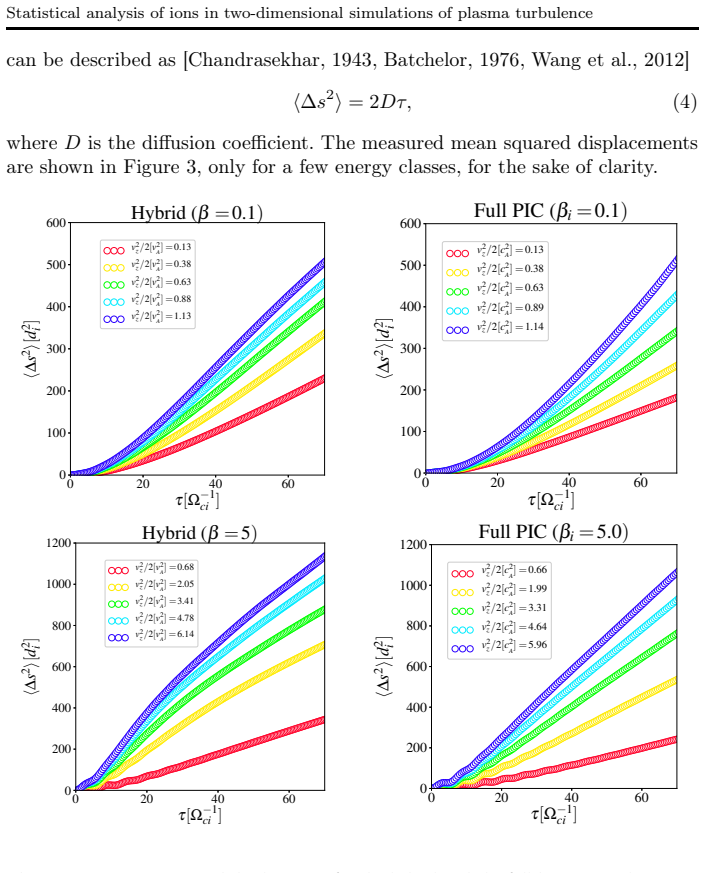
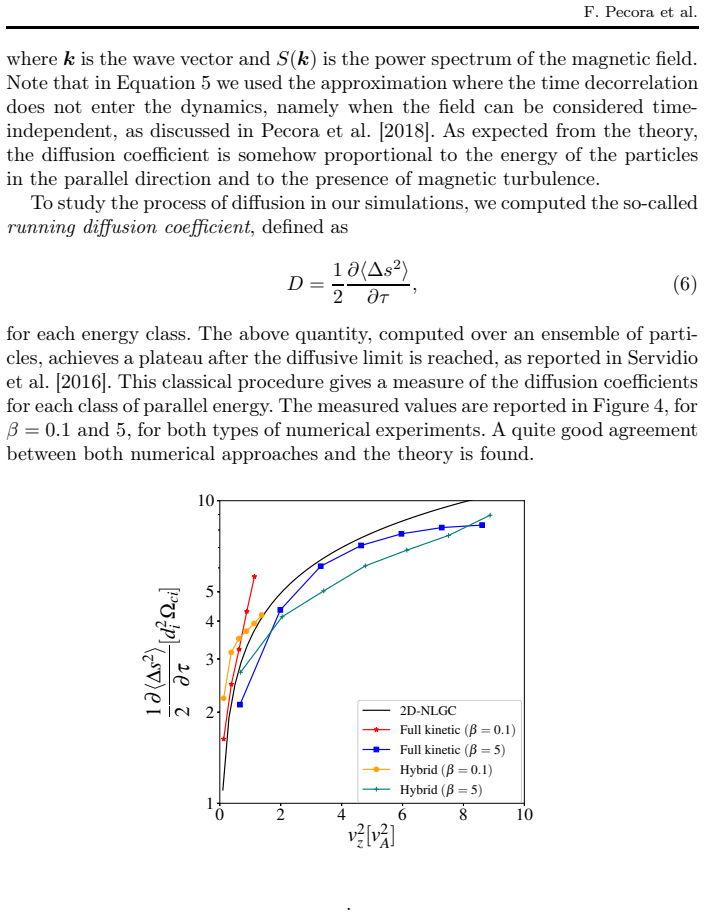
The comparison is carried by a paired numerical experiment: identical initial conditions (superimposed large-scale fluctuations with $\delta b/B_0 \sim 0.3$ in a $128 \times 128 d_i^2$ periodic box with a mean out-of-plane field) evolved by two codes—a hybrid PIC code with an adiabatic electron pressure closure, and the implicit full PIC code iPIC3D with a mass ratio $m_i/m_e = 25$—at $\beta = 0.1$, $0.5$, and $5$. The diagnostic that carries the central comparison is the per-energy-class perpendicular mean squared displacement $\langle \Delta s^2 \rangle = 2D\tau$, whose plateau defines a measured diffusion coefficient $D$, tested against the 2D nonlinear guiding center (NLGC) prediction evaluated in a time-independent-field approximation; the magnetic and electric power spectra and the ion kinetic-energy PDFs provide the secondary diagnostics that expose the kinetic-electron contributions.
What would settle it
Re-run the same $\beta = 0.1$ and $\beta = 5$ configurations with a mass ratio substantially above 25, or in a fully three-dimensional domain, and check whether the full PIC excess in sub-ion electric power and the suppressed low-$\beta$ ion acceleration tail persist; if they shrink or vanish, those differences stem from the mass-ratio or geometry approximations rather than from the hybrid-versus-full distinction the paper draws.
Extended reading notes
Core claim
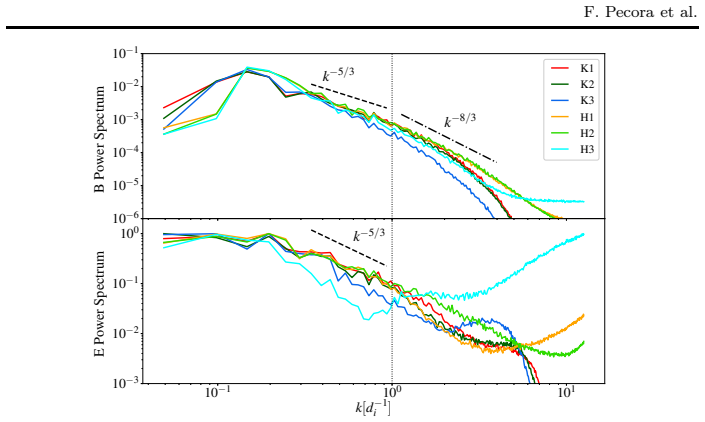
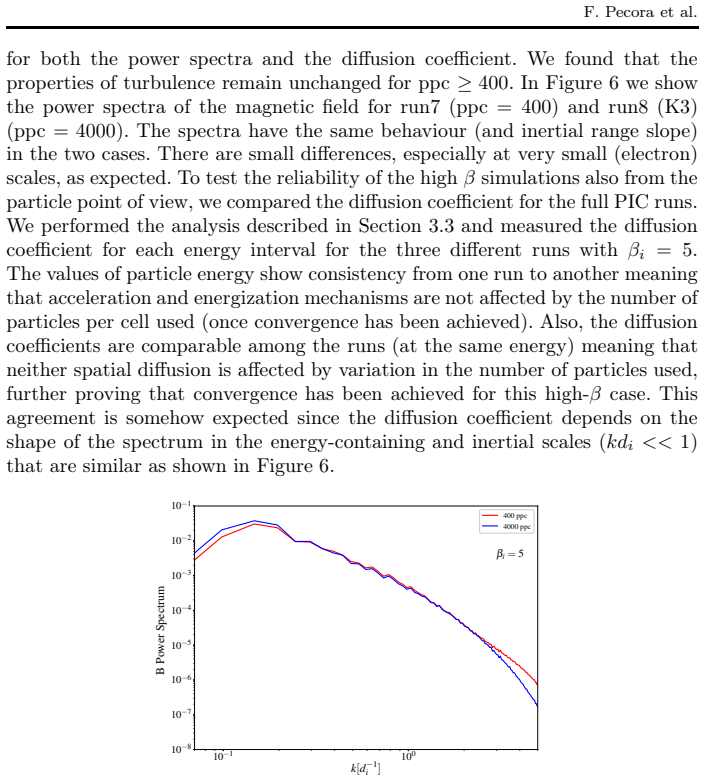
The central claim is a calibration result: the two methods agree on everything governed by large scales and differ precisely where electron kinetics enters. Both codes produce a Kolmogorov-like $k^{-5/3}$ magnetic spectrum in the inertial range and a steeper $k^{-8/3}$ kinetic range, with grid-scale differences attributed to particle-noise smoothing in the full PIC runs. The running diffusion coefficient for each parallel-energy class reaches a plateau in both codes, and the measured values agree with each other and with the 2D nonlinear guiding center prediction $D^* \sim (\sqrt{\langle v_z^2 \rangle}/B_0^2) \int dk\, S(k)/k^2$ across all three $\beta$ values. The differences are confined to the electric field—more sub-ion power in full PIC at low $\beta$, credited to electron pressure-divergence and inertial terms missing from the hybrid Ohm's law—and to the ion energy distribution, whose low-$\beta$ high-energy tail is slightly weaker in full PIC, which the authors interpret as electrons participating more effectively in the turbulence–particle energy exchange.
Load-bearing premise
The comparison treats the full PIC runs as the faithful reference, but those runs use an ion-to-electron mass ratio of 25, and in the conclusions the authors concede that this unphysical ratio cannot fully clarify the competition between species; if electron kinetics is distorted at that ratio, the claimed differences in sub-ion electric fields and acceleration tails could be artifacts of the approximation rather than genuine consequences of the modeling approach.
Editorial extensions
If this is right
- Hybrid PIC is sufficient for computing ion spatial diffusion coefficients in 2.5D turbulence for $\beta$ from 0.1 to 5, because the diffusion statistics match full PIC and the 2D-NLGC prediction.
- Sub-ion electric field spectra and ion acceleration statistics require full kinetic PIC: the hybrid generalized Ohm's law omits electron pressure-divergence and inertial terms that add electric power at $k d_i \gtrsim 1$.
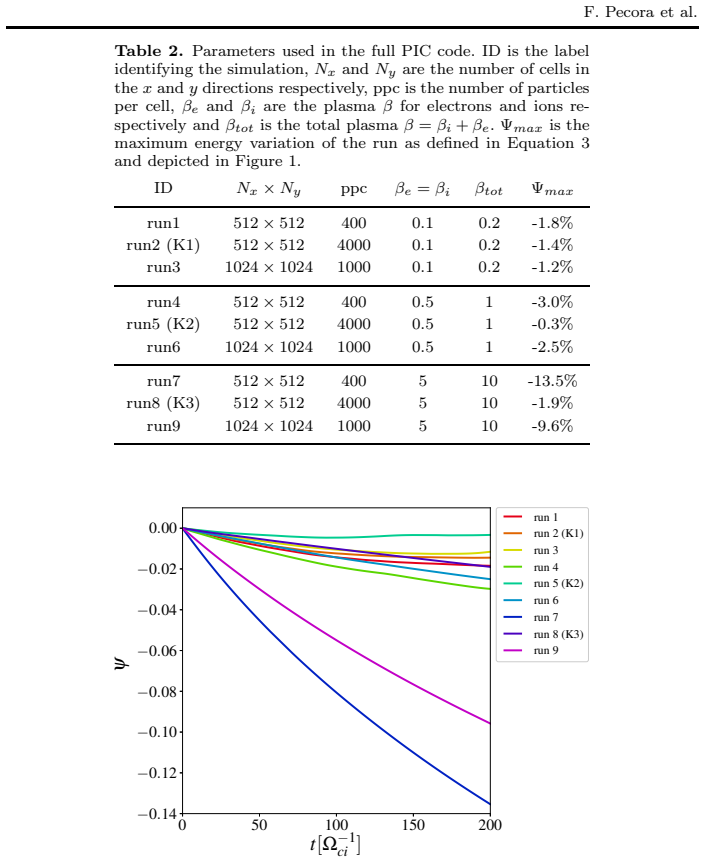
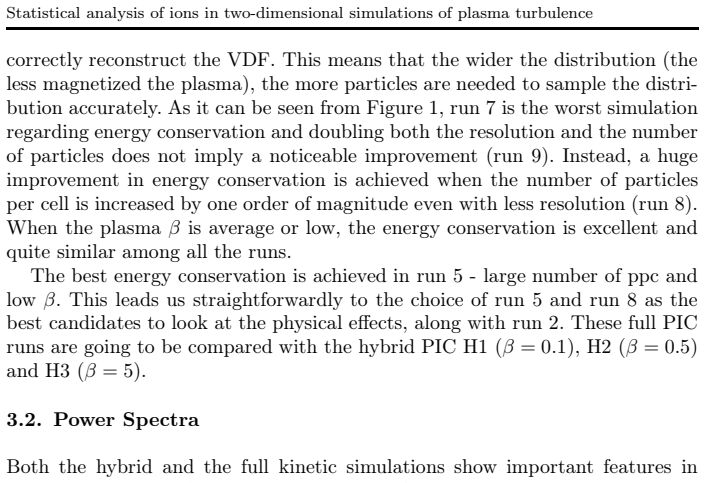
- In full PIC runs, increasing the number of particles per cell improves energy conservation far more than increasing grid resolution, especially at high $\beta$ where low-particle-count runs lose up to 13.5% of the total energy.
- Ion energization is strongest at low $\beta$ in both models, consistent with current-sheet resonance, but the high-energy tail is weaker in full PIC, suggesting kinetic electrons draw energy from the turbulence before ions can absorb it.
Reading between the lines
- The diffusion agreement is a large-scale result: the running diffusion coefficient is set by the energy-containing and inertial ranges where the two codes' spectra coincide, so the methods should diverge only for transport dominated by sub-ion-scale scattering—a regime this 2.5D setup cannot resolve; a testable extension would compare test-particle scattering at $k d_i \ge 1$ between the two codes
- If kinetic electrons genuinely suppress low-$\beta$ ion acceleration, hybrid-based predictions of turbulent ion heating in the solar wind may run high; a check would be to compare proton temperature enhancements with electron measurements across the same turbulent intervals observed by spacecraft.
- The high-$\beta$ energy loss at low particle counts implies a practical floor on particles-per-cell for weakly magnetized, magnetosheath-like conditions, a constraint hybrid codes avoid because their electrons are cheap; seeding a hybrid run with kinetic test electrons could pinpoint which electron terms produce the full PIC electric-field excess.
Signed reviews
Editorial analysis
A structured set of objections, weighed in public.
Referee Report
Summary. The manuscript compares hybrid PIC (fluid electrons) and full PIC (iPIC3D) simulations of 2.5D decaying plasma turbulence at ion beta values 0.1, 0.5, and 5, using identical initial conditions and a 128 x 128 di^2 domain. The comparison covers total energy conservation, magnetic and electric field power spectra, ion perpendicular diffusion against the 2D-NLGC prediction, and kinetic-energy probability density functions. The paper reports good agreement in magnetic spectra and ion diffusion statistics, with differences in sub-ion electric-field spectra and ion acceleration tails attributed to the more complete kinetic treatment in the full PIC approach.
Significance. If the central claims hold, the paper provides practically useful guidance: hybrid PIC appears adequate for bulk ion diffusion statistics across a range of beta, while full PIC would be needed for sub-ion electric fields and acceleration tails. The study's strengths include a systematic scan over beta and numerical parameters, energy-conservation diagnostics, a convergence appendix for particle-per-cell effects, and the use of an externally derived NLGC formula (Eq. 5) rather than a fitted model, so the diffusion comparison is not circular. The main limitation is that the full PIC reference uses an unphysical ion-to-electron mass ratio of 25 with electron scales below the grid resolution, which makes the attribution of the sub-ion and acceleration differences to full kinetic physics uncertain.
major comments (3)
- [§2.2, §3.2, §4] The abstract and Section 4 claim that the sub-ion electric-field and ion-acceleration differences are 'due evidently to the more consistent treatment' of the plasma in the full PIC approach, but this causal claim is not established by the presented runs. With mi/me=25, L=128 di, and N=512, the electron skin depth is de=0.2 di, which is below the grid spacing dx=0.25 di; at beta_i=0.1 the electron gyroradius is about 0.06 di, far below the grid. The electron-pressure-divergence and electron-inertia terms invoked in Section 3.2 to explain the enhanced full-PIC electric field live on these unresolved scales, so the enhancement could be a mass-ratio or under-resolution artifact rather than a physical property of the full kinetic model. The paper itself concedes in Section 4 that the mass ratio 'cannot clarify completely the possible competition taking place between the two species.' The conclusion that full PIC is required for sub-ion fields and acceleration tails should therefore be softened or supported by additional evidence, such as a resolved-electron run or a scan over mi/me.
- [§3.3, Fig. 4] The central claim of good agreement in ion diffusion between the two codes and with 2D-NLGC is made by visual inspection without error bars or a quantitative agreement metric. The running-diffusion coefficient in Eq. (6) has statistical uncertainty from the finite particle ensembles, and the diffusion coefficients in Figure 4 are shown as points without uncertainty estimates. A bootstrap or ensemble-based error bar on D, together with a stated tolerance for agreement with Eq. (5), would make the comparison quantitative and would strengthen the paper's main positive result.
- [§3.4, Fig. 5] The claimed differences in acceleration statistics, specifically that the low-beta tail is 'slightly less pronounced' in the full PIC case, are reported without a quantitative comparison of the PDFs. A Kolmogorov-Smirnov test or another distribution-comparison statistic, or at least an estimate of the noise level in the tails, is needed to support the qualitative statement that the two models differ in ion energization.
minor comments (5)
- [Table 2, §3.1] The text says 'eight runs out of ten' conserve energy, but Table 2 lists nine runs; please correct this inconsistency.
- [Figure 2] The bottom panel (electric field spectrum) is discussed in the text before the top panel (magnetic field spectrum), and the caption only mentions the magnetic spectra; please clarify the panel order in the caption.
- [Figure 3] The full PIC panels label the squared parallel velocity as v_z^2/2[c_A^2], while the hybrid panels use v_z^2/2[v_A^2]; the notation should be unified.
- [References] The reference to Marsch (2006) is cited as 'JLR, 3, 2006'; it should be Living Reviews in Solar Physics, volume 3.
- [§3.1] The statement that 'the number of particles should increase to correctly reconstruct the VDF' is vague; a quantitative relation between required ppc and beta would be more informative.
Circularity Check
No circularity: the hybrid/full-PIC comparison is an independent code comparison, and the 2D-NLGC check uses an external theory as a benchmark rather than a fitted prediction.
full rationale
I find no circular derivation. The central result is a side-by-side comparison of two independently implemented simulation approaches (hybrid PIC with fluid electrons versus full kinetic PIC) run from the same initial conditions; agreement is measured directly from each code's fields and particle statistics, with no fitting constants used to force agreement. The 2D-NLGC test in Eq. (5) is a genuine external benchmark: the formula is taken from Matthaeus et al. (2003) and Ruffolo et al. (2012), as adapted in Pecora et al. (2018), and it takes the simulated magnetic spectrum S(k) as input to predict D*, while the measured diffusion coefficient comes separately from the mean squared displacement. Nothing in the comparison is defined in terms of the quantity it is supposed to predict. The self-citations (e.g., Servidio et al. 2016 for hybrid convergence and Pecora et al. 2018 for the diffusion approximation) are references to published, external prior work and are not load-bearing: the hybrid/full-PIC agreement does not reduce to those citations. The only notable limitation is stated in Section 4, where the authors concede that the mi/me = 25 mass ratio in the full-PIC runs 'cannot clarify completely the possible competition taking place between the two species'; this weakens the causal attribution of sub-ion electric-field and acceleration differences to 'the more consistent treatment of the plasma in the full PIC approach,' but that is a limitation on external validity and causal interpretation, not a circularity in the derivation. Overall, the paper is self-contained against external benchmarks and contains no fitted input renamed as a prediction.
Assumptions & free parameters
free parameters (4)
- Hybrid resistivity eta =
0.006
- Ion-to-electron mass ratio mi/me =
25
- Initial fluctuation amplitude delta_b/B0 =
0.3
- Particles per cell =
1500 hybrid; 4000 selected full PIC
assumptions (5)
- domain assumption 2.5D geometry with mean magnetic field along z captures the dominant perpendicular turbulent dynamics relevant to ion diffusion and acceleration.
- domain assumption The Vlasov-Maxwell system, discretized by PIC, accurately represents weakly collisional plasma turbulence at ion and sub-ion scales.
- domain assumption The 2D-NLGC diffusion formula D* ~ sqrt(v_z^2)/B0^2 times the integral of S(k)/k^2, with time decorrelation neglected, is valid for these runs.
- domain assumption Electron pressure closure Pe = beta n^gamma with gamma = 5/3 and a resistive term suffices for the hybrid model.
- domain assumption Statistical convergence of full PIC runs at ppc >= 400 is established by the appendix spectral and diffusion comparisons.
Cite this review
Pith. "Pith review of Statistical analysis of ions in two-dimensional plasma turbulence." pith.science (2026). https://pith.science/paper/2ZQPAKQN
@misc{pith2026190802791,
  author       = {Pith},
  title        = {Pith review of: Statistical analysis of ions in two-dimensional plasma turbulence},
  year         = {2026},
  howpublished = {\url{https://pith.science/paper/2ZQPAKQN}},
  note         = {Machine review of arXiv:1908.02791}
}
abstract
The statistical properties of ions in two-dimensional fully developed turbulence have been compared between two different numerical algorithms. In particular, we compare Hybrid Particle In Cell (hybrid PIC with fluid electrons) and full PIC simulations, focusing on particle diffusion and acceleration phenomena. To investigate several heliospheric plasma conditions, a series of numerical simulations has been performed by varying the plasma $\beta$ - the ratio between kinetic and magnetic pressure. These numerical studies allow the exploration of different scenarios, going from the solar corona (low $\beta$) to the solar wind ($\beta \sim 1$), as well as the Earth's magnetosheath (high $\beta$). It has been found that the two approaches compare pretty well, especially for the spectral properties of the magnetic field and the ion diffusion statistics. Small differences among the models have been found regarding the electric field behaviour at sub-ion scales and the acceleration statistics, due evidently to the more consistent treatment of the plasma in the full PIC approach.
Figures
Figures from the paper (4 more)

Reference graph
Works this paper leans on
-
[1]
O. Alexandrova , J. Saur , C. Lacombe , A. Mangeney , J. Mitchell , S. J. Schwartz , and P. Robert . Universality of Solar-Wind Turbulent Spectrum from MHD to Electron Scales . , 103 0 (16): 0 165003, Oct 2009. doi:10.1103/PhysRevLett.103.165003
-
[2]
S. D. Bale , P. J. Kellogg , F. S. Mozer , T. S. Horbury , and H. Reme . Measurement of the Electric Fluctuation Spectrum of Magnetohydrodynamic Turbulence . Physical Review Letters, 94 0 (21): 0 215002, June 2005. doi:10.1103/PhysRevLett.94.215002
-
[3]
David Ball , Lorenzo Sironi , and Feryal \"O zel . Electron and Proton Acceleration in Trans-relativistic Magnetic Reconnection: Dependence on Plasma Beta and Magnetization . , 862 0 (1): 0 80, Jul 2018. doi:10.3847/1538-4357/aac820
-
[4]
G. K. Batchelor. Brownian diffusion of particles with hydrodynamic interaction. Journal of Fluid Mechanics, 74 0 (1): 0 1--29, 1976. doi:10.1017/S0022112076001663
-
[5]
Bieber , Wolfgang Wanner , and William H
John W. Bieber , Wolfgang Wanner , and William H. Matthaeus . Dominant two-dimensional solar wind turbulence with implications for cosmic ray transport . , 101 0 (A2): 0 2511--2522, Feb 1996. doi:10.1029/95JA02588
-
[6]
R. Bruno and V. Carbone , editors. Turbulence in the Solar Wind , volume 928 of Lecture Notes in Physics, Berlin Springer Verlag, 2016. doi:10.1007/978-3-319-43440-7
-
[7]
J. L. Burch , R. B. Torbert , T. D. Phan , L. J. Chen , T. E. Moore , R. E. Ergun , J. P. Eastwood , D. J. Gershman , P. A. Cassak , M. R. Argall , S. Wang , M. Hesse , C. J. Pollock , B. L. Giles , R. Nakamura , B. H. Mauk , S. A. Fuselier , C. T. Russell , R. J. Strangeway , J. F. Drake , M. A. Shay , Yu. V. Khotyaintsev , P. A. Lindqvist , G. Marklund ...
2016
-
[8]
B. D. G. Chandran , B. Li , B. N. Rogers , E. Quataert , and K. Germaschewski . Perpendicular Ion Heating by Low-frequency Alfv \'e n-wave Turbulence in the Solar Wind . The Astrophysical Journal, 720: 0 503--515, September 2010. doi:10.1088/0004-637X/720/1/503
Show all 56 references
-
[9]
Chandrasekhar
S. Chandrasekhar. Stochastic problems in physics and astronomy. Rev. Mod. Phys., 15 0 (1): 0 1--89, Jan 1943. doi:10.1103/RevModPhys.15.1
1943 doi
-
[10]
Particle acceleration in relativistic plasma turbulence
Luca Comisso and Lorenzo Sironi. Particle acceleration in relativistic plasma turbulence. Phys. Rev. Lett., 121: 0 255101, Dec 2018. doi:10.1103/PhysRevLett.121.255101
2018 doi
-
[11]
Daughton , V
W. Daughton , V. Roytershteyn , H. Karimabadi , L. Yin , B. J. Albright , B. Bergen , and K. J. Bowers . Role of electron physics in the development of turbulent magnetic reconnection in collisionless plasmas . Nature Physics, 7: 0 539--542, July 2011. doi:10.1038/nphys1965
2011 doi
-
[12]
C. E. DeForest , W. H. Matthaeus , T. A. Howard , and D. R. Rice . Turbulence in the Solar Wind Measured with Comet Tail Test Particles . , 812: 0 108, October 2015. doi:10.1088/0004-637X/812/2/108
2015 doi
-
[13]
Dmitruk , W
P. Dmitruk , W. H. Matthaeus , and N. Seenu . Test Particle Energization by Current Sheets and Nonuniform Fields in Magnetohydrodynamic Turbulence . The Astrophysical Journal, 617: 0 667--679, December 2004. doi:10.1086/425301
2004 doi
-
[14]
J. F. Drake , M. Opher , M. Swisdak , and J. N. Chamoun . A Magnetic Reconnection Mechanism for the Generation of Anomalous Cosmic Rays . The Astrophysical Journal, 709: 0 963--974, February 2010. doi:10.1088/0004-637X/709/2/963
2010 doi
-
[15]
Einaudi , M
G. Einaudi , M. Velli , H. Politano , and A. Pouquet . Energy release in a turbulent corona. , 457 0 (2): 0 L113, feb 1996. doi:10.1086/309893
1996 doi
-
[16]
N. J. Fox, M. C. Velli, S. D. Bale, R. Decker, A. Driesman, R. A. Howard, J. C. Kasper, J. Kinnison, M. Kusterer, D. Lario, M. K. Lockwood, D. J. McComas, N. E. Raouafi, and A. Szabo. The solar probe plus mission: Humanity's first visit to our star. Space Science Reviews, 204 ...
2016 doi
-
[17]
Franci , S
L. Franci , S. Landi , L. Matteini , A. Verdini , and P. Hellinger . High-resolution Hybrid Simulations of Kinetic Plasma Turbulence at Proton Scales . The Astrophysical Journal, 812: 0 21, October 2015. doi:10.1088/0004-637X/812/1/21
2015 doi
-
[18]
Franci , S
L. Franci , S. Landi , A. Verdini , L. Matteini , and P. Hellinger . Solar Wind Turbulent Cascade from MHD to Sub-ion Scales: Large-size 3D Hybrid Particle-in-cell Simulations . , 853: 0 26, January 2018. doi:10.3847/1538-4357/aaa3e8
2018 doi
-
[19]
C. T. Haynes , D. Burgess , and E. Camporeale . Reconnection and Electron Temperature Anisotropy in Sub-proton Scale Plasma Turbulence . The Astrophysical Journal, 783: 0 38, March 2014. doi:10.1088/0004-637X/783/1/38
2014 doi
-
[20]
Plasma turbulence and kinetic instabilities at ion scales in the expanding solar wind
Petr Hellinger, Lorenzo Matteini, Simone Landi, Andrea Verdini, Luca Franci, and Pavel M Tr \'a vn \' c ek. Plasma turbulence and kinetic instabilities at ion scales in the expanding solar wind. The Astrophysical Journal, 811 0 (2): 0 L32, sep 2015. doi:10.1088/2041-8205/811/2/l32
2015 doi
-
[21]
G. G. Howes . A prospectus on kinetic heliophysics . Physics of Plasmas, 24 0 (5): 0 055907, May 2017. doi:10.1063/1.4983993
2017 doi
-
[22]
P. A. Isenberg . Turbulence-driven Solar Wind Heating and Energization of Pickup Protons in the Outer Heliosphere . , 623: 0 502--510, April 2005. doi:10.1086/428609
2005 doi
-
[23]
J. R. Jokipii and E. H. Levy . Effects of particle drifts on the solar modulation of galactic cosmic rays . , 213: 0 L85--L88, April 1977. doi:10.1086/182415
1977 doi
-
[24]
J. C. Kasper, A. J. Lazarus, and S. P. Gary. Hot solar-wind helium: Direct evidence for local heating by alfv\'en-cyclotron dissipation. Phys. Rev. Lett., 101: 0 261103, Dec 2008. doi:10.1103/PhysRevLett.101.261103
2008 doi
-
[25]
Particle and fluid simulations of low-temperature plasma discharges: benchmarks and kinetic effects
HC Kim, Felipe Iza, SS Yang, M Radmilovi \'c -Radjenovi \'c , and JK Lee. Particle and fluid simulations of low-temperature plasma discharges: benchmarks and kinetic effects. Journal of Physics D: Applied Physics, 38 0 (19): 0 R283--R301, sep 2005. doi:10.1088/0022-3727/38/19/r01
2005 doi
-
[26]
T. C. Li , G. G. Howes , K. G. Klein , and J. M. TenBarge . Energy Dissipation and Landau Damping in Two- and Three-dimensional Plasma Turbulence . , 832: 0 L24, December 2016. doi:10.3847/2041-8205/832/2/L24
2016 doi
-
[27]
Y. G. Maneva , A. F. Vi \ n as , and L. Ofman . Turbulent heating and acceleration of He ^ ++ ions by spectra of Alfv \'e n-cyclotron waves in the expanding solar wind: 1.5-D hybrid simulations . Journal of Geophysical Research (Space Physics), 118: 0 2842--2853, June 2013. do...
2013 doi
-
[28]
Y. G. Maneva , L. Ofman , and A. Vi \ n as . Relative drifts and temperature anisotropies of protons and particles in the expanding solar wind: 2.5D hybrid simulations . , 578: 0 A85, June 2015. doi:10.1051/0004-6361/201424401
2015 doi
-
[29]
Multi-scale simulations of plasma with ipic3d
Stefano Markidis, Giovanni Lapenta, and Rizwan-uddin. Multi-scale simulations of plasma with ipic3d. Mathematics and Computers in Simulation, 80 0 (7): 0 1509 -- 1519, 2010. ISSN 0378-4754. doi:https://doi.org/10.1016/j.matcom.2009.08.038. Multiscale modeling of moving interfa...
2010 doi
-
[30]
E. Marsch. Kinetic physics of the solar corona and solar wind. JLR, 3, 2006. doi:10.12942/lrsp-2006-1
2006 doi
-
[31]
W. H. Matthaeus and S. L. Lamkin . Turbulent magnetic reconnection . Physics of Fluids, 29: 0 2513--2534, August 1986. doi:10.1063/1.866004
1986 doi
-
[32]
Nonlinear collisionless perpendicular diffusion of charged particles
WH Matthaeus, G Qin, JW Bieber, and GP Zank. Nonlinear collisionless perpendicular diffusion of charged particles. The Astrophysical Journal, 590 0 (1): 0 L53--L56, may 2003. doi:10.1086/376613
2003 doi
-
[33]
A. P. Matthews . Current Advance Method and Cyclic Leapfrog for 2D Multispecies Hybrid Plasma Simulations . Journal of Computational Physics, 112: 0 102--116, May 1994. doi:10.1006/jcph.1994.1084
1994
-
[34]
L. Ofman . Wave Modeling of the Solar Wind . Living Reviews in Solar Physics, 7: 0 4, October 2010. doi:10.12942/lrsp-2010-4
2010 doi
-
[35]
Ofman and A
L. Ofman and A. F. Vi \ n as . Two-dimensional hybrid model of wave and beam heating of multi-ion solar wind plasma . Journal of Geophysical Research (Space Physics), 112: 0 A06104, June 2007. doi:10.1029/2006JA012187
2007 doi
-
[36]
Ofman , A
L. Ofman , A. F. Vi \ n as , and Y. Maneva . Two-dimensional hybrid models of H ^ + -He ^ ++ expanding solar wind plasma heating . Journal of Geophysical Research (Space Physics), 119: 0 4223--4238, June 2014. doi:10.1002/2013JA019590
2014 doi
-
[37]
Ofman , A
L. Ofman , A. F. Vi \ n as , and D. A. Roberts . The effects of inhomogeneous proton- drifts on the heating of the solar wind . Journal of Geophysical Research (Space Physics), 122: 0 5839--5855, June 2017. doi:10.1002/2016JA023705
2017 doi
-
[38]
Olshevsky , S
V. Olshevsky , S. Servidio , F. Pucci , L. Primavera , and G. Lapenta . Properties of Decaying Plasma Turbulence at Subproton Scales . The Astrophysical Journal, 860: 0 11, June 2018. doi:10.3847/1538-4357/aac1bd
2018 doi
-
[39]
Magnetic-confinement fusion
J Ongena, R Koch, R Wolf, and H Zohm. Magnetic-confinement fusion. Nature Physics, 12 0 (5): 0 398, 2016. doi:https://doi.org/10.1038/nphys3745
2016 doi
-
[40]
Evidence for inhomogeneous heating in the solar wind
KT Osman, WH Matthaeus, A Greco, and S Servidio. Evidence for inhomogeneous heating in the solar wind. The Astrophysical Journal Letters, 727 0 (1): 0 L11, 2010. doi:10.1088/2041-8205/727/1/l11
2010 doi
-
[41]
Pecora, S
F. Pecora, S. Servidio, A. Greco, W. H. Matthaeus, D. Burgess, C. T. Haynes, V. Carbone, and P. Veltri. Ion diffusion and acceleration in plasma turbulence. Journal of Plasma Physics, 84 0 (6): 0 725840601, 2018. doi:10.1017/S0022377818000995
2018 doi
-
[42]
Ruffolo , T
D. Ruffolo , T. Pianpanit , W. H. Matthaeus , and P. Chuychai . Random Ballistic Interpretation of Nonlinear Guiding Center Theory . The Astrophysical Journal Letters, 747: 0 L34, March 2012. doi:10.1088/2041-8205/747/2/L34
2012 doi
-
[43]
A. A. Schekochihin , J. T. Parker , E. G. Highcock , P. J. Dellar , W. Dorland , and G. W. Hammett . Phase mixing versus nonlinear advection in drift-kinetic plasma turbulence . Journal of Plasma Physics, 82 0 (2): 0 905820212, April 2016. doi:10.1017/S0022377816000374
2016 doi
-
[44]
Servidio , F
S. Servidio , F. Valentini , D. Perrone , A. Greco , F. Califano , W. H. Matthaeus , and P. Veltri . A kinetic model of plasma turbulence . Journal of Plasma Physics, 81 0 (1): 0 325810107, January 2015. doi:10.1017/S0022377814000841
2015 doi
-
[45]
Servidio, C
S. Servidio, C. T. Haynes, W. H. Matthaeus, D. Burgess, V. Carbone, and P. Veltri. Explosive particle dispersion in plasma turbulence. Phys. Rev. Lett., 117: 0 095101, Aug 2016. doi:10.1103/PhysRevLett.117.095101
2016 doi
-
[46]
Servidio, A
S. Servidio, A. Chasapis, W. H. Matthaeus, D. Perrone, F. Valentini, T. N. Parashar, P. Veltri, D. Gershman, C. T. Russell, B. Giles, S. A. Fuselier, T. D. Phan, and J. Burch. Magnetospheric multiscale observation of plasma velocity-space cascade: Hermite representation and th...
2017 doi
-
[47]
J. V. Shebalin . Hybrid statistics of ideal 2D MHD turbulence in a mean magnetic field . Radiation Effects and Defects in Solids, 166: 0 774--788, October 2011. doi:10.1080/10420150.2011.615314
2011
-
[48]
J. V. Shebalin , W. H. Matthaeus , and D. Montgomery . Anisotropy in MHD turbulence due to a mean magnetic field . Journal of Plasma Physics, 29: 0 525--547, June 1983. doi:10.1017/S0022377800000933
1983 doi
-
[49]
Heating of the low-latitude solar wind by dissipation of turbulent magnetic fluctuations
Charles W Smith, William H Matthaeus, Gary P Zank, Norman F Ness, Sean Oughton, and John D Richardson. Heating of the low-latitude solar wind by dissipation of turbulent magnetic fluctuations. Journal of Geophysical Research: Space Physics, 106 0 (A5): 0 8253--8272, 2001. doi:...
2001 doi
-
[50]
J. A. Tessein , W. H. Matthaeus , M. Wan , K. T. Osman , D. Ruffolo , and J. Giacalone . Association of Suprathermal Particles with Coherent Structures and Shocks . The Astrophysical Journall, 776: 0 L8, October 2013. doi:10.1088/2041-8205/776/1/L8
2013 doi
-
[51]
Valentini, P
F. Valentini, P. Trávníček, F. Califano, P. Hellinger, and A. Mangeney. A hybrid-vlasov model based on the current advance method for the simulation of collisionless magnetized plasma. Journal of Computational Physics, 225 0 (1): 0 753 -- 770, 2007. ISSN 0021-9991. doi:http://...
2007 doi
-
[52]
Turbulent heating and temperature evolution in the solar wind plasma
MK Verma, DA Roberts, and ML Goldstein. Turbulent heating and temperature evolution in the solar wind plasma. Journal of Geophysical Research: Space Physics, 100 0 (A10): 0 19839--19850, 1995. doi:10.1029/95JA01216
1995 doi
-
[53]
When brownian diffusion is not gaussian
Bo Wang, James Kuo, Sung Chul Bae, and Steve Granick. When brownian diffusion is not gaussian. Nature materials, 11 0 (6): 0 481, 2012. doi:10.1038/nmat3308
2012 doi
-
[54]
D. Winske . Hybrid simulation codes with application to shocks and upstream waves . Space Science Review, 42: 0 53--66, October 1985. doi:10.1007/BF00218223
1985 doi
-
[55]
The two-fluid dynamics and energetics of the asymmetric magnetic reconnection in laboratory and space plasmas
M Yamada, L-J Chen, J Yoo, S Wang, W Fox, J Jara-Almonte, H Ji, W Daughton, A Le, J Burch, et al. The two-fluid dynamics and energetics of the asymmetric magnetic reconnection in laboratory and space plasmas. Nature communications, 9 0 (1): 0 5223, 2018. doi:10.1038/s41467-018-07680-2
2018 doi
-
[56]
Magnetic turbulence in the geospace environment
G Zimbardo, A Greco, L Sorriso-Valvo, S Perri, Z V \"o r \"o s, G Aburjania, K Chargazia, and O Alexandrova. Magnetic turbulence in the geospace environment. Space science reviews, 156 0 (1-4): 0 89--134, 2010. doi:10.1007/s11214-010-9692-5
2010 doi
Reviewed August 14, 2026 · model on record in the stance chip above.
Discussion (0). Continue with ORCID to comment.