Probing Signatures of Right-Handed Neutrinos via b to s ν barν Decays
Pith reviewed 2026-06-27 19:18 UTC · model grok-4.3
The pith
Belle II measurement of B to K nu nubar constrains right-handed neutrino operators in b to s transitions.
A machine-rendered reading of the paper's core claim, the machinery that carries it, and where it could break.
Core claim
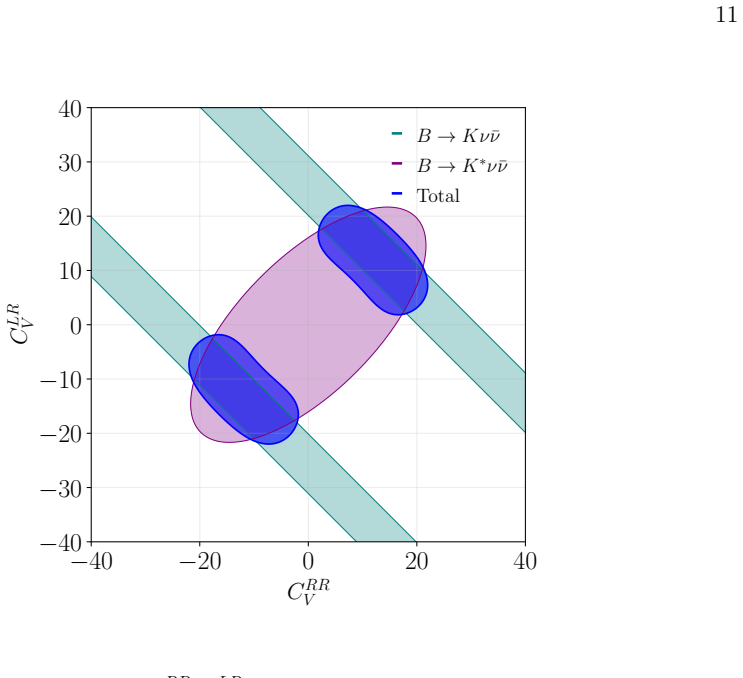
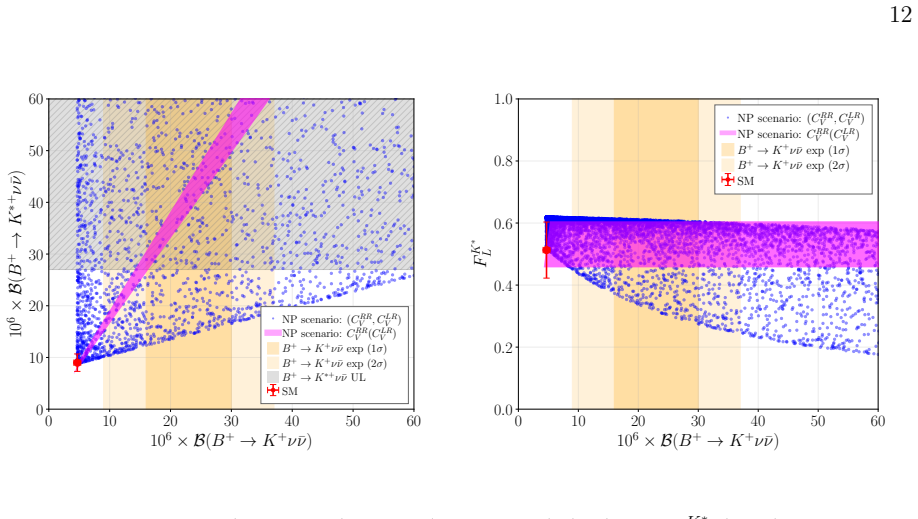
Using the Belle II measurement of B(B+ to K+ nu nubar) together with the upper limit on B(B to K* nu nubar), dimension-six vector operators involving right-handed neutrinos are constrained in a model-independent way, producing sizeable enhancements in the branching fractions of the studied b to s nu nubar modes and allowing F_L^K* to distinguish among the underlying right-handed neutrino interaction structures.
What carries the argument
Dimension-six vector operators involving right-handed neutrinos in the effective theory for b to s nu nubar transitions
If this is right
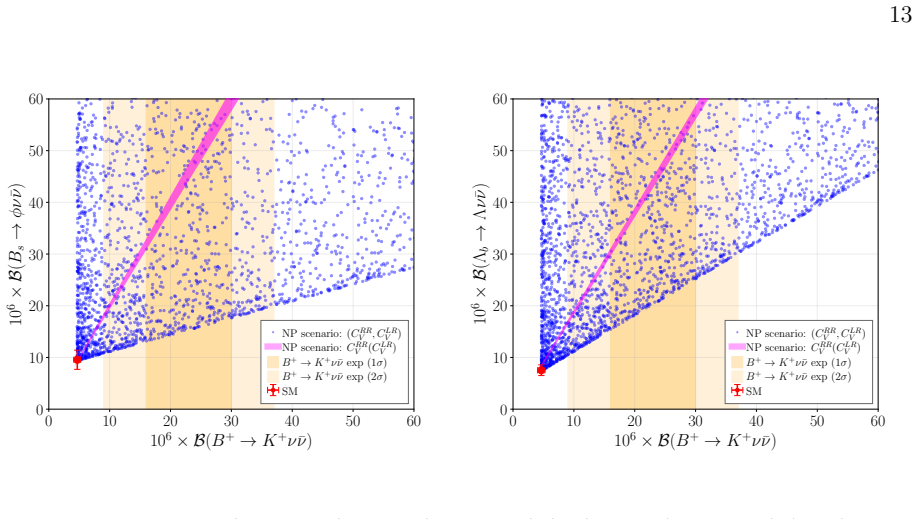
- Sizeable enhancements appear in B(B to K* nu nubar), B(Bs to phi nu nubar), and B(Lambda_b to Lambda nu nubar).
- The branching fractions of the different modes exhibit strong correlations.
- The longitudinal polarization fraction F_L^K* supplies complementary sensitivity to the right-handed neutrino operator structure.
- Testable signatures are expected at Belle II, LHCb, and the future FCC-ee experiment.
Where Pith is reading between the lines
- If the predicted enhancements are observed, the same operator framework could be applied to other flavor-changing processes to search for consistent right-handed neutrino effects.
- Future high-precision data could resolve the relative sizes of different operator coefficients and thereby identify the dominant interaction structure.
- The approach could be combined with constraints from neutrino mass generation mechanisms to test whether the same right-handed neutrinos appear in both sectors.
Load-bearing premise
The observed deviation is produced solely by dimension-six vector operators with right-handed neutrinos and receives no significant contributions from other new physics or higher-dimensional operators.
What would settle it
A precision measurement returning the B to K nu nubar branching fraction to the Standard Model value or yielding an F_L^K* value outside the range allowed by the constrained operators would falsify the right-handed neutrino explanation within this setup.
Figures
read the original abstract
The recent Belle II measurement of $\mathcal{B}(B^+\to K^+\nu\bar{\nu})$, which deviates from the Standard Model prediction, provides a strong motivation to search for New Physics in $b\to s\nu\bar{\nu}$ transitions. We perform a model-independent analysis within the low-energy effective theory, focusing on dimension-six vector operators involving right-handed neutrinos. Using the Belle II measurement of $\mathcal{B}({B\to K\nu\bar{\nu}})$ together with the upper limit on $\mathcal{B}({B\to K^{*}\nu\bar{\nu}})$, we constrain the new physics interactions. We study the correlation of $\mathcal{B}({B\to K\nu\bar{\nu}})$ with $\mathcal{B}({B\to K^{*}\nu\bar{\nu}})$, $\mathcal{B}({B_s\to\phi\nu\bar{\nu}})$, $\mathcal{B}({\Lambda_b\to\Lambda\nu\bar{\nu}})$, and the longitudinal polarization fraction $F_L^{K^*}$. We find sizeable enhancements in all branching fractions studied, while $F_L^{K^*}$ offers complementary sensitivity to the underlying RHN interaction structure. These results provide testable signatures of right-handed neutrino interactions at Belle~II and LHCb, and at the future FCC-ee experiment.
Editorial analysis
A structured set of objections, weighed in public.
Referee Report
Summary. The paper performs a model-independent analysis in the low-energy effective theory, restricted to dimension-six vector operators involving right-handed neutrinos. It uses the Belle II central value for B(B+ → K+ νν̄) together with the upper limit on B(B → K* νν̄) to constrain the relevant Wilson coefficients, then examines correlations of this branching fraction with B(B → K* νν̄), B(Bs → φ νν̄), B(Λb → Λ νν̄), and the longitudinal polarization fraction F_L^{K*}. The analysis reports sizeable enhancements in all branching fractions and notes that F_L^{K*} provides complementary sensitivity to the underlying RHN operator structure, yielding testable predictions for Belle II, LHCb, and FCC-ee.
Significance. If the results hold within the stated operator subspace, the work supplies concrete, correlated predictions for multiple b → s νν̄ channels and demonstrates the diagnostic power of F_L^{K*} for distinguishing vector RHN interactions. This directly ties a recent experimental anomaly to future observables and gives credit for the explicit use of the Belle II measurement to fix parameters and derive falsifiable correlations.
major comments (1)
- [Abstract and §2] Abstract and §2 (operator basis): the headline claims of 'signatures of right-handed neutrino interactions' and the reported correlations rest on the explicit restriction to dimension-six vector operators with RH neutrinos only. No quantitative scan or comparison is provided against scalar/tensor operators or left-handed neutrino contributions that could produce a comparable shift in B(B → K νν̄) while satisfying the B → K* upper limit; without this, the extracted parameter space and predicted enhancements are not shown to be unique to the RHN case.
Simulated Author's Rebuttal
We thank the referee for the careful review and the recommendation of major revision. We respond to the major comment below.
read point-by-point responses
-
Referee: [Abstract and §2] Abstract and §2 (operator basis): the headline claims of 'signatures of right-handed neutrino interactions' and the reported correlations rest on the explicit restriction to dimension-six vector operators with RH neutrinos only. No quantitative scan or comparison is provided against scalar/tensor operators or left-handed neutrino contributions that could produce a comparable shift in B(B → K νν̄) while satisfying the B → K* upper limit; without this, the extracted parameter space and predicted enhancements are not shown to be unique to the RHN case.
Authors: Our analysis is explicitly limited to dimension-six vector operators involving right-handed neutrinos, as stated in the title, abstract, and Section 2. The objective is to map out the signatures and correlations that follow within this well-defined subspace, using the Belle II central value and the B → K* upper limit to fix the allowed Wilson coefficients. We do not claim that the resulting enhancements or correlations are unique to right-handed neutrinos, nor do we exclude the possibility that scalar/tensor operators or left-handed neutrino contributions could produce comparable shifts while satisfying the same experimental inputs. Such a broader comparison lies outside the stated scope of the work. The predictions remain testable and falsifiable under the assumptions adopted in the manuscript. revision: no
Circularity Check
No significant circularity
full rationale
The paper restricts its scope explicitly to dimension-six vector operators with right-handed neutrinos, fits Wilson coefficients to the Belle II central value (plus the K* upper limit), and then computes correlations and enhancements for other branching fractions and F_L^{K*}. This is standard conditional EFT phenomenology using external data; no equation reduces by construction to a self-definition, no fitted parameter is renamed as an independent prediction, and no load-bearing premise rests on a self-citation chain. The operator restriction is stated as an assumption rather than derived, so the derivation chain remains self-contained against the cited experimental inputs.
Axiom & Free-Parameter Ledger
free parameters (1)
- Wilson coefficients of vector operators with RH neutrinos
axioms (1)
- domain assumption Low-energy effective theory with dimension-six operators is sufficient to describe the b to s nu nubar transitions
Reference graph
Works this paper leans on
-
[1]
J. Albrecht, D. van Dyk and C. Langenbruch,Flavour anomalies in heavy quark decays, Prog. Part. Nucl. Phys.120(2021) 103885 [arXiv:2107.04822]. 15
arXiv 2021
-
[2]
A. Crivellin,New Physics in the Flavour Sector, in51st Rencontres de Moriond on QCD and High Energy Interactions, pp. 183–188, ARISF, 2016 [arXiv:1605.02934]
Pith/arXiv arXiv 2016
-
[3]
F.J. Botella, G.C. Branco and M. Nebot,The Hunt for New Physics in the Flavour Sector with up vector-like quarks,JHEP12(2012) 040 [arXiv:1207.4440]
Pith/arXiv arXiv 2012
-
[4]
Straub,New Physics Searches in Flavour Physics,Nuovo Cim
D.M. Straub,New Physics Searches in Flavour Physics,Nuovo Cim. C035N1(2012) 249 [arXiv:1107.0266]
arXiv 2012
-
[5]
Buras,Flavour Theory: 2009,PoSEPS-HEP2009(2009) 024 [arXiv:0910.1032]
A.J. Buras,Flavour Theory: 2009,PoSEPS-HEP2009(2009) 024 [arXiv:0910.1032]
Pith/arXiv arXiv 2009
-
[6]
Glashow, J
S.L. Glashow, J. Iliopoulos and L. Maiani,Weak Interactions with Lepton-Hadron Symmetry,Phys. Rev. D2(1970) 1285
1970
-
[7]
A.J. Buras, J. Girrbach-Noe, C. Niehoff and D.M. Straub,B→K (∗)ννdecays in the Standard Model and beyond,JHEP02(2015) 184 [arXiv:1409.4557]
Pith/arXiv arXiv 2015
- [8]
-
[9]
T.E. Browder, N.G. Deshpande, R. Mandal and R. Sinha,Impact of B→Kνν¯ measurements on beyond the Standard Model theories,Phys. Rev. D104(2021) 053007 [arXiv:2107.01080]
arXiv 2021
-
[10]
L. Allwicher, D. Becirevic, G. Piazza, S. Rosauro-Alcaraz and O. Sumensari,Understanding the first measurement of B(B→Kνν¯),Phys. Lett. B848(2024) 138411 [arXiv:2309.02246]
arXiv 2024
-
[11]
G. Buchalla, A.J. Buras and M.E. Lautenbacher,Weak Decays beyond Leading Logarithms, Rev. Mod. Phys.68(1996) 1125 [hep-ph/9512380]
Pith/arXiv arXiv 1996
-
[12]
P. Colangelo, F. De Fazio, P. Santorelli and E. Scrimieri,RareB→K (∗) neutrino anti-neutrino decays atBfactories,Phys. Lett. B395(1997) 339 [hep-ph/9610297]
Pith/arXiv arXiv 1997
-
[13]
W. Altmannshofer, A.J. Buras, D.M. Straub and M. Wick,New strategies for New Physics search inB→K ∗ν¯ν,B→Kν¯νandB→X sν¯νdecays,JHEP04(2009) 022 [arXiv:0902.0160]
Pith/arXiv arXiv 2009
-
[14]
S. Descotes-Genon, S. Fajfer, J.F. Kamenik and M. Novoa-Brunet,Implications ofb→sµµ anomalies for future measurements ofB→K (∗)ν¯νandK→πν¯ν,Phys. Lett. B809(2020) 135769 [arXiv:2005.03734]. 16 [15]LHCbcollaboration,Test of lepton universality inb→sℓ +ℓ− decays,Phys. Rev. Lett.131 (2023) 051803 [arXiv:2212.09152]. [16]BELLEcollaboration,Test of lepton flav...
arXiv 2020
-
[15]
M. Fael, J. Jenkins, E. Lunghi and Z. Polonsky,The Standard Model prediction for the rare decayB→X sνν,JHEP03(2026) 217 [arXiv:2512.19138]
arXiv 2026
-
[16]
Q.-Y. Hu and Z.-B. Duan,Influence of invisible light particles onΛb→ΛEmiss,Phys. Rev. D 112(2025) 095007 [arXiv:2510.05272]
arXiv 2025
-
[17]
D. Das, D. Shameer and R. Sain, Λ b →Λ (∗)ν¯νdecays and the recent Belle-IIB + →K +ν¯ν data,Phys. Rev. D112(2025) 1 [arXiv:2507.01863]
arXiv 2025
-
[18]
S. Rosauro-Alcaraz and L.P.S. Leal,Disentangling left and right-handed neutrino effects in B→K (∗)νν,Eur. Phys. J. C84(2024) 795 [arXiv:2404.17440]. 17
arXiv 2024
-
[19]
W. Altmannshofer, S.A. Gadam and K. Toner,New strategies for new physics search with Λb→Λνν¯decays,Phys. Rev. D111(2025) 075005 [arXiv:2501.10652]
arXiv 2025
-
[20]
W. Altmannshofer and P. Stangl,New physics in rare B decays after Moriond 2021,Eur. Phys. J. C81(2021) 952 [arXiv:2103.13370]
arXiv 2021
-
[21]
A.J. Buras and P. Stangl,On the interplay of constraints fromB s,D, and K meson mixing inZ ′ models with implications forb→sν¯νtransitions,Eur. Phys. J. C85(2025) 519 [arXiv:2412.14254]
arXiv 2025
-
[22]
T. Felkl, S.L. Li and M.A. Schmidt,A tale of invisibility: constraints on new physics in b→ sνν,JHEP12(2021) 118 [arXiv:2111.04327]
arXiv 2021
-
[23]
D. Beˇ cirevi´ c, S. Fajfer, N. Koˇ snik and L. Paviˇ ci´ c,Right-handed interactions in puzzling B-decays,Phys. Lett. B861(2025) 139285 [arXiv:2410.23257]
arXiv 2025
- [24]
-
[25]
A. Crivellin, S. Iguro and T. Kitahara,Discriminating tauphilic leptoquark explanations of the B anomalies via K→πνν¯and B→Kνν¯,Phys. Rev. D112(2025) 095016 [arXiv:2505.05552]
arXiv 2025
-
[26]
C.-H. Chen, C.-W. Chiang and L.M.G. de la Vega,Leptoquark-mediated Dirac neutrino mass and its impact onB→Kν νandK→πν νdecays,JHEP09(2025) 055 [arXiv:2503.22431]
arXiv 2025
-
[27]
W. Altmannshofer, A. Crivellin, H. Haigh, G. Inguglia and J. Martin Camalich,Light new physics in B→K(*)νν¯?,Phys. Rev. D109(2024) 075008 [arXiv:2311.14629]
arXiv 2024
- [28]
-
[29]
T.M. Aliev, A. Elpe, L. Selbuz and I. Turan,Explaining Belle data on B→K(*)νν¯decays via dark Z resonances,Phys. Rev. D112(2025) 015025 [arXiv:2503.22347]. [40]Belle-IIcollaboration,Evidence for B+→K+νν¯decays,Phys. Rev. D109(2024) 112006 [arXiv:2311.14647]. 18 [41]Bellecollaboration,Search forB→hν¯νdecays with semileptonic tagging at Belle,Phys. Rev. D96...
arXiv 2025
- [30]
-
[31]
P. Escalona, J.P. Pinheiro, V. Oliveira, A. Doff and C.A. De Sousa Pires,Three Decades of FCNC Studies in 3-3-1 Model with Right-Handed Neutrinos: From Z’-Dominance to the Alignment Limit,Universe11(2025) 396 [arXiv:2510.17979]
arXiv 2025
-
[32]
L. Delle Rose, S. Khalil, S.J.D. King and S. Moretti,R K andR K∗ in an Aligned 2HDM with Right-Handed Neutrinos,Phys. Rev. D101(2020) 115009 [arXiv:1903.11146]. [47]Particle Data Group Collaborationcollaboration,Review of particle physics,Phys. Rev. D110(2024) 030001
arXiv 2020
-
[33]
King,Right-handed neutrinos: seesaw models and signatures, (2025) [arXiv:2502.07877]
S.F. King,Right-handed neutrinos: seesaw models and signatures, (2025) [arXiv:2502.07877]
arXiv 2025
-
[34]
Bailey et al.,B→Kl +l− Decay Form Factors from Three-Flavor Lattice QCD,Phys
J.A. Bailey et al.,B→Kl +l− Decay Form Factors from Three-Flavor Lattice QCD,Phys. Rev. D93(2016) 025026 [arXiv:1509.06235]
Pith/arXiv arXiv 2016
-
[35]
A. Bharucha, D.M. Straub and R. Zwicky,B→V ℓ +ℓ− in the Standard Model from light-cone sum rules,JHEP08(2016) 098 [arXiv:1503.05534]
Pith/arXiv arXiv 2016
-
[36]
W. Detmold and S. Meinel, Λ b →Λℓ +ℓ− form factors, differential branching fraction, and angular observables from lattice QCD with relativisticbquarks,Phys. Rev. D93(2016) 074501 [arXiv:1602.01399]. [52]FCCcollaboration,Future Circular Collider Feasibility Study Report: Volume 1, Physics, Experiments, Detectors,Eur. Phys. J. C85(2025) 1468 [arXiv:2505.00272]
arXiv 2016
discussion (0)
Sign in with ORCID, Apple, or X to comment. Anyone can read and Pith papers without signing in.