REVIEW 5 major objections 4 minor 36 references
Probing the semiconductor-to-dirac semimetal transition in Na-Sb-Bi alloys with x-ray Compton scattering
T0 review · 5 major / 4 minor · reviewed 2026-08-07 · deepseek-v4-flash
Pith's one-line read Compton scattering sizes the Dirac-semimetal shift at 10.4% of an electron.
desk verdict Useful Compton-scattering descriptor for the Na-Sb-Bi gap closing, but the quantitative 10% Born-charge agreement is not controlled and the abstract overstates what is experimental. read the letter →
The pith
A machine-rendered reading of the paper's core claim, the machinery that carries it, and where it could break.
The reading
What carries the argument
The load-bearing object is the spherically averaged Compton profile $J(p)$ and its difference $\Delta J(p) = J^{\mathrm{Na_3Bi-Bi}}(p) - J^{\mathrm{Na_3Sb-Sb}}(p)$, which isolates the Na valence electron's momentum distribution in the two end compounds. The charge displaced by the transition is then defined by $q = \tfrac{1}{2}\int_{-p_{\max}}^{p_{\max}} |\Delta J_{\mathrm{DFT}}(p)|\, dp$ with $p_{\max} = 1.5$ a.u., a cutoff chosen to capture only the s-p valence contribution. The subtraction procedure removes Bi or Sb matrix contributions using measured elemental profiles and removes Na core electrons with relativistic Hartree-Fock profiles. The Born effective charge of Na in Na$_3$Bi provides the independent, topologically charged quantity that is compared with $q$.
What would settle it
Measure the same alloy series with a different reference: compute matrix-dependent Bi and Sb Compton profiles from the DFT electronic structure and use those in the subtraction instead of elemental profiles, or vary $p_{\max}$ systematically. If the resulting $q$ moves far from the 10% Born-charge deviation, or if the integrated difference changes sign or collapses, the claimed quantitative signature would be falsified. Independently, an experimental determination of the Born effective charge of Na in Na3Bi from infrared reflectivity or lattice-dynamics data would test the 0.9 value on which the agreement rests.
Extended reading notes
Core claim
The central claim is that the transition from insulating Na$_3$Sb to Dirac semimetal Na$_3$Bi is accompanied by a specific, measurable redistribution of low-momentum electron density, and that the amount of charge moved can be read off the Compton profile. The authors isolate the Na contribution by subtracting measured elemental Bi or Sb profiles and removing core electrons, then define $\Delta J(p) = J^{\mathrm{Na_3Bi-Bi}}(p) - J^{\mathrm{Na_3Sb-Sb}}(p)$. Integrating $|\Delta J_{\mathrm{DFT}}(p)|$ over the valence momentum range $[-1.5, 1.5]$ a.u. gives $q = 10.4\%$ of an electron, which they take as the number of electrons per Na participating in the spin-orbit-driven rearrangement. As an independent check, they point out that the Born effective charge of Na in Na$_3$Bi is 0.9, deviating by 10% from the nominal +1, and read this as close agreement with $q$. They also report that the intermediate alloy's measured profile falls between the two end compounds, with the experimental data leaning toward the insulating side while their DFT indicates a Fermi-level crossing, a discrepancy they attribute to exchange-correlation effects.
Load-bearing premise
The quantitative $q = 10.4\%$ stands on the assumption that subtracting measured elemental Bi or Sb profiles from the alloy profiles removes all Bi and Sb contributions, and that the momentum cutoff $p_{\max} = 1.5$ a.u. captures the full valence redistribution; neither choice is tested in the paper.
Editorial extensions
If this is right
- The integrated difference profile $q$ can serve as a quantitative descriptor of spin-orbit-coupling strength, not just in the Na-Sb-Bi family but in any gap-closing transition that redistributes valence momentum density.
- Because Compton scattering is bulk-sensitive, the same subtraction analysis can reveal the orbital character of the states participating in the transition, here the spillover of Bi $6p$ relativistic states onto Na sites.
- The reported consistency between $q$ and the Born-charge deviation links a momentum-space observable to a real-space polarizability response, connecting the topological transition to Berry-curvature physics.
- For the intermediate alloy Na$_{3.3}$Sb$_{0.5}$Bi$_{0.5}$, the experimental Compton profile lies between the end members and closer to the insulator, while the present DFT shows a Fermi-level crossing; the paper resolves this with a meta-GGA correction, implying that correlation effects control the topological character at intermediate compositions.
- A practical consequence is that Compton scattering could be used to map the phase boundary of the alloy series by measuring $q$ as a function of Bi content, with the paper's linear extrapolation suggesting the gap closes when $q$ lies between 2.5% and 6% of an electron.
Reading between the lines
- If the $q \approx 10\%$ agreement with the Born-charge deviation holds under scrutiny, a natural extension is to treat $q$ as an operational charge-transfer descriptor and calibrate it across the full Na$_3$Sb$_x$Bi$_{1-x}$ composition range, which the paper samples only at the end points and one intermediate alloy.
- The subtraction step assumes elemental Bi or Sb profiles faithfully represent the matrix contribution in the alloy. One testable refinement is to recompute $q$ using alloy-specific Bi/Sb profiles derived from the same DFT; a significant change would show the 10.4% figure is not a literal charge count.
- The same protocol could be applied to isostructural $A_3$Bi compounds with different alkali metals such as K$_3$Bi or Rb$_3$Bi; if $q$ scales with atomic spin-orbit strength, the descriptor would be transferable beyond sodium chemistry.
- A forward-looking use would be to join $q$ with transport or optical measurements across the transition to see whether it tracks the Dirac carrier density, which would give Compton scattering a role as a bulk, contact-free probe of the phase boundary.
Signed reviews
Editorial analysis
A structured set of objections, weighed in public.
Referee Report
Summary. The paper reports x-ray Compton scattering measurements on Na3Sb, Na3Bi, and Na3.3Sb0.5Bi0.5, together with fully relativistic SPR-KKR/CPA calculations, and proposes that the semiconductor-to-Dirac-semimetal transition is accompanied by a characteristic redistribution of the Na valence electron momentum profile. The central quantitative object is q, defined in Eq. (3) as half the integrated absolute difference between the DFT-derived Na contributions to the Compton profiles of Na3Bi and Na3Sb, giving q = 10.4% of an electron. This value is compared with the deviation of the Born effective charge of Na in Na3Bi from +1, which is reported as 10%, and the agreement is called 'remarkably close.' The paper also states that the intermediate alloy profile lies between the end members and discusses the relation between q and gap closing.
Significance. If sustained, the claim would establish Compton scattering as a bulk-sensitive probe of the SOC-driven charge redistribution associated with the Dirac-semimetal transition in Na3Bi, and q would be a new quantitative descriptor. The paper has real strengths: it combines new experimental Compton profiles with state-of-the-art fully relativistic KKR-CPA calculations, and it proposes a concrete, falsifiable observable (the integrated difference profile). However, the headline quantitative claim is currently not supported with sufficient rigor: q is not extracted from the experimental profiles, it depends on an untested momentum cutoff, it drops from 10.4% to 5% under resolution convolution, it has no reported uncertainty, and its comparison with the Born charge is missing a necessary control.
major comments (5)
- [Section III, Eq. (3) and Abstract] The value q = 10.4% is computed from the unconvolved DFT difference profile, not from the measured Compton profiles, yet the abstract and conclusion describe the 'about 10%' value as experimental. This is misleading. Moreover, the text immediately states that after convolving with the 0.5 a.u. experimental resolution, q is reduced to 5%. The central quantitative claim therefore depends on whether the unconvolved or convolved value is used, and the manuscript must clarify which quantity is being compared with the Born-charge deviation and why. Please report both values with a clear statement of what is measured, what is calculated, and what uncertainty applies to each.
- [Section III, comparison with Born effective charge] The comparison between q and the Born effective charge is not an apples-to-apples one. q is defined as a difference between Na3Bi and Na3Sb, i.e., a transition-induced change, whereas the comparison uses the absolute deviation of Z*_Na(Na3Bi) = 0.9 from the nominal ionic value +1. The appropriate control is the change in Z*_Na between Na3Sb and Na3Bi, i.e., Z*_Na(Na3Sb) needs to be computed and compared with q. Without this control, the 10% agreement could be coincidental, especially if Z*_Na in Na3Sb is also close to 0.9. This is a concrete, missing calculation that the authors should perform.
- [Section III, step (3), Eq. (3)] The integration cutoff p_max = 1.5 a.u. is asserted as 'reasonable' but is not tested. Since q is the integral of |ΔJ_DFT(p)| over [-p_max, p_max], the result is directly sensitive to this choice. The paper should show how q varies with p_max and demonstrate a plateau or a defensible criterion for selecting the cutoff; otherwise the 10.4% number is not pinned to an observable.
- [Section III, Eq. (3) and closing paragraph] No uncertainty is reported for q. The later statement that linear extrapolations place gap closing between q = 2.5% and 6% depending on the exchange-correlation functional shows that the estimate is strongly functional-dependent, but this is not an error bar. Please provide a realistic uncertainty budget that includes the effect of the p_max choice, the resolution convolution, the subtraction procedure, and the choice of exchange-correlation functional.
- [Section III, steps (1)-(3)] The subtraction method assumes that the experimental Compton profile of elemental Bi or Sb, when subtracted from the alloy profile, removes all Bi and Sb contributions and isolates the Na valence contribution. This assumption is not tested. Matrix effects, hybridization, and the CPA treatment of the alloy could all modify the Bi/Sb momentum density relative to the element. The authors should validate this step, for example by applying the same subtraction to the DFT-calculated alloy and elemental profiles, or by comparing the resulting Na profile with an independent calculation.
minor comments (4)
- [Section II B] The momentum resolution is given as 0.5 a.u., but the experimental error bars in Fig. 3 are only described by the marker size. Please provide numerical error bars or a description of how they were estimated.
- [Section IV] The conclusion refers to 'Na-Bi-Sn alloys' whereas the paper is about Na-Sb-Bi; this appears to be a typo and should be corrected.
- [Section III, intermediate alloy] The observation that the experimental profile for Na3.3Sb0.5Bi0.5 lies close to Na3Sb while DFT (PBE) predicts a gapless Fermi surface crossing is discussed only briefly. Please clarify whether the meta-GGA correction resolves this discrepancy quantitatively or only qualitatively.
- [References] Reference [34] is an arXiv preprint; if a peer-reviewed version exists, it should be cited instead of or in addition to the preprint.
Circularity Check
No significant circularity: q is a defined DFT-based difference-profile integral, and the 10% agreement is with an independently computed Born effective charge, not with a fitted input.
full rationale
Section III defines q in Eq. (3) as 1/2∫|ΔJ_DFT(p)|dp over [−p_max,p_max]; this is an explicit definition of a DFT-derived descriptor, not a quantity fitted to the Born charge. The 'remarkably close' comparison is made with Z*_Na = 0.9 from Ref. [33], a separate published DFT calculation by different authors; q and Z* are not the same variable by construction, and neither is adjusted to make the other come out. The experimental data enter through the qualitative ΔJ(p) in Figs. 3 and 4, which are compared with theory after convolution, not used to set q. The extraction steps cite Kothalawala et al. [31], but that is a prior method paper from the same group; the present paper independently checks its SPR-KKR profile against Ref. [31] and applies the subtraction to new measurements, so the self-citation is not a load-bearing uniqueness argument. The paper's own reporting that q falls to 5% after convolution and that the gap-closing q is 2.5–6% depending on functional exposes robustness/correctness limitations, not a circular reduction. The missing Na3Sb Born-charge control is a legitimate scientific criticism of the interpretation, but it does not make the derivation circular. No equation or parameter in the paper reduces to the claim it is used to support.
Assumptions & free parameters
free parameters (1)
- p_max momentum cutoff =
1.5 a.u.
assumptions (7)
- domain assumption The impulse approximation in Eq. (1) is valid at 182.6 keV and a 178 degree scattering angle.
- domain assumption SPRKKR-CPA with the GGA-PBE functional accurately describes the band structure and Compton profiles of Na-Sb-Bi alloys.
- ad hoc to paper Elemental Bi and Sb Compton profiles can be subtracted from alloy profiles to isolate the Na contribution.
- domain assumption The relativistic Hartree-Fock Na core profile from Ref. [32] accurately removes the Na core contribution.
- ad hoc to paper p_max = 1.5 a.u. captures all valence s-p redistribution relevant to the transition.
- domain assumption Multiple scattering corrections can be neglected in powder samples.
- domain assumption The Born effective charge of Na in Na3Bi is 0.9 as given in Ref. [33].
Cite this review
Pith. "Pith review of Probing the semiconductor-to-dirac semimetal transition in Na-Sb-Bi alloys with x-ray Compton scattering." pith.science (2026). https://pith.science/paper/32C2AUMT
@misc{pith2026250602833,
  author       = {Pith},
  title        = {Pith review of: Probing the semiconductor-to-dirac semimetal transition in Na-Sb-Bi alloys with x-ray Compton scattering},
  year         = {2026},
  howpublished = {\url{https://pith.science/paper/32C2AUMT}},
  note         = {Machine review of arXiv:2506.02833}
}
abstract
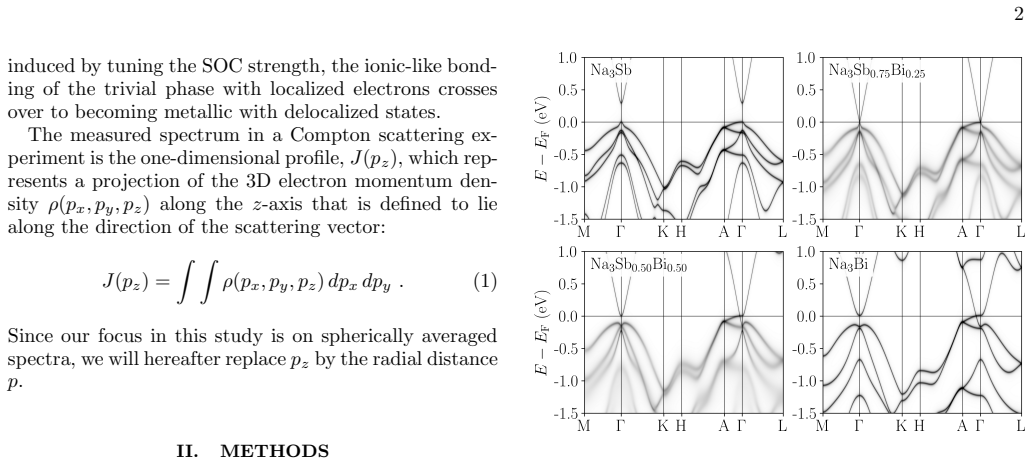
We discuss electron redistribution during the semiconductor-to-Dirac semimetal transition in Na-Sb-Bi alloys using x-ray Compton scattering experiments combined with first-principles electronic structure modeling. A robust signature of the semiconductor-to-Dirac semimetal transition is identified in the spherically averaged Compton profile. We demonstrate how the number of electrons involved in this transition can be estimated to provide a novel descriptor for quantifying the strength of spin-orbit coupling responsible for driving the transition. The associated theoretical deviation of the Born charge of Na in Na$_3$Bi from the expected ionic charge of +1 is found to be consistent with the corresponding experimental value of about 10%. Our study also shows the sensitivity of the Compton scattering technique toward capturing the spillover of Bi 6p relativistic states onto Na sites.
Figures


Reference graph
Works this paper leans on
-
[1]
A. Narayan, D. Di Sante, S. Picozzi, and S. Sanvito, Topological tuning in three-dimensional dirac semimet- als, Physical review letters113, 256403 (2014)
work page 2014
-
[2]
W.-C. Chiu, B. Singh, S. Mardanya, J. Nokelainen, A. Agarwal, H. Lin, C. Lane, K. Pussi, B. Barbiellini, and A. Bansil, Topological dirac semimetal phase in bis- muth based anode materials for sodium-ion batteries, Condensed Matter5, 39 (2020)
work page 2020
-
[3]
A. Darwiche, C. Marino, M. T. Sougrati, B. Fraisse, L. Stievano, and L. Monconduit, Better cycling perfor- mances of bulk sb in na-ion batteries compared to li- ion systems: an unexpected electrochemical mechanism, Journal of the American Chemical Society134, 20805 (2012)
work page 2012
-
[4]
A. Darwiche, M. Fehse, A. Mahmoud, C. La Fontaine, B. Fraisse, R. P. Hermann, M.-L. Doublet, L. Moncon- duit, M. T. Sougrati, M. Ben Yahia,et al., The elec- trochemical sodiation of sb investigated by operando x- ray absorption and 121sb m¨ ossbauer spectroscopy: What does one really learn?, Batteries4, 25 (2018)
work page 2018
-
[5]
J. He, Y. Wei, T. Zhai, and H. Li, Antimony-based ma- terials as promising anodes for rechargeable lithium-ion and sodium-ion batteries, Materials Chemistry Frontiers 2, 437 (2018)
work page 2018
-
[6]
Jiang, S
L. Jiang, S. V. Levchenko, and A. M. Rappe, Rigorous definition of oxidation states of ions in solids, Phys. Rev. Lett.108, 166403 (2012)
2012
- [7]
-
[8]
R. Resta, Faraday law, oxidation numbers, and ionic con- ductivity: The role of topology, The Journal of Chemical Physics155(2021)
work page 2021
Show all 36 references
-
[9]
C.-H. Hsu, X. Zhou, T.-R. Chang, Q. Ma, N. Gedik, A. Bansil, S.-Y. Xu, H. Lin, and L. Fu, Topology on a new facet of bismuth, Proceedings of the National Academy of Sciences116, 13255 (2019)
2019
-
[10]
Pyykko and J
P. Pyykko and J. P. Desclaux, Relativity and the periodic system of elements, Accounts of Chemical Research12, 276 (1979)
1979
-
[11]
L. J. Norrby, Why is mercury liquid? or, why do rela- tivistic effects not get into chemistry textbooks?, Journal of Chemical Education68, 110 (1991)
1991
-
[12]
Pyper, Relativity and the periodic table, Philosoph- ical Transactions of the Royal Society A378, 20190305 (2020)
N. Pyper, Relativity and the periodic table, Philosoph- ical Transactions of the Royal Society A378, 20190305 (2020)
2020
-
[13]
Chen, Boosting the discovery of 3d topological ma- terials: mixing chemistry with physics via a two-step computational screening strategy, National Science Re- view5, 316 (2018)
X.-Q. Chen, Boosting the discovery of 3d topological ma- terials: mixing chemistry with physics via a two-step computational screening strategy, National Science Re- view5, 316 (2018)
2018
-
[14]
Z. Liu, B. Zhou, Y. Zhang, Z. Wang, H. Weng, D. Prabhakaran, S.-K. Mo, Z. Shen, Z. Fang, X. Dai, et al., Discovery of a three-dimensional topological dirac semimetal, na3bi, Science343, 864 (2014)
2014
-
[15]
Bansil, H
A. Bansil, H. Lin, and T. Das, Colloquium: Topologi- cal band theory, Reviews of Modern Physics88, 021004 (2016)
2016
-
[16]
G. S. Jenkins, C. Lane, B. Barbiellini, A. B. Sushkov, R. L. Carey, F. Liu, J. W. Krizan, S. K. Kushwaha, Q. Gibson, T.-R. Chang, H.-T. Jeng, H. Lin, R. J. Cava, A. Bansil, and H. D. Drew, Three-dimensional dirac cone carrier dynamics in na 3Bi and cd 3as2, Phys. Rev. B94, 085...
2016
-
[17]
Di Bernardo, J
I. Di Bernardo, J. Hellerstedt, C. Liu, G. Akhgar, W. Wu, S. A. Yang, D. Culcer, S.-K. Mo, S. Adam, M. T. Ed- monds,et al., Progress in epitaxial thin-film na3bi as a topological electronic material, Advanced materials33, 2005897 (2021)
2021
-
[18]
Cooper, P
M. Cooper, P. Mijnarends, N. Shiorani, N. Sakai, and A. Bansil, inX-Ray Compton Scattering(Oxford Uni- versity Press, Oxford, 2004) pp. 31–39
2004
-
[19]
Barbiellini and A
B. Barbiellini and A. Bansil, Scattering techniques, Compton, inEncyclopedia of Condensed Matter Physics (Second Edition), edited by T. Chakraborty (Academic Press, Oxford, 2024) 2nd ed., pp. 173–186
2024
-
[20]
I. G. Kaplan, B. Barbiellini, and A. Bansil, Compton scattering beyond the impulse approximation, Phys. Rev. B68, 235104 (2003)
2003
-
[21]
V. N. Kothalawala, K. Suzuki, X. Li, B. Barbiellini, J. Nokelainen, I. Makkonen, R. Ferragut, P. Tynj¨ al¨ a, P. Laine, J. V¨ alikangas,et al., Determining effects of doping lithium nickel oxide with tungsten using comp- ton scattering, APL Energy2(2024)
2024
-
[22]
H. C. Robarts, T. E. Millichamp, D. A. Lagos, J. Lave- rock, D. Billington, J. A. Duffy, D. O’Neill, S. R. Giblin, J. W. Taylor, G. Kontrym-Sznajd, M. Samsel-Czeka la, H. Bei, S. Mu, G. D. Samolyuk, G. M. Stocks, and S. B. Dugdale, Extreme fermi surface smearing in a maximally...
2020
-
[23]
Ebert, D
H. Ebert, D. K¨ odderitzsch, and J. Min´ ar, Calculat- ing condensed matter properties using the KKR-Green’s function method—recent developments and applications, Reports on Progress in Physics74, 096501 (2011)
2011
-
[24]
Bansil, R
A. Bansil, R. S. Rao, P. E. Mijnarends, and L. Schwartz, Electron momentum densities in disordered muffin-tin al- loys, Phys. Rev. B23, 3608 (1981)
1981
-
[25]
Bansil, S
A. Bansil, S. Kaprzyk, P. E. Mijnarends, and J. Tobo la, Electronic structure and magnetism of fe 3−xvxx(x= Si, ga, and al) alloys by the kkr-cpa method, Phys. Rev. B 60, 13396 (1999)
1999
-
[26]
Benea, S
D. Benea, S. Mankovsky, and H. Ebert, Fully relativistic description of magnetic Compton profiles with an appli- cation to UFe2, Phys. Rev. B73, 094411 (2006)
2006
-
[27]
Benea, J
D. Benea, J. Min´ ar, H. Ebert, and L. Chioncel, Magnetic Compton profiles of disordered Fe 0.5Ni0.5 and ordered FeNi alloys, Phys. Rev. B97, 144408 (2018)
2018
-
[28]
J. P. Perdew, K. Burke, and M. Ernzerhof, Generalized gradient approximation made simple, Phys. Rev. Lett. 6 77, 3865 (1996)
1996
-
[29]
Bansil, Special directions in the brillouin zone, Solid State Communications16, 885 (1975)
A. Bansil, Special directions in the brillouin zone, Solid State Communications16, 885 (1975)
1975
-
[30]
Kontrym-Sznajd and S
G. Kontrym-Sznajd and S. B. Dugdale, How to esti- mate isotropic distributions and mean values in crys- talline solids, Journal of Physics: Condensed Matter27, 435501 (2015)
2015
-
[31]
V. N. Kothalawala, T. Guruswamy, O. Quaranta, U. M. Patel, L. Gades, K. Taddei, A. Yakovenko, M. Zheng, K. Morgan, J. Weber,et al., Extracting the electronic structure of light elements in bulk materials through a compton scattering method in the readily accessible hard x-ray ...
2024
-
[32]
Biggs, L
F. Biggs, L. Mendelsohn, and J. Mann, Hartree-fock compton profiles for the elements, Atomic data and nu- clear data tables16, 201 (1975)
1975
-
[33]
Dong, J.-X
X.-X. Dong, J.-X. Chen, Y. Wang, Z.-L. Lv, and H.-Y. Wang, Electronic, elastic and lattice dynamic properties of the topological dirac semimetal na3bi, Materials Re- search Express6, 076308 (2019)
2019
-
[34]
Resta, Adiabatic observables and berry curvatures in insulators and metals, arXiv preprint arXiv:2311.12729 (2023)
R. Resta, Adiabatic observables and berry curvatures in insulators and metals, arXiv preprint arXiv:2311.12729 (2023)
2023 arXiv
-
[35]
K. O. Ruotsalainen, J. Inkinen, T. Pylkk¨ anen, T. Bus- laps, M. Hakala, K. H¨ am¨ al¨ ainen, and S. Huotari, The isotropic compton profile difference across the phase tran- sition of vo 2, The European Physical Journal B91, 1 (2018)
2018
-
[36]
Barbiellini, A
B. Barbiellini, A. Koizumi, P. E. Mijnarends, W. Al- Sawai, H. Lin, T. Nagao, K. Hirota, M. Itou, Y. Saku- rai, and A. Bansil, Role of oxygen electrons in the metal-insulator transition in the magnetoresistive oxide la2−2xsr1+2xmn2o7 probed by compton scattering, Phys. Rev. Le...
2009
Reviewed August 7, 2026 · model on record in the stance chip above.
Discussion (0). Continue with ORCID to comment.