REVIEW 1 major objections 3 minor 1 cited by
The one-dimensional Riesz s-energy satisfies a Monge inequality that reduces fixed-cardinality minimum-energy subset selection on ordered points to polynomial-time min-cut.
Reviewed by Pith at T0; open to challenge. T0 means a machine referee read the full paper against a public rubric. the ladder, T0–T4 →
T0 review · grok-4.3
2026-06-27 01:54 UTC pith:32FCVLRX
load-bearing objection The paper gives a polynomial-time exact algorithm for minimum Riesz s-energy k-subset selection on sorted 1D points by reducing it to s-t min-cut via a Monge inequality that yields submodularity on the index lattice. the 1 major comments →
Polynomial-Time Riesz-Energy Subset Selection for Ordered Point Sets on Lines and ell₁-Staircases
The pith
A machine-rendered reading of the paper's core claim, the machinery that carries it, and where it could break.
Core claim
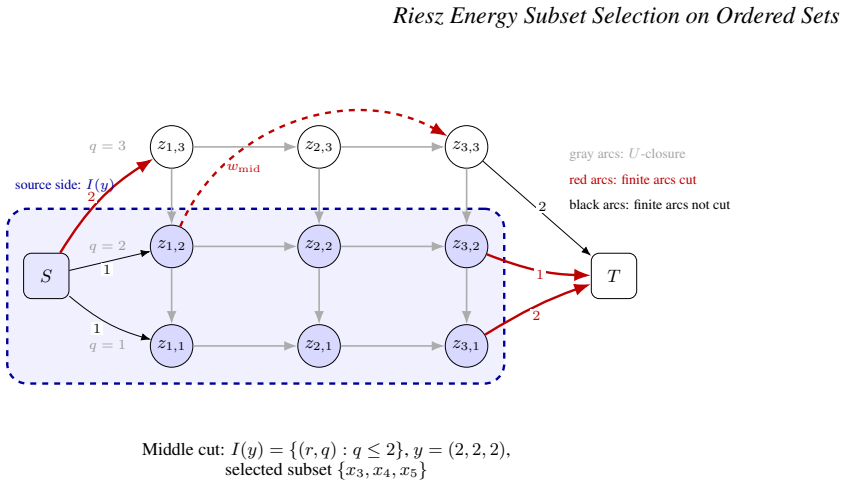
We prove that the one-dimensional Riesz interaction satisfies a Monge inequality. When feasible subsets are encoded as increasing index vectors, this property implies submodularity on a finite distributive lattice and yields polynomial-time solvability by submodular minimization over such lattices. The structural reduction holds for every real s>0. We also derive an explicit minimum S--T cut formulation with k(n-k) threshold variables and O(k^2(n-k)^2) finite pairwise edges.
What carries the argument
The Monge inequality for the Riesz s-energy interaction on ordered points, which establishes submodularity on the lattice of increasing index vectors and enables reduction to min-cut.
Load-bearing premise
The Riesz s-energy on ordered real-line point sets satisfies the Monge inequality for every real s>0.
What would settle it
An instance with ordered points x1 < ... < xn, s>0, and cardinality k where the subset chosen by the min-cut algorithm has higher energy than some other feasible subset found by exhaustive search.
Editorial analysis
A structured set of objections, weighed in public.
Referee Report
Summary. The manuscript claims a polynomial-time exact algorithm for minimum Riesz s-energy k-subset selection on ordered n-point sets on the line (and by isometry on ℓ1-staircases). The central argument is that the pairwise cost (x_q - x_p)^{-s} satisfies a Monge inequality for every s > 0; when subsets are encoded as strictly increasing index vectors, this yields submodularity on the distributive lattice of such vectors, permitting solution by submodular minimization. An explicit s-t cut construction is given with N = k(n-k) nodes and M = O(k²(n-k)²) arcs, yielding an O(k³(n-k)³) (or conservatively O(k⁴(n-k)⁴)) algorithm via standard max-flow bounds. A Python implementation and runtime benchmarks (crossover with enumeration near n = 24–26 for k = n/2) are included.
Significance. If the Monge property and lattice reduction hold, the work supplies the first exact polynomial-time method for this geometric subset-selection problem, together with reproducible code and an extension to skyline/Pareto approximations. The parameter-free structural derivation and explicit graph construction are strengths that distinguish the contribution from heuristic or approximate approaches.
major comments (1)
- [Abstract / Monge-inequality section] Abstract and the section deriving submodularity: the claim that the Riesz interaction satisfies the Monge inequality for all s > 0 is load-bearing for the entire polynomial-time result. The manuscript must supply the full steps (strict convexity of t ↦ t^{-s} on (0,∞) together with the majorization (x_{j'}-x_i, x_j-x_{i'}) ≻ (x_j-x_i, x_{j'}-x_{i'}) for i < i' < j < j') rather than stating the inequality without derivation, as the reader’s report notes the absence of these details.
minor comments (3)
- [Abstract] Abstract: the two max-flow bounds are presented; the implementation section should state which bound (or practical solver) is actually used for the reported runtimes.
- [Extension to ℓ1-staircases] The isometry argument mapping the line problem to ℓ1-staircases is invoked but not expanded; a short paragraph or figure illustrating the distance preservation would improve clarity.
- [Empirical evaluation] Benchmark description: hardware platform, Python version, and the specific max-flow library should be recorded so that the n ≈ 25 crossover point can be reproduced.
Simulated Author's Rebuttal
We thank the referee for their careful reading and for identifying the missing derivation steps in the Monge-inequality argument. We agree that the full proof must be supplied explicitly and will revise the manuscript to include it.
read point-by-point responses
-
Referee: [Abstract / Monge-inequality section] Abstract and the section deriving submodularity: the claim that the Riesz interaction satisfies the Monge inequality for all s > 0 is load-bearing for the entire polynomial-time result. The manuscript must supply the full steps (strict convexity of t ↦ t^{-s} on (0,∞) together with the majorization (x_{j'}-x_i, x_j-x_{i'}) ≻ (x_j-x_i, x_{j'}-x_{i'}) for i < i' < j < j') rather than stating the inequality without derivation, as the reader’s report notes the absence of these details.
Authors: We agree that the current manuscript states the Monge inequality without supplying the complete derivation. The proof relies on the strict convexity of f(t) = t^{-s} for s > 0 on (0, ∞) together with the majorization relation (x_{j'}-x_i, x_j-x_{i'}) ≻ (x_j-x_i, x_{j'}-x_{i'}) whenever i < i' < j < j'. We will insert the full step-by-step argument (including the convexity verification and the explicit majorization check) into the submodularity section of the revised manuscript. revision: yes
Circularity Check
No significant circularity; derivation is self-contained
full rationale
The paper's central claim is a proof that the Riesz s-energy satisfies the Monge inequality for all s>0 via the standard majorization argument on convex t^{-s} (explicitly sketched in the skeptic analysis and consistent with the abstract's statement of a proof). This property is then used to establish submodularity on the distributive lattice of increasing index vectors, which directly yields the min-cut reduction via known lattice-submodular optimization techniques. No parameter fitting, self-definitional loops, self-citation load-bearing steps, or renaming of known results appear; the algorithm follows from independently verifiable structural properties and standard graph algorithms. The derivation chain is therefore self-contained against external mathematical facts.
Axiom & Free-Parameter Ledger
axioms (1)
- domain assumption The one-dimensional Riesz s-energy interaction satisfies the Monge inequality for every real s>0
read the original abstract
We study efficient algorithms for one-dimensional fixed-cardinality minimum Riesz $s$-energy subset selection on ordered real-line point sets and propose and test a polynomial-time exact s-t cut-based algorithm for this problem. Given $x_1<\cdots<x_n$, an exponent $s>0$, and a cardinality $k$, the task is to choose $1\leq i_1<\cdots<i_k\leq n$ minimizing $E_s(i_1,\ldots,i_k)=\sum_{1\leq p<q\leq k}(x_{i_q}-x_{i_p})^{-s}$. We prove that the one-dimensional Riesz interaction satisfies a Monge inequality. When feasible subsets are encoded as increasing index vectors, this property implies submodularity on a finite distributive lattice and yields polynomial-time solvability by submodular minimization over such lattices. The structural reduction holds for every real $s>0$. We also derive an explicit minimum $S$--$T$ cut formulation with $k(n-k)$ threshold variables and $O(k^2(n-k)^2)$ finite pairwise edges. The constructed graph has $N=k(n-k)$ nodes and $M=O(k^2(n-k)^2)$ arcs after an $O(k^2(n-k)^2)$ coefficient-construction step; an $O(NM)$ max-flow bound gives an $O(k^3(n-k)^3)$ cut step, while the conservative $O(N^2M)$ bound gives $O(k^4(n-k)^4)$. By an isometry argument, the same algorithm applies to $\ell_1$-staircases, including monotone two-dimensional Pareto-front and skyline approximations. The accompanying Python implementation includes verification examples and an empirical runtime benchmark; on balanced instances $n=2k$, the reference min-cut code overtakes exhaustive enumeration around $n=24$--$26$. The appendix provides examples and detailed explanations of the underlying theory.
Figures


Forward citations
Cited by 1 Pith paper
-
Exact and Fast Subset Selection Algorithms for the Bi-objective Integral R2 Indicator
Exact O(kn) algorithm for fixed-cardinality subset selection under the continuous integral bi-objective R2 indicator via adjacent-neighbor decomposition and Monge matrix search.
Reference graph
Works this paper leans on
-
[1]
Rings of sets,
G. Birkhoff, “Rings of sets,”Duke Mathematical Journal, vol. 3, no. 3, pp. 443–454, 1937
1937
-
[2]
B. A. Davey and H. A. Priestley,Introduction to Lattices and Order, 2nd ed., Cambridge Mathematical Textbooks. Cambridge University Press, 2002
2002
-
[3]
Finding Diverse Minimum s–t Cuts,
M. de Berg, A. López Martínez, and F. Spieksma, “Finding Diverse Minimum s–t Cuts,”arXiv preprint arXiv:2303.07290v3, 2024. Earlier version appeared at the 34th International Symposium on Algorithms and Computation (ISAAC 2023). doi:10.48550/arXiv.2303.07290
-
[4]
Finding Diverse Solutions in Combinatorial Problems with a Distributive Lattice Structure,
M. de Berg, A. López Martínez, and F. Spieksma, “Finding Diverse Solutions in Combinatorial Problems with a Distributive Lattice Structure,”arXiv preprintarXiv:2504.02369, 2025. doi:10.48550/arXiv.2504.02369
-
[5]
Minimum Rieszs-Energy Subset Selection in Ordered Point Sets via Dynamic Program- ming,
M. T. M. Emmerich, “Minimum Rieszs-Energy Subset Selection in Ordered Point Sets via Dynamic Program- ming,”arXiv preprintarXiv:2502.01163, 2025. doi:10.48550/arXiv.2502.01163
-
[6]
On the Complexity of Minimum Riesz s-Energy Subset Selection in Euclidean and Ultrametric Spaces
M. T. M. Emmerich, K. Pereverdieva, and A. Deutz, “On the Complexity of Minimum Riesz s- Energy Subset Selection in Euclidean and Ultrametric Spaces,”arXiv preprintarXiv:2605.04715, 2026. doi:10.48550/arXiv.2605.04715
work page internal anchor Pith review Pith/arXiv arXiv doi:10.48550/arxiv.2605.04715 2026
-
[7]
Exact Dynamic Programming for Solow--Polasky Diversity Subset Selection on Lines and Staircases
M. T. M. Emmerich, “Exact Dynamic Programming for Solow–Polasky Diversity Subset Selection on Lines and Staircases,”arXiv preprintarXiv:2604.26929, 2026. doi:10.48550/arXiv.2604.26929
work page internal anchor Pith review Pith/arXiv arXiv doi:10.48550/arxiv.2604.26929 2026
-
[8]
Rieszs-energy as a diversity indicator in evolutionary multiobjective optimization,
J. G. Falcón-Cardona, L. Uribe, and P. Rosas, “Rieszs-energy as a diversity indicator in evolutionary multiobjective optimization,”IEEE Transactions on Evolutionary Computation, 2024. doi:10.1109/TEVC.2024.3405197
-
[9]
Fujishige,Submodular Functions and Optimization, 2nd ed., Annals of Discrete Mathematics, vol
S. Fujishige,Submodular Functions and Optimization, 2nd ed., Annals of Discrete Mathematics, vol. 58. Elsevier, 2005
2005
-
[10]
Minimal Riesz Energy Point Configurations for Rectifiabled-Dimensional Manifolds,
D. P. Hardin and E. B. Saff, “Minimal Riesz Energy Point Configurations for Rectifiabled-Dimensional Manifolds,” Advances in Mathematics, vol. 193, no. 1, pp. 174–204, 2005. doi:10.1016/j.aim.2004.01.004
-
[11]
S. Iwata, L. Fleischer, and S. Fujishige, “A combinatorial strongly polynomial algorithm for minimizing submodu- lar functions,”Journal of the ACM, vol. 48, no. 4, pp. 761–777, 2001. doi:10.1145/502090.502096
-
[12]
What energy functions can be minimized via graph cuts?
V . Kolmogorov and R. Zabih, “What energy functions can be minimized via graph cuts?”IEEE Transactions on Pattern Analysis and Machine Intelligence, vol. 26, no. 2, pp. 147–159, 2004. doi:10.1109/TPAMI.2004.1262177
-
[13]
An NP-hard problem? Computational complexity of minimum Rieszs-energy subset selection on the real line,
MathOverflow answer to “An NP-hard problem? Computational complexity of minimum Rieszs-energy subset selection on the real line,” by S.D., MathOverflow, 2026. Available at:https://mathoverflow.net/q/512233 (accessed 14 June 2026)
2026
-
[14]
A faster strongly polynomial time algorithm for submodular function minimization,
J. B. Orlin, “A faster strongly polynomial time algorithm for submodular function minimization,”Mathematical Programming, vol. 118, no. 2, pp. 237–251, 2009. doi:10.1007/s10107-007-0189-2
-
[15]
Comparative Analysis of Indicators for Multiobjective Diversity Optimization,
K. Pereverdieva, A. Deutz, T. Ezendam, T. Bäck, H. Hofmeyer, and M. T. M. Emmerich, “Comparative Analysis of Indicators for Multiobjective Diversity Optimization,”arXiv preprintarXiv:2410.18900, 2024. doi:10.48550/arXiv.2410.18900
-
[16]
Maximal closure of a graph and applications to combinatorial problems,
J.-C. Picard, “Maximal closure of a graph and applications to combinatorial problems,”Management Science, vol. 22, no. 11, pp. 1268–1272, 1976. doi:10.1287/mnsc.22.11.1268
-
[17]
A. Schrijver, “A combinatorial algorithm minimizing submodular functions in strongly polynomial time,”Journal of Combinatorial Theory, Series B, vol. 80, no. 2, pp. 346–355, 2000. doi:10.1006/jctb.2000.1989
-
[18]
Schrijver,Combinatorial Optimization: Polyhedra and Efficiency, Algorithms and Combinatorics, vol
A. Schrijver,Combinatorial Optimization: Polyhedra and Efficiency, Algorithms and Combinatorics, vol. 24. Springer, 2003
2003
-
[19]
D. M. Topkis,Supermodularity and Complementarity. Princeton University Press, 1998. 18
1998
discussion (0)
Sign in with ORCID, Apple, or X to comment. Anyone can read and Pith papers without signing in.