REVIEW 4 major objections 3 minor 67 references
On Robust Cross Domain Alignment
T0 review · 4 major / 3 minor · reviewed 2026-08-11 · deepseek-v4-flash
Pith's one-line read The paper claims three outlier-resistant variants of the Gromov-Wasserstein distance—Tukey/Huber penalization, local metric truncation, and robust Monge-map regularization—preserve metric structure and keep transport plans as probability…
desk verdict Genuinely new robust GW formulations with a real proof gap: the headline cross-domain guarantee is only proved for same-space distributions, though a one-line triangle-argument corollary would likely close it. read the letter →
The pith
A machine-rendered reading of the paper's core claim, the machinery that carries it, and where it could break.
The reading
What carries the argument
The load-bearing objects are three distinct attack points on the GW objective. The Tukey loss $T_p(x)=\min\{|x|^p,\tau^p\}$ and the Huber loss $H(x)=x^2/(2\tau)$ for $|x|\leq\tau$ and $|x|-\tau/2$ otherwise cap the contribution of huge pairwise-distance discrepancies; the triangle inequality for the induced $T_p$ 'norm', which follows from subadditivity of $T_p^{1/p}$, is what lets TGW inherit GW's metric structure. The truncated metric $l_\lambda(d)=\min\{d,\lambda\}$ modifies the distances themselves before they enter the cost; Proposition 11 shows the locally robust inner-product GW cost is bounded above by an optimal-transport problem on truncated observations, which ties trimming to OT and enables sample-complexity arguments. The coupling family $\Pi_\epsilon(\mu,\nu)=\{\pi:\pi=(\tilde{\mathrm{Id}}_\epsilon,F)_\#\mu=(G,\tilde{\mathrm{Id}}_\epsilon)_\#\nu\}$, with $\tilde{\mathrm{Id}}_\epsilon{}_\#\alpha\leq(1-\epsilon)\alpha$, implements partial alignment while keeping plans as probability distributions and leads to the RRGM Lagrangian with $W_1$ measure-preservation terms. The chain $\mathrm{LRGW}\leq\mathrm{TGW}\leq\mathrm{GW}$ and the reduction of RRGM to robust OT tie the three proposals together.
What would settle it
For two distributions on genuinely different metric spaces, contaminate one side with a single outlier moved arbitrarily far and record $d_{\mathrm{TGW}}(\mu',\nu)-d_{\mathrm{GW}}(\mu,\nu)$ at fixed $\tau$; if this gap grows without bound while the same-space bound stays finite, the claimed cross-domain robustness is not a population-level property.
Extended reading notes
Core claim
The central claim is that GW is best robustified at the level of the distortion, the metric, or the coupling, not by relaxing marginal constraints. First, replacing the raw distortion in the GW objective with the Tukey loss $T_p(x)=\min\{|x|^p,\tau^p\}$ gives the Tukey-GW distance $d_{\mathrm{TGW}}$, a pseudometric that lower-bounds GW, converges to it as $\tau\to\infty$, and under Huber's $\epsilon$-contamination satisfies $d_{\mathrm{TGW}}(\mu',\nu)\leq \tau\epsilon^{1/p}+W_{T_p}(\mu,\nu)$ when both measures live on the same metric space; the smooth Huber variant gives a computable HGW. Second, truncating the base metrics $d_X,d_Y$ with $l_\lambda(d)=\min\{d,\lambda\}$ yields locally robust GW, a lower bound to Tukey-GW whose cost is shown to become an optimal-transport problem on trimmed observations, and the construction extends to probabilistic metric-measure spaces via the robust Wasserstein distance $W_p^\epsilon$. Third, regularizing the admissible couplings with clean-proxy marginals or partial maps $\tilde{\mathrm{Id}}_\epsilon$ whose pushforward is dominated by $(1-\epsilon)$ of the original measure produces the RRGM loss for robust image translation. The three formulations are positioned as complementary: TGW protects against extreme distortions, LRGW protects at the nascency of pairwise distances, and RRGM protects the learned measure-preserving map.
Load-bearing premise
The quantitative robustness guarantee for Tukey-GW is proved only when both distributions are supported on the same metric space, so the paper's strongest cross-domain guarantee does not actually apply to cross-domain problems and instead rests on heuristic thresholds and experiments.
Editorial extensions
If this is right
- Tukey-GW is a pseudometric lower bound to GW that recovers it as $\tau\to\infty$, so robust alignment can stay inside the balanced-coupling framework.
- Under Huber contamination and same-space support, TGW is provably a robust estimator of GW with an explicit bound, and the resilience of distributions under $W_{T_p}$ follows from Corollary 5.
- HGW inherits the entropic GW algorithm with a Huber cost at the same $O(m^2n^2)$ complexity class, yielding robust shape matching with full marginal distributions.
- LRGW reduces to an OT problem on truncated observations, so its computation and sample complexity can be approached with OT tools, and it extends to Gaussian-mixture and probabilistic mm spaces.
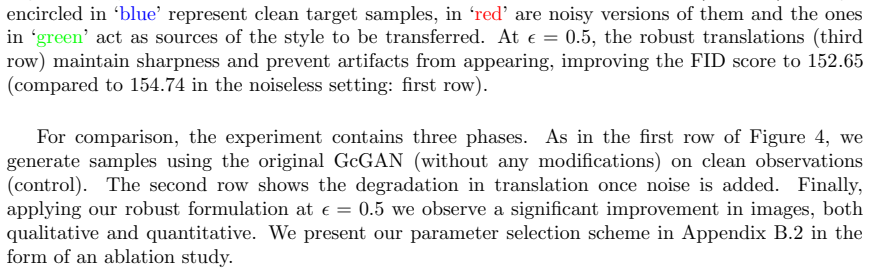
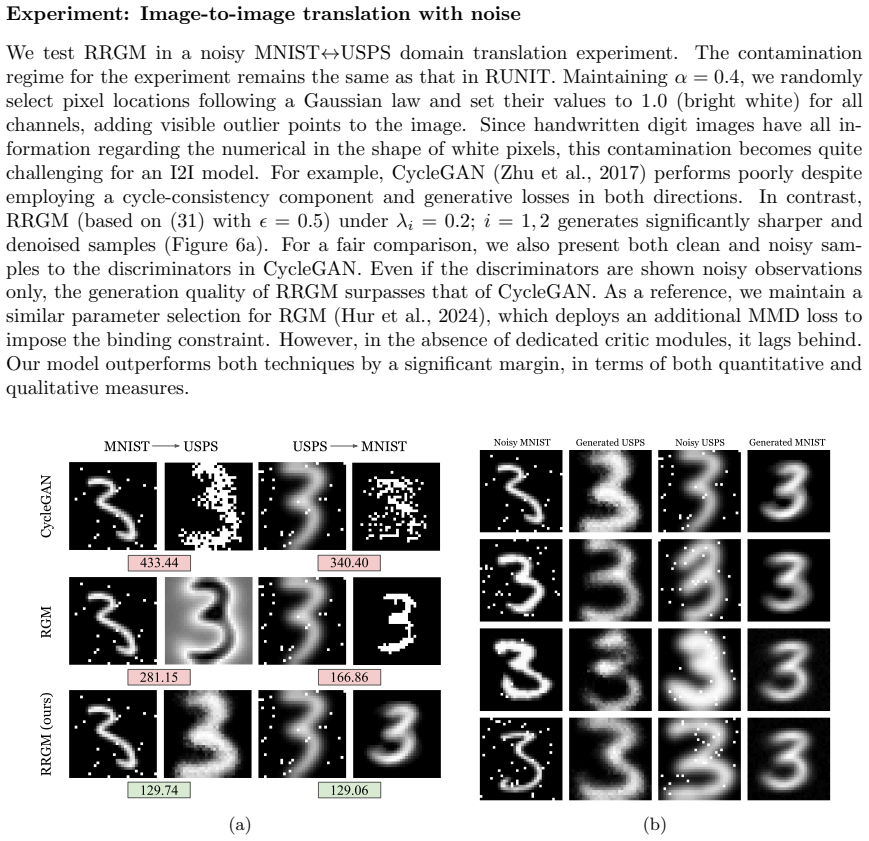
- RRGM improves noisy MNIST-to-USPS translation over CycleGAN and reversible Gromov-Monge baselines in reported FID scores while keeping plans as probability distributions.
Reading between the lines
- The same truncation and penalization ideas should transfer to other GW-type objectives, such as Fused GW or Z-GW, wherever the distortion or base metric is the vulnerable part; the paper's Lemma 9 suggests this transfer is direct for any metrics satisfying the same pointwise inequality.
- Because Proposition 3 is restricted to one shared metric space, a genuine cross-domain guarantee would likely need a bound in terms of the dissimilarity between the two spaces, such as their Gromov-Hausdorff distance or an optimal embedding distortion; the experiments do not substitute for that.
- The proposed threshold choice $\tau=\tilde{m}+3\tilde{\sigma}$ is a heuristic; a data-dependent, contamination-level-adaptive rule that provably preserves the metric and robustness bounds would be a natural next test.
- Since RRGM and LRGW both reduce to robust OT on trimmed or proxy distributions, their sample complexity can probably be analyzed with existing robust-OT bounds, and Proposition 21 is a first concentration result in that direction.
Editorial analysis
A structured set of objections, weighed in public.
Referee Report
Summary. The paper proposes three robustifications of the Gromov-Wasserstein (GW) distance for cross-domain alignment: Tukey/Huber penalized GW (TGW/HGW), locally robust GW (LRGW) via truncated metrics, and plan-robustification through RRGM. For each variant, the authors study metric properties, robustness guarantees, and relations to GW, and they report experiments on shape matching and image-to-image translation under contamination. The central claims are that TGW/HGW are robust to Huber contamination, that LRGW reduces to an OT problem between truncated observations, and that RRGM yields robust transport maps; each claim is supported by at least one theorem, algorithm, or experimental comparison.
Significance. The paper addresses an important and timely problem: robustifying GW-type distances, which are widely used for cross-domain alignment but are known to be brittle under outliers. The concrete contributions include the triangle inequality for TGW (Proposition 2), a same-space contamination bound (Proposition 3), an upper-bound duality for the cross-term of LRIGW (Proposition 11), and non-asymptotic concentration inequalities for the RRGM loss (Propositions 21–22). The experimental sections are detailed and the code is made available, which strengthens reproducibility. However, as detailed below, the most prominent claims—especially cross-domain robustness and the 'boils down to OT' statement—are not fully supported by the theorems as written, so the significance of the paper depends on whether these gaps can be closed by revision.
major comments (4)
- [Section 4.1, Proposition 3] The robustness guarantee is stated only for distributions µ and ν on the same metric measure space, yet the abstract and Section 4.1 present Proposition 3 as establishing robustness for cross-domain GW. The proof (Appendix A, eqs. 33–35) uses the triangle inequality of a single metric dX for points drawn from both distributions, which is unavailable when X ≠ Y. Remark 7 then applies Proposition 3 to empirical distributions on two different spaces by calling it a corollary, but no proof of that extension is given. Adding the triangle-inequality corollary via the intermediate space (X, dX, µ), namely dTGW(µ′,ν) ≤ τ ε^{1/p} + dGW(µ,ν), would make the cross-domain claim true; as it stands the claim is unsupported.
- [Section 4.2, Proposition 11] The contribution bullet states that 'solving the same boils down to calculating an OT between truncated observations from µ and ν (Proposition 11).' However, Proposition 11 provides an upper bound on the F2 component of the squared LRIGW cost, not an equality for the full distance d²_LRIGW = F1 + F2. The F1 term is a sum of marginal moments and is not expressed as an OT problem. The text later acknowledges an 'upper bound' (eq. 16), but the contribution language is not qualified accordingly. The authors should either prove an equality for the full minimal cost or rewrite the claim to say that the OT reduction applies to the cross-term upper bound only.
- [Section 4.1, Definition 8 and following text] HGW is introduced as the second penalized variant, and the text claims that 'HGW poses as a robust estimate of the corresponding GW value as it follows a property similar to Proposition 3.' No theorem or proof is given for this robustness property, and the Huber loss in Definition 8 is not monotone, so the TGW proof does not carry over directly. Since HGW is one of the three headline methods and is used in the shape-matching experiments, this unproved assertion is load-bearing. The authors should either provide a rigorous statement with proof or explicitly downgrade the claim.
- [Section 4.3, eq. (29)] The RRGM construction relies on a denoising map Id̃_ε satisfying Id̃_ε#α ≤ (1−ε)α, and the non-emptiness of Π_ε(µ,ν) is justified by an appeal to partial mass transport. However, no construction or learnable parametrization of Id̃_ε is given, and the loss (30) treats this map as an input. Since the claimed robust translation capability depends on the existence and identifiability of such a map, the authors should either specify how Id̃_ε is obtained in practice or present the existence argument as a formal lemma with the required assumptions.
minor comments (3)
- [Figure 3 and Figure 7] The y-axis labels 'Cost Metrics' are unhelpful; please specify the plotted quantity, e.g., 'average loss value' or 'distance value'.
- [Appendix A, proof of Proposition 3, inequality (34)] The step WTp((1−ε)µ + εµc, µ) ≤ WTp(εµ, εµc) is used without justification; a one-sentence explanation of why deleting the common part cannot increase the OT cost would improve readability.
- [Section 4.1, parameter selection] The text defines τ = m̃ + 3σ̃, where m̃ and σ̃ are the median and mean absolute deviation about the median, but the subsequent discussion in Appendix B.1 refers to 'mean deviation about median' without spelling out the estimator; please align the terminology.
Circularity Check
No significant circularity: the robust GW variants are defined with explicit thresholds and their stated bounds are proved for fixed parameters, not fitted and repackaged as predictions.
full rationale
The paper's derivation chain is self-contained: TGW/HGW are defined by inserting Tukey/Huber losses into the GW distortion functional (Definition 1 and Definition 8), and the metric and robustness statements (Proposition 2, Proposition 3, Corollary 5, Remark 7) are proved from those definitions for fixed parameters τ, ε, λ. No fitted parameter is later reused as a prediction of a closely related quantity. Proposition 3's bound dTGW(µ′,ν) ≤ τε^{1/p} + W_Tp(µ,ν) follows from the triangle inequality and the cap imposed by the Tukey threshold; the same-space assumption limits its applicability to genuinely cross-domain settings, but that is a scope/correctness gap rather than circularity. The data-dependent choices τ = m̃ + 3σ̃ and ϵ = 0.5 are heuristics or ablation selections made before reporting losses and FID scores, and the empirical comparisons are against external baselines (GW, FGW, PGW, UGW, CycleGAN, RGM), so no benchmark is defined by the method itself. Self-citations (Chakrabarty and Das 2022; Chakrabarty et al. 2023) supply auxiliary facts such as cycle-consistency loss equivalence and examples of information-preserving transforms; they are not load-bearing for the main robust-distance claims. No uniqueness theorem from the authors' prior work is invoked to forbid alternatives, and the relations among TGW, LRGW, and RRGM are explicitly derived inequalities rather than renamed inputs. The result is therefore not circular, with only a minor scope caveat in Proposition 3.
Assumptions & free parameters
free parameters (4)
- Tukey/Huber threshold tau =
median + 3 MAD of distortion values (about 2.07 for folded normal); 95th percentile used for TGW
- Local truncation threshold lambda =
user-tuned, no default given
- Robustness radius epsilon in W^epsilon_p and dLRGW =
0.5 in the reported image experiments
- Weights lambda1, lambda2 in RRGM loss =
0.2
assumptions (5)
- standard math Subadditivity of T_p^{1/p} for the Tukey loss (min{|x|, tau})
- standard math Compactness of the coupling set Pi(mu,nu) and the Gluing lemma
- domain assumption Huber's epsilon-contamination model with independent outliers
- domain assumption O union I framework with bounded outlier counts
- ad hoc to paper Existence of a shared latent space Z with isometric embeddings and left/right inverse maps
invented entities (1)
-
Denoising map Id~_epsilon
Cite this review
Pith. "Pith review of On Robust Cross Domain Alignment." pith.science (2026). https://pith.science/paper/32IPHO2H
@misc{pith2026241215861,
  author       = {Pith},
  title        = {Pith review of: On Robust Cross Domain Alignment},
  year         = {2026},
  howpublished = {\url{https://pith.science/paper/32IPHO2H}},
  note         = {Machine review of arXiv:2412.15861}
}
read the original abstract
The Gromov-Wasserstein (GW) distance is an effective measure of alignment between distributions supported on distinct ambient spaces. Calculating essentially the mutual departure from isometry, it has found vast usage in domain translation and network analysis. It has long been shown to be vulnerable to contamination in the underlying measures. All efforts to introduce robustness in GW have been inspired by similar techniques in optimal transport (OT), which predominantly advocate partial mass transport or unbalancing. In contrast, the cross-domain alignment problem being fundamentally different from OT, demands specific solutions to tackle diverse applications and contamination regimes. Deriving from robust statistics, we discuss three contextually novel techniques to robustify GW and its variants. For each method, we explore metric properties and robustness guarantees along with their co-dependencies and individual relations with the GW distance. For a comprehensive view, we empirically validate their superior resilience to contamination under real machine learning tasks against state-of-the-art methods.
Figures


Figures from the paper (7 more)



Reference graph
Works this paper leans on
-
[1]
P. C. Alvarez-Esteban, E. Del Barrio, J. A. Cuesta-Albertos, and C. Matran. Trimmed comparison of distributions. Journal of the American Statistical Association, 103 0 (482): 0 697--704, 2008
work page 2008
-
[2]
S. Arya, A. Auddy, R. A. Clark, S. Lim, F. Memoli, and D. Packer. The gromov--wasserstein distance between spheres. Foundations of Computational Mathematics, pages 1--56, 2024
work page 2024
-
[3]
Y. Bai, R. D. Martin, A. Kothapalli, H. Du, X. Liu, and S. Kolouri. Partial gromov-wasserstein metric. arXiv preprint arXiv:2402.03664, 2024
arXiv 2024
- [4]
- [5]
-
[6]
S. Benaim and L. Wolf. One-sided unsupervised domain mapping. Advances in neural information processing systems, 30, 2017
work page 2017
-
[7]
J. Blanchet, A. Jambulapati, C. Kent, and A. Sidford. Towards optimal running timesfor optimal transport. Operations Research Letters, 52: 0 107054, 2024
work page 2024
-
[8]
A. J. Blumberg, I. Gal, M. A. Mandell, and M. Pancia. Robust statistics, hypothesis testing, and confidence intervals for persistent homology on metric measure spaces. Foundations of Computational Mathematics, 14: 0 745--789, 2014
work page 2014
Show all 67 references
-
[9]
Y. Brenier. Polar factorization and monotone rearrangement of vector-valued functions. Communications on pure and applied mathematics, 44 0 (4): 0 375--417, 1991
1991
-
[10]
Chakrabarty and S
A. Chakrabarty and S. Das. On translation and reconstruction guarantees of the cycle-consistent generative adversarial networks. Advances in Neural Information Processing Systems, 35: 0 23607--23620, 2022
2022
-
[11]
Chakrabarty, A
A. Chakrabarty, A. Basu, and S. Das. Concurrent density estimation with wasserstein autoencoders: Some statistical insights. arXiv preprint arXiv:2312.06591, 2023
2023 arXiv
-
[12]
Chapel, M
L. Chapel, M. Z. Alaya, and G. Gasso. Partial optimal tranport with applications on positive-unlabeled learning. Advances in Neural Information Processing Systems, 33: 0 2903--2913, 2020
2020
-
[13]
Y. Choi, M. Choi, M. Kim, J.-W. Ha, S. Kim, and J. Choo. Stargan: Unified generative adversarial networks for multi-domain image-to-image translation. In Proceedings of the IEEE Conference on Computer Vision and Pattern Recognition (CVPR), June 2018
2018
-
[14]
Chowdhury and T
S. Chowdhury and T. Needham. Generalized spectral clustering via gromov-wasserstein learning. In International Conference on Artificial Intelligence and Statistics, pages 712--720. PMLR, 2021
2021
-
[15]
R. A. Clark, T. Needham, and T. Weighill. Generalized dimension reduction using semi-relaxed gromov-wasserstein distance. arXiv preprint arXiv:2405.15959, 2024
2024 arXiv
-
[16]
Clarkson, R
K. Clarkson, R. Wang, and D. Woodruff. Dimensionality reduction for tukey regression. In International Conference on Machine Learning, pages 1262--1271. PMLR, 2019
2019
-
[17]
K. L. Clarkson and D. P. Woodruff. Sketching for m-estimators: A unified approach to robust regression. In Proceedings of the twenty-sixth annual ACM-SIAM symposium on Discrete algorithms, pages 921--939. SIAM, 2014
2014
-
[18]
M. Cuturi. Sinkhorn distances: Lightspeed computation of optimal transport. Advances in neural information processing systems, 26, 2013
2013
-
[19]
Czado and A
C. Czado and A. Munk. Assessing the similarity of distributions-finite sample performance of the empirical mallows distance. Journal of Statistical Computation and Simulation, 60 0 (4): 0 319--346, 1998
1998
-
[20]
De Ponti and A
N. De Ponti and A. Mondino. Entropy-transport distances between unbalanced metric measure spaces. Probability Theory and Related Fields, 184 0 (1): 0 159--208, 2022
2022
-
[21]
Demetci, R
P. Demetci, R. Santorella, B. Sandstede, W. S. Noble, and R. Singh. Scot: Single-cell multi-omics alignment with optimal transport. Journal of Computational Biology, 29 0 (1): 0 3--18, 2022
2022
-
[22]
Dowson and B
D. Dowson and B. Landau. The fr \'e chet distance between multivariate normal distributions. Journal of multivariate analysis, 12 0 (3): 0 450--455, 1982
1982
-
[23]
Dumont, T
T. Dumont, T. Lacombe, and F.-X. Vialard. On the existence of monge maps for the gromov--wasserstein problem. Foundations of Computational Mathematics, pages 1--48, 2024
2024
-
[24]
B. E. Fristedt and L. F. Gray. A modern approach to probability theory. Springer Science & Business Media, 2013
2013
-
[25]
H. Fu, M. Gong, C. Wang, K. Batmanghelich, K. Zhang, and D. Tao. Geometry-consistent generative adversarial networks for one-sided unsupervised domain mapping. In Proceedings of the IEEE/CVF conference on computer vision and pattern recognition, pages 2427--2436, 2019
2019
-
[26]
F. Gong, Y. Nie, and H. Xu. Gromov-wasserstein multi-modal alignment and clustering. In Proceedings of the 31st ACM International Conference on Information & Knowledge Management, pages 603--613, 2022
2022
-
[27]
Greven, P
A. Greven, P. Pfaffelhuber, and A. Winter. Convergence in distribution of random metric measure spaces ( -coalescent measure trees). Probability Theory and Related Fields, 145 0 (1): 0 285--322, 2009
2009
-
[28]
Groppe and S
M. Groppe and S. Hundrieser. Lower complexity adaptation for empirical entropic optimal transport. arXiv preprint arXiv:2306.13580, 2023
2023 arXiv
-
[29]
Gulrajani, F
I. Gulrajani, F. Ahmed, M. Arjovsky, V. Dumoulin, and A. C. Courville. Improved training of wasserstein gans. Advances in neural information processing systems, 30, 2017
2017
-
[30]
Huang, M.-Y
X. Huang, M.-Y. Liu, S. Belongie, and J. Kautz. Multimodal unsupervised image-to-image translation. In Proceedings of the European conference on computer vision (ECCV), pages 172--189, 2018
2018
-
[31]
P. Huber. Robust Statistics. Wiley Series in Probability and Statistics. Wiley, 1981
1981
-
[32]
P. J. Huber. Robust Estimation of a Location Parameter . The Annals of Mathematical Statistics, 35 0 (1): 0 73 -- 101, 1964
1964
-
[33]
Y. Hur, W. Guo, and T. Liang. Reversible gromov--monge sampler for simulation-based inference. SIAM Journal on Mathematics of Data Science, 6 0 (2): 0 283--310, 2024
2024
-
[34]
L. Kong, J. Li, J. Tang, and A. M.-C. So. Outlier-robust gromov-wasserstein for graph data. Advances in Neural Information Processing Systems, 36, 2024
2024
-
[35]
K. Le, H. Nguyen, Q. M. Nguyen, T. Pham, H. Bui, and N. Ho. On robust optimal transport: Computational complexity and barycenter computation. Advances in Neural Information Processing Systems, 34: 0 21947--21959, 2021
2021
-
[36]
Lecu \'e and M
G. Lecu \'e and M. Lerasle. Robust machine learning by median-of-means: Theory and practice . The Annals of Statistics, 48 0 (2): 0 906 -- 931, 2020
2020
-
[37]
M. Li, J. Yu, H. Xu, and C. Meng. Efficient approximation of gromov-wasserstein distance using importance sparsification. Journal of Computational and Graphical Statistics, 32 0 (4): 0 1512--1523, 2023
2023
-
[38]
M.-Y. Liu, T. Breuel, and J. Kautz. Unsupervised image-to-image translation networks. Advances in neural information processing systems, 30, 2017
2017
-
[39]
P.-L. Loh. Statistical consistency and asymptotic normality for high-dimensional robust M -estimators . The Annals of Statistics, 45 0 (2): 0 866 -- 896, 2017
2017
-
[40]
Y. Ma, H. Liu, D. La Vecchia, and M. Lerasle. Inference via robust optimal transportation: theory and methods. arXiv preprint arXiv:2301.06297, 2023
2023 arXiv
-
[41]
R. J. McCann. Polar factorization of maps on riemannian manifolds. Geometric & Functional Analysis GAFA, 11 0 (3): 0 589--608, 2001
2001
-
[42]
M \'e moli
F. M \'e moli. Gromov--wasserstein distances and the metric approach to object matching. Foundations of computational mathematics, 11: 0 417--487, 2011
2011
-
[43]
Memoli, Z
F. Memoli, Z. Smith, and Z. Wan. The wasserstein transform. In International Conference on Machine Learning, pages 4496--4504. PMLR, 2019
2019
-
[44]
Mena and J
G. Mena and J. Niles-Weed. Statistical bounds for entropic optimal transport: sample complexity and the central limit theorem. Advances in neural information processing systems, 32, 2019
2019
-
[45]
Mroueh and M
Y. Mroueh and M. Rigotti. Unbalanced sobolev descent. Advances in Neural Information Processing Systems, 33: 0 17034--17043, 2020
2020
-
[46]
Mukherjee, A
D. Mukherjee, A. Guha, J. M. Solomon, Y. Sun, and M. Yurochkin. Outlier-robust optimal transport. In International Conference on Machine Learning, pages 7850--7860. PMLR, 2021
2021
-
[47]
Musco, C
C. Musco, C. Musco, D. P. Woodruff, and T. Yasuda. Active linear regression for l_p norms and beyond. arXiv preprint arXiv:2111.04888, 2021
2021 arXiv
-
[48]
Q. M. Nguyen, H. H. Nguyen, Y. Zhou, and L. M. Nguyen. On unbalanced optimal transport: Gradient methods, sparsity and approximation error. The Journal of Machine Learning Research, 24 0 (1): 0 18390--18430, 2023
2023
-
[49]
Nietert, Z
S. Nietert, Z. Goldfeld, and R. Cummings. Outlier-robust optimal transport: Duality, structure, and statistical analysis. In International Conference on Artificial Intelligence and Statistics, pages 11691--11719. PMLR, 2022
2022
-
[50]
Nietert, R
S. Nietert, R. Cummings, and Z. Goldfeld. Robust estimation under the wasserstein distance. arXiv preprint arXiv:2302.01237, 2023
2023 arXiv
-
[51]
Pele and M
O. Pele and M. Werman. Fast and robust earth mover's distances. In 2009 IEEE 12th international conference on computer vision, pages 460--467. IEEE, 2009
2009
-
[52]
Peyr \'e , M
G. Peyr \'e , M. Cuturi, and J. Solomon. Gromov-wasserstein averaging of kernel and distance matrices. In International conference on machine learning, pages 2664--2672. PMLR, 2016
2016
-
[53]
Raghvendra, P
S. Raghvendra, P. Shirzadian, and K. Zhang. A new robust partial p- W asserstein-based metric for comparing distributions. In Proceedings of the 41st International Conference on Machine Learning, volume 235 of Proceedings of Machine Learning Research, pages 41867--41885. PMLR,...
2024
-
[54]
Rioux, Z
G. Rioux, Z. Goldfeld, and K. Kato. Entropic gromov-wasserstein distances: Stability and algorithms. arXiv preprint arXiv:2306.00182, 2023
2023 arXiv
-
[55]
Salmona, A
A. Salmona, A. Desolneux, and J. Delon. Gromov-wasserstein-like distances in the gaussian mixture models space. Transactions on Machine Learning Research, 2024. ISSN 2835-8856
2024
-
[56]
Scetbon, G
M. Scetbon, G. Peyr \'e , and M. Cuturi. Linear-time gromov wasserstein distances using low rank couplings and costs. In International Conference on Machine Learning, pages 19347--19365. PMLR, 2022
2022
-
[57]
Schweizer, A
B. Schweizer, A. Sklar, et al. Statistical metric spaces. Pacific J. Math, 10 0 (1): 0 313--334, 1960
1960
-
[58]
S \'e journ \'e , F.-X
T. S \'e journ \'e , F.-X. Vialard, and G. Peyr \'e . The unbalanced gromov-wasserstein distance: Conic formulation and relaxation. Advances in Neural Information Processing Systems, 34: 0 8766--8779, 2021
2021
-
[59]
K.-T. Sturm. On the geometry of metric measure spaces. Acta Mathematica, 196 0 (1): 0 65 -- 131, 2006
2006
-
[60]
K.-T. Sturm. The space of spaces: curvature bounds and gradient flows on the space of metric measure spaces, volume 290. American Mathematical Society, 2023
2023
-
[61]
Q. H. Tran, H. Janati, N. Courty, R. Flamary, I. Redko, P. Demetci, and R. Singh. Unbalanced co-optimal transport. In Proceedings of the AAAI Conference on Artificial Intelligence, volume 37, pages 10006--10016, 2023
2023
-
[62]
Vayer, L
T. Vayer, L. Chapel, R. Flamary, R. Tavenard, and N. Courty. Fused gromov-wasserstein distance for structured objects. Algorithms, 13 0 (9): 0 212, 2020
2020
-
[63]
C. Villani. Topics in optimal transportation, volume 58. American Mathematical Soc., 2021
2021
-
[64]
Villani et al
C. Villani et al. Optimal transport: old and new, volume 338. Springer, 2009
2009
-
[65]
Zhang, Y
Z. Zhang, Y. Mroueh, Z. Goldfeld, and B. Sriperumbudur. Cycle consistent probability divergences across different spaces. In International Conference on Artificial Intelligence and Statistics, pages 7257--7285. PMLR, 2022
2022
-
[66]
Zhang, Z
Z. Zhang, Z. Goldfeld, Y. Mroueh, and B. K. Sriperumbudur. Gromov--wasserstein distances: Entropic regularization, duality and sample complexity. The Annals of Statistics, 52 0 (4): 0 1616--1645, 2024
2024
-
[67]
J.-Y. Zhu, T. Park, P. Isola, and A. A. Efros. Unpaired image-to-image translation using cycle-consistent adversarial networks. In Proceedings of the IEEE international conference on computer vision, pages 2223--2232, 2017
2017
Reviewed August 11, 2026 · model on record in the stance chip above.
Discussion (0). Continue with ORCID to comment.