REVIEW 3 major objections 5 minor 68 references
A Quality-Guided Mixture of Score-Fusion Experts Framework for Human Recognition
T0 review · 3 major / 5 minor · reviewed 2026-08-06 · deepseek-v4-flash
Pith's one-line read A quality-guided mixture of score-fusion experts improves whole-body biometric recognition across face, gait, and body modalities, beating fixed and learned fusion baselines on four benchmarks.
desk verdict Solid, practically useful score-fusion paper; empirical results are credible, but the quality-guided MoE mechanism and pseudo-label story are oversold. read the letter →
The pith
A machine-rendered reading of the paper's core claim, the machinery that carries it, and where it could break.
The reading
What carries the argument
The load-bearing machinery is the Quality Estimator (QE) trained with a pseudo-quality loss. For each frame, the QE extracts intermediate features from a pretrained backbone following the aggregation scheme of [25], reduces them to a mean and standard deviation representation, and outputs a quality weight via an MLP with sigmoid. The pseudo-label is defined in Eq. 1 as a linear ramp on the ranking position of the query among gallery templates: the better the true-match rank, the closer the target weight is to 1. This weight controls the router of a Mixture of Experts layer with $Z=2$ experts, where $p_1 = w_n$ and $p_2 = 1 - w_n$, so high-quality modalities dominate the fused score matrix; the score triplet loss of Eq. 5 enforces margin separation between match and non-match fused scores. Score fusion operates on raw similarity matrices, with Euclidean distances converted to similarities via $1/(1+\mathrm{Euc}(q,g))$.
What would settle it
Train QME on a benchmark where the pretrained face model's rankings are deliberately corrupted, e.g., by enriching the gallery with easy impostor templates for low-quality queries, so that ranking success no longer tracks image quality; if fusion performance degrades or the QE weights stop correlating with measurable quality attributes like blur or resolution, the pseudo-quality premise is refuted.
Extended reading notes
Core claim
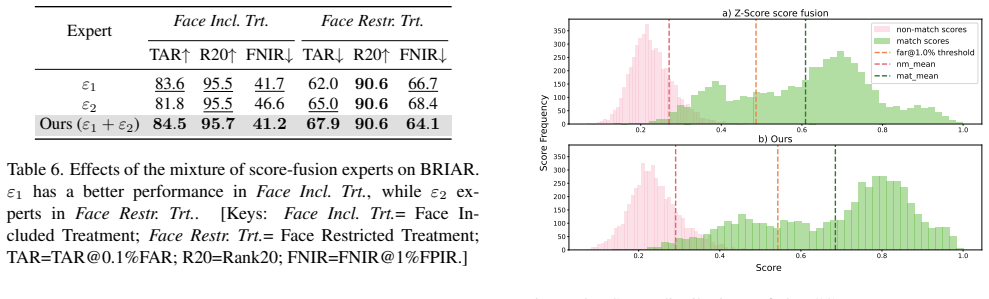
The central discovery is that treating score fusion as a quality-conditioned mixture-of-experts problem, trained with two new losses, yields consistent gains over both fixed-rule and trained-rule fusion baselines. A modality-specific Quality Estimator predicts a scalar quality weight for each input from intermediate backbone features, using a pseudo-quality label derived from how well the query ranks against gallery templates under a pretrained model. A router consumes these weights to combine outputs of multiple fusion experts, each specialized to a different input condition, and a score triplet loss directly pushes non-match scores down while keeping match scores above a margin. The authors show this improves performance on four whole-body benchmarks, with larger gains where face quality is poor, and ablations attribute the gains to the score triplet loss, the QE guidance, and the number of experts.
Load-bearing premise
The load-bearing premise is that a better ranking of a query against gallery templates under the pretrained model means the query images are genuinely higher quality; if ranking success comes from gallery bias, label noise, or model-specific quirks rather than image quality, the QE's weights will mislead the fusion on unseen data.
Editorial extensions
If this is right
- Any deployment using fixed score averaging can swap in QME without retraining biometric backbones and obtain higher Rank-1, mAP, TAR@FAR, and lower FNIR@FPIR on whole-body recognition benchmarks.
- QME extends to three modalities and to models with different similarity metrics, since Euclidean distances are converted to similarities before fusion.
- The score triplet loss is directly aligned with verification and open-set search metrics and can replace the standard triplet loss in fusion training.
- The QE can be trained on one model (e.g., AdaFace) and used to guide fusion with another model (e.g., CAL), showing cross-model generality.
- Larger gains appear in face-restricted or low-quality regimes, suggesting the method is most valuable where facial input is unreliable.
Reading between the lines
- Editorial inference: The same pseudo-quality ranking scheme could be applied to fuse any pretrained embedding models beyond biometrics, e.g., audio-visual speaker recognition or multimodal retrieval, whenever raw similarity scores are available.
- Editorial inference: If ranking-based pseudo-labels are noisy, an oracle-quality ablation (ground-truth blur, pose, or occlusion labels) would reveal the ceiling of the QE and how much headroom remains.
- Editorial inference: The score triplet loss might be adapted as a general fine-tuning objective for any score-based fusion system, including face-anti-spoofing score fusion or multi-camera tracking.
- Editorial inference: On datasets where one modality dominates, the QE could be trained adversarially to prevent easy-gallery shortcuts, since the pseudo-quality label in Eq. 1 depends on gallery composition.
Editorial analysis
A structured set of objections, weighed in public.
Referee Report
Summary. The paper proposes QME, a score-fusion layer for multimodal whole-body biometric recognition. For each pretrained backbone, a Quality Estimator (QE) predicts a modality quality weight from intermediate features, trained by regressing to a pseudo-label derived from the query's rank against a training gallery under that backbone. The predicted weights are used to combine the outputs of a small number of score-fusion experts, which are trained with a score triplet loss that suppresses non-match scores and enforces a margin for match scores. Experiments on CCVID, MEVID, LTCC, and BRIAR compare QME with fixed and learned fusion baselines, and ablations examine the contributions of the score loss, the QE, and the number of experts.
Significance. If the results hold, QME offers a modular, backbone-agnostic way to improve score fusion without retraining biometric models. The multi-dataset evaluation across face, gait, and body models, together with open-set metrics such as FNIR@FPIR, is a real strength, and the proposed pseudo-label approach avoids manual quality annotation. The ablations give some support for each component. However, the central mechanism depends on a gallery-relative quality definition, and the evidence does not yet establish that the quality weights generalize to novel galleries; the routing implementation is also under-specified. The practical impact is potentially high for surveillance and law-enforcement applications where heterogeneous pretrained models must be combined, but the current manuscript does not fully substantiate the claimed quality-guided mechanism.
major comments (3)
- [Sec. 3.1, Eq. (1)] The pseudo-quality label used to train the QE is the rank of the query against the training gallery under the pretrained model. This label conflates intrinsic input quality with gallery-relative ranking: the same image can receive a low label if the gallery contains a hard impostor or if the true match is poorly represented, and a modality that is weak on a dataset will be down-weighted at the dataset level rather than at the sample level. Because the QE output is the only quality signal that gates the experts, this is a load-bearing assumption for the claim that QME improves recognition through quality-guided fusion. The ablation in Sec. 4.4 removes QE but does not test the mechanism on a novel gallery or a different gallery composition. A concrete test would be to train the QE on one gallery split and evaluate on a disjoint gallery, or to compare QE weights against a gallery with different impostor distributions; without such evidence, the reported gains could come from dataset-level reweighting rather than sample-level quality adaptation.
- [Sec. 3.2/3.3 vs Sec. 4.1] The described architecture has a router N_r that takes the vector of modality quality weights w_n as input and outputs expert probabilities, but the implementation section sets Z=2 with p1 = w_n and p2 = 1-p1, where w_n appears to be a single scalar. It is not specified how per-modality weights are combined when N=3, and Tables 2-4 label variants by a single QE source (e.g., 'AdaFace-QE', 'CAL-QE'), suggesting only one modality's quality weight is used. This discrepancy makes the method non-reproducible and weakens the 'mixture-of-experts' claim; please clarify whether the routing is learned, how multi-modality weights are aggregated, and which QE source was used for each reported row.
- [Tables 2-4] The core empirical claim of state-of-the-art performance rests on small margins in several metrics, and the paper reports no uncertainty or significance tests for Rank-1, mAP, or TAR. For example, in Table 4 the Face-Included TAR gain over Weighted-sum is 0.5 points (84.5 vs 84.0) and R20 is tied with Min-max (96.0); in Table 3 the Rank-1 gain over AIM is 0.5 points (75.3 vs 74.8). Only FNIR is reported with median and standard deviation over random non-mated subsets. Without confidence intervals or paired statistical tests, it is not possible to distinguish these improvements from evaluation noise, which is especially important given the small size of some test sets (e.g., MEVID has 316 queries).
minor comments (5)
- [Tables 2-4] The label 'Weigthed-sum' should be 'Weighted-sum' in several places.
- [Abstract] The paper states 'Code is available at the Project Link' but no URL or supplementary code is provided; please include the link or a reproducibility description.
- [Sec. 3.3, Eq. (2)] Equation (2) uses Euc(q,g) without defining q and g at that point; the variables should be defined where the equation appears.
- [Sec. 4.1] The text says 'precompute gallery features for all training subjects' but it is not clear how this training gallery relates to the test gallery used for evaluation; please clarify the distinction.
- [Table 2(a)] The row 'Ours' appears alongside 'Ours (AdaFace-QE)' and 'Ours (CAL-QE)' without explaining what 'Ours' without a QE label denotes; please clarify the configuration.
Circularity Check
No significant circularity: the quality estimator is trained on ranking-based pseudo-labels, but the final claim is evaluated on held-out test sets and no equation reduces the central result to its inputs.
full rationale
The paper's derivation chain is not circular. The Quality Estimator (QE) is trained with the pseudo-quality loss L_rank (Eq. 1), where the target is a monotone function of the query's rank under a frozen pretrained model. This is a form of self-distillation: the QE learns to predict how well the pretrained model ranks a given query against the training gallery. That label is a model-specific confidence, not a direct fit of the final evaluation metric. The fused score (Eq. 3) is a weighted combination of expert outputs, with weights produced by the QE, and the score triplet loss (Eq. 5) is optimized on training data. All reported results in Tables 2-4 are computed on held-out test sets (CCVID, MEVID, LTCC, BRIAR) using standard protocols or protocols from the authors' own prior work (e.g., open-set non-mated lists following [53]); following an evaluation protocol is not a fitted parameter. No equation or citation in the manuscript makes the final Rank-1, mAP, TAR@FAR, or FNIR@FPIR values depend by construction on the training objective or on a self-citation. The assumption that a better rank implies higher quality may be empirically debatable and generalization to new galleries is a valid concern, but that is a correctness/robustness issue, not circular reasoning. The central empirical claim is therefore self-contained and independently testable.
Assumptions & free parameters
free parameters (3)
- ranking threshold delta =
3 for CCVID, MEVID, LTCC; 20 for BRIAR
- score margin m =
3
- number of experts Z =
2
assumptions (3)
- domain assumption A higher true-match ranking in the pretrained model implies higher input quality.
- domain assumption Score distributions from heterogeneous models can be aligned by BatchNorm and learned experts without retraining backbones.
- ad hoc to paper A single quality scalar is sufficient to gate the experts for all N-modality fusion settings.
Cite this review
Pith. "Pith review of A Quality-Guided Mixture of Score-Fusion Experts Framework for Human Recognition." pith.science (2026). https://pith.science/paper/32IWXC7T
@misc{pith2026250800053,
  author       = {Pith},
  title        = {Pith review of: A Quality-Guided Mixture of Score-Fusion Experts Framework for Human Recognition},
  year         = {2026},
  howpublished = {\url{https://pith.science/paper/32IWXC7T}},
  note         = {Machine review of arXiv:2508.00053}
}
read the original abstract
Whole-body biometric recognition is a challenging multimodal task that integrates various biometric modalities, including face, gait, and body. This integration is essential for overcoming the limitations of unimodal systems. Traditionally, whole-body recognition involves deploying different models to process multiple modalities, achieving the final outcome by score-fusion (e.g., weighted averaging of similarity matrices from each model). However, these conventional methods may overlook the variations in score distributions of individual modalities, making it challenging to improve final performance. In this work, we present \textbf{Q}uality-guided \textbf{M}ixture of score-fusion \textbf{E}xperts (QME), a novel framework designed for improving whole-body biometric recognition performance through a learnable score-fusion strategy using a Mixture of Experts (MoE). We introduce a novel pseudo-quality loss for quality estimation with a modality-specific Quality Estimator (QE), and a score triplet loss to improve the metric performance. Extensive experiments on multiple whole-body biometric datasets demonstrate the effectiveness of our proposed approach, achieving state-of-the-art results across various metrics compared to baseline methods. Our method is effective for multimodal and multi-model, addressing key challenges such as model misalignment in the similarity score domain and variability in data quality.
Figures


Figures from the paper (2 more)

Reference graph
Works this paper leans on
-
[1]
Geff: improving any clothes-changing person ReID model using gallery enrichment with face features
Daniel Arkushin, Bar Cohen, Shmuel Peleg, and Ohad Fried. Geff: improving any clothes-changing person ReID model using gallery enrichment with face features. InWACV, 2024. 6
work page 2024
-
[2]
Lacey Best-Rowden and Anil K Jain. Learning face image quality from human assessments.IEEE Transactions on In- formation forensics and security, 13(12), 2018. 2
work page 2018
-
[3]
Bio- metric quality: a review of fingerprint, iris, and face
Samarth Bharadwaj, Mayank Vatsa, and Richa Singh. Bio- metric quality: a review of fingerprint, iris, and face. EURASIP journal on Image and Video Processing, 2014,
work page 2014
-
[4]
Data uncertainty learning in face recognition
Jie Chang, Zhonghao Lan, Changmao Cheng, and Yichen Wei. Data uncertainty learning in face recognition. InCVPR,
-
[5]
Atm: Action tempo- rality modeling for video question answering
Junwen Chen, Jie Zhu, and Yu Kong. Atm: Action tempo- rality modeling for video question answering. InACM MM,
-
[6]
An approach for full reinforcement-based biometric score fusion.IEEE Access, 2024
Mohamed Cheniti, Zahid Akhtar, Chandranath Adak, and Kamran Siddique. An approach for full reinforcement-based biometric score fusion.IEEE Access, 2024. 2
work page 2024
-
[7]
Expanding accurate person recognition to new altitudes and ranges: The briar dataset
David Cornett, Joel Brogan, Nell Barber, Deniz Aykac, Seth Baird, Nicholas Burchfield, Carl Dukes, Andrew Duncan, Regina Ferrell, Jim Goddard, et al. Expanding accurate person recognition to new altitudes and ranges: The briar dataset. InWACV, 2023. 2
work page 2023
-
[8]
Generalizable person re-identification with relevance-aware mixture of experts
Yongxing Dai, Xiaotong Li, Jun Liu, Zekun Tong, and Ling-Yu Duan. Generalizable person re-identification with relevance-aware mixture of experts. InCVPR, 2021. 4
work page 2021
Show all 68 references
-
[9]
Ca- bala—collaborative architectures based on biometric adapt- able layers and activities.PR, 45(6):2348–2362, 2012
Maria De Marsico, Michele Nappi, and Daniel Riccio. Ca- bala—collaborative architectures based on biometric adapt- able layers and activities.PR, 45(6):2348–2362, 2012. 2
2012
-
[10]
Arcface: Additive angular margin loss for deep face recognition
Jiankang Deng, Jia Guo, Niannan Xue, and Stefanos Zafeiriou. Arcface: Additive angular margin loss for deep face recognition. InCVPR, 2019. 1
2019
-
[11]
Quality assessment of image-based biometric information.EURASIP Journal on Image and video Process- ing, 2015, 2015
Mohamad El-Abed, Christophe Charrier, and Christophe Rosenberger. Quality assessment of image-based biometric information.EURASIP Journal on Image and video Process- ing, 2015, 2015. 2
2015
-
[12]
Switch transformers: Scaling to trillion parameter models with sim- ple and efficient sparsity.Journal of Machine Learning Re- search, 23(120), 2022
William Fedus, Barret Zoph, and Noam Shazeer. Switch transformers: Scaling to trillion parameter models with sim- ple and efficient sparsity.Journal of Machine Learning Re- search, 23(120), 2022. 4
2022
-
[13]
Performance of biomet- ric quality measures.TPAMI, 29(4), 2007
Patrick Grother and Elham Tabassi. Performance of biomet- ric quality measures.TPAMI, 29(4), 2007. 2
2007
-
[14]
Face re-identification in thermal infrared spectrum based on Ther- malFaceNet neural network
Artur Grudzien, Marcin Kowalski, and Norbert Palka. Face re-identification in thermal infrared spectrum based on Ther- malFaceNet neural network. InMIKON, 2018. 2
2018
-
[15]
Clothes-changing person re-identification with rgb modality only
Xinqian Gu, Hong Chang, Bingpeng Ma, Shutao Bai, Shiguang Shan, and Xilin Chen. Clothes-changing person re-identification with rgb modality only. InCVPR, 2022. 1, 5, 6, 7
2022
-
[16]
Multi- domain learning for updating face anti-spoofing models
Xiao Guo, Yaojie Liu, Anil Jain, and Xiaoming Liu. Multi- domain learning for updating face anti-spoofing models. In ECCV, 2022. 2
2022
-
[17]
Rethinking vision-language model in face forensics: Multi-modal interpretable forged face detector
Xiao Guo, Xiufeng Song, Yue Zhang, Xiaohong Liu, and Xiaoming Liu. Rethinking vision-language model in face forensics: Multi-modal interpretable forged face detector. In CVPR, 2025. 2
2025
-
[18]
Multi-modal human authentication using silhouettes, gait and rgb
Yuxiang Guo, Cheng Peng, Chun Pong Lau, and Rama Chel- lappa. Multi-modal human authentication using silhouettes, gait and rgb. InFG, 2023. 2
2023
-
[19]
Performance evaluation of score level fusion in multimodal biometric systems.PR, 43 (5), 2010
Mingxing He, Shi-Jinn Horng, Pingzhi Fan, Ray-Shine Run, Rong-Jian Chen, Jui-Lin Lai, Muhammad Khurram Khan, and Kevin Octavius Sentosa. Performance evaluation of score level fusion in multimodal biometric systems.PR, 43 (5), 2010. 2, 5, 6, 7
2010
-
[20]
Combining multiple biometric traits us- ing asymmetric aggregation operators for improved person recognition.Symmetry, 12(3):444, 2020
Abderrahmane Herbadji, Zahid Akhtar, Kamran Siddique, Noubeil Guermat, Lahcene Ziet, Mohamed Cheniti, and Khan Muhammad. Combining multiple biometric traits us- ing asymmetric aggregation operators for improved person recognition.Symmetry, 12(3):444, 2020. 5, 6, 7
2020
-
[21]
Faceqnet: Quality assessment for face recognition based on deep learning
Javier Hernandez-Ortega, Javier Galbally, Julian Fierrez, Rudolf Haraksim, and Laurent Beslay. Faceqnet: Quality assessment for face recognition based on deep learning. In ICB, 2019. 2
2019
-
[22]
Whole-body detection, recognition and identification at altitude and range.arXiv preprint arXiv:2311.05725, 2023
Siyuan Huang, Ram Prabhakar Kathirvel, Chun Pong Lau, and Rama Chellappa. Whole-body detection, recognition and identification at altitude and range.arXiv preprint arXiv:2311.05725, 2023. 2
2023 arXiv
-
[23]
Score nor- malization in multimodal biometric systems.PR, 38(12),
Anil Jain, Karthik Nandakumar, and Arun Ross. Score nor- malization in multimodal biometric systems.PR, 38(12),
-
[24]
Adaface: Quality adaptive margin for face recognition
Minchul Kim, Anil K Jain, and Xiaoming Liu. Adaface: Quality adaptive margin for face recognition. InCVPR,
-
[25]
Cluster and aggregate: Face recognition with large probe set
Minchul Kim, Feng Liu, Anil K Jain, and Xiaoming Liu. Cluster and aggregate: Face recognition with large probe set. InNeurIPS, 2022. 2, 3, 6
2022
-
[26]
KeyPoint Relative Position Encoding for Face Recog- nition
Minchul Kim, Yiyang Su, Feng Liu, Anil Jain, and Xiaoming Liu. KeyPoint Relative Position Encoding for Face Recog- nition. InCVPR, 2024. 5, 7
2024
-
[27]
Sapiensid: Foundation for human recognition
Minchul Kim, Dingqiang Ye, Yiyang Su, Feng Liu, and Xi- aoming Liu. Sapiensid: Foundation for human recognition. InCVPR, 2025. 1, 2, 5, 6, 7
2025
-
[28]
A new probabilistic iris quality measure for com- prehensive noise detection
Emine Krichen, Sonia Garcia-Salicetti, and Bernadette Dorizzi. A new probabilistic iris quality measure for com- prehensive noise detection. InBTAS, 2007. 2
2007
-
[29]
Gshard: Scaling giant models with conditional computation and automatic sharding.arXiv preprint arXiv:2006.16668, 2020
Dmitry Lepikhin, HyoukJoong Lee, Yuanzhong Xu, Dehao Chen, Orhan Firat, Yanping Huang, Maxim Krikun, Noam Shazeer, and Zhifeng Chen. Gshard: Scaling giant models with conditional computation and automatic sharding.arXiv preprint arXiv:2006.16668, 2020. 4
2006 arXiv
-
[30]
Toward facial re- identification: Experiments with data from an operational surveillance camera plant
Pei Li, Joel Brogan, and Patrick J Flynn. Toward facial re- identification: Experiments with data from an operational surveillance camera plant. InBTAS, 2016. 2
2016
-
[31]
Learning face similarity for re-identification from real surveillance video: A deep metric solution
Pei Li, Maria Loreto Prieto, Patrick J Flynn, and Domingo Mery. Learning face similarity for re-identification from real surveillance video: A deep metric solution. InIJCB, 2017. 2
2017
-
[32]
An in-depth ex- ploration of person re-identification and gait recognition in cloth-changing conditions
Weijia Li, Saihui Hou, Chunjie Zhang, Chunshui Cao, Xu Liu, Yongzhen Huang, and Yao Zhao. An in-depth ex- ploration of person re-identification and gait recognition in cloth-changing conditions. InCVPR, 2023. 1
2023
-
[33]
Grid search, random search, genetic algorithm: a big comparison for nas
Petro Liashchynskyi and Pavlo Liashchynskyi. Grid search, random search, genetic algorithm: a big comparison for nas. arXiv preprint arXiv:1912.06059, 2019. 2
1912 arXiv
-
[34]
Farsight: A physics- driven whole-body biometric system at large distance and al- titude
Feng Liu, Ryan Ashbaugh, Nicholas Chimitt, Najmul Has- san, Ali Hassani, Ajay Jaiswal, Minchul Kim, Zhiyuan Mao, Christopher Perry, Zhiyuan Ren, et al. Farsight: A physics- driven whole-body biometric system at large distance and al- titude. InWACV, 2024. 2, 5, 6, 7
2024
-
[35]
Distilling CLIP with Dual Guidance for Learning Discrimi- native Human Body Shape Representation
Feng Liu, Minchul Kim, Zhiyuan Ren, and Xiaoming Liu. Distilling CLIP with Dual Guidance for Learning Discrimi- native Human Body Shape Representation. InCVPR, 2024. 1, 5, 6, 7
2024
-
[36]
Person recognition at altitude and range: Fusion of face, body shape and gait
Feng Liu, Nicholas Chimitt, Lanqing Guo, Jitesh Jain, Aditya Kane, Minchul Kim, Wes Robbins, Yiyang Su, Dingqiang Ye, Xingguang Zhang, et al. Person recognition at altitude and range: Fusion of face, body shape and gait. arXiv preprint arXiv:2505.04616, 2025. 2
2025 arXiv
-
[37]
Magface: A universal representation for face recognition and quality assessment
Qiang Meng, Shichao Zhao, Zhida Huang, and Feng Zhou. Magface: A universal representation for face recognition and quality assessment. InCVPR, 2021. 2
2021
-
[38]
Likelihood ratio-based biometric score fusion.TPAMI, 30 (2), 2007
Karthik Nandakumar, Yi Chen, Sarat C Dass, and Anil Jain. Likelihood ratio-based biometric score fusion.TPAMI, 30 (2), 2007. 2
2007
-
[39]
Improving face recognition with a quality-based probabilistic framework
Necmiye Ozay, Yan Tong, Frederick W Wheeler, and Xi- aoming Liu. Improving face recognition with a quality-based probabilistic framework. InCVPRW, 2009. 2
2009
-
[40]
Multi-scale speaker diarization with neural affinity score fu- sion
Tae Jin Park, Manoj Kumar, and Shrikanth Narayanan. Multi-scale speaker diarization with neural affinity score fu- sion. InICASSP, 2021. 2, 5, 6, 7
2021
-
[41]
A unified framework for bio- metric expert fusion incorporating quality measures.TPAMI, 34(1), 2011
Norman Poh and Josef Kittler. A unified framework for bio- metric expert fusion incorporating quality measures.TPAMI, 34(1), 2011. 2
2011
-
[42]
Im- proving biometric device interoperability by likelihood ratio- based quality dependent score normalization
Norman Poh, Josef Kittler, and Thirimachos Bourlai. Im- proving biometric device interoperability by likelihood ratio- based quality dependent score normalization. InBTAS, 2007. 2
2007
-
[43]
Long-term cloth-changing person re-identification
Xuelin Qian, Wenxuan Wang, Li Zhang, Fangrui Zhu, Yanwei Fu, Tao Xiang, Yu-Gang Jiang, and Xiangyang Xue. Long-term cloth-changing person re-identification. In ACCV, 2020. 1
2020
-
[44]
Implicit Discriminative Knowl- edge Learning for Visible-Infrared Person Re-Identification
Kaijie Ren and Lei Zhang. Implicit Discriminative Knowl- edge Learning for Visible-Infrared Person Re-Identification. InCVPR, 2024. 2
2024
-
[45]
Information fusion in biometrics
Arun Ross and Anil Jain. Information fusion in biometrics. PR letters, 24(13), 2003. 2
2003
-
[46]
Re-iqa: Unsupervised learning for image quality assessment in the wild
Avinab Saha, Sandeep Mishra, and Alan C Bovik. Re-iqa: Unsupervised learning for image quality assessment in the wild. InCVPR, pages 5846–5855, 2023. 2
2023
-
[47]
Facenet: A unified embedding for face recognition and clus- tering
Florian Schroff, Dmitry Kalenichenko, and James Philbin. Facenet: A unified embedding for face recognition and clus- tering. InCVPR, 2015. 5
2015
-
[48]
Outra- geously large neural networks: The sparsely-gated mixture- of-experts layer.arXiv preprint arXiv:1701.06538, 2017
Noam Shazeer, Azalia Mirhoseini, Krzysztof Maziarz, Andy Davis, Quoc Le, Geoffrey Hinton, and Jeff Dean. Outra- geously large neural networks: The sparsely-gated mixture- of-experts layer.arXiv preprint arXiv:1701.06538, 2017. 4
2017 arXiv
-
[49]
Mesh-tensorflow: Deep learning for supercomputers
Noam Shazeer, Youlong Cheng, Niki Parmar, Dustin Tran, Ashish Vaswani, Penporn Koanantakool, Peter Hawkins, HyoukJoong Lee, Mingsheng Hong, Cliff Young, et al. Mesh-tensorflow: Deep learning for supercomputers. In NeurIPS, 2018. 4
2018
-
[50]
Probabilistic face embeddings
Yichun Shi and Anil K Jain. Probabilistic face embeddings. InICCV, 2019. 2
2019
-
[51]
A comprehen- sive overview of biometric fusion.Information Fusion, 52,
Maneet Singh, Richa Singh, and Arun Ross. A comprehen- sive overview of biometric fusion.Information Fusion, 52,
-
[52]
Multimodal biometrics: issues in design and testing
Robert Snelick, Mike Indovina, James Yen, and Alan Mink. Multimodal biometrics: issues in design and testing. In ICMI, 2003. 5, 6, 7
2003
-
[53]
Open-set biometrics: Beyond good closed-set models
Yiyang Su, Minchul Kim, Feng Liu, Anil Jain, and Xiaoming Liu. Open-set biometrics: Beyond good closed-set models. InECCV, 2024. 2, 6
2024
-
[54]
Hamobe: Hierarchical and adaptive mixture of biometric ex- perts for video-based person reid
Yiyang Su, Yunping Shi, Feng Liu, and Xiaoming Liu. Hamobe: Hierarchical and adaptive mixture of biometric ex- perts for video-based person reid. InICCV, 2025. 4
2025
-
[55]
Optimized score level fusion for multi-instance finger vein recognition
Jackson Horlick Teng, Thian Song Ong, Tee Connie, Kala- iarasi Sonai Muthu Anbananthen, and Pa Pa Min. Optimized score level fusion for multi-instance finger vein recognition. Algorithms, 2022. 2, 5, 6, 7
2022
-
[56]
Ser-fiq: Unsupervised esti- mation of face image quality based on stochastic embedding robustness
Philipp Terhorst, Jan Niklas Kolf, Naser Damer, Florian Kirchbuchner, and Arjan Kuijper. Ser-fiq: Unsupervised esti- mation of face image quality based on stochastic embedding robustness. InCVPR, 2020. 2
2020
-
[57]
Im- proving biometric identification through quality-based face and fingerprint biometric fusion
Yan Tong, Frederick W Wheeler, and Xiaoming Liu. Im- proving biometric identification through quality-based face and fingerprint biometric fusion. InCVPRW, 2010. 2
2010
-
[58]
Integrating image quality in 2ν-svm biometric match score fusion.In- ternational Journal of Neural Systems, 17(05), 2007
Mayank Vatsa, Richa Singh, and Afzel Noore. Integrating image quality in 2ν-svm biometric match score fusion.In- ternational Journal of Neural Systems, 17(05), 2007. 2
2007
-
[59]
Adaptive graph representation learn- ing for video person re-identification.IEEE Transactions on Image Processing, 29, 2020
Yiming Wu, Omar El Farouk Bourahla, Xi Li, Fei Wu, Qi Tian, and Xue Zhou. Adaptive graph representation learn- ing for video person re-identification.IEEE Transactions on Image Processing, 29, 2020. 5, 6
2020
-
[60]
Shallow-Deep Collab- orative Learning for Unsupervised Visible-Infrared Person Re-Identification
Bin Yang, Jun Chen, and Mang Ye. Shallow-Deep Collab- orative Learning for Unsupervised Visible-Infrared Person Re-Identification. InCVPR, 2024. 2
2024
-
[61]
Person re- identification by contour sketch under moderate clothing change.TPAMI, 43(6), 2019
Qize Yang, Ancong Wu, and Wei-Shi Zheng. Person re- identification by contour sketch under moderate clothing change.TPAMI, 43(6), 2019. 1
2019
-
[62]
Good is bad: Causality inspired cloth-debiasing for cloth-changing person re-identification
Zhengwei Yang, Meng Lin, Xian Zhong, Yu Wu, and Zheng Wang. Good is bad: Causality inspired cloth-debiasing for cloth-changing person re-identification. InCVPR, 2023. 5, 7
2023
-
[63]
BigGait: Learning Gait Representation You Want by Large Vision Models
Dingqiang Ye, Chao Fan, Jingzhe Ma, Xiaoming Liu, and Shiqi Yu. BigGait: Learning Gait Representation You Want by Large Vision Models. InCVPR, 2024. 1, 5, 6, 7
2024
-
[64]
Score level fusion of classifiers in off-line signature verification.Infor- mation Fusion, 32, 2016
Mustafa Berkay Yılmaz and Berrin Yanıko ˘glu. Score level fusion of classifiers in off-line signature verification.Infor- mation Fusion, 32, 2016. 2
2016
-
[65]
Common sense reasoning for deepfake de- tection
Yue Zhang, Ben Colman, Xiao Guo, Ali Shahriyari, and Gaurav Bharaj. Common sense reasoning for deepfake de- tection. InECCV, 2024. 2
2024
-
[66]
Gait recognition via disentangled representation learning
Ziyuan Zhang, Luan Tran, Xi Yin, Yousef Atoum, Xiaom- ing Liu, Jian Wan, and Nanxin Wang. Gait recognition via disentangled representation learning. InCVPR, 2019. 1
2019
-
[67]
Webface260m: A benchmark unveiling the power of million-scale deep face recognition
Zheng Zhu, Guan Huang, Jiankang Deng, Yun Ye, Junjie Huang, Xinze Chen, Jiagang Zhu, Tian Yang, Jiwen Lu, Dalong Du, et al. Webface260m: A benchmark unveiling the power of million-scale deep face recognition. InCVPR,
-
[68]
Tam- ing sparsely activated transformer with stochastic experts
Simiao Zuo, Xiaodong Liu, Jian Jiao, Young Jin Kim, Hany Hassan, Ruofei Zhang, Tuo Zhao, and Jianfeng Gao. Tam- ing sparsely activated transformer with stochastic experts. In ICLR, 2022. 4
2022
Reviewed August 6, 2026 · model on record in the stance chip above.
Discussion (0). Continue with ORCID to comment.