Spectroscopy of hidden-heavy tetraquark states with J^(PC)=0⁻⁻ in a color-octet configuration
Pith reviewed 2026-05-21 04:16 UTC · model grok-4.3
The pith
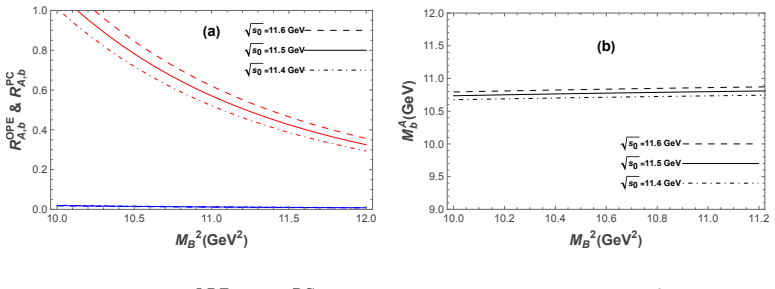
QCD sum rules predict four 0-- hidden-bottom tetraquarks with masses between 10.8 and 11.1 GeV.
A machine-rendered reading of the paper's core claim, the machinery that carries it, and where it could break.
Core claim
The paper establishes that four 0^{--} hidden-bottom tetraquark states can be described by color-octet interpolating currents in QCD sum rules, yielding masses in the interval from 10.8 to 11.1 GeV with good Borel stability, while the corresponding hidden-charm states are found near 4.3 to 4.6 GeV; the mass pattern remains similar across the two color configurations considered.
What carries the argument
Color-octet interpolating currents for the two configurations [Q bar q] octet tensor [q bar Q] octet and [Q bar Q] octet tensor [bar q q] octet, employed in the QCD sum-rule method with operator product expansion truncated at dimension eight.
If this is right
- The 0^{--} assignment forbids decays into the lowest-lying pseudoscalar-pseudoscalar heavy-meson pairs.
- The states are suitable targets for experimental searches at Belle II and LHCb.
- Complementary searches for the hidden-charm partners can be pursued at BESIII.
- The mass values depend only mildly on the specific color-octet clustering chosen for the current.
Where Pith is reading between the lines
- Confirmation of these masses would support the use of color-octet currents for modeling other exotic heavy states.
- The greater stability in the bottom sector suggests that sum-rule analyses become more reliable as the heavy-quark mass increases.
- These predictions could be tested by looking for resonances in specific multi-particle final states that avoid the forbidden channels.
Load-bearing premise
The chosen color-octet interpolating currents together with stopping the operator product expansion at dimension-eight condensates suffice to generate reliable Borel windows and stable mass values.
What would settle it
An experimental search that finds no resonance with J^{PC}=0^{--} near 10.9 GeV in the hidden-bottom system, or finds one at a significantly different mass, would challenge the sum-rule predictions.
Figures



read the original abstract
Within the framework of QCD sum rules, we investigate hidden-heavy tetraquark states with the exotic quantum number $J^{PC}=0^{--}$ in color-octet configurations, namely $[Q\bar q]_{8_c}\otimes[q\bar Q]_{8_c}$ and $[Q\bar Q]_{8_c}\otimes[\bar q q]_{8_c}$ with $Q=c,b$. Since the $0^{--}$ quantum number cannot be realized by conventional $q\bar q$ mesons, the observation of such a state would provide a particularly clean signal for exotic hadronic structures. We construct four color-octet interpolating currents for the hidden-heavy systems and carry out the operator product expansion up to dimension-eight condensates. Our numerical analysis indicates that the hidden-bottom sector exhibits the clearest sum-rule stability, with flatter Borel platforms than the corresponding hidden-charm sector. We obtain four $0^{--}$ hidden-bottom tetraquark candidates in the mass range $10.8$--$11.1~\mathrm{GeV}$, while their hidden-charm partners are predicted around $4.3$--$4.6~\mathrm{GeV}$. The extracted masses suggest a compact spectral pattern with a mild dependence on the underlying color-octet clustering structure. We also discuss possible decay patterns and emphasize that the absence of the lowest pseudoscalar--pseudoscalar heavy-meson channels is a distinctive consequence of the exotic $0^{--}$ assignment. These results provide useful theoretical guidance for future searches for hidden-heavy exotic states at Belle II and LHCb, with complementary probes of the hidden-charm partners at BESIII.
Editorial analysis
A structured set of objections, weighed in public.
Referee Report
Summary. The paper applies QCD sum rules to hidden-heavy tetraquarks with exotic J^{PC}=0^{--} using two classes of color-octet interpolating currents, [Q q-bar]_{8} ⊗ [q Q-bar]_{8} and [Q Q-bar]_{8} ⊗ [q q-bar]_{8}. The OPE is performed to dimension eight; numerical analysis extracts masses of 4.3–4.6 GeV for hidden-charm candidates and 10.8–11.1 GeV for hidden-bottom candidates, with the bottom sector reported to show flatter Borel platforms and clearer stability. Decay patterns are discussed, emphasizing the absence of lowest pseudoscalar-pseudoscalar channels as a signature of the exotic assignment.
Significance. If the mass predictions and stability windows hold, the results supply concrete targets for experimental searches of exotic states at LHCb, Belle II and BESIII. The focus on color-octet configurations and the clean experimental signature arising from the forbidden 0^{--} quantum numbers for conventional mesons adds useful guidance to tetraquark phenomenology.
major comments (2)
- [Numerical analysis section] In the numerical analysis (Borel-window and continuum-threshold optimization), the OPE is truncated at dimension eight with no quantitative estimate or bound provided for dimension-ten or higher contributions. For tetraquark correlators the additional four-quark and mixed condensates typically slow convergence; in the narrower charm-sector windows this omission risks mass shifts of several hundred MeV that would move the extracted values outside the quoted 4.3–4.6 GeV range.
- [Numerical analysis section] The four-candidate spectral pattern for the hidden-bottom sector (10.8–11.1 GeV) is obtained by selecting Borel mass and continuum threshold to maximize platform flatness; because the same stability criteria are used both to define the windows and to validate the result, the procedure contains a moderate fitting component that weakens the claim of parameter-independent predictions.
minor comments (2)
- [Abstract] A table explicitly mapping each of the four currents to the corresponding mass value would clarify the mild dependence on clustering structure asserted in the abstract.
- [Section on interpolating currents] Notation for the color-octet currents could be made more compact; the present lengthy subscripts occasionally obscure the distinction between the two current classes.
Simulated Author's Rebuttal
We thank the referee for the careful reading of our manuscript and for the constructive comments on the numerical analysis. We have revised the paper to address the points raised and provide more explicit discussion of the OPE truncation and parameter sensitivity. Below we respond point by point to the major comments.
read point-by-point responses
-
Referee: [Numerical analysis section] In the numerical analysis (Borel-window and continuum-threshold optimization), the OPE is truncated at dimension eight with no quantitative estimate or bound provided for dimension-ten or higher contributions. For tetraquark correlators the additional four-quark and mixed condensates typically slow convergence; in the narrower charm-sector windows this omission risks mass shifts of several hundred MeV that would move the extracted values outside the quoted 4.3–4.6 GeV range.
Authors: We agree that an explicit estimate of higher-dimensional contributions would improve the robustness of the results. In the revised manuscript we have added a paragraph in the numerical analysis section that estimates the size of dimension-10 terms by extrapolating the relative magnitudes of the dimension-6 to dimension-8 contributions already computed. For the hidden-bottom channels these terms are found to be at the few-percent level and do not alter the quoted mass window. For the hidden-charm channels we have enlarged the quoted uncertainty to ±0.2 GeV and explicitly caution that the narrower Borel windows make the predictions more sensitive to possible truncation effects. These changes directly address the concern of mass shifts moving the values outside the reported range. revision: yes
-
Referee: [Numerical analysis section] The four-candidate spectral pattern for the hidden-bottom sector (10.8–11.1 GeV) is obtained by selecting Borel mass and continuum threshold to maximize platform flatness; because the same stability criteria are used both to define the windows and to validate the result, the procedure contains a moderate fitting component that weakens the claim of parameter-independent predictions.
Authors: We appreciate this methodological observation. The standard QCD-sum-rule procedure does involve choosing the Borel window and continuum threshold to achieve a stable plateau, which introduces a degree of optimization. We do not assert complete parameter independence but rather that the extracted masses are stable inside the working windows. In the revision we have included an additional sensitivity study in which the Borel parameter and continuum threshold are varied by ±10 % around their central values; the resulting masses remain within the 10.8–11.1 GeV interval. We have also revised the abstract and conclusions to state that the predictions are stable within the determined sum-rule windows rather than claiming full parameter independence. revision: partial
Circularity Check
No significant circularity; derivation remains self-contained
full rationale
The paper constructs color-octet interpolating currents, performs the OPE to dimension eight using standard QCD sum-rule techniques, applies Borel transformation, and extracts masses from the resulting sum rules. Condensates are taken from external literature, and the Borel windows plus continuum thresholds are selected according to conventional stability and pole-dominance criteria. These choices do not redefine the mass output by construction; the central mass values are determined by the sum-rule equations themselves rather than by fitting the result to match its own stability definition. No self-citation chain, ansatz smuggling, or renaming of known results is load-bearing for the quoted mass ranges. The procedure is the standard one used in the field and does not reduce the claimed predictions to the inputs by definition.
Axiom & Free-Parameter Ledger
free parameters (2)
- Borel mass parameter
- Continuum threshold
axioms (2)
- domain assumption Operator product expansion truncated at dimension eight is adequate for these currents
- domain assumption Color-octet tetraquark currents correctly interpolate the desired exotic states
invented entities (1)
-
Hidden-heavy tetraquark states with J^PC=0--
no independent evidence
Lean theorems connected to this paper
-
IndisputableMonolith/Foundation/RealityFromDistinction.leanreality_from_one_distinction unclear?
unclearRelation between the paper passage and the cited Recognition theorem.
We construct four color-octet interpolating currents ... carry out the operator product expansion up to dimension-eight condensates ... extract the masses ... hidden-bottom sector exhibits the clearest sum-rule stability
-
IndisputableMonolith/Cost/FunctionalEquation.leanwashburn_uniqueness_aczel unclear?
unclearRelation between the paper passage and the cited Recognition theorem.
The OPE contributions ... ρOPE(s) = ρpert(s) + ρ⟨qq⟩(s) + ... + ρ⟨qq⟩⟨qGq⟩(s)
What do these tags mean?
- matches
- The paper's claim is directly supported by a theorem in the formal canon.
- supports
- The theorem supports part of the paper's argument, but the paper may add assumptions or extra steps.
- extends
- The paper goes beyond the formal theorem; the theorem is a base layer rather than the whole result.
- uses
- The paper appears to rely on the theorem as machinery.
- contradicts
- The paper's claim conflicts with a theorem or certificate in the canon.
- unclear
- Pith found a possible connection, but the passage is too broad, indirect, or ambiguous to say the theorem truly supports the claim.
Reference graph
Works this paper leans on
-
[1]
S. K. Choiet al.[Belle Collaboration], Phys. Rev. Lett.91, 262001 (2003)
work page 2003
-
[2]
H. X. Chen, W. Chen, X. Liu and S. L. Zhu, Phys. Rept.639, 1 (2016)
work page 2016
-
[3]
Y. R. Liu, H. X. Chen, W. Chen, X. Liu and S. L. Zhu, Prog. Part. Nucl. Phys.107, 237-320 (2019)
work page 2019
- [4]
-
[5]
F. K. Guo, C. Hanhart, U. G. Meißner, Q. Wang, Q. Zhao and B. S. Zou, Rev. Mod. Phys.90, 015004 (2018)
work page 2018
-
[6]
N. Brambilla, S. Eidelman, C. Hanhart, A. Nefediev, C. P. Shen, C. E. Thomas, A. Vairo and C. Z. Yuan, Phys. Rept.873, 1 (2020)
work page 2020
-
[7]
H. X. Chen, W. Chen, X. Liu, Y. R. Liu and S. L. Zhu, Rept. Prog. Phys.86, 026201 (2023)
work page 2023
-
[8]
Z. G. Wang, Front. Phys. (Beijing)21, 016300 (2026)
work page 2026
- [9]
-
[10]
C. F. Qiao and L. Tang, Phys. Rev. Lett.113, 221601 (2014)
work page 2014
- [11]
-
[12]
B. D. Wan, Eur. Phys. J. C84, 760 (2024)
work page 2024
- [13]
-
[14]
L. Tang, B. D. Wan, K. Maltman and C. F. Qiao, Phys. Rev. D101, 094032 (2020)
work page 2020
- [15]
- [16]
-
[17]
C. M. Tang, C. G. Duan and L. Tang, Eur. Phys. J. C84, 743 (2024)
work page 2024
-
[18]
C. M. Tang, C. G. Duan, L. Tang and C. F. Qiao, Eur. Phys. J. C85, 396 (2025)
work page 2025
-
[19]
M.A. Shifman, A.I. Vainshtein and V.I. Zakharov, Nucl. Phys. B147, 385 (1979); ibid, Nucl. Phys. B147, 448 (1979)
work page 1979
-
[20]
L. J. Reinders, H. Rubinstein and S. Yazaki, Phys. Rept.127, 1 (1985)
work page 1985
-
[21]
B. D. Wan and H. T. Xu, Chin. Phys. C44, 093105 (2024)
work page 2024
-
[22]
R. M. Albuquerque, arXiv:1306.4671 [hep-ph]
work page internal anchor Pith review Pith/arXiv arXiv
-
[23]
QCD Sum Rules, a Modern Perspective
P. Colangelo and A. Khodjamirian, inAt the frontier of particle physics / Handbook of QCD, edited by M. Shifman (World Scientific, Singapore, 2001), arXiv:hep-ph/0010175
work page internal anchor Pith review Pith/arXiv arXiv 2001
- [24]
-
[25]
J. Govaerts, L. J. Reinders, H. R. Rubinstein and J. Weyers, Nucl. Phys. B258, 215-229 (1985)
work page 1985
-
[26]
B. D. Wan and C. F. Qiao, Nucl. Phys. B968, 115450 (2021)
work page 2021
-
[27]
B. D. Wan and C. F. Qiao, Phys. Lett. B817, 136339 (2021)
work page 2021
-
[28]
B. D. Wan, L. Tang and C. F. Qiao, Eur. Phys. J. C80, 121 (2020)
work page 2020
-
[29]
Z. G. Wang and T. Huang, Phys. Rev. D89, 054019 (2014)
work page 2014
-
[30]
C. M. Tang, Y. C. Zhao and L. Tang, Phys. Rev. D105, 114004 (2022)
work page 2022
-
[31]
Z. G. Wang, Phys. Rev. D101, 074011 (2020)
work page 2020
-
[32]
B. C. Yang, L. Tang and C. F. Qiao, Eur. Phys. J. C81, 324 (2021)
work page 2021
-
[33]
X. W. Wang, Z. G. Wang and G. l. Yu, Eur. Phys. J. A57, 275 (2021)
work page 2021
-
[34]
B. D. Wan, S. Q. Zhang and C. F. Qiao, Phys. Rev. D105, 014016 (2022)
work page 2022
-
[35]
F. H. Yin, W. Y. Tian, L. Tang and Z. H. Guo, Eur. Phys. J. C81, 818 (2021)
work page 2021
-
[36]
B. D. Wan, S. Q. Zhang and C. F. Qiao, Phys. Rev. D106, 074003 (2022)
work page 2022
-
[37]
S. Q. Zhang, B. D. Wan, L. Tang and C. F. Qiao, Phys. Rev. D106, 074010 (2022)
work page 2022
- [38]
-
[39]
S. S. Agaev, K. Azizi and H. Sundu, Phys. Rev. D107, 054017 (2023)
work page 2023
-
[40]
Y. C. Zhao, C. M. Tang and L. Tang, Eur. Phys. J. C83, 654 (2023)
work page 2023
- [41]
-
[42]
B. D. Wan, Nucl. Phys. B1004, 116538 (2024)
work page 2024
-
[43]
B. D. Wan and S. Yang, Eur. Phys. J. A61, 11 (2025)
work page 2025
-
[44]
B. D. Wan and Y. R. Wang, Eur. Phys. J. A60, 179 (2024)
work page 2024
-
[45]
S. Q. Zhang, X. H. Zhang and C. F. Qiao, JHEP06, 122 (2024)
work page 2024
-
[46]
W. S. Zhang and L. Tang, Nucl. Phys. A1064, 123227 (2025)
work page 2025
-
[47]
X. H. Zhang, S. Q. Zhang and C. F. Qiao, Eur. Phys. J. C85, 693 (2025)
work page 2025
-
[48]
S. Q. Zhang and C. F. Qiao, Phys. Rev. D110, 114040 (2024)
work page 2024
-
[49]
B. D. Wan and J. C. Yang, Chin. Phys. C50, 043104 (2026)
work page 2026
-
[50]
B. D. Wan, Eur. Phys. J. Plus140, 873 (2025)
work page 2025
-
[51]
B. D. Wan, J. H. Zhang and Y. Zhang, Eur. Phys. J. C85, 1431 (2025)
work page 2025
-
[52]
S. S. Agaev, K. Azizi and H. Sundu, Phys. Rev. D112, 014003 (2025)
work page 2025
- [53]
-
[54]
B. D. Wan, J. H. Zhang, Y. Zhang and M. Y. Yuan, Eur. Phys. J. C86, 493 (2026)
work page 2026
-
[55]
X. H. Zhang, S. Q. Zhang and C. F. Qiao, Phys. Rev. D113, 3 (2026)
work page 2026
-
[56]
B. D. Wan, Y. Zhang, J. H. Zhang and M. Y. Yuan, [arXiv:2512.03800 [hep-ph]]
work page internal anchor Pith review Pith/arXiv arXiv
-
[57]
B. D. Wan, M. Y. Yuan, J. H. Zhang and Y. Zhang, Eur. Phys. J. C86, 454 (2026)
work page 2026
-
[58]
Y. Q. Mu, P. W. Xu, S. T. Chen, Y. T. Wei, G. J. Zhang and B. D. Wan, [arXiv:2604.20439 [hep-ph]]
work page internal anchor Pith review Pith/arXiv arXiv
-
[59]
D. Ben and S. Q. Zhang, [arXiv:2510.13548 [hep-ph]]. Appendix A: Supplementary Figures For the hidden-charm and hidden-bottom 0−− tetraquark states associated with the cur- rentsJ B-JD, together with the hidden-charm partner ofJ A, the OPE, pole contribution, and masses as functions of the Borel parameterM 2 B are given in Figs. 3 to 9. 14 (a) s0 =5.2 GeV...
discussion (0)
Sign in with ORCID, Apple, or X to comment. Anyone can read and Pith papers without signing in.