REVIEW 2 major objections 8 minor 70 references
The UD-NewsCrawl Treebank: Reflections and Challenges from a Large-scale Tagalog Syntactic Annotation Project
T0 review · 2 major / 8 minor · reviewed 2026-08-07 · deepseek-v4-flash
Pith's one-line read This paper presents UD-NewsCrawl, a 15,619-sentence manually annotated Tagalog treebank, and shows that parsers trained on it outperform previous Tagalog dependency parsers.
desk verdict A genuinely useful 15.6k-sentence Tagalog treebank, released, but the annotation-quality evidence is circular and needs fixing. read the letter →
The pith
A machine-rendered reading of the paper's core claim, the machinery that carries it, and where it could break.
The reading
What carries the argument
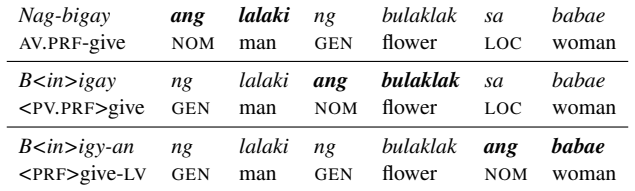
The load-bearing object is the treebank itself: 15,619 sentences, each annotated with lemmas, universal parts of speech, a selected set of morphological features, and dependency relations, divided into training, development, and test splits. It carries the argument because it is the training signal for all baselines and the evidence that Tagalog syntax can be learned by supervised models. The second mechanism is a set of language-specific annotation conventions: the asymmetrical-voice treatment of Tagalog voice (all three voice forms are basic transitive clauses, with the ang-marked noun phrase as nsubj and non-subject agents labeled obj:agent), the morphological rule that assigns a word's part of speech by its affixes, and a silver-standard parsing model trained on the same annotations to flag disagreements for human review.
What would settle it
Take a random sample of, say, 200 UD-NewsCrawl sentences and have a new set of Tagalog-speaking linguists annotate them independently under the same guidelines; if inter-annotator agreement for dependency relations falls well below the 0.68 kappa the paper reports from its silver-standard model, the treebank's reliability premise is not supported.
Extended reading notes
Core claim
The paper's central claim is that UD-NewsCrawl captures enough of Tagalog syntax that a parser trained on it outperforms all previously reported Tagalog parsers, including on the smaller existing Tagalog treebanks, and that the treebank provides the first canonical train/dev/test split for the language. The annotation adopts an asymmetrical-voice analysis: actor-, patient-, and locative-focus sentences are all treated as basic transitive clauses rather than active/passive pairs, the ang-marked argument is the dependency subject, and voice is stored as a morphological feature. The best baseline, built on multilingual transformer representations, reaches about 81 percent labeled attachment score on the test split, roughly five points above a model with no contextual embeddings, while a parser trained on a typologically similar language transfers poorly. The paper reads those results as evidence that Tagalog needs dedicated syntactic annotation and that the resulting treebank can serve as a reusable training and evaluation resource.
Load-bearing premise
The load-bearing premise is that the treebank's annotations are accurate and consistent enough to serve as reliable training and evaluation data, even though the reported agreement is measured against a model trained on the same annotations and no independent inter-annotator agreement is reported.
Editorial extensions
If this is right
- Tagalog dependency parsing gains a canonical large training set, so future systems can be compared on a fixed split instead of through k-fold cross-validation on 149 sentences.
- The best pipeline's gains transfer to the two older Tagalog treebanks, indicating that the resource captures syntactic patterns common to different genres and annotation styles.
- The poor cross-lingual transfer results imply that dedicated Tagalog annotation is necessary and that multilingual transfer alone is not enough to parse Tagalog well.
- The documented annotation decisions provide a concrete case for updating Universal Dependencies' language-specific guidelines for Tagalog, particularly for voice, determiners, and auxiliary-like words.
- The treebank and baselines give a reusable benchmark for future work on lemmatization, part-of-speech tagging, morphological analysis, and dependency parsing in a low-resource Austronesian language.
Reading between the lines
- Because the main quality metric is agreement between human annotations and a model trained on those same annotations, the reported kappa values do not measure reproducibility; an independent double-annotation study would be the natural next test.
- With over 60 percent of sentences in entertainment and health topics and all text from 2011 news crawl, models trained here may lose accuracy on contemporary or conversational Tagalog; a small out-of-domain evaluation would quantify that drop.
- The annotation choices that restrict determiner and auxiliary categories mean downstream models inherit sharp category boundaries; applications needing nuanced function-word behavior should check whether those boundaries matter.
- The paper's critique of the subject relation suggests a testable alternative: labeling the ang-marked argument with a topic-like relation rather than nsubj, then comparing parser scores and linguistic adequacy.
Editorial analysis
A structured set of objections, weighed in public.
Referee Report
Summary. The paper introduces UD-NewsCrawl, a Tagalog Universal Dependencies treebank of 15,619 sentences manually annotated by 15 native-speaker annotators, and positions it as the largest Tagalog treebank to date. It describes the data collection from Leipzig NewsCrawl, the iterative annotation workflow, semi-automated quality control, and baseline dependency-parsing experiments with several feature representations, including fastText, monolingual RoBERTa-Tagalog, mDeBERTa-v3, and XLM-RoBERTa. The paper also evaluates cross-treebank generalization on UD-TRG and UD-Ugnayan, analyzes the topic distribution of the corpus, and discusses typological challenges that Tagalog poses for Universal Dependencies.
Significance. If the annotation-quality concern is addressed, this is a substantial contribution to low-resource NLP: it increases the available Tagalog UD treebank data by two orders of magnitude, is publicly released, and provides reproducible baseline models. The detailed documentation of annotation decisions for Tagalog voice marking, root categorization, and UD guideline departures is valuable for future work on Philippine-type languages. The paper also honestly documents topic skew and domain bias. These concrete, released resources are the main strengths of the manuscript.
major comments (2)
- [§4.4 and §6.1, Table 3] The only quantitative quality evidence is Cohen's κ between the original annotations and a silver-standard model that was itself trained on those annotations (§4.4). This is not independent evidence of annotation reliability: the model is a function of the labels it is compared against, so the reported κ values (0.68–0.75) cannot establish human consistency or correctness. The paper reports no inter-annotator agreement, and the percentage of corrected sentences in Table 3 is computed only over sentences where the model disagreed, so it does not give an overall error rate. Because the treebank's reliability is load-bearing for its use as a gold-standard resource, this point needs to be addressed, for example by reporting IAA on a sample or by evaluating a held-out set against an external gold standard.
- [§6.2, Table 4] The claim that the models 'achieve state-of-the-art performance' is not supported by the comparisons shown. The earlier results in Table 4 come from systems trained on different data, with different model families, and under different evaluation protocols, so 'surpassing previously reported benchmarks' is not equivalent to state-of-the-art parsing for Tagalog. The authors should either rephrase this as 'outperforms previously published numbers on these datasets' with the caveat that the comparison is not controlled, or add a controlled comparison under identical training and evaluation conditions.
minor comments (8)
- [Abstract and dataset link] The dataset link 'Datasethf.co/datasets/UD-Filipino/UD_Tagalog-NewsCrawl' appears malformed; it should be given as a full URL, and the collection should be cited with a stable identifier.
- [§1] The phrase 'de factonation' appears to be a typo for 'de facto national', and the citation 'Philippine Statistics Authority)' is missing a year and has an unbalanced parenthesis.
- [§4.3] The abbreviation 'c.f.' should be 'cf.'.
- [Appendix D.2] There is a typo: 'hyperperameters' should be 'hyperparameters'.
- [Figure 1] The interlinear glosses in Figure 1 lack spaces between morpheme-by-morpheme gloss items (e.g., 'AV.PRF-giveNOMmanGENflowerLOCwoman'), making them difficult to read; adding spaces would improve clarity.
- [§6.1] The sentence 'The percentage of corrected sentences shows that a small portion of the annotations required adjustments' is vague because the percentage is computed only over sentences where the silver model disagreed; the denominator should be stated explicitly.
- [Appendix B.1] The full annotation guidelines are deferred until 'after the review period'; for a resource paper, the guidelines should be released with the final version so that annotation decisions are reproducible.
- [§3.1 and §B.1.4] The phrase 'ayinversion marker' should be 'ay inversion marker' (with a space) for consistency with standard Tagalog grammatical terminology.
Circularity Check
Quality evidence is circular: agreement is measured against a silver-standard model trained on the same annotations, and no inter-annotator agreement is reported.
-
fitted input called prediction
[Section 4.4 (Treebank quality-control) and Section 6.1 (Quality analysis), Table 3]
"First, we trained a silver-standard parsing model on our existing annotations using spaCy (Honnibal et al., 2020) and identified instances where the model's morphological annotations and dependency parsing relations disagree with human annotations. ... Table 3 shows the initial disagreement, as measured by Cohen's κ between the silver-standard model and the original annotations, together with the proportion of the disagreed sentences that we corrected."
The silver-standard model is trained on the same UD-NewsCrawl annotations that §6.1 then uses as the reference for agreement. The reported κ values (0.68–0.75) therefore measure how well the model reproduces the labels it was fitted to, not an independent measure of annotation quality or human consistency. No inter-annotator agreement is reported, so the conclusion that 'the annotations are fairly consistent' rests entirely on a self-comparison with a model fitted to those same annotations. This is a fitted-input-called-prediction pattern: the model's agreement with its own training data is presented as evidence for the reliability of that data.
full rationale
The paper's central claim — that UD-NewsCrawl is the largest Tagalog treebank to date and supports dependency parser baselines — is independent and not circular. The parser experiments in §5 and the cross-treebank generalization study in §6.2 are genuine empirical contributions. However, the only quantitative quality evidence in §6.1 is Cohen's κ between the original annotations and a silver-standard model trained on those same annotations in §4.4. Because the model learns from the labels it is compared against, these agreement values do not independently verify human consistency or annotation correctness. The paper also reports no inter-annotator agreement, despite having 15 annotators. The paper's own Limitations section concedes that 'some inconsistencies may still exist despite quality-control,' which further tempers the quality claim. Overall, the central contribution stands on its own, but the quality-assurance evaluation is partially circular, warranting a score of 4 rather than 0.
Assumptions & free parameters
assumptions (3)
- domain assumption The Universal Dependencies framework is an appropriate annotation scheme for Tagalog despite known mismatches.
- ad hoc to paper A silver-standard model trained on partially incorrect labels can identify annotation inconsistencies.
- domain assumption The Leipzig NewsCrawl 2011 corpus is representative enough of Tagalog for training parsers.
Cite this review
Pith. "Pith review of The UD-NewsCrawl Treebank: Reflections and Challenges from a Large-scale Tagalog Syntactic Annotation Project." pith.science (2026). https://pith.science/paper/32SGCAAQ
@misc{pith2026250520428,
  author       = {Pith},
  title        = {Pith review of: The UD-NewsCrawl Treebank: Reflections and Challenges from a Large-scale Tagalog Syntactic Annotation Project},
  year         = {2026},
  howpublished = {\url{https://pith.science/paper/32SGCAAQ}},
  note         = {Machine review of arXiv:2505.20428}
}
read the original abstract
This paper presents UD-NewsCrawl, the largest Tagalog treebank to date, containing 15.6k trees manually annotated according to the Universal Dependencies framework. We detail our treebank development process, including data collection, pre-processing, manual annotation, and quality assurance procedures. We provide baseline evaluations using multiple transformer-based models to assess the performance of state-of-the-art dependency parsers on Tagalog. We also highlight challenges in the syntactic analysis of Tagalog given its distinctive grammatical properties, and discuss its implications for the annotation of this treebank. We anticipate that UD-NewsCrawl and our baseline model implementations will serve as valuable resources for advancing computational linguistics research in underrepresented languages like Tagalog.
Figures


Figures from the paper (3 more)


Reference graph
Works this paper leans on
-
[1]
David Adelani, Hannah Liu, Xiaoyu Shen, Nikita Vassilyev, Jesujoba Alabi, Yanke Mao, Haonan Gao, and En-Shiun Lee. 2024. https://aclanthology.org/2024.eacl-long.14/ SIB -200: A simple, inclusive, and big evaluation dataset for topic classification in 200+ languages and dialects . In Proceedings of the 18th Conference of the European Chapter of the Associa...
work page 2024
-
[2]
Z eljko Agi \'c . 2017. https://aclanthology.org/W17-0401 Cross-lingual parser selection for low-resource languages . In Proceedings of the N o D a L i D a 2017 Workshop on Universal Dependencies ( UDW 2017) , pages 1--10, Gothenburg, Sweden. Association for Computational Linguistics
work page 2017
-
[3]
Angelina Aquino and Franz de Leon. 2020. https://aclanthology.org/2020.udw-1.2 Parsing in the absence of related languages: Evaluating low-resource dependency parsers on T agalog . In Proceedings of the Fourth Workshop on Universal Dependencies (UDW 2020), pages 8--15, Barcelona, Spain (Online). Association for Computational Linguistics
work page 2020
-
[4]
Angelina Aquino and Franz de Leon. 2022. https://aclanthology.org/2022.paclic-1.22 Zero-shot and few-shot approaches for tokenization, tagging, and dependency parsing of T agalog text . In Proceedings of the 36th Pacific Asia Conference on Language, Information and Computation, pages 190--202, Manila, Philippines. Association for Computational Linguistics
work page 2022
-
[5]
Mikel Artetxe, Sebastian Ruder, and Dani Yogatama. 2019. On the cross-lingual transferability of monolingual representations. arXiv preprint arXiv:1910.11856
arXiv 2019
-
[6]
Maria Bardaj\' i , Elsie Or, Angelina Aquino, and Nikolaus Himmelmann. 2024. The challenges of symmetrical voice languages for universal dependencies. In Proceedings of the 15th International Conference of the Association for Linguistic Typology
work page 2024
-
[7]
Jonathan Berant, Andrew Chou, Roy Frostig, and Percy Liang. 2013. https://aclanthology.org/D13-1160/ Semantic parsing on F reebase from question-answer pairs . In Proceedings of the 2013 Conference on Empirical Methods in Natural Language Processing, pages 1533--1544, Seattle, Washington, USA. Association for Computational Linguistics
2013
-
[8]
Shaily Bhatt and Fernando Diaz. 2024. https://doi.org/10.18653/v1/2024.findings-emnlp.942 Extrinsic evaluation of cultural competence in large language models . In Findings of the Association for Computational Linguistics: EMNLP 2024, pages 16055--16074, Miami, Florida, USA. Association for Computational Linguistics
Show all 70 references
-
[9]
Frank R Blake. 1917. Reduplication in tagalog. The American journal of philology, 38(4):425--431
1917
-
[10]
Robert Blust. 1991. http://www.jstor.org/stable/3623084 The Greater Central Philippines Hypothesis . Oceanic Linguistics, 30(2):73--129
1991
-
[11]
Piotr Bojanowski, Edouard Grave, Armand Joulin, and Tomas Mikolov. 2017. https://doi.org/10.1162/tacl_a_00051 Enriching word vectors with subword information . Transactions of the Association for Computational Linguistics, 5:135--146
2017 doi
-
[12]
Jill Carrier-Duncan. 1985. http://www.jstor.org/stable/4178418 Linking of thematic roles in derivational word formation . Linguistic Inquiry, 16(1):1--34
1985
-
[13]
Alexis Conneau, Kartikay Khandelwal, Naman Goyal, Vishrav Chaudhary, Guillaume Wenzek, Francisco Guzm \'a n, Edouard Grave, Myle Ott, Luke Zettlemoyer, and Veselin Stoyanov. 2020. https://doi.org/10.18653/v1/2020.acl-main.747 Unsupervised cross-lingual representation learning ...
2020 doi
-
[14]
Jan Christian Blaise Cruz and Charibeth Cheng. 2022. https://aclanthology.org/2022.lrec-1.703 Improving large-scale language models and resources for F ilipino . In Proceedings of the Thirteenth Language Resources and Evaluation Conference, pages 6548--6555, Marseille, France....
2022
-
[15]
Ernesto H. Cubar. 1975. Topicalization and Some Related Processes in Philippine Languages. University of the Philippines Department of Linguistics. Reprinted in The Archive Classics (2019)
2019
-
[16]
V. P. De Guzman. 1978. Syntactic Derivation of Tagalog Verbs. University of Hawaii Press, Honolulu
1978
-
[17]
Manning, Joakim Nivre, and Daniel Zeman
Marie-Catherine de Marneffe, Christopher D. Manning, Joakim Nivre, and Daniel Zeman. 2021. https://doi.org/10.1162/coli_a_00402 U niversal D ependencies . Computational Linguistics, 47(2):255--308
2021 doi
-
[18]
Fiona de Vos. 2010. Essential Tagalog Grammar: A Reference for Learners of Tagalog. Learning Tagalog
2010
-
[19]
Mathieu Dehouck and Pascal Denis. 2019. https://doi.org/10.18653/v1/N19-1017 Phylogenic multi-lingual dependency parsing . In Proceedings of the 2019 Conference of the North A merican Chapter of the Association for Computational Linguistics: Human Language Technologies, Volume...
2019 doi
-
[20]
Peter Dirix, Liesbeth Augustinus, Daniel van Niekerk, and Frank Van Eynde. 2017. https://aclanthology.org/W17-0405/ U niversal D ependencies for A frikaans . In Proceedings of the N o D a L i D a 2017 Workshop on Universal Dependencies ( UDW 2017) , pages 38--47, Gothenburg, S...
2017
-
[21]
Timothy Dozat, Peng Qi, and Christopher D. Manning. 2017. https://doi.org/10.18653/v1/K17-3002 S tanford ' s graph-based neural dependency parser at the C o NLL 2017 shared task . In Proceedings of the C o NLL 2017 Shared Task: Multilingual Parsing from Raw Text to Universal D...
2017 doi
-
[22]
Dryer and Martin Haspelmath
Matthew S. Dryer and Martin Haspelmath. 2013. https://doi.org/10.5281/zenodo.13950591 WALS Online (v2020.4) . Data set
2013 doi
-
[23]
Abhimanyu Dubey, Abhinav Jauhri, Abhinav Pandey, Abhishek Kadian, Ahmad Al-Dahle, Aiesha Letman, Akhil Mathur, Alan Schelten, Amy Yang, Angela Fan, et al. 2024. The llama 3 herd of models. arXiv preprint arXiv:2407.21783
2024 arXiv
-
[24]
Eberhard, Gary F
David M. Eberhard, Gary F. Simons, and Charles D. Fennig, editors. 2024. http://www.ethnologue.com Ethnologue: Languages of the World , 27 edition. SIL International, Dallas, Texas
2024
-
[25]
Leo James English. 1986. Tagalog-English dictionary. Congregation of the Most Holy Redeemer Manila
1986
-
[26]
William Foley. 2008. The place of philippine languages in a typology of voice systems. In P. K. Austin and S. Musgraves, editors, Voice and grammatical relations in Austronesian languages, pages 22--44. CSLI Publications
2008
-
[27]
Kar \"e n Fort. 2016. Collaborative Annotation for Reliable Natural Language Processing: Technical and Sociological Aspects. John Wiley & Sons
2016
-
[28]
Dirk Goldhahn, Thomas Eckart, and Uwe Quasthoff. 2012. https://aclanthology.org/L12-1154/ Building large monolingual dictionaries at the L eipzig corpora collection: From 100 to 200 languages . In Proceedings of the Eighth International Conference on Language Resources and Eva...
2012
-
[29]
Pengcheng He, Xiaodong Liu, Jianfeng Gao, and Weizhu Chen. 2021. https://openreview.net/forum?id=XPZIaotutsD DeBERTa: Decoding-enhanced BERT with Disentangled Attention . In International Conference on Learning Representations
2021
-
[30]
Santiago Herrera, Caio Corro, and Sylvain Kahane. 2024. https://aclanthology.org/2024.lrec-main.1314/ Sparse logistic regression with high-order features for automatic grammar rule extraction from treebanks . In Proceedings of the 2024 Joint International Conference on Computa...
2024
-
[31]
u r Sprachwissenschaft, Universit \
Nikolaus P. Himmelmann. 1991. The Philippine Challenge to Universal Grammar . Number N.F. 15 in Arbeitspapier / Institut f \"u r Sprachwissenschaft, Universit \"a t K \"o ln
1991
-
[32]
Himmelmann
Nikolaus P. Himmelmann. 2005. Tagalog. In K. Alexander Adelaar and Nikolaus P. Himmelmann, editors, The Austronesian Languages of Asia and Madagascar, 1st edition, page 27. Routledge
2005
-
[33]
Himmelmann
Nikolaus P. Himmelmann. 2007. Lexical categories and voice in tagalog. In P. K. Austin and S. Musgrave, editors, Voice and grammatical relations in Austronesian languages, pages 247--293
2007
-
[34]
Matthew Honnibal and Mark Johnson. 2015. https://doi.org/10.18653/v1/D15-1162 An improved non-monotonic transition system for dependency parsing . In Proceedings of the 2015 Conference on Empirical Methods in Natural Language Processing, pages 1373--1378, Lisbon, Portugal. Ass...
2015 doi
-
[35]
Matthew Honnibal, Ines Montani, Sofie Van Landeghem, and Adriane Boyd. 2020. https://doi.org/10.5281/zenodo.1212303 spaCy: Industrial-strength Natural Language Processing in Python
2020 doi
-
[36]
Jem R Javier and Elsie Marie T Or. 2022. Tagalog linguistics: Historical development and theoretical trends. In The Routledge Handbook of Asian Linguistics, pages 33--46. Routledge
2022
-
[37]
Pratik Joshi, Sebastin Santy, Amar Budhiraja, Kalika Bali, and Monojit Choudhury. 2020. https://doi.org/10.18653/v1/2020.acl-main.560 The state and fate of linguistic diversity and inclusion in the NLP world . In Proceedings of the 58th Annual Meeting of the Association for Co...
2020 doi
-
[38]
Hiroshi Kanayama and Ran Iwamoto. 2020. https://aclanthology.org/2020.lrec-1.500/ How universal are U niversal D ependencies? exploiting syntax for multilingual clause-level sentiment detection . In Proceedings of the Twelfth Language Resources and Evaluation Conference, pages...
2020
-
[39]
Daniel Kaufman. 2009. https://doi.org/doi:10.1515/THLI.2009.001 Austronesian nominalism and its consequences: A tagalog case study . Theoretical Linguistics, 35(1):1--49
2009 doi
-
[40]
Dan Kondratyuk and Milan Straka. 2019. https://doi.org/10.18653/v1/D19-1279 75 languages, 1 model: Parsing U niversal D ependencies universally . In Proceedings of the 2019 Conference on Empirical Methods in Natural Language Processing and the 9th International Joint Conferenc...
2019 doi
-
[41]
Paul Kroeger. 1993. Phrase structure and grammatical relations in Tagalog. Center for the Study of Language (CSLI)
1993
-
[42]
Shalom Lappin. 2024. Assessing the strengths and weaknesses of large language models. Journal of Logic, Language and Information, 33(1):9--20
2024
-
[43]
Percy Liang, Michael Jordan, and Dan Klein. 2011. https://aclanthology.org/P11-1060/ Learning dependency-based compositional semantics . In Proceedings of the 49th Annual Meeting of the Association for Computational Linguistics: Human Language Technologies, pages 590--599, Por...
2011
-
[44]
Mary L McHugh. 2012. Interrater reliability: the kappa statistic. Biochemia medica, 22(3):276--282
2012
-
[45]
Lester James Miranda. 2023 a . https://doi.org/10.18653/v1/2023.nlposs-1.1 calaman C y: A T agalog natural language processing toolkit . In Proceedings of the 3rd Workshop for Natural Language Processing Open Source Software (NLP-OSS 2023), pages 1--7, Singapore. Association f...
2023 doi
-
[46]
Lester James Miranda. 2023 b . https://doi.org/10.18653/v1/2023.sealp-1.2 Developing a named entity recognition dataset for T agalog . In Proceedings of the First Workshop in South East Asian Language Processing, pages 13--20, Nusa Dua, Bali, Indonesia. Association for Computa...
2023 doi
-
[47]
Lester James Miranda, \'A kos K \'a d \'a r, Adriane Boyd, Sofie Van Landeghem, Anders S gaard, and Matthew Honnibal. 2022. Multi hash embeddings in spacy. arXiv preprint arXiv:2212.09255
2022 arXiv
-
[48]
Kadri Muischnek, Kaili M \"u \"u risep, and Tiina Puolakainen. 2016. https://aclanthology.org/L16-1247/ E stonian dependency treebank: from constraint grammar tagset to U niversal D ependencies . In Proceedings of the Tenth International Conference on Language Resources and Ev...
2016
-
[49]
u ller, Ryan Cotterell, Alexander Fraser, and Hinrich Sch \
Thomas M \"u ller, Ryan Cotterell, Alexander Fraser, and Hinrich Sch \"u tze. 2015. https://doi.org/10.18653/v1/D15-1272 Joint lemmatization and morphological tagging with lemming . In Proceedings of the 2015 Conference on Empirical Methods in Natural Language Processing, page...
2015 doi
-
[50]
Manning, Sampo Pyysalo, Sebastian Schuster, Francis Tyers, and Daniel Zeman
Joakim Nivre, Marie-Catherine de Marneffe, Filip Ginter, Jan Haji c , Christopher D. Manning, Sampo Pyysalo, Sebastian Schuster, Francis Tyers, and Daniel Zeman. 2020. https://aclanthology.org/2020.lrec-1.497 U niversal D ependencies v2: An evergrowing multilingual treebank co...
2020
-
[51]
Timothy Osborne and Kim Gerdes. 2019. The status of function words in dependency grammar: A critique of universal dependencies (ud). Glossa: a journal of general linguistics (2016-2021)
2019
-
[52]
2020 census of population and housing report no
Philippine Statistics Authority . 2020 census of population and housing report no. 21 - demographic and housing characteristics (non-sample variables). Retrieved from https://library.psa.gov.ph/
2020
-
[53]
Peng Qi, Yuhao Zhang, Yuhui Zhang, Jason Bolton, and Christopher D. Manning. 2020. https://doi.org/10.18653/v1/2020.acl-demos.14 S tanza: A python natural language processing toolkit for many human languages . In Proceedings of the 58th Annual Meeting of the Association for Co...
2020 doi
-
[54]
Uwe Quasthoff and Matthias Richter. 1998. Projekt Der Deutsche Wortschatz. na
1998
-
[55]
Andrea Rackowski and Norvin Richards. 2005. Phrase edge and extraction: A tagalog case study. Linguistic Inquiry, 36(4):565--599
2005
-
[56]
Ria P. Rafael. 2016. Sinong pasimuno? paggamit ng subject at topic sa pag-aaral ng wika' (who's the initiator? the use of subject and topic in language studies). Daluyan: Journal ng Wikang Filipino, 22(1/2):165--180
2016
-
[57]
Lawrence Reid. 2005. Tagalog and philippine languages. In Philipp Skutch, editor, Encyclopedia of Linguistics. Routledge, New York
2005
-
[58]
Himmelmann
Sonja Riesberg, Kurt Malcher, and Nikolaus P. Himmelmann. 2019. https://doi.org/10.1353/lan.2019.0055 How universal is agent-first? evidence from symmetrical voice languages . Language, 95(3):523--561
2019
-
[59]
Michael J Ryan, William Held, and Diyi Yang. 2024. https://doi.org/10.18653/v1/2024.acl-long.853 Unintended impacts of LLM alignment on global representation . In Proceedings of the 62nd Annual Meeting of the Association for Computational Linguistics (Volume 1: Long Papers), p...
2024 doi
-
[60]
Stephanie Dawn Samson. 2018. A treebank prototype of Tagalog . Bachelor's thesis, University of T \"u bingen, Germany
2018
-
[61]
Paul Schachter. 1976. The subject in philippine languages: Topic, actor, actor-topic, or none of the above. In Charles Li, editor, Subject and Topic, pages 491--518. Academic Press, New York
1976
-
[62]
Paul Schachter and Fe T. Otanes. 1972. Tagalog Reference Grammar. University of California Press
1972
-
[63]
Milan Straka, Jan Haji c , and Jana Strakov \'a . 2016. https://aclanthology.org/L16-1680 UDP ipe: Trainable pipeline for processing C o NLL - U files performing tokenization, morphological analysis, POS tagging and parsing . In Proceedings of the Tenth International Conferenc...
2016
-
[64]
Roberto D Tangco and Ricardo Ma Nolasco. 2002. ‘taglish’verbs: How english loanwords make it into the philippine languages. In Tenth Annual Meeting of the Southeast Asian Linguistics Society, pages 391--406
2002
-
[65]
Simone Tedeschi, Valentino Maiorca, Niccol \`o Campolungo, Francesco Cecconi, and Roberto Navigli. 2021. https://doi.org/10.18653/v1/2021.findings-emnlp.215 W iki NE u R al: C ombined neural and knowledge-based silver data creation for multilingual NER . In Findings of the Ass...
2021 doi
-
[66]
Jianwei Wang, Tianyin Wang, and Ziqian Zeng. 2024. https://aclanthology.org/2024.lrec-main.1088/ On the use of silver standard data for zero-shot classification tasks in information extraction . In Proceedings of the 2024 Joint International Conference on Computational Linguis...
2024
-
[67]
Xin Zhang, Yanzhao Zhang, Dingkun Long, Wen Xie, Ziqi Dai, Jialong Tang, Huan Lin, Baosong Yang, Pengjun Xie, Fei Huang, et al. 2024. mgte: Generalized long-context text representation and reranking models for multilingual text retrieval. In Proceedings of the 2024 Conference ...
2024
-
[68]
Zhisong Zhang, Emma Strubell, and Eduard Hovy. 2022. https://doi.org/10.18653/v1/2022.emnlp-main.414 A survey of active learning for natural language processing . In Proceedings of the 2022 Conference on Empirical Methods in Natural Language Processing, pages 6166--6190, Abu D...
2022 doi
-
[69]
online" 'onlinestring :=
ENTRY address archivePrefix author booktitle chapter edition editor eid eprint eprinttype howpublished institution journal key month note number organization pages publisher school series title type volume year doi pubmed url lastchecked label extra.label sort.label short.list...
-
[70]
write newline
" write newline "" before.all 'output.state := FUNCTION n.dashify 't := "" t empty not t #1 #1 substring "-" = t #1 #2 substring "--" = not "--" * t #2 global.max substring 't := t #1 #1 substring "-" = "-" * t #2 global.max substring 't := while if t #1 #1 substring * t #2 gl...
Reviewed August 7, 2026 · model on record in the stance chip above.
Discussion (0). Continue with ORCID to comment.