REVIEW 2 major objections 4 minor 71 references
On T-Invariance Violation in Neutrino Oscillations and Matter Effects
T0 review · 2 major / 4 minor · reviewed 2026-08-11 · deepseek-v4-flash
Pith's one-line read Matter-induced time-reversal violation in neutrino oscillations requires an asymmetric matter distribution—and on Earth it is tiny.
desk verdict A clear, honest pedagogical systematization of known T-violation physics in matter, with a solid DUNE-specific quantitative result and a slightly overbroad generalization. read the letter →
The pith
A machine-rendered reading of the paper's core claim, the machinery that carries it, and where it could break.
The reading
What carries the argument
The load-bearing object is the piecewise-constant flavor-evolution product $V^{ab}=V_N\cdots V_1$ versus $V^{ba}=V_1\cdots V_N$, where each segment propagator is $V_n=e^{-iH_n(x_n-x_{n-1})}$. Even when every $V_n$ is symmetric, the reverse-ordered product need not be, and the difference between the two orderings is exactly the matter-asymmetry effect. The quantitative diagnostic is $\Delta P_{\rm asym}$, defined as $(P_{\mu e}-P_{e\mu})$ in the real density profile minus the same difference in a constant profile with the average density; this isolates the contribution of the profile's asymmetry. The two-flavor result follows from unitarity alone: probability conservation in both rows and columns forces $P_{e\mu}=P_{\mu e}$ for every $2\times2$ Hamiltonian.
What would settle it
Compute $\Delta P_{\rm asym}$ for a geologically conceivable density profile with a dense anomaly concentrated near one end of a 1300 km baseline; if the resulting asymmetry-induced difference exceeds about $6\times10^{-4}$ at any energy where the oscillation probability is measurable, the blanket terrestrial-smallness conclusion fails.
Extended reading notes
Core claim
The central discovery is a dichotomy controlled by $A(x)$ versus $A(L-x)$. For a symmetric potential, the forward evolution matrix $V^{ab}$ equals the reverse $V^{ba}$, so proper and improper T tests coincide and matter-induced T violation is absent; for an asymmetric potential, $V^{ab}\neq V^{ba}$, and $P_{\mu e}\neq P_{e\mu}$ can occur even with the intrinsic CP/T phase $\delta_{\mathrm{CP}}=0$. The paper evaluates the size of this asymmetry effect for two realistic terrestrial density profiles at the DUNE baseline and finds, after subtracting the constant-density result, $|\Delta P_{\rm asym}|\lesssim 6\times10^{-4}$ for all energies and for $\delta_{\rm CP}=0,\pm\pi/2$. It also proves that with only two flavors unitarity enforces $P_{e\mu}=P_{\mu e}$ identically, so genuine improper T violation requires at least three flavors.
Load-bearing premise
The broad claim that Earth-bound long-baseline T-odd effects are small rests on two specific terrestrial density profiles plus exaggerated toy profiles, not on a proven upper bound over all geologically plausible density asymmetries.
Editorial extensions
If this is right
- At DUNE, an observed $P(\nu_\mu\to\nu_e)-P(\nu_e\to\nu_\mu)$ asymmetry would signal intrinsic T violation rather than Earth's density asymmetry, because the asymmetry-induced part is below $6\times10^{-4}$.
- A symmetric-matter setup cannot generate matter-induced T violation; any nonzero T-odd difference measured there must come from intrinsic sources.
- Future neutrino-factory comparisons of $P(\nu_\mu\to\nu_e)$ with $P(\nu_e\to\nu_\mu)$ can be interpreted for intrinsic T violation without subtracting a large matter-asymmetry background.
- Two-flavor oscillation studies cannot exhibit improper T violation at all, so T-violation claims require a three-flavor analysis.
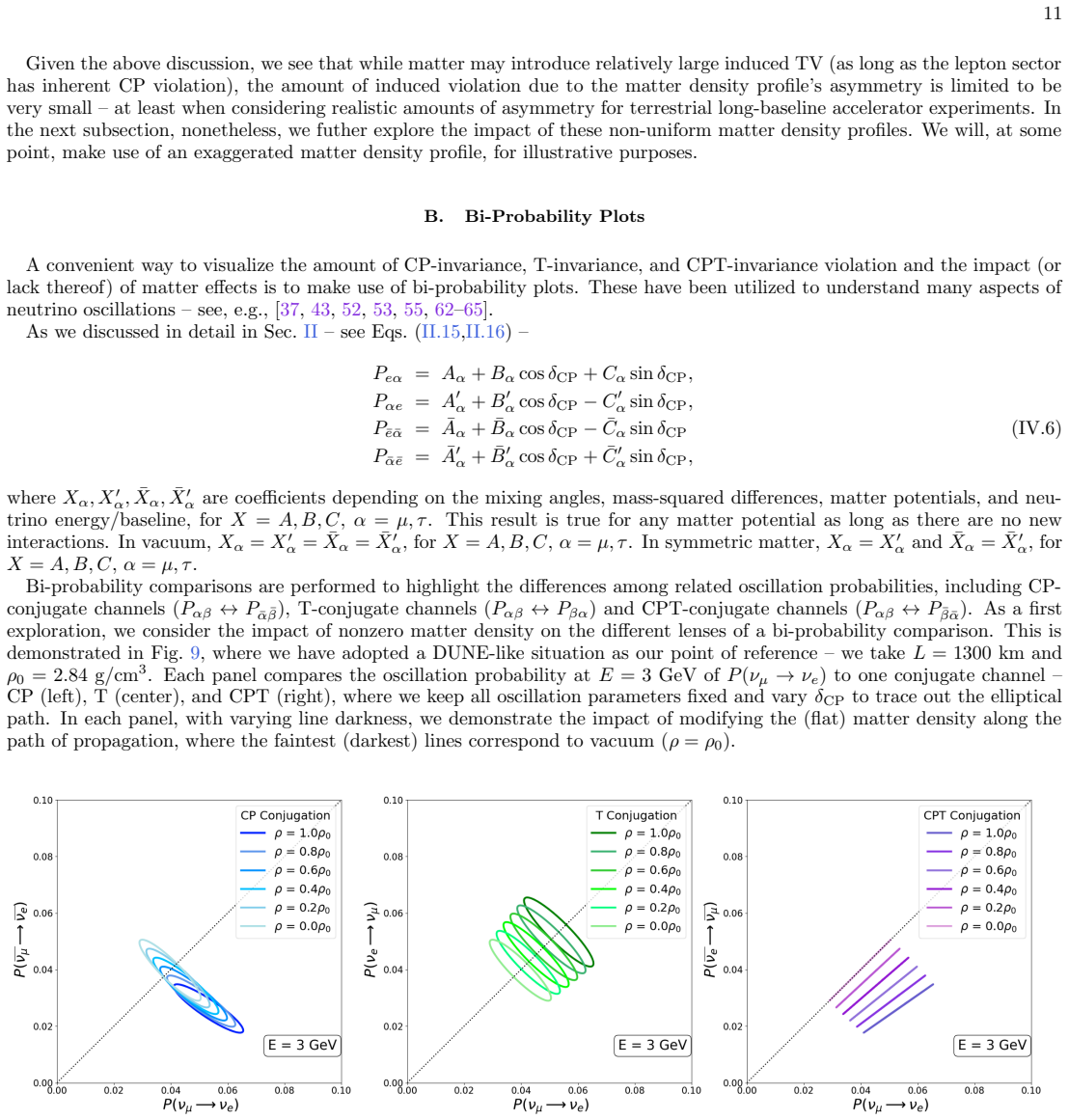
- Bi-probability plots involving electron flavor remain exact ellipses for any matter potential absent new interactions, while those involving only $\mu$ and $\tau$ generally do not.
Reading between the lines
- Going beyond the paper: the ordering-asymmetry argument could be turned into a general criterion for when any non-uniform medium contaminates discrete-symmetry tests, not just T and the solar term.
- Going beyond the paper: the smallness claim would be on firmer footing if tested against an ensemble of geologically possible density perturbations; the paper itself uses two representative profiles rather than an exhaustive bound.
- Going beyond the paper: in the neutrino-factory era, a practical next step is to design a T-odd observable that is exactly profile-independent, since the paper shows the asymmetry contamination is small but not zero.
Editorial analysis
A structured set of objections, weighed in public.
Referee Report
Summary. The paper analyzes matter-induced T-invariance violation (TV) in neutrino oscillations, with the goal of clarifying the distinction between proper and improper T tests. It proves that for a symmetric matter potential proper and improper T tests coincide, so symmetric matter alone cannot produce TV; for asymmetric matter, improper TV can arise. A two-flavor theorem shows that all improper T-odd observables vanish identically by unitarity, regardless of the Hamiltonian. The three-flavor discussion is illustrated with constant, piecewise-constant, and realistic terrestrial density profiles at DUNE geometry, concluding that realistic Earth-matter asymmetries induce a T-odd probability difference below about 6×10^-4. The paper also discusses bi-probability plots for CP, T, and CPT conjugate channels, δCP dependence, and the limited practical relevance of current neutrino beams for T tests.
Significance. The formal core of the paper—piecewise-constant evolution, the proper/improper T distinction, and the two-flavor unitarity theorem—is correct, cleanly presented, and pedagogically valuable. The numerical DUNE study with two published Earth density profiles is a useful, transparent demonstration that realistic terrestrial density asymmetries induce very small T-odd effects. The paper is explicit that it uses NuFit oscillation parameters and published density models rather than fitting anything, so the qualitative conclusions are robust. Its main new quantitative contribution is the DUNE-profile smallness estimate; however, that estimate is example-based, and one of the paper's own extreme-profile figures appears to conflict with the abstract's general smallness claim.
major comments (2)
- [Sec. IV.B, Fig. 10 and Sec. V] The extreme asymmetric profile in Fig. 10 appears to contradict the abstract's claim that matter-induced TV remains small even for 'unrealistically-asymmetric matter potentials.' At E = 1 GeV and L = 1300 km, the ρ = 0 for the first half, 2ρ0 for the second half profile moves the δCP = 0 point 'significantly away' from the diagonal compared to constant ρ0. Since the two profiles have the same average density, this displacement is precisely the asymmetry-induced TV defined by Eq. (IV.5), not an overall matter-density effect. The authors should quantify ΔP_assym for this profile and either show that it remains below the ~10^-3 level or amend the abstract and the third bullet of Sec. V to restrict the smallness claim to realistic terrestrial profiles and specified energies. As written, the central quantitative claim is not supported by the paper's own figure.
- [Sec. IV.A, Figs. 7–8 and Sec. V] The general statement that 'for Earth-bound long-baseline oscillation experiments these effects are small' is based on only two density profiles at a single baseline (L = 1300 km). The paper candidly says it argues 'mostly via concrete examples,' but the abstract and conclusion state the claim without that qualifier. Since the relevant physics depends on L/E and on the solar mass-squared splitting, other baselines (e.g., T2HK's ~295 km) or energy ranges could in principle have larger asymmetry-induced TV. The authors should either provide an analytic bound in terms of a measure of profile asymmetry, add a scan over representative baselines, or soften the wording to make clear that the quantitative smallness has been demonstrated for the specific profiles and energies studied.
minor comments (4)
- [Sec. IV.B] The assertion that the CPT-conjugate ellipse vanishes to order s13^2 (Δm21^2/Δm31^2)^2 is attributed to Ref. [66] without showing the analytic estimate; please include the derivation or replace it with a direct numerical demonstration.
- [Sec. IV.B, Fig. 10] The text says the δCP = 0 point moves 'significantly away' from the diagonal, but the magnitude is not quantified and the axes are hard to read; adding a numerical panel showing (Pμe − Peμ) as a function of E for the step profile would make the claim testable.
- [Sec. IV.A, Eq. (IV.5)] It would be helpful to state explicitly that subtracting the constant-density difference with average density ρbar isolates the asymmetry effect from the overall matter-density effect, and to note that Fig. 10 does not plot this same quantity for the extreme profile.
- [Throughout] There are several typos and stylistic slips: 'densiyy' (Sec. IV.A), 'futher' (Sec. IV.B), 'detemine' (Sec. IV.B), 'vaccum' (Sec. I), 'asymetric' (Sec. II.A), 'incidently' (Sec. IV.B), and 'chance' for 'change' (Sec. V). A careful proofread is recommended.
Circularity Check
No significant circularity: the paper's T-odd results follow from the flavor-evolution Hamiltonian and external inputs; the only self-citations are contextual and the quoted smallness claim is a numerical example, not a fitted prediction.
full rationale
The derivation chain is self-contained in the relevant sense. The key symmetry statements follow from the evolution-operator algebra: for A(x)=A(L-x), Eq. (II.11) gives V^ab = V^ba, so proper and improper T tests coincide, and with real H the V_n are symmetric, so asymmetric matter is required for matter-induced TV. The two-flavor result P_{e mu}=P_{mu e} is obtained from unitarity (Eqs. III.2-III.3), not from any fitted input. The quantitative claim that asymmetry-induced TV is small for Earth-bound experiments is computed, not assumed: Eq. (IV.5) defines Delta P_assym as the difference between the full-profile and average-density T-odd asymmetries, and the paper evaluates it at L=1300 km with the external Shen-Ritzwoller and Crustal density profiles and NuFit oscillation parameters, finding Delta P_assym <~ 6e-4; the 'hollowed-out' profile is an illustrative stress test. Oscillation parameters are taken from NuFit [56] and density profiles from geophysical models [58,59] and Roe's analysis [60], so the target results are not used as inputs. Self-citations [29] and [61] are background or source-profile references, and the present computations do not reduce to them. The honest limitation is that the general conclusion 'For Earth-bound long-baseline oscillation experiments, these effects are small' is argued 'mostly via concrete examples' rather than proven by an upper bound over all density asymmetries; this is an extrapolation/robustness concern, not circularity. Score 2 reflects only the presence of minor, non-load-bearing self-citations.
Assumptions & free parameters
free parameters (3)
- NuFit best-fit oscillation parameters =
sin^2 theta_12=0.308, sin^2 theta_23=0.470, sin^2 theta_13=0.02215, Delta m^2_21=7.49e-5 eV^2, Delta m^2_31=2.513e-3…
- Two-step matter potential parameters =
A1=5e-4 eV^2/GeV, x1=800 km, A2=1.5e-3 eV^2/GeV, x2=2000 km
- Hollow-out/exaggerated profile =
rho=0 for first L/2, rho=2 rho0 for second L/2
assumptions (5)
- domain assumption Neutrinos are ultra-relativistic with a common, well-defined energy E
- domain assumption Only standard-model interactions, no new vector-mediated couplings
- domain assumption Matter is neutral and described by electron-number density ne(x), piecewise constant
- standard math CPT invariance holds, so neutrino and antineutrino masses and mixing matrix U are identical
- standard math PDG parameterization of the mixing matrix with U_ei real for all i
invented entities (1)
-
Non-standard flavor-transforming neutrino-matter interaction H_NSI = i A(x)/2 |nu_e><nu_mu| - i A(x)/2 |nu_mu><nu_e|
Cite this review
Pith. "Pith review of On T-Invariance Violation in Neutrino Oscillations and Matter Effects." pith.science (2026). https://pith.science/paper/32UYUFSW
@misc{pith2026241213287,
  author       = {Pith},
  title        = {Pith review of: On T-Invariance Violation in Neutrino Oscillations and Matter Effects},
  year         = {2026},
  howpublished = {\url{https://pith.science/paper/32UYUFSW}},
  note         = {Machine review of arXiv:2412.13287}
}
read the original abstract
We investigate the impact of matter effects on T (time-reversal)-odd observables, making use of the quantum-mechanical formalism of neutrino-flavor evolution. We attempt to be comprehensive and pedagogical. Matter-induced T-invariance violation (TV) is qualitatively different from, and more subtle than, matter-induced CP (charge-parity)-invariance violation. If the matter distribution is symmetric relative to the neutrino production and detection points, matter effects will not introduce any new TV. However, if there is intrinsic TV, matter effects can modify the size of the T-odd observable. On the other hand, if the matter distribution is not symmetric, there is genuine matter-induced TV. For Earth-bound long-baseline oscillation experiments, these effects are small. This remains true for unrealistically-asymmetric matter potentials (for example, we investigate the effects of ''hollowing out'' 50% of the DUNE neutrino trajectory). More broadly, we explore consequences, or lack thereof, of asymmetric matter potentials on oscillation probabilities. While fascinating in their own right, T-odd observables are currently of limited practical use, due in no small part to a dearth of intense, well-characterized, high-energy electron-neutrino beams. Further in the future, however, intense, high-energy muon storage rings might become available and allow for realistic studies of T invariance in neutrino oscillations.
Figures


Figures from the paper (8 more)




Reference graph
Works this paper leans on
-
[66]
Matter Density Profile Shape Effects at DUNE,
K. J. Kelly and S. J. Parke, “Matter Density Profile Shape Effects at DUNE,” Phys. Rev. D 98 (2018) no. 1, 015025, arXiv:1802.06784 [hep-ph]
arXiv 2018
-
[1]
An Improved Measurement of Neutrino Oscillation Parameters by the NOvA Experiment,
NOvA , M. A. Acero et al. , “An Improved Measurement of Neutrino Oscillation Parameters by the NOvA Experiment,” arXiv:2108.08219 [hep-ex]
-
[2]
L = 2000 km. The dotted lines correspond to oscillations in vacuum while the solid and dashed lines correspond to oscillations in constant matter with A = 1.1 × 10⁻³ eV2/GeV. We briefly present and discuss a few concrete examples. Fig. 1 depicts several oscillation probabilities as a function of the neutrino energy assuming a neutrino mass-squared differe...
work page 2000
-
[3]
The dotted lines correspond to vacuum oscillations of both neutrinos and 6 antineutrinos; the four vacuum oscillation probabilities are identical and the curves lie on top of one another. The solid and dashed curves correspond to the oscillation probabilities for neutrinos and antineutrinos, as labelled in the figure, assuming the (anti)neutrinos traverse...
-
[4]
L = 2000 km. The black dotted lines (all identical) correspond to oscillations in constant matter with A = 1.1 × 10⁻³ eV2/GeV while the colorful lines correspond to oscillations in piecewise constant matter with A1 = 5 × 10⁻⁴ eV2/GeV, x1 = 800 km and A2 = 1.5 × 10⁻³ eV2/GeV, x2 = 800 + 1200 km (right panel). The different oscillation channels are labelled...
work page 2000
-
[5]
In order to gauge the impact of the asymmetric matter potential, Fig
We consider both the case where the neutrinos are produced at x = 0 and detected at x = L (superscript ab) and the case where the neutrinos are produced at x = L and detected at x = 0 (superscript ba). In order to gauge the impact of the asymmetric matter potential, Fig. 2 also depicts neutrino oscillation probabilities for a constant matter potential A =...
-
[6]
L = 2000 km. Here, we assume the presence of non-standard neutrino–matter interactions that translate into Eq. (III.4). The black dotted lines (all identical) correspond to oscillations in constant matter with A = 1.1 × 10⁻³ eV2/GeV while the colorful lines correspond to oscillations in piecewise constant matter with A1 = 5 × 10⁻⁴ eV2/GeV, x1 = 800 km and...
work page 2000
-
[7]
Improved constraints on neutrino mixing from the T2K experiment with 3.13 × 10²¹ protons on target,
T2K , K. Abe et al. , “Improved constraints on neutrino mixing from the T2K experiment with 3.13 × 10²¹ protons on target,” Phys. Rev. D 103 (2021) no. 11, 112008, arXiv:2101.03779 [hep-ex]
arXiv 2021
Show all 71 references
-
[8]
Hyper-Kamiokande Design Report,
Hyper-Kamiokande , K. Abe et al. , “Hyper-Kamiokande Design Report,” arXiv:1805.04163 [physics.ins-det]
-
[9]
Deep Underground Neutrino Experiment (DUNE), Far Detector Technical Design Report, Volume II: DUNE Physics,
DUNE , B. Abi et al. , “Deep Underground Neutrino Experiment (DUNE), Far Detector Technical Design Report, Volume II: DUNE Physics,” arXiv:2002.03005 [hep-ex]
2002
-
[10]
Neutrino Oscillations in Matter,
L. Wolfenstein, “Neutrino Oscillations in Matter,” Phys. Rev. D 17 (1978) 2369–2374. 14 FIG. 11: Illustration of the impact of the neutrino mass ordering and energy in bi-probability comparisons of different conjugations: CP (left), T (center), and CPT (right). Each column cor...
1978
-
[11]
Resonance Amplification of Oscillations in Matter and Spectroscopy of Solar Neutrinos,
S. P. Mikheyev and A. Y. Smirnov, “Resonance Amplification of Oscillations in Matter and Spectroscopy of Solar Neutrinos,” Sov. J. Nucl. Phys. 42 (1985) 913–917
1985
-
[12]
Neutrino Oscillations in Matter,
T.-K. Kuo and J. T. Pantaleone, “Neutrino Oscillations in Matter,” Rev. Mod. Phys. 61 (1989) 937
1989
-
[13]
International Design Study for the Neutrino Factory, Interim Design Report,
IDS-NF , S. Choubey et al. , “International Design Study for the Neutrino Factory, Interim Design Report,” arXiv:1112.2853 [hep-ex]
-
[14]
The NuMAX Long Baseline Neutrino Factory Concept,
J. P. Delahaye, C. M. Ankenbrandt, S. A. Bogacz, P. Huber, H. G. Kirk, D. Neuffer, M. A. Palmer, R. Ryne, and P. V. Snopok, “The NuMAX Long Baseline Neutrino Factory Concept,” JINST 13 (2018) T06003, arXiv:1803.07431 [physics.acc-ph]
2018 arXiv
-
[15]
The Physics Case for a Neutrino Factory,
A. Bogacz et al. , “The Physics Case for a Neutrino Factory,” in Snowmass 2021 . 3, 2022. arXiv:2203.08094 [hep-ph]
2021 arXiv
-
[16]
A Modern Look at the Oscillation Physics Case for a Neutrino Factory,
P. B. Denton and J. Gehrlein, “A Modern Look at the Oscillation Physics Case for a Neutrino Factory,” arXiv:2407.02572 [hep-ph]
-
[17]
T violation at a future neutrino factory,
R. Kitano, J. Sato, and S. Sugama, “T violation at a future neutrino factory,” arXiv:2407.05807 [hep-ph]. 15
-
[18]
Search for T violation in neutrino oscillation with the use of muon polarization at a neutrino factory,
T. Ota, J. Sato, and Y. Kuno, “Search for T violation in neutrino oscillation with the use of muon polarization at a neutrino factory,” Phys. Lett. B 520 (2001) 289–297, arXiv:hep-ph/0107007
2001 arXiv
-
[19]
T Nonconservation in Three Neutrino Oscillations,
T.-K. Kuo and J. T. Pantaleone, “ T Nonconservation in Three Neutrino Oscillations,” Phys. Lett. B 198 (1987) 406
1987
-
[20]
Resonance Amplification and t Violation Effects in Three Neutrino Oscillations in the Earth,
P. I. Krastev and S. T. Petcov, “Resonance Amplification and t Violation Effects in Three Neutrino Oscillations in the Earth,” Phys. Lett. B 205 (1988) 84–92
1988
-
[21]
Maximal T Violation in Matter,
S. Toshev, “Maximal T Violation in Matter,” Phys. Lett. B 226 (1989) 335–340
1989
-
[22]
CP and T violation test in neutrino oscillation,
J. Arafune and J. Sato, “CP and T violation test in neutrino oscillation,” Phys. Rev. D 55 (1997) 1653–1658, arXiv:hep-ph/9607437
1997 arXiv
-
[23]
The Matter effect to T violation at a neutrino factory,
T. Miura, E. Takasugi, Y. Kuno, and M. Yoshimura, “The Matter effect to T violation at a neutrino factory,” Phys. Rev. D 64 (2001) 013002, arXiv:hep-ph/0102111
2001 arXiv
-
[24]
T violation in neutrino oscillations in matter,
E. K. Akhmedov, P. Huber, M. Lindner, and T. Ohlsson, “T violation in neutrino oscillations in matter,” Nucl. Phys. B 608 (2001) 394–422, arXiv:hep-ph/0105029
2001 arXiv
-
[25]
Optimizing T violating effects for neutrino oscillations in matter,
S. J. Parke and T. J. Weiler, “Optimizing T violating effects for neutrino oscillations in matter,” Phys. Lett. B 501 (2001) 106–114, arXiv:hep-ph/0011247
2001 arXiv
-
[26]
On Neutrino Mixing in Matter and CP and T Violation Effects in Neutrino Oscillations,
S. T. Petcov and Y.-L. Zhou, “On Neutrino Mixing in Matter and CP and T Violation Effects in Neutrino Oscillations,” Phys. Lett. B 785 (2018) 95–104, arXiv:1806.09112 [hep-ph]
2018 arXiv
-
[27]
Do T asymmetries for neutrino oscillations in uniform matter have a CP-even component?,
J. Bernab´ eu and A. Segarra, “Do T asymmetries for neutrino oscillations in uniform matter have a CP-even component?,” JHEP 03 (2019) 103, arXiv:1901.02761 [hep-ph]
2019 arXiv
-
[28]
Model-Independent Test of T Violation in Neutrino Oscillations,
T. Schwetz and A. Segarra, “Model-Independent Test of T Violation in Neutrino Oscillations,” Phys. Rev. Lett. 128 (2022) no. 9, 091801, arXiv:2106.16099 [hep-ph]
2022 arXiv
-
[29]
Analytic Formulae for T Violation in Neutrino Oscillations,
O. Yasuda, “Analytic Formulae for T Violation in Neutrino Oscillations,” Entropy 26 (2024) no. 6, 472
2024
-
[30]
Model-independent search for T violation with T2HK and DUNE,
S. S. Chatterjee, S. Patra, T. Schwetz, and K. Sharma, “Model-independent search for T violation with T2HK and DUNE,” arXiv:2408.06419 [hep-ph]
-
[31]
CP violation effects and high-energy neutrinos,
P. Lipari, “CP violation effects and high-energy neutrinos,” Phys. Rev. D 64 (2001) 033002, arXiv:hep-ph/0102046
2001 arXiv
-
[32]
T violation in nonstandard neutrino oscillation scenarios,
T. Schwetz and A. Segarra, “T violation in nonstandard neutrino oscillation scenarios,” Phys. Rev. D 105 (2022) no. 5, 055001, arXiv:2112.08801 [hep-ph]
2022 arXiv
-
[33]
Matter enhancement of T violation in neutrino oscillation,
H. Yokomakura, K. Kimura, and A. Takamura, “Matter enhancement of T violation in neutrino oscillation,” Phys. Lett. B 496 (2000) 175–184, arXiv:hep-ph/0009141
2000 arXiv
-
[34]
The Oscillation probability of GeV solar neutrinos of all active species,
A. de Gouvea, “The Oscillation probability of GeV solar neutrinos of all active species,” Phys. Rev. D 63 (2001) 093003, arXiv:hep-ph/0006157
2001 arXiv
-
[35]
Disentangling genuine from matter-induced CP violation in neutrino oscillations,
J. Bernab´ eu and A. Segarra, “Disentangling genuine from matter-induced CP violation in neutrino oscillations,” Phys. Rev. Lett. 121 (2018) no. 21, 211802, arXiv:1806.07694 [hep-ph]
2018 arXiv
-
[36]
T violation search with very long baseline neutrino oscillation experiments,
M. Koike and J. Sato, “T violation search with very long baseline neutrino oscillation experiments,” Phys. Rev. D 62 (2000) 073006, arXiv:hep-ph/9911258
2000 arXiv
-
[37]
CP and T violation in (long)long baseline neutrino oscillation experiments,
J. Sato, “CP and T violation in (long)long baseline neutrino oscillation experiments,” Nucl. Instrum. Meth. A 451 (2000) 36–41, arXiv:hep-ph/9910442
2000 arXiv
-
[38]
Long baseline neutrino oscillation experiments and CP violation in the lepton sector,
S. M. Bilenky, C. Giunti, and W. Grimus, “Long baseline neutrino oscillation experiments and CP violation in the lepton sector,” Phys. Rev. D 58 (1998) 033001, arXiv:hep-ph/9712537
1998 arXiv
-
[39]
CP and T violation in long baseline experiments with low-energy neutrino from muon storage ring,
M. Koike and J. Sato, “CP and T violation in long baseline experiments with low-energy neutrino from muon storage ring,” Phys. Rev. D 61 (2000) 073012, arXiv:hep-ph/9909469. [Erratum: Phys.Rev.D 62, 079903 (2000)]
2000 arXiv
-
[40]
Neutrino mixing, CP / T violation and textures in four neutrino models,
V. D. Barger, Y.-B. Dai, K. Whisnant, and B.-L. Young, “Neutrino mixing, CP / T violation and textures in four neutrino models,” Phys. Rev. D 59 (1999) 113010, arXiv:hep-ph/9901388
1999 arXiv
-
[41]
Overall feature of CP dependence for neutrino oscillation probability in arbitrary matter profile,
H. Yokomakura, K. Kimura, and A. Takamura, “Overall feature of CP dependence for neutrino oscillation probability in arbitrary matter profile,” Phys. Lett. B 544 (2002) 286–294, arXiv:hep-ph/0207174
2002 arXiv
-
[42]
Unity of CP and T violation in neutrino oscillations,
M. Blom and H. Minakata, “Unity of CP and T violation in neutrino oscillations,” New J. Phys. 6 (2004) 130, arXiv:hep-ph/0404142
2004 arXiv
-
[43]
Can we probe intrinsic CP and T violations and nonunitarity at long baseline accelerator experiments?,
J. Rout, M. Masud, and P. Mehta, “Can we probe intrinsic CP and T violations and nonunitarity at long baseline accelerator experiments?,” Phys. Rev. D 95 (2017) no. 7, 075035, arXiv:1702.02163 [hep-ph]
2017 arXiv
-
[44]
Parameter Degeneracies in Neutrino Oscillation Measurement of Leptonic CP and T Violation,
H. Minakata, H. Nunokawa, and S. J. Parke, “Parameter Degeneracies in Neutrino Oscillation Measurement of Leptonic CP and T Violation,” Phys. Rev. D 66 (2002) 093012, arXiv:hep-ph/0208163
2002 arXiv
-
[45]
Signatures of the genuine and matter-induced components of the CP violation asymmetry in neutrino oscillations,
J. Bernab´ eu and A. Segarra, “Signatures of the genuine and matter-induced components of the CP violation asymmetry in neutrino oscillations,” JHEP 11 (2018) 063, arXiv:1807.11879 [hep-ph]
2018 arXiv
-
[46]
Leptonic commutators and clean T violation in neutrino oscillations,
Z.-z. Xing, “Leptonic commutators and clean T violation in neutrino oscillations,” Phys. Rev. D 88 (2013) no. 1, 017301, arXiv:1304.7606 [hep-ph]
2013 arXiv
-
[47]
Time Reversal in Neutrino Oscillations,
E. M. Henley, M. B. Johnson, and L. S. Kisslinger, “Time Reversal in Neutrino Oscillations,” Int. J. Mod. Phys. E 20 (2011) 2463–2473, arXiv:1205.6430 [hep-ph]. [Erratum: Int.J.Mod.Phys.E 21, 1292001 (2012)]
2011 arXiv
-
[48]
Extrinsic CPT violation in neutrino oscillations,
T. Ohlsson, “Extrinsic CPT violation in neutrino oscillations,” AIP Conf. Proc. 721 (2004) no. 1, 265–268, arXiv:hep-ph/0308278
2004 arXiv
-
[49]
Neutrino physics,
E. K. Akhmedov, “Neutrino physics,” in ICTP Summer School in Particle Physics , pp. 103–164. 6, 1999. arXiv:hep-ph/0001264
1999 arXiv
-
[50]
Ambiguities of theoretical parameters and CP/T violation in neutrino factories,
M. Koike, T. Ota, and J. Sato, “Ambiguities of theoretical parameters and CP/T violation in neutrino factories,” Phys. Rev. D 65 (2002) 053015, arXiv:hep-ph/0011387
2002 arXiv
-
[51]
Extrinsic CPT violation in neutrino oscillations in matter,
M. Jacobson and T. Ohlsson, “Extrinsic CPT violation in neutrino oscillations in matter,” Phys. Rev. D 69 (2004) 013003, arXiv:hep-ph/0305064
2004 arXiv
-
[52]
CP and T violation in neutrino oscillations,
J. Bernabeu and M. C. Banuls, “CP and T violation in neutrino oscillations,” Nucl. Phys. B Proc. Suppl. 87 (2000) 315–317, arXiv:hep-ph/0003299
2000 arXiv
-
[53]
CP, T violation in neutrino oscillations,
J. Bernabeu, “CP, T violation in neutrino oscillations,” in 17th International Workshop on Weak Interactions and Neutrinos , pp. 41–49. 1, 1999. arXiv:hep-ph/9904474
1999 arXiv
-
[54]
Time Reversal Violation in Neutrino Oscillation,
N. Cabibbo, “Time Reversal Violation in Neutrino Oscillation,” Phys. Lett. B 72 (1978) 333–335. 16
1978
-
[55]
Three flavor neutrino oscillations and application to long baseline experiments,
O. Yasuda, “Three flavor neutrino oscillations and application to long baseline experiments,” Acta Phys. Polon. B 30 (1999) 3089–3103, arXiv:hep-ph/9910428
1999 arXiv
-
[56]
CP and T violation effects in long baseline neutrino oscillation experiments,
M. Koike and J. Sato, “CP and T violation effects in long baseline neutrino oscillation experiments,” in APCTP Workshop: Pacific Particle Physics Phenomenology (P4 97) , pp. 247–255. 7, 1997. arXiv:hep-ph/9707203
1997 arXiv
-
[57]
Neutrino mass hierarchy and δCP investigation within the biprobability (P–PT) plane,
M. Singh, “Neutrino mass hierarchy and δCP investigation within the biprobability (P–PT) plane,” PTEP 2016 (2016) no. 8, 083B02, arXiv:1606.03102 [hep-ph]
2016 arXiv
-
[58]
CP and T Trajectory Diagrams for a Unified Graphical Representation of Neutrino Oscillations,
H. Minakata, H. Nunokawa, and S. J. Parke, “CP and T Trajectory Diagrams for a Unified Graphical Representation of Neutrino Oscillations,” Phys. Lett. B 537 (2002) 249–255, arXiv:hep-ph/0204171
2002 arXiv
-
[59]
CP and T violation in neutrino oscillations and invariance of Jarlskog’s determinant to matter effects,
P. F. Harrison and W. G. Scott, “CP and T violation in neutrino oscillations and invariance of Jarlskog’s determinant to matter effects,” Phys. Lett. B 476 (2000) 349–355, arXiv:hep-ph/9912435
2000 arXiv
-
[60]
Exact formula of probability and CP violation for neutrino oscillations in matter,
K. Kimura, A. Takamura, and H. Yokomakura, “Exact formula of probability and CP violation for neutrino oscillations in matter,” Phys. Lett. B 537 (2002) 86–94, arXiv:hep-ph/0203099
2002 arXiv
-
[61]
NuFit-6.0: Updated global analysis of three-flavor neutrino oscillations,
I. Esteban, M. C. Gonzalez-Garcia, M. Maltoni, I. Martinez-Soler, J. a. P. Pinheiro, and T. Schwetz, “NuFit-6.0: Updated global analysis of three-flavor neutrino oscillations,” arXiv:2410.05380 [hep-ph]
-
[62]
Three neutrino oscillations in matter, CP violation and topological phases,
V. A. Naumov, “Three neutrino oscillations in matter, CP violation and topological phases,” Int. J. Mod. Phys. D 1 (1992) 379–399
1992
-
[63]
Crustal and uppermost mantle structure beneath the United States,
W. Shen and M. H. Ritzwoller, “Crustal and uppermost mantle structure beneath the United States,” Journal of Geophysical Research: Solid Earth 121 (2016) no. 6, 4306–4342
2016
-
[64]
Update on CRUST1.0 - A 1-degree Global Model of Earth’s Crust,
M. G. M. Z. Laske, G. and M. Pasyanos, “Update on CRUST1.0 - A 1-degree Global Model of Earth’s Crust,” Geophys. Res. Abstracts 15 (2013) no. Abstract EGU2013-2658,
2013
-
[65]
Matter density versus distance for the neutrino beam from Fermilab to Lead, South Dakota, and comparison of oscillations with variable and constant density,
B. Roe, “Matter density versus distance for the neutrino beam from Fermilab to Lead, South Dakota, and comparison of oscillations with variable and constant density,” Phys. Rev. D 95 (2017) no. 11, 113004, arXiv:1707.02322 [hep-ex]
2017 arXiv
-
[67]
Exploring neutrino mixing with low-energy superbeams,
H. Minakata and H. Nunokawa, “Exploring neutrino mixing with low-energy superbeams,” JHEP 10 (2001) 001, arXiv:hep-ph/0108085
2001 arXiv
-
[68]
Parameter degeneracy in neutrino oscillation — solution network and structural overview,
H. Minakata and S. Uchinami, “Parameter degeneracy in neutrino oscillation — solution network and structural overview,” Journal of High Energy Physics 2010 (Apr., 2010) . http://dx.doi.org/10.1007/JHEP04(2010)111
2010 doi
-
[69]
Understanding CP phase dependent measurements at neutrino superbeams in terms of bi-rate graphs,
W. Winter, “Understanding CP phase dependent measurements at neutrino superbeams in terms of bi-rate graphs,” Phys. Rev. D 70 (2004) 033006, arXiv:hep-ph/0310307
2004 arXiv
-
[70]
CP and T violation in neutrino oscillations,
H. Minakata, H. Nunokawa, and S. J. Parke, “CP and T violation in neutrino oscillations,” AIP Conf. Proc. 670 (2003) no. 1, 132–139, arXiv:hep-ph/0306221
2003 arXiv
-
[71]
Analytic approximations for three neutrino oscillation parameters and probabilities in matter,
M. Freund, “Analytic approximations for three neutrino oscillation parameters and probabilities in matter,” Phys. Rev. D 64 (2001) 053003, arXiv:hep-ph/0103300
2001 arXiv
Reviewed August 11, 2026 · model on record in the stance chip above.
Discussion (0). Continue with ORCID to comment.