Broadened Lensing Rings of Compact Boson Stars: Enhanced Imprint of Accretion Flow in Images and Visibilities
Pith reviewed 2026-06-27 08:45 UTC · model grok-4.3
The pith
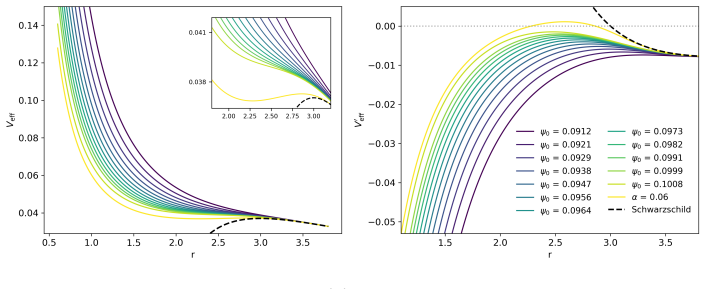
Compact boson stars produce wider lensing rings than black holes because their photon effective potential develops a flat region that widens with compactness.
A machine-rendered reading of the paper's core claim, the machinery that carries it, and where it could break.
Core claim
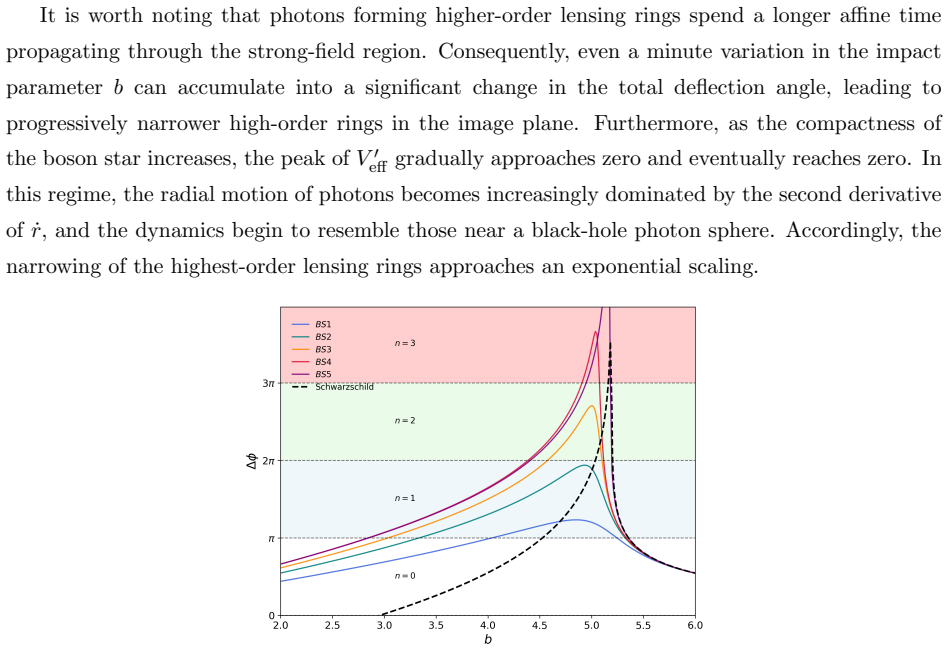
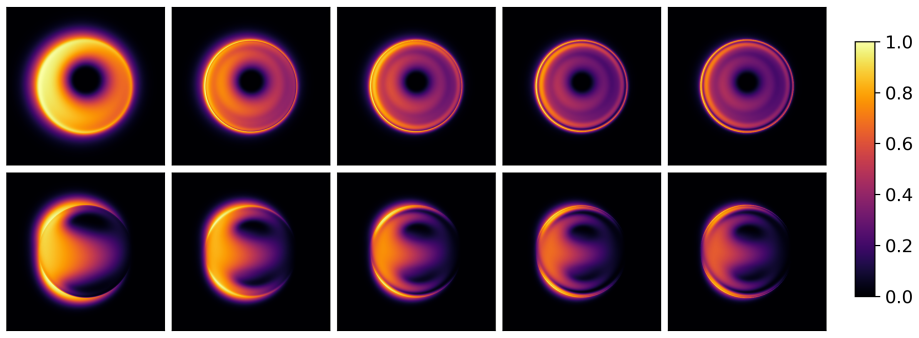
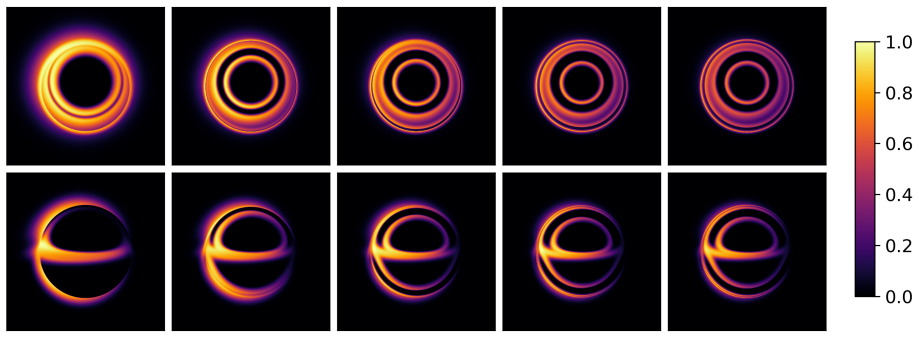
Unlike black holes, the photon effective potential of a compact boson star develops a nearly flat region, whose width increases with the compactness of the star. This flat structure significantly broadens the range of impact parameters that can produce large-angle deflections, leading to noticeably wider lensing rings of all orders. Photons constituting these rings traverse more complex paths, rendering the resulting images more sensitive to the spatial distribution of the accretion flow. Ray tracing results show that, compared to black hole models, the image topology and visibility amplitudes of compact boson stars exhibit a stronger dependence on the accretion flow structure.
What carries the argument
The nearly flat region that appears in the photon effective potential of compact boson stars; its growing width with compactness broadens the set of impact parameters capable of large-angle deflections.
If this is right
- All orders of lensing rings become measurably wider around boson stars than around black holes of equal mass.
- Image topology changes more visibly when the accretion flow is varied around boson stars than around black holes.
- Interferometric visibility amplitudes display stronger variation with accretion-flow geometry for boson stars.
- The observational distinction between boson stars and black holes grows with the spatial complexity of the accretion flow.
Where Pith is reading between the lines
- Ring-width measurements could serve as a diagnostic to separate boson-star candidates from black holes even when accretion details remain uncertain.
- Similar potential flattening might occur in other horizonless compact objects and could be tested with the same ray-tracing approach.
- Current EHT-style observations of Sgr A* or M87* could already place limits on boson-star compactness if ring widths are measured to sufficient precision.
Load-bearing premise
Compact boson stars possess a photon effective potential containing a nearly flat region whose width grows with the star's compactness.
What would settle it
High-resolution images or visibility data of a compact object showing lensing-ring widths identical to black-hole predictions at the same compactness would falsify the claim.
Figures
read the original abstract
In this work, we systematically study the gravitational lensing properties and observational signatures of compact boson stars. Unlike black holes, the photon effective potential of a compact boson star develops a nearly flat region, whose width increases with the compactness of the star. This flat structure significantly broadens the range of impact parameters that can produce large-angle deflections, leading to noticeably wider lensing rings of all orders. Photons constituting these rings traverse more complex paths, rendering the resulting images more sensitive to the spatial distribution of the accretion flow. Ray tracing results show that, compared to black hole models, the image topology and visibility amplitudes of compact boson stars exhibit a stronger dependence on the accretion flow structure. These results highlight qualitative differences in the observational properties of compact boson stars and black holes.
Editorial analysis
A structured set of objections, weighed in public.
Referee Report
Summary. The manuscript claims that compact boson stars develop a nearly flat region in the photon effective potential (width increasing with compactness) that broadens the range of impact parameters yielding large deflection angles, producing wider lensing rings of all orders than in Schwarzschild or Kerr spacetimes. Ray-tracing simulations then show that the resulting image topology and visibility amplitudes depend more strongly on accretion-flow structure, providing a qualitative observational distinction from black holes.
Significance. If the numerical results hold, the work supplies a concrete, mechanism-driven prediction for distinguishing boson-star candidates from black holes in strong-gravity imaging, with direct relevance to EHT and future VLBI analyses. The identification of the flat effective-potential region as the origin of the broadened rings is a clear, falsifiable link between spacetime structure and observable signatures.
major comments (2)
- [§3] §3 (or equivalent methods section on ray tracing): the claim of 'stronger dependence' on accretion-flow structure requires explicit quantitative metrics (e.g., fractional change in ring width or visibility amplitude per unit change in flow parameters) rather than qualitative visual comparison; without these, the central observational distinction remains unquantified.
- [§2] Eq. (photon effective potential definition, likely in §2): the statement that the flat region 'significantly broadens' the impact-parameter range needs an explicit integral or plot of deflection angle α(b) showing the width of the plateau in b where |α| > 2π; the current description is consistent but lacks the supporting calculation that would make the broadening claim load-bearing.
minor comments (2)
- [Figures] Figure captions for the ray-traced images should state the exact boson-star compactness parameter, spin (if any), and accretion-flow model parameters used, to allow direct reproduction.
- [Notation] Notation for impact parameter b and deflection angle should be unified across text and figures; minor inconsistencies appear in the abstract versus the methods description.
Simulated Author's Rebuttal
We thank the referee for the constructive report and positive assessment of the work's significance. We address the two major comments below. Both points identify areas where additional quantitative support would strengthen the manuscript, and we will incorporate the requested elements in a revised version.
read point-by-point responses
-
Referee: [§3] §3 (or equivalent methods section on ray tracing): the claim of 'stronger dependence' on accretion-flow structure requires explicit quantitative metrics (e.g., fractional change in ring width or visibility amplitude per unit change in flow parameters) rather than qualitative visual comparison; without these, the central observational distinction remains unquantified.
Authors: We agree that the central claim would benefit from explicit quantitative metrics rather than relying solely on visual comparisons. In the revised manuscript we will add a new subsection (or table) that reports fractional changes in ring width and visibility amplitude as functions of accretion-flow parameters (e.g., radial density power-law index and temperature profile). These metrics will be computed for both boson-star and black-hole spacetimes at matched compactness, allowing direct numerical comparison of the sensitivity. revision: yes
-
Referee: [§2] Eq. (photon effective potential definition, likely in §2): the statement that the flat region 'significantly broadens' the impact-parameter range needs an explicit integral or plot of deflection angle α(b) showing the width of the plateau in b where |α| > 2π; the current description is consistent but lacks the supporting calculation that would make the broadening claim load-bearing.
Authors: We accept that an explicit demonstration of the broadened plateau in α(b) is needed to make the mechanism load-bearing. We will add a dedicated figure in §2 that plots the deflection angle α(b) for several boson-star compactness values together with the Schwarzschild case. The figure will mark the intervals of b where |α| > 2π and will include a table (or inset) listing the measured widths Δb of those intervals, thereby quantifying the broadening directly from the effective-potential structure. revision: yes
Circularity Check
No significant circularity
full rationale
The paper's central claims rest on the computed photon effective potential for compact boson star metrics (which develop a flat region whose width grows with compactness) and subsequent ray-tracing comparisons to Schwarzschild/Kerr. These are direct consequences of solving the geodesic equations in the given spacetime, not definitions or fits that presuppose the lensing-ring width or accretion-flow sensitivity. No self-citation is invoked as load-bearing justification for the flat-region property, no parameter is fitted to a subset and then relabeled a prediction, and no ansatz or uniqueness theorem is smuggled in. The derivation chain is therefore self-contained against external benchmarks (numerical integration of null geodesics).
Axiom & Free-Parameter Ledger
axioms (2)
- standard math General relativity governs the spacetime of compact boson stars
- domain assumption Compact boson stars can be modeled with specific scalar field configurations leading to a photon effective potential with a flat region
invented entities (1)
-
compact boson star
no independent evidence
Reference graph
Works this paper leans on
-
[1]
Monitoring stellar orbits around the Massive Black Hole in the Galactic Center,
S. Gillessen, F. Eisenhauer, S. Trippe, T. Alexander, R. Genzel, F. Martins, and T. Ott, “Monitoring stellar orbits around the Massive Black Hole in the Galactic Center,” Astrophys. J.692(2009) 1075–1109,arXiv:0810.4674 [astro-ph]. 20
Pith/arXiv arXiv 2009
-
[2]
The Galactic Center Massive Black Hole and Nuclear Star Cluster,
R. Genzel, F. Eisenhauer, and S. Gillessen, “The Galactic Center Massive Black Hole and Nuclear Star Cluster,” Rev. Mod. Phys.82(2010) 3121–3195,arXiv:1006.0064 [astro-ph.GA]. [3]GRA VITYCollaboration, R. Abuter et al., “Detection of the gravitational redshift in the orbit of the star S2 near the Galactic centre massive black hole,” Astron. Astrophys.615 ...
Pith/arXiv arXiv 2010
-
[3]
Relativistic redshift of the star S0-2 orbiting the Galactic center supermassive black hole,
T. Do et al., “Relativistic redshift of the star S0-2 orbiting the Galactic center supermassive black hole,” Science365no. 6454, (2019) 664–668,arXiv:1907.10731 [astro-ph.GA]. [6]Event Horizon T elescopeCollaboration, K. Akiyama et al., “First Sagittarius A* Event Horizon Telescope Results. I. The Shadow of the Supermassive Black Hole in the Center of the...
arXiv 2019
-
[4]
Constraints on self-dual black hole in loop quantum gravity with S0-2 star in the galactic center,
J.-M. Yan, Q. Wu, C. Liu, T. Zhu, and A. Wang, “Constraints on self-dual black hole in loop quantum gravity with S0-2 star in the galactic center,” JCAP09(2022) 008, arXiv:2203.03203 [gr-qc]
arXiv 2022
-
[5]
Constraining a disformal Schwarzschild black hole in DHOST theories with the orbit of the S2 star,
Z. Zhang, S. Chen, and J. Jing, “Constraining a disformal Schwarzschild black hole in DHOST theories with the orbit of the S2 star,” Eur. Phys. J. C84no. 8, (2024) 827, arXiv:2404.05957 [gr-qc]. [9]Event Horizon T elescopeCollaboration, K. Akiyama et al., “First M87 Event Horizon Telescope Results. VI. The Shadow and Mass of the Central Black Hole,” Astro...
arXiv 2024
-
[6]
Sgr A* and General Relativity,
T. Johannsen, “Sgr A* and General Relativity,” Class. Quant. Grav.33no. 11, (2016) 113001,arXiv:1512.03818 [astro-ph.GA]
Pith/arXiv arXiv 2016
-
[7]
Black Hole Shadows, Photon Rings, and Lensing Rings,
S. E. Gralla, D. E. Holz, and R. M. Wald, “Black Hole Shadows, Photon Rings, and Lensing Rings,” Phys. Rev. D100no. 2, (2019) 024018,arXiv:1906.00873 [astro-ph.HE]
Pith/arXiv arXiv 2019
-
[8]
Universal interferometric signatures of a black hole’s photon ring,
M. D. Johnson et al., “Universal interferometric signatures of a black hole’s photon ring,” Sci. Adv.6no. 12, (2020) eaaz1310,arXiv:1907.04329 [astro-ph.IM]
arXiv 2020
-
[9]
D. Psaltis, F. Ozel, C.-K. Chan, and D. P. Marrone, “A General Relativistic Null Hypothesis Test with Event Horizon Telescope Observations of the black-hole shadow in Sgr A*,” Astrophys. J.814no. 2, (2015) 115,arXiv:1411.1454 [astro-ph.HE]
Pith/arXiv arXiv 2015
-
[10]
Shadows and strong gravitational lensing: a brief review,
P. V. P. Cunha and C. A. R. Herdeiro, “Shadows and strong gravitational lensing: a brief review,” Gen. Rel. Grav.50no. 4, (2018) 42,arXiv:1801.00860 [gr-qc]
Pith/arXiv arXiv 2018
-
[11]
Imaging a boson star at the Galactic center,
F. H. Vincent, Z. Meliani, P. Grandclement, E. Gourgoulhon, and O. Straub, “Imaging a boson star at the Galactic center,” Class. Quant. Grav.33no. 10, (2016) 105015, arXiv:1510.04170 [gr-qc]
Pith/arXiv arXiv 2016
-
[12]
Shadows of boson and Proca stars with thin accretion disks,
J. L. Rosa and D. Rubiera-Garcia, “Shadows of boson and Proca stars with thin accretion disks,” Phys. Rev. D106no. 8, (2022) 084004,arXiv:2204.12949 [gr-qc]
arXiv 2022
-
[13]
Spinning boson stars and Kerr black holes with scalar hair: the effect of self-interactions,
C. A. R. Herdeiro, E. Radu, and H. F. R´ unarsson, “Spinning boson stars and Kerr black holes with scalar hair: the effect of self-interactions,” Int. J. Mod. Phys. D25no. 09, (2016) 1641014,arXiv:1604.06202 [gr-qc]
Pith/arXiv arXiv 2016
-
[14]
Gravitational collapse and space-time singularities,
R. Penrose, “Gravitational collapse and space-time singularities,” Phys. Rev. Lett.14(1965) 57–59
1965
-
[15]
Breakdown of Predictability in Gravitational Collapse,
S. W. Hawking, “Breakdown of Predictability in Gravitational Collapse,” Phys. Rev. D14 (1976) 2460–2473
1976
-
[16]
Do black holes destroy information?,
J. Preskill, “Do black holes destroy information?,” in International Symposium on Black holes, Membranes, Wormholes and Superstrings. 1, 1992. arXiv:hep-th/9209058. 22
Pith/arXiv arXiv 1992
-
[17]
Wormholes in space-time and their use for interstellar travel: A tool for teaching general relativity,
M. S. Morris and K. S. Thorne, “Wormholes in space-time and their use for interstellar travel: A tool for teaching general relativity,” Am. J. Phys.56(1988) 395–412
1988
-
[18]
Gravitational Condensate Stars: An Alternative to Black Holes,
P. O. Mazur and E. Mottola, “Gravitational Condensate Stars: An Alternative to Black Holes,” Universe9no. 2, (2023) 88,arXiv:gr-qc/0109035
arXiv 2023
-
[19]
The Fuzzball proposal for black holes: An Elementary review,
S. D. Mathur, “The Fuzzball proposal for black holes: An Elementary review,” Fortsch. Phys.53(2005) 793–827,arXiv:hep-th/0502050
Pith/arXiv arXiv 2005
-
[20]
Black holes, quantum information, and the foundations of physics,
S. B. Giddings, “Black holes, quantum information, and the foundations of physics,” Phys. Today66no. 4, (2013) 30–35
2013
-
[21]
Black Hole’s Quantum N-Portrait,
G. Dvali and C. Gomez, “Black Hole’s Quantum N-Portrait,” Fortsch. Phys.61(2013) 742–767,arXiv:1112.3359 [hep-th]
Pith/arXiv arXiv 2013
-
[22]
General relativistic boson stars,
F. E. Schunck and E. W. Mielke, “General relativistic boson stars,” Class. Quant. Grav.20 (2003) R301–R356,arXiv:0801.0307 [astro-ph]
Pith/arXiv arXiv 2003
-
[23]
Testing the nature of dark compact objects: a status report,
V. Cardoso and P. Pani, “Testing the nature of dark compact objects: a status report,” Living Rev. Rel.22no. 1, (2019) 4,arXiv:1904.05363 [gr-qc]
Pith/arXiv arXiv 2019
-
[24]
Stability of Boson Stars,
M. Gleiser, “Stability of Boson Stars,” Phys. Rev. D38(1988) 2376. [Erratum: Phys.Rev.D 39, 1257 (1989)]
1988
-
[25]
Dynamical Evolution of Boson Stars. 1. Perturbing the Ground State,
E. Seidel and W.-M. Suen, “Dynamical Evolution of Boson Stars. 1. Perturbing the Ground State,” Phys. Rev. D42(1990) 384–403
1990
-
[26]
S. L. Liebling and C. Palenzuela, “Dynamical boson stars,” Living Rev. Rel.26no. 1, (2023) 1,arXiv:1202.5809 [gr-qc]
Pith/arXiv arXiv 2023
-
[27]
The imitation game: Proca stars that can mimic the schwarzschild shadow,
C. A. Herdeiro, A. M. Pombo, E. Radu, P. V. Cunha, and N. Sanchis-Gual, “The imitation game: Proca stars that can mimic the schwarzschild shadow,” Journal of Cosmology and Astroparticle Physics2021no. 04, (2021) 051
2021
-
[28]
Accretion disc onto a static nonbaryonic compact object,
D. F. Torres, “Accretion disc onto a static nonbaryonic compact object,” Nucl. Phys. B626 (2002) 377–394,arXiv:hep-ph/0201154
Pith/arXiv arXiv 2002
-
[29]
Accretion disc onto boson stars: A Way to supplant black holes candidates,
F. S. Guzman, “Accretion disc onto boson stars: A Way to supplant black holes candidates,” Phys. Rev. D73(2006) 021501,arXiv:gr-qc/0512081. 23
Pith/arXiv arXiv 2006
-
[30]
Spherical boson stars as black hole mimickers,
F. S. Guzman and J. M. Rueda-Becerril, “Spherical boson stars as black hole mimickers,” Phys. Rev. D80(2009) 084023,arXiv:1009.1250 [astro-ph.HE]
Pith/arXiv arXiv 2009
-
[31]
Astrophysical signatures of boson stars: quasinormal modes and inspiral resonances,
C. F. B. Macedo, P. Pani, V. Cardoso, and L. C. B. Crispino, “Astrophysical signatures of boson stars: quasinormal modes and inspiral resonances,” Phys. Rev. D88no. 6, (2013) 064046,arXiv:1307.4812 [gr-qc]
Pith/arXiv arXiv 2013
-
[32]
Gravitational Wave Signatures of Highly Compact Boson Star Binaries,
C. Palenzuela, P. Pani, M. Bezares, V. Cardoso, L. Lehner, and S. Liebling, “Gravitational Wave Signatures of Highly Compact Boson Star Binaries,” Phys. Rev. D96no. 10, (2017) 104058,arXiv:1710.09432 [gr-qc]
Pith/arXiv arXiv 2017
-
[33]
How to tell an accreting boson star from a black hole,
H. Olivares, Z. Younsi, C. M. Fromm, M. De Laurentis, O. Porth, Y. Mizuno, H. Falcke, M. Kramer, and L. Rezzolla, “How to tell an accreting boson star from a black hole,” Mon. Not. Roy. Astron. Soc.497no. 1, (2020) 521–535,arXiv:1809.08682 [gr-qc]
arXiv 2020
-
[34]
H. R. Olivares-S´ anchez, P. Kocherlakota, and C. A. R. Herdeiro, GRMHD Simulations of Accretion Onto Exotic Compact Objects. 2025.arXiv:2408.09893 [astro-ph.HE]
arXiv 2025
-
[35]
Comparison of magnetized thick disks around black holes and boson stars,
K. Gjorgjieski, J. Kunz, and P. Nedkova, “Comparison of magnetized thick disks around black holes and boson stars,” Eur. Phys. J. C84no. 3, (2024) 286,arXiv:2401.13857 [gr-qc]
arXiv 2024
-
[36]
Observational features of the Bardeen-boson star with thin disk accretion,
C.-Y. Yang, H. Ye, and X.-X. Zeng, “Observational features of the Bardeen-boson star with thin disk accretion,”arXiv:2509.17535 [gr-qc]
-
[37]
Polarization images of solitonic boson stars,
X.-X. Zeng, C.-Y. Yang, H. Yu, and K.-J. He, “Polarization images of solitonic boson stars,” Eur. Phys. J. C86no. 2, (2026) 169,arXiv:2508.11992 [gr-qc]
arXiv 2026
-
[38]
Optical images of massive boson stars with nonlinear electrodynamics,
X.-X. Zeng, H. Ye, K.-J. He, and H. Yu, “Optical images of massive boson stars with nonlinear electrodynamics,” Eur. Phys. J. C85no. 10, (2025) 1211,arXiv:2507.11583 [gr-qc]
arXiv 2025
-
[39]
Observational signatures of hot spots orbiting horizonless objects,
J. L. Rosa, P. Garcia, F. H. Vincent, and V. Cardoso, “Observational signatures of hot spots orbiting horizonless objects,” Phys. Rev. D106no. 4, (2022) 044031,arXiv:2205.11541 [gr-qc]
arXiv 2022
-
[40]
Imaging compact boson stars with hot spots and thin accretion disks,
J. L. Rosa, C. F. B. Macedo, and D. Rubiera-Garcia, “Imaging compact boson stars with hot spots and thin accretion disks,” Phys. Rev. D108no. 4, (2023) 044021,arXiv:2303.17296 [gr-qc]. 24
arXiv 2023
-
[41]
Accretion disks and relativistic line broadening in boson star spacetimes,
J. L. Rosa, J. Pelle, and D. P´ erez, “Accretion disks and relativistic line broadening in boson star spacetimes,” Phys. Rev. D110no. 8, (2024) 084068,arXiv:2403.11540 [gr-qc]
arXiv 2024
-
[42]
N. Aimar, J. L. Rosa, H. L. Tamm, and P. Garcia, “Sagittarius A* near-infrared flares polarization as a probe of space-time I: Non-rotating exotic compact objects,” Astron. Astrophys.708(2026) A379,arXiv:2506.23931 [astro-ph.HE]
Pith/arXiv arXiv 2026
-
[43]
Lensing and light rings of parity-odd rotating boson stars,
Y. Huang, D.-J. Liu, and H. Zhang, “Lensing and light rings of parity-odd rotating boson stars,” Sci. China Phys. Mech. Astron.68no. 8, (2025) 280411,arXiv:2410.20867 [gr-qc]
arXiv 2025
-
[44]
Imaging and polarization patterns of various thick disks around Kerr-MOG black holes,
X. Wang, H. Ye, and X.-X. Zeng, “Imaging and polarization patterns of various thick disks around Kerr-MOG black holes,” JCAP05(2026) 057,arXiv:2511.09379 [gr-qc]
arXiv 2026
-
[45]
The imitation game (r)evolutions:Q-star effective shadow from GRMHD analysis,
V. Jaramillo, L. Meneses, H. R. O. S´ anchez, C. Herdeiro, D. N´ u˜ nez, and S.-Y. Zhou, “The imitation game (r)evolutions:Q-star effective shadow from GRMHD analysis,” arXiv:2603.16995 [gr-qc]
-
[46]
Imaging thick accretion disks and jets surrounding black holes,
Z. Zhang, Y. Hou, M. Guo, and B. Chen, “Imaging thick accretion disks and jets surrounding black holes,” JCAP05(2024) 032,arXiv:2401.14794 [astro-ph.HE]
arXiv 2024
-
[47]
Observational signatures of rotating black holes in the semiclassical gravity with trace anomaly*,
Z. Zhang, Y. Hou, and M. Guo, “Observational signatures of rotating black holes in the semiclassical gravity with trace anomaly*,” Chin. Phys. C48no. 8, (2024) 085106, arXiv:2305.14924 [gr-qc]
arXiv 2024
-
[48]
T.-C. Lee, Z. Hu, M. Guo, and B. Chen, “Circular orbits and polarized images of charged particles orbiting a Kerr black hole with a weak magnetic field,” Phys. Rev. D108no. 2, (2023) 024008,arXiv:2211.04143 [gr-qc]
arXiv 2023
-
[49]
Images and photon ring signatures of thick disks around black holes,
F. H. Vincent, S. E. Gralla, A. Lupsasca, and M. Wielgus, “Images and photon ring signatures of thick disks around black holes,” Astron. Astrophys.667(2022) A170, arXiv:2206.12066 [astro-ph.HE]
arXiv 2022
-
[50]
Array programming with numpy,
C. R. Harris, K. J. Millman, S. J. van der Walt, R. Gommers, P. Virtanen, D. Cournapeau, E. Wieser, J. Taylor, S. Berg, N. J. Smith, et al., “Array programming with numpy,” Nature 585no. 7825, (2020) 357–362
2020
-
[51]
Exploring black holes with multiple photon spheres by interferometric signatures,
X.-J. Wang, Y. Meng, X.-M. Kuang, and K. Liao, “Exploring black holes with multiple photon spheres by interferometric signatures,” Phys. Rev. D112no. 12, (2025) 124016, arXiv:2508.02355 [gr-qc]. 25
arXiv 2025
discussion (0)
Sign in with ORCID, Apple, or X to comment. Anyone can read and Pith papers without signing in.