Delay coordinates synchronization and induces abrupt transition in excitable networks
Pith reviewed 2026-06-26 12:31 UTC · model grok-4.3
The pith
Time delays in excitatory neuron connections create self-sustained oscillations that trigger abrupt in-phase synchronization.
A machine-rendered reading of the paper's core claim, the machinery that carries it, and where it could break.
Core claim
Delays in excitatory connections between excitable neurons coordinate their synchronization patterns by creating self-sustained oscillations that may be out-of-phase or in-phase. The emergence of these oscillations leads to an abrupt, explosive, transition to in-phase synchronized regimes due to small changes in connection strength or time-delay. The mechanism underlying these phenomena is an interaction between the neuron's excitable dynamics and the delay in signal transmission.
What carries the argument
Interaction between the neuron's excitable dynamics and the delay in signal transmission, which generates self-sustained oscillations.
If this is right
- Small shifts in connection strength or delay produce sudden jumps from partial to full in-phase locking.
- The oscillations can remain out-of-phase or switch to in-phase depending on the exact delay and strength values.
- The abrupt transition persists in the presence of noise and across different network topologies and neuron models.
Where Pith is reading between the lines
- The same delay-driven mechanism could produce sudden state switches in larger brain circuits during normal or pathological activity.
- Analogous explosive synchronization might occur in other delayed excitable systems such as cardiac tissue or chemical reaction networks.
- Varying delay while holding strength fixed could serve as an experimental test to isolate the contribution of propagation time.
Load-bearing premise
The interaction of excitable neuron response with transmission delays is what generates the self-sustained oscillations and the abrupt synchronization transition.
What would settle it
A network simulation in which all delays are set exactly to zero while keeping connection strengths, topology, and neuron parameters fixed, to check whether the abrupt transition to in-phase synchronization disappears.
Figures
read the original abstract
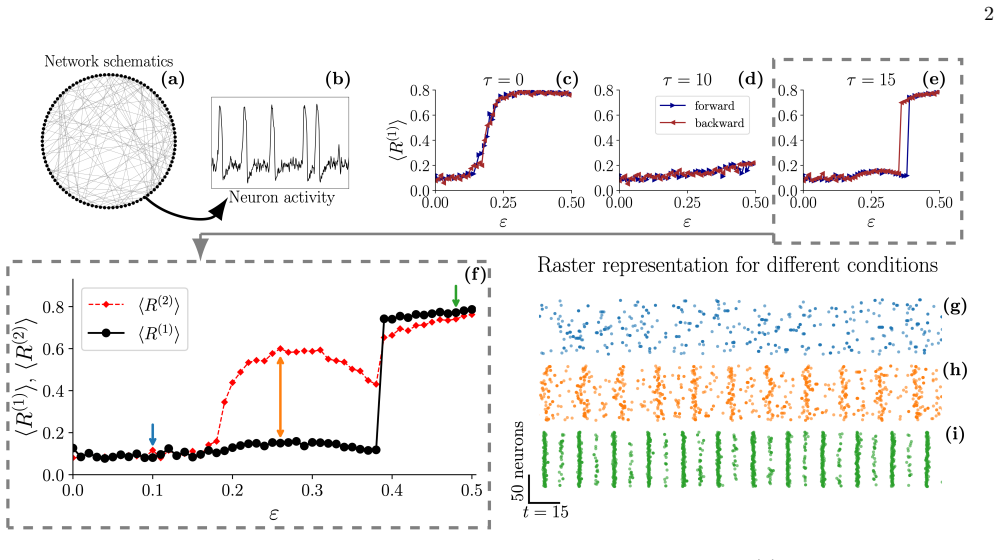
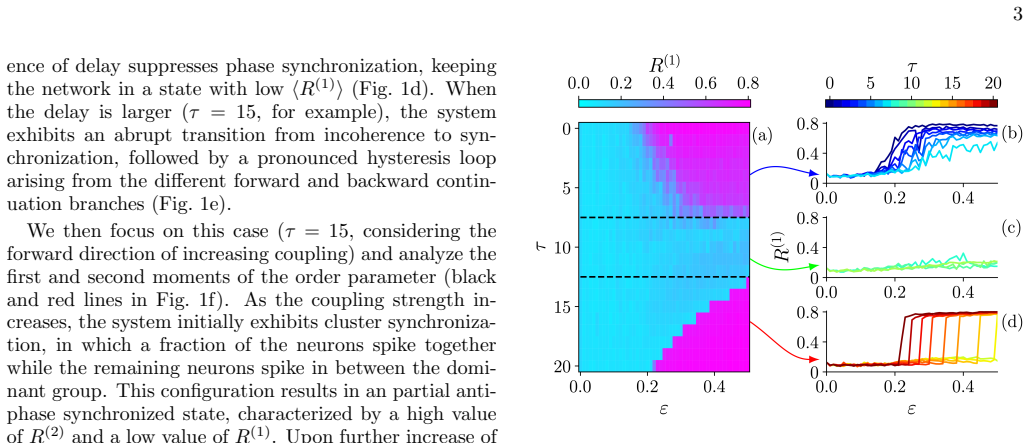
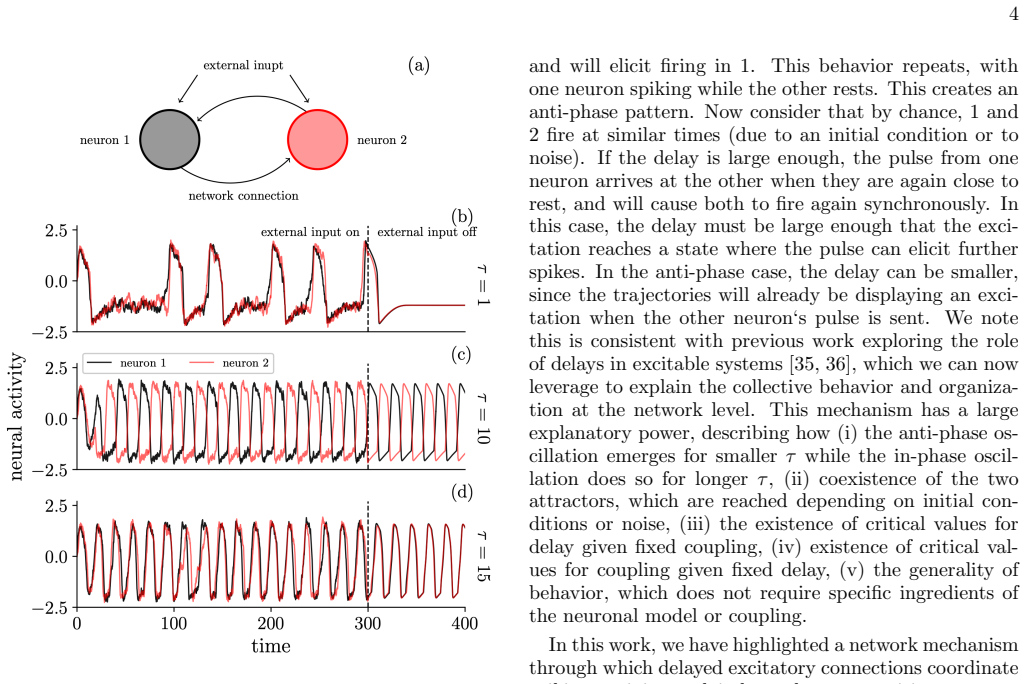
Neuronal communication is inherently time-delayed, due to the finite speed of signal propagation. Although often considered challenging or disruptive, such time delays can also endow neural circuits with useful capabilities. Here, we show that delays in excitatory connections between excitable neurons coordinate their synchronization patterns by creating self-sustained oscillations that may be out-of-phase or in-phase. The emergence of these oscillations leads to an abrupt, explosive, transition to in-phase synchronized regimes due to small changes in connection strength or time-delay. We describe the mechanism underlying these phenomena as an interaction between the neuron's excitable dynamics and the delay in signal transmission, explaining many aspects of how the oscillations emerge. We show this phenomenon in different network connectivities, neuronal models, with and without excitation, with and without noise, highlighting the generality of the mechanism.
Editorial analysis
A structured set of objections, weighed in public.
Referee Report
Summary. The manuscript claims that finite time delays in excitatory connections between excitable neurons induce self-sustained oscillations (which can be out-of-phase or in-phase) that coordinate synchronization patterns across the network. These oscillations produce an abrupt, explosive transition to in-phase synchronization triggered by small changes in connection strength or delay. The proposed mechanism is an interaction between the intrinsic excitable dynamics of the neurons and the transmission delay; the authors report that the phenomenon persists across varied connectivities, neuronal models, excitation levels, and noise conditions.
Significance. If the reported mechanism and its generality hold, the result would be significant for the study of collective dynamics in neural circuits. It provides a concrete, delay-based route to explosive synchronization that does not rely on ad-hoc parameter tuning and operates in both deterministic and noisy regimes, offering a plausible explanation for abrupt state transitions observed in biological networks.
minor comments (2)
- [Title] The title contains a grammatical error and should be revised for clarity (e.g., 'Delays coordinate synchronization and induce abrupt transitions in excitable networks').
- [Abstract] The abstract states that the mechanism is demonstrated 'in different network connectivities, neuronal models, with and without excitation, with and without noise,' but does not name the specific models or connectivities; adding these details would improve reproducibility.
Simulated Author's Rebuttal
We thank the referee for the positive assessment of our manuscript on delay-induced synchronization and explosive transitions in excitable networks. The recommendation for minor revision is noted, and we will prepare a revised version accordingly. No specific major comments were raised in the report.
Circularity Check
No significant circularity identified
full rationale
The paper's central claims rest on numerical simulations of excitable neuron networks incorporating time delays, demonstrating self-sustained oscillations and abrupt synchronization transitions across varied connectivities, models, excitation levels, and noise. The described mechanism (interaction of excitable dynamics with transmission delays) is presented as an explanatory account of the observed simulation outcomes rather than a mathematical derivation that reduces to fitted parameters or self-citations by construction. No equations, uniqueness theorems, or ansatzes are quoted that would indicate self-definitional or load-bearing circular steps; the generality is established empirically.
Axiom & Free-Parameter Ledger
Reference graph
Works this paper leans on
-
[1]
Girard, J
P. Girard, J. Hup´ e, and J. Bullier, Feedforward and feed- back connections between areas v1 and v2 of the monkey have similar rapid conduction velocities, Journal of Neu- rophysiology85, 1328 (2001)
2001
-
[2]
H. A. Swadlow and S. G. Waxman, Axonal conduction delays, Scholarpedia7, 1451 (2012)
2012
-
[3]
Muller, F
L. Muller, F. Chavane, J. Reynolds, and T. J. Sejnowski, Cortical travelling waves: mechanisms and computa- tional principles, Nature Reviews Neuroscience19, 255 (2018)
2018
-
[4]
Takahashi, S
K. Takahashi, S. Kim, T. P. Coleman, K. A. Brown, A. J. Suminski, M. D. Best, and N. G. Hatsopoulos, Large-scale spatiotemporal spike patterning consistent with wave propagation in motor cortex, Nature Commu- nications6, 7169 (2015)
2015
-
[5]
G. Deco, V. Jirsa, A. R. McIntosh, O. Sporns, and R. K¨ otter, Key role of coupling, delay, and noise in resting brain fluctuations, Proceedings of the National Academy of Sciences106, 10302 (2009)
2009
-
[6]
Muller, G
L. Muller, G. Piantoni, D. Koller, S. S. Cash, E. Halgren, and T. J. Sejnowski, Rotating waves during human sleep spindles organize global patterns of activity that repeat precisely through the night, Elife5, e17267 (2016)
2016
-
[7]
Zhaoping, Conduction velocity of intracortical axons in monkey primary visual cortex grows with distance: im- plications for computation, Vision Research244, 108824 (2026)
L. Zhaoping, Conduction velocity of intracortical axons in monkey primary visual cortex grows with distance: im- plications for computation, Vision Research244, 108824 (2026)
2026
-
[8]
G. B. Benigno, R. C. Budzinski, Z. W. Davis, J. H. Reynolds, and L. Muller, Waves traveling over a map of visual space can ignite short-term predictions of sensory input, Nature Communications14, 3409 (2023)
2023
-
[9]
R. C. Budzinski, A. N. Busch, S. Mestern, E. Martin, L. H. Liboni, F. W. Pasini, J. Min´ aˇ c, T. Coleman, W. In- oue, and L. E. Muller, An exact mathematical descrip- tion of computation with transient spatiotemporal dy- namics in a complex-valued neural network, Communi- cations Physics7, 239 (2024)
2024
-
[10]
S. K. Tavakoli and A. Longtin, Boosting reservoir com- puter performance with multiple delays, Physical Review E109, 054203 (2024)
2024
-
[11]
S. K. Tavakoli and A. Longtin, Signal demixing using multi-delay multi-layer reservoir computing, PLOS Com- plex Systems2, e0000034 (2025)
2025
-
[12]
F. M. Atay, Distributed delays facilitate amplitude death of coupled oscillators, Physical Review Letters91, 094101 (2003)
2003
-
[13]
W. Zou, D. Senthilkumar, M. Zhan, and J. Kurths, Re- viving oscillations in coupled nonlinear oscillators, Phys- ical Review Letters111, 014101 (2013)
2013
-
[14]
Koseska, E
A. Koseska, E. Volkov, and J. Kurths, Oscillation quench- ing mechanisms: Amplitude vs. oscillation death, Physics Reports531, 173 (2013)
2013
-
[15]
W. Zou, D. Senthilkumar, R. Nagao, I. Z. Kiss, Y. Tang, A. Koseska, J. Duan, and J. Kurths, Restoration of rhyth- micity in diffusively coupled dynamical networks, Nature Communications6, 7709 (2015)
2015
-
[16]
Yanchuk and G
S. Yanchuk and G. Giacomelli, Spatio-temporal phenom- ena in complex systems with time delays, Journal of Physics A: Mathematical and Theoretical50, 103001 (2017)
2017
-
[17]
Hansen, P
M. Hansen, P. R. Protachevicz, K. C. Iarosz, I. L. Caldas, A. M. Batista, and E. E. Macau, The effect of time de- lay for synchronisation suppression in neuronal networks, Chaos, Solitons & Fractals164, 112690 (2022)
2022
-
[18]
D. V. R. Reddy, A. Sen, and G. L. Johnston, Time delay induced death in coupled limit cycle oscillators, Physical Review Letters80, 5109 (1998)
1998
-
[19]
Zou and M
W. Zou and M. Zhan, Partial time-delay coupling en- larges death island of coupled oscillators, Physical Re- view E80, 065204 (2009)
2009
-
[20]
Masoliver, N
M. Masoliver, N. Malik, E. Sch¨ oll, and A. Zakharova, Coherence resonance in a network of fitzhugh-nagumo systems: interplay of noise, time-delay, and topology, Chaos: An Interdisciplinary Journal of Nonlinear Science 27(2017)
2017
-
[21]
Saha and U
A. Saha and U. Feudel, Extreme events in fitzhugh- nagumo oscillators coupled with two time delays, Physi- cal Review E95, 062219 (2017)
2017
-
[22]
Z. W. Davis, G. B. Benigno, C. Fletterman, T. Desbor- des, C. Steward, T. J. Sejnowski, J. H. Reynolds, and L. Muller, Spontaneous traveling waves naturally emerge from horizontal fiber time delays and travel through lo- cally asynchronous-irregular states, Nature Communica- tions12, 6057 (2021). 6
2021
-
[23]
S. M. Crook, G. B. Ermentrout, M. C. Vanier, and J. M. Bower, The role of axonal delay in the synchronization of networks of coupled cortical oscillators, Journal of Com- putational Neuroscience4, 161 (1997)
1997
-
[24]
Mihara and R
A. Mihara and R. O. Medrano-T, Stability in the kuramoto–sakaguchi model for finite networks of iden- tical oscillators, Nonlinear Dynamics98, 539 (2019)
2019
-
[25]
H. S. Lee, B. J. Kim, and H. J. Park, Stability of twisted states in power-law-coupled kuramoto oscillators on a cir- cle with and without time delay, Physical Review E109, 064203 (2024)
2024
-
[26]
Sinha, P
Y. Sinha, P. B. Jain, A. Mihara, R. O. Medrano-T, J. Min´ aˇ c, L. E. Muller, and R. C. Budzinski, Geomet- ric perspective of linear stability of q-states in finite ku- ramoto networks on circulant graphs, Physical Review E 112, 054204 (2025)
2025
-
[27]
S. O. Jeong, T. W. Ko, and H. T. Moon, Time-delayed spatial patterns in a two-dimensional array of coupled oscillators, Physical Review Letters89, 154104 (2002)
2002
-
[28]
R. C. Budzinski, T. T. Nguyen, G. B. Benigno, J. Do` an, J. Min´ aˇ c, T. J. Sejnowski, and L. E. Muller, Analyti- cal prediction of specific spatiotemporal patterns in non- linear oscillator networks with distance-dependent time delays, Physical Review Research5, 013159 (2023)
2023
-
[29]
FitzHugh, Impulses and physiological states in theo- retical models of nerve membrane, Biophysical Journal 1, 445 (1961)
R. FitzHugh, Impulses and physiological states in theo- retical models of nerve membrane, Biophysical Journal 1, 445 (1961)
1961
-
[30]
Destexhe, Z
A. Destexhe, Z. F. Mainen, and T. J. Sejnowski, An effi- cient method for computing synaptic conductances based on a kinetic model of receptor binding, Neural Compu- tation6, 14 (1994)
1994
-
[31]
D. J. Watts and S. H. Strogatz, Collective dynamics of ‘small-world’ networks, Nature393, 440 (1998)
1998
-
[32]
Sepulchre, D
R. Sepulchre, D. A. Paley, and N. E. Leonard, Stabiliza- tion of planar collective motion: All-to-all communica- tion, IEEE Transactions on Automatic Control52, 811 (2007)
2007
-
[33]
M. V. Ivanchenko, G. V. Osipov, V. D. Shalfeev, and J. Kurths, Phase synchronization in ensembles of bursting oscillators, Physical Review Letters93, 134101 (2004)
2004
-
[34]
Kuramoto, Self-entrainment of a population of coupled non-linear oscillators, inInternational sympo- sium on mathematical problems in theoretical physics (Springer, 1975) pp
Y. Kuramoto, Self-entrainment of a population of coupled non-linear oscillators, inInternational sympo- sium on mathematical problems in theoretical physics (Springer, 1975) pp. 420–422
1975
-
[35]
Buri´ c and D
N. Buri´ c and D. Todorovi´ c, Dynamics of fitzhugh- nagumo excitable systems with delayed coupling, Physi- cal Review E67, 066222 (2003)
2003
-
[36]
M. A. Dahlem, G. Hiller, A. Panchuk, and E. Sch¨ oll, Dy- namics of delay-coupled excitable neural systems, Inter- national Journal of Bifurcation and Chaos19, 745 (2009)
2009
-
[37]
E. S. Medeiros, R. O. Medrano-T, I. L. Caldas, and U. Feudel, Boundaries of synchronization in oscillator networks, Physical Review E98, 030201 (2018)
2018
- [38]
-
[39]
Medeiros, R
E. Medeiros, R. Medrano-T, I. Caldas, and U. Feudel, The impact of chaotic saddles on the synchronization of complex networks of discrete-time units, Journal of Physics: Complexity2, 035002 (2021)
2021
-
[40]
Contreras, E
M. Contreras, E. S. Medeiros, A. Zakharova, P. H¨ ovel, and I. Franovi´ c, Scale-free avalanches in arrays of FitzHugh–nagumo oscillators, Chaos: An Interdisci- plinary Journal of Nonlinear Science33, 093106 (2023)
2023
-
[41]
K. L. Rossi, E. S. Medeiros, P. Ashwin, and U. Feudel, Transients versus network interactions give rise to mul- tistability through trapping mechanism, Chaos: An In- terdisciplinary Journal of Nonlinear Science35, 033125 (2025)
2025
-
[42]
G´ omez-Gardenes, S
J. G´ omez-Gardenes, S. G´ omez, A. Arenas, and Y. Moreno, Explosive synchronization transitions in scale-free networks, Physical Review Letters106, 128701 (2011)
2011
-
[43]
B. R. R. Boaretto, R. C. Budzinski, T. L. Prado, and S. R. Lopes, Mechanism for explosive synchronization of neural networks, Physical Review E100, 052301 (2019)
2019
-
[44]
Battaglia, N
D. Battaglia, N. Brunel, and D. Hansel, Temporal decor- relation of collective oscillations in neural networks with local inhibition and long-range excitation, Physical Re- view Letters99, 238106 (2007)
2007
-
[45]
J. F. Mejias and X.-J. Wang, Mechanisms of distributed working memory in a large-scale network of macaque neo- cortex, eLife11, e72136 (2022)
2022
-
[46]
Sagalajev, T
B. Sagalajev, T. Zhang, N. Abdollahi, N. Yousefpour, L. Medlock, D. Al-Basha, A. Ribeiro-da Silva, R. Es- teller, S. Ratt´ e, and S. A. Prescott, Absence of paresthe- sia during high-rate spinal cord stimulation reveals im- portance of synchrony for sensations evoked by electrical stimulation, Neuron112, 404 (2024)
2024
-
[47]
Peddinti, D
V. Peddinti, D. Povey, and S. Khudanpur, A time delay neural network architecture for efficient modeling of long temporal contexts, inProc. Interspeech(2015) pp. 3214– 3218
2015
-
[48]
P. Sun, Y. Chua, P. Devos, and D. Botteldooren, Learn- able axonal delay in spiking neural networks improves spoken word recognition, Frontiers in Neuroscience17, 1275944 (2023)
2023
discussion (0)
Sign in with ORCID, Apple, or X to comment. Anyone can read and Pith papers without signing in.