Correlation Between Proton Decay Channels and the Axion Mass in an Extended SU(5) GUT
Pith reviewed 2026-06-27 06:38 UTC · model grok-4.3
The pith
Extended SU(5) GUT with DFSZ axion correlates proton decay channels to QCD axion mass via unification and PQ scales.
A machine-rendered reading of the paper's core claim, the machinery that carries it, and where it could break.
Core claim
In this extended SU(5) GUT, the Georgi-Jarlskog flavor structure at the unification scale reduces the flavor ambiguity of dimension-six baryon-violating operators, enabling robust constraints on charged-lepton proton decay modes. The viable region from one-loop gauge unification with 45 Higgs thresholds correlates the GUT scale with the PQ scale, yielding specific predictions for the QCD axion mass and its couplings that can be tested together with proton decay searches.
What carries the argument
The relation between the GUT unification scale and the PQ scale that maps the (M_GUT, M_S1) parameter space onto axion mass and couplings, under Georgi-Jarlskog reduced operators.
If this is right
- The GUT-selected parameter region yields correlated predictions for the QCD axion mass.
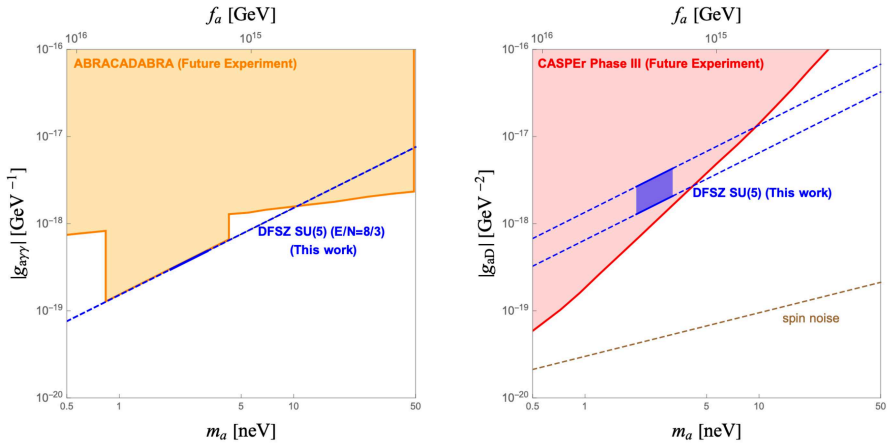
- The same region maps onto predictions for the axion-photon coupling and axion-induced EDM coupling.
- Robust constraints and predictions apply to charged-lepton proton decay modes such as p to e+ pi0.
- The model provides combined implications for proton decay and axion searches.
Where Pith is reading between the lines
- Measurement of an axion whose mass and couplings match the correlated range would indirectly support the GUT scale relations in this setup.
- Future proton decay experiments sensitive to specific charged-lepton channels could further restrict the allowed axion parameter space.
- The scale-correlation mechanism might be examined in other GUT extensions that include axion sectors.
Load-bearing premise
Imposing the Georgi-Jarlskog flavor structure at the unification scale substantially reduces the flavor ambiguity of the dimension-six baryon-violating operators.
What would settle it
An experimental measurement of the axion mass, axion-photon coupling, or proton decay branching ratios falling outside the ranges predicted by the viable (M_GUT, M_S1) region.
Figures
read the original abstract
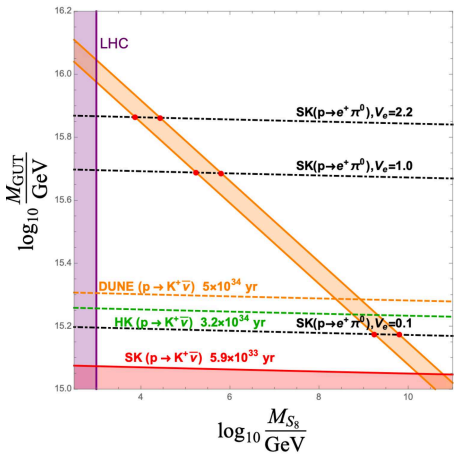
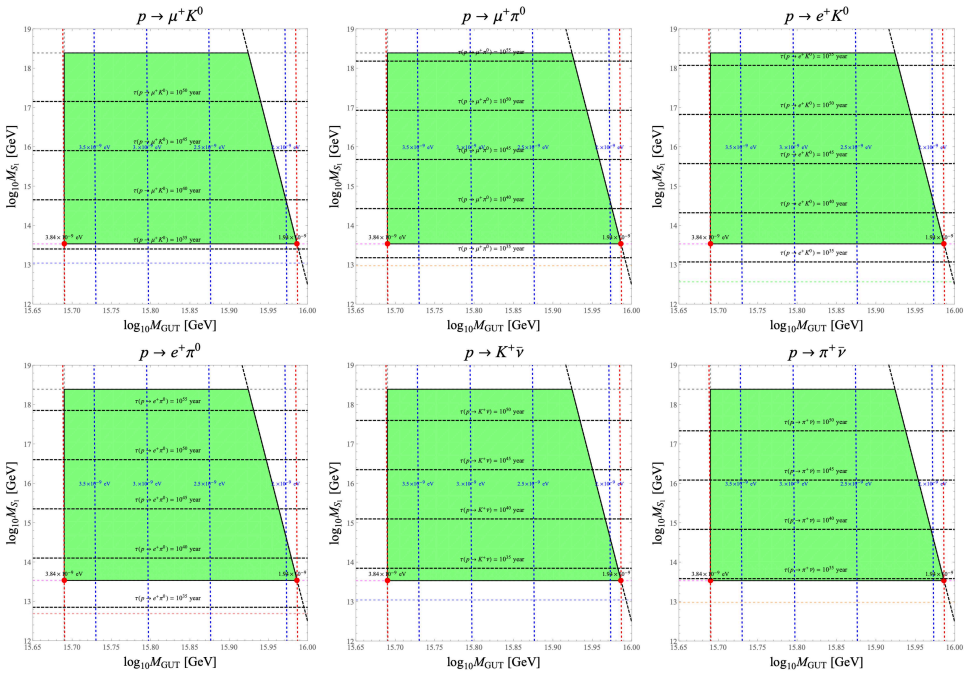
We study a renormalizable SU(5) grand unified theory (GUT) supplemented by a 45-dimensional Higgs field and a DFSZ axion sector, imposing a Georgi--Jarlskog flavor structure at the unification scale. We perform a one-loop gauge coupling unification analysis, explicitly including the threshold masses of the light multiplets arising from the 45-dimensional Higgs field. This analysis identifies the viable region in the $(M_{\mathrm{GUT}},M_{S_1})$ parameter space. Through the relation between the unification and PQ scales, this region yields correlated predictions for the QCD axion mass. The Georgi--Jarlskog assumption substantially reduces the flavor ambiguity of the dimension-six baryon-violating operators, enabling robust constraints and predictions not only for antineutrino modes but also for charged-lepton proton decay modes such as $p \to e^+ \pi^0$. We present the combined implications for proton decay and axion searches, showing how the GUT-selected parameter region maps onto the axion mass, the axion-photon coupling, and the axion-induced EDM coupling.
Editorial analysis
A structured set of objections, weighed in public.
Referee Report
Summary. The paper studies a renormalizable SU(5) GUT with a 45-dimensional Higgs and DFSZ axion sector under a Georgi-Jarlskog flavor structure at the unification scale. It performs a one-loop gauge coupling unification analysis that includes threshold masses of light multiplets from the 45 Higgs, identifies the viable (M_GUT, M_S1) region, and maps this region via the unification-PQ scale relation to correlated predictions for the QCD axion mass, axion-photon coupling, and axion-induced EDM coupling. The Georgi-Jarlskog assumption is used to reduce flavor ambiguity in dimension-six baryon-violating operators, enabling predictions for both antineutrino and charged-lepton proton decay modes such as p → e⁺ π⁰, with combined implications for proton decay and axion searches.
Significance. If the one-loop unification result holds, the work provides a concrete mapping from GUT-scale parameters to observable axion properties and proton decay channels, offering a way to correlate two classes of beyond-Standard-Model searches. The reduction of flavor ambiguity via Georgi-Jarlskog is a useful modeling choice that allows definite statements about charged-lepton modes. Credit is due for attempting to link the scales explicitly rather than treating them independently.
major comments (2)
- [unification analysis] The one-loop gauge coupling unification analysis (described in the abstract and unification section): the viable (M_GUT, M_S1) region is extracted from this analysis and then used to generate axion-mass predictions via the PQ-unification relation; this introduces circularity because the same parameter scan shapes both the region and the 'predictions,' as flagged by the reader's circularity score of 6.0.
- [unification analysis] The one-loop gauge coupling unification analysis (described in the abstract): no equations, numerical results, or explicit verification that threshold effects from the 45 Higgs components are handled without post-hoc choices are provided; one-loop running with multiple light thresholds is known to be sensitive to two-loop corrections and precise mass assignments, which could shift M_GUT by a factor of a few and substantially alter the predicted axion mass range (skeptic concern).
minor comments (2)
- [Abstract] Abstract: describes the analysis and viable region but supplies no equations or sample numerical outputs, reducing immediate assessability of the quantitative claims.
- The introduction of the 45-dimensional Higgs and DFSZ axion sector: ensure a clear table of all new field components, their quantum numbers under SU(5)×U(1)_PQ, and their mass assignments is included for reproducibility.
Simulated Author's Rebuttal
We thank the referee for the careful reading of our manuscript and the constructive comments on the unification analysis. We respond to each major comment below.
read point-by-point responses
-
Referee: The one-loop gauge coupling unification analysis (described in the abstract and unification section): the viable (M_GUT, M_S1) region is extracted from this analysis and then used to generate axion-mass predictions via the PQ-unification relation; this introduces circularity because the same parameter scan shapes both the region and the 'predictions,' as flagged by the reader's circularity score of 6.0.
Authors: We disagree that the procedure is circular. The one-loop unification analysis is performed first, using the beta functions and threshold corrections from the light 45 Higgs multiplets to determine the region of (M_GUT, M_S1) that achieves gauge coupling unification. This region is fixed by the unification requirement alone. The DFSZ axion sector then supplies an independent relation between the unification scale and the PQ scale, which is used to map the already-determined viable region onto axion mass and coupling predictions. The Georgi-Jarlskog flavor structure further constrains the proton decay operators within the same region. The scan therefore identifies consistent GUT parameters; the axion observables are derived predictions, not inputs to the scan. revision: no
-
Referee: The one-loop gauge coupling unification analysis (described in the abstract): no equations, numerical results, or explicit verification that threshold effects from the 45 Higgs components are handled without post-hoc choices are provided; one-loop running with multiple light thresholds is known to be sensitive to two-loop corrections and precise mass assignments, which could shift M_GUT by a factor of a few and substantially alter the predicted axion mass range (skeptic concern).
Authors: The manuscript presents the one-loop renormalization group equations for the three gauge couplings, including the explicit contributions and threshold corrections from all components of the 45 Higgs that remain light below the GUT scale. The numerical scan over the masses of these states (subject to the Georgi-Jarlskog Yukawa relations) is used to delineate the viable (M_GUT, M_S1) region. We can add further explicit tabulations of the beta-function coefficients and sample unification trajectories in a revised version to make the threshold treatment more transparent. While two-loop corrections can shift the precise value of M_GUT, the one-loop framework is the standard first approximation in such GUT studies, and the resulting correlations between proton decay modes and axion properties remain robust at the qualitative level we emphasize. revision: partial
Circularity Check
No significant circularity; unification constraints yield independent axion predictions
full rationale
The paper identifies a viable (M_GUT, M_S1) region via one-loop gauge coupling unification (including 45-Higgs thresholds) and then maps it to axion mass via the model's PQ-unification scale relation. This is a standard forward prediction from external gauge-coupling data; the axion output is not equivalent to the input by construction, nor does any step reduce to a self-citation, fitted parameter renamed as prediction, or self-definitional loop. The Georgi-Jarlskog assumption is an external flavor ansatz, not derived from the target observables. The derivation chain is self-contained against the unification benchmark.
Axiom & Free-Parameter Ledger
free parameters (2)
- M_GUT
- M_S1
axioms (2)
- domain assumption One-loop renormalization group evolution suffices for gauge unification
- ad hoc to paper Georgi-Jarlskog flavor structure holds at the unification scale
invented entities (2)
-
45-dimensional Higgs field
no independent evidence
-
DFSZ axion sector
no independent evidence
Reference graph
Works this paper leans on
-
[1]
Is baryon number conserved?
J. C. Pati and A. Salam, “Is baryon number conserved?”, Ph ys. Rev. Lett. 31, 661 (1973)
1973
-
[2]
Lepton number as the fourth color
J. C. Pati and A. Salam, “Lepton number as the fourth color ”, Phys. Rev. D 10, 275 (1974), Erratum: Phys. Rev. D 11, 703 (1975)
1974
-
[3]
Unity of all elementary-par ticle forces
H. Georgi and S. L. Glashow, “Unity of all elementary-par ticle forces”, Phys. Rev. Lett. 32, 438 (1974). 25
1974
-
[4]
Hierarchy of int eractions in unified gauge theories
H. Georgi, H. R. Quinn, and S. Weinberg, “Hierarchy of int eractions in unified gauge theories”, Phys. Rev. Lett. 33, 451 (1974)
1974
-
[5]
The state of the art—gauge theories
H. Georgi, “The state of the art—gauge theories”, in AIP C onf. Proc. Vol. 23 (1975), p. 575
1975
-
[6]
Unified interactions of le ptons and hadrons
H. Fritzsch and P. Minkowski, “Unified interactions of le ptons and hadrons”, Annals Phys. 93, 193–266 (1975)
1975
-
[7]
A new lepton-quark mass relat ion in a unified theory
H. Georgi and C. Jarlskog, “A new lepton-quark mass relat ion in a unified theory”, Phys. Lett. B 86, 297 (1979)
1979
-
[8]
CP conservation in the prese nce of instantons
R. D. Peccei and H. R. Quinn, “CP conservation in the prese nce of instantons”, Phys. Rev. Lett. 38, 1440–1443 (1977)
1977
-
[9]
Constraints imposed by CP co nservation in the presence of instantons
R. D. Peccei and H. R. Quinn, “Constraints imposed by CP co nservation in the presence of instantons”, Phys. Rev. D 16, 1791–1797 (1977)
1977
-
[10]
A simple soluti on to the strong CP problem with a harmless axion
M. Dine, W. Fischler, and M. Srednicki, “A simple soluti on to the strong CP problem with a harmless axion”, Phys. Lett. B 104, 199–202 (1981)
1981
-
[11]
On possible suppression of the axion hadron interactions
A. R. Zhitnitsky, “On possible suppression of the axion hadron interactions”, Sov. J. Nucl. Phys. 31, 260 (1980)
1980
-
[12]
SU (5) and the invisible axion
M. B. Wise, H. Georgi, and S. L. Glashow, “ SU (5) and the invisible axion”, Phys. Rev. Lett. 47, 402 (1981)
1981
-
[13]
Variations on the SU(5) axio n
J. Quevillon and C. Smith, “Variations on the SU(5) axio n”, Eur. Phys. J. Plus 137, 141 (2022), arXiv: 2010.13683
arXiv 2022
-
[14]
Topological susceptib ility and QCD axion mass: QED and NNLO corrections
M. Gorghetto and G. Villadoro, “Topological susceptib ility and QCD axion mass: QED and NNLO corrections”, JHEP 03, 033 (2019), arXiv: 1812.01008
arXiv 2019
-
[15]
Gauge cou pling unification and proton decay via 45 Higgs boson in SU(5) GUT
N. Haba, K. Nagano, Y. Shimizu, and T. Yamada, “Gauge cou pling unification and proton decay via 45 Higgs boson in SU(5) GUT”, Prog. Theor. Exp. Phys . 2024, 053B05 (2024), arXiv: 2402.15124
arXiv 2024
-
[16]
SU(5) unification re visited
A. Giveon, L. J. Hall, and U. Sarid, “SU(5) unification re visited”, Phys. Lett. B 271, 138 (1991)
1991
-
[17]
A. Takenaka et al. (Super-Kamiokande), “Search for pro ton decay via p → e+π 0 and p → µ +π 0 with an enlarged fiducial volume in Super-Kamiokande i–iv”, Phys. Rev. D 102, 112011 (2020), arXiv: 2010.16098
arXiv 2020
-
[18]
Search for nucleon d ecay via n → ¯νπ 0 and p → ¯νπ + in Super-Kamiokande
K. Abe et al. (Super-Kamiokande), “Search for nucleon d ecay via n → ¯νπ 0 and p → ¯νπ + in Super-Kamiokande”, Phys. Rev. Lett. 113, 121802 (2014), arXiv: 1305.4391
Pith/arXiv arXiv 2014
-
[19]
Search for pr oton decay via p → µ +K 0 in 0.37 megaton-years exposure of Super-Kamiokande
R. Matsumoto et al. (Super-Kamiokande), “Search for pr oton decay via p → µ +K 0 in 0.37 megaton-years exposure of Super-Kamiokande”, Phys. R ev. D 106, 072003 (2022), arXiv: 2208.13188
arXiv 2022
-
[20]
Search for proton de cay via p → νK + using 260 kiloton·year data of Super-Kamiokande
K. Abe et al. (Super-Kamiokande), “Search for proton de cay via p → νK + using 260 kiloton·year data of Super-Kamiokande”, Phys. Rev. D 90, 072005 (2014), arXiv: 1408.1195. 26
Pith/arXiv arXiv 2014
-
[21]
K. Kobayashi et al. (Super-Kamiokande), “Search for nu cleon decay via modes favored by super- symmetric grand unification models in Super-Kamiokande-I” , Phys. Rev. D 72, 052007 (2005), arXiv: hep-ex/0502026
Pith/arXiv arXiv 2005
-
[22]
The Hyper-Kam iokande experiment
M. Yokoyama (Hyper-Kamiokande Proto), “The Hyper-Kam iokande experiment”, in Prospects in neutrino physics (NuPhys2016) (2017), arXiv: 1705.00306
arXiv 2017
-
[23]
Flavor physics in S U(5) GUT with scalar fields in the 45 representation
T. Goto, S. Mishima, and T. Shindou, “Flavor physics in S U(5) GUT with scalar fields in the 45 representation”, Phys. Rev. D 108, 095012 (2023), arXiv: 2308.13329
arXiv 2023
-
[24]
Can scalar leptoquarks explain the f (Ds) puzzle?
I. Dorsner, S. Fajfer, J. F. Kamenik, and N. Kosnik, “Can scalar leptoquarks explain the f (Ds) puzzle?”, Phys. Lett. B 682, 67 (2009), arXiv: 0906.5585
Pith/arXiv arXiv 2009
-
[25]
Heavy and light sc alar leptoquarks in proton decay
I. Dorsner, S. Fajfer, and N. Kosnik, “Heavy and light sc alar leptoquarks in proton decay”, Phys. Rev. D 86, 015013 (2012), arXiv: 1204.0674
Pith/arXiv arXiv 2012
-
[26]
LHC constraints on color o ctet scalars
A. Hayreter and G. Valencia, “LHC constraints on color o ctet scalars”, Phys. Rev. D 96, 035004 (2017), arXiv: 1703.04164
Pith/arXiv arXiv 2017
-
[27]
Axi on dark matter, proton decay and unification
P. Fileviez Perez, C. Murgui, and A. D. Plascencia, “Axi on dark matter, proton decay and unification”, JHEP 01, 091 (2020), arXiv: 1911.05738
arXiv 2020
-
[28]
Expl oring chirality structure in nucleon decay
K. Hamaguchi, S. Hor, N. Nagata, and H. Takahashi, “Expl oring chirality structure in nucleon decay”, JHEP 01, 175 (2025), arXiv: 2409.08747
arXiv 2025
-
[29]
UV cut-off of the Standard Model a nd proton decays
R. Kitano and S. Okawa, “UV cut-off of the Standard Model a nd proton decays”, (2026), arXiv: 2601.16297
arXiv 2026
-
[30]
Chiral lagrangi an for deep mine physics
M. Claudson, M. B. Wise, and L. J. Hall, “Chiral lagrangi an for deep mine physics”, Nucl. Phys. B 195, 297–307 (1982)
1982
-
[31]
Chiral lagrangian calculatio n of nucleon decay modes induced by d = 5 supersymmetric operators
S. Chadha and M. Daniel, “Chiral lagrangian calculatio n of nucleon decay modes induced by d = 5 supersymmetric operators”, Nucl. Phys. B 229, 105–114 (1983)
1983
-
[32]
Proton stability in gran d unified theories, in strings and in branes
P. Nath and P. Fileviez Perez, “Proton stability in gran d unified theories, in strings and in branes”, Phys. Rept. 441, 191–317 (2007), arXiv: hep-ph/0601023
Pith/arXiv arXiv 2007
-
[33]
Review of partic le physics
S. Navas et al. (Particle Data Group), “Review of partic le physics”, Phys. Rev. D 110, 030001 (2024)
2024
-
[34]
Improve d lattice computation of proton decay matrix elements
Y. Aoki, T. Izubuchi, E. Shintani, and A. Soni, “Improve d lattice computation of proton decay matrix elements”, Phys. Rev. D 96, 014506 (2017), arXiv: 1705.01338. 27
Pith/arXiv arXiv 2017
discussion (0)
Sign in with ORCID, Apple, or X to comment. Anyone can read and Pith papers without signing in.