REVIEW 3 major objections 4 minor 49 references
Decision-Focused Learning Enhanced by Automated Feature Engineering for Energy Storage Optimisation
T0 review · 3 major / 4 minor · reviewed 2026-08-05 · deepseek-v4-flash
Pith's one-line read Decision-focused learning plus automated features cuts battery scheduling regret by 67 percent.
desk verdict Interesting real-world DFL study with honest statistics, but the regret evaluation ignores demand uncertainty in the constraints, which undermines the headline cost savings. read the letter →
The pith
A machine-rendered reading of the paper's core claim, the machinery that carries it, and where it could break.
The reading
What carries the argument
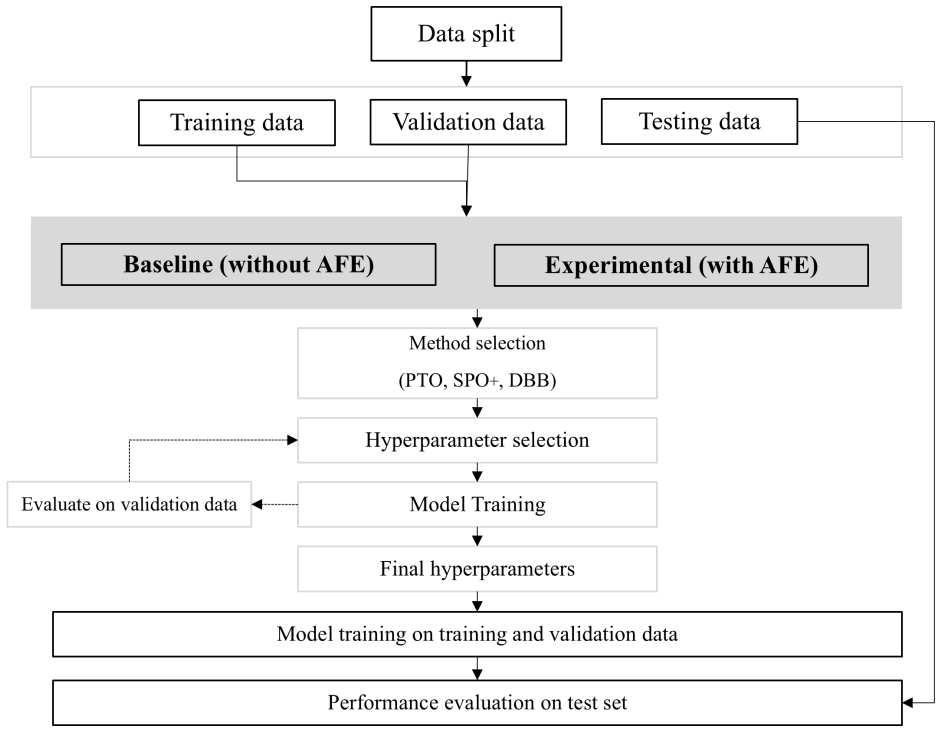
The load-bearing components are: (1) the normalised regret metric, which scales the extra cost of decisions made under imperfect forecasts by the true optimal objective, so training optimises decision quality rather than forecast error; (2) the SPO+ convex surrogate loss, which upper-bounds the regret of predicted cost vectors and enables gradient-based training through the MILP solver; (3) DBB, a differentiable black-box approximation used as a second DFL baseline; and (4) AutoEnergy, the automated feature engineering algorithm that generates temporal, lag, and rolling-window features from timestamps and historical data, reducing reliance on manual domain expertise. The optimisation layer i
What would settle it
A decisive test would be to run the same SPO+ with and without AFE against PTO on a broader sample—for example, a full year of data from multiple households or several tariff structures—and compute normalised regret per property. If SPO+ with AFE does not consistently beat PTO with AFE on that broader sample, or if PTO matches it under certain tariffs, the general claim that DFL is practically viable under data scarcity would fail. A cheaper check is to hold out a different 14-day window from the same property and see whether the 67 percent reduction persists or was specific to the chosen Febr
Extended reading notes
Core claim
The central claim is that aligning prediction with the optimisation objective—training neural networks with a regret-based loss that measures the extra cost caused by imperfect forecasts—is practically viable for real-world battery energy storage system (BESS) scheduling under data scarcity, and that automated feature engineering amplifies this benefit. The authors formulate the BESS scheduling problem as a mixed-integer linear program (MILP) that minimises electricity cost subject to demand, battery capacity, charging/discharging limits, and state-of-charge constraints. They compare three methods: PTO trained with mean squared error, and two decision-focused methods, SPO+ and DBB, trained w
Load-bearing premise
The central result rests on a single 55-day dataset from one UK household, with 41 days for training and validation and 14 consecutive days for testing; if those 14 test days are not representative of other homes, seasons, or markets, the reported regret ordering may not transfer.
Editorial extensions
If this is right
- If the claim holds, energy storage operators with small datasets can obtain cheaper charge/discharge schedules by training on downstream cost rather than on forecast error.
- Automated feature engineering can substitute for manual domain-knowledge engineering in data-scarce BESS settings, since AFE improved all methods and never degraded performance in the paper's runs.
- The result implies that method choice within DFL matters: SPO+ benefited strongly while DBB did not, so DFL should not be treated as a single monolithic approach.
- Because AFE also improved the PTO baseline, the finding suggests that cheaper schedules can come partly from better features independent of the learning objective, and partly from aligning the loss with the decision task.
- The framework is presented as adaptable to other energy management problems with uncertain prices and demand, provided the optimisation constraints and objective are reformulated.
Reading between the lines
- The 55-day, single-property evaluation makes the quantitative regret values a proof of concept rather than a reliable effect size; the ordering could shift on data from different seasons, climates, or tariff structures.
- A testable extension is to run the same AFE-DFL pipeline on a multi-property or multi-market dataset and check whether SPO+ with AFE retains its edge, and whether the large regret spikes on February 22-23 are noise or systematic.
- The SHAP finding that lag and rolling-window features dominate importance suggests that automatic lag selection could be a cheap, transferable fix for PTO baselines too, even before adopting a decision-focused loss.
- Because the paper lists solar integration as future work, a natural follow-up is whether AFE-DFL also reduces regret when the optimisation includes renewable generation, export decisions, and battery degradation constraints.
Editorial analysis
A structured set of objections, weighed in public.
Referee Report
Summary. The paper proposes an AFE–DFL framework for residential battery energy storage scheduling. It couples the authors' AutoEnergy feature-engineering algorithm with three neural-network predictors (PTO, SPO+, DBB) and a MILP battery scheduler, then evaluates normalized regret on 14 held-out days from a 55-day UK property dataset. The headline result is that SPO+ with AFE achieves a mean normalized regret of 0.0672 versus 0.2046 for PTO with AFE, and that AFE improves each method by 19.42–56.48%. Non-parametric tests with Bonferroni corrections are reported.
Significance. The paper has clear strengths: it targets a realistic small-data regime in which DFL is rarely evaluated, uses a novel real-world dataset, ships code and data for reproducibility, and is transparent in reporting adjusted p-values. If the regret evaluation is valid, the SPO+ result would be a practically useful demonstration of decision-focused training for BESS. However, the validity of the central numerical evidence is currently undermined by an unspecified treatment of demand uncertainty in the regret computation, and the abstract's global claims are stronger than the reported statistics support. The contribution is therefore still conditional on a corrected evaluation.
major comments (3)
- [§3.4, Eq. (14); §2.2, constraints (1)–(12)] The regret metric is defined only over predicted cost vectors c_hat: L_Regret(ĉ_i, c_i)=c_i^T w*(ĉ_i)−z*(c_i). But the BESS MILP has demand d_t as a right-hand-side parameter in constraint (2) and as a bound on discharge through b_t ≥ 0. The manuscript never states how predicted demand enters w*(ĉ_i) or how a schedule generated under predicted demand is evaluated against actual demand. If constraint (2) uses predicted demand, the schedule is generally infeasible for actual demand, and c_i^T w*(ĉ_i) omits the cost of recourse grid purchases. If constraint (2) uses actual demand, then demand is not actually being forecast. Either way, the regret values in Table 4 and the 67.16% improvement in §4.1 are not established. SPO+ theory assumes a fixed feasible set with uncertainty only in objective coefficients; applying it to constraint-side demand uncertainty requires explicit justification. T
- [Abstract; §4.1, Table 4] The statement that 'DFL yields lower operating costs than PTO' is contradicted by the DBB results. In Table 4, DBB with AFE has mean regret 0.2458 versus PTO with AFE at 0.2046, and DBB without AFE has 0.3187 versus PTO without AFE at 0.2539. Thus only SPO+ supports the claim that a decision-focused method outperforms PTO. The abstract and conclusions should be qualified to SPO+ specifically or should explicitly state that DFL methods vary, with DBB underperforming PTO in this setting.
- [§4.3, Table 5; §4.2] The AFE-improvement claim, which is a stated contribution, is not statistically robust after multiple-comparison correction. The Bonferroni-adjusted within-method comparisons are not significant: SPO+ (AFE) vs SPO+ (No AFE) has adjusted p=1.000, PTO has p=0.508, and DBB has p=0.302. Moreover, SPO+ (AFE) vs PTO (AFE) has adjusted p=0.070. The 22.9–56.5% improvements are mean differences over 14 test days. The abstract's unqualified 'adding AFE further improves the performance of DFL methods' overstates the evidence. The authors should report effect sizes with confidence intervals, explicitly discuss the low power of pairwise tests on 14 days, and soften the causal wording accordingly.
minor comments (4)
- [§3.4, Eq. (14)] The notation z*(c_i) and w*(ĉ_i) is ambiguous because the MILP also depends on demand d. Please define the optimization value and solution as functions of all exogenous parameters that affect the feasible region, not only the cost vector c.
- [§2.4] The description of 'nested window features' is vague. The paper refers to [28] for details, but the method should be sufficiently self-contained for a reader to know what features are generated (e.g., window lengths, aggregation functions).
- [§3.1, §5] The 55-day dataset is from a single UK property over winter months. This limit on generalisability is acknowledged in the conclusion, but it should also appear in the abstract or introduction since it directly conditions the scope of the empirical claims.
- [General] The GitHub link for code and data appears only in a footnote. If this is an availability statement, it should be a labelled data-availability section in the main text.
Circularity Check
No circular derivation: central claims rest on out-of-sample regret comparisons; self-cited AFE is applied, not assumed.
full rationale
The paper's central claim is an empirical comparison, not a derivation. The 14-day test set is held out from the 55-day dataset, hyperparameters are tuned on a separate validation split, and regret is computed by solving the BESS MILP with predicted and actual parameters. No parameter is fitted to the test set and then renamed a prediction, and the decision-focused losses (SPO+, DBB) are evaluated with a regret metric that is external to those training losses. The AFE method (AutoEnergy) is self-cited [28], but the paper does not rely on the citation as proof of benefit: it directly compares AFE vs no-AFE conditions on the same test set, so the reported 22.9-56.5% improvements are generated by this paper's experiments rather than imported by citation. No uniqueness theorem from the authors is invoked, and no ansatz is smuggled in via citation. A separate correctness concern is that Eq. 14 defines regret only in terms of the objective coefficient vector c, while the BESS MILP also has demand d_t in constraint (2); if predicted demand is used to construct w*, the regret may not reflect true operating cost under actual demand. This is an evaluation-validity risk, not a circularity, and it is not acknowledged in Section 5's limitations. The acknowledged small dataset and limited hyperparameter search affect generalizability, not circularity. The self-citation to AutoEnergy is present but not load-bearing in the circular sense, so the score stays low.
Assumptions & free parameters
free parameters (3)
- BESS configuration parameters (max_charge, max_discharge, E_max, SoC_min) =
5 kWh, 4.5 kWh, 50 kWh, 10%
- ANN hyperparameters per method and AFE condition =
e.g., 2 hidden layers; 30 epochs; learning rate 1e-3 (PTO, DBB) or 1e-5 (SPO+) in best configurations
- AutoEnergy feature selection settings =
not reported in this paper (Kendall tau significance threshold)
assumptions (4)
- domain assumption MILP constraints (2)-(10) adequately model BESS operation and economics, including round-trip efficiency approximated by a 4.5 kW discharge cap.
- domain assumption The 14-day test window is representative of future price-demand conditions for this BESS (stationarity).
- domain assumption DFL training through PyEPO correctly handles two uncertain quantities, price in the objective and demand in constraints.
- standard math Regret metric (Eq. 14) with true cost vector measures decision quality.
Cite this review
Pith. "Pith review of Decision-Focused Learning Enhanced by Automated Feature Engineering for Energy Storage Optimisation." pith.science (2026). https://pith.science/paper/33XHXBLK
@misc{pith2026250905772,
  author       = {Pith},
  title        = {Pith review of: Decision-Focused Learning Enhanced by Automated Feature Engineering for Energy Storage Optimisation},
  year         = {2026},
  howpublished = {\url{https://pith.science/paper/33XHXBLK}},
  note         = {Machine review of arXiv:2509.05772}
}
read the original abstract
Decision-making under uncertainty in energy management is complicated by unknown parameters hindering optimal strategies, particularly in Battery Energy Storage System (BESS) operations. Predict-Then-Optimise (PTO) approaches treat forecasting and optimisation as separate processes, allowing prediction errors to cascade into suboptimal decisions as models minimise forecasting errors rather than optimising downstream tasks. The emerging Decision-Focused Learning (DFL) methods overcome this limitation by integrating prediction and optimisation; however, they are relatively new and have been tested primarily on synthetic datasets or small-scale problems, with limited evidence of their practical viability. Real-world BESS applications present additional challenges, including greater variability and data scarcity due to collection constraints and operational limitations. Because of these challenges, this work leverages Automated Feature Engineering (AFE) to extract richer representations and improve the nascent approach of DFL. We propose an AFE-DFL framework suitable for small datasets that forecasts electricity prices and demand while optimising BESS operations to minimise costs. We validate its effectiveness on a novel real-world UK property dataset. The evaluation compares DFL methods against PTO, with and without AFE. The results show that, on average, DFL yields lower operating costs than PTO and adding AFE further improves the performance of DFL methods by 22.9-56.5% compared to the same models without AFE. These findings provide empirical evidence for DFL's practical viability in real-world settings, indicating that domain-specific AFE enhances DFL and reduces reliance on domain expertise for BESS optimisation, yielding economic benefits with broader implications for energy management systems facing similar challenges.
Figures


Figures from the paper (6 more)


Reference graph
Works this paper leans on
-
[1]
Muhammad Sohail Ibrahim, Wei Dong, and Qiang Yang. Machine learning driven smart electric power systems: Current trends and new perspectives.Applied Energy, 272:115237, 2020
work page 2020
-
[2]
M.S. Reza, M.A. Hannan, Pin Jern Ker, M. Mansor, M.S. Hossain Lipu, M.J. Hossain, and T.M. Indra Mahlia. Uncertainty parameters of battery energy storage integrated grid and their modeling approaches: A review and future research directions.Journal of Energy Storage, 68:107698, 2023
work page 2023
-
[3]
Yuqing Yang, Stephen Bremner, Chris Menictas, and Merlinde Kay. Modelling and optimal energy management for battery energy storage systems in renewable energy systems: A review.Renewable and Sustainable Energy Reviews, 167:112671, 2022
work page 2022
-
[4]
Shiwei Yu, Limin You, and Shuangshuang Zhou. A review of optimization modeling and solution methods in renewable energy systems.Frontiers of Engineering Management, 10(4):640–671, 2023
work page 2023
-
[5]
Predict+optimize problem in renewable energy scheduling
Christoph Bergmeir, Frits de Nijs, Evgenii Genov, Abishek Sriramulu, Mahdi Abolghasemi, Richard Bean, John Betts, Quang Bui, Nam Trong Dinh, Nils Einecke, Rasul Esmaeilbeigi, Scott Ferraro, Priya Galketiya, Robert Glasgow, Rakshitha Godahewa, Yanfei Kang, Steffen Limmer, Luis Magdalena, Pablo Montero-Manso, Daniel Peralta, Yogesh Pipada Sunil Kumar, Aleja...
work page 2025
-
[6]
Toon Vanderschueren, Tim Verdonck, Bart Baesens, and Wouter Verbeke. Predict-then-optimize or predict-and- optimize? an empirical evaluation of cost-sensitive learning strategies.Information Sciences, 594:400–415, 2022
work page 2022
-
[7]
Bryan Wilder, Bistra Dilkina, and Milind Tambe. Melding the data-decisions pipeline: Decision-focused learning for combinatorial optimization.Proceedings of the AAAI Conference on Artificial Intelligence, 33(01):1658–1665, 2019
work page 2019
-
[8]
Decision-focused learning: Through the lens of learning to rank
Jayanta Mandi, Vıctor Bucarey, Maxime Mulamba Ke Tchomba, and Tias Guns. Decision-focused learning: Through the lens of learning to rank. InInternational conference on machine learning, pages 14935–14947. PMLR, 2022
work page 2022
Show all 49 references
-
[9]
Task-based end-to-end model learning in stochastic optimization
Priya Donti, Brandon Amos, and J Zico Kolter. Task-based end-to-end model learning in stochastic optimization. Advances in neural information processing systems, 30, 2017
2017
-
[10]
The forecast trap.Ecology Letters, 25(7):1655–1664, 2022
Carl Boettiger. The forecast trap.Ecology Letters, 25(7):1655–1664, 2022
2022
-
[11]
Stuckey, and Tias Guns
Jayanta Mandi, Emir Demirovi, Peter J. Stuckey, and Tias Guns. Smart predict-and-optimize for hard combina- torial optimization problems.Proceedings of the AAAI Conference on Artificial Intelligence, 34(02):1603–1610, 2020
2020
-
[12]
Predict-and-optimize techniques for data-driven optimization problems: A review.Neural Processing Letters, 57(2), 2025
Alan Anis Lahoud, Ahmad Saeed Khan, Erik Schaffernicht, Marco Trincavelli, and Johannes Andreas Stork. Predict-and-optimize techniques for data-driven optimization problems: A review.Neural Processing Letters, 57(2), 2025
2025
-
[13]
predict, then optimize
Adam N. Elmachtoub and Paul Grigas. Smart “predict, then optimize”.Management Science, 68(1):9–26, 2022
2022
-
[14]
Differentiation of blackbox combinatorial solvers
Marin Vlastelica Pogan ˇci´c, Anselm Paulus, Vit Musil, Georg Martius, and Michal Rolinek. Differentiation of blackbox combinatorial solvers. InInternational Conference on Learning Representations, 2020
2020
-
[15]
End-to-end constrained optimiza- tion learning: A survey.arXiv preprint arXiv:2103.16378, 2021
James Kotary, Ferdinando Fioretto, Pascal Van Hentenryck, and Bryan Wilder. End-to-end constrained optimiza- tion learning: A survey.arXiv preprint arXiv:2103.16378, 2021
2021 arXiv
-
[16]
Decision-focused learning: Foundations, state of the art, benchmark and future opportunities.Journal of Artificial Intelligence Research, 80:1623–1701, 2024
Jayanta Mandi, James Kotary, Senne Berden, Maxime Mulamba, Victor Bucarey, Tias Guns, and Ferdinando Fioretto. Decision-focused learning: Foundations, state of the art, benchmark and future opportunities.Journal of Artificial Intelligence Research, 80:1623–1701, 2024
2024
-
[17]
Benchmarking pto and pno methods in the predictive combinatorial optimization regime.Advances in Neural Information Processing Systems, 37:65944–65971, 2024
Haoyu Geng, Hang Ruan, Runzhong Wang, Yang Li, Yang Wang, Lei Chen, and Junchi Yan. Benchmarking pto and pno methods in the predictive combinatorial optimization regime.Advances in Neural Information Processing Systems, 37:65944–65971, 2024
2024
-
[18]
Decision fo- cused causal learning for direct counterfactual marketing optimization
Hao Zhou, Rongxiao Huang, Shaoming Li, Guibin Jiang, Jiaqi Zheng, Bing Cheng, and Wei Lin. Decision fo- cused causal learning for direct counterfactual marketing optimization. InProceedings of the 30th ACM SIGKDD Conference on Knowledge Discovery and Data Mining, page 6368–637...
2024
-
[19]
Aguado, and Franc ¸ois Vall´ee
´Angel Paredes, Jean-Franc ¸ois Toubeau, Jos´e A. Aguado, and Franc ¸ois Vall´ee. On the participation of energy storage systems in reserve markets using decision focused learning.Sustainable Energy, Grids and Networks, 42:101677, 2025. 20
2025
-
[20]
Ai-optimized decision-making in energy systems: Toward a decision-aware machine learning framework.Engi- neering, 2025
Guotao Wang, Zhenjia Lin, Yuntian Chen, Haoran Ji, Dayin Chen, Haoran Zhang, Peng Li, and Jinyue Yan. Ai-optimized decision-making in energy systems: Toward a decision-aware machine learning framework.Engi- neering, 2025
2025
-
[21]
Electricity price prediction for energy storage system arbitrage: A decision-focused approach.IEEE Transactions on Smart Grid, 13(4):2822–2832, 2022
Linwei Sang, Yinliang Xu, Huan Long, Qinran Hu, and Hongbin Sun. Electricity price prediction for energy storage system arbitrage: A decision-focused approach.IEEE Transactions on Smart Grid, 13(4):2822–2832, 2022
2022
-
[22]
Why do tree-based models still outperform deep learning on typical tabular data?Advances in neural information processing systems, 35:507–520, 2022
L ´eo Grinsztajn, Edouard Oyallon, and Ga¨el Varoquaux. Why do tree-based models still outperform deep learning on typical tabular data?Advances in neural information processing systems, 35:507–520, 2022
2022
-
[23]
TabPFN: A Transformer That Solves Small Tabular Classification Problems in a Second, 2022
Noah Hollmann, Samuel M ¨uller, Katharina Eggensperger, and Frank Hutter. TabPFN: A Transformer That Solves Small Tabular Classification Problems in a Second, 2022
2022
-
[24]
Bowler, Direnc Pekaslan, Gulcan Serdaroglu, Steve Closs, Nicholas J
Nasser Alkhulaifi, Alexander L. Bowler, Direnc Pekaslan, Gulcan Serdaroglu, Steve Closs, Nicholas J. Watson, and Isaac Triguero. Machine learning pipeline for energy and environmental prediction in cold storage facilities. IEEE Access, 12:153935–153951, 2024
2024
-
[25]
Srinivasan, and Xiangnan Song
Zeyu Wang, Lisha Xia, Hongping Yuan, Ravi S. Srinivasan, and Xiangnan Song. Principles, research status, and prospects of feature engineering for data-driven building energy prediction: A comprehensive review.Journal of Building Engineering, 58:105028, 2022
2022
-
[26]
AFGSL: Automatic Feature Generation based on Graph Structure Learning
Yu Wu, Xin Xi, and Jieyue He. AFGSL: Automatic Feature Generation based on Graph Structure Learning. Knowledge-Based Systems, 238:107835, 2022
2022
-
[27]
Large Language Models for Automated Data Science: Intro- ducing CAAFE for Context-Aware Automated Feature Engineering.Advances in Neural Information Processing Systems, 36, 2024
Noah Hollmann, Samuel M ¨uller, and Frank Hutter. Large Language Models for Automated Data Science: Intro- ducing CAAFE for Context-Aware Automated Feature Engineering.Advances in Neural Information Processing Systems, 36, 2024
2024
-
[28]
Bowler, Direnc Pekaslan, Nicholas J
Nasser Alkhulaifi, Alexander L. Bowler, Direnc Pekaslan, Nicholas J. Watson, and Isaac Triguero. Autoenergy: An automated feature engineering algorithm for energy consumption forecasting with automl.Knowledge-Based Systems, page 114300, 2025
2025
-
[29]
How to predict and optimise with asymmetric error metrics, 2022
Mahdi Abolghasemi and Richard Bean. How to predict and optimise with asymmetric error metrics, 2022
2022
-
[30]
Interior point solving for lp-based prediction+ optimisation.Advances in Neural Information Processing Systems, 33:7272–7282, 2020
Jayanta Mandi and Tias Guns. Interior point solving for lp-based prediction+ optimisation.Advances in Neural Information Processing Systems, 33:7272–7282, 2020
2020
-
[31]
Hannan, S.B
M.A. Hannan, S.B. Wali, P.J. Ker, M.S. Abd Rahman, M. Mansor, V .K. Ramachandaramurthy, K.M. Muttaqi, T.M.I. Mahlia, and Z.Y . Dong. Battery energy-storage system: A review of technologies, optimization objectives, constraints, approaches, and outstanding issues.Journal of Ene...
2021
-
[32]
Smart optimization in battery energy storage systems: An overview.Energy and AI, 17:100378, 2024
Hui Song, Chen Liu, Ali Moradi Amani, Mingchen Gu, Mahdi Jalili, Lasantha Meegahapola, Xinghuo Yu, and George Dickeson. Smart optimization in battery energy storage systems: An overview.Energy and AI, 17:100378, 2024
2024
-
[33]
Alrasheedi, Khalid A
Adel F. Alrasheedi, Khalid A. Alnowibet, and Ahmad M. Alshamrani. A smart predict-and-optimize framework for microgrid’s bidding strategy in a day-ahead electricity market.Electric Power Systems Research, 228:110016, 2024
2024
-
[34]
PhD thesis, Vrije Universiteit Brussel, 2023
Jayanta Mandi.Towards Scalable Decision-Focused Learning for Combinatorial Optimization Problems. PhD thesis, Vrije Universiteit Brussel, 2023
2023
-
[35]
Bo Tang and Elias B. Khalil. Pyepo: a pytorch-based end-to-end predict-then-optimize library for linear and integer programming.Mathematical Programming Computation, 16(3):297–335, 2024
2024
-
[36]
Intelligent plant – industrial software solutions, 2025
Intelligent Plant Ltd. Intelligent plant – industrial software solutions, 2025. Accessed: 2025-05-19
2025
-
[37]
Octopus energy api endpoints.https://developer.octopus.energy/rest/guides/end points, 2025
Octopus Energy. Octopus energy api endpoints.https://developer.octopus.energy/rest/guides/end points, 2025. [Accessed 19-may-2025]
2025
-
[38]
Prediction of worldwide energy resources (power).https://power.larc.nasa.gov/data-acces s-viewer/, 2025
NASA. Prediction of worldwide energy resources (power).https://power.larc.nasa.gov/data-acces s-viewer/, 2025. [Accessed 19-may-2025]
2025
-
[39]
Multi-task learning based multi-energy load prediction in integrated energy system.Applied Intelligence, 53(9):10273–10289, 2022
Lulu Wang, Mao Tan, Jie Chen, and Chengchen Liao. Multi-task learning based multi-energy load prediction in integrated energy system.Applied Intelligence, 53(9):10273–10289, 2022
2022
-
[40]
Python API Reference.https://docs.gurobi.com/projects/optimizer/e n/current/reference/python.html, 2024
Gurobi Optimization, LLC. Python API Reference.https://docs.gurobi.com/projects/optimizer/e n/current/reference/python.html, 2024. Accessed: 2025-04-01
2024
-
[41]
Sheskin.Handbook of Parametric and Nonparametric Statistical Procedures: Third Edition
David J. Sheskin.Handbook of Parametric and Nonparametric Statistical Procedures: Third Edition. Chapman and Hall/CRC, 2003. 21
2003
-
[42]
Salvador Garc ´ıa, Alberto Fern ´andez, Juli´an Luengo, and Francisco Herrera. Advanced nonparametric tests for multiple comparisons in the design of experiments in computational intelligence and data mining: Experimental analysis of power.Information Sciences, 180(10):2044–2064, 2010
-
[43]
Statistical comparisons of classifiers over multiple data sets.The Journal of Machine learning research, 7:1–30, 2006
Janez Dem ˇsar. Statistical comparisons of classifiers over multiple data sets.The Journal of Machine learning research, 7:1–30, 2006
2006
-
[44]
An Extension on” Statistical Comparisons of Classifiers over Multiple Data Sets” for all Pairwise Comparisons.Journal of machine learning research, 9(12), 2008
Salvador Garcia and Francisco Herrera. An Extension on” Statistical Comparisons of Classifiers over Multiple Data Sets” for all Pairwise Comparisons.Journal of machine learning research, 9(12), 2008
2008
-
[45]
Landscape surrogate: Learning decision losses for mathematical optimization under partial information.Ad- vances in Neural Information Processing Systems, 36:27332–27350, 2023
Arman Zharmagambetov, Brandon Amos, Aaron Ferber, Taoan Huang, Bistra Dilkina, and Yuandong Tian. Landscape surrogate: Learning decision losses for mathematical optimization under partial information.Ad- vances in Neural Information Processing Systems, 36:27332–27350, 2023
2023
-
[46]
Bowler, Direnc Pekaslan, Isaac Triguero, and Nicholas J
Nasser Alkhulaifi, Alexander L. Bowler, Direnc Pekaslan, Isaac Triguero, and Nicholas J. Watson. Exploring Automated Feature Engineering for Energy Consumption Forecasting with AutoML. In2024 IEEE International Conference on Systems, Man, and Cybernetics (SMC), page 2993–2998....
2024
-
[47]
A unified approach to interpreting model predictions
Scott M Lundberg and Su-In Lee. A unified approach to interpreting model predictions. In I. Guyon, U. V on Luxburg, S. Bengio, H. Wallach, R. Fergus, S. Vishwanathan, and R. Garnett, editors,Advances in Neural Information Processing Systems, volume 30. Curran Associates, Inc., 2017
2017
-
[48]
Prediction of building’s thermal performance using lstm and mlp neural networks.Applied Sciences, 10(21):7439, 2020
Miguel Mart ´ınez Comesa ˜na, Lara Febrero-Garrido, Francisco Troncoso-Pastoriza, and Javier Mart ´ınez-Torres. Prediction of building’s thermal performance using lstm and mlp neural networks.Applied Sciences, 10(21):7439, 2020
2020
-
[49]
Contrastive losses and solution caching for predict-and-optimize
Maxime Mulamba, Jayanta Mandi, Michelangelo Diligenti, Michele Lombardi, Victor Bucarey, and Tias Guns. Contrastive losses and solution caching for predict-and-optimize. InProceedings of the Thirtieth International Joint Conference on Artificial Intelligence, IJCAI-2021, page ...
2021
Reviewed August 5, 2026 · model on record in the stance chip above.
Discussion (0). Continue with ORCID to comment.