FREESS: A Web-Based Educational Simulator for a RISC-V-Inspired Superscalar Processor with Tomasulo-Style Dynamic Scheduling
Pith reviewed 2026-07-01 15:54 UTC · model grok-4.3
The pith
FREESS gives a single textual view of register renaming, issue, execution, and commit in a Tomasulo-style superscalar processor.
A machine-rendered reading of the paper's core claim, the machinery that carries it, and where it could break.
Core claim
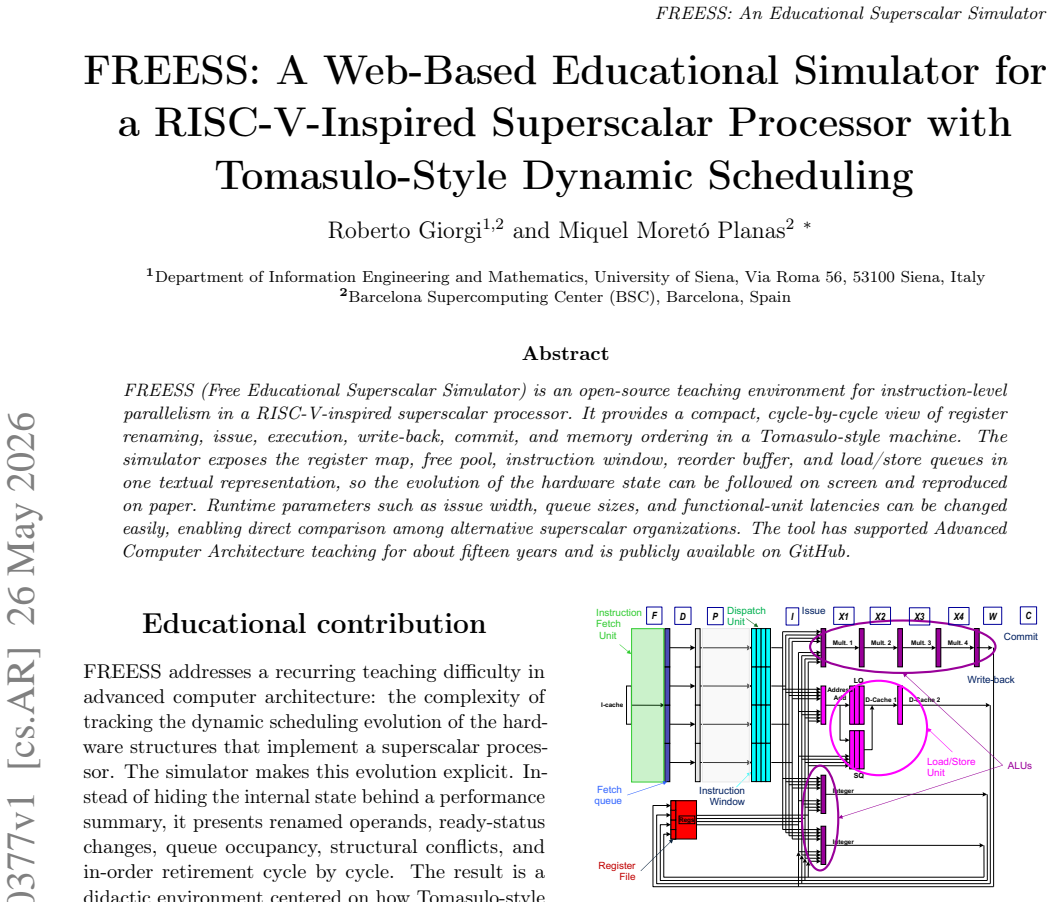
FREESS is an open-source web-based simulator for a RISC-V-inspired superscalar processor that implements Tomasulo-style dynamic scheduling. It provides a compact, cycle-by-cycle view of register renaming, issue, execution, write-back, commit, and memory ordering. The simulator exposes the register map, free pool, instruction window, reorder buffer, and load/store queues in one textual representation so that the evolution of the hardware state can be followed on screen and reproduced on paper. Runtime parameters such as issue width, queue sizes, and functional-unit latencies can be changed easily to enable direct comparison among alternative superscalar organizations.
What carries the argument
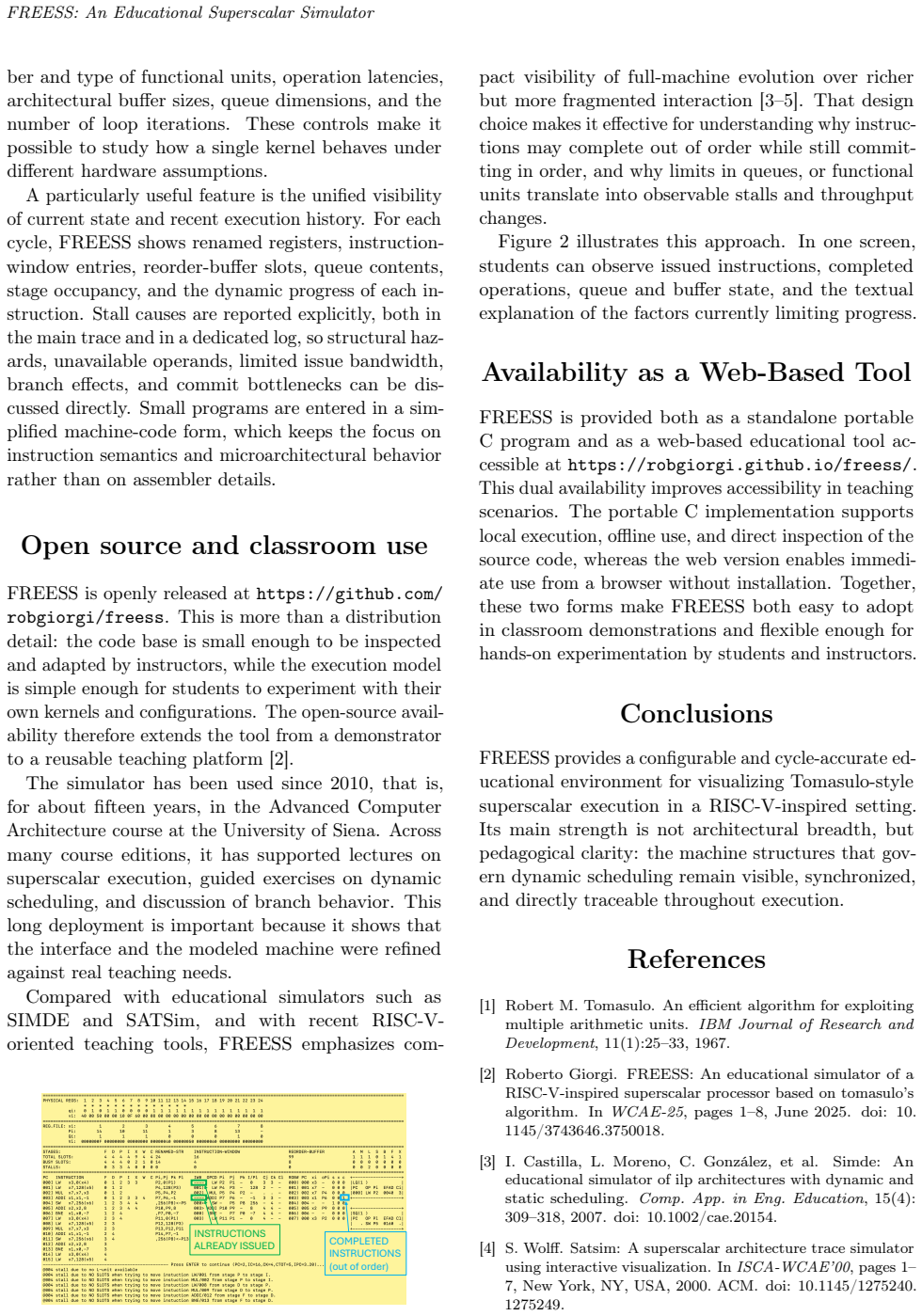
The single textual representation that combines the register map, free pool, instruction window, reorder buffer, and load/store queues and updates each cycle.
If this is right
- Alternative superscalar organizations can be compared directly by varying issue width, queue sizes, and functional-unit latencies at runtime.
- Students can follow the evolution of hardware state on screen and reproduce it on paper for any chosen parameter set.
- The tool supports teaching of instruction-level parallelism and dynamic scheduling in advanced computer architecture courses.
- Public availability allows repeated use and sharing of specific configuration examples across classrooms.
Where Pith is reading between the lines
- The combined display of multiple structures may help learners see how register renaming interacts with the reorder buffer and load/store queues in one glance.
- If the model holds, the simulator can serve as a reference for checking student hand simulations of Tomasulo execution.
- The ability to change parameters on the fly suggests the same interface could support quick exploration of design trade-offs in related out-of-order mechanisms.
Load-bearing premise
The simulator's internal model correctly implements Tomasulo-style dynamic scheduling and RISC-V semantics for the exposed hardware structures.
What would settle it
Running a known instruction sequence through the simulator and comparing its cycle-by-cycle state changes against an independent manual Tomasulo simulation with identical parameters would reveal any mismatch in the model.
Figures
read the original abstract
FREESS (Free Educational Superscalar Simulator) is an open-source teaching environment for instruction-level parallelism in a RISC-V-inspired superscalar processor. It provides a compact, cycle-by-cycle view of register renaming, issue, execution, write-back, commit, and memory ordering in a Tomasulo-style machine. The simulator exposes the register map, free pool, instruction window, reorder buffer, and load/store queues in one textual representation, so the evolution of the hardware state can be followed on screen and reproduced on paper. Runtime parameters such as issue width, queue sizes, and functional-unit latencies can be changed easily, enabling direct comparison among alternative superscalar organizations. The tool has supported Advanced Computer Architecture teaching for about fifteen years and is publicly available on GitHub.
Editorial analysis
A structured set of objections, weighed in public.
Referee Report
Summary. The manuscript describes FREESS, a web-based open-source educational simulator for a RISC-V-inspired superscalar processor with Tomasulo-style dynamic scheduling. It provides a compact, cycle-by-cycle view of register renaming, issue, execution, write-back, commit, and memory ordering, exposing the register map, free pool, instruction window, reorder buffer, and load/store queues in one textual representation. Runtime parameters such as issue width, queue sizes, and functional-unit latencies can be changed to compare superscalar organizations. The tool has supported Advanced Computer Architecture teaching for about fifteen years and is publicly available on GitHub.
Significance. If the simulator's internal model matches the described behaviors, FREESS provides a practical educational resource for visualizing instruction-level parallelism and Tomasulo structures. The open-source GitHub release and fifteen years of documented classroom deployment are explicit strengths that support reproducibility and direct auditing by users.
minor comments (1)
- The abstract states that the tool 'exposes' multiple hardware structures in one textual representation, but the manuscript would benefit from including at least one concrete cycle-by-cycle example trace (with parameter settings) to illustrate the claimed compactness and reproducibility on paper.
Simulated Author's Rebuttal
We thank the referee for the thorough summary of the manuscript and for the recommendation to accept. The report contains no major comments.
Circularity Check
No significant circularity; tool-description paper with no derivations
full rationale
The manuscript is a description of an open-source educational simulator (FREESS) exposing Tomasulo-style structures in a RISC-V-inspired processor. No equations, predictions, fitted parameters, or load-bearing derivations appear in the abstract or stated claims. The central assertions concern the tool's UI features, parameter configurability, GitHub availability, and fifteen years of classroom use; these are externally verifiable and do not reduce to self-definition or self-citation chains. No steps match any enumerated circularity pattern.
Axiom & Free-Parameter Ledger
Reference graph
Works this paper leans on
-
[1]
Tomasulo
Robert M. Tomasulo. An efficient algorithm for exploiting multiple arithmetic units.IBM Journal of Research and Development, 11(1):25–33, 1967
1967
-
[2]
Roberto Giorgi. FREESS: An educational simulator of a RISC-V-inspired superscalar processor based on tomasulo’s algorithm. InWCAE-25, pages 1–8, June 2025. doi: 10. 1145/3743646.3750018
-
[3]
I. Castilla, L. Moreno, C. González, et al. Simde: An educational simulator of ilp architectures with dynamic and static scheduling.Comp. App. in Eng. Education, 15(4): 309–318, 2007. doi: 10.1002/cae.20154
-
[4]
S. Wolff. Satsim: A superscalar architecture trace simulator using interactive visualization. InISCA-WCAE’00, pages 1– 7, New York, NY, USA, 2000. ACM. doi: 10.1145/1275240. 1275249
-
[5]
J. Jaros. Web-based simulator of superscalar risc-v proces- sors. InICS’24, pages 1–6, Piscataway, NJ, USA, 2024. IEEE. doi: 10.1109/SCW63240.2024.00209. 2 RISC-V Summit Europe, Bologna, 8-12th June 2026
discussion (0)
Sign in with ORCID, Apple, or X to comment. Anyone can read and Pith papers without signing in.