REVIEW 2 major objections 6 minor 71 references
Accountability Framework for Healthcare AI Systems: Towards Joint Accountability in Decision Making
T0 review · 2 major / 6 minor · reviewed 2026-08-05 · deepseek-v4-flash
Pith's one-line read The paper argues that final clinical decisions made with AI assistance carry joint accountability shared by healthcare professionals and the AI development team.
desk verdict A useful taxonomy of healthcare AI accountability, but the central joint-accountability claim is asserted rather than derived. read the letter →
The pith
A machine-rendered reading of the paper's core claim, the machinery that carries it, and where it could break.
The reading
What carries the argument
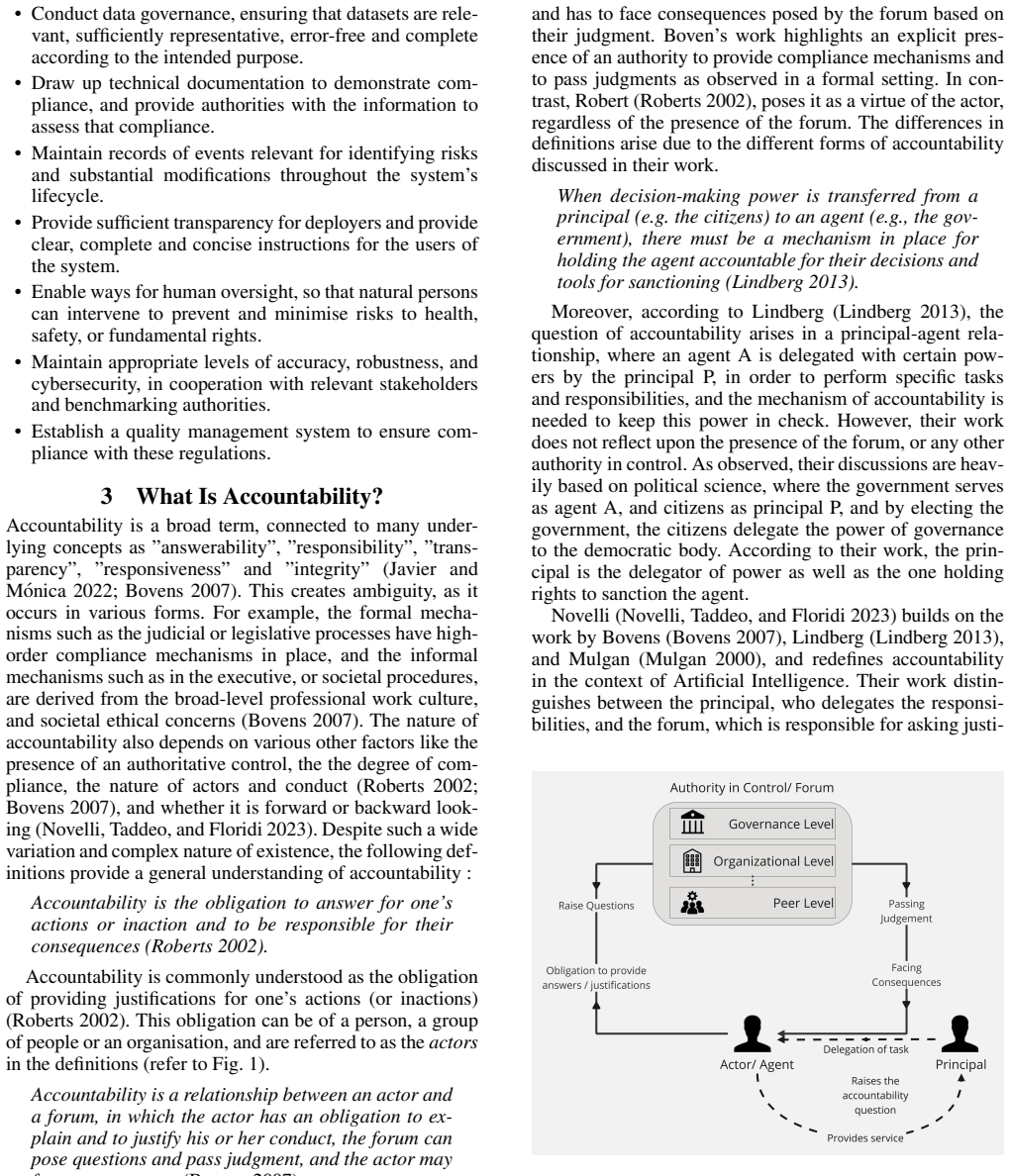
The key mechanism is the principal-agent-forum model of accountability, in which an actor must explain and justify conduct to a forum that can pose questions and pass judgment. The paper splits the principal (patients) from the forum (regulators and authorities) and treats the entire healthcare AI pipeline as a single interdependent agent. It then classifies actor conduct into three levels, product, process, and decision, and assigns joint accountability specifically to the decision tier, where the clinician and the AI development team share responsibility for the final care decision.
What would settle it
Observe a deployed AI-assisted diagnostic service after an adverse outcome and inspect the incident record: if the clinician's note and the developer's logs are never jointly referenced, or the two parties produce contradictory accounts with no shared review board, the joint-accountability model is not operating. Stronger, a controlled pilot that adopts joint accountability and shows no reduction in blame-shifting or no improvement in information flow compared with single-party accountability would count against the central claim.
Extended reading notes
Core claim
The paper's central claim is that accountability for a final clinical decision made with AI assistance belongs jointly to the healthcare professional and the AI development team. The argument runs through two conditions on accountable decision-making, control and epistemic understanding: the AI system shapes the clinician's situation through training demands, cognitive load, and the black-box opacity of model outputs, while the clinician makes the final call. Neither party alone can fully satisfy the conditions for accountability, so the unit of accountability should be the pair. Alongside this, the paper develops a three-tier structure that classifies actor conduct into product, process, an
Load-bearing premise
The framework assumes that a governance model in which patients delegate power and an external authority exacts justifications transfers cleanly to a multi-organisation healthcare AI pipeline, and that clinicians and AI developers can meaningfully share responsibility for final care decisions; the paper itself says formalising and operationalising this needs deliberate discussion and action.
Editorial extensions
If this is right
- Regulators and auditors can map existing rules, such as data protection laws, the AI Act, and hospital norms, onto the product, process, and decision tiers and see which parts of the pipeline currently lack oversight.
- Clinicians and AI developers would be evaluated jointly on final treatment decisions, which could reduce blame-shifting and scapegoating after adverse outcomes.
- Explainability tools would be designed as communication interfaces between clinicians and developers, not merely as post-hoc justifications for individual decisions.
- Accountability mechanisms that currently focus on products and processes would need to be extended to a decision-level review layer.
- Joint accountability would need to be built into handover processes, procurement contracts, and audit practice, though the paper notes formalising this requires deliberate discussion and action.
Reading between the lines
- If joint accountability is institutionalised, hospital procurement contracts and liability insurance between healthcare providers and AI vendors would likely need shared-risk clauses; the paper does not propose these.
- A concrete test of the framework would be to compare incident investigations in settings that adopt joint accountability against settings with single-party accountability, measuring changes in blame-shifting, reporting, and learning.
- The paper's view of explainability as a communication tool implies that explanation quality should be judged by whether it improves the clinician-developer dialogue, not only by technical accuracy; this criterion is left implicit.
- Treating the whole pipeline as one interdependent agent suggests that explicit handover artifacts, such as shared decision logs, could mitigate the 'many eyes' problem, but the paper does not empirically test this.
Signed reviews
Editorial analysis
A structured set of objections, weighed in public.
Referee Report
Summary. The paper addresses accountability in AI-assisted healthcare decision-making. It first reviews how 'accountability' is understood across governance and AI literatures, building on Bovens, Lindberg, and Novelli et al. to define actors, forum, and principal. It then proposes a conceptual framework positioning healthcare AI actors under existing regulations and mechanisms, identifies three practical challenges (independent authorities with unclear handovers, unclear accountability for shared dependencies, and interdisciplinary miscommunication), and introduces a three-tier accountability structure distinguishing product, process, and decision-level accountability. The central normative proposal is that final AI-assisted clinical decisions should be governed by joint accountability between healthcare professionals and the AI developing team, with explainability as a tool to promote communication and collaboration. The paper explicitly states in Section 7 that it lacks empirical grounding and that formalizing/operationalizing joint accountability requires future work.
Significance. If the framework is accepted, it offers a useful common vocabulary for discussing accountability in healthcare AI and organizes existing mechanisms into a coherent structure. The paper's strengths include its careful synthesis of well-established accountability definitions, the identification of specific challenges such as unclear handover processes and shared dependencies, and the cataloguing of technical mechanisms mapped to accountability concepts. The three-tier structure is a plausible heuristic. However, the central normative claim about joint accountability is not adequately supported, and the claimed benefits of joint accountability are asserted rather than demonstrated. The paper is a timely conceptual contribution, but its main recommendation needs stronger theoretical grounding.
major comments (2)
- [§6, Decision Level (Joint) Accountability] The argument for joint accountability is not supported by the paper's own framework. The authors use Habli et al.'s control and epistemic conditions to argue that clinicians cannot be solely accountable, because AI involvement creates indirect effects and black-box models block the epistemic condition. However, they never check whether the AI developing team satisfies those same conditions for the specific patient decision. In typical deployments, the developer has no control over the final act (the clinician can override) and lacks epistemic access to patient-specific context; when the developer does control the model, the object of accountability is the model/product, which the paper already classifies under product-level accountability. Thus, the move from 'AI influences the final decision' to 'the final decision should be jointly accountable' is a non sequitur; the logically consiste
- [§6 and §5.2] The claimed benefits of joint accountability—releasing accountability tensions, promoting healthy communication, and minimising scapegoating and blaming—and the claim that explainability facilitates collaboration are asserted without empirical or systematic theoretical support. These benefits are load-bearing for the recommendation to adopt joint accountability. Since Section 7 acknowledges the lack of empirical grounding, the authors should either reframe these claims as tentative hypotheses or provide theoretical argumentation from the organizational accountability literature. As written, the central recommendation rests on unsubstantiated assertions.
minor comments (6)
- [§3] Typo: 'the the degree of compliance' should read 'the degree of compliance'.
- [§3 and throughout] The author name is inconsistent: the text refers to 'Boven' and 'Boven’s work' while the reference is Bovens (2007). Use 'Bovens' consistently.
- [References] Barredo Arrieta et al. 2020a and 2020b appear to be the same paper; remove the duplicate or distinguish them properly.
- [Figure 2 caption] Typo: 'regulatiosn' should be 'regulations'.
- [§5.1] Incomplete sentence: 'Additionally.' appears with a standalone period. Fix punctuation.
- [§6] Citation format: 'Staszkiewicz et. al.' should be 'Staszkiewicz et al.'
Circularity Check
No significant circularity: the framework is an explicit application of external accountability definitions, not a self-referential derivation.
full rationale
The paper makes no quantitative predictions and contains no fitted parameters or equations. Its derivation chain is definitional and normative: it adopts accountability definitions from Bovens (2007), Roberts (2002), Lindberg (2013) and Novelli et al. (2023), then maps healthcare-AI actors, authorities, and mechanisms onto those definitions. The three-tier structure is explicitly presented as an application of Bovens's conduct-based classification ('We classify this according to Boven's classification of accountability based on the aspect of conduct'), not as a derivation of that classification. The central claim that AI-influenced final decisions should carry joint accountability is argued from control and epistemic conditions (Habli et al. 2020) and from the existence of shared dependencies; it may be under-supported as a normative inference, but it is not assumed in the premises and therefore is not circular. The only self-citation (Knof et al. 2023, featuring two of the current authors) appears as an example of XAI in Table 1 and in a list of explainability mechanisms; it is not load-bearing for the framework or the joint-accountability conclusion. The paper itself flags in Section 7 that the framework lacks empirical grounding and that formalising joint accountability requires future work, which further indicates the authors are not presenting a forced or self-referential derivation. No circular step can be exhibited.
Assumptions & free parameters
assumptions (5)
- domain assumption The principal-agent-forum model of accountability applies to healthcare AI systems.
- domain assumption Patients act as the principal who delegates health decisions to the system.
- domain assumption The entire healthcare AI pipeline can be treated as a single agent.
- ad hoc to paper Joint accountability is feasible and beneficial.
- ad hoc to paper Explainability can instigate communication and information sharing between actors.
invented entities (2)
-
Three-tier accountability structure (product, process, decision)
-
Joint accountability for AI-assisted decisions
Cite this review
Pith. "Pith review of Accountability Framework for Healthcare AI Systems: Towards Joint Accountability in Decision Making." pith.science (2026). https://pith.science/paper/343TMDFL
@misc{pith2026250903286,
  author       = {Pith},
  title        = {Pith review of: Accountability Framework for Healthcare AI Systems: Towards Joint Accountability in Decision Making},
  year         = {2026},
  howpublished = {\url{https://pith.science/paper/343TMDFL}},
  note         = {Machine review of arXiv:2509.03286}
}
read the original abstract
AI is transforming the healthcare domain and is increasingly helping practitioners to make health-related decisions. Therefore, accountability becomes a crucial concern for critical AI-driven decisions. Although regulatory bodies, such as the EU commission, provide guidelines, they are highlevel and focus on the ''what'' that should be done and less on the ''how'', creating a knowledge gap for actors. Through an extensive analysis, we found that the term accountability is perceived and dealt with in many different ways, depending on the actor's expertise and domain of work. With increasing concerns about AI accountability issues and the ambiguity around this term, this paper bridges the gap between the ''what'' and ''how'' of AI accountability, specifically for AI systems in healthcare. We do this by analysing the concept of accountability, formulating an accountability framework, and providing a three-tier structure for handling various accountability mechanisms. Our accountability framework positions the regulations of healthcare AI systems and the mechanisms adopted by the actors under a consistent accountability regime. Moreover, the three-tier structure guides the actors of the healthcare AI system to categorise the mechanisms based on their conduct. Through our framework, we advocate that decision-making in healthcare AI holds shared dependencies, where accountability should be dealt with jointly and should foster collaborations. We highlight the role of explainability in instigating communication and information sharing between the actors to further facilitate the collaborative process.
Figures


Reference graph
Works this paper leans on
-
[1]
Agarwal, V.; Priyanka, L.; Reddy, P.; Sidhu, A.; Gupta, S.; and Rastogi, S. 2024. Analyzing Ethical Dilemmas in AI-Assisted Diagnostics and Treatment Decisions for Patient Safety. Seminars in Medical Writing and Education, 3
work page 2024
-
[2]
Akter, S.; and Mustafa, H. A. 2024. Analysis and interpretability of machine learning models to classify thyroid disease. PLoS ONE, 19(5): e0300670
work page 2024
-
[3]
A.; Dilip Taru, R.; and Iftikhar, A
Ali, I.; Vasant Patil, Y.; Jangid, A.; Rahaman, M. A.; Dilip Taru, R.; and Iftikhar, A. 2025. Blockchain-Driven Supply Chain Finance for Public Healthcare in India: Enhancing Financial Resilience in Public Health Systems. Salud, Ciencia y Tecnologia, 5
work page 2025
-
[4]
Alison Paprica, P.; Sutherland, E.; Smith, A.; Brudno, M.; Cartagena, R. G.; Crichlow, M.; Courtney, B. K.; Loken, C.; McGrail, K. M.; Ryan, A.; Schull, M. J.; Thorogood, A.; Virtanen, C.; and Yang, K. 2020. Essential requirements for establishing and operating data trusts: Practical guidance co-developed by representatives from fifteen canadian organizat...
work page 2020
-
[5]
(ASPE). 1996. Health Insurance Portability and Accountability Act of 1996 (HIPAA). https://aspe.hhs.gov/reports/health-insurance-portability-accountability-act-1996
work page 1996
-
[6]
Barredo Arrieta , A.; Díaz-Rodríguez, N.; Del Ser , J.; Bennetot, A.; Tabik, S.; Barbado, A.; Garcia, S.; Gil-Lopez, S.; Molina, D.; Benjamins, R.; Chatila, R.; and Herrera, F. 2020 a . Explainable Artificial Intelligence (XAI): Concepts, taxonomies, opportunities and challenges toward responsible AI. Information Fusion, 58: 82--115
work page 2020
-
[7]
Barredo Arrieta , A.; Díaz-Rodríguez, N.; Del Ser , J.; Bennetot, A.; Tabik, S.; Barbado, A.; Garcia, S.; Gil-Lopez, S.; Molina, D.; Benjamins, R.; Chatila, R.; and Herrera, F. 2020 b . Explainable Artificial Intelligence (XAI): Concepts, taxonomies, opportunities and challenges toward responsible AI. Information Fusion, 58: 82--115
work page 2020
-
[8]
K.; Delbanco, T.; Anderson-Shaw, L.; McDonald, T
Bell, S. K.; Delbanco, T.; Anderson-Shaw, L.; McDonald, T. B.; and Gallagher, T. H. 2011. Accountability for Medical Error: Moving Beyond Blame to Advocacy. Chest, 140(2): 519--526
work page 2011
Show all 71 references
-
[9]
J.; and Torgler, B
Bickley, S. J.; and Torgler, B. 2023. Cognitive architectures for artificial intelligence ethics. AI and Society, 38(2): 501--519
2023
-
[10]
C.; and Armoundas, A
Bota, P.; Thambiraj, G.; Bollepalli, S. C.; and Armoundas, A. A. 2024. Artificial Intelligence Algorithms in Cardiovascular Medicine: An Attainable Promise to Improve Patient Outcomes or an Inaccessible Investment? Current Cardiology Reports, 26(12): 1477--1485
2024
-
[11]
Bovens, M. 2007. Analysing and Assessing Accountability: A Conceptual Framework. European Law Journal, 13(4): 447--468
2007
-
[12]
Casalino, G.; Castellano, G.; Kaczmarek-Majer, K.; and Zaza, G. 2024. Prototype-Based Explanations to Improve Understanding of Unsupervised Datasets. In IEEE International Conference on Fuzzy Systems
2024
-
[13]
Chan, A.; Salganik, R.; Markelius, A.; Pang, C.; Rajkumar, N.; Krasheninnikov, D.; Langosco, L.; He, Z.; Duan, Y.; Carroll, M.; Lin, M.; Mayhew, A.; Collins, K.; Molamohammadi, M.; Burden, J.; Zhao, W.; Rismani, S.; Voudouris, K.; Bhatt, U.; Weller, A.; Krueger, D.; and Mahara...
2023
-
[14]
Chaudhary, G. 2024. Unveiling the black box: Bringing algorithmic transparency to AI. Masaryk University Journal of Law and Technology, 18(1): 93--122
2024
-
[15]
Cobbe, J.; Lee, M. S. A.; and Singh, J. 2021. Reviewable Automated Decision-Making: A Framework for Accountable Algorithmic Systems. In Proceedings of the 2021 ACM Conference on Fairness, Accountability, and Transparency, FAccT '21, 598–609. New York, NY, USA: Association for ...
2021
-
[16]
European Commission . 2016. General Data Protection Regulation. https://eur-lex.europa.eu/eli/reg/2016/679/oj. Accessed: 2024-01-31
2016
-
[17]
European Commission . 2019. Ethics guidelines for trustworthy AI. https://digital-strategy.ec.europa.eu/en/library/ethics-guidelines-trustworthy-ai. Accessed: 2025-08-06
2019
-
[18]
European Commission . 2023. Data Governance Act. https://digital-strategy.ec.europa.eu/en/library/data-governance-act. Accessed: 2024-01-31
2023
-
[19]
European Commission . 2024 a . Data Act. https://digital-strategy.ec.europa.eu/en/policies/data-act. Accessed: 2024-01-31
2024
-
[20]
European Commission . 2024 b . Regulation of the European parliament and of the council: Laying down harmonised rules on artificial intelligence (Artificial Intelligence Act) and amending certain union Legislative acts. https://artificialintelligenceact.eu/wp-content/uploads/2...
2024
-
[21]
Ewuoso, C. 2023. Black box problem and African views of trust. Humanities and Social Sciences Communications, 10(1)
2023
-
[22]
G.; Stein, J
Filippi, C. G.; Stein, J. M.; Wang, Z.; Bakas, S.; Liu, Y.; Chang, P. D.; Lui, Y.; Hess, C.; Barboriak, D. P.; Flanders, A. E.; Wintermark, M.; Zaharchuk, G.; and Wu, O. 2023. Ethical Considerations and Fairness in the Use of Artificial Intelligence for Neuroradiology. America...
2023
-
[23]
Freiesleben, T.; and K \"o nig, G. 2023. Dear XAI Community, We Need to Talk! In Longo, L., ed., Explainable Artificial Intelligence, 48--65. Cham: Springer Nature Switzerland. ISBN 978-3-031-44064-9
2023
-
[24]
M.; Blanes-Selva, V.; and Doñate-Martínez, A
García-Gómez, J. M.; Blanes-Selva, V.; and Doñate-Martínez, A. 2024. Proposing an AI Passport as a Mitigating Action of Risk Associated to Artificial Intelligence in Healthcare. In Studies in Health Technology and Informatics, volume 316, 547--551
2024
-
[25]
M.; Arnetz, J
Goetz, C. M.; Arnetz, J. E.; Sudan, S.; and Arnetz, B. B. 2020. Perceptions of virtual primary care physicians: A focus group study of medical and data science graduate students. PLoS ONE, 15(12 December): e0243641
2020
-
[26]
Government of the Netherlands . 2024. Ministry of Health, Welfare and Sport. https://www.government.nl/ministries/ministry-of-health-welfare-and-sport. Accessed: 2024-02-29
2024
-
[27]
Groh, M.; Harris, C.; Daneshjou, R.; Badri, O.; and Koochek, A. 2022. Towards Transparency in Dermatology Image Datasets with Skin Tone Annotations by Experts, Crowds, and an Algorithm. Proceedings of the ACM on Human-Computer Interaction, 6(CSCW2): 1--26
2022
-
[28]
Gupta, K.; Ruan, Y.; Ibrahim, A.; Mendonca, R.; Cooper, S.; Morris, S.; and Hattery, D. 2023. Transforming Rapid Diagnostic Tests into Trusted Diagnostic Tools in LMIC using AI. In Proceedings - 2023 IEEE Conference on Artificial Intelligence, CAI 2023, 306--308
2023
-
[29]
Habli, I.; Lawton, T.; and Porter, Z. 2020. Artificial intelligence in health care: accountability and safety. Bulletin of the World Health Organization, 98: 251 -- 256
2020
-
[30]
Hajric, E. 2021. AI and Data Rights Considerations for U.S. Policy. IEEE Technology and Society Magazine, 40(3): 93--98
2021
-
[31]
R.; Rashidi, H
Jackson, B. R.; Rashidi, H. H.; Lennerz, J. K.; and de Baca, M. E. 2025. Ethical and Regulatory Perspectives on Generative Artificial Intelligence in Pathology. Archives of Pathology and Laboratory Medicine, 149(2): 123--129
2025
-
[32]
I.; and Mónica, V
Javier, C. I.; and Mónica, V. O. 2022. Operationalising AI ethics: how are companies bridging the gap between practice and principles? An exploratory study. AI & Society, 37: 1663–1687
2022
-
[33]
Jiang, F.; Jiang, Y.; Zhi, H.; Dong, Y.; Li, H.; Ma, S.; Wang, Y.; Dong, Q.; Shen, H.; and Wang, Y. 2017. Artificial intelligence in healthcare: Past, present and future. Stroke and Vascular Neurology, 2(4): 230 – 243. Cited by: 2400; All Open Access, Gold Open Access, Green O...
2017
-
[34]
F.; Hussein, M.; Ahmad, O
Kader, R.; Baggaley, R. F.; Hussein, M.; Ahmad, O. F.; Patel, N.; Corbett, G.; Dolwani, S.; Stoyanov, D.; and Lovat, L. B. 2022. Survey on the perceptions of UK gastroenterologists and endoscopists to artificial intelligence. Frontline Gastroenterology, 13(5): 423--429
2022
-
[35]
P.; Chettri, S
Kalita, K. P.; Chettri, S. K.; and Deka, R. K. 2023. A Blockchain-based Model for Maternal Health Information Exchange and Prediction of Health Risks using Machine Learning. In Proceedings of the International Conference on Intelligent and Innovative Technologies in Computing,...
2023
-
[36]
Karimov, F.; and Saidolimov, S. 2024. The Various Technical Security to be Taken into Considerations for Implementation of Artificial Intelligence in Various Applications. In 2024 4th International Conference on Advance Computing and Innovative Technologies in Engineering, ICA...
2024
-
[37]
Kim, B.; Park, J.; and Suh, J. 2020. Transparency and accountability in AI decision support: Explaining and visualizing convolutional neural networks for text information. Decision Support Systems, 134: 113302
2020
-
[38]
Knof, H.; Bagave, P.; Boerger, M.; Tcholtchev, N.; and Ding, A. Y. 2023. Exploring CNN and XAI-based Approaches for Accountable MI Detection in the Context of IoT-enabled Emergency Communication Systems. In ACM International Conference Proceeding Series, 50--57
2023
-
[39]
Kroll, J. A. 2021. Outlining Traceability: A Principle for Operationalizing Accountability in Computing Systems. In Proceedings of the 2021 ACM Conference on Fairness, Accountability, and Transparency, FAccT '21, 758–771. New York, NY, USA: Association for Computing Machinery....
2021
-
[40]
Kukreja, V.; Hariharan, S.; Dogra, A.; and Goyal, B. 2025. Information Modeling Technique to Decipher Research Trends of Federated Learning in Healthcare. Open Neuroimaging Journal, 18(1)
2025
-
[41]
Larasati, R. 2022. Explainable AI for Breast Cancer Diagnosis: Application and User's Understandability Perception. In International Conference on Electrical, Computer, and Energy Technologies, ICECET 2022
2022
-
[42]
Lindberg, S. I. 2013. Mapping accountability: core concept and subtypes. International Review of Administrative Sciences, 79(2): 202--226
2013
-
[43]
K.; Krieger, U.; and Zhu, S
Liu, W.; Park, E. K.; Krieger, U.; and Zhu, S. S. 2020. Smart e-Health Security and Safety Monitoring with Machine Learning Services. In Proceedings - International Conference on Computer Communications and Networks, ICCCN, volume 2020-August
2020
-
[44]
Mannava, M. K. 2024. Causal Inference in AI Based Decision Support: Beyond Correlation to Causation. In Proceedings of the 4th International Conference on Ubiquitous Computing and Intelligent Information Systems, ICUIS 2024, 176--181
2024
-
[45]
Mohseni, S.; Zarei, N.; and Ragan, E. D. 2021. A Multidisciplinary Survey and Framework for Design and Evaluation of Explainable AI Systems. ACM Trans. Interact. Intell. Syst., 11(3–4)
2021
-
[46]
Moodley, K. 2023. Artificial intelligence (AI) or augmented intelligence? How big data and AI are transforming healthcare: Challenges and opportunities. South African medical journal = Suid-Afrikaanse tydskrif vir geneeskunde, 114(1): 22--26
2023
-
[47]
Mulgan, R. 2000. 'Accountability': an ever-expanding concept? Public Administration, 78: 555--573
2000
-
[48]
Murphy, A.; Bowen, K.; Naqa, I. M. E.; Yoga, B.; and Green, B. L. 2024. Bridging Health Disparities in the Data-Driven World of Artificial Intelligence: A Narrative Review. Journal of Racial and Ethnic Health Disparities
2024
-
[49]
Novelli, C.; Taddeo, M.; and Floridi, L. 2023. Accountability in artificial intelligence: what it is and how it works. AI & SOCIETY, 1--12
2023
-
[50]
Papangelou, K.; Sechidis, K.; Weatherall, J.; and Brown, G. 2019. Toward an understanding of adversarial examples in clinical trials. In Lecture Notes in Computer Science (including subseries Lecture Notes in Artificial Intelligence and Lecture Notes in Bioinformatics), volume...
2019
-
[51]
Parra-Mora, E.; and Da Silva Cruz, L. A. 2022. Explainable Deep Learning-Based Epiretinal Membrane Classification - An Empirical Comparison of Seven Interpretation Methods. In 6th IEEE Ecuador Technical Chapters Meeting, ETCM 2022
2022
-
[52]
Pawar, U.; O'Shea, D.; Rea, S.; and O'Reilly, R. 2020. Explainable AI in Healthcare. In 2020 International Conference on Cyber Situational Awareness, Data Analytics and Assessment, Cyber SA 2020
2020
-
[53]
S.; Al-Bedaery, R.; Bowen, L.; Yahia, R.; Chandrasekaran, L.; and Oakeshott, P
Razai, M. S.; Al-Bedaery, R.; Bowen, L.; Yahia, R.; Chandrasekaran, L.; and Oakeshott, P. 2024. Implementation challenges of artificial intelligence (AI) in primary care: Perspectives of general practitioners in London UK. PLoS ONE, 19(11): e0314196
2024
-
[54]
Roberts, N. C. 2002. Keeping Public Officials Accountable through Dialogue: Resolving the Accountability Paradox. Public Administration Review, 62(6)
2002
-
[55]
A.; Cheah, P
Shaw, J.; Ali, J.; Atuire, C. A.; Cheah, P. Y.; Español, A. G.; Gichoya, J. W.; Hunt, A.; Jjingo, D.; Littler, K.; Paolotti, D.; and Vayena, E. 2024. Research ethics and artificial intelligence for global health: perspectives from the global forum on bioethics in research. BMC...
2024
-
[56]
Shortt, S.; and Macdonald, J. 2002. Toward an Accountability Framework for Canadian Healthcare. Healthcare Management Forum, 15(2): 24--32
2002
-
[57]
Skerlj, J.; Braun, M.; Witz, S.; Breuer, S.; Bak, M.; Scholz, S.; Naceri, A.; Muller, R.; Haddadin, S.; and Eisenberger, I. 2023. Data Recording for Responsible Robotics. In Proceedings of IEEE Workshop on Advanced Robotics and its Social Impacts, ARSO, volume 2023-June, 103--109
2023
-
[58]
Sonawane, A.; Shah, S.; Pote, S.; and He, M. 2023. The application of artificial intelligence: perceptions from healthcare professionals. Health and Technology, 13(5): 861--867
2023
-
[59]
Staszkiewicz, P.; Horobiowski, J.; Szelagowska, A.; and Strzelecka, A. M. 2024. Artificial intelligence legal personality and accountability: auditors’ accounts of capabilities and challenges for instrument boundary. Meditari Accountancy Research, 32(7): 141 – 167
2024
-
[60]
team: Health Ethics & Governance (WHO-HEG), W. 2021. Ethics and governance of artificial intelligence for health. https://www.who.int/publications/i/item/9789240029200
2021
-
[61]
Thomas, A. G. E.; and Duela, J. S. 2024. A Study on Ethical Considerations in Automated Lung Ultrasound Analysis. In ICCDS 2024 - International Conference on Computing and Data Science
2024
-
[62]
B.; Brownstein, J.; Dunn, A.; Faye, S.; Kong, J.; Malou, N.; Nordon, C.; Rader, B.; and Morgan, O
Tornimbene, B.; Leiva Rioja, Z. B.; Brownstein, J.; Dunn, A.; Faye, S.; Kong, J.; Malou, N.; Nordon, C.; Rader, B.; and Morgan, O. 2025. Harnessing the power of artificial intelligence for disease-surveillance purposes. BMC Proceedings, 19(Suppl 4): 7
2025
-
[63]
C.; and Syed-Abdul, S
Upadhyay, U.; Gradisek, A.; Iqbal, U.; Dhar, E.; Li, Y. C.; and Syed-Abdul, S. 2023. Call for the responsible artificial intelligence in the healthcare. BMJ Health and Care Informatics, 30(1)
2023
-
[64]
(USACM), A. U. P. P. C.; and (EUACM), A. E. C. P. C. 2024. Statement on Algorithmic Transparency and Accountability. https://www.acm.org/binaries/content/assets/public policy/2017_joint_statement_algorithms.pdf. Accessed: 2017-05-25
2024
-
[65]
Werder, K.; Ramesh, B.; and Zhang, R. S. 2022. Establishing Data Provenance for Responsible Artificial Intelligence Systems. ACM Trans. Manage. Inf. Syst., 13(2)
2022
-
[66]
(WHO), W. H. O. 2019. Accountability as a driver of health equity. https://iris.who.int/handle/10665/312282
2019
-
[67]
Wieringa, M. 2020. What to account for when accounting for algorithms: a systematic literature review on algorithmic accountability. In Proceedings of the 2020 Conference on Fairness, Accountability, and Transparency, FAT* '20. Association for Computing Machinery. ISBN 9781450369367
2020
-
[68]
Zhdanov, D.; Bhattacharjee, S.; and Bragin, M. A. 2022. Incorporating FAT and privacy aware AI modeling approaches into business decision making frameworks. Decision Support Systems, 155: 113715
2022
-
[69]
Zyryanov, S. 2023. Artificial Intelligence as a Means of Rosselhoznadzor: Problems and Prospects. In Lecture Notes in Networks and Systems, volume 574 LNNS, 2134--2141
2023
-
[70]
, " * write output.state after.block = add.period write newline
ENTRY address archivePrefix author booktitle chapter edition editor eid eprint howpublished institution isbn journal key month note number organization pages publisher school series title type volume year label extra.label sort.label short.list INTEGERS output.state before.all...
-
[71]
write newline
" write newline "" before.all 'output.state := FUNCTION n.dashify 't := "" t empty not t #1 #1 substring "-" = t #1 #2 substring "--" = not "--" * t #2 global.max substring 't := t #1 #1 substring "-" = "-" * t #2 global.max substring 't := while if t #1 #1 substring * t #2 gl...
Reviewed August 5, 2026 · model on record in the stance chip above.
Discussion (0). Continue with ORCID to comment.