REVIEW 3 major objections 5 minor 37 references
CrossICL: Cross-Task In-Context Learning via Unsupervised Demonstration Transfer
T0 review · 3 major / 5 minor · reviewed 2026-08-07 · deepseek-v4-flash
Pith's one-line read Existing demonstrations from other tasks can serve as reliable in-context examples for a new task.
desk verdict CrossICL is a genuinely new cross-task ICL setup with a solid empirical sweep, but the central claim is confounded by a large inference-budget gap between method and baselines. read the letter →
The pith
A machine-rendered reading of the paper's core claim, the machinery that carries it, and where it could break.
The reading
What carries the argument
The load-bearing mechanism is a two-stage alignment strategy. Minimum Gap Selection uses an embedding model to choose, first, the source task whose task description is semantically closest to the target query's description, and then the demonstrations within that task whose inputs are closest to the query. Progressive Task Adaptation then reshapes each chosen demonstration: the LLM rewrites the source query into the target form, refines the rewrite to remove noise, and generates a label for the refined query by consulting the original source demonstration. These aligned demonstrations are prepended to the target query as standard in-context learning examples.
What would settle it
Run CrossICL on the Super-NI test tasks using prompts that omit the task-description part, with only raw input strings and no automatic splitting step; if performance drops to zero-shot levels, the core claim fails for the general user prompts the paper gestures at. A narrower check would remove the nearest source task by description embedding and measure whether the adaptation stage can still beat zero-shot.
Extended reading notes
Core claim
The central discovery is that cross-task demonstration transfer works: feeding an LLM demonstrations adapted from a different task improves its answers to a target query, with no target-task annotation. Concretely, selecting the source task whose description embedding is closest to the target query and whose example inputs are closest to the query, then transforming those examples through query rewriting, refinement, and source-guided label generation, raises average Super-NI ROUGE-L from 0.532 to 0.568 on Llama3.1-8B and from 0.644 to 0.676 on GPT-4o. The paper also maps seven types of cross-task interference and shows that the method still helps even when the source task is not the most similar one.
Load-bearing premise
The method assumes every user query can be split cleanly into a task description and a task input, and that this description is available or can be extracted; the paper's Limitations section admits this constraint and only suggests, without evaluating, that an LLM could do the extraction automatically.
Editorial extensions
If this is right
- CrossICL outperforms zero-shot, zero-shot chain-of-thought, and Self-ICL on average across all six tested LLMs, including GPT-4o.
- The method works even when the selected source task is not the most similar one available, because the adaptation stage absorbs much of the cross-task gap.
- Five aligned demonstrations are near-optimal; both fewer and more demonstrations reduce the gain, mirroring standard in-context learning.
- Combining CrossICL with query-supervised ICL improves that method further, because the cross-task-derived labels are more accurate than zero-shot labels.
- Task-description-plus-task-input selection outperforms twelve alternative selection criteria on average, though individual task categories prefer different criteria such as output similarity or query length.
Reading between the lines
- If an LLM can reliably split arbitrary free-form prompts into task description plus task input, the method should carry over to the messy queries real users type; the paper suggests this but does not test it.
- Because the selection stage only needs an embedding model and a pool of labelled examples, the recipe could transfer to other modalities, such as image or audio tasks, wherever embeddings capture input similarity.
- The taxonomy of seven interference types gives a diagnostic checklist for prompt design: users could avoid cross-task confusion by explicitly separating task instruction from input in their queries.
- A harder test would be to see whether CrossICL gains persist when the pool of source tasks is small or domain-distant, since the paper's gains come from a large 756-task source pool.
Editorial analysis
A structured set of objections, weighed in public.
Referee Report
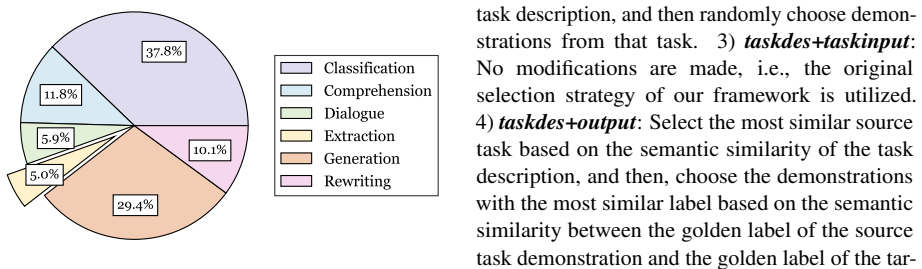
Summary. The paper introduces CrossICL, a zero-annotation paradigm for in-context learning in which demonstrations are taken from existing source-task datasets and transferred to a target task. The method has two stages: Minimum Gap Selection (§3.1) retrieves a source task whose task-description embedding is closest to the target query and then selects demonstrations whose input embeddings are closest, followed by Progressive Task Adaptation (§3.2) that rewrites each source query into the target-task format, refines the rewrite, and generates a label by referring to the original source demonstration. The aligned demonstrations are then used for standard ICL (§3.3). Experiments on 875 Super-NI tasks across six LLMs, including GPT-4o, report consistent ROUGE-L gains over Zero-Shot, Zero-shot-CoT, and Self-ICL, with additional analyses of selection criteria, ablations, an error taxonomy, source-task similarity, and combination with query-supervised ICL.
Significance. If the central claim is correct, CrossICL is a useful extension of ICL: it removes the need for target-task demonstrations and shows that existing labeled source tasks can reliably guide inference on new tasks. The paper has notable strengths: it evaluates across six model families, uses a large benchmark with 875 tasks, validates the ROUGE-L metric with exact-match checks in Appendix G, provides a detailed ablation of the adaptation stages in Table 2, and offers a concrete error taxonomy in §4.7. The selection-criteria analysis in §4.5 and the source-similarity analysis in §4.8 are also informative. These strengths make the empirical phenomenon worth investigating. However, the main comparison is not compute-matched, and the paper lacks error bars or significance tests, so the central claim of consistent improvement is not yet established at the standard expected for a strong empirical NLP contribution.
major comments (3)
- [§3.2–§3.3, Table 1] The main results are confounded by an unequal inference budget. For each query, CrossICL makes n Prompt-1 calls, n Prompt-2 calls, n Prompt-3 calls, and one Prompt-4 call (n=5 in the experiments, so 16 LLM calls per query), plus embedding retrieval, whereas the Zero-Shot and Zero-shot-CoT baselines use one call. Self-ICL also does not appear to spend this per-query adaptation budget. The paper's central claim in §4.4 that 'CrossICL consistently outperforms the baseline methods' is therefore compatible with a simpler explanation: additional test-time compute, or the repeated inclusion of the target task instruction in every demonstration, improves ROUGE-L independently of cross-task transfer. Appendix D only compares annotation time against manual annotation, not inference cost against baselines. To support the causal attribution to cross-task demonstration transfer, the authors should add a compute-matched or budget-controlled baseline—for example, zero-shot with self-consistency using the same number of LLM calls, or Self-ICL given the same number of generation/refinement calls—and report per-query cost and latency.
- [Tables 1, 2, 4, 6; Figures 3–5] No error bars, confidence intervals, or significance tests are reported for any of the main aggregate results. The paper states that 'the average score of three rounds of predictions' is reported (§4.1), but no variance is given across rounds or across tasks. Many of the claimed gains are small in absolute terms (for example, Llama3.1-8B average ROUGE-L rises from 0.532 to 0.568, and Deepseek-7B from 0.433 to 0.449 in Table 1), and the per-category differences are sometimes much smaller or negative (e.g., Extraction for Deepseek-7B drops from 0.451 to 0.428). Since the central claim is that CrossICL consistently outperforms all baselines, the authors should report standard errors or bootstrap confidence intervals and, where appropriate, paired significance tests over tasks or runs.
- [§2 and Limitations] The method assumes that every user query can be cleanly decomposed into a task description and a task input, and that the task description is available at inference time. The Limitations section acknowledges this constraint and suggests, without evaluation, that an LLM can transform arbitrary queries into this two-part form. Because the paper's motivating scenario is real-world users who do not provide demonstrations, the unvalidated query-transformation step is load-bearing for the claimed practical applicability. To make the scope of the contribution clear, the authors should either evaluate the automatic query decomposition step or explicitly restrict the claims to settings where the two-part format is available or readily provided.
minor comments (5)
- [§1, first paragraph of findings] There is a typo: 'al six types of LLMs' should be 'all six types of LLMs'.
- [References] The same paper appears twice as Gao et al. (2024a) and Gao et al. (2024b) with different venues but overlapping content; please unify the citation or clarify the distinction.
- [Table 2] The ablation label 'w/o Src in All' is ambiguous: it means that no source-task information is referenced anywhere in the adaptation, but the target task description and target query are still used. Please state this explicitly in the table caption or in §4.6.
- [Appendix D] The efficiency discussion reports only annotation time and performance for four example tasks. It would be more informative to also report the wall-clock inference time per query for CrossICL versus each baseline on the same tasks.
- [Appendix G and Table 6] The exact-match results are reported only for four task categories; please state clearly that generation and rewriting are excluded because they are not suitable for exact match, as is already noted, but also indicate whether the same held-out test split and sample size are used as in Table 1.
Circularity Check
No circularity: CrossICL's empirical gains are not derived from its inputs; no fitted parameter or self-citation chain forces the result.
full rationale
CrossICL is an empirical method paper rather than a derivation chain: the two-stage alignment pipeline (minimum gap selection via embedding cosine similarity, then LLM-based query rewriting, refinement, and source-guided label generation) contains no fitted parameters, no learned model, and no closed-form prediction that could reduce to its inputs by construction. Target-task labels are never used: selection uses only task descriptions and task inputs, and the aligned demonstrations are obtained without access to the gold answer for the user query. The central claim that CrossICL 'consistently outperforms the baseline methods' is evaluated on held-out Super-NI test tasks against Zero-Shot, Zero-shot-CoT, and Self-ICL, and the ablations in Table 2 and Appendix C show that the gains depend on the specific adaptation components rather than being tautological. The only author self-citation in the Limitations section (Gao et al. 2024a, for the suggestion that LLMs can split a query into task description and input) is not load-bearing for the main results and is explicitly offered as a future/practical mitigation rather than as evidence for the performance claim. The compute-mismatch criticism raised by a skeptic is a threat to the causal attribution of the improvement, not a circularity: spending more LLM calls per query could explain the gains independently of cross-task transfer, but that is an experimental confound, not a definitional equivalence between the method's output and its input. No equation in the paper defines the predicted quantity in terms of the fitted input, and no self-citation is invoked to forbid alternative explanations. The paper is therefore self-contained against external benchmarks, and no significant circularity is present.
Assumptions & free parameters
free parameters (3)
- number_of_demonstrations_n =
5
- sampling_temperature =
0.6/0.6/0.7/0.7/0.7/1.0 per model
- number_of_selected_source_tasks =
1
assumptions (5)
- domain assumption ROUGE-L is a reliable evaluation metric for all Super-NI task types.
- domain assumption Every user query can be decomposed into a task description and a task input.
- domain assumption Embedding cosine similarity between task descriptions and inputs is a faithful proxy for the cross-task gap that causes ICL interference.
- domain assumption LLMs can rewrite source queries, refine them, and generate labels for aligned queries without introducing harmful noise.
- domain assumption Super-NI training tasks used as sources do not leak into the test tasks used as targets.
Cite this review
Pith. "Pith review of CrossICL: Cross-Task In-Context Learning via Unsupervised Demonstration Transfer." pith.science (2026). https://pith.science/paper/344ETFRK
@misc{pith2026250524143,
  author       = {Pith},
  title        = {Pith review of: CrossICL: Cross-Task In-Context Learning via Unsupervised Demonstration Transfer},
  year         = {2026},
  howpublished = {\url{https://pith.science/paper/344ETFRK}},
  note         = {Machine review of arXiv:2505.24143}
}
read the original abstract
In-Context Learning (ICL) enhances the performance of large language models (LLMs) with demonstrations. However, obtaining these demonstrations primarily relies on manual effort. In most real-world scenarios, users are often unwilling or unable to provide such demonstrations. Inspired by the human analogy, we explore a new ICL paradigm CrossICL to study how to utilize existing source task demonstrations in the ICL for target tasks, thereby obtaining reliable guidance without any additional manual effort. To explore this, we first design a two-stage alignment strategy to mitigate the interference caused by gaps across tasks, as the foundation for our experimental exploration. Based on it, we conduct comprehensive exploration of CrossICL, with 875 NLP tasks from the Super-NI benchmark and six types of LLMs, including GPT-4o. Experimental results demonstrate the effectiveness of CrossICL and provide valuable insights on questions like the criteria for selecting cross-task demonstrations, as well as the types of task-gap-induced interference in CrossICL.
Figures


Figures from the paper (8 more)




Reference graph
Works this paper leans on
-
[1]
Shengnan An, Zeqi Lin, Qiang Fu, Bei Chen, Nanning Zheng, Jian-Guang Lou, and Dongmei Zhang. 2023. https://doi.org/10.18653/v1/2023.acl-long.618 How do in-context examples affect compositional generalization? In Proceedings of the 61st Annual Meeting of the Association for Computational Linguistics (Volume 1: Long Papers), pages 11027--11052, Toronto, Can...
-
[2]
Tom Brown, Benjamin Mann, Nick Ryder, Melanie Subbiah, Jared D Kaplan, Prafulla Dhariwal, Arvind Neelakantan, Pranav Shyam, Girish Sastry, Amanda Askell, et al. 2020. Language models are few-shot learners. Advances in neural information processing systems, 33:1877--1901
2020
-
[3]
Oana-Maria Camburu, Tim Rockt\" a schel, Thomas Lukasiewicz, and Phil Blunsom. 2018. http://papers.nips.cc/paper/8163-e-snli-natural-language-inference-with-natural-language-explanations.pdf e-snli: Natural language inference with natural language explanations . In S. Bengio, H. Wallach, H. Larochelle, K. Grauman, N. Cesa-Bianchi, and R. Garnett, editors,...
work page 2018
-
[4]
Anwoy Chatterjee, Eshaan Tanwar, Subhabrata Dutta, and Tanmoy Chakraborty. 2024. https://aclanthology.org/2024.acl-long.621 Language models can exploit cross-task in-context learning for data-scarce novel tasks . In Proceedings of the 62nd Annual Meeting of the Association for Computational Linguistics (Volume 1: Long Papers), pages 11568--11587, Bangkok,...
work page 2024
-
[5]
Jianlv Chen, Shitao Xiao, Peitian Zhang, Kun Luo, Defu Lian, and Zheng Liu. 2024. https://arxiv.org/abs/2402.03216 Bge m3-embedding: Multi-lingual, multi-functionality, multi-granularity text embeddings through self-knowledge distillation . Preprint, arXiv:2402.03216
arXiv 2024
-
[6]
Wei-Lin Chen, Cheng-Kuang Wu, Yun-Nung Chen, and Hsin-Hsi Chen. 2023. Self-icl: Zero-shot in-context learning with self-generated demonstrations. In Proceedings of the 2023 Conference on Empirical Methods in Natural Language Processing, pages 15651--15662
work page 2023
-
[7]
DeepSeek-AI, :, Xiao Bi, Deli Chen, Guanting Chen, Shanhuang Chen, Damai Dai, Chengqi Deng, Honghui Ding, Kai Dong, Qiushi Du, Zhe Fu, Huazuo Gao, Kaige Gao, Wenjun Gao, Ruiqi Ge, Kang Guan, Daya Guo, Jianzhong Guo, Guangbo Hao, Zhewen Hao, Ying He, Wenjie Hu, Panpan Huang, Erhang Li, Guowei Li, Jiashi Li, Yao Li, Y. K. Li, Wenfeng Liang, Fangyun Lin, A. ...
arXiv 2024
-
[8]
Qingxiu Dong, Lei Li, Damai Dai, Ce Zheng, Jingyuan Ma, Rui Li, Heming Xia, Jingjing Xu, Zhiyong Wu, Baobao Chang, et al. 2024. A survey on in-context learning. In Proceedings of the 2024 Conference on Empirical Methods in Natural Language Processing, pages 1107--1128
2024
Show all 37 references
-
[9]
Abhimanyu Dubey, Abhinav Jauhri, Abhinav Pandey, Abhishek Kadian, Ahmad Al-Dahle, Aiesha Letman, Akhil Mathur, Alan Schelten, Amy Yang, Angela Fan, et al. 2024. The llama 3 herd of models. arXiv preprint arXiv:2407.21783
2024 arXiv
-
[10]
Jinglong Gao, Xiao Ding, Yiming Cui, Jianbai Zhao, Hepeng Wang, Ting Liu, and Bing Qin. 2024 a . https://aclanthology.org/2024.acl-long.346 Self-evolving GPT : A lifelong autonomous experiential learner . In Proceedings of the 62nd Annual Meeting of the Association for Computa...
2024
-
[11]
Jinglong Gao, Xiao Ding, Yiming Cui, Jianbai Zhao, Hepeng Wang, Ting Liu, and Bing Qin. 2024 b . https://arxiv.org/abs/2407.08937 Self-evolving gpt: A lifelong autonomous experiential learner . Preprint, arXiv:2407.08937
2024 arXiv
-
[12]
Jinglong Gao, Xiao Ding, Zhongyang Li, Ting Liu, and Bing Qin. 2024 c . https://doi.org/10.1016/j.knosys.2024.112139 Event causality identification via competitive-cooperative cognition networks . Knowledge-Based Systems, 300:112139
2024
-
[13]
Jinglong Gao, Xiao Ding, Bing Qin, and Ting Liu. 2023. https://arxiv.org/abs/2305.07375 Is chatgpt a good causal reasoner? a comprehensive evaluation . Preprint, arXiv:2305.07375
2023 arXiv
-
[14]
Jinglong Gao, Xiao Ding, Lingxiao Zou, Bibo Cai, Bing Qin, and Ting Liu. 2025 a . https://arxiv.org/abs/2505.23191 Expetrans: Llms are experiential transfer learners . Preprint, arXiv:2505.23191
2025 arXiv
-
[15]
Jinglong Gao, Chen Lu, Xiao Ding, Zhongyang Li, Ting Liu, and Bing Qin. 2025 b . Enhancing complex causality extraction via improved subtask interaction and knowledge fusion. In Natural Language Processing and Chinese Computing, pages 67--80, Singapore. Springer Nature Singapore
2025
-
[16]
Dedre Gentner. 1983. https://doi.org/10.1016/S0364-0213(83)80009-3 Structure-mapping: A theoretical framework for analogy . Cognitive Science, 7(2):155--170
1983 doi
-
[17]
Hyuhng Joon Kim, Hyunsoo Cho, Junyeob Kim, Taeuk Kim, Kang Min Yoo, and Sang-goo Lee. 2022. Self-generated in-context learning: Leveraging auto-regressive language models as a demonstration generator. arXiv preprint arXiv:2206.08082
2022 arXiv
-
[18]
Takeshi Kojima, Shixiang Shane Gu, Machel Reid, Yutaka Matsuo, and Yusuke Iwasawa. 2024. Large language models are zero-shot reasoners. In Proceedings of the 36th International Conference on Neural Information Processing Systems, NIPS '22, Red Hook, NY, USA. Curran Associates Inc
2024
-
[19]
Chin-Yew Lin. 2004. Rouge: A package for automatic evaluation of summaries. In Text summarization branches out, pages 74--81
2004
-
[20]
Man Luo, Xin Xu, Yue Liu, Panupong Pasupat, and Mehran Kazemi. 2024. In-context learning with retrieved demonstrations for language models: A survey. arXiv preprint arXiv:2401.11624
2024 arXiv
-
[21]
Xinxi Lyu, Sewon Min, Iz Beltagy, Luke Zettlemoyer, and Hannaneh Hajishirzi. 2023. Z-icl: Zero-shot in-context learning with pseudo-demonstrations. In Proceedings of the 61st Annual Meeting of the Association for Computational Linguistics (Volume 1: Long Papers), pages 2304--2317
2023
-
[22]
J MacQueen. 1967. Some methods for classification and analysis of multivariate observations. In Proceedings of 5-th Berkeley Symposium on Mathematical Statistics and Probability/University of California Press
1967
-
[23]
Sewon Min, Xinxi Lyu, Ari Holtzman, Mikel Artetxe, Mike Lewis, Hannaneh Hajishirzi, and Luke Zettlemoyer. 2022. https://doi.org/10.18653/v1/2022.emnlp-main.759 Rethinking the role of demonstrations: What makes in-context learning work? In Proceedings of the 2022 Conference on ...
2022 doi
-
[24]
OpenAI, Josh Achiam, Steven Adler, Sandhini Agarwal, and Lama Ahmad. 2024. https://arxiv.org/abs/2303.08774 Gpt-4 technical report . Preprint, arXiv:2303.08774
2024 arXiv
-
[25]
Jane Pan, Tianyu Gao, Howard Chen, and Danqi Chen. 2023. https://doi.org/10.18653/v1/2023.findings-acl.527 What in-context learning learns in-context: Disentangling task recognition and task learning . In Findings of the Association for Computational Linguistics: ACL 2023, pag...
2023 doi
-
[26]
Qwen, :, An Yang, Baosong Yang, Beichen Zhang, Binyuan Hui, Bo Zheng, Bowen Yu, Chengyuan Li, Dayiheng Liu, Fei Huang, Haoran Wei, Huan Lin, Jian Yang, Jianhong Tu, Jianwei Zhang, Jianxin Yang, Jiaxi Yang, Jingren Zhou, Junyang Lin, Kai Dang, Keming Lu, Keqin Bao, Kexin Yang, ...
2025 arXiv
-
[27]
Melissa Roemmele, Cosmin Adrian Bejan, and Andrew S Gordon. 2011. Choice of plausible alternatives: An evaluation of commonsense causal reasoning. In 2011 AAAI spring symposium series
2011
-
[28]
Yi Su, Yunpeng Tai, Yixin Ji, Juntao Li, Yan Bowen, and Min Zhang. 2024. https://doi.org/10.18653/v1/2024.findings-acl.846 Demonstration augmentation for zero-shot in-context learning . In Findings of the Association for Computational Linguistics: ACL 2024, pages 14232--14244,...
2024 doi
-
[29]
Gemma Team, Morgane Riviere, Shreya Pathak, Pier Giuseppe Sessa, Cassidy Hardin, Surya Bhupatiraju, Léonard Hussenot, Thomas Mesnard, Bobak Shahriari, Alexandre Ramé, Johan Ferret, Peter Liu, Pouya Tafti, Abe Friesen, Michelle Casbon, Sabela Ramos, Ravin Kumar, Charline Le Lan...
2024 arXiv
-
[30]
Dingzirui Wang, Xuanliang Zhang, Qiguang Chen, Longxu Dou, Xiao Xu, Rongyu Cao, Yingwei Ma, Qingfu Zhu, Wanxiang Che, Binhua Li, et al. 2024 a . In-context transfer learning: Demonstration synthesis by transferring similar tasks. arXiv preprint arXiv:2410.01548
2024 arXiv
-
[31]
Liang Wang, Nan Yang, and Furu Wei. 2024 b . Learning to retrieve in-context examples for large language models. In Proceedings of the 18th Conference of the European Chapter of the Association for Computational Linguistics (Volume 1: Long Papers), pages 1752--1767
2024
-
[32]
Yifan Wang, Yafei Liu, Chufan Shi, Haoling Li, Chen Chen, Haonan Lu, and Yujiu Yang. 2024 c . https://doi.org/10.18653/v1/2024.naacl-long.37 I ns CL : A data-efficient continual learning paradigm for fine-tuning large language models with instructions . In Proceedings of the 2...
2024 doi
-
[33]
Yizhong Wang, Swaroop Mishra, Pegah Alipoormolabashi, Yeganeh Kordi, Amirreza Mirzaei, Atharva Naik, Arjun Ashok, Arut Selvan Dhanasekaran, Anjana Arunkumar, David Stap, Eshaan Pathak, Giannis Karamanolakis, Haizhi Lai, Ishan Purohit, Ishani Mondal, Jacob Anderson, Kirby Kuzni...
2022
-
[34]
Wenhan Xiong, Jiawei Wu, Hong Wang, Vivek Kulkarni, Mo Yu, Shiyu Chang, Xiaoxiao Guo, and William Yang Wang. 2019. Tweetqa: A social media focused question answering dataset. In Proceedings of the 57th Annual Meeting of the Association for Computational Linguistics, pages 5020--5031
2019
-
[35]
An Yang, Baosong Yang, Binyuan Hui, Bo Zheng, Bowen Yu, Chang Zhou, Chengpeng Li, Chengyuan Li, Dayiheng Liu, Fei Huang, Guanting Dong, Haoran Wei, Huan Lin, Jialong Tang, Jialin Wang, Jian Yang, Jianhong Tu, Jianwei Zhang, Jianxin Ma, Jianxin Yang, Jin Xu, Jingren Zhou, Jinze...
2024 arXiv
-
[36]
Zhuosheng Zhang, Aston Zhang, Mu Li, and Alex Smola. 2022. Automatic chain of thought prompting in large language models. arXiv preprint arXiv:2210.03493
2022 arXiv
-
[37]
going on a vacation
Ben Zhou, Daniel Khashabi, Qiang Ning, and Dan Roth. 2019. “going on a vacation” takes longer than “going for a walk”: A study of temporal commonsense understanding. In Proceedings of the 2019 Conference on Empirical Methods in Natural Language Processing and the 9th Internati...
2019
Reviewed August 7, 2026 · model on record in the stance chip above.
Discussion (0). Sign in to comment.