REVIEW 4 major objections 6 minor 2 cited by
Dynamical resolution scale in transverse momentum distributions at the LHC
T0 review · 4 major / 6 minor · reviewed 2026-08-14 · deepseek-v4-flash
Pith's one-line read This paper claims that initial-state transverse momentum in QCD is built from many angular-ordered emissions rather than a single last emission, and that this is why the low- and high-$p_T$ regions of the $Z$-boson spectrum discriminate…
desk verdict Clean new equations for PB TMDs with dynamical resolution scale, but the paper overreads its low-pT comparison by mixing q0, intrinsic-kT shape, and emission multiplicity. read the letter →
The pith
A machine-rendered reading of the paper's core claim, the machinery that carries it, and where it could break.
The reading
What carries the argument
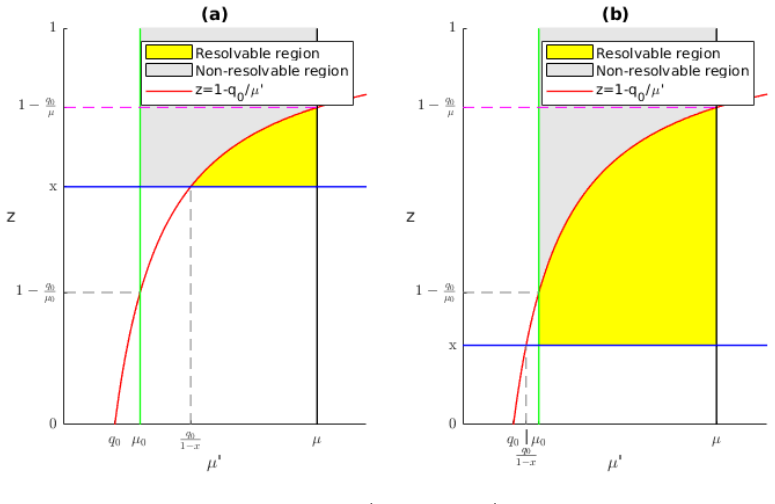
The load-bearing object is the dynamical soft-gluon resolution scale $z_M(\mu') = 1 - q_0/\mu'$, which separates resolvable branchings ($z < z_M$) from non-resolvable ones. It is derived from the requirement that an emitted parton have transverse momentum $q_\perp = (1-z)\mu'$ above the minimum resolvable value $q_0 \sim 1$ GeV. Because $z_M$ depends on the branching scale $\mu'$, both the real-emission kernel and the Sudakov form factor in the PB evolution equation acquire a scale-dependent phase-space boundary. This is the mechanism that puts multiple emissions into the transverse momentum and generates the differences with the single-emission KMRW approach.
What would settle it
A decisive test would be to recompute the PB prediction with the same inputs but with $q_\perp$ given by the alternative angular-ordering choice $q_\perp = z(1-z)\mu'$, or with $q_0$ varied between 0.5 and 2 GeV, and compare the resulting $Z$ $p_T$ slopes below 10 GeV against finely binned LHC data; if the data no longer prefer the dynamical-resolution-scale shape, the central claim is refuted.
Extended reading notes
Core claim
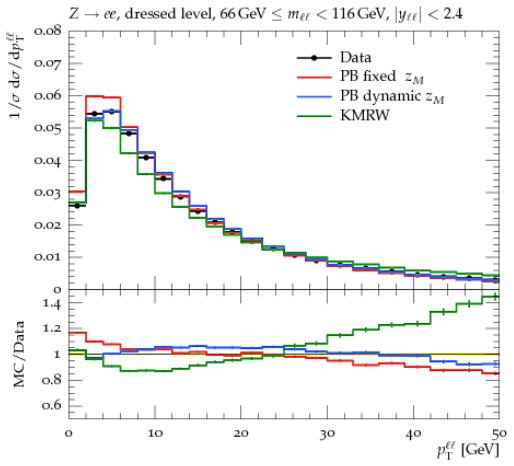
In the parton branching method, the soft-gluon resolution scale is a function of the branching scale, $z_M(\mu') = 1 - q_0/\mu'$, with the angular-ordering relation $q_\perp = (1-z)\mu'$ fixing the transverse momentum of the emitted parton. With this dynamical scale, the PB equation for integrated distributions coincides with the coherent-branching (CMW) equation, but the PB and KMRW descriptions of how $k_\perp$ is built up are different: PB sums the recoils of all resolvable branchings, KMRW keeps only the last emission. The paper shows analytically and numerically that this structural difference makes the two TMDs disagree strongly for $k_\perp \ll \mu$ and $k_\perp \gg \mu$, while they nearly coincide for $k_\perp \sim \mu$. For $Z$-boson production, the multiple-emission PB prediction matches the measured LHC $p_T$ spectrum, and the slope at low $p_T$ is sensitive to the dynamical resolution scale, so measurements with fine bins in the region $p_T \lesssim 5$–10 GeV could test the effect.
Load-bearing premise
The whole low-$p_T$ conclusion hangs on two calibration choices: that a branching's transverse momentum is exactly $(1-z)$ times its scale, and that a gluon becomes resolvable only above 1 GeV; with different choices, the difference between the multiple-emission and single-emission results could vanish.
Editorial extensions
If this is right
- The $Z$-boson transverse momentum spectrum at the LHC, measured with fine binning in the region $p_T \lesssim 5$–10 GeV, can act as a direct probe of soft-gluon angular ordering and of whether the resolution scale is dynamical.
- PB and CMW agree at the level of integrated distributions, so the multiple-emission picture is consistent with established coherent-branching results; KMRW is the outlier among the three.
- The largest differences between PB and KMRW TMDs lie at $k_\perp \ll \mu$ and $k_\perp \gg \mu$, with only mild differences near $k_\perp \sim \mu$.
- Because the integrated KMRW TMDs do not reduce to the collinear input PDF at all $k_\perp$, the choice of resolution scale also affects how much of the distribution sits in the high-transverse-momentum tail.
Reading between the lines
- If the dynamical resolution scale is the right description, the same multiple-emission logic should also leave visible signatures in other Drell-Yan observables, such as the $W$ boson transverse momentum or low-mass dilepton spectra; the paper does not compute these predictions.
- A way to isolate the single-versus-multiple-emission difference from phase-space choices would be to compare PB with a version of KMRW whose Sudakov form factor satisfies the no-branching probability product rule given in Eq. (19).
- The paper's PB-last-step variant is an internal control: a quantitative match between PB-last-step and KMRW would confirm that the single-emission picture, not the PDF set or intrinsic-$k_\perp$ smearing, drives the KMRW discrepancy.
- Future high-luminosity data with small $p_T$ bins could turn the fitted value of $q_0$ into a measurable nonperturbative parameter, effectively pinning down the minimum transverse momentum at which a gluon is resolvable.
Signed reviews
Editorial analysis
A structured set of objections, weighed in public.
Referee Report
Summary. The paper studies transverse-momentum-dependent (TMD) parton distributions in the parton-branching (PB) formalism with a dynamical soft-gluon resolution scale, zM(µ′)=1−q0/µ′. It derives a phase-space mapping from branching scales to transverse momenta in Sec. 3, uses this to compare the PB formulation with the coherent-branching (CMW) and single-emission (KMRW) approaches in Sec. 4, and presents numerical TMDs and Z-boson p⊥ spectra in Sec. 5. The central qualitative claim is that PB builds the initial-state transverse momentum from multiple emissions whereas KMRW builds it from a single last emission, and that the differences are large at low and high k⊥ but small in the intermediate k⊥ region. The paper further claims that the PB calculation describes the ATLAS Z p⊥ spectrum well, while MRW-CT10nlo does not, and that high-resolution measurements with p⊥≲5–10 GeV can probe dynamical resolution-scale effects.
Significance. If established, the multi-emission versus single-emission distinction would be a useful clarification for TMD phenomenology, and the prediction of enhanced sensitivity in the low-p⊥ Z-boson region is falsifiable with high-resolution LHC data. The analytic mapping in Sec. 3 is a genuine contribution, and the use of public codes uPDFevolv and TMDplotter with the same CT10nlo collinear input for PB and KMRW makes the numerical comparison reproducible at the level of the collinear input. These strengths are partially offset by the uncontrolled differences in the nonperturbative inputs discussed below; the significance of the paper therefore depends on whether the authors can isolate the multiple-emission effect from the modeling of the intrinsic-k⊥ distribution and the choice of q0.
major comments (4)
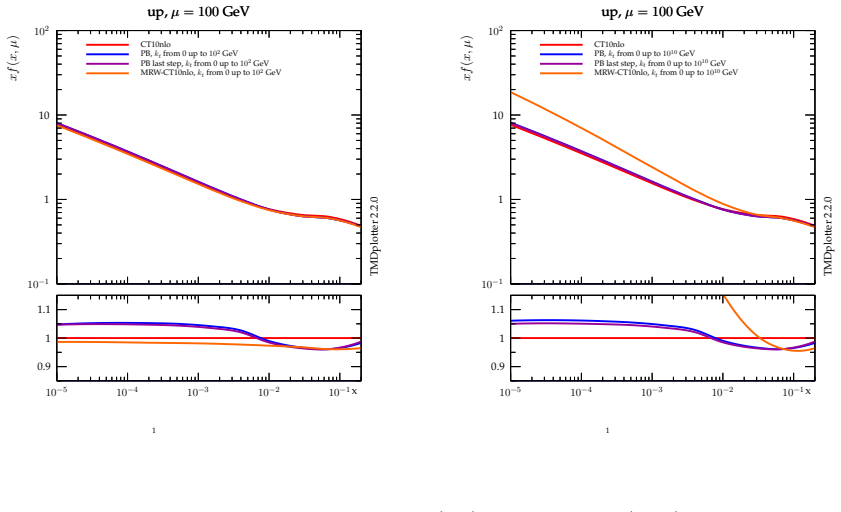
- [Sec. 5.1, Fig. 4] The central numerical comparison between PB and MRW-CT10nlo simultaneously varies the number of resolved emissions, the intrinsic-kT parametrization, and the resolution threshold: PB uses a Gaussian intrinsic-kT distribution with width k0/√2, k0=0.5 GeV, while MRW-CT10nlo uses a flat intrinsic-kT distribution for kT<1 GeV, and the PB dynamical scale is fixed by q0=1 GeV. The low-kT kink in MRW-CT10nlo and its absence in PB may therefore reflect the different nonperturbative inputs rather than the single-emission versus multiple-emission mechanism. Please provide a controlled comparison in which the intrinsic-kT distributions are matched (e.g., evaluate PB with a flat intrinsic-kT input, or convolve both TMDs with the same Gaussian smearing) and in which q0 is varied over a plausible range.
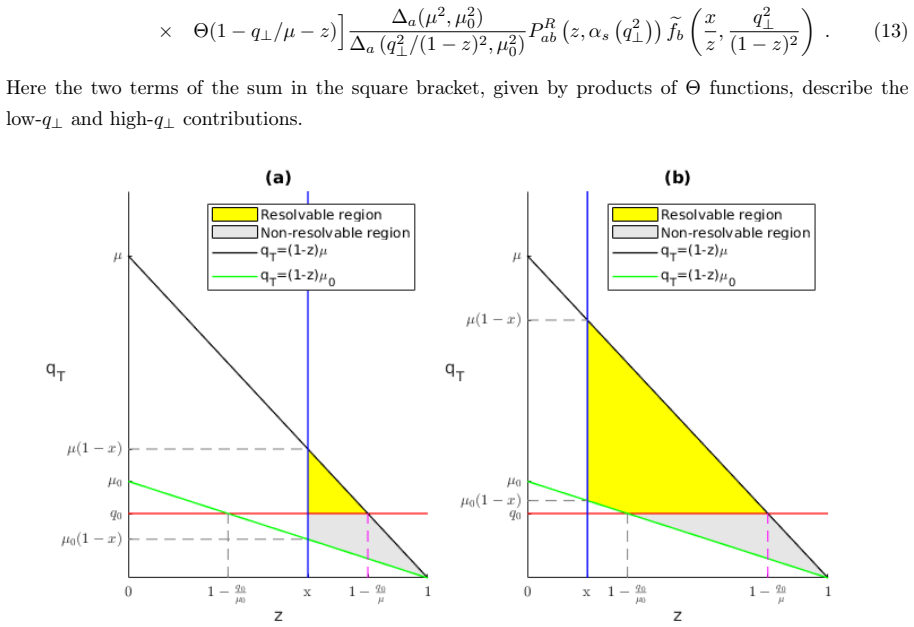
- [Sec. 4 versus Sec. 5.1] The analytic comparison with KMRW is made under the condition q0≈µ0 (text preceding Eq. (11)), whereas the numerical PB calculation uses q0=1 GeV and the PB starting scale µ0 from the uPDFevolv setup. Because zM(µ′)=1−q0/µ′ and the phase-space domains in Eqs. (11)–(13) depend on the ratio q0/µ0, the analytic identification of the numerical differences with single-emission versus multiple-emission physics is not the same parameter setting that is realized in Figs. 4–7. Please either repeat the analytic comparison at the numerical values of q0 and µ0, or demonstrate that the conclusions are insensitive to q0/µ0.
- [Sec. 5.2, Fig. 7] The empirical claim that PB describes the ATLAS Z-boson p⊥ spectrum while MRW-CT10nlo does not is based on central values only; the paper acknowledges that TMD uncertainties for dynamical zM are not yet available. Without uncertainty bands or a variation of q0 and k0, the reader cannot determine whether the differences in the low-p⊥ region are significant. Please add at least a sensitivity scan over q0 (and k0), or estimate the uncertainty by propagating PB Set-2 uncertainties with the dynamical resolution scale.
- [Sec. 4, CMW comparison] The statement that Eq. (10) agrees with the CMW result, citing Eqs. (42) and (49) of Ref. [9], is made by reference rather than by derivation. Since one of the paper's conclusions is that 'the PB formula coincides with CMW at the level of integrated distributions,' this is a load-bearing point. Please provide the explicit variable transformation and the main steps connecting Eq. (10) to the CMW branching equation, including the treatment of the resolution cut and the running-coupling scale.
minor comments (6)
- [Eq. (1)] The notation ∫ d2µ′/πµ′2 is non-standard; it should be ∫ dµ′^2/µ′^2 (or explicitly defined), since µ′ is a single scale.
- [Sec. 2, Eq. (7)] The inequality 'q⊥>q 0' should be typeset as q⊥>q0, and q0∼>ΛQCD should be q0≳ΛQCD.
- [Sec. 5.1] The definition of PB-last-step should state explicitly whether the intrinsic-kT distribution is included in the transverse momentum assigned to the last emission; otherwise the comparison in Fig. 4 is ambiguous.
- [Sec. 5.1] The text alternates between 'MRW-CT10nlo' and 'MRW-ct10nlo'; use one form throughout.
- [Sec. 5.2] The notation 'p⊥∼< 5 - 10 GeV' should be written as p⊥≲5–10 GeV.
- [Ref. [19]] Reference [19] is incomplete: it gives no title or journal, only the arXiv number; please supply the full citation.
Circularity Check
Low-k⊥ kink attributed to single-emission is actually built into MRW-CT10nlo's flat intrinsic-k⊥ input; central multiple-vs-single-emission derivation is otherwise non-circular.
-
fitted input called prediction
[Sec. 5.1, Fig. 4 discussion]
"KMRW TMD distribution sets have been obtained in [27] according to the KMRW angular ordering prescription (18), using the CT10nlo PDF set as a starting collinear distribution and a flat parameterization for k⊥ < 1 GeV as an intrinsic k⊥ distribution at starting scale µ0. ... The kink at low k⊥ in MRW-CT10nlo is a consequence of the single-emission picture, and is not present in the full PB case, where multiple branchings are responsible for generating the transverse momentum."
The kink at k⊥ = 1 GeV coincides exactly with the boundary of the flat intrinsic-k⊥ parameterization quoted immediately above. A flat distribution below 1 GeV joined to a different functional behavior above 1 GeV produces a slope discontinuity at 1 GeV by construction, so observing that kink does not test the single-emission mechanism. The PB comparison simultaneously changes the intrinsic distribution to a Gaussian of width 0.5 GeV, so the low-k⊥ difference is not uniquely attributable to emission multiplicity. Calling the kink a consequence of the single-emission picture therefore relabels an input parameterization as a dynamical prediction.
full rationale
The paper's central dynamical-resolution-scale formalism is not circular. Sections 2 and 3 define z_M(µ') = 1 - q0/µ' and derive the transverse-momentum forms of the branching equations directly from the master evolution equation, and the analytic comparison with KMRW in Sec. 4 is an equation-to-equation comparison. The PB-last-step construction is an honest internal diagnostic for isolating emission multiplicity. The numerical PB evolution uses stated inputs (q0 = 1 GeV, Gaussian intrinsic k⊥ with k0 = 0.5 GeV) inherited from earlier PB work, so the ATLAS DY agreement in Sec. 5.2 is not an independent validation of those nonperturbative parameters; the paper partially concedes this by showing only central values because 'TMD uncertainties in the case of dynamical zM are not yet available.' That is a caveat about parameter provenance, not a circular derivation. The one place where a claim reduces to its input is the low-k⊥ kink: MRW-CT10nlo is defined with a flat intrinsic-k⊥ distribution for k⊥ < 1 GeV, so the kink at that boundary is put in by hand, yet the text calls it a consequence of the single-emission picture. That step is a supporting numerical observation rather than the core derivation, so the overall circularity is partial rather than total.
Assumptions & free parameters
free parameters (2)
- q0 =
1 GeV
- k0 =
0.5 GeV
assumptions (4)
- domain assumption Angular ordering is implemented with a(z) = b(z) = 1 - z, giving qT = (1 - z) mu' and alpha_s(qT^2).
- domain assumption Resolvable soft gluons satisfy z < 1 - q0/mu' with a fixed universal q0.
- standard math The Sudakov form factor is a probability for no resolvable branching and obeys the multiplicative property in Eq. (19).
- domain assumption The Z pT spectrum in the low-pT region can be computed from LO on-shell matrix elements plus TMD-generated initial-state kT via Cascade.
Cite this review
Pith. "Pith review of Dynamical resolution scale in transverse momentum distributions at the LHC." pith.science (2026). https://pith.science/paper/34JRHWXT
@misc{pith2026190808524,
  author       = {Pith},
  title        = {Pith review of: Dynamical resolution scale in transverse momentum distributions at the LHC},
  year         = {2026},
  howpublished = {\url{https://pith.science/paper/34JRHWXT}},
  note         = {Machine review of arXiv:1908.08524}
}
abstract
The QCD evolution of transverse momentum dependent (TMD) distribution functions has recently been formulated in a parton branching (PB) formalism. In this approach, soft-gluon coherence effects are taken into account by introducing the soft-gluon resolution scale and exploiting the relation between transverse-momentum recoils and branching scales. In this work we investigate the implications of dynamical, i.e., branching scale dependent, resolution scales. We present both analytical studies and numerical solution of PB evolution equations in the presence of dynamical resolution scales. We use this to compare PB results with other approaches in the literature, and to analyze predictions for transverse momentum distributions in $Z$-boson production at the Large Hadron Collider (LHC).
Figures

Figures from the paper (4 more)


Forward citations
Cited by 2 Pith papers
-
Soft-gluon coupling and the TMD parton branching Sudakov form factor
The parton branching TMD framework is upgraded from NLL to NNLL accuracy using the soft-gluon physical coupling, with the Collins-Soper kernel evaluated at NNLL.
-
Coarse-grained binning in Drell-Yan transverse momentum spectra
A coarse two-bin ratio of Drell-Yan transverse momentum cross sections can determine the intrinsic kT width with sensitivity comparable to fine binned spectra, as shown by pseudo-data and CMS data.
Reference graph
Works this paper leans on
- [9]
- [1]
-
[2]
Angeles-Martinez et al., Acta Phys
R. Angeles-Martinez et al., Acta Phys. Polon.B46, 2501 (2015). 1507.05267
arXiv 2015
-
[3]
F. Hautmann, H. Jung, A. Lelek, V. Radescu, and R. Zlebcik, Phys. Lett. B772, 446 (2017). 1704.01757
arXiv 2017
-
[4]
F. Hautmann, H. Jung, A. Lelek, V. Radescu, and R. Zlebcik, JHEP01, 070 (2018). 1708.03279
arXiv 2018
-
[5]
B. R. Webber, Ann. Rev. Nucl. Part. Sci.36, 253 (1986)
work page 1986
-
[6]
Webber,QCD and Collider Physics
R.K.Ellis, W.J.Stirling, and B. Webber,QCD and Collider Physics . Cambridge University Press, 2003
work page 2003
- [7]
Show all 43 references
-
[8]
Y. L. Dokshitzer, V. A. Khoze, S. I. Troian, and A. H. Mueller, Rev. Mod. Phys.60, 373 (1988)
1988
-
[10]
Catani, B
S. Catani, B. R. Webber, and G. Marchesini, Nucl. Phys.B349, 635 (1991)
1991
- [11]
-
[12]
Hautmann, H
F. Hautmann, H. Jung, and S. T. Monfared, Eur. Phys. J.C74, 3082 (2014). 1407.5935
2014 arXiv
-
[13]
M. A. Kimber, A. D. Martin, and M. G. Ryskin, Eur. Phys. J.C12, 655 (2000).hep-ph/9911379
2000 arXiv
-
[14]
M. A. Kimber, A. D. Martin, and M. G. Ryskin, Phys. Rev.D63, 114027 (2001).hep-ph/0101348
2001 arXiv
-
[15]
G. Watt, A. D. Martin, and M. G. Ryskin, Eur. Phys. J.C31, 73 (2003). hep-ph/0306169
2003 arXiv
-
[16]
A. D. Martin, M. G. Ryskin, and G. Watt, Eur. Phys. J.C66, 163 (2010). 0909.5529
2010 arXiv
-
[17]
25,316(1970)
S.D.DrellandT.-M.Yan, Phys.Rev.Lett. 25,316(1970). [Erratum:Phys.Rev.Lett.25,902(1970)]
1970
-
[18]
Bermudez Martinez, P
A. Bermudez Martinez, P. Connor, H. Jung, A. Lelek, R. Zlebcik, F. Hautmann, and V. Radescu, Phys. Rev. D99, 074008 (2019). 1804.11152
2019 arXiv
- [19]
-
[20]
Hautmann, TMDs and Monte Carlo Event Generators , in 23rd International Symposium on Spin Physics (SPIN 2018) Ferrara, Italy, September 10-14, 2018
F. Hautmann, TMDs and Monte Carlo Event Generators , in 23rd International Symposium on Spin Physics (SPIN 2018) Ferrara, Italy, September 10-14, 2018 . 2019. Also in preprint 1907.03353
2018 arXiv
-
[21]
V. N. Gribov and L. N. Lipatov, Sov. J. Nucl. Phys.15, 438 (1972). [Yad. Fiz.15,781(1972)]
1972
-
[22]
L. N. Lipatov, Sov. J. Nucl. Phys.20, 94 (1975). [Yad. Fiz.20,181(1974)]
1975
-
[23]
Altarelli and G
G. Altarelli and G. Parisi, Nucl. Phys.B126, 298 (1977)
1977
-
[24]
Y. L. Dokshitzer, Sov. Phys. JETP46, 641 (1977). [Zh. Eksp. Teor. Fiz.73,1216(1977)]
1977
- [25]
-
[26]
Golec-Biernat and A
K. Golec-Biernat and A. M. Stasto, Phys. Lett.B781, 633 (2018). 1803.06246. 15
2018 arXiv
-
[27]
M. Bury, A. van Hameren, H. Jung, K. Kutak, S. Sapeta, and M. Serino, Eur. Phys. J. C78, 137 (2018). 1712.05932
2018 arXiv
-
[28]
H.-L. Lai, M. Guzzi, J. Huston, Z. Li, P. M. Nadolsky, J. Pumplin, and C. P. Yuan, Phys. Rev. D82, 074024 (2010). 1007.2241
2010 arXiv
-
[29]
Hautmann, H
F. Hautmann, H. Jung, M. Krämer, P. J. Mulders, E. R. Nocera, T. C. Rogers, and A. Signori, Eur. Phys. J. C74, 3220 (2014). 1408.3015
2014 arXiv
-
[30]
P. L. S. Connor, H. Jung, F. Hautmann, and J. Scheller, PoSDIS2016, 039 (2016)
2016
-
[31]
Aadet al., Eur
ATLAS Collaboration, G. Aadet al., Eur. Phys. J.C76, 291 (2016). 1512.02192
2016 arXiv
-
[32]
Aadet al., JHEP 09, 145 (2014)
ATLAS Collaboration, G. Aadet al., JHEP 09, 145 (2014). 1406.3660
2014 arXiv
-
[33]
Khachatryanet al., JHEP 02, 096 (2017)
CMS Collaboration, V. Khachatryanet al., JHEP 02, 096 (2017). 1606.05864
2017 arXiv
-
[34]
Chatrchyanet al., Phys
CMS Collaboration, S. Chatrchyanet al., Phys. Rev.D85, 032002 (2012). 1110.4973
2012 arXiv
-
[35]
Alwall et al., Comput
J. Alwall et al., Comput. Phys. Commun.176, 300 (2007). hep-ph/0609017
2007 arXiv
-
[36]
Sjostrand, S
T. Sjostrand, S. Mrenna, and P. Z. Skands, Comput. Phys. Commun.178, 852 (2008).0710.3820
2008 arXiv
-
[37]
Sjostrand, S
T. Sjostrand, S. Ask, J. R. Christiansen, R. Corke, N. Desai, P. Ilten, S. Mrenna, S. Prestel, C. O. Rasmussen, and P. Z. Skands, Comput. Phys. Commun.191, 159 (2015). 1410.3012
2015 arXiv
-
[38]
Bengtsson, T
M. Bengtsson, T. Sjostrand, and M. van Zijl, Z. Phys.C32, 67 (1986)
1986
- [39]
-
[40]
Dobbs and J
M. Dobbs and J. B. Hansen, Comput. Phys. Commun.134, 41 (2001)
2001
-
[41]
Buckley, J
A. Buckley, J. Butterworth, L. Lonnblad, D. Grellscheid, H. Hoeth, J. Monk, H. Schulz, and F. Siegert, Comput. Phys. Commun.184, 2803 (2013). 1003.0694
2013 arXiv
-
[42]
Hautmann, M
F. Hautmann, M. Hentschinski, and H. Jung, Nucl. Phys.B865, 54 (2012). 1205.1759
2012 arXiv
- [43]
Reviewed August 14, 2026 · model on record in the stance chip above.
Discussion (0). Continue with ORCID to comment.