SN 2020bij and a Possible Slow-Rise High-Velocity Subclass of Type IIP Supernovae
Pith reviewed 2026-07-03 07:39 UTC · model grok-4.3
The pith
Five Type IIP supernovae with slow rises and high velocities are explained by weak circumstellar material interaction and proposed as a new subclass.
A machine-rendered reading of the paper's core claim, the machinery that carries it, and where it could break.
Core claim
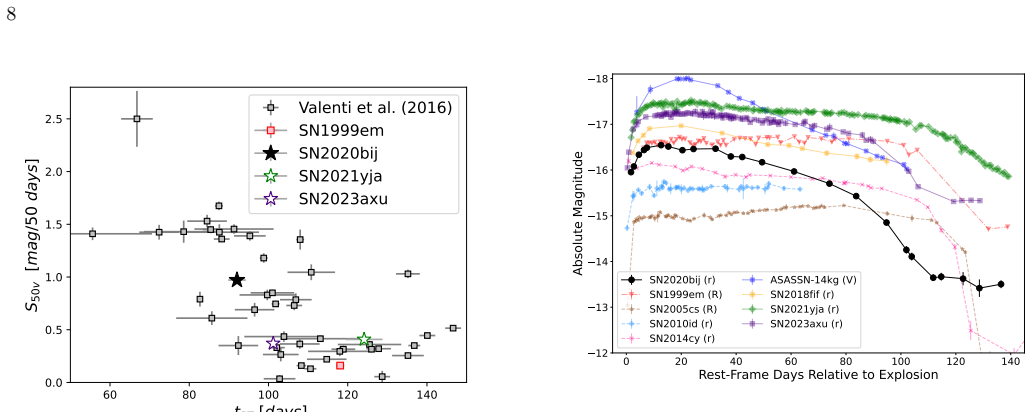
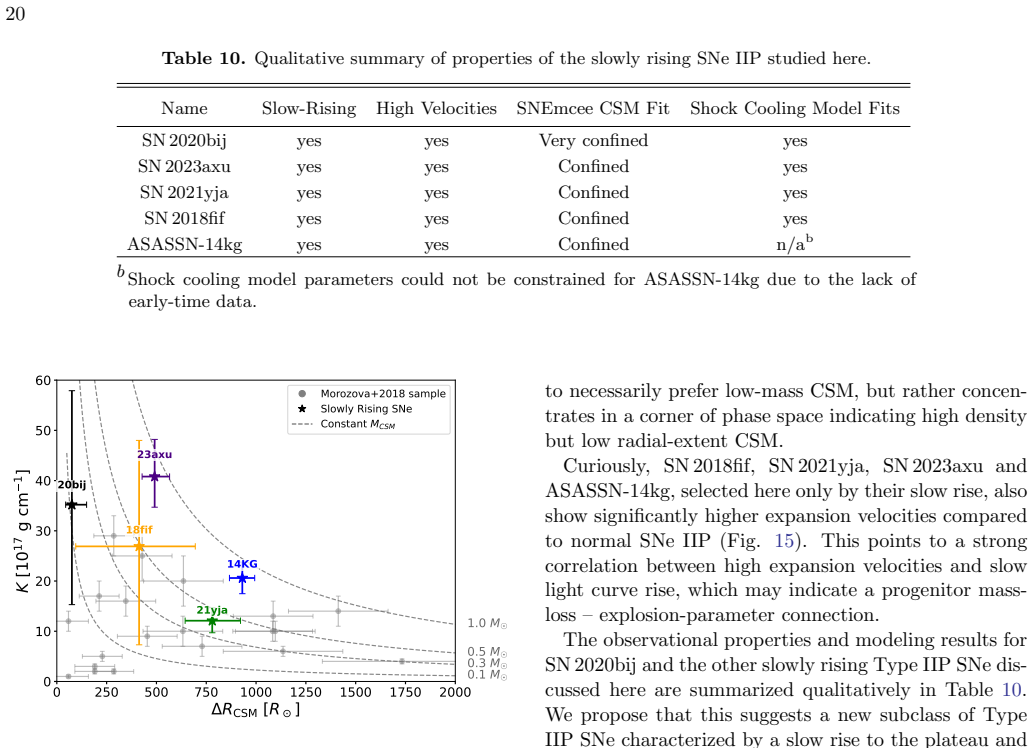
SN 2020bij and the four comparison events (ASASSN-14kg, SN 2018fif, SN 2021yja, SN 2023axu) share slowly rising light curves and high expansion velocities yet are reproduced by models with weak to no circumstellar material interaction; the authors therefore propose these events constitute a new subclass of Type IIP supernovae associated with relatively confined circumstellar material.
What carries the argument
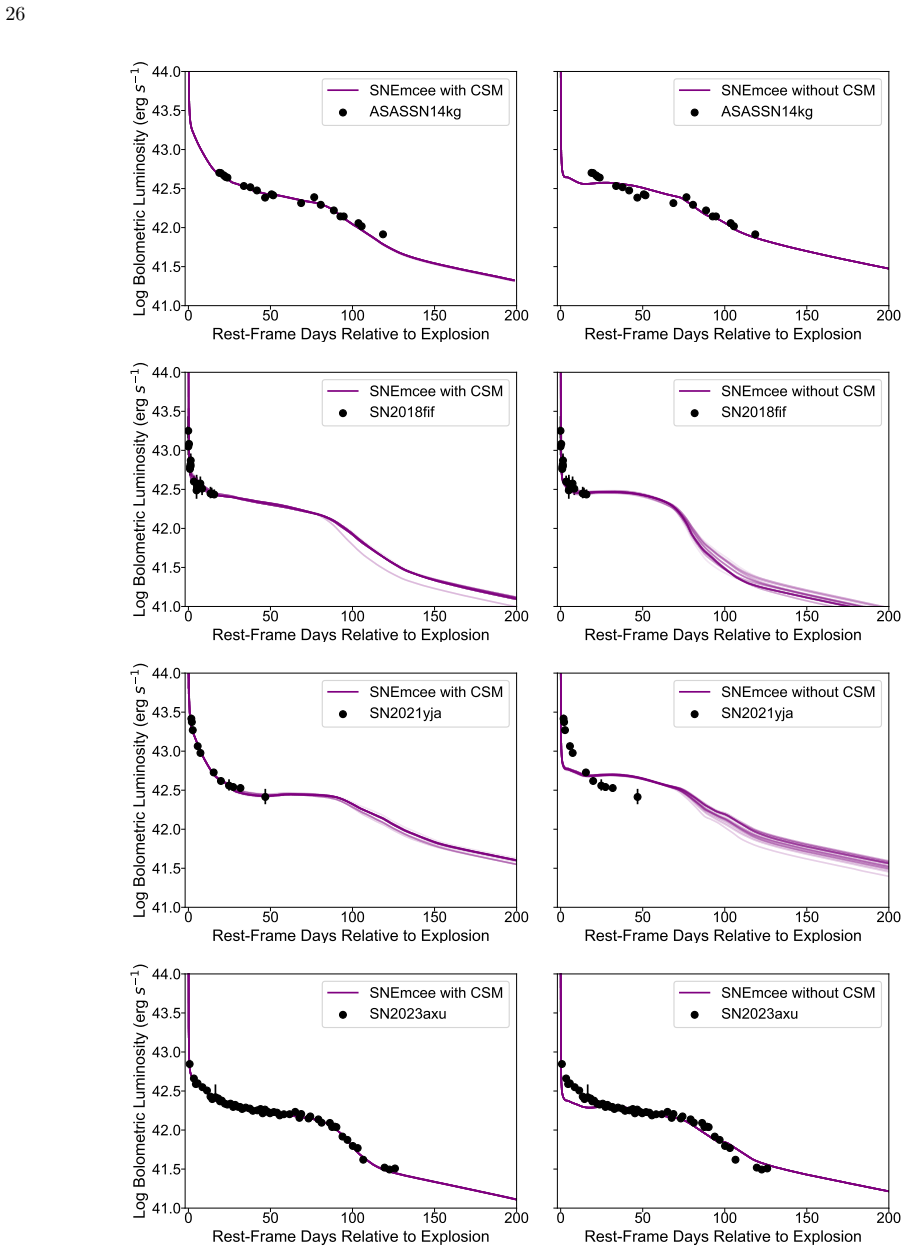
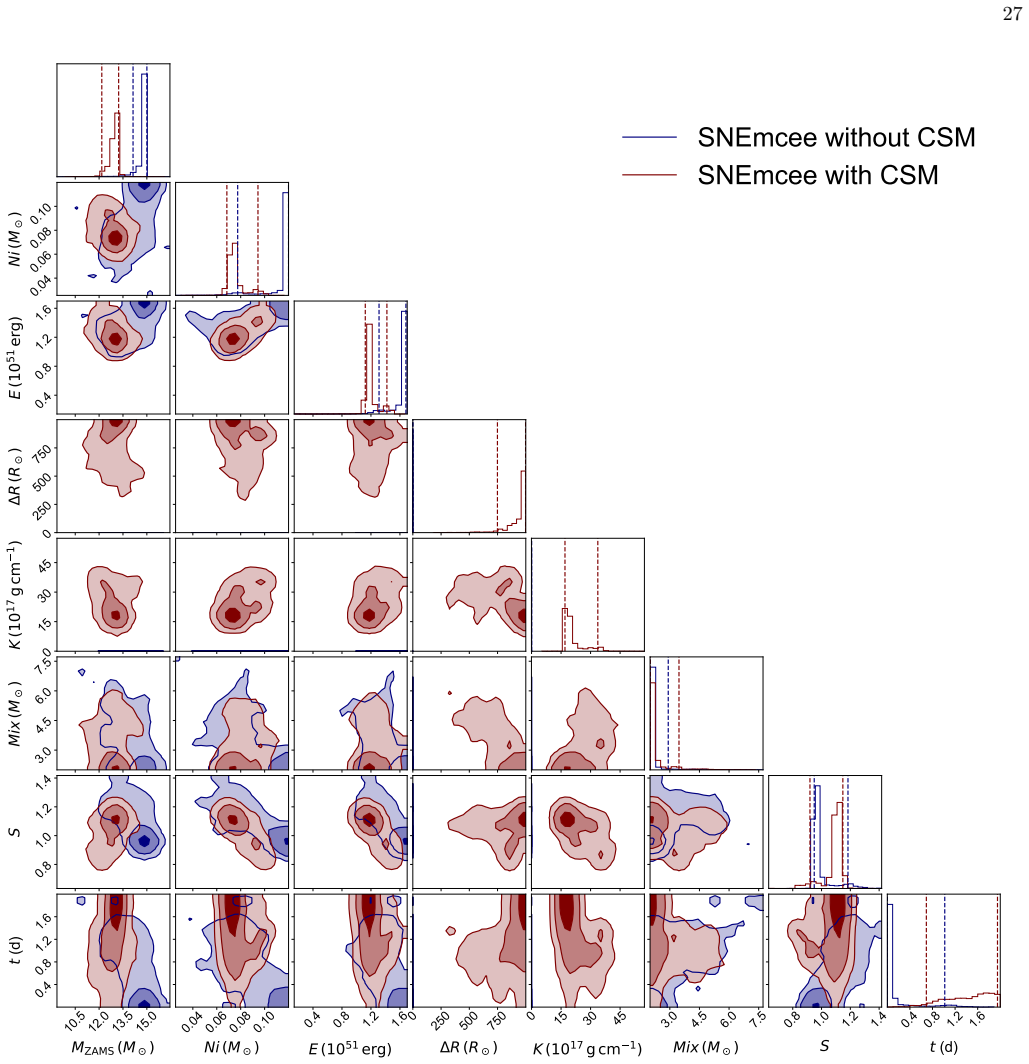
Analytical and numerical models of Type IIP light curves and spectra that incorporate varying levels of circumstellar material interaction, used to show that weak or absent interaction accounts for the slow rise and high velocities observed in the five events.
If this is right
- Early and dense photometric coverage plus early spectroscopy will identify additional members of the subclass and map its range of properties.
- The subclass would directly constrain the diversity of late-stage mass loss in red supergiants.
- Events in this subclass would require less circumstellar material than typical fast-rising Type IIP supernovae to match observations.
- The proposal implies that confined circumstellar material is sufficient to produce the observed diversity without invoking strong interaction.
Where Pith is reading between the lines
- If the subclass is real, surveys with rapid cadence could separate it from the general Type IIP population at early times.
- The confined circumstellar material picture might link these events to a narrow range of red supergiant envelope stripping that is not captured in standard single-star evolution tracks.
- Follow-up X-ray or radio observations of future members could test whether the confined material leaves a detectable signature at later phases.
Load-bearing premise
That the slow rise and high velocities are driven primarily by the amount of circumstellar material interaction rather than by differences in explosion energy, progenitor radius, or other factors.
What would settle it
A set of hydrodynamic models or additional well-observed events in which the same slow-rise high-velocity properties are reproduced only when circumstellar material interaction is set to zero while explosion energy or radius is varied instead.
Figures
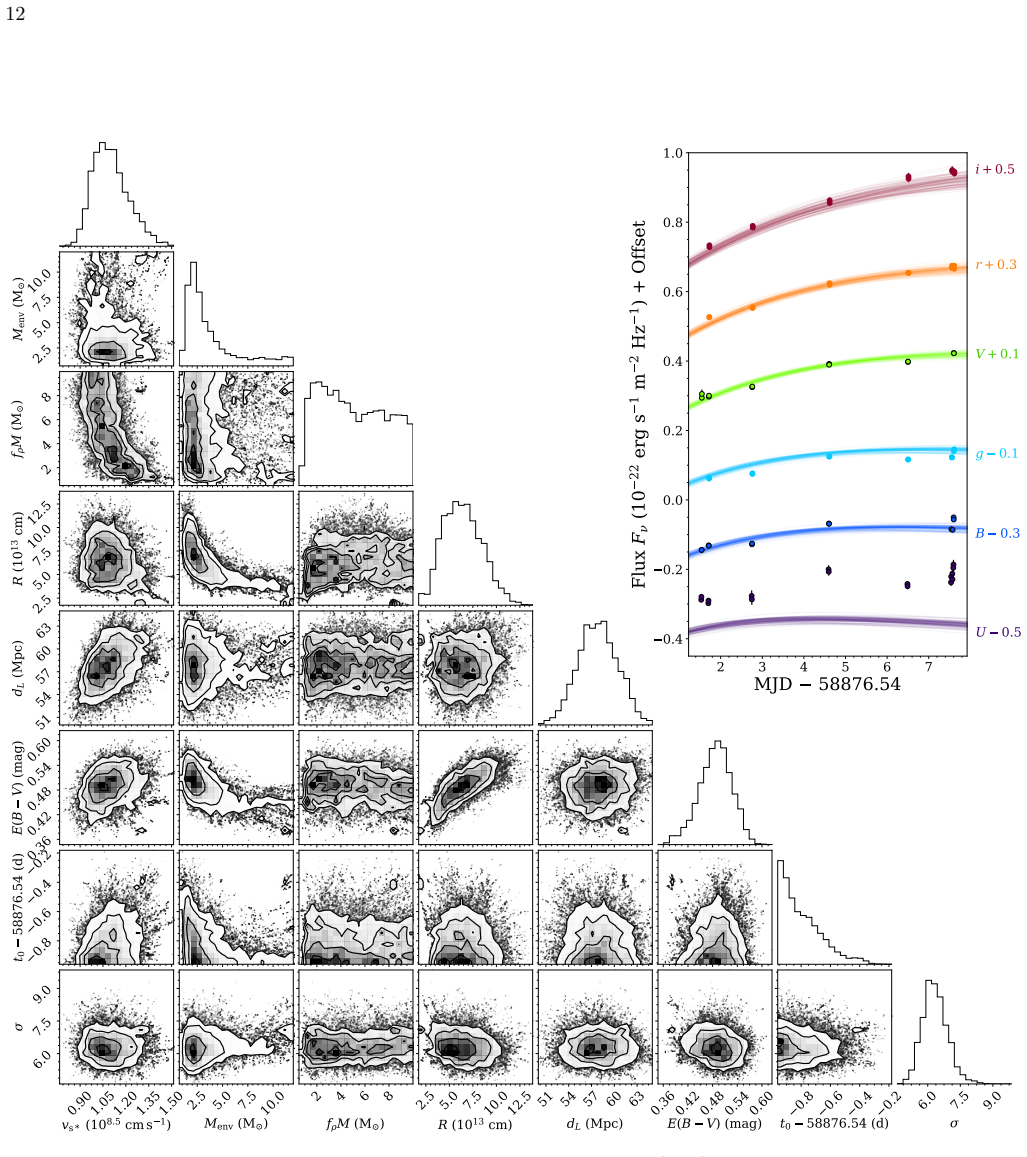
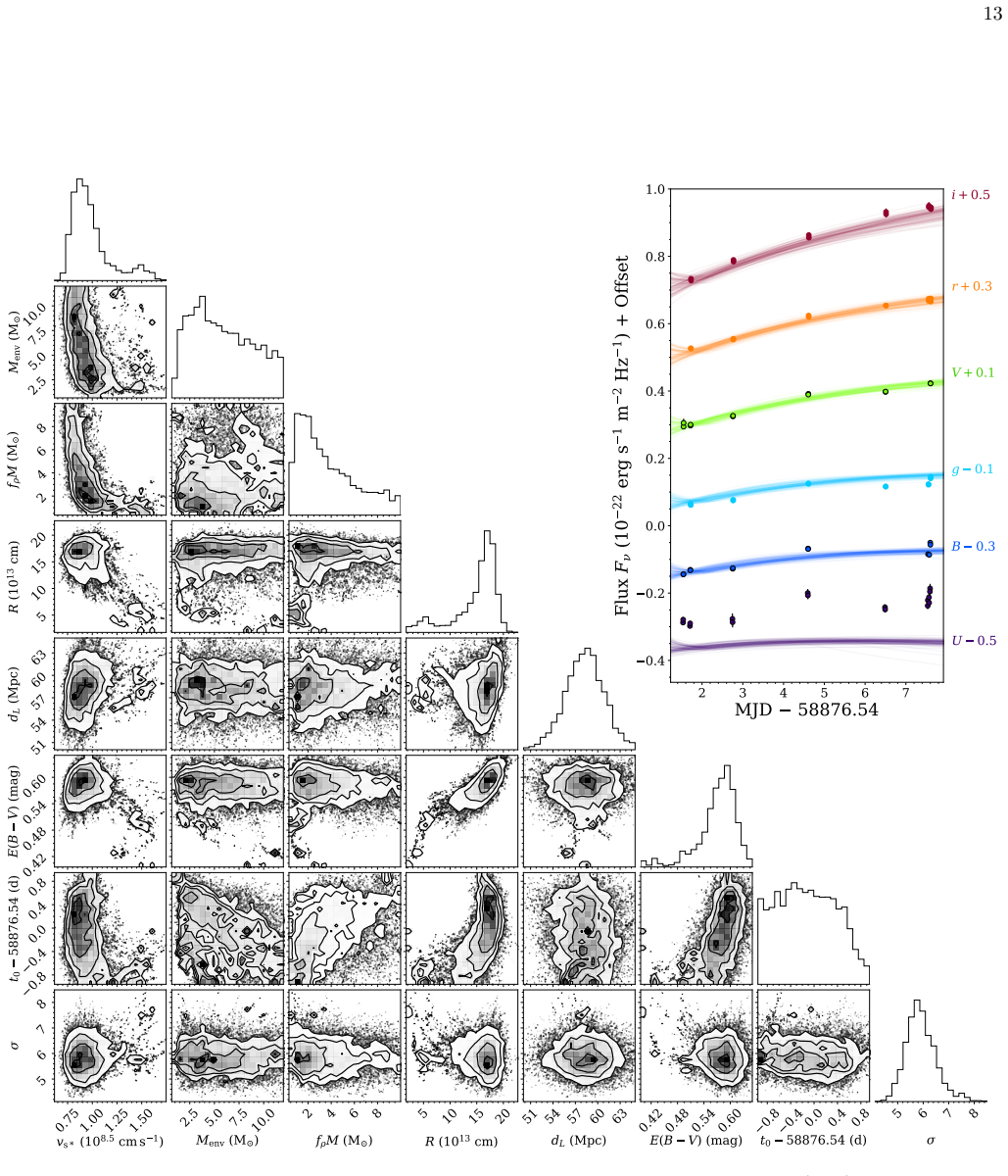
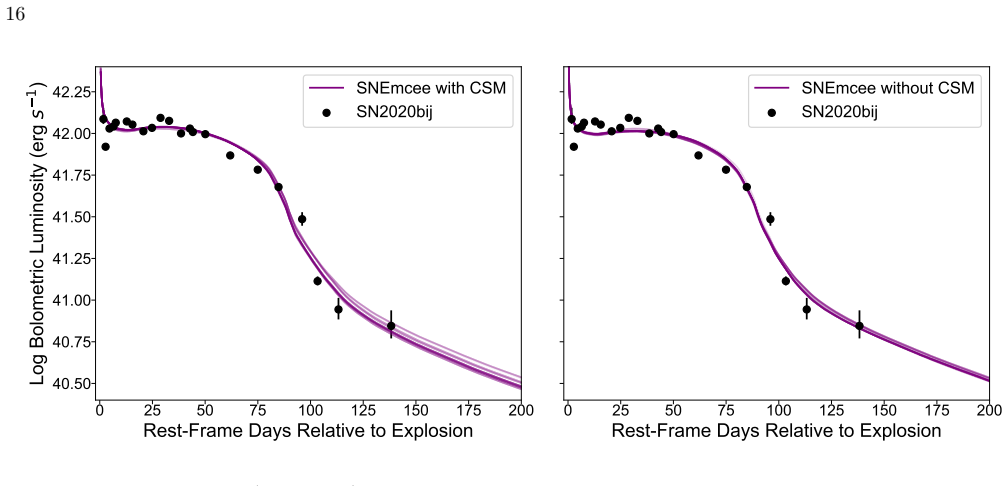
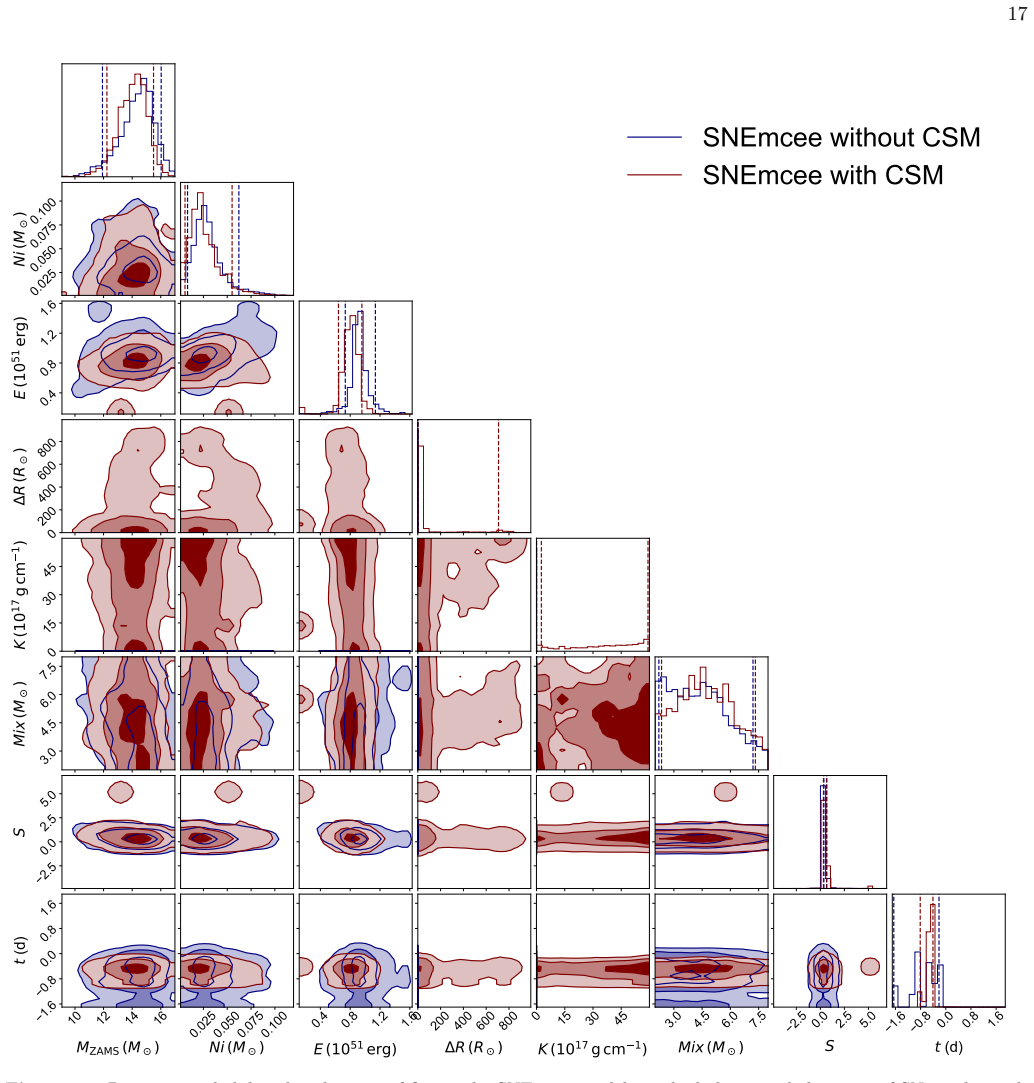
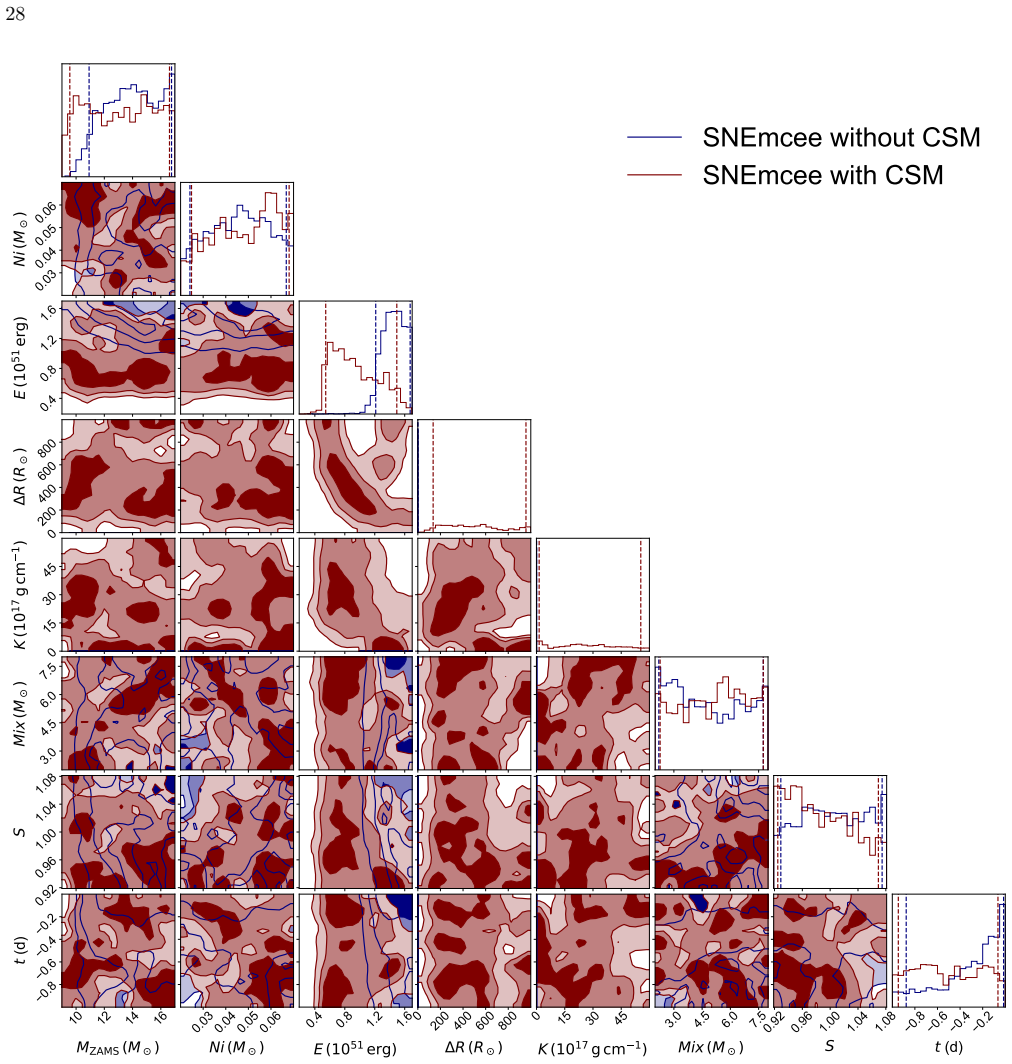
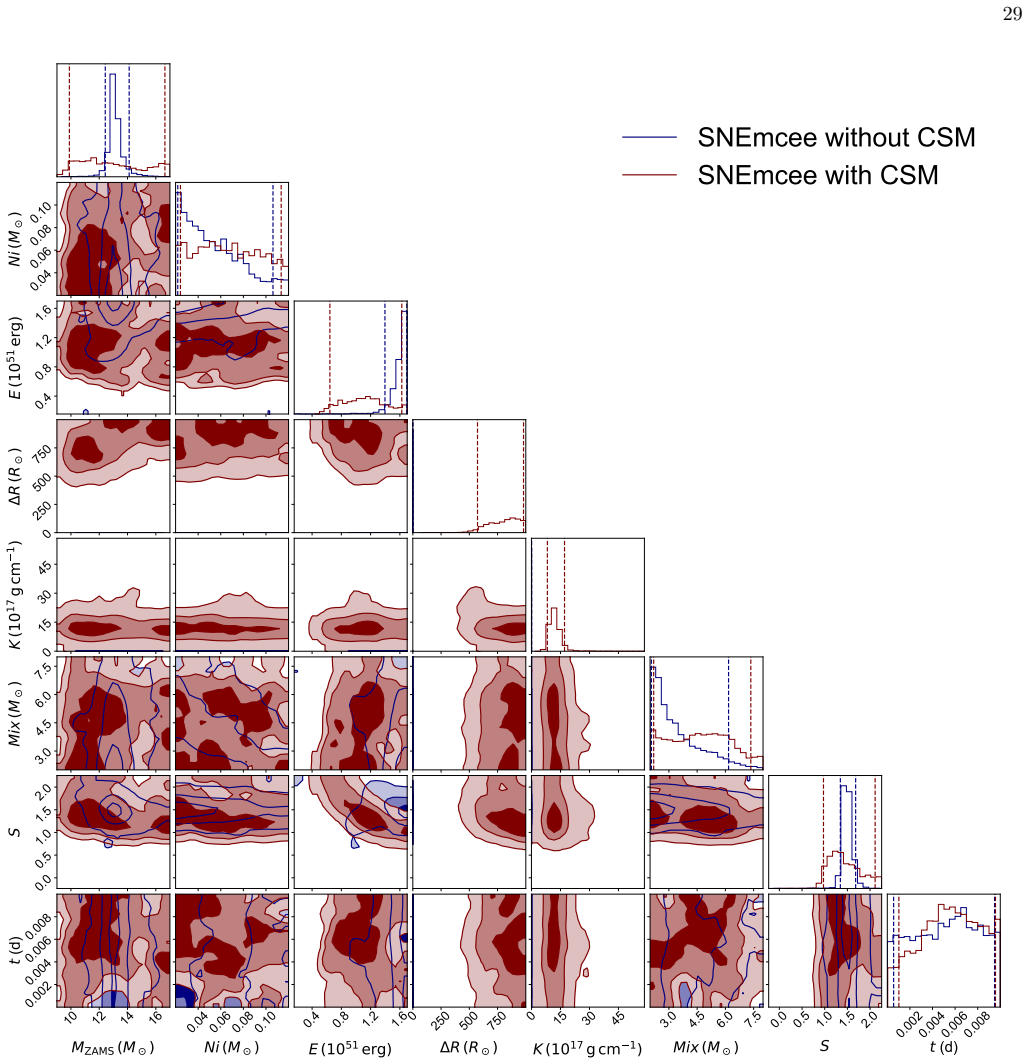
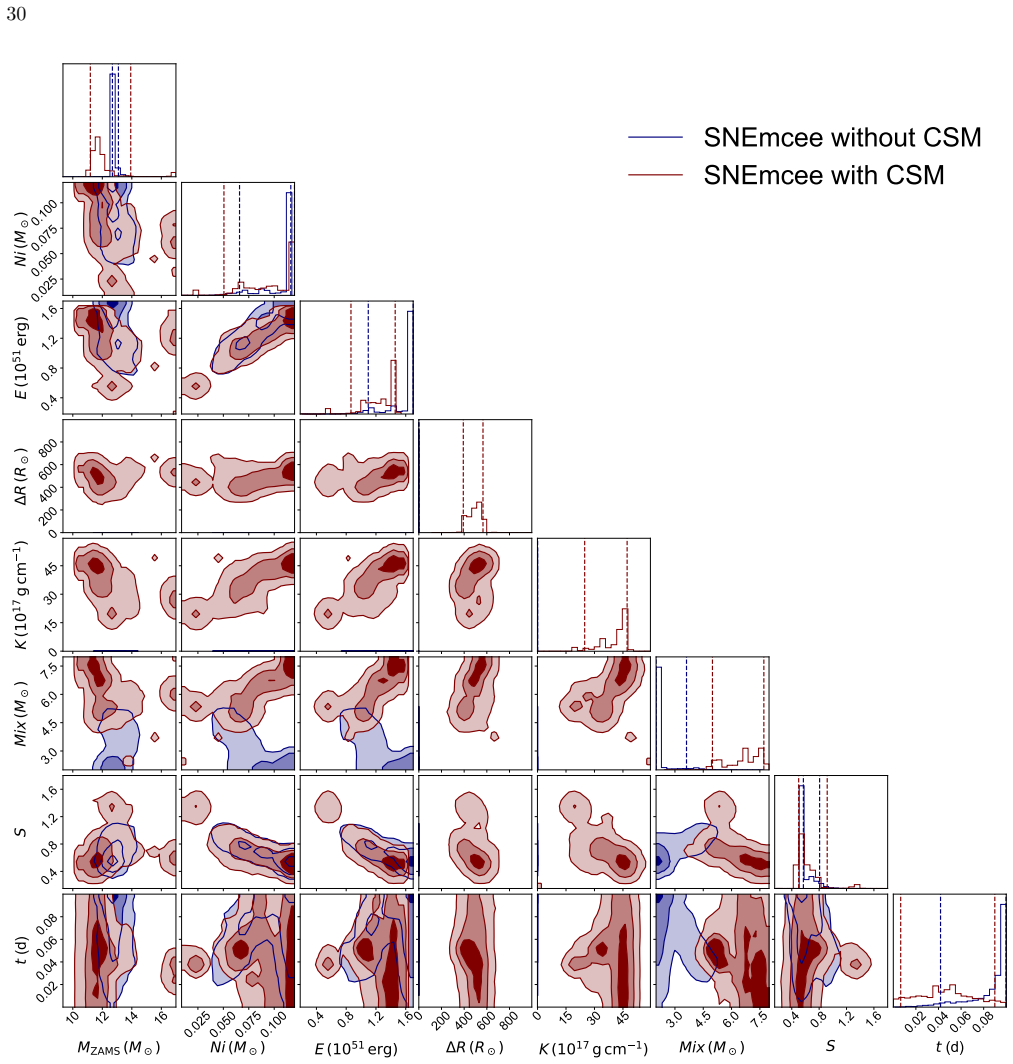
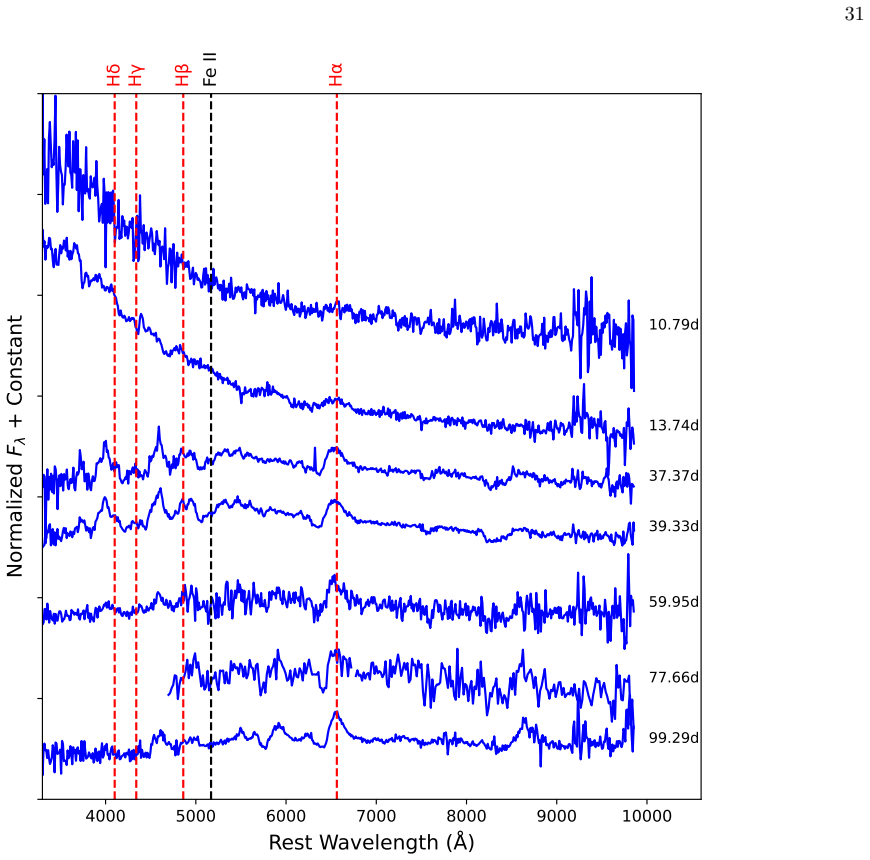
read the original abstract
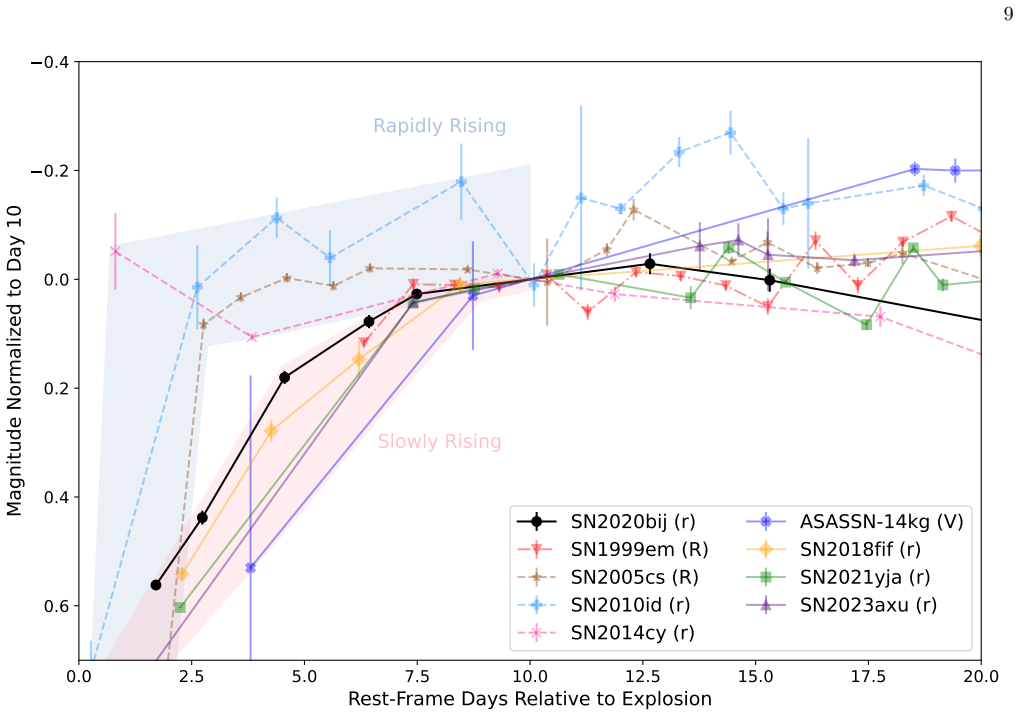
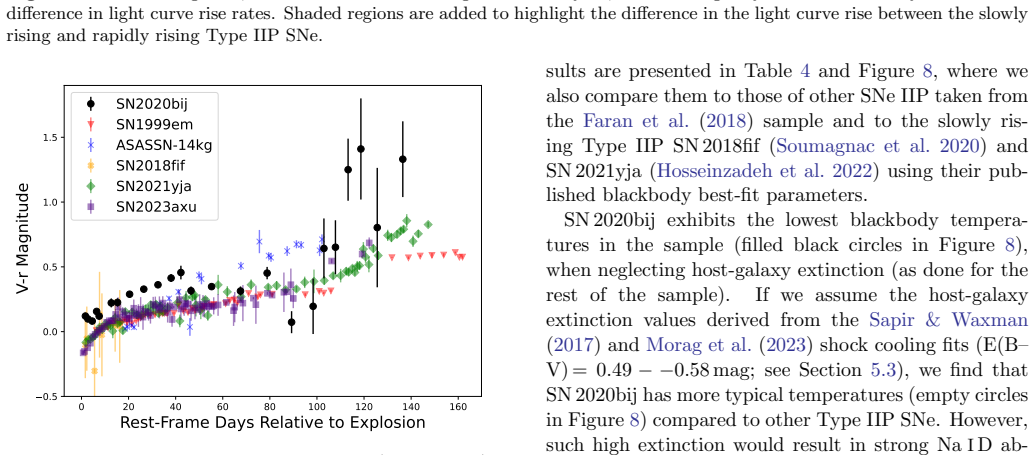
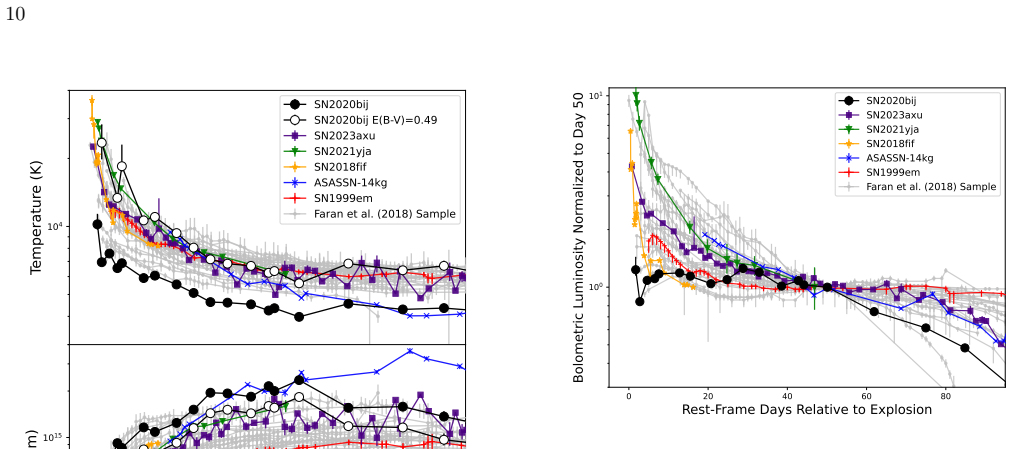
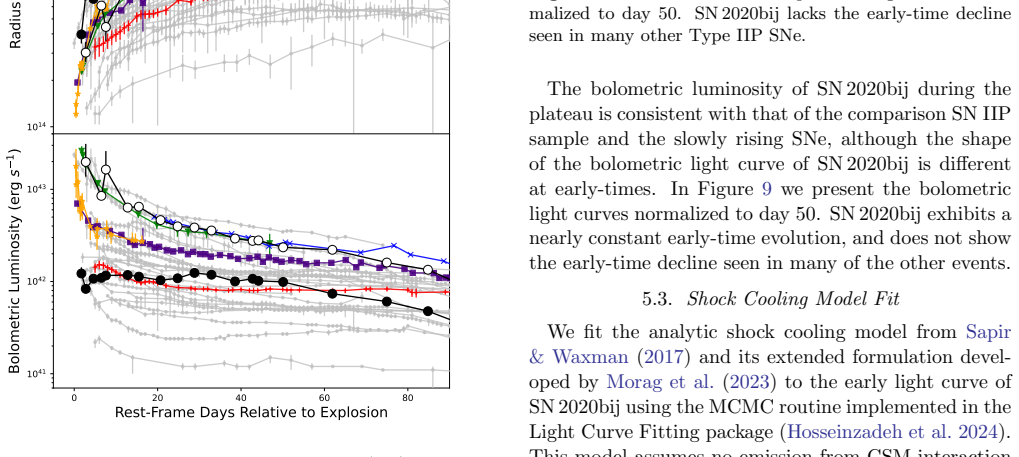
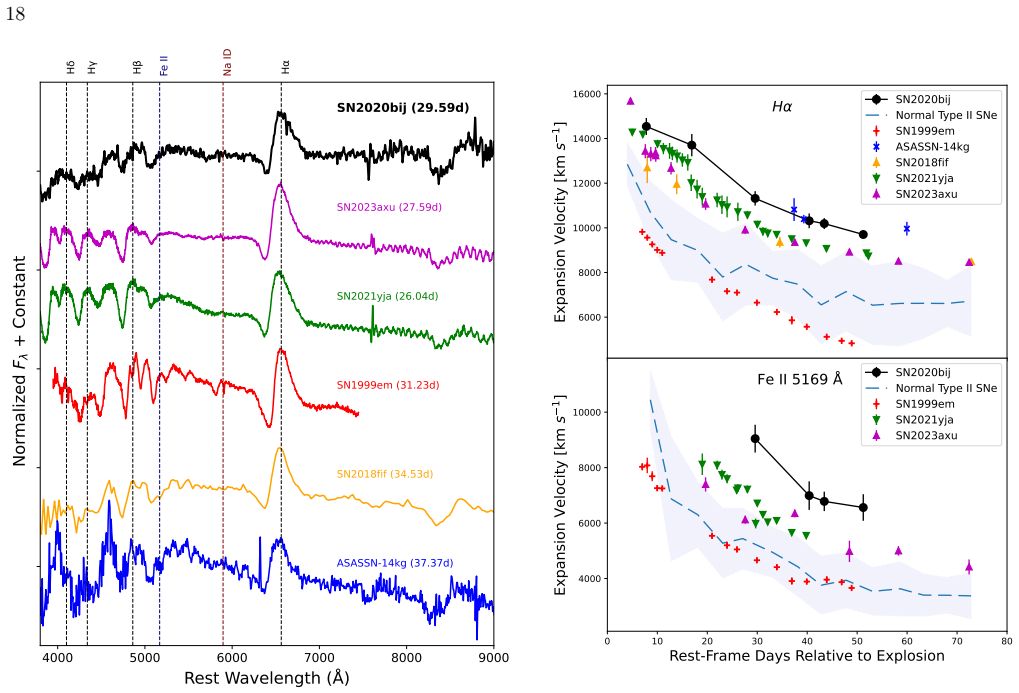
Mapping how the explosion properties of Type II supernovae (SNe II) relate to the properties of their progenitors can provide strong constraints for understanding the final evolutionary stages of massive stars. Type IIP SNe, linked to the explosions of single red super-giant (RSG) stars, have recently been found to require some form of interaction with circumstellar material (CSM) to reproduce the rapid rise to the plateau often seen in their light curves. In this work, we present observations and analysis of the Type IIP SN 2020bij, characterized by a slow rise to its plateau as well as high expansion velocities. We identify four other SNe IIP from the literature (ASASSN-14kg, SN 2018fif, SN 2021yja and SN 2023axu) with similarly slowly rising light curves and find that they also show high expansion velocities. Using both analytical and numerical models, all five events can be explained with weak to no CSM interaction. We therefore propose that these events constitute a new subclass of Type IIP SNe which could be associated with relatively confined CSM. Early and dense photometric coverage of future SNe IIP together with early spectroscopic observations will further map this subclass and its physical properties. Understanding such rare events could be key to constraining the diversity of late-stage mass-loss in RSGs.
Editorial analysis
A structured set of objections, weighed in public.
Referee Report
Summary. The manuscript presents observations of SN 2020bij, a Type IIP supernova with a slow rise to plateau and high expansion velocities. It identifies four additional literature events (ASASSN-14kg, SN 2018fif, SN 2021yja, SN 2023axu) sharing these traits. Analytical and numerical models are shown to reproduce the light curves and velocities of all five events with weak to no CSM interaction. The authors propose these events form a new subclass of Type IIP SNe associated with relatively confined CSM and recommend early dense observations to map it further.
Significance. If the subclass identification holds, the work would help constrain the range of late-stage mass loss in red supergiant progenitors by linking specific light-curve and velocity properties to confined CSM configurations. The use of both analytical and numerical models to fit the sample provides a concrete starting point for testing progenitor diversity, though the quantitative mapping from model parameters to the proposed CSM association remains to be established.
major comments (1)
- [Modeling and discussion sections] The central claim that the five events constitute a subclass 'associated with relatively confined CSM' is load-bearing but not quantitatively supported. The abstract and modeling description state that the events are reproduced with weak to no CSM interaction, yet no parameter ranges, degeneracy tests against variations in explosion energy or progenitor radius, or explicit comparisons to standard RSG models lacking extra CSM are reported; this leaves open whether the 'confined CSM' label is required by the data or is an interpretive overlay.
Simulated Author's Rebuttal
We thank the referee for the detailed review and constructive feedback. We address the major comment below and have revised the manuscript to strengthen the quantitative support for our claims.
read point-by-point responses
-
Referee: [Modeling and discussion sections] The central claim that the five events constitute a subclass 'associated with relatively confined CSM' is load-bearing but not quantitatively supported. The abstract and modeling description state that the events are reproduced with weak to no CSM interaction, yet no parameter ranges, degeneracy tests against variations in explosion energy or progenitor radius, or explicit comparisons to standard RSG models lacking extra CSM are reported; this leaves open whether the 'confined CSM' label is required by the data or is an interpretive overlay.
Authors: We agree that the manuscript would benefit from more explicit quantitative details to support the subclass claim. In the revised version, we have added a table listing the best-fit parameters (explosion energy, progenitor radius, CSM mass and extent) for all five events from both the analytical and numerical models. We have also included a new subsection discussing degeneracies, demonstrating that variations in explosion energy or radius alone cannot reproduce the slow rise without invoking weak/no CSM interaction. Explicit comparisons to standard RSG models without extra CSM are now shown, confirming that the observed light curves and velocities require the confined CSM interpretation rather than being an overlay. revision: yes
Circularity Check
Subclass proposal rests on external modeling and observations; no internal reduction to fitted inputs or self-citations
full rationale
The paper defines the candidate subclass via observed slow-rise light curves and high velocities in five events, then invokes external analytical/numerical models (not derived here) to show these are reproducible with weak-to-no CSM interaction. The proposal that the subclass 'could be associated with relatively confined CSM' is an interpretive overlay rather than a quantity derived from equations or parameters fitted inside the paper. No self-definitional steps, fitted-input-as-prediction, or load-bearing self-citation chains appear in the abstract or described chain. This matches the default expectation of non-circularity with only a minor allowance for typical modeling citations.
Axiom & Free-Parameter Ledger
axioms (1)
- domain assumption Analytical and numerical models of Type IIP supernovae can accurately reproduce observed light curves and velocities when varying the level of CSM interaction.
Reference graph
Works this paper leans on
-
[1]
Las Cumbres Observatory Global Telescope Network
Las Cumbres Observatory Global Telescope Network. , keywords =. doi:10.1086/673168 , archivePrefix =. 1305.2437 , primaryClass =
work page internal anchor Pith review Pith/arXiv arXiv doi:10.1086/673168
-
[2]
Physical Correlations and Predictions Emerging from Modern Core-collapse Supernova Theory. , keywords =. doi:10.3847/2041-8213/ad319e , archivePrefix =. 2401.06840 , primaryClass =
-
[3]
and Tchekhovskoy, Alexander and Blandford, Roger D
An empirical relation between sodium absorption and dust extinction. , keywords =. doi:10.1111/j.1365-2966.2012.21796.x , archivePrefix =. 1206.6107 , primaryClass =
-
[4]
Transient Name Server Discovery Report , keywords =
Transient Discovery Report for 2020-01-29. Transient Name Server Discovery Report , keywords =
2020
-
[5]
ATLAS: A High-Cadence All-Sky Survey System
ATLAS: A High-cadence All-sky Survey System. , keywords =. doi:10.1088/1538-3873/aabadf , archivePrefix =. 1802.00879 , primaryClass =
work page internal anchor Pith review Pith/arXiv arXiv doi:10.1088/1538-3873/aabadf
-
[6]
First cosmology results using type Ia supernovae from the Dark Energy Survey: the effect of host galaxy properties on supernova luminosity. , keywords =. doi:10.1093/mnras/staa946 , archivePrefix =. 2001.11294 , primaryClass =
-
[7]
S. T. Hodgkin and D. L. Harrison and E. Breedt and T. Wevers and G. Rixon and A. Delgado and A. Yoldas and Z. Kostrzewa-Rutkowska and. i Gaia /i Early Data Release 3 , journal =. doi:10.1051/0004-6361/202140735 , url =
-
[8]
Zackay, Barak and Ofek, Eran O. and Gal-Yam, Avishay , year=. PROPER IMAGE SUBTRACTION—OPTIMAL TRANSIENT DETECTION, PHOTOMETRY, AND HYPOTHESIS TESTING , volume=. The Astrophysical Journal , publisher=. doi:10.3847/0004-637x/830/1/27 , number=
-
[9]
Nine-Year Wilkinson Microwave Anisotropy Probe (WMAP) Observations: Cosmological Parameter Results
Nine-year Wilkinson Microwave Anisotropy Probe (WMAP) Observations: Cosmological Parameter Results. , keywords =. doi:10.1088/0067-0049/208/2/19 , archivePrefix =. 1212.5226 , primaryClass =
work page internal anchor Pith review Pith/arXiv arXiv doi:10.1088/0067-0049/208/2/19
-
[10]
Measuring Reddening with Sloan Digital Sky Survey Stellar Spectra and Recalibrating SFD. , keywords =. doi:10.1088/0004-637X/737/2/103 , archivePrefix =. 1012.4804 , primaryClass =
work page internal anchor Pith review Pith/arXiv arXiv doi:10.1088/0004-637x/737/2/103
-
[11]
Correcting for the Effects of Interstellar Extinction
Correcting for the Effects of Interstellar Extinction. , keywords =. doi:10.1086/316293 , archivePrefix =. astro-ph/9809387 , primaryClass =
work page internal anchor Pith review Pith/arXiv arXiv doi:10.1086/316293
-
[12]
Transient Name Server Classification Report , keywords =
ePESSTO+ Transient Classification Report for 2020-02-02. Transient Name Server Classification Report , keywords =
2020
-
[13]
Transient Name Server AstroNote , keywords =
ePESSTO+ spectroscopic classification of optical transients. Transient Name Server AstroNote , keywords =
-
[14]
Maps of Dust IR Emission for Use in Estimation of Reddening and CMBR Foregrounds
Maps of Dust Infrared Emission for Use in Estimation of Reddening and Cosmic Microwave Background Radiation Foregrounds. , keywords =. doi:10.1086/305772 , archivePrefix =. astro-ph/9710327 , primaryClass =
work page internal anchor Pith review Pith/arXiv arXiv doi:10.1086/305772
-
[15]
, keywords =
Photometric properties of type II supernovae. , keywords =
-
[16]
Valenti, S. and Howell, D. A. and Stritzinger, M. D. and Graham, M. L. and Hosseinzadeh, G. and Arcavi, I. and Bildsten, L. and Jerkstrand, A. and McCully, C. and Pastorello, A. and Piro, A. L. and Sand, D. and Smartt, S. J. and Terreran, G. and Baltay, C. and Benetti, S. and Brown, P. and Filippenko, A. V. and Fraser, M. and Rabinowitz, D. and Sullivan, ...
work page internal anchor Pith review doi:10.1093/mnras/stw870
-
[17]
Morozova, V. and Piro, A. L. and Renzo, M. and Ott, C. D. and Clausen, D. and Couch, S. M. and Ellis, J. and Roberts, L. F. , keywords =. Light Curves of Core-Collapse Supernovae with Substantial Mass Loss using the New Open-Source SuperNova Explosion Code (SNEC) , publisher =. 2015 , copyright =. doi:10.48550/ARXIV.1505.06746 , url =
work page internal anchor Pith review Pith/arXiv arXiv doi:10.48550/arxiv.1505.06746 2015
-
[18]
and Renzo, Mathieu and Ott, Christian D
Morozova, Viktoriya and Piro, Anthony L. and Renzo, Mathieu and Ott, Christian D. , year=. NUMERICAL MODELING OF THE EARLY LIGHT CURVES OF TYPE IIP SUPERNOVAE , volume=. The Astrophysical Journal , publisher=. doi:10.3847/0004-637x/829/2/109 , number=
-
[19]
Piro and Stefano Valenti , title =
Viktoriya Morozova and Anthony L. Piro and Stefano Valenti , title =. doi:10.3847/1538-4357/aa6251 , url =
-
[20]
doi:10.5281/zenodo.1043973 , url =
David Guevel and Griffin Hosseinzadeh , title =. doi:10.5281/zenodo.1043973 , url =
-
[21]
Photometric Science Alerts from Gaia
Wyrzykowski, Lukasz and Hodgkin, Simon and Blogorodnova, Nadejda and Koposov, Sergey and Burgon, Ross , keywords =. Photometric Science Alerts from Gaia , publisher =. 2012 , copyright =. doi:10.48550/ARXIV.1210.5007 , url =
work page internal anchor Pith review Pith/arXiv arXiv doi:10.48550/arxiv.1210.5007 2012
-
[22]
Homogeneous Photometry for Star Clusters and Resolved Galaxies. II. Photometric Standard Stars. , keywords =. doi:10.1086/316595 , archivePrefix =. astro-ph/0004144 , primaryClass =
work page internal anchor Pith review Pith/arXiv arXiv doi:10.1086/316595
-
[23]
UBVRI Photometric Standard Stars in the Magnitude Range 11.5 < V < 16.0 Around the Celestial Equator. , keywords =. doi:10.1086/116242 , adsurl =
-
[24]
The 13th Data Release of the Sloan Digital Sky Survey: First Spectroscopic Data from the SDSS-IV Survey Mapping Nearby Galaxies at Apache Point Observatory. , keywords =. doi:10.3847/1538-4365/aa8992 , archivePrefix =. 1608.02013 , primaryClass =
work page internal anchor Pith review Pith/arXiv arXiv doi:10.3847/1538-4365/aa8992
-
[25]
Piro and Stefano Valenti , title =
Viktoriya Morozova and Anthony L. Piro and Stefano Valenti , title =. doi:10.3847/1538-4357/aab9a6 , url =
-
[26]
An Open Catalog for Supernova Data , volume=
Guillochon, James and Parrent, Jerod and Kelley, Luke Zoltan and Margutti, Raffaella , year=. An Open Catalog for Supernova Data , volume=. The Astrophysical Journal , publisher=. doi:10.3847/1538-4357/835/1/64 , number=
-
[27]
UBVRIz Light Curves of 51 Type II Supernovae
UBVRIz Light Curves of 51 Type II Supernovae. , keywords =. doi:10.3847/0004-6256/151/2/33 , archivePrefix =. 1511.08402 , primaryClass =
work page internal anchor Pith review Pith/arXiv arXiv doi:10.3847/0004-6256/151/2/33
-
[28]
Zimmerman, E. A. and Irani, I. and Chen, P. and Gal-Yam, A. and Schulze, S. and Perley, D. A. and Sollerman, J. and Filippenko, A. V. and Shenar, T. and Yaron, O. and Shahaf, S. and Bruch, R. J. and Ofek, E. O. and De Cia, A. and Brink, T. G. and Yang, Y. and Vasylyev, S. S. and Ben Ami, S. and Aubert, M. and Badash, A. and Bloom, J. S. and Brown, P. J. a...
-
[29]
Weak Mass Loss from the Red Supergiant Progenitor of the Type II SN 2021yja. , keywords =. doi:10.3847/1538-4357/ac75f0 , archivePrefix =. 2203.08155 , primaryClass =
-
[30]
Type II Supernova Spectral Diversity. I. Observations, Sample Characterization, and Spectral Line Evolution. , keywords =. doi:10.3847/1538-4357/aa8f52 , archivePrefix =. 1709.02487 , primaryClass =
work page internal anchor Pith review Pith/arXiv arXiv doi:10.3847/1538-4357/aa8f52
-
[31]
The Distance to SN 1999em in NGC 1637 from the Expanding Photosphere Method
The Distance to SN 1999em in NGC 1637 from the Expanding Photosphere Method. , keywords =. doi:10.1086/324785 , archivePrefix =. astro-ph/0109535 , primaryClass =
work page internal anchor Pith review Pith/arXiv arXiv doi:10.1086/324785
-
[32]
doi:10.5281/zenodo.4312178 , url =
Light Curve Fitting , month = 12, year = 2020, publisher =. doi:10.5281/zenodo.4312178 , url =
-
[33]
Azalee and Ben-Ami, Tom and Gomez, Sebastian , title =
Hosseinzadeh, Griffin and Bostroem, K. Azalee and Ben-Ami, Tom and Gomez, Sebastian , title =. doi:10.5281/zenodo.11405219 , url =
-
[34]
The Evolution of Temperature and Bolometric Luminosity in Type-II Supernovae
The evolution of temperature and bolometric luminosity in Type II supernovae. , keywords =. doi:10.1093/mnras/stx2288 , archivePrefix =. 1707.07695 , primaryClass =
work page internal anchor Pith review Pith/arXiv arXiv doi:10.1093/mnras/stx2288
-
[35]
Early supernovae light-curves following the shock-breakout
Early Supernovae Light Curves Following the Shock Breakout. , keywords =. doi:10.1088/0004-637X/725/1/904 , archivePrefix =. 1004.2496 , primaryClass =
work page internal anchor Pith review Pith/arXiv arXiv doi:10.1088/0004-637x/725/1/904
-
[36]
SN 2018fif: The Explosion of a Large Red Supergiant Discovered in Its Infancy by the Zwicky Transient Facility. , keywords =. doi:10.3847/1538-4357/abb247 , archivePrefix =. 1907.11252 , primaryClass =
-
[37]
The Messenger , keywords =
The ESO Faint Object Spectrograph and Camera / EFOSC. The Messenger , keywords =
-
[38]
The first month of evolution of the slow rising type II-P SN 2013ej in M74
The first month of evolution of the slow-rising Type IIP SN 2013ej in M74 ^ ★. , keywords =. doi:10.1093/mnrasl/slt171 , archivePrefix =. 1309.4269 , primaryClass =
work page internal anchor Pith review Pith/arXiv arXiv doi:10.1093/mnrasl/slt171
-
[39]
PESSTO: survey description and products from the first data release by the Public ESO Spectroscopic Survey of Transient Objects. , keywords =. doi:10.1051/0004-6361/201425237 , archivePrefix =. 1411.0299 , primaryClass =
work page internal anchor Pith review Pith/arXiv arXiv doi:10.1051/0004-6361/201425237
-
[40]
Photometric and Spectroscopic Properties of Type II-P Supernovae
Photometric and spectroscopic properties of Type II-P supernovae. , keywords =. doi:10.1093/mnras/stu955 , archivePrefix =. 1404.0378 , primaryClass =
work page internal anchor Pith review Pith/arXiv arXiv doi:10.1093/mnras/stu955
-
[41]
Pinto and Jose Maza and Nicholas B
Mario Hamuy and Philip A. Pinto and Jose Maza and Nicholas B. Suntzeff and M. M. Phillips and Ronald G. Eastman and R. C. Smith and C. J. Corbally and D. Burstein and Yong Li and Valentin Ivanov and Amaya Moro-Martin and L. G. Strolger and R. E. de Souza and S. dos Anjos and Elizabeth M. Green and T. E. Pickering and Luis Gonzalez and Roberto Antezana and...
-
[42]
Characterizing the V-band light-curves of hydrogen-rich type II supernovae
Characterizing the V-band Light-curves of Hydrogen-rich Type II Supernovae. , keywords =. doi:10.1088/0004-637X/786/1/67 , archivePrefix =. 1403.7091 , primaryClass =
work page internal anchor Pith review Pith/arXiv arXiv doi:10.1088/0004-637x/786/1/67
-
[43]
The evolution and explosion of massive stars , author =. Rev. Mod. Phys. , volume =. 2002 , month =. doi:10.1103/RevModPhys.74.1015 , url =
-
[44]
, year = 1941, month = aug, volume =
Spectra of Supernovae. , year = 1941, month = aug, volume =. doi:10.1086/125315 , adsurl =
-
[45]
doi:10.1007/978-3-319-21846-5_39 , url =
Iair Arcavi , title =. doi:10.1007/978-3-319-21846-5_39 , url =
-
[46]
Constraints on the Progenitor of SN 2016gkg From Its Shock-Cooling Light Curve
Constraints on the Progenitor of SN 2016gkg from Its Shock-cooling Light Curve. , keywords =. doi:10.3847/2041-8213/aa5be1 , archivePrefix =. 1611.06451 , primaryClass =
work page internal anchor Pith review Pith/arXiv arXiv doi:10.3847/2041-8213/aa5be1 2041
-
[47]
Signatures of large-scale magnetic fields in AGN jets: transverse asymmetries
Observed fractions of core-collapse supernova types and initial masses of their single and binary progenitor stars. , keywords =. doi:10.1111/j.1365-2966.2011.17229.x , archivePrefix =. 1006.3899 , primaryClass =
-
[48]
Signatures of large-scale magnetic fields in AGN jets: transverse asymmetries
Nearby supernova rates from the Lick Observatory Supernova Search - II. The observed luminosity functions and fractions of supernovae in a complete sample. , keywords =. doi:10.1111/j.1365-2966.2011.18160.x , archivePrefix =. 1006.4612 , primaryClass =
-
[49]
Progenitors of core-collapse supernovae
Progenitors of Core-Collapse Supernovae. , keywords =. doi:10.1146/annurev-astro-082708-101737 , archivePrefix =. 0908.0700 , primaryClass =
work page internal anchor Pith review Pith/arXiv arXiv doi:10.1146/annurev-astro-082708-101737
-
[50]
Observational Constraints on the Progenitors of Core-Collapse Supernovae: The Case for Missing High-Mass Stars. , keywords =. doi:10.1017/pasa.2015.17 , archivePrefix =. 1504.02635 , primaryClass =
work page internal anchor Pith review Pith/arXiv arXiv doi:10.1017/pasa.2015.17 2015
-
[51]
doi:10.1146/annurev-astro-081913-040025 , url =
Nathan Smith , title =. doi:10.1146/annurev-astro-081913-040025 , url =
-
[52]
, keywords =
A new subclass of type II supernovae ?. , keywords =
-
[53]
Evidence for energizing of H alpha emission in type II supernovae by ejecta-wind interaction. , keywords =. doi:10.1093/mnras/250.3.513 , adsurl =
-
[54]
Robert M. Quimby and J. Craig Wheeler and Peter Hoflich and Carl W. Akerlof and Peter J. Brown and Eli S. Rykoff , title =. doi:10.1086/520532 , url =
-
[55]
Douglas C. Leonard and Alexei V. Filippenko and Aaron J. Barth and Thomas Matheson , title =. doi:10.1086/308910 , url =
-
[56]
Isaac Shivvers and Jose H. Groh and Jon C. Mauerhan and Ori D. Fox and Douglas C. Leonard and Alexei V. Filippenko , title =. doi:10.1088/0004-637x/806/2/213 , url =
-
[57]
Core-Collapse Supernovae from 9 to 120 Solar Masses Based on Neutrino-powered Explosions
Core-collapse Supernovae from 9 to 120 Solar Masses Based on Neutrino-powered Explosions. , keywords =. doi:10.3847/0004-637X/821/1/38 , archivePrefix =. 1510.04643 , primaryClass =
work page internal anchor Pith review Pith/arXiv arXiv doi:10.3847/0004-637x/821/1/38
-
[58]
and Kumar, Brajesh and Graham, M
Bose, Subhash and Valenti, Stefano and Misra, Kuntal and Pumo, Maria Letizia and Zampieri, Luca and Sand, David and Kumar, Brijesh and Pastorello, Andrea and Sutaria, Firoza and Maccarone, Thomas J. and Kumar, Brajesh and Graham, M. L. and Howell, D. Andrew and Ochner, Paolo and Chandola, H. C. and Pandey, Shashi B. , year=. SN 2013ab: a normal Type IIP s...
-
[59]
Signatures of circumstellar interaction in the Type IIL supernova ASASSN-15oz , volume=
Bostroem, K Azalee and Valenti, Stefano and Horesh, Assaf and Morozova, Viktoriya and Kuin, N Paul M and Wyatt, Samuel and Jerkstrand, Anders and Sand, David J and Lundquist, Michael and Smith, Mathew and Sullivan, Mark and Hosseinzadeh, Griffin and Arcavi, Iair and Callis, Emma and Cartier, Régis and Gal-Yam, Avishay and Galbany, Lluís and Gutiérrez, Cla...
-
[60]
The Compactness of Presupernova Stellar Cores
The Compactness of Presupernova Stellar Cores. , keywords =. doi:10.1088/0004-637X/783/1/10 , archivePrefix =. 1311.6546 , primaryClass =
work page internal anchor Pith review Pith/arXiv arXiv doi:10.1088/0004-637x/783/1/10
-
[61]
The Remarkable Deaths of 9 - 11 Solar Mass Stars
The Remarkable Deaths of 9-11 Solar Mass Stars. , keywords =. doi:10.1088/0004-637X/810/1/34 , archivePrefix =. 1505.06712 , primaryClass =
work page internal anchor Pith review Pith/arXiv arXiv doi:10.1088/0004-637x/810/1/34
-
[62]
Nucleosynthesis and Remnants in Massive Stars of Solar Metallicity
Nucleosynthesis and remnants in massive stars of solar metallicity. , keywords =. doi:10.1016/j.physrep.2007.02.009 , archivePrefix =. astro-ph/0702176 , primaryClass =
work page internal anchor Pith review Pith/arXiv arXiv doi:10.1016/j.physrep.2007.02.009 2007
-
[63]
Presupernova evolution of massive stars. , keywords =. doi:10.1086/156569 , adsurl =
-
[64]
The Zwicky Transient Facility: System Overview, Performance, and First Results
The Zwicky Transient Facility: System Overview, Performance, and First Results. , keywords =. doi:10.1088/1538-3873/aaecbe , archivePrefix =. 1902.01932 , primaryClass =
work page internal anchor Pith review Pith/arXiv arXiv doi:10.1088/1538-3873/aaecbe 1902
-
[65]
PTF11iqb: cool supergiant mass-loss that bridges the gap between Type IIn and normal supernovae. , keywords =. doi:10.1093/mnras/stv35410.48550/arXiv.1501.02820 , archivePrefix =. 1501.02820 , primaryClass =
-
[66]
A Wolf-Rayet-like progenitor of supernova SN 2013cu from spectral observations of a wind
A Wolf-Rayet-like progenitor of SN 2013cu from spectral observations of a stellar wind. , keywords =. doi:10.1038/nature13304 , archivePrefix =. 1406.7640 , primaryClass =
work page internal anchor Pith review Pith/arXiv arXiv doi:10.1038/nature13304
-
[67]
O. Yaron and D. A. Perley and A. Gal-Yam and J. H. Groh and A. Horesh and E. O. Ofek and S. R. Kulkarni and J. Sollerman and C. Fransson and A. Rubin and P. Szabo and N. Sapir and F. Taddia and S. B. Cenko and S. Valenti and I. Arcavi and D. A. Howell and M. M. Kasliwal and P. M. Vreeswijk and D. Khazov and O. D. Fox and Y. Cao and O. Gnat and P. L. Kelly...
-
[68]
Pastorello, A. and Valenti, S. and Zampieri, L. and Navasardyan, H. and Taubenberger, S. and Smartt, S. J. and Arkharov, A. A. and Bärnbantner, O. and Barwig, H. and Benetti, S. and Birtwhistle, P. and Botticella, M. T. and Cappellaro, E. and Del Principe, M. and Di Mille, F. and Di Rico, G. and Dolci, M. and Elias-Rosa, N. and Efimova, N. V. and Fiedler,...
-
[69]
WISeREP - An Interactive Supernova Data Repository
WISeREP An Interactive Supernova Data Repository. , keywords =. doi:10.1086/666656 , archivePrefix =. 1204.1891 , primaryClass =
work page internal anchor Pith review Pith/arXiv arXiv doi:10.1086/666656
-
[70]
Modules for Experiments in Stellar Astrophysics (MESA): Planets, Oscillations, Rotation, and Massive Stars. , keywords =. doi:10.1088/0067-0049/208/1/4 , archivePrefix =. 1301.0319 , primaryClass =
work page internal anchor Pith review Pith/arXiv arXiv doi:10.1088/0067-0049/208/1/4
-
[71]
The Palomar Transient Factory: System Overview, Performance and First Results
The Palomar Transient Factory: System Overview, Performance, and First Results. , keywords =. doi:10.1086/648598 , archivePrefix =. 0906.5350 , primaryClass =
work page internal anchor Pith review Pith/arXiv arXiv doi:10.1086/648598
-
[72]
Exploring the Optical Transient Sky with the Palomar Transient Factory
Exploring the Optical Transient Sky with the Palomar Transient Factory. , keywords =. doi:10.1086/605911 , archivePrefix =. 0906.5355 , primaryClass =
work page internal anchor Pith review Pith/arXiv arXiv doi:10.1086/605911
-
[73]
Modules for Experiments in Stellar Astrophysics (MESA)
Modules for Experiments in Stellar Astrophysics (MESA). , keywords =. doi:10.1088/0067-0049/192/1/3 , archivePrefix =. 1009.1622 , primaryClass =
work page internal anchor Pith review Pith/arXiv arXiv doi:10.1088/0067-0049/192/1/3
-
[74]
Tartaglia, L. and Fraser, M. and Sand, D. J. and Valenti, S. and Smartt, S. J. and McCully, C. and Anderson, J. P. and Arcavi, I. and Elias-Rosa, N. and Galbany, L. and Gal-Yam, A. and Haislip, J. B. and Hosseinzadeh, G. and Howell, D. A. and Inserra, C. and Jha, S. W. and Kankare, E. and Lundqvist, P. and Maguire, K. and Mattila, S. and Reichart, D. and ...
-
[75]
SN2009ip: Constraints on the progenitor mass-loss rate
SN 2009ip: Constraints on the Progenitor Mass-loss Rate. , keywords =. doi:10.1088/0004-637X/768/1/47 , archivePrefix =. 1303.3894 , primaryClass =
work page internal anchor Pith review Pith/arXiv arXiv doi:10.1088/0004-637x/768/1/47
-
[76]
Homogeneous Velocity-Distance Data for Peculiar Velocity Analysis. III. The Mark III Catalog of Galaxy Peculiar Velocities. , keywords =. doi:10.1086/312983 , archivePrefix =. astro-ph/9610202 , primaryClass =
work page internal anchor Pith review Pith/arXiv arXiv doi:10.1086/312983
-
[77]
Flash Spectroscopy: Emission Lines from the Ionized Circumstellar Material around <10-day-old Type II Supernovae. , keywords =. doi:10.3847/0004-637X/818/1/3 , archivePrefix =. 1512.00846 , primaryClass =
work page internal anchor Pith review Pith/arXiv arXiv doi:10.3847/0004-637x/818/1/3
-
[78]
Short-Lived Circumstellar Interaction in the Low-Luminosity Type IIP SN 2016bkv
Short-lived Circumstellar Interaction in the Low-luminosity Type IIP SN 2016bkv. , keywords =. doi:10.3847/1538-4357/aac5f6 , archivePrefix =. 1801.00015 , primaryClass =
work page internal anchor Pith review Pith/arXiv arXiv doi:10.3847/1538-4357/aac5f6
-
[79]
Nikolai N. Chugai and Roger A. Chevalier and Victor P. Utrobin , title =. doi:10.1086/518160 , url =
-
[80]
Handbook of Supernovae , year = 2017, editor =
Light Curves of Type II Supernovae. Handbook of Supernovae , year = 2017, editor =. doi:10.1007/978-3-319-21846-5_26 , adsurl =
discussion (0)
Sign in with ORCID, Apple, or X to comment. Anyone can read and Pith papers without signing in.