REVIEW 4 major objections 5 minor 53 references
Some Large Language Models Exhibit Consistent Risk Attitudes
T0 review · 4 major / 5 minor · reviewed 2026-08-02 · deepseek-v4-flash
Pith's one-line read Most large language models show stable, domain-general risk attitudes, not task-specific responses.
desk verdict A well-structured empirical framework for measuring LLM risk attitudes, but the headline cross-domain rank stability is likely confounded with a shared numeric-response style and needs control conditions before the trait interpretation holds. read the letter →
The pith
A machine-rendered reading of the paper's core claim, the machinery that carries it, and where it could break.
The reading
What carries the argument
The central object is the belief-to-decision (BC→RD) mapping: the conditional relationship between a model's stated contextual risk belief (0–100, normalized to [0,1]) and its categorical risk decision (five ordered levels, with 1 = most cautious). The machinery is ordered logistic regression, which fits a monotone S-curve to that mapping and yields two summary indices: the slope β (risk sensitivity) and the area under the fitted curve, AUC (risk attitude bias, range [1,5], lower = more cautious). This decomposition is what lets the authors separate how much risk a model perceives from how it prefers to act on that perception. Cross-domain stability is then tested by ranking models by AUC wi
What would settle it
A direct check would be to re-estimate the AUC ranks after replacing each task's decision discretization with a different but equally valid one (for example, using a raw continuous decision variable for navigation and allocation instead of K-means categories, or using a different number of response categories). If the cross-task rank ordering of models changes substantially under that re-discretization, the apparent trait is an artifact of the shared numeric-response format rather than a stable risk attitude. A second check: run one task with the belief scale changed from 0–100 to, say, 0–10 o
Extended reading notes
Core claim
The central claim is that, for most LLMs tested, the belief-to-decision mapping — how a reported risk belief on a 0–100 scale becomes a five-level ordinal risk decision — is stable within a task and preserves each model's relative risk posture across tasks. The authors quantify this by fitting an ordered logistic curve to each model's belief–decision pairs, using the curve's slope as risk sensitivity and the area under the curve as risk attitude bias (lower area = more cautious). They report that five of six models keep the same rank ordering of risk attitude bias across drone navigation, clinical triage, and financial allocation, while one model is most aggressive in navigation and most cau
Load-bearing premise
The load-bearing assumption is that the three tasks' ordinal decision scales are commensurable enough that a stable rank ordering of the area-under-the-curve index reflects a domain-general risk trait, rather than a shared tendency to map numeric 0–100 ratings onto five ordered response options in a consistent way.
Editorial extensions
If this is right
- If a model is characterized as cautious in one decision domain, that characterization can be expected to transfer to other domains, so risk posture can serve as a predictor before deployment in new high-stakes tasks.
- Risk attitude can be measured independently of factual accuracy or belief calibration, giving evaluators a distinct axis — how the model acts under uncertainty — alongside standard capability benchmarks.
- Because risk sensitivity is task-dependent while attitude bias is stable, safety assessments should treat the decision threshold (where along the belief scale a model switches) and the responsiveness (how sharply it switches) as separate quantities.
- Current alignment procedures appear to compress LLM risk postures into a narrow band near the human mean, so aligning behavior with the full range of human risk preferences is an open problem, not a solved one.
Reading between the lines
- The paper leaves implicit that its rank-stability test could serve as a behavioral fingerprint for model identity: two differently fine-tuned versions of the same base model might be distinguished by their AUC ranks even when their benchmark scores match.
- A natural extension would test whether the stable ordering also appears under purely descriptive, text-only risk scenarios with no dynamic environment, which would indicate whether the trait arises from instruction-following style rather than from genuine decision processes.
- If the compression toward the human mean is caused by reinforcement-learning-from-human-feedback averaging, one testable prediction is that models with more extreme reward-model sampling would show wider AUC spread; the paper does not test this.
Editorial analysis
A structured set of objections, weighed in public.
Referee Report
Summary. The paper proposes a cross-domain framework for measuring risk attitudes in LLMs by decomposing decisions into a contextual belief (BC, rated 0–100) and a categorical risk decision (RD, coded 1–5 from cautious to aggressive). Three tasks—drone navigation (DNC), clinical triage (CTD), and financial allocation (FIP)—are administered to six LLMs and 100 human participants. Ordered logistic regression is fit per model–task cell, producing a risk-sensitivity slope and an AUC-based risk-attitude bias. The paper reports (i) intra-task consistency of belief and decision, (ii) cross-domain rank-order stability of AUC, and (iii) a compressed LLM risk-attitude distribution relative to humans, interpreting these as evidence of a stable, model-level risk trait.
Significance. If the claims were fully established, the paper would make a useful contribution to machine psychology and AI alignment: it offers a concrete protocol for separating risk perception from risk choice, compares six contemporary LLMs directly with human participants, and makes trial-level data publicly available. The OLR fits and rank computations are straightforward and reproducible in principle. However, the headline conclusions currently rest on a small-sample rank-stability test that becomes significant only after excluding a discrepant model, on a design that shares response-format features across tasks, and on a human-divergence claim without a formal statistical comparison. The contribution is potentially significant, but the evidence as presented is not yet convincing.
major comments (4)
- [Results, Inter-task Universality; Appendix D.7; Table 9] The central evidence for claim (ii) is the sentence 'Kendall's W = 1.00, p = 0.017, excluding Grok 4.' This is a post-hoc exclusion of the only model that reverses rank ordering between DNC and the other two tasks. With all six models, DNC–CTD and DNC–FIP correlations are τ_b = 0.33 (p = 0.469), which are not significant; only CTD–FIP is perfect. Thus the cross-domain rank-stability claim is supported by one task pair and by deleting the most informative observation. Please report full-sample statistics, pre-specify any exclusion rule, and temper the 'most tested LLMs' wording accordingly.
- [Results, Inter-task Universality; Materials and Methods D.2; Tables 1–2] The paper asserts that cross-domain invariance 'cannot be explained by shared surface features or task-specific heuristics,' but the three tasks share the same response architecture: a 0–100 belief scale and a five-category decision scale coded in the same cautious-to-aggressive direction. A model with a consistent tendency to choose low (or high) category numbers on any ordered scale, or with a consistent numeric-anchoring style, would produce exactly the observed rank stability without any latent risk disposition. DNC differs in that RD is derived from action logs, but CTD and FIP are direct ordinal labels, and all are pooled into the same 1–5 coding. A non-risk control task with the same response format, a reversed decision-scale condition, or a continuous/binary decision mode is needed to rule out this confound. As written, the central interpretation of cross-domain stability is not
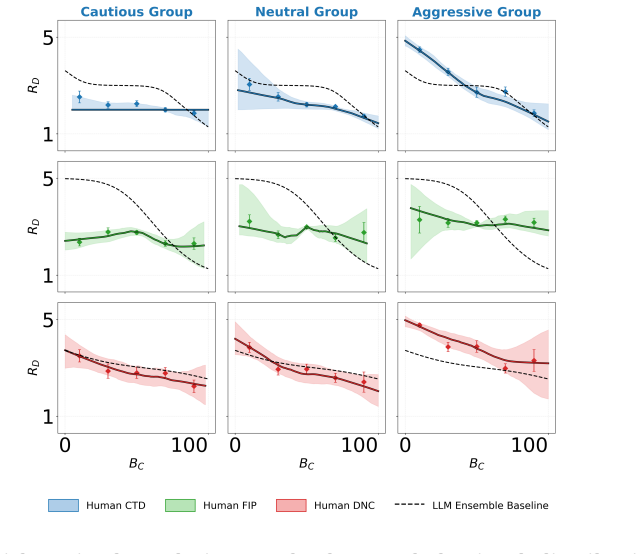
- [LLMs vs. Human Risk Baselines; Figure 6] The paper claims that LLM risk attitudes are 'compressed' or 'restricted' relative to the human distribution, but no statistical test of variance or distribution is reported. Figure 6 shows a visual comparison; there is no Levene/Brown–Forsythe test, no permutation or bootstrap interval for the variance ratio, and no numeric summary of the human vs. LLM AUC distributions. Without this, claim (iii) is unsupported. Please add formal comparisons (e.g., variance-ratio test, bootstrapped confidence intervals) and report the underlying distributions.
- [Materials and Methods D.4–D.7; Figures 4–5] AUC values are point estimates from fitted OLR curves, and all cross-model ranks are computed from these point estimates. No confidence intervals or bootstrap distributions are provided, so it is unclear whether the observed rank orders—especially the 5/6 perfect concordance—are robust to sampling variability. With six models and 100 trials per cell, the rank-stability analysis should include uncertainty intervals on AUC and on the Kendall coefficients.
minor comments (5)
- [Appendix B.7, D.2] The coding of CTD direction is confusing: B.7 says lower ESI values indicate a conservative strategy, while D.2 says 'larger values indicate more aggressive decisions.' Please state explicitly which ESI level maps to category 1 (most cautious) in the analysis.
- [Eq. (1) and Eq. (9)] The expected-decision function is written E_i(x) in Eq. (1) but E[RD | B_C] in Section D.4. Define one notation and use it consistently.
- [Figure 6] Figure 6 lacks axis labels, units, and error bars. Please add numeric scales and a legend so the claimed compression can be evaluated visually.
- [Appendix D.2] The K-means discretization uses k=5 and seed 42. This is a free parameter; please report sensitivity of the AUC values and model ranks to the number of clusters and random seed.
- [Data Availability] The repository contains data, but analysis code is only 'available from the corresponding author upon reasonable request.' Please deposit the analysis code alongside the data for reproducibility.
Circularity Check
No significant circularity: cross-task AUC rank stability is an empirical finding, not a construction from the model specification or a self-citation chain.
full rationale
The paper's derivation chain is: per entity and task, fit an ordered logistic regression of the ordinal risk decision on normalized contextual belief (Eqs. 5-6); define risk sensitivity as the slope beta and risk attitude bias as the AUC of the resulting expected-decision curve (Eq. 9); then compare AUC ranks across DNC, CTD, and FIP. Each entity-task cell is fit independently: D.4 states 'Each cell is estimated independently, with no information shared across entities within a task,' and no parameters or fitted values are shared among the three tasks. The cross-domain rank stability (Table 9, Kendall's W and tau) is therefore an empirical outcome of separate fits, not something forced by the equations, by shared fitted parameters, or by a prior citation. The paper does not relabel a fitted value as a held-out prediction: its cross-domain claim is a rank-order comparison of independently estimated AUCs, not an out-of-sample forecast. The references are standard external methods (McCullagh's OLR, NIST RSD) and there is no load-bearing self-citation, imported uniqueness theorem, or ansatz smuggled in by citation. The main validity concern, that the three tasks share a 0-100 belief scale and five ordered response categories so stable ordering could partly reflect a response-style confound, is a substantive interpretive threat but not circularity: it offers an alternative explanation of the empirical pattern rather than showing that the pattern is equivalent to the inputs by construction. The paper itself also flags generalization as open: 'whether the risk attitudes characterized here generalize across this space, and whether a finite, standardized set of paradigms could serve as a comprehensive risk-attitude assessment instrument ... remains an open and important question.' Thus no circular step is exhibited.
Assumptions & free parameters
free parameters (3)
- K-means discretization for DNC SI =
k=5, seed 42
- K-means discretization for FIP allocations =
k=5, seed 42
- CTD ESI-to-risk-category mapping =
ESI 1=most cautious, ESI 5=most aggressive
assumptions (5)
- standard math Proportional odds / parallel slopes assumption in ordered logistic regression
- domain assumption Repeated trials for each model are independent and identically distributed realizations of the same entity-task mapping
- domain assumption The three tasks share no meaningful surface features, so cross-domain rank stability reflects a general disposition
- domain assumption Human and LLM measurements are commensurable in the same analytical framework
- domain assumption The elicited contextual belief (BC) is measured independently enough from the decision to reveal a true mapping
Cite this review
Pith. "Pith review of Some Large Language Models Exhibit Consistent Risk Attitudes." pith.science (2026). https://pith.science/paper/3573OJCG
@misc{pith2026260716197,
  author       = {Pith},
  title        = {Pith review of: Some Large Language Models Exhibit Consistent Risk Attitudes},
  year         = {2026},
  howpublished = {\url{https://pith.science/paper/3573OJCG}},
  note         = {Machine review of arXiv:2607.16197}
}
read the original abstract
As artificial intelligence systems are deployed in open-ended, high-stakes settings, a critical dimension remains unmeasured: how perceived risk is translated into action. We test whether large language models (LLMs) exhibit systematic and consistent risk attitudes under uncertainty. We introduce a cross-domain framework that decouples contextual risk belief from categorical decision, and apply it to six representative LLMs and 100 human participants across spatial navigation, clinical triage, and financial allocation tasks. Using regression models, we extract each agents belief-to-decision mapping and quantify risk sensitivity and risk attitude bias. We find that most tested LLMs exhibit (i) robust intra-task consistency, indicating stable mappings from contextual belief to risk decision within a fixed task domain; (ii) cross-domain rank-order stability, preserving relative risk posture across tasks; and (iii) a convergence toward a restricted risk-attitude distribution relative to the broader human baseline. These results reveal risk attitude as a stable and previously uncharacterized dimension of LLM behavior, establishing a foundation for evaluating and aligning AI systems in open-ended decision-making and motivating further investigation into the origins of these intrinsic behavioral dispositions.
Figures


Figures from the paper (6 more)





Reference graph
Works this paper leans on
-
[1]
The role of ai in emergency department triage: An integrative systematic review.Intensive and Critical Care Nursing, 89:104058,
Rabie Adel El Arab and Omayma Abdulaziz Al Moosa. The role of ai in emergency department triage: An integrative systematic review.Intensive and Critical Care Nursing, 89:104058,
-
[2]
Andrew Taylor, Chris Chmura, Jeremiah Hinson, Benjamin Steinhart, Rohit Sangal, Ar- jun K
R. Andrew Taylor, Chris Chmura, Jeremiah Hinson, Benjamin Steinhart, Rohit Sangal, Ar- jun K. Venkatesh, Haipeng Xu, Inessa Cohen, Isaac V. Faustino, and Scott Levin. Impact of artificial intelligence–based triage decision support on emergency department care.NEJM AI, 2(3):AIoa2400296, 2025. doi: 10.1056/AIoa2400296. URLhttps://ai.nejm.org/doi/full/ 10.10...
-
[3]
Origbo, Ayokunle Osonuga, Eghosasere Egbon, and David B
Adebayo Da’Costa, Jennifer Teke, Joseph E. Origbo, Ayokunle Osonuga, Eghosasere Egbon, and David B. Olawade. Ai-driven triage in emergency departments: A review of benefits, challenges, and future directions.International Journal of Medical Informatics, 197:105838,
-
[4]
High-performance medicine: the convergence of human and artificial intelligence
Eric J Topol. High-performance medicine: the convergence of human and artificial intelligence. Nature Medicine, 25(1):44–56, 2019
2019
-
[5]
doi: https://doi.org/10.1016/j.ijmedinf.2025.105838
ISSN 1386-5056. doi: https://doi.org/10.1016/j.ijmedinf.2025.105838. URLhttps: //www.sciencedirect.com/science/article/pii/S1386505625000553
arXiv 2025
-
[6]
Golnoosh Babaei, Paolo Giudici, and Emanuela Raffinetti. Explainable artificial intelligence for crypto asset allocation.Finance Research Letters, 47:102941, 2022. ISSN 1544-6123. doi: https://doi.org/10.1016/j.frl.2022.102941. URLhttps://www.sciencedirect.com/science/ article/pii/S1544612322002021
arXiv 2022
-
[7]
Artificial intelligence, dynamic capabilities, and cor- porate financial asset allocation.International Review of Financial Analysis, 96:103773,
Yu Li, Huiyi Zhong, and Qiye Tong. Artificial intelligence, dynamic capabilities, and cor- porate financial asset allocation.International Review of Financial Analysis, 96:103773,
-
[8]
J. B. Heaton, N. G. Polson, and J. H. Witte. Deep learning for finance: Deep portfolios.Applied Stochastic Models in Business and Industry, 33(1):3–12, 2017
2017
Show all 53 references
-
[9]
On the opportunities and risks of foundation models.arXiv preprint arXiv:2108.07258, 2021
Rishi Bommasani, Drew A Hudson, Ehsan Adeli, Russ Altman, Simran Arora, Sydney von Arx, Michael S Bernstein, Jeannette Bohg, Antoine Bosselut, Emma Brunskill, et al. On the opportunities and risks of foundation models.arXiv preprint arXiv:2108.07258, 2021
2021 arXiv
-
[10]
Causal artificial intel- ligence for high-stakes decisions: The design and development of a causal machine learning model.IEEE Access, 10:24327–24339, 2022
Bukhoree Sahoh, Kanjana Haruehansapong, and Mallika Kliangkhlao. Causal artificial intel- ligence for high-stakes decisions: The design and development of a causal machine learning model.IEEE Access, 10:24327–24339, 2022. doi: 10.1109/ACCESS.2022.3155118
2022
-
[11]
A domain-specific risk-attitude scale: Measuring risk perceptions and risk behaviors.Journal of behavioral decision making, 15(4): 263–290, 2002
Elke U Weber, Ann-Renee Blais, and Nancy E Betz. A domain-specific risk-attitude scale: Measuring risk perceptions and risk behaviors.Journal of behavioral decision making, 15(4): 263–290, 2002. 32
2002
-
[12]
Risk attitude and preference.Wiley Interdisciplinary Reviews: Cognitive Sci- ence, 1(1):79–88, 2010
Elke U Weber. Risk attitude and preference.Wiley Interdisciplinary Reviews: Cognitive Sci- ence, 1(1):79–88, 2010
2010
-
[13]
Individual risk attitudes: Measurement, determinants, and behavioral consequences.Jour- nal of the European Economic Association, 9(3):522–550, 2011
Thomas Dohmen, Armin Falk, David Huffman, Uwe Sunde, Jürgen Schupp, and Gert G Wag- ner. Individual risk attitudes: Measurement, determinants, and behavioral consequences.Jour- nal of the European Economic Association, 9(3):522–550, 2011
2011
-
[14]
Rout- ledge, 2017
David Hillson and Ruth Murray-Webster.Understanding and managing risk attitude. Rout- ledge, 2017
2017
-
[15]
Genetic variation in preferences for giving and risk taking.Quarterly Journal of Economics, 124(2):809–842, 2009
David Cesarini, Christopher T Dawes, Magnus Johannesson, Paul Lichtenstein, and Björn Wallace. Genetic variation in preferences for giving and risk taking.Quarterly Journal of Economics, 124(2):809–842, 2009
2009
-
[16]
Assessing the construct validity of risk attitude.Manage- ment Science, 46(10):1337–1348, 2000
Joost ME Pennings and Ale Smidts. Assessing the construct validity of risk attitude.Manage- ment Science, 46(10):1337–1348, 2000
2000
-
[17]
Decisions from experience and the effect of rare events in risky choice.Psychological Science, 15(8):534–539, 2004
Ralph Hertwig, Greg Barron, Elke U Weber, and Ido Erev. Decisions from experience and the effect of rare events in risky choice.Psychological Science, 15(8):534–539, 2004
2004
-
[18]
Reasoningthefastandfrugalway: Modelsofbounded rationality.Psychological Review, 103(4):650–669, 1996
GerdGigerenzerandDanielGGoldstein. Reasoningthefastandfrugalway: Modelsofbounded rationality.Psychological Review, 103(4):650–669, 1996. doi: 10.1037/0033-295X.103.4.650
1996 doi
-
[19]
Who takes risks when and why? Determinants of risk taking
Bernd Figner and Elke U Weber. Who takes risks when and why? Determinants of risk taking. Current Directions in Psychological Science, 20(4):211–216, 2011
2011
-
[20]
Emergent abilities of large language models.Transactions on Machine Learning Research, 2022
Jason Wei, Yi Tay, Rishi Bommasani, Colin Raffel, Barret Zoph, Sebastian Borgeaud, Dani Yogatama, Maarten Bosma, Denny Zhou, Donald Metzler, et al. Emergent abilities of large language models.Transactions on Machine Learning Research, 2022
2022
-
[21]
Probing the psychology of ai models.Proceedings of the National Academy of Sciences, 120(10):e2300963120, 2023
Richard Shiffrin and Melanie Mitchell. Probing the psychology of ai models.Proceedings of the National Academy of Sciences, 120(10):e2300963120, 2023
2023
-
[22]
Risk as feelings
George F Loewenstein, Elke U Weber, Christopher K Hsee, and Ned Welch. Risk as feelings. Psychological bulletin, 127(2):267, 2001
2001
-
[23]
Kernels of selfhood: Gpt-4o shows humanlike patterns of cognitive dissonance moderated by free choice.Proceedings of the National Academy of Sciences, 122(20):e2501823122, 2025
Steven A Lehr, Ketan S Saichandran, Eddie Harmon-Jones, Nykko Vitali, and Mahzarin R Ba- naji. Kernels of selfhood: Gpt-4o shows humanlike patterns of cognitive dissonance moderated by free choice.Proceedings of the National Academy of Sciences, 122(20):e2501823122, 2025
2025
-
[24]
Machine psychology.arXiv preprint arXiv:2303.13988, 2023
Thilo Hagendorff, Ishita Dasgupta, Marcel Binz, Stephanie CY Chan, Andrew Lampinen, Jane X Wang, Zeynep Akata, and Eric Schulz. Machine psychology.arXiv preprint arXiv:2303.13988, 2023
2023 arXiv
-
[25]
Using cognitive psychology to understand GPT-3.Proceedings of the National Academy of Sciences, 120(6):e2218523120, 2023
Marcel Binz and Eric Schulz. Using cognitive psychology to understand GPT-3.Proceedings of the National Academy of Sciences, 120(6):e2218523120, 2023
2023
-
[26]
Evaluating large language models trained on code.arXiv preprint arXiv:2107.03374, 2021
Mark Chen, Jerry Tworek, Heewoo Jun, Qiming Yuan, Henrique Pondé de Oliveira Pinto, Jared Kaplan, Harrison Edwards, Yuri Burda, Nicholas Joseph, Greg Brockman, et al. Evaluating large language models trained on code.arXiv preprint arXiv:2107.03374, 2021
2021 arXiv
-
[27]
Artificial intelligence, values, and alignment.Minds and machines, 30(3):411– 437, 2020
Iason Gabriel. Artificial intelligence, values, and alignment.Minds and machines, 30(3):411– 437, 2020. 33
2020
-
[28]
Measuring massive multitask language understanding.arXiv preprint arXiv:2009.03300, 2020
Dan Hendrycks, Collin Burns, Steven Basart, Andy Zou, Mantas Mazeika, Dawn Song, and Jacob Steinhardt. Measuring massive multitask language understanding.arXiv preprint arXiv:2009.03300, 2020
2009 arXiv
-
[29]
Alan Heckert, James J
N. Alan Heckert, James J. Filliben, Carroll Croarkin, Barry Hembree, William F. Guthrie, Paul Tobias, and Julia Prinz. Handbook 151: Nist/sematech e-handbook of statistical methods, 2002
2002
-
[30]
Regression models for ordinal data.Journal of the Royal Statistical Society: Series B (Methodological), 42(2):109–127, 1980
Peter McCullagh. Regression models for ordinal data.Journal of the Royal Statistical Society: Series B (Methodological), 42(2):109–127, 1980
1980
-
[31]
Concrete problems in AI safety.arXiv preprint arXiv:1606.06565, 2016
Dario Amodei, Chris Olah, Jacob Steinhardt, Paul Christiano, John Schulman, and Dan Mané. Concrete problems in AI safety.arXiv preprint arXiv:1606.06565, 2016
2016 arXiv
-
[32]
Influence of safety climate on risk tolerance and risk-taking behavior: A cross-cultural examination.Safety Science, 146:105559, 2022
S Bhandari and M R Hallowell. Influence of safety climate on risk tolerance and risk-taking behavior: A cross-cultural examination.Safety Science, 146:105559, 2022. doi: 10.1016/j.ssci. 2021.105559
2022
-
[33]
Safety risk tolerance in the construction industry: Cross-cultural analysis.Journal of Construction Engineering and Management, 146 (4):04020022, 2020
R Salas, M Hallowell, R Balaji, and S Bhandari. Safety risk tolerance in the construction industry: Cross-cultural analysis.Journal of Construction Engineering and Management, 146 (4):04020022, 2020. doi: 10.1061/(ASCE)CO.1943-7862.0001789
2020
-
[34]
Personal characteristics and risk tolerance in a natural experiment
Peter Brous and Bo Han. Personal characteristics and risk tolerance in a natural experiment. The Journal of Risk Finance, 23(2):155–168, 2022. doi: 10.1108/JRF-11-2021-0176
2022 doi
-
[35]
Deep reinforcement learning from human preferences
Paul F Christiano, Jan Leike, Tom B Brown, Miljan Martic, Shane Legg, and Dario Amodei. Deep reinforcement learning from human preferences. InAdvances in Neural Information Processing Systems, volume 30. Curran Associates, 2017
2017
-
[36]
Training language models to follow instructions with human feedback.Advances in neural information processing systems, 35:27730–27744, 2022
Long Ouyang, Jeffrey Wu, Xu Jiang, Diogo Almeida, Carroll Wainwright, Pamela Mishkin, Chong Zhang, Sandhini Agarwal, Katarina Slama, Alex Ray, et al. Training language models to follow instructions with human feedback.Advances in neural information processing systems, 35:27730...
2022
-
[37]
Risks and rewards in adolescent decision-making.Current opinion in psychology, 48:101457, 2022
Anna CK Van Duijvenvoorde, Jorien van Hoorn, and Neeltje E Blankenstein. Risks and rewards in adolescent decision-making.Current opinion in psychology, 48:101457, 2022
2022
-
[38]
Prospect theory: An analysis of decision under risk
Daniel Kahneman and Amos Tversky. Prospect theory: An analysis of decision under risk. InHandbook of the fundamentals of financial decision making: Part I, pages 99–127. World Scientific, 2013
2013
-
[39]
Advances in prospect theory: Cumulative representation of uncertainty.Journal of Risk and Uncertainty, 5(4):297–323, 1992
Amos Tversky and Daniel Kahneman. Advances in prospect theory: Cumulative representation of uncertainty.Journal of Risk and Uncertainty, 5(4):297–323, 1992
1992
-
[40]
Perceptionofrisk.Science, 236(4799):280–285, 1987
PaulSlovic. Perceptionofrisk.Science, 236(4799):280–285, 1987. doi: 10.1126/science.3563507
1987 doi
-
[41]
Take caution in using llms as human surrogates.Proceedings of the National Academy of Sciences, 122(24):e2501660122, 2025
Yuan Gao, Dokyun Lee, Gordon Burtch, and Sina Fazelpour. Take caution in using llms as human surrogates.Proceedings of the National Academy of Sciences, 122(24):e2501660122, 2025
2025
-
[42]
Whose opinions do language models reflect? InProceedings of the International Conference on Machine Learning, pages 29971–30004
Shibani Santurkar, Esin Durmus, Faisal Ladd, Cinoo Lee, Percy Liang, and Tatsunori Hashimoto. Whose opinions do language models reflect? InProceedings of the International Conference on Machine Learning, pages 29971–30004. PMLR, 2023. 34
2023
-
[43]
Large language models show amplified cognitive biases in moral decision-making.Proceedings of the National Academy of Sciences, 122(25):e2412015122, 2025
Vanessa Cheung, Maximilian Maier, and Falk Lieder. Large language models show amplified cognitive biases in moral decision-making.Proceedings of the National Academy of Sciences, 122(25):e2412015122, 2025
2025
-
[44]
Grok 4 model card.https://data.x.ai/2025-08-20-grok-4-model-card.pdf, 2025
xAI. Grok 4 model card.https://data.x.ai/2025-08-20-grok-4-model-card.pdf, 2025. Accessed: August 2025
2025
-
[45]
Qwen3 technical report.arXiv preprint arXiv:2505.09388, 2025
An Yang, Anfeng Li, Baosong Yang, Beichen Zhang, Binyuan Hui, Bo Zheng, Bowen Yu, Chang Gao, Chengen Huang, Chenxu Lv, et al. Qwen3 technical report.arXiv preprint arXiv:2505.09388, 2025
2025 arXiv
-
[46]
GPT-5.2 system card.https://cdn.openai.com/pdf/ 3a4153c8-c748-4b71-8e31-aecbde944f8d/oai_5_2_system-card.pdf, 2025
OpenAI. GPT-5.2 system card.https://cdn.openai.com/pdf/ 3a4153c8-c748-4b71-8e31-aecbde944f8d/oai_5_2_system-card.pdf, 2025. Accessed: December 2025
2025
-
[47]
Gemini 3 pro frontier safety framework report.https://storage
Google DeepMind. Gemini 3 pro frontier safety framework report.https://storage. googleapis.com/deepmind-media/gemini/gemini_3_pro_fsf_report.pdf, 2025. Accessed: November 2025
2025
-
[48]
Deepseek-v3 technical report, 2024
DeepSeek-AI. Deepseek-v3 technical report, 2024. URLhttps://arxiv.org/abs/2412.19437
2024 arXiv
-
[49]
System card: Claude Sonnet 4.5.https://www.anthropic.com/ claude-sonnet-4-5-system-card, 2025
Anthropic. System card: Claude Sonnet 4.5.https://www.anthropic.com/ claude-sonnet-4-5-system-card, 2025. Accessed: September 2025
2025
-
[50]
Ordinal regression models made easy: A tutorial on parameter interpretation, data simulation and power analysis.International Journal of Psychology, 59(6):1263–1292, 2024
Filippo Gambarota and Gianmarco Altoè. Ordinal regression models made easy: A tutorial on parameter interpretation, data simulation and power analysis.International Journal of Psychology, 59(6):1263–1292, 2024. 35
2024
-
[52]
Wang, and Robert Krovetz
Yixin Chen, James Z. Wang, and Robert Krovetz. Clue: Cluster-based retrieval of images by unsupervised learning.IEEE Transactions on Image Processing, 14(8):1187–1201, 2005
2005
-
[2024]
doi: https://doi.org/10.1016/j.irfa.2024.103773
ISSN 1057-5219. doi: https://doi.org/10.1016/j.irfa.2024.103773. URLhttps://www. sciencedirect.com/science/article/pii/S1057521924007051
2024
-
[2025]
doi: https://doi.org/10.1016/j.iccn.2025.104058
ISSN 0964-3397. doi: https://doi.org/10.1016/j.iccn.2025.104058. URLhttps://www. sciencedirect.com/science/article/pii/S0964339725001193
2025
Reviewed August 2, 2026 · model on record in the stance chip above.
Discussion (0). Sign in to comment.