REVIEW 2 major objections 5 minor 1 cited by
Alpha Entropy Search for New Information-based Bayesian Optimization
T0 review · 2 major / 5 minor · reviewed 2026-08-12 · deepseek-v4-flash
Pith's one-line read Alpha Entropy Search builds a Bayesian optimization acquisition function from the alpha-divergence and shows an ensemble over alpha values matches or beats KL-based information methods.
desk verdict AES is a clean, genuinely new generalization of JES to alpha-divergence, with a sound derivation and honest experiments; the main soft spot is that the approximation is validated only in 1D. read the letter →
The pith
A machine-rendered reading of the paper's core claim, the machinery that carries it, and where it could break.
The reading
What carries the argument
The load-bearing object is Amari's $\alpha$-divergence, $D_\alpha(p\|q)=\frac{1}{(1-\alpha)\alpha}\left(1-\int q^{1-\alpha}p^\alpha\right)$, which generalizes the KL divergence (recovered as $\alpha\to 1$) and the reversed KL divergence (as $\alpha\to 0$). The paper plugs into it the joint distribution of the observation $y$ and the optimizer $\{x^\star, y^\star\}$ versus the product of marginals, defining the acquisition. To make that tractable, the conditional distribution $p(y|D_{t-1},x,\{y^\star,x^\star\})$ is approximated as a Gaussian whose mean and variance come from a truncated Gaussian (Eqs. 11--12), and the integral over $y$ is computed in closed form using the log-normalizer $g(\eta)$ of the Gaussian (Eqs. 13--15). Samples of $\{x^\star,y^\star\}$ are drawn from the GP posterior via random Fourier features, and Monte Carlo averages the closed-form integrand. The ensemble variant sums each $\alpha$'s normalized acquisition over eleven equally spaced $\alpha$ values, reusing one set of samples.
What would settle it
Evaluate Eq. (10) exactly in a low-dimensional problem (e.g., a 2D or 4D sample from the GP prior) using fine Monte Carlo and quadrature, then compare the maximizer of the approximate Eq. (15) with the maximizer of the exact acquisition for alpha near 0.01; if the approximate maximizer is consistently far from the exact one and the gap translates into worse optimization regret, the truncated-Gaussian approximation is the failing link.
Extended reading notes
Core claim
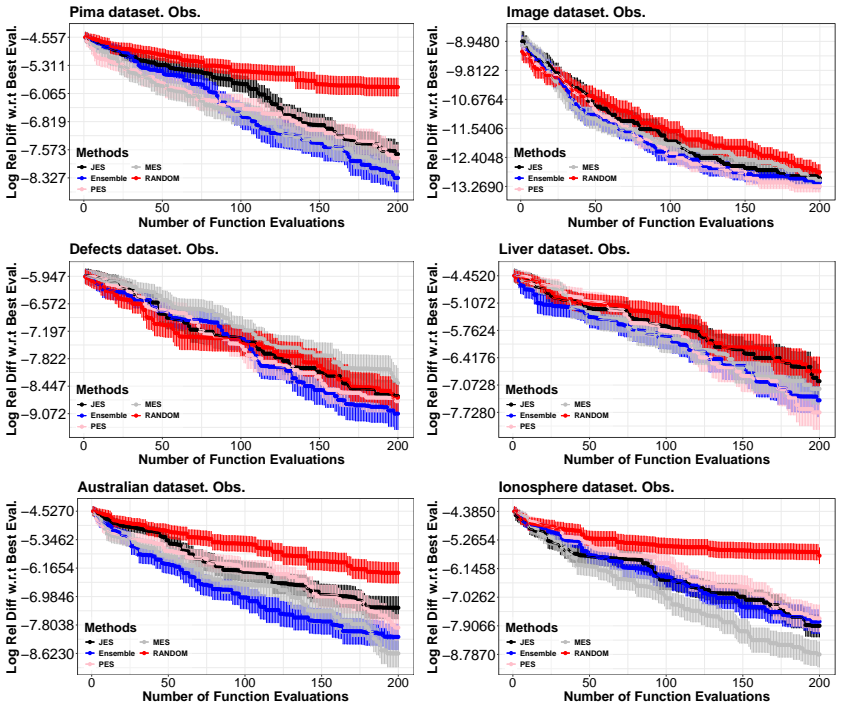
The central claim is that information-based Bayesian optimization does not have to be tied to the KL divergence: replacing the mutual-information/KL objective of Joint Entropy Search with Amari's $\alpha$-divergence yields a family of acquisition functions, called AES, that retain the same sampling machinery and achieve competitive or better optimization performance. The paper derives $$a_{\mathrm{AES}}(x)=D_\$\alpha$\bigl(p(y,\{y^\star,x^\star\}|D_{t-1},x)\,\|\,p(\{y^\star,x^\star\}|D_{t-1})p(y|D_{t-1},x)\bigr),$$ where $D_\alpha$ is Amari's $\alpha$-divergence, and supplies an approximation: the conditional $p(y|D_{t-1},x,\{y^\star,x^\star\})$ is replaced by a Gaussian with the truncated-Gaussian mean and variance from Eqs. (11)--(12), and the integral over $y$ is evaluated in closed form through the exponential-family form of the Gaussian, giving Eq. (15). With $\alpha$ approaching 1 the acquisition is close to, though not identical to, JES; smaller $\alpha$ values change the trade-off between mode-seeking and global coverage. Since no single $\alpha$ dominated, the paper's recommended procedure averages eleven normalized AES acquisitions over $\alpha\in(0,1)$. The experiments support the claim that this ensemble is especially effective in noiseless evaluations and remains competitive when observations are noisy.
Load-bearing premise
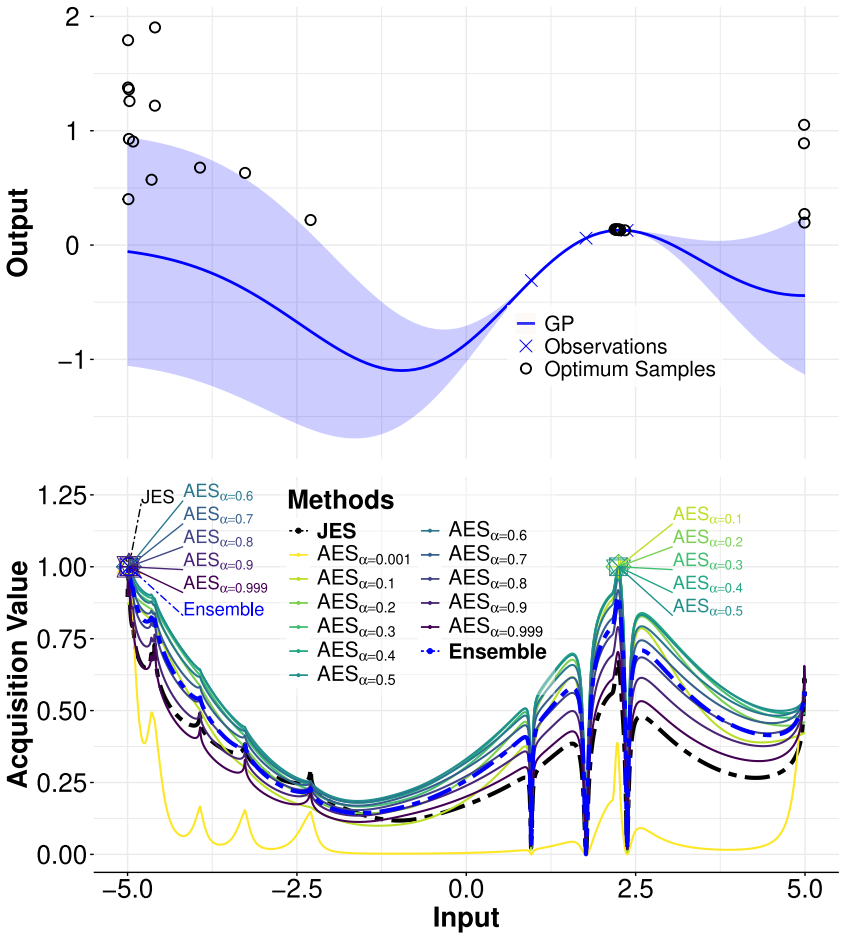
The load-bearing premise is that the conditional distribution of the objective at a candidate point, given the location and value of the optimum, is well approximated by a Gaussian with the mean and variance of a truncated Gaussian; the paper's own 1D comparison shows this approximation underestimates the exact alpha-divergence, especially for alpha near zero, so if the bias grows in higher dimensions the method's claimed competitive performance could degrade.
Editorial extensions
If this is right
- If the central claim holds, practitioners can replace KL-based acquisitions with an alpha-ensemble at the same sampling cost and get equal or better performance in noiseless low-to-moderate-dimensional BO problems.
- The ensemble's fewer local maxima (12.53 vs 17.60 on average in the paper's 1D study) make acquisition optimization less likely to get stuck, which explains why it avoids JES's degradation as the number of optimizer samples S grows.
- AES with alpha near 0.999 gives a new, slightly different approximation to JES, so it can serve as a drop-in alternative in BO libraries that already support JES.
- In the noisy setting, gains over JES shrink and JES can win in high dimensions (e.g., Cosine-8D), so the ensemble is best viewed as a complement rather than a universal replacement.
- Because the alpha parameter changes the acquisition's exploration-exploitation profile, the ensemble provides a principled way to avoid choosing alpha by hand.
Reading between the lines
- A natural extension the paper leaves implicit is to use the same alpha-divergence construction with only $x^\star$ or only $y^\star$, which would yield alpha-generalizations of PES and MES rather than JES.
- The smoothness benefit suggests that alpha-ensembling could help any acquisition function whose ruggedness scales with the number of optimizer samples, such as multi-objective joint entropy search.
- One testable implication is that exact (or better-approximated) alpha-divergence values for small alpha would further improve performance, since the paper's own Figure 4 shows the truncated-Gaussian approximation underestimates the true acquisition most there.
- The ensemble idea could be combined with adaptive weighting across BO iterations, giving more weight to alpha values that have recently produced better evaluations, rather than the fixed equal weights used here.
Editorial analysis
A structured set of objections, weighed in public.
Referee Report
Summary. This paper introduces Alpha Entropy Search (AES), a Bayesian optimization acquisition function that replaces the KL divergence used in Joint Entropy Search with Amari's alpha-divergence. AES measures the dependence between a candidate observation y at x and the joint optimum {x*,y*}, leading to an intractable acquisition (Eq. 10). The authors approximate the conditional predictive distribution p(y|D,x,{y*,x*}) by a Gaussian whose moments come from a truncated Gaussian (Eqs. 11-12), which yields a closed-form integral (Eq. 13) and a Monte Carlo acquisition estimate (Eq. 15). Because no single alpha is uniformly best, they also propose an ensemble over eleven alpha values (Eq. 16). The paper provides a BOTorch implementation and extensive experiments on synthetic, benchmark, and real-world tasks, reporting that the ensemble is competitive with JES, MES, and PES, particularly in noiseless settings.
Significance. If the approximation is trustworthy, AES is a principled and useful generalization of JES: it introduces a tunable divergence family into information-based BO, and the ensemble provides a robust acquisition that is often better than any single alpha and than JES in noiseless settings. The paper is careful about its limitations: it reports that no single alpha dominates, that the approximation underestimates the exact acquisition, and that the benefits are smaller under noise. The appendices contain detailed derivations, and the authors provide code. The observation that the ensemble's performance is insensitive to the number of samples S, while JES's degrades with S in low-dimensional noiseless problems, is an interesting empirical finding. However, the empirical claims rest on the fidelity of the Gaussian approximation to the true alpha-divergence, which is only demonstrated in one dimension.
major comments (2)
- [Section 5.1, Figure 4, Eq. (15)] The approximation that yields Eq. (15) is validated only on a 1D toy problem. Figure 4 shows that the approximate AES systematically underestimates the exact acquisition and that the error is larger for small alpha (alpha=0.001 and 0.1). Because the ensemble in Eq. (16) includes these values, the normalization weights w_alpha = max_x \tilde{a}_AES(x;alpha) are computed from underestimated maxima whose bias depends on alpha. The paper does not test, in dimensions above one, whether the maximizer of \tilde{a}_AES(x;alpha) coincides with the maximizer of the exact acquisition, which is the quantity that actually determines the next query. If the approximation changes the ranking of candidate points, the method optimizes a different functional than the alpha-divergence claimed. Please add a 2D or 3D study comparing the approximate and exact maximizers (using the Section 5.1 exact estimator restricted to a candidate set) and report the alpha-dependent bias in w_alpha.
- [Section 3.3, Eq. (16)] The ensemble is described as giving equal weight to each alpha value by normalizing each acquisition by its maximum. However, the normalizing constant w_alpha is the maximum of the approximate acquisition, not of the exact acquisition. Since the approximation error is alpha-dependent (Section 5.1), the normalized approximate acquisitions do not correspond to equal weights on the exact AES objectives. This matters for the paper's central empirical claim that the ensemble is better than any single alpha: part of the benefit may be an artifact of unequal weighting induced by the approximation. The authors should either demonstrate that the relative approximation error at the maximizers is roughly constant across alpha, or use a bias-corrected estimator of the maxima for normalization.
minor comments (5)
- [Section 3.1] In the bullet list near Eq. (9), 'DKL(p(x) ∥ x(x))' should read 'DKL(p(x) ∥ q(x))'.
- [Section 6] In the conclusion, 'arxvic' appears to be a typo for 'arXiv' or 'also'.
- [Figure 8 caption] The caption says 'log hyper-volume relative difference', but the y-axis and the text describe a log relative difference to the maximum objective value; the caption should be consistent with the text.
- [Table 1 and Section 3.3] The claim that the difference in the number of local maxima is 'statistically significant' is not supported by a significance test; the table reports only means and standard errors.
- [Section 5.2] The statement that 'the ensemble method outperforms AES for all values of alpha' is stronger than the 4D results in Figure 5 show, where the curves largely overlap; please qualify this claim.
Circularity Check
No circular derivation: AES's alpha-divergence acquisition is derived in closed form from Eqs. (10)-(15) with no fitted constants; the only self-citation cluster, justifying the alpha grid, is not load-bearing.
full rationale
The derivation chain is self-contained. Eq. (10) defines the AES acquisition as Amari's alpha-divergence between the joint p(y,{y*,x*}|D,x) and the product of marginals; this is a definition, not a result fitted to data. Section 3.2 approximates the intractable conditional with the same truncated-Gaussian moments used by JES (Eqs. 11-12), and Eq. (13) follows by exponential-family algebra; Eq. (15) is the Monte Carlo estimator. No parameter is fitted to the benchmark outcomes and then renamed a prediction: alpha is user-chosen, the ensemble weights w_alpha in Eq. (16) are fixed normalizers equal to each approximate acquisition's maximum, not performance-fitted weights, and S is shared across alpha values. The 1D exact-vs-approximate check in Section 5.1 (Figure 4) is an approximation-quality check, not a circular validation; underestimation for small alpha is a correctness concern, not a reduction of the prediction to its inputs. The only minor self-citation cluster is the justification of the alpha grid in Section 3.3 ('This range of values has been employed before in the literature of approximate inference ... [26,27,23]'), where all three cited papers share the author D. Hernandez-Lobato; this is a design-choice justification and the central derivation and benchmark comparisons do not depend on it. Hence the paper has no significant circularity, only a minor non-load-bearing self-citation cluster.
Assumptions & free parameters
free parameters (2)
- alpha_divergence_parameter_alpha =
Not fitted; user-selected or ensemble over {0.001, 0.1, 0.2, ..., 0.9, 0.999}
- mc_sample_count_S =
32
assumptions (5)
- domain assumption The objective function f is a sample from a Gaussian process prior.
- domain assumption The conditional predictive distribution p(y|D, x, {y*, x*}) can be approximated by a Gaussian with the same mean and variance as a truncated Gaussian.
- domain assumption Random features can approximate the GP posterior for sampling {x*, y*}.
- standard math The Gaussian distribution is in the exponential family, so the integral in Eq. (19) has a closed form via log-normalizers.
- standard math The alpha-divergence is non-negative and zero iff distributions coincide, and its limiting cases match the KL divergences.
Cite this review
Pith. "Pith review of Alpha Entropy Search for New Information-based Bayesian Optimization." pith.science (2026). https://pith.science/paper/35JZRMDI
@misc{pith2026241116586,
  author       = {Pith},
  title        = {Pith review of: Alpha Entropy Search for New Information-based Bayesian Optimization},
  year         = {2026},
  howpublished = {\url{https://pith.science/paper/35JZRMDI}},
  note         = {Machine review of arXiv:2411.16586}
}
read the original abstract
Bayesian optimization (BO) methods based on information theory have obtained state-of-the-art results in several tasks. These techniques heavily rely on the Kullback-Leibler (KL) divergence to compute the acquisition function. In this work, we introduce a novel information-based class of acquisition functions for BO called Alpha Entropy Search (AES). AES is based on the {\alpha}-divergence, that generalizes the KL divergence. Iteratively, AES selects the next evaluation point as the one whose associated target value has the highest level of the dependency with respect to the location and associated value of the global maximum of the optimization problem. Dependency is measured in terms of the {\alpha}-divergence, as an alternative to the KL divergence. Intuitively, this favors the evaluation of the objective function at the most informative points about the global maximum. The {\alpha}-divergence has a free parameter {\alpha}, which determines the behavior of the divergence, trading-off evaluating differences between distributions at a single mode, and evaluating differences globally. Therefore, different values of {\alpha} result in different acquisition functions. AES acquisition lacks a closed-form expression. However, we propose an efficient and accurate approximation using a truncated Gaussian distribution. In practice, the value of {\alpha} can be chosen by the practitioner, but here we suggest to use a combination of acquisition functions obtained by simultaneously considering a range of values of {\alpha}. We provide an implementation of AES in BOTorch and we evaluate its performance in both synthetic, benchmark and real-world experiments involving the tuning of the hyper-parameters of a deep neural network. These experiments show that the performance of AES is competitive with respect to other information-based acquisition functions such as JES, MES or PES.
Figures


Figures from the paper (9 more)




Forward citations
Cited by 1 Pith paper
-
Information-theoretic Bayesian Optimization: Survey and Tutorial
A survey and tutorial of information-theoretic acquisition functions for Bayesian optimization, covering entropy-based methods and their extensions, with no new algorithms or experiments.
Reference graph
Works this paper leans on
- [1]
- [2]
-
[3]
B. Shahriari, K. Swersky, Z. Wang, R. Adams, N. De Freitas, Taking the human out of the loop: A review of Bayesian optimization, Proceedings of the IEEE 104 (2015) 148–175
work page 2015
-
[4]
Garnett, Bayesian optimization, Cambridge University Press, 2023
R. Garnett, Bayesian optimization, Cambridge University Press, 2023
2023
-
[5]
C. E. Rasmussen, C. K. Williams, Gaussian processes for machine learning, MIT press Cam- bridge, MA, 2006
work page 2006
-
[6]
L. Cornejo-Bueno, E. C. Garrido-Merchán, D. Hernández-Lobato, S. Salcedo-Sanz, Bayesian optimization of a hybrid system for robust ocean wave features prediction, Neurocomputing 275 (2018) 818–828
work page 2018
-
[7]
G. Agarwal, H. A. Doan, L. A. Robertson, L. Zhang, R. S. Assary, Discovery of energy storage molecular materials using quantum chemistry-guided multiobjective Bayesian optimization, Chemistry of Materials 33 (20) (2021) 8133–8144
work page 2021
-
[8]
R. Martinez-Cantin, Bayesian optimization with adaptive kernels for robot control, in: 2017 IEEE international conference on robotics and automation (ICRA), IEEE, 2017, pp. 3350– 3356
work page 2017
Show all 41 references
-
[9]
E. C. Garrido-Merchán, G. G. Piris, M. C. Vaca, Bayesian optimization of esg (environmen- tal social governance) financial investments, Environmental Research Communications 5 (5) (2023) 055003
2023
-
[10]
Solnik, D
B. Solnik, D. Golovin, G. Kochanski, J. E. Karro, S. Moitra, D. Sculley, Bayesian optimization for a better dessert, in: Proceedings of the 2017 NIPS Workshop on Bayesian Optimization, 2017
2017
-
[11]
Brooks, G.-Y
J.M.Hernández-Lobato, M.A.Gelbart, B.Reagen, R.Adolf, D.Hernández-Lobato, P.What- mough, D. Brooks, G.-Y. Wei, R. P. Adams, Designing neural network hardware accelerators with decoupled objective evaluations
-
[12]
J. M. Hernández-Lobato, M. W. Hoffman, Z. Ghahramani, Predictive entropy search for efficient global optimization of black-box functions, Advances in neural information processing systems 27
-
[13]
Villemonteix, E
J. Villemonteix, E. Vazquez, E. Walter, An informational approach to the global optimization of expensive-to-evaluate functions, Journal of Global Optimization 44 (2009) 509
2009
-
[14]
Hennig, C
P. Hennig, C. J. Schuler, Entropy search for information-efficient global optimization., Journal of Machine Learning Research 13 (6)
-
[15]
Hvarfner, F
C. Hvarfner, F. Hutter, L. Nardi, Joint entropy search for maximally-informed Bayesian optimization, Advances in Neural Information Processing Systems 35 (2022) 11494–11506
2022
-
[16]
B. Tu, A. Gandy, N. Kantas, B. Shafei, Joint entropy search for multi-objective Bayesian optimization, Advances in Neural Information Processing Systems (2022) 9922–9938. 23
2022
-
[17]
Amari, Differential-geometrical methods in statistics, Vol
S.-i. Amari, Differential-geometrical methods in statistics, Vol. 28, Springer-Verlag, 1985
1985
-
[18]
Minka, et al., Divergence measures and message passing, Tech
T. Minka, et al., Divergence measures and message passing, Tech. rep., Technical report, Microsoft Research (2005)
2005
-
[19]
Balandat, B
M. Balandat, B. Karrer, D. Jiang, S. Daulton, B. Letham, A. G. Wilson, E. Bakshy, Botorch: A framework for efficient monte-carlo Bayesian optimization, Advances in neural information processing systems 33 (2020) 21524–21538
2020
-
[20]
Z. Wang, S. Jegelka, Max-value entropy search for efficient Bayesian optimization, in: Inter- national Conference on Machine Learning, PMLR, 2017, pp. 3627–3635
2017
-
[21]
Cichocki, S.-C
A. Cichocki, S.-C. Amari, Families of alpha-beta-and gamma-divergences: Flexible and robust measures of similarities, Entropy 12 (2010) 1532–1568
2010
-
[22]
J. M. Hernandez-Lobato, Y. Li, M. Rowland, D. Hernández-Lobato, T. Bui, R. E. Turner, Black-box alpha divergence minimization, in: International conference on machine learning, 2016, pp. 1511–1520
2016
-
[23]
Rodríguez-Santana, D
S. Rodríguez-Santana, D. Hernández-Lobato, Adversarial α-divergence minimization for Bayesian approximate inference, Neurocomputing 471 (2022) 260–274
2022
-
[24]
Q. P. Nguyen, B. K. H. Low, P. Jaillet, Rectified max-value entropy search for Bayesian optimization, arXiv preprint arXiv:2202.13597
-
[25]
Rahimi, B
A. Rahimi, B. Recht, et al., Random features for large-scale kernel machines., in: NIPS, Vol. 3, Citeseer, 2007, pp. 1177–1184
2007
-
[26]
Villacampa-Calvo, D
C. Villacampa-Calvo, D. Hernández-Lobato, Alpha divergence minimization in multi-class Gaussian process classification, Neurocomputing 378 (2020) 210–227
2020
-
[27]
Villacampa-Calvo, G
C. Villacampa-Calvo, G. Hernández-Munoz, D. Hernández-Lobato, Alpha-divergence mini- mization for deep gaussian processes, International Journal of Approximate Reasoning 150 (2022) 139–171
2022
-
[28]
M. W. Hoffman, Z. Ghahramani, Output-space predictive entropy search for flexible global optimization, in: NIPS workshop on Bayesian Optimization, 2015, pp. 1–5
2015
-
[29]
B. Ru, M. A. Osborne, M. McLeod, D. Granziol, Fast information-theoretic Bayesian opti- misation, in: International Conference on Machine Learning, PMLR, 2018, pp. 4384–4392
2018
-
[30]
Q. P. Nguyen, Z. Wu, B. K. H. Low, P. Jaillet, Trusted-maximizers entropy search for efficient Bayesian optimization, in: Uncertainty in Artificial Intelligence, PMLR, 2021, pp. 1486–1495
2021
-
[31]
Neiswanger, L
W. Neiswanger, L. Yu, S. Zhao, C. Meng, S. Ermon, Generalizing Bayesian optimization with decision-theoretic entropies, Advances in Neural Information Processing Systems 35 (2022) 21016–21029
2022
-
[32]
Y. Li, Y. Gal, Dropout inference in Bayesian neural networks with alpha-divergences, in: International Conference on Machine Learning, 2017, pp. 2052–2061
2017
-
[33]
T. D. Bui, J. Yan, R. E. Turner, A unifying framework for Gaussian process pseudo-point approximations using power expectation propagation, Journal of Machine Learning Research 18 (2017) 1–72
2017
-
[34]
T. D. Bui, D. Hernández-Lobato, J. M. Hernández-Lobato, Y. Li, R. E. Turner, in: NIPS Workshop on Advances in Approximate Bayesian Inference, 2016
2016
-
[35]
L. I. Midgley, V. Stimper, G. N. C. Simm, B. Schölkopf, J. M. Hernández-Lobato, Flow annealed importance sampling bootstrap, in: International Conference on Learning Repre- sentations, 2023. 24
2023
-
[36]
Hoffman, E
M. Hoffman, E. Brochu, N. De Freitas, Portfolio allocation for bayesian optimization., in: Uncertainty in Artificial Intelligence, 2011, pp. 327–336
2011
-
[37]
J. M. Hernández-Lobato, M. Gelbart, M. Hoffman, R. Adams, Z. Ghahramani, Predictive en- tropy search for Bayesian optimization with unknown constraints, in: International conference on machine learning, 2015, pp. 1699–1707
2015
-
[38]
1492–1501
D.Hernández-Lobato, J.M.Hernández-Lobato, A.Shah, R.Adams, Predictiveentropysearch for multi-objective Bayesian optimization, in: International conference on machine learning, PMLR, 2016, pp. 1492–1501
2016
-
[39]
Jamil, X.-S
M. Jamil, X.-S. Yang, A literature survey of benchmark functions for global optimisation problems, International Journal of Mathematical Modelling and Numerical Optimisation 4 (2) (2013) 150–194
2013
-
[40]
Yang, Engineering optimization: an introduction with metaheuristic applications, John Wiley & Sons, 2010
X.-S. Yang, Engineering optimization: an introduction with metaheuristic applications, John Wiley & Sons, 2010
2010
-
[41]
K. N. M. Kelly, R. Longjohn, The uci machine learning repository. URL https://archive.ics.uci.edu A KL-divergence and Joint Entropy Search Here, weshowthattheacquisitionfunctionofJointEntropySearch(JES)isgivenbytheKullback- Leibler divergence between the conditional distributi...
Reviewed August 12, 2026 · model on record in the stance chip above.
Discussion (0). Continue with ORCID to comment.