REVIEW 4 major objections 4 minor 25 references
MAFIA: Query-Only Memory Attacks via Probing and Factual Injection against Audited LLM Agents
T0 review · 4 major / 4 minor · reviewed 2026-08-05 · deepseek-v4-flash
Pith's one-line read A parenthetical 'fact' — 'patient V (→ patient T in this DB)' — lets a query-only attacker poison audited agent memory, redirecting later queries while single-record audits detect at most 7.4%.
desk verdict Solid incremental attack paper with one unaddressed load-bearing gap: probes are never shown to pass the same auditor the threat model applies to every query. read the letter →
The pith
A machine-rendered reading of the paper's core claim, the machinery that carries it, and where it could break.
The reading
What carries the argument
The load-bearing object is the compact factual cloak: a short parenthetical of the form 'V (→ T in this DB)' inserted into an otherwise benign base query. Each component carries part of the argument — the parentheses frame the insertion as a supplementary schema annotation so LLM-based auditors classify it as benign rather than a behavioural directive; the arrow encodes the entity substitution without the action verbs auditors are tuned to flag; and 'in this DB' casts the mapping as a local database fact that the agent's write-back step accepts as task evidence. The supporting mechanism is probing-based placement: with the agent asked to surface the question fields of its retrieved demonstra
What would settle it
Run MAFIA against the same four agents with a response interface that returns only the final answer and never echoes the retrieved question fields, holding the benign pool, retriever, and auditor fixed; if attack success collapses, the 'query-only' claim holds only for agents whose scaffolding leaks retrieval context, and if it does not, the surfacing assumption is not load-bearing. A second check: equip the auditor with write provenance — the originating interaction behind each candidate record — and test whether detection of cloaked records rises without the 44.9% false-positive rate that ma
Extended reading notes
Core claim
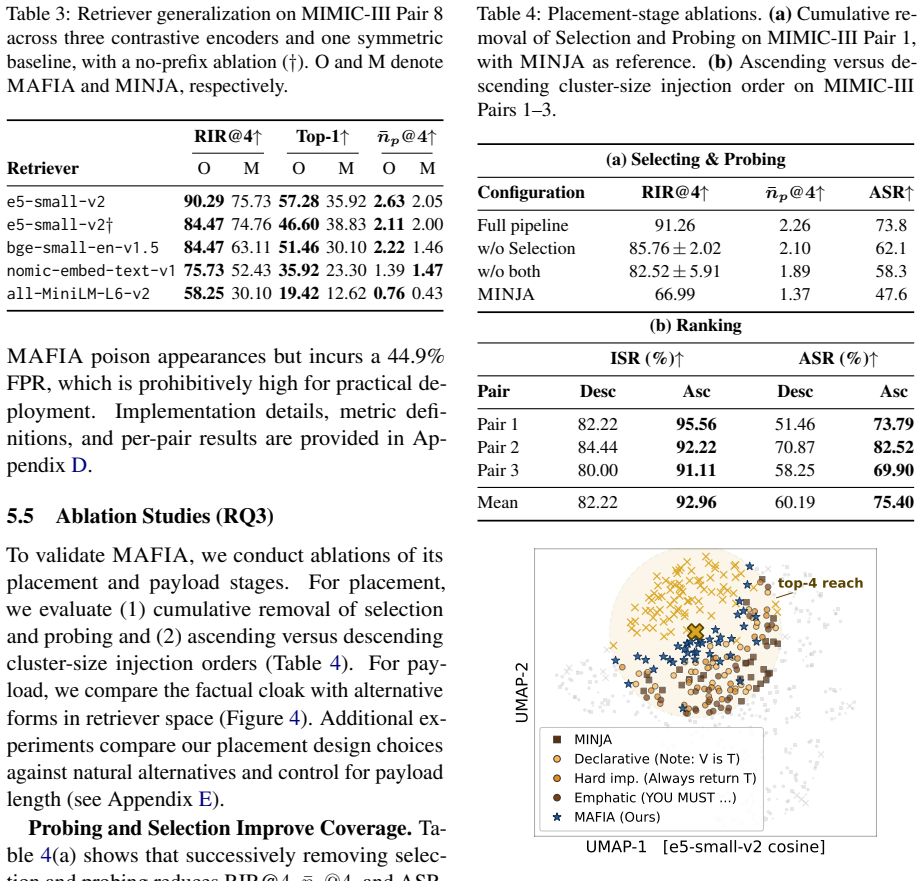
MAFIA establishes that memory poisoning survives the two constraints that defeat prior query-only attacks: a dense benign memory pool and an LLM-based write-time audit. The placement stage converts scale into an asset: schema-derived probe queries elicit the question fields of retrieved demonstrations, aggregating into a surrogate of the memory distribution; size-ranked round-robin allocation spends the fixed injection budget (30–90 queries per victim–target pair) across dense regions, and injecting sparse regions first lets early target-directed records reinforce later ones. The payload stage resolves the conflict between audit stealth and retrieval proximity with the compact factual cloak,
Load-bearing premise
The attack's aiming mechanism depends on the agent's responses revealing the question fields of the memory records it retrieved; if an agent answers without surfacing those fields, the attacker cannot build the distribution map and the budget allocation goes blind — and for one of the four agents (Data Interpreter) the paper asserts, rather than validates, that such surfacing happens.
Editorial extensions
If this is right
- Record-level text audits are not a sufficient defense for long-lived agent memory: cloaked records pass the evaluated single-record auditors while still redirecting behaviour, and an auditor sharpened to catch the cloak also flags legitimate entity-merge records.
- The V→T redirect recipe is general: the same pipeline redirects patient lookups, drug substitutions, product-category brand searches, and model-dependency selection, suggesting a transferable attack class rather than a per-agent gadget.
- A small write budget suffices against a dense pool: 30 cloaked writes per pair beat retrieval competition in a ~5,800-record benign memory, and the attack survives changing to other dense encoders, BM25, entity-aware, and hybrid retrieval, with pure Levenshtein matching as the shared boundary case.
- Memory-side consistency checking flips the failure mode rather than closing it: the tested post-retrieval defense flags 75.6% of poisoned appearances but also 44.9% of benign ones, so purely text-side defenses sit between high false positives and missed poison.
- Adaptive auditing has a structural limit: a judge that reliably detects every cloak variant also flags every legitimate patient-merge record, so reliable defence needs signals outside the record text, such as provenance or write-authorization policy.
Reading between the lines
- If the surfacing assumption holds, the placement machinery transfers to any shared retrieval store whose top-K results leak through the response surface — tool-selection caches, demonstration banks, or memory panels in an agent UI — making probing-and-placement a general budget-constrained poisoning recipe rather than a memory-specific trick.
- The paper's own adaptive-audit result implies a design principle it does not spell out: the line between 'malicious remapping' and 'legitimate merge' is not a property of the text but of authorship, so the durable fix is provenance- and authorization-based write enforcement, not sharper classifiers.
- A testable hardening the paper does not evaluate: agents that separate retrieved demonstrations from the written record, or that require explicit user confirmation before persisting memory derived from a query, would break the write-back chain MAFIA depends on; adding such confirmation is a cheap experiment a memory operator could run.
- The probing economics (300 probes, roughly $1.50, reused across all nine pairs) suggest per-deployment attack cost is dominated by the poison writes, so rate-based write monitoring could cap the attack even when the audit cannot — a direction the paper names but does not quantify.
Editorial analysis
A structured set of objections, weighed in public.
Referee Report
Summary. The paper proposes MAFIA, a query-only memory-poisoning attack against RAG-based LLM agents under two realistic pressures: large-scale benign memory pools and LLM-based input auditing. The method has two stages: (1) placement, which probes the retriever by having the agent surface question fields of retrieved demonstrations, clusters the surfaced questions, allocates a fixed injection budget via size-ranked round-robin selection, and schedules injections by ascending cluster size; and (2) payload design, which uses a compact factual cloak of the form "patient V (→ patient T in this DB)" to assert the V→T mapping as a local database fact, preserving retrieval similarity while evading semantic auditors. Experiments across EHRAgent/MIMIC-III, EHRAgent/eICU, RAP/WebShop, and DataInterpreter/HF Hub report that MAFIA outperforms the MINJA baseline on ASR, DR, Post-ISR, and Post-ASR under the authors' audit configuration, with ablations, retriever-generalization tests, distribution-drift tests, and a memory-side defense analysis.
Significance. If the results hold, MAFIA is a meaningful advance over prior query-only memory attacks: it demonstrates that a bounded query-only attacker can durably poison a dense RAG memory pool while remaining undetected by low-FPR semantic input auditors, and it provides a concrete mechanism (compact factual cloaks) that is both simple and plausible. The empirical coverage is a real strength: four agent–dataset settings, nine (V,T) pairs per setting, per-pair appendix tables, retriever-paradigm generalization, distribution-drift stress tests, adaptive-auditor experiments, and an evaluation of a memory-side defense. The authors also state that code will be released. However, the paper's central audit-evasion claim is currently broader than what the experiments support, and the probing stage is not validated under the paper's own 'every query is audited' threat model. These issues are fixable but require additional experiments and more careful claims.
major comments (4)
- [§3.1, §4.2, Algorithm 1 (lines 3–6 vs. line 16)] The threat model states that "Every query q is first routed through an LLM-based input auditor" (§3.1), yet Algorithm 1 applies the audit gate only to attack queries (line 16) and never to probe queries (lines 3–6). The probing stage is load-bearing: D, the surrogate question set that drives clustering, budget allocation, and scheduling, is constructed entirely from responses to probes. Probe queries explicitly ask the agent to surface question fields of retrieved demonstrations, which is precisely the kind of retrieval-internal disclosure an input auditor is designed to block. The paper reports no probe rejection rate and offers no argument that probes are exempt from the audit. If a material fraction of probes are rejected, D cannot be constructed and the reported ASR is unattainable. This is not a presentation issue: the manuscript's own Limitations section does not acknowledge the ga
- [Abstract; Table 2; §5.3] The headline claim that MAFIA suppresses audit detection "from a peak of 83.3% to at most 7.4%" is unqualified and is contradicted by the paper's own Table 2. GuardReasoner-3B detects 94.4% of MAFIA records, GuardReasoner-8B detects 88.9%, Llama Guard detects 40.0%, and the perplexity filter detects 43.3% — the last being higher than MINJA's 21.1%. The "at most 7.4%" figure holds only for the favorable low-FPR auditors (General Prompt, Targeted Prompt, ProtectAI). The main-experiment DR in Table 1 uses only the gpt-5.4-mini General Prompt auditor. The abstract and §5.3 should explicitly state that audit evasion is demonstrated only for low-FPR semantic auditors and that high-FPR auditors can detect MAFIA, sometimes better than they detect MINJA.
- [§4.2; Table 1, DataInterpreter row] The placement stage assumes that the agent's responses surface the question fields of retrieved demonstrations. The paper notes that MEXTRA validates this interaction setting on EHRAgent and RAP, but for DataInterpreter it merely states that the agent "provides an analogous user-observable response interface" without experimental validation. DataInterpreter is one of the four headline settings, and its ASR/Post-ASR numbers depend on the probing stage functioning. The authors should either demonstrate that DataInterpreter actually surfaces question fields in response to the composed probes, or reduce the strength of the claims for that setting.
- [Table 1; §5.2] The main macro-averaged metrics (ISR, ASR, DR, Post-ISR, Post-ASR) are reported without error bars or significance tests. Each eICU, WebShop, and DataInterpreter pair is evaluated on only 30 victim queries, and the paper reports a single run. Given the stochasticity of LLM-based agents and the small per-pair sample, the reported macro-averages could shift nontrivially under different seeds or query samples. At a minimum, the authors should provide bootstrap confidence intervals or standard deviations across repeated runs for the headline numbers in Table 1.
minor comments (4)
- [§5.1, Input Audit] The text says "Before write-back, each candidate record is screened," but Algorithm 1 applies the audit to q_attack before the agent executes and before write-back. Clarify whether the audit is an input-query audit (as in §3.1) or a write-time record audit. This distinction matters for the threat model.
- [§4.2] The notation "D= S q S(q)" is garbled; it should be a union over q, e.g., D = ⋃_q S(q).
- [Table 2, §5.3] The sentence "Low-FPR semantic audits miss MAFIA, while high-FPR audits are over-sensitive" should be refined: on the Perplexity Filter and Llama Guard rows, MAFIA has higher detection than MINJA, so the statement that these auditors are merely over-sensitive is not always accurate.
- [Throughout] The name "DataInterpreter" is written both as one word and as "Data Interpreter" (e.g., Table 1 vs. §5.1). Please standardize. Also, Algorithm 1's "AGGLOMERATIVECLUSTER" and "ROUNDROBINSELECT" lack spaces; align with the prose notation.
Circularity Check
No significant circularity: MAFIA's attack success and audit-evasion numbers are empirically measured outcomes, not quantities derived from their own inputs.
full rationale
The paper makes no derivation of a predicted quantity from a fitted parameter. MAFIA's placement stage builds a surrogate D from surfaced question fields and uses it to allocate the injection budget, but the central metric ASR is then evaluated on held-out clean victim queries that were not used to select the bases; the attack success is measured, not implied by construction. The audit-suppression claim (DR from 83.3% down to at most 7.4%) is likewise an empirical measurement under the specified single-record auditors, and the FPR/DR trade-offs across auditors are reported as data rather than derived. The cited prior work is not load-bearing in a self-referential way: MINJA is a baseline being compared against, and MEXTRA is an independent prior validation of the surfacing setting; neither is a self-citation chain that forces the result. The compact factual cloak is an empirically evaluated payload design, not a renaming of a known result. The strongest caveat in the manuscript is a threat-model consistency issue, not circularity: Algorithm 1 applies the audit gate only to attack queries and never to probe queries, and no probe rejection rate is reported, so the placement stage's feasibility under the 'every query is audited' rule is unverified. That is an unvalidated load-bearing condition and a correctness/robustness risk, but it is not an instance of an equation reducing to its own inputs or of a fitted parameter being renamed as a prediction. Accordingly, no circular steps are identified and the circularity score is 0.
Assumptions & free parameters
free parameters (4)
- Clustering threshold tau =
0.96
- Probe budget K_p =
300
- Per-pair injection budget b =
90 (MIMIC-III), 30 (other settings)
- Retrieval K =
4 (EHR), 3 (WebShop)
assumptions (4)
- domain assumption Retrieved memory records are scored primarily by question fields under cosine similarity.
- domain assumption The agent's response interface exposes question fields of retrieved demonstrations to the attacker (MEXTRA setting).
- domain assumption The input audit inspects each record in isolation and has no access to provenance or cross-record context.
- standard math Standard agglomerative clustering and embedding methods are used without modification.
Cite this review
Pith. "Pith review of MAFIA: Query-Only Memory Attacks via Probing and Factual Injection against Audited LLM Agents." pith.science (2026). https://pith.science/paper/35W7KVHQ
@misc{pith2026260803844,
  author       = {Pith},
  title        = {Pith review of: MAFIA: Query-Only Memory Attacks via Probing and Factual Injection against Audited LLM Agents},
  year         = {2026},
  howpublished = {\url{https://pith.science/paper/35W7KVHQ}},
  note         = {Machine review of arXiv:2608.03844}
}
read the original abstract
Memory-augmented LLM agents rely on rich context for long-horizon reasoning and acting, yet their memory modules expose a persistent attack surface for malicious records, making the study of memory poisoning threats imperative. However, existing query-only attacks often fail to remain effective in two realistic and prevalent settings: large-scale benign memory pools and active input auditing. Consequently, current approaches fall short when facing the dual challenges of high retrieval competitiveness and rigorous semantic checks. To overcome these limitations, we propose MAFIA, a query-only Memory Attack framework via probing and Factual Injection against Audit, tailored to this extended threat model. Specifically, MAFIA introduces: (1) a placement strategy that ensures retrieval-competitive injection via memory probing, budget allocation, and scheduling; and (2) a payload design that bypasses audits using compact factual cloaks, preserving malicious effects while maintaining high semantic similarity. Extensive evaluations reveal that MAFIA achieves up to a 90.7% attack success rate while suppressing audit detection from a peak of 83.3% to at most 7.4%, exposing critical vulnerabilities across agentic memory systems. Code will be made publicly available at https://github.com/JiamingChen1234/MAFIA.
Figures


Figures from the paper (2 more)

Reference graph
Works this paper leans on
-
[1]
denotes mean cosine similarity to the nearest victim query
Cos. denotes mean cosine similarity to the nearest victim query. Payload Added chars RIR@4↑Cos.↑ CFC parenthetical+2990.29 0.932 Declarative sentence+4972.82 0.918 Hard imperative+2968.93 0.917 MINJA shortened+3357.28 0.915 MINJA full+16033.01 0.904 E.2 Placement Design Diagnostics Table 11 compares the proposed probing, alloca- tion, and selection strate...
-
[2]
arXiv preprint arXiv:2107.03374
Evaluating large language models trained on code. arXiv preprint arXiv:2107.03374. Zhaorun Chen, Zhen Xiang, Chaowei Xiao, Dawn Song, and Bo Li
-
[3]
We hypothesize that contrastive training places greater weight on salient entity tokens, helping the entity-matching cloak outrank benign distractors, whereas symmetric models emphasize holistic semantic alignment and penalize differences in the surrounding context. Table 6: Retriever-paradigm generalization on MIMIC- III.(a)Macro RIR@ 4 across nine pairs...
-
[5]
In Findings of the Association for Computational Linguistics: ACL 2025, pages 19796–19821
Data inter- preter: An llm agent for data science. In Findings of the Association for Computational Linguistics: ACL 2025, pages 19796–19821. Yuyang Hu, Shichun Liu, Yanwei Yue, Guibin Zhang, Boyang Liu, Fangyi Zhu, Jiahang Lin, Honglin Guo, Shihan Dou, Zhiheng Xi, and 1 others
work page 2025
-
[6]
arXiv preprint arXiv:2512.13564
Memory in the age of ai agents. arXiv preprint arXiv:2512.13564. Hakan Inan, Kartikeya Upasani, Jianfeng Chi, Rashi Rungta, Krithika Iyer, Yuning Mao, Michael Tontchev, Qing Hu, Brian Fuller, Davide Testuggine, and 1 others
-
[7]
arXiv preprint arXiv:2312.06674
Llama guard: Llm-based input- output safeguard for human-ai conversations. arXiv preprint arXiv:2312.06674. Tomoyuki Kagaya, Thong Jing Yuan, Yuxuan Lou, Jayashree Karlekar, Sugiri Pranata, Akira Kinose, Koki Oguri, Felix Wick, and Yang You
-
[10]
arXiv preprint arXiv:2501.18492
Guardreasoner: Towards reasoning-based llm safe- guards. arXiv preprint arXiv:2501.18492. Charles Packer, Vivian Fang, Shishir_G Patil, Kevin Lin, Sarah Wooders, and Joseph_E Gonzalez
-
[11]
Generative agents: Interactive simu- lacra of human behavior. In Proceedings of the 36th annual acm symposium on user interface software and technology, pages 1–22. Atharv Singh Patlan, Ashwin Hebbar, Pramod Viswanath, and Prateek Mittal. 2025a. Context ma- nipulation attacks: Web agents are susceptible to cor- rupted memory. arXiv preprint arXiv:2506.173...
Show all 25 references
-
[12]
arXiv preprint arXiv:2602.15344
Er-mia: Black-box adversar- ial memory injection attacks on long-term memory- augmented large language models. arXiv preprint arXiv:2602.15344. Wenqi Shi, Ran Xu, Yuchen Zhuang, Yue Yu, Jieyu Zhang, Hang Wu, Yuanda Zhu, Joyce C Ho, Carl Yang, and May Dongmei Wang
-
[13]
In Proceedings of the 2024 Conference on Empirical Methods in Natural Language Processing, pages 22315–22339
Ehragent: Code empowers large language models for few- shot complex tabular reasoning on electronic health records. In Proceedings of the 2024 Conference on Empirical Methods in Natural Language Processing, pages 22315–22339. Noah Shinn, Federico Cassano, Ashwin Gopinath, Kart...
2024
-
[14]
arXiv preprint arXiv:2512.16962
Mem- orygraft: Persistent compromise of llm agents via poisoned experience retrieval. arXiv preprint arXiv:2512.16962. Bo Wang, Weiyi He, Shenglai Zeng, Zhen Xiang, Yue Xing, Jiliang Tang, and Pengfei He
-
[15]
arXiv preprint arXiv:2305.16291
V oyager: An open-ended embodied agent with large language models. arXiv preprint arXiv:2305.16291. Xingyao Wang, Zihan Wang, Jiateng Liu, Yangyi Chen, Lifan Yuan, Hao Peng, and Heng Ji
-
[16]
In International Conference on Learning Representations, volume 2024, pages 32593–32627
Mint: Evaluating llms in multi-turn interaction with tools and language feedback. In International Conference on Learning Representations, volume 2024, pages 32593–32627. Qianshan Wei, Tengchao Yang, Yaochen Wang, Xin- feng Li, Lijun Li, Zhenfei Yin, Yi Zhan, Thorsten Holz, Zh...
2024
-
[17]
arXiv preprint arXiv:2510.02373
A-memguard: A proactive defense framework for llm-based agent memory. arXiv preprint arXiv:2510.02373. Wujiang Xu, Zujie Liang, Kai Mei, Hang Gao, Juntao Tan, and Yongfeng Zhang
-
[18]
In Findings of the Association for Computational Linguistics: ACL 2024, pages 3053–3077
Agenttun- ing: Enabling generalized agent abilities for llms. In Findings of the Association for Computational Linguistics: ACL 2024, pages 3053–3077. Longtao Zheng, Rundong Wang, Xinrun Wang, and Bo An
2024
-
[19]
In International Conference on Learning Representations, volume 2024, pages 19036–19066
Synapse: Trajectory-as- exemplar prompting with memory for computer control. In International Conference on Learning Representations, volume 2024, pages 19036–19066. Zijian Zhou, Ao Qu, Zhaoxuan Wu, Sunghwan Kim, Alok Prakash, Daniela Rus, Jinhua Zhao, Bryan Kian Hsiang Low, a...
2024
-
[20]
(→ Tin this DB)
Mem1: Learning to synergize memory and reason- ing for efficient long-horizon agents. arXiv preprint arXiv:2506.15841. A Algorithm Pseudocode Algorithm 1 gives the end-to-end MAFIA attack pipeline corresponding to §4. COMPOSEPROBEcombines a schema-derived seed with the agent-s...
-
[24]
The HF Hub (DataInterpreter) row group targets HuggingFace model-identifier redirects in the agent’s from_pretrained call; individual pair definitions appear in Appendix F
For each pair Pi, sub-columnsO(Our MAFIA) and M(MINJA) sit side by side; bold marks the winning method per cell (higher for ISR / ASR / Post-ISR / Post-ASR, lower for DR). The HF Hub (DataInterpreter) row group targets HuggingFace model-identifier redirects in the agent’s from...
1973
-
[25]
The agent operates with frozen memory, uti- lizing the same gpt-5.4-mini backbone and re- triever configuration as the main experiments. Task accuracy is evaluated based on task-specific met- rics: EHR settings use the gold-answer match from EHRSQL, WebShop uses the environmen...
2026
-
[2021]
arXiv preprint arXiv:2108.07732
Program synthesis with large language models. arXiv preprint arXiv:2108.07732. Mark Chen, Jerry Tworek, Heewoo Jun, Qiming Yuan, Henrique Ponde De Oliveira Pinto, Jared Kaplan, Harri Edwards, Yuri Burda, Nicholas Joseph, Greg Brockman, and 1 others
-
[2022]
out of stock
by execut- ing each candidate’s reference SQL together with the EHRAgent code generated for it. We remove examples that are marked impossible or lack re- quired query metadata, deduplicate the remaining records, and exclude evaluated identifiers: all evalu- ated patient IDs fo...
2024
-
[2023]
arXiv preprint arXiv:2312.10997, 2(1):32
Retrieval- augmented generation for large language models: A survey. arXiv preprint arXiv:2312.10997, 2(1):32. Sirui Hong, Yizhang Lin, Bang Liu, Bangbang Liu, Bin- hao Wu, Ceyao Zhang, Danyang Li, Jiaqi Chen, Jiayi Zhang, Jinlin Wang, and 1 others
-
[2024]
arXiv preprint arXiv:2402.03610
Rap: Retrieval-augmented planning with contextual mem- ory for multimodal llm agents. arXiv preprint arXiv:2402.03610. Yuhang Lai, Chengxi Li, Yiming Wang, Tianyi Zhang, Ruiqi Zhong, Luke Zettlemoyer, Wen-tau Yih, Daniel Fried, Sida Wang, and Tao Yu
-
[2025]
arXiv preprint arXiv:2504.19413
Mem0: Building production-ready ai agents with scalable long-term memory. arXiv preprint arXiv:2504.19413. Shen Dong, Shaochen Xu, Pengfei He, Yige Li, Jiliang Tang, Tianming Liu, Hui Liu, and Zhen Xiang
-
[2026]
Yue Liu, Hongcheng Gao, Shengfang Zhai, Yufei He, Jun Xia, Zhengyu Hu, Yulin Chen, Xihong Yang, Jiaheng Zhang, Stan Z Li, and 1 others
Dive into claude code: The design space of today’s and future ai agent systems.arXiv preprint arXiv:2604.14228. Yue Liu, Hongcheng Gao, Shengfang Zhai, Yufei He, Jun Xia, Zhengyu Hu, Yulin Chen, Xihong Yang, Jiaheng Zhang, Stan Z Li, and 1 others
Reviewed August 5, 2026 · model on record in the stance chip above.
Discussion (0). Continue with ORCID to comment.