REVIEW 4 major objections 5 minor 1 cited by
Player-Centric Multimodal Prompt Generation for Large Language Model Based Identity-Aware Basketball Video Captioning
T0 review · 4 major / 5 minor · reviewed 2026-08-06 · deepseek-v4-flash
Pith's one-line read Player names can be read from broadcast basketball video itself, and that is enough to generate identity-aware captions without external game notes.
desk verdict A useful new dataset and a plausible visual-identification pipeline, but the VC-NBA-2022 results are not reproducible as written. read the letter →
The pith
A machine-rendered reading of the paper's core claim, the machinery that carries it, and where it could break.
The reading
What carries the argument
The load-bearing mechanism is the player-centric multimodal prompt. Training starts from a player-centric video clip set: every caption names the players involved, and the dataset's bounding boxes let the paper crop each named player into a sequence of images; a player identification network (PIN), a TimeSformer backbone plus a linear classification head, learns to map those sequences to one of 321 player names. The bidirectional semantic interaction module (BSIM) then exchanges information between the video feature and the top-2 players' visual features with cross-attention in both directions, and the visual context learning module (VCLM) uses 32 learnable query vectors to condense the video into context tokens. The four token groups, video context, video features, player visual features, and player-name text embeddings, are projected into the LLM's embedding space and concatenated as a prompt, so the decoder sees both who is on screen and what is happening. At inference, SportsMOT supplies player tracks, the PIN names and ranks them, and the top-2 are fed forward the same way.
What would settle it
Run the released code on VC-NBA-2022 using only SportsMOT tracks, without any ground-truth bounding boxes: if the identity-aware CIDEr falls from the reported 150.7 toward the video-only level of about 103.1, then the state-of-the-art result depends on annotation access not supplied by that dataset.
Extended reading notes
Core claim
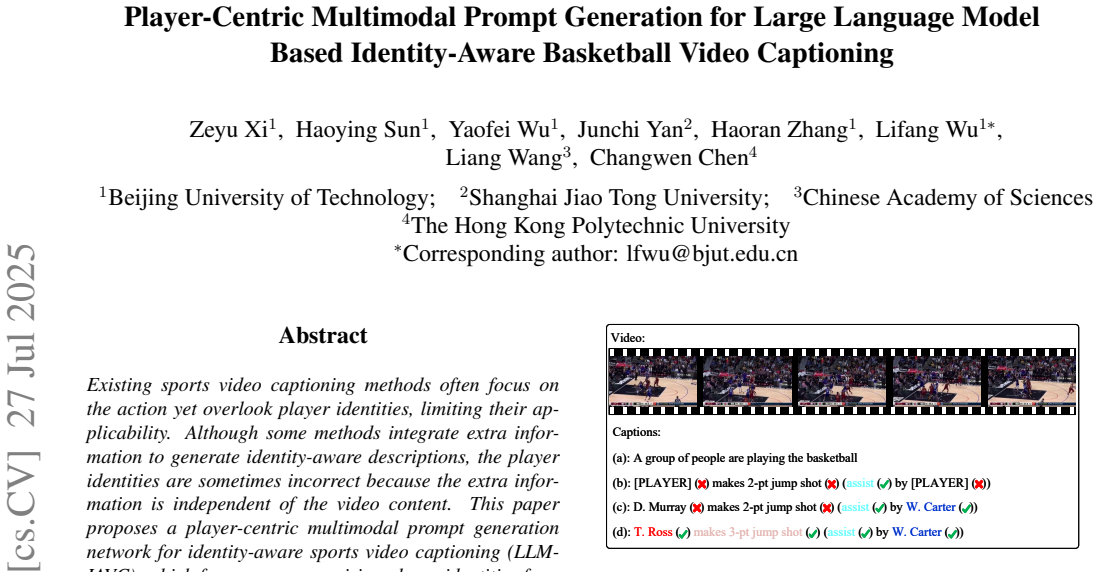
The paper's central claim is that player identities are visually discoverable in broadcast basketball clips, and a network that learns them from a player-centric clip set can supply an LLM with everything needed to generate identity-aware captions without external knowledge assistance. The discovery is that organizing training clips around individual players, using captions and bounding boxes to link each player to his clips, makes it possible to train a player identification network that achieves 91.40% classification accuracy among 321 players, and that injecting the top-2 identified players' visual features and name embeddings, together with learned video context, into the LLM prompt is what accounts for the large gains in captioning quality. On NBA-Identity the full model reaches 105.3 CIDEr and 18.8 BLEU-4, and on VC-NBA-2022 it reaches 150.7 CIDEr and 38.6 BLEU-4, the best scores in the comparison; the ablation shows that dropping the player identification network reduces CIDEr from 105.3 to 66.5.
Load-bearing premise
The reported VC-NBA-2022 gains assume the player-centric pipeline can be run on that dataset even though it is listed as having no player bounding boxes; the paper never states how player sequences are obtained there.
Editorial extensions
If this is right
- Identity-aware sports captions can be generated without external game notes or candidate rosters, because player names are read from the video itself.
- Feeding player-name tokens plus video-context tokens as a multimodal prompt to an LLM improves naming accuracy and CIDEr by large margins, with the Llama3.2-3B variant gaining 38.8 CIDEr points on NBA-Identity when the prompt is added.
- A benchmark with per-player bounding boxes, NBA-Identity, is sufficient to train a visual player identification network, so datasets without identity annotations can be augmented by a similar player-centric pipeline.
- The same player-centric prompt design should transfer to other sports after retraining the player identification network on that sport's manually annotated bounding boxes.
- Because the player identification network is the main source of name accuracy, improving jerse recognition through player numbers and jersey colors is a direct path to further captioning gains.
Reading between the lines
- Left implicit by the paper: the NBA-Identity split by game does not guarantee generalization to never-seen players, since the same 321 players can appear in both training and test games; a held-out-identity split would be a harder and more informative test of visual recognition.
- The VC-NBA-2022 comparison is central to the claim, so one easy check is to rerun inference using only SportsMOT tracks and verify whether the reported 150.7 CIDEr persists; a large drop would show the identity prompt depends on annotation access rather than purely visual recognition.
- The paper's own admission that shot-distance estimation is weak suggests a natural extension: add a regression head for shooting distance and feed it as an extra prompt token, which would directly address the observed 6-ft versus 4-ft errors without changing the architecture.
Editorial analysis
A structured set of objections, weighed in public.
Referee Report
Summary. The paper proposes LLM-IAVC, a basketball video captioning model that extracts player identities from visual player sequences using a player identification network (PIN), combines these identity features with video context through a bidirectional semantic interaction module (BSIM) and a visual context learning module (VCLM), and feeds the resulting multimodal prompt into an LLM decoder. The authors introduce NBA-Identity, a new identity-aware basketball captioning dataset with 9,726 clips, 321 identity-labeled players, player bounding boxes, and 9 major event types, and report quantitative results on NBA-Identity and VC-NBA-2022. The core claim is that visual-only player identification is sufficient to generate identity-aware captions and achieves state-of-the-art performance without external knowledge assistance.
Significance. If the reported results are reproducible, the paper makes two useful contributions: NBA-Identity is a substantial new benchmark for identity-aware sports captioning, and the idea of deriving player identities from visual player-centric clips rather than from external candidate lists is a sensible and potentially generalizable direction. The paper also promises public code and data, which would aid follow-up work. However, the evidence for the central SOTA claim is weakened by an under-specified cross-dataset pipeline, a confounded baseline comparison, and the absence of uncertainty estimates. The dataset itself is the strongest asset; the method-level claim needs firmer experimental support.
major comments (4)
- [Table 1, Section 3.5, Supplementary Section E] The VC-NBA-2022 columns in Table 3 are not reproducible from the method as written. The training flow in Section 3.5 builds the player-centric clip set by querying player sequences derived from bounding boxes, and Table 1 lists VC-NBA-2022 as having no bounding boxes. Supplementary Section E further states that manually annotated player bounding boxes are required to pre-train the player identification network for each sport. The paper never states how player sequences and PIN identity labels were obtained for VC-NBA-2022, such as whether SportsMOT pseudo-tracklets were used, whether a separate 286-player PIN was trained, or whether the NBA-Identity-trained PIN was applied despite the different identity sets. This is a load-bearing missing detail for the cross-dataset SOTA claim.
- [Section 4.3, Table 3] The state-of-the-art comparison is confounded by decoder size. The LLM-IAVC variants use GPT-2, Qwen2.5, and Llama3.2 decoders of up to 3B parameters, whereas the listed baselines use much smaller caption decoders. The rows labeled "without prompt" show that even without identity information the larger LLM decoders already outperform several baselines on BLEU-4, so part of the improvement may come from decoder capacity rather than the proposed modules. A matched decoder baseline or an ablation that uses the same LLM decoder without the identity prompt is needed to attribute the gains to the player-centric prompt.
- [Section 4.1, Section 4.3] No error bars, variance, or significance tests are reported anywhere in the experimental sections. With test sets of 1,059 clips for NBA-Identity and 786 clips for VC-NBA-2022, differences of one or two CIDEr points between the best and second-best systems may be within run-to-run noise. The authors should report multiple seeds, bootstrap confidence intervals, or a paired significance test, especially for the headline SOTA comparisons in Table 3.
- [Section 4.1] The game-based train/test split does not prevent the same players from appearing in both training and test games, since the dataset covers only 321 players across 40 games. A player appearing in a training-game clip is also likely to appear in a test-game clip, so the PIN may be evaluated on identities already seen during training. This weakens the claim that identities are recognized from a visual perspective rather than memorized. The authors should either construct a disjoint-identity split or report accuracy stratified by whether test players appeared in training games.
minor comments (5)
- [Section 3.2, Eq. (7)] The text says "demotes" where it should say "denotes", and Figure 4 contains the typo "Droupout" for "Dropout".
- [Figure 2 and Section 4.2] The inference flow in Figure 2 says top-k players are selected, and Section 4.2 specifies top-2 for NBA-Identity, but no k value is stated for VC-NBA-2022; specify k for each dataset.
- [Table 3] The abbreviations G, Q, and L for GPT-2, Qwen2.5, and Llama3.2 appear in the table but are defined only in the paragraph after the table; define them directly in the table caption.
- [Section 4.2] The sentence "training and testing per epoch take 221.2s and 115.3s, respectively, with 0.3s per caption generation" is ambiguous: it is unclear whether the 115.3s testing time includes feature extraction, tracking, and decoding or only decoding, and whether the 0.3s figure covers the full pipeline.
- [Contributions] The contribution bullet "LLM-IA VC" is missing the hyphen between IA and VC; the notation should be unified as LLM-IAVC throughout the paper.
Circularity Check
No significant circularity: the player identification network is a genuinely learned visual classifier with held-out game evaluation, and the self-cited baselines serve only as comparison points, not as load-bearing justifications.
full rationale
The derivation chain is self-contained rather than circular. The player identification network is trained with a cross-entropy loss (Eq. 2) on player sequences cropped from bounding boxes; the class labels are player names associated with clips through captions, but the learned mapping is from visual features to identities and is evaluated on held-out games. At inference (Sec. 3.5), SportsMOT extracts sequences and the PIN must classify them, and the LLM generates captions from the multimodal prompt (Eq. 12); the captioning metrics compare against external ground-truth captions, so no equation defines the predicted caption as a function of the ground-truth caption or of fitted probabilities in a way that forces the result. Incorrect visual identification degrades the output, which is why the without-prompt and with-prompt results differ. The self-citations to KEANet (Ref. 50) and EIKA (Ref. 51) are prior baselines and the VC-NBA-2022 benchmark; they are used for comparison and not as justification for the method's capability, and no uniqueness theorem or ansatz is imported from them. One non-circularity concern is worth flagging explicitly: Table 3 reports VC-NBA-2022 results while Table 1 lists VC-NBA-2022 as having no bounding boxes, and Sec. 3.5 plus Supp. C describe training player sequences as cropped from dataset-provided bounding boxes; the paper never states how the player-centric clip set or PIN identity labels are obtained for VC-NBA-2022. This is an omitted experimental detail and a reproducibility risk, but it is not an equivalence-by-construction, so it does not raise the circularity score. The paper's own stated limitation that the model relies on the performance of the player identification network (Sec. 5) is an honest scope note, not a circular step.
Assumptions & free parameters
free parameters (4)
- top-k players =
2
- VCLM learnable query vectors Nq =
32
- BSIM down-projection dimension Ddown =
512
- Player sequence length =
20 frames
assumptions (5)
- domain assumption Player identities are implied within video clips and can be learned from visual appearance.
- domain assumption At inference, SportsMOT detects and tracks the players who are the subjects of the caption.
- domain assumption A caption mentions at most two key players, so retaining the top-2 player sequences is sufficient.
- domain assumption Standard captioning metrics (BLEU, METEOR, Rouge-L, CIDEr) validly measure identity correctness.
- ad hoc to paper VC-NBA-2022 can be processed with the same player-centric training procedure despite lacking bounding boxes.
Cite this review
Pith. "Pith review of Player-Centric Multimodal Prompt Generation for Large Language Model Based Identity-Aware Basketball Video Captioning." pith.science (2026). https://pith.science/paper/3665RRTI
@misc{pith2026250720163,
  author       = {Pith},
  title        = {Pith review of: Player-Centric Multimodal Prompt Generation for Large Language Model Based Identity-Aware Basketball Video Captioning},
  year         = {2026},
  howpublished = {\url{https://pith.science/paper/3665RRTI}},
  note         = {Machine review of arXiv:2507.20163}
}
read the original abstract
Existing sports video captioning methods often focus on the action yet overlook player identities, limiting their applicability. Although some methods integrate extra information to generate identity-aware descriptions, the player identities are sometimes incorrect because the extra information is independent of the video content. This paper proposes a player-centric multimodal prompt generation network for identity-aware sports video captioning (LLM-IAVC), which focuses on recognizing player identities from a visual perspective. Specifically, an identity-related information extraction module (IRIEM) is designed to extract player-related multimodal embeddings. IRIEM includes a player identification network (PIN) for extracting visual features and player names, and a bidirectional semantic interaction module (BSIM) to link player features with video content for mutual enhancement. Additionally, a visual context learning module (VCLM) is designed to capture the key video context information. Finally, by integrating the outputs of the above modules as the multimodal prompt for the large language model (LLM), it facilitates the generation of descriptions with player identities. To support this work, we construct a new benchmark called NBA-Identity, a large identity-aware basketball video captioning dataset with 9,726 videos covering 9 major event types. The experimental results on NBA-Identity and VC-NBA-2022 demonstrate that our proposed model achieves advanced performance. Code and dataset are publicly available at https://github.com/Zeyu1226-mt/LLM-IAVC.
Figures


Figures from the paper (8 more)


Forward citations
Cited by 1 Pith paper
-
Explainable Action Form Assessment by Exploiting Multimodal Chain-of-Thoughts Reasoning
A new dataset and model for assessing whether exercise/martial-arts actions are performed correctly and explaining why.
Reference graph
Works this paper leans on
-
[1]
Josh Achiam, Steven Adler, Sandhini Agarwal, et al. Gpt-4 technical report. arXiv preprint arXiv:2303.08774, 2023. 2
arXiv 2023
-
[2]
Meteor: An automatic metric for mt evaluation with improved correlation with hu- man judgments
Satanjeev Banerjee and Alon Lavie. Meteor: An automatic metric for mt evaluation with improved correlation with hu- man judgments. In Proceedings of Annual Meeting of the Association for Computational Linguistics (ACL), pages 65– 72, 2005. 6, 3
work page 2005
-
[3]
Is space-time attention all you need for video understanding? In ICML, page 4, 2021
Gedas Bertasius, Heng Wang, and Lorenzo Torresani. Is space-time attention all you need for video understanding? In ICML, page 4, 2021. 2, 3, 4, 7
work page 2021
-
[4]
Activitynet: A large-scale video benchmark for human activity understanding
Fabian Caba Heilbron, Victor Escorcia, Bernard Ghanem, and Juan Carlos Niebles. Activitynet: A large-scale video benchmark for human activity understanding. In Proceed- ings of the ieee conference on computer vision and pattern recognition, pages 961–970, 2015. 2, 5
work page 2015
-
[5]
Quo vadis, action recognition? a new model and the kinetics dataset
Joao Carreira and Andrew Zisserman. Quo vadis, action recognition? a new model and the kinetics dataset. In pro- ceedings of the IEEE Conference on Computer Vision and Pattern Recognition, pages 6299–6308, 2017. 7
work page 2017
-
[6]
Collecting highly paral- lel data for paraphrase evaluation
David Chen and William B Dolan. Collecting highly paral- lel data for paraphrase evaluation. InProceedings of the 49th annual meeting of the association for computational linguis- tics: human language technologies, pages 190–200, 2011. 2, 5
work page 2011
-
[7]
Learning phrase representations using rnn encoder- decoder for statistical machine translation
Kyunghyun Cho, Bart Van Merri ¨enboer, Caglar Gulcehre, et al. Learning phrase representations using rnn encoder- decoder for statistical machine translation. arXiv preprint arXiv:1406.1078, 2014. 2
arXiv 2014
-
[8]
Sportsmot: A large multi-object tracking dataset in multiple sports scenes
Yutao Cui, Chenkai Zeng, Xiaoyu Zhao, et al. Sportsmot: A large multi-object tracking dataset in multiple sports scenes. In Proceedings of the IEEE/CVF International Conference on Computer Vision, pages 9921–9931, 2023. 5, 4
work page 2023
Show all 58 references
-
[9]
A thou- sand frames in just a few words: Lingual description of videos through latent topics and sparse object stitching
Pradipto Das, Chenliang Xu, Richard F Doell, et al. A thou- sand frames in just a few words: Lingual description of videos through latent topics and sparse object stitching. In Proceedings of the IEEE conference on computer vision and pattern recognition, pages 2634–2641, 2013. 2, 5
2013
-
[10]
An image is worth 16x16 words: Transformers for im- age recognition at scale
Alexey Dosovitskiy, Lucas Beyer, Alexander Kolesnikov, et al. An image is worth 16x16 words: Transformers for im- age recognition at scale. arXiv preprint arXiv:2010.11929,
2010 arXiv
-
[11]
Soccer captioning: dataset, transformer-based model, and triple-level evaluation
Ahmad Hammoudeh, Bastien Vanderplaetse, and St ´ephane Dupont. Soccer captioning: dataset, transformer-based model, and triple-level evaluation. Procedia Computer Sci- ence, 210:104–111, 2022. 5
2022
-
[12]
Kensho Hara, Hirokatsu Kataoka, et al. Can spatiotemporal 3d cnns retrace the history of 2d cnns and imagenet? In Pro- ceedings of the IEEE Conference on Computer Vision and Pattern Recognition (CVPR), pages 6546–6555, 2018. 2, 7
2018
-
[13]
Deep residual learning for image recognition
Kaiming He, Xiangyu Zhang, Shaoqing Ren, et al. Deep residual learning for image recognition. In Proceedings of the IEEE Conference on Computer Vision and Pattern Recognition (CVPR), pages 770–778, 2016. 2, 7
2016
-
[14]
Gaussian error linear units (gelus)
Dan Hendrycks and Kevin Gimpel. Gaussian error linear units (gelus). arXiv preprint arXiv:1606.08415, 2016. 4
2016 arXiv
-
[15]
Overview of temporal action detection based on deep learning
Kai Hu, Chaowen Shen, Tianyan Wang, et al. Overview of temporal action detection based on deep learning. Artificial Intelligence Review, 57(2):26, 2024. 3
2024
-
[16]
Learn- ing to generate move-by-move commentary for chess games from large-scale social forum data
Harsh Jhamtani, Varun Gangal, Eduard Hovy, et al. Learn- ing to generate move-by-move commentary for chess games from large-scale social forum data. In Proceedings of the 56th Annual Meeting of the Association for Computational Linguistics (ACL), pages 1661–1671, 2018. 2
2018
-
[17]
Learning seg- ment similarity and alignment in large-scale content based video retrieval
Chen Jiang, Kaiming Huang, Sifeng He, et al. Learning seg- ment similarity and alignment in large-scale content based video retrieval. In MM ’21: ACM Multimedia Conference , pages 1618–1626. ACM, 2021. 1
2021
-
[18]
Automatic baseball commentary generation using deep learning
Byeong Jo Kim and Yong Suk Choi. Automatic baseball commentary generation using deep learning. In Proceedings of the 35th Annual ACM Symposium on Applied Computing, pages 1056–1065, 2020. 2
2020
-
[19]
Adam: A method for stochastic optimization
Diederik P Kingma and Jimmy Ba. Adam: A method for stochastic optimization. arXiv preprint arXiv:1412.6980 ,
-
[20]
Video story- telling: Textual summaries for events
Junnan Li, Yongkang Wong, Qi Zhao, et al. Video story- telling: Textual summaries for events. IEEE Trans. Multim., 22(2):554–565, 2020. 1
2020
-
[21]
Rouge: A package for automatic evaluation of summaries
Chin-Yew Lin. Rouge: A package for automatic evaluation of summaries. In Text summarization branches out , pages 74–81, 2004. 6, 3
2004
-
[22]
Swinbert: End- to-end transformers with sparse attention for video caption- ing
Kevin Lin, Linjie Li, Chung-Ching Lin, et al. Swinbert: End- to-end transformers with sparse attention for video caption- ing. In Proceedings of the IEEE/CVF Conference on Com- puter Vision and Pattern Recognition , pages 17949–17958,
-
[23]
Video swin transformer
Ze Liu, Jia Ning, Yue Cao, et al. Video swin transformer. In Proceedings of the IEEE/CVF conference on computer vi- sion and pattern recognition, pages 3202–3211, 2022. 6
2022
-
[24]
Llama 3.2 quantized models, 2024
Meta-llama. Llama 3.2 quantized models, 2024. 2, 6
2024
-
[25]
Soccernet- caption: Dense video captioning for soccer broadcasts com- mentaries
Hassan Mkhallati and Anthony others Cioppa. Soccernet- caption: Dense video captioning for soccer broadcasts com- mentaries. In Proceedings of the IEEE/CVF Conference on Computer Vision and Pattern Recognition , pages 5074– 5085, 2023. 1, 2, 5
2023
-
[26]
Search-oriented micro-video captioning
Liqiang Nie, Leigang Qu, Dai Meng, et al. Search-oriented micro-video captioning. In MM ’22: The 30th ACM Interna- tional Conference on Multimedia, Lisboa, Portugal, October 10 - 14, 2022, pages 3234–3243. ACM, 2022. 1
2022
-
[27]
Enhancing visual question answering through question-driven image captions as prompts
¨Ovg¨u ¨Ozdemir and Erdem Akag ¨und¨uz. Enhancing visual question answering through question-driven image captions as prompts. In Proceedings of the IEEE/CVF Conference on Computer Vision and Pattern Recognition , pages 1562– 1571, 2024. 2
2024
-
[28]
Bleu: a method for automatic evaluation of machine translation
Kishore Papineni, Salim Roukos, et al. Bleu: a method for automatic evaluation of machine translation. In Proceedings of the 40th Annual Meeting of the Association for Computa- tional Linguistics (ACL), pages 311–318, 2002. 6, 3
2002
-
[29]
Identity- aware multi-sentence video description
Jae Sung Park, Trevor Darrell, and Anna Rohrbach. Identity- aware multi-sentence video description. In Computer Vision–ECCV 2020: 16th European Conference, Glasgow, UK, August 23–28, 2020, Proceedings, Part XXI 16 , pages 360–378. Springer, 2020. 1, 2
2020
-
[30]
Goal: A challenging knowledge-grounded video captioning benchmark for real- time soccer commentary generation
Ji Qi, Jifan Yu, Teng Tu, et al. Goal: A challenging knowledge-grounded video captioning benchmark for real- time soccer commentary generation. In Proceedings of the 32nd ACM International Conference on Information and Knowledge Management, pages 5391–5395, 2023. 1, 2, 5
2023
-
[31]
Sports video captioning via attentive motion representation and group re- lationship modeling
Mengshi Qi, Yunhong Wang, Annan Li, et al. Sports video captioning via attentive motion representation and group re- lationship modeling. IEEE Transactions on Circuits and Sys- tems for Video Technology, 30(8):2617–2633, 2019. 2, 5
2019
-
[32]
Language models are unsupervised multitask learners
Alec Radford, Jeffrey Wu, Rewon Child, et al. Language models are unsupervised multitask learners. OpenAI blog, 1 (8):9, 2019. 2, 6
2019
-
[33]
Learn- ing transferable visual models from natural language super- vision
Alec Radford, Jong Wook Kim, Chris Hallacy, et al. Learn- ing transferable visual models from natural language super- vision. In International Conference on Machine Learning (ICML), pages 8748–8763. PMLR, 2021. 6
2021
-
[34]
Matchtime: Towards automatic soccer game commentary generation
Jiayuan Rao, Haoning Wu, Chang Liu, Yanfeng Wang, and Weidi Xie. Matchtime: Towards automatic soccer game commentary generation. arXiv preprint arXiv:2406.18530 ,
-
[35]
Towards universal soccer video under- standing
Jiayuan Rao, Haoning Wu, Hao Jiang, Ya Zhang, Yanfeng Wang, and Weidi Xie. Towards universal soccer video under- standing. In Proceedings of the Computer Vision and Pattern Recognition Conference, pages 8384–8394, 2025. 1, 2, 5
2025
-
[36]
Grounding action descriptions in videos
Michaela Regneri, Marcus Rohrbach, et al. Grounding action descriptions in videos. Transactions of the Association for Computational Linguistics, 1:25–36, 2013. 5
2013
-
[37]
Timechat: A time-sensitive multimodal large language model for long video understanding
Shuhuai Ren, Linli Yao, Shicheng Li, et al. Timechat: A time-sensitive multimodal large language model for long video understanding. In Proceedings of the IEEE/CVF Con- ference on Computer Vision and Pattern Recognition, pages 14313–14323, 2024. 2
2024
-
[38]
A dataset for movie description
Anna Rohrbach, Marcus Rohrbach, Niket Tandon, et al. A dataset for movie description. In Proceedings of the IEEE conference on computer vision and pattern recogni- tion, pages 3202–3212, 2015. 5
2015
-
[39]
Accurate and fast compressed video captioning
Yaojie Shen, Xin Gu, Kai Xu, Heng Fan, Longyin Wen, and Libo Zhang. Accurate and fast compressed video captioning. In Proceedings of the IEEE/CVF International Conference on Computer Vision, pages 15558–15567, 2023. 1, 2, 6, 7
2023
-
[40]
An overview of the tesseract ocr engine
Ray Smith. An overview of the tesseract ocr engine. In Ninth international conference on document analysis and recogni- tion (ICDAR 2007), pages 629–633. IEEE, 2007. 1
2007
-
[41]
Clip4caption: Clip for video caption
Mingkang Tang, Zhanyu Wang, Zhenhua Liu, et al. Clip4caption: Clip for video caption. In Proceedings of the 29th ACM International Conference on Multimedia , pages 4858–4862, 2021. 1, 2, 6, 7
2021
-
[42]
Qwen2.5: A party of foundation models, 2024
Qwen Team. Qwen2.5: A party of foundation models, 2024. 2, 6
2024
-
[43]
Llama 2: Open foundation and fine-tuned chat models
Hugo Touvron, Louis Martin, Kevin Stone, et al. Llama 2: Open foundation and fine-tuned chat models. arXiv preprint arXiv:2307.09288, 2023. 2
2023 arXiv
-
[44]
Atten- tion is all you need
Ashish Vaswani, Noam Shazeer, Niki Parmar, et al. Atten- tion is all you need. Advances in neural information process- ing systems, 30, 2017. 2
2017
-
[45]
Player tracking and identification in ice hockey.Expert systems with applications, 213:119250, 2023
Kanav Vats, Pascale Walters, Mehrnaz Fani, et al. Player tracking and identification in ice hockey.Expert systems with applications, 213:119250, 2023. 3
2023
-
[46]
Cider: Consensus-based image description evalua- tion
Ramakrishna Vedantam, C Lawrence Zitnick, and Devi Parikh. Cider: Consensus-based image description evalua- tion. In Proceedings of the IEEE Conference on Computer Vision and Pattern Recognition (CVPR) , pages 4566–4575,
-
[47]
Omnivid: A generative framework for universal video understanding
Junke Wang, Dongdong Chen, Chong Luo, et al. Omnivid: A generative framework for universal video understanding. In Proceedings of the IEEE/CVF Conference on Computer Vision and Pattern Recognition, pages 18209–18220, 2024. 1, 2, 6, 7
2024
-
[48]
Sports video anal- ysis on large-scale data
Dekun Wu, He Zhao, Xingce Bao, et al. Sports video anal- ysis on large-scale data. In European Conference on Com- puter Vision (ECCV), pages 19–36. Springer, 2022. 1, 5
2022
-
[49]
Learning label semantics for weakly supervised group activity recognition
Lifang Wu, Meng Tian, Ye Xiang, et al. Learning label semantics for weakly supervised group activity recognition. IEEE Transactions on Multimedia, 2024. 7, 3
2024
-
[50]
A simple yet effective knowledge guided method for entity-aware video captioning on a basketball benchmark
Zeyu Xi, Ge Shi, Xuefen Li, et al. A simple yet effective knowledge guided method for entity-aware video captioning on a basketball benchmark. Neurocomputing, 619:129177,
-
[51]
Eika: Explicit & im- plicit knowledge-augmented network for entity-aware sports video captioning
Zeyu Xi, Ge Shi, Haoying Sun, et al. Eika: Explicit & im- plicit knowledge-augmented network for entity-aware sports video captioning. Expert Systems with Applications , page 126906, 2025. 1, 2, 6, 7
2025
-
[52]
Msr-vtt: A large video description dataset for bridging video and language
Jun Xu, Tao Mei, Ting Yao, et al. Msr-vtt: A large video description dataset for bridging video and language. In Pro- ceedings of the IEEE conference on computer vision and pat- tern recognition, pages 5288–5296, 2016. 2, 5
2016
-
[53]
Hierarchical modular network for video captioning
Hanhua Ye, Guorong Li, Yuankai Qi, et al. Hierarchical modular network for video captioning. In Proceedings of the IEEE Conference on Computer Vision and Pattern Recogni- tion (CVPR), pages 17939–17948, 2022. 1, 2
2022
-
[54]
Fine-grained video captioning for sports narrative
Huanyu Yu, Shuo Cheng, Bingbing Ni, et al. Fine-grained video captioning for sports narrative. In Proceedings of the IEEE Conference on Computer Vision and Pattern Recogni- tion, pages 6006–6015, 2018. 5
2018
-
[55]
Movie101: A new movie understanding benchmark
Zihao Yue, Qi Zhang, Anwen Hu, et al. Movie101: A new movie understanding benchmark. arXiv preprint arXiv:2305.12140, 2023. 5
2023 arXiv
-
[56]
Harnessing large language models for training-free video anomaly detection
Luca Zanella, Willi Menapace, Massimiliano Mancini, et al. Harnessing large language models for training-free video anomaly detection. In Proceedings of the IEEE/CVF Con- ference on Computer Vision and Pattern Recognition, pages 18527–18536, 2024. 2
2024
-
[57]
A descriptive basketball highlight dataset for automatic commentary gen- eration
Benhui Zhang, Junyu Gao, and Yuan Yuan. A descriptive basketball highlight dataset for automatic commentary gen- eration. In Proceedings of the 32nd ACM International Con- ference on Multimedia, pages 10316–10325, 2024. 2, 5
2024
-
[58]
jump ball
Luowei Zhou, Chenliang Xu, and Jason Corso. Towards automatic learning of procedures from web instructional videos. In Proceedings of the AAAI Conference on Artificial Intelligence, 2018. 5 Player-Centric Multimodal Prompt Generation for Large Language Model Based Identity-Awa...
2018
Reviewed August 6, 2026 · model on record in the stance chip above.
Discussion (0). Sign in to comment.