REVIEW 2 major objections 6 minor 2 cited by
AffordanceSAM: Segment Anything Once More in Affordance Grounding
T0 review · 2 major / 6 minor · reviewed 2026-08-16 · deepseek-v4-flash
Pith's one-line read The paper claims that SAM, a general image segmenter, can be turned into a state-of-the-art affordance grounding model by adding learnable queries and training on a three-part coarse-to-fine dataset.
desk verdict A useful dataset recipe and a sensible SAM adaptation, but the SOTA claims are undercut by test-set tuning and a stage-1 category-overlap gap that weakens the novel-object story. read the letter →
The pith
A machine-rendered reading of the paper's core claim, the machinery that carries it, and where it could break.
The reading
What carries the argument
The load-bearing component is the affordance-adaption module: a set of learnable 'affordance queries' inserted between the EVF-SAM multimodal encoder and the SAM mask decoder. The queries first cross-attend to text-conditioned image features, then to a learnable weighted fusion of SAM image-encoder layers, and the refined queries are injected into the decoder alongside the original mask features to produce a heatmap-like affordance map. The second pillar is the C2F-Aff dataset and its three-stage recipe: stage 1 supervises the EVF-SAM backbone with binary masks from PADv2, Handal, and RGB-D Part Affordance; stage 2 adds post-processed LOCATE pseudo-labels on unannotated AGD20K images; stage 3 fine-tunes on human-labeled AGD20K maps. The staged schedule itself is part of the mechanism, since the ablation shows that mixing all data at once hurts performance.
What would settle it
Rerun the evaluation after deleting from training any image whose file hash appears in the test set or whose object category appears in the hard-split test categories; if any deletion changes the reported KLD, SIM, or NSS values for AffordanceSAM trained on C2F-Aff, the split-disjointness assumption is violated.
Extended reading notes
Core claim
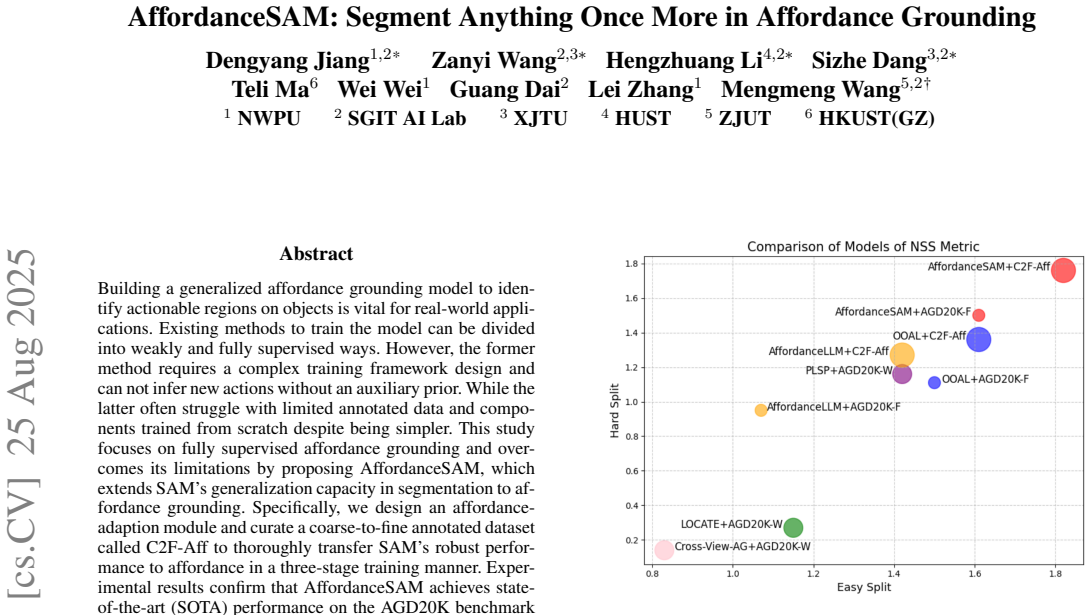
AffordanceSAM reports state-of-the-art results on the AGD20K benchmark, with the best Similarity and Normalized Scanpath Saliency scores among compared fully supervised methods on both the easy and hard splits, and its best KLD on the hard split. The paper attributes this to two complementary transfers: SAM's existing generalization in segmentation carries over to affordance grounding through a lightweight affordance-adaption module, and the C2F-Aff dataset supplies enough supervised signal, in three label-quality stages, to teach the model verb-object relations that do not appear in standard segmentation data. Ablations show each stage matters, since combining all data in one stage degrades performance, and qualitative results on internet images indicate the model maps novel objects and actions to reasonable affordance regions. The paper also claims the C2F-Aff data alone improves prior fully supervised methods, so the dataset is reusable beyond the proposed model.
Load-bearing premise
The load-bearing premise is that the stage-2 pseudo-labeled images and the object categories they depict do not appear in the easy or hard test splits of AGD20K; if test images or their categories leak into the training pool, the reported generalization numbers stop measuring generalization.
Editorial extensions
If this is right
- On the paper's evidence, fully supervised affordance grounding can be built directly on a SAM foundation model with a small adapter, reducing the need for task-specific decoders trained from scratch.
- C2F-Aff, when used as training data, lifts the hard-split performance of other fully supervised methods such as AffordanceLLM and OOAL, so the dataset is claimed to be a reusable resource beyond AffordanceSAM itself.
- Because the text prompt is formed as '<action> <object>', the model can be queried with action-object pairs at inference time; qualitative results on internet images support generalization to novel objects and actions.
- The three-stage training order matters: ablations show that the coarse-to-fine schedule, rather than simply adding more data, is necessary for the reported gains.
- If the central claims hold, the weakly supervised approach's two-branch training complexity is no longer needed for strong affordance grounding, since a fully supervised SAM adaptation achieves higher scores with simpler supervision.
Reading between the lines
- Editorial inference: if the generalization claim survives on broader test sets, AffordanceSAM could be dropped into robot grasping or human-robot interaction loops where one verb-object prompt must map onto unseen object instances; the paper only gestures at robotics and reports no closed-loop test.
- Editorial inference: the pseudo-label post-processing pipeline suggests that a weak supervisor plus aggressive thresholding can create usable affordance supervision at scale; replacing LOCATE with a stronger current model in stage 2 is a direct comparative experiment the paper does not run.
- Editorial inference: the reported failure cases, multiple objects or multiple actions in one image, point to the single-object and single-action composition of the training data as the main remaining bottleneck, so constructing composite-scene C2F-Aff extensions is the most direct test of further gains.
Signed reviews
Editorial analysis
A structured set of objections, weighed in public.
Referee Report
Summary. This paper proposes AffordanceSAM, a fully supervised affordance grounding model built on EVF-SAM (a text-prompted variant of SAM) with the addition of an affordance-adaption module: a set of learnable queries that cross-attend to text features and to multi-layer SAM image features. The authors also curate C2F-Aff, a three-part coarse-to-fine dataset: part 1 combines binary-mask-labeled data from PADv2, Handal, and RGB-D Part Affordance; part 2 uses LOCATE to pseudo-label the unlabeled images of AGD20K, followed by a post-processing filtration algorithm; part 3 uses the human-annotated AGD20K affordance maps. Training proceeds in three stages matching these dataset parts, with progressive unfreezing of the model. Experiments on AGD20K report state-of-the-art SIM and NSS on the easy and hard splits, and qualitative results on internet images suggest generalization to novel objects and actions.
Significance. If the results hold, the contribution is meaningful: it demonstrates that a large segmentation foundation model (SAM) can be adapted to affordance grounding with a lightweight prompt-like module, and it shows that scaling fully supervised data via pseudo-labeling improves all tested fully supervised baselines. The staged ablation is internally consistent and clearly isolates the contribution of each dataset part and module component. The architecture and training recipe are described in enough detail to be reproducible. However, the central SOTA and generalization claims are weakened by the test-set hyperparameter selection and by the incomplete category-disjointness guarantee for stage 1, detailed in the major comments. Once these issues are addressed, the paper could be a solid contribution to the affordance grounding literature.
major comments (2)
- [Experiments, Ablation Study (Tables 5 and 6)] The post-processing hyperparameters γ and the number of filtration passes in Algorithm 1 are selected using the hard split test set: Table 6 sweeps γ and reports the best NSS at γ=0.45, and Table 5 sweeps the number of filtration steps; the default settings (γ=0.45, Num=3) are then used in the main comparison of Table 2. This is test-set hyperparameter tuning, so the reported hard-split numbers are optimistically biased and are not a clean out-of-sample estimate of the model's generalization. The authors should select these hyperparameters on a validation set held out from the hard split, or alternatively state explicitly that the reported numbers include test-set selection and discuss the resulting optimism in the SOTA claims.
- [Evaluation section and Appendix 2] The hard-split guarantee of no object-category overlap is stated only for stages 2 and 3: the Evaluation section says 'The hard split ensures that there is no overlap between the object categories in the train and test set (both in our stage 2 and stage 3).' Appendix 2 reveals that stage 1 does not perform any object-category split: 'we do not split any object when training'. Stage 1 uses PADv2, Handal, and RGB-D Part Affordance, which plausibly contain object categories that also appear in the hard-split test list. Since stage 1 trains object-verb associations, the model has been exposed to those categories before the hard-split evaluation, even though the label format differs (binary masks vs. heatmaps). Consequently, the hard-split results do not strictly measure category-level novelty, weakening the claim of 'strong generalized capacity to novel objects'. The authors should either document that the stage-1 categories are disjoint from the hard-split test categories, or retrain without the overlapping categories and re-evaluate.
minor comments (6)
- [Conclusion and Abstract] The term 'state-of-the-art' is used without qualification, but Table 2 shows that OOAL trained on C2F-Aff achieves a better KLD than AffordanceSAM on both the easy split (0.974 vs 1.083) and the hard split (1.119 vs 1.128). Please qualify the claim, e.g., 'best SIM and NSS'.
- [Approach, Section 3] There is a typo: 'finaly' should be 'finally'.
- [Figure 6 caption] In the caption, 'row maps' and 'row affordance maps' should be 'raw maps' and 'raw affordance maps'.
- [Appendix title] The appendix section titled 'Failure Cases and Feature Work' should be 'Failure Cases and Future Work'.
- [Reproducibility] The paper does not state whether the C2F-Aff dataset, the pseudo-label post-processing code, and the exact train/test category lists will be released; given the split-hygiene concerns raised above, releasing these artifacts is important for verification.
- [Figure 5] The generalization results on internet images are qualitative only; adding a small quantitative evaluation (e.g., human ratings or agreement with hand-annotated maps) would strengthen the claim of generalization to novel objects and actions.
Circularity Check
No circular derivation: the SOTA claim rests on supervised training against external AGD20K human labels; the hard-split category-overlap caveat is a data-hygiene concern, not circularity.
full rationale
The paper's central claim is an empirical supervised-transfer result: it initializes from EVF-SAM, adds a learnable affordance-adaption module, trains on C2F-Aff (merged existing datasets plus LOCATE pseudo-labels plus AGD20K human labels), and evaluates on AGD20K with KLD/SIM/NSS against human ground truth. None of the method's equations (Eqs. 1-5) defines a target quantity in terms of the metric being predicted; stage-2 pseudo-labels come from an external weakly supervised model (LOCATE), not from the test labels or from AffordanceSAM itself; stage-3 uses human labels from AGD20K, and the test split is an external benchmark. The self-citations (GLOVER, ActionCLIP) are background related-work citations and are not load-bearing. The paper itself flags the only significant validity caveat in Appendix 2: "we do not split any object when training, because the output form of this stage is completely different from the output used in the final evaluation," and the Evaluation section limits category disjointness to "both in our stage 2 and stage 3." This is a possible train/test category-overlap (leakage) concern for the hard-split generalization claim, but it is a data-selection/split-hygiene issue, not a circular reduction of a prediction to fitted inputs. Under the hard rules, that does not raise the circularity score. Score 1 reflects minor non-load-bearing self-citations and the acknowledged split caveat, with no circular derivation chain.
Assumptions & free parameters
free parameters (3)
- gamma =
0.45
- number of filtration passes =
3
- loss weights =
lambda_dice=0.5, lambda_bce=1; focal positive=0.9, negative=0.1
assumptions (4)
- domain assumption Affordance grounding can be treated as text-prompted dense prediction with heatmap output, so SAM's mask decoder can be repurposed with minimal changes.
- domain assumption LOCATE pseudo-labels, after the thresholding post-processor, are a reliable intermediate supervision signal.
- domain assumption The prompt template '<affordance action> <object name>' (e.g., 'wear hat') provides sufficient text supervision for learning affordances.
- standard math The AGD20K evaluation metrics (KLD, SIM, NSS), computed as in prior work, correctly measure affordance map quality.
Cite this review
Pith. "Pith review of AffordanceSAM: Segment Anything Once More in Affordance Grounding." pith.science (2026). https://pith.science/paper/36DDO7BU
@misc{pith2026250415650,
  author       = {Pith},
  title        = {Pith review of: AffordanceSAM: Segment Anything Once More in Affordance Grounding},
  year         = {2026},
  howpublished = {\url{https://pith.science/paper/36DDO7BU}},
  note         = {Machine review of arXiv:2504.15650}
}
read the original abstract
Building a generalized affordance grounding model to identify actionable regions on objects is vital for real-world applications. Existing methods to train the model can be divided into weakly and fully supervised ways. However, the former method requires a complex training framework design and can not infer new actions without an auxiliary prior. While the latter often struggle with limited annotated data and components trained from scratch despite being simpler. This study focuses on fully supervised affordance grounding and overcomes its limitations by proposing AffordanceSAM, which extends SAM's generalization capacity in segmentation to affordance grounding. Specifically, we design an affordance-adaption module and curate a coarse-to-fine annotated dataset called C2F-Aff to thoroughly transfer SAM's robust performance to affordance in a three-stage training manner. Experimental results confirm that AffordanceSAM achieves state-of-the-art (SOTA) performance on the AGD20K benchmark and exhibits strong generalized capacity.
Figures


Figures from the paper (4 more)


Forward citations
Cited by 2 Pith papers
-
Zero-shot 2D Grounding with Novel Affordance Types
A new benchmark and pipeline show that grounding an action word like 'cut' on a familiar object can be done without ever training on that action word, outperforming prior affordance grounding methods by a large margin.
-
PanoAffordanceNet: Towards Holistic Affordance Grounding in 360{\deg} Indoor Environments
PanoAffordanceNet performs affordance grounding directly on 360-degree equirectangular indoor images and introduces the 360-AGD dataset, outperforming two adapted one-shot baselines on that benchmark.
Reference graph
Works this paper leans on
-
[1]
, " * write output.state after.block = add.period write newline
ENTRY address archivePrefix author booktitle chapter edition editor eid eprint howpublished institution isbn journal key month note number organization pages publisher school series title type volume year label extra.label sort.label short.list INTEGERS output.state before.all mid.sentence after.sentence after.block FUNCTION init.state.consts #0 'before.a...
-
[2]
write newline
" write newline "" before.all 'output.state := FUNCTION n.dashify 't := "" t empty not t #1 #1 substring "-" = t #1 #2 substring "--" = not "--" * t #2 global.max substring 't := t #1 #1 substring "-" = "-" * t #2 global.max substring 't := while if t #1 #1 substring * t #2 global.max substring 't := if while FUNCTION word.in bbl.in capitalize " " * FUNCT...
-
[3]
S.; Ramamoorthy, S.; and Petrick, R
Ard \'o n, P.; Pairet, \`E .; Lohan, K. S.; Ramamoorthy, S.; and Petrick, R. 2020. Affordances in robotic tasks--a survey. arXiv preprint arXiv:2004.07400
arXiv 2020
-
[4]
P.; Ramamoorthy, S.; and Lohan, K
Ard \'o n, P.; Pairet, E.; Petrick, R. P.; Ramamoorthy, S.; and Lohan, K. S. 2019. Learning grasp affordance reasoning through semantic relations. IEEE Robotics and Automation Letters, 4(4): 4571--4578
work page 2019
-
[5]
Bahl, S.; Mendonca, R.; Chen, L.; Jain, U.; and Pathak, D. 2023. Affordances from human videos as a versatile representation for robotics. In Proceedings of the IEEE/CVF Conference on Computer Vision and Pattern Recognition, 13778--13790
2023
-
[6]
Bai, J.; Bai, S.; Yang, S.; Wang, S.; Tan, S.; Wang, P.; Lin, J.; Zhou, C.; and Zhou, J. 2023. Qwen-VL: A Versatile Vision-Language Model for Understanding, Localization. Text Reading, and Beyond, 2
work page 2023
-
[7]
Bharadhwaj, H.; Gupta, A.; and Tulsiani, S. 2023. Visual affordance prediction for guiding robot exploration. In 2023 IEEE International Conference on Robotics and Automation (ICRA), 3029--3036. IEEE
work page 2023
-
[8]
Borja-Diaz, J.; Mees, O.; Kalweit, G.; Hermann, L.; Boedecker, J.; and Burgard, W. 2022. Affordance learning from play for sample-efficient policy learning. In 2022 International Conference on Robotics and Automation (ICRA), 6372--6378. IEEE
work page 2022
Show all 58 references
-
[9]
Bylinskii, Z.; Judd, T.; Oliva, A.; Torralba, A.; and Durand, F. 2018. What do different evaluation metrics tell us about saliency models? IEEE transactions on pattern analysis and machine intelligence, 41(3): 740--757
2018
-
[10]
Carion, N.; Massa, F.; Synnaeve, G.; Usunier, N.; Kirillov, A.; and Zagoruyko, S. 2020. End-to-end object detection with transformers. In European conference on computer vision, 213--229. Springer
2020
-
[11]
Chen, Z.; Wang, W.; Tian, H.; Ye, S.; Gao, Z.; Cui, E.; Tong, W.; Hu, K.; Luo, J.; Ma, Z.; et al. 2024. How far are we to gpt-4v? closing the gap to commercial multimodal models with open-source suites. Science China Information Sciences, 67(12): 220101
2024
-
[12]
Conneau, A. 2019. Unsupervised cross-lingual representation learning at scale. arXiv preprint arXiv:1911.02116
2019 arXiv
-
[13]
Gibson, J. J. 2014. The ecological approach to visual perception: classic edition. Psychology press
2014
-
[14]
Guo, A.; Wen, B.; Yuan, J.; Tremblay, J.; Tyree, S.; Smith, J.; and Birchfield, S. 2023. Handal: A dataset of real-world manipulable object categories with pose annotations, affordances, and reconstructions. In 2023 IEEE/RSJ International Conference on Intelligent Robots and S...
2023
-
[15]
Han, G.; and Lim, S.-N. 2024. Few-shot object detection with foundation models. In Proceedings of the IEEE/CVF Conference on Computer Vision and Pattern Recognition, 28608--28618
2024
-
[16]
Kazemzadeh, S.; Ordonez, V.; Matten, M.; and Berg, T. 2014. Referitgame: Referring to objects in photographs of natural scenes. In Proceedings of the 2014 conference on empirical methods in natural language processing (EMNLP), 787--798
2014
-
[17]
Ke, L.; Ye, M.; Danelljan, M.; Tai, Y.-W.; Tang, C.-K.; Yu, F.; et al. 2024. Segment anything in high quality. Advances in Neural Information Processing Systems, 36
2024
-
[18]
U.; Wasim, S
Khattak, M. U.; Wasim, S. T.; Naseer, M.; Khan, S.; Yang, M.-H.; and Khan, F. S. 2023. Self-regulating prompts: Foundational model adaptation without forgetting. In Proceedings of the IEEE/CVF International Conference on Computer Vision, 15190--15200
2023
-
[19]
Kingma, D. P. 2014. Adam: A method for stochastic optimization. arXiv preprint arXiv:1412.6980
2014 arXiv
-
[20]
C.; Lo, W.-Y.; et al
Kirillov, A.; Mintun, E.; Ravi, N.; Mao, H.; Rolland, C.; Gustafson, L.; Xiao, T.; Whitehead, S.; Berg, A. C.; Lo, W.-Y.; et al. 2023. Segment anything. In Proceedings of the IEEE/CVF International Conference on Computer Vision, 4015--4026
2023
-
[21]
A.; Haustein, J
Kokic, M.; Stork, J. A.; Haustein, J. A.; and Kragic, D. 2017. Affordance detection for task-specific grasping using deep learning. In 2017 IEEE-RAS 17th International Conference on Humanoid Robotics (Humanoids), 91--98. IEEE
2017
-
[22]
Lafon, M.; Ramzi, E.; Rambour, C.; Audebert, N.; and Thome, N. 2024. Gallop: Learning global and local prompts for vision-language models. arXiv preprint arXiv:2407.01400
2024 arXiv
-
[23]
Lai, X.; Tian, Z.; Chen, Y.; Li, Y.; Yuan, Y.; Liu, S.; and Jia, J. 2024. Lisa: Reasoning segmentation via large language model. In Proceedings of the IEEE/CVF Conference on Computer Vision and Pattern Recognition, 9579--9589
2024
-
[24]
Li, G.; Jampani, V.; Sun, D.; and Sevilla-Lara, L. 2023 a . Locate: Localize and transfer object parts for weakly supervised affordance grounding. In Proceedings of the IEEE/CVF Conference on Computer Vision and Pattern Recognition, 10922--10931
2023
-
[25]
Li, G.; Sun, D.; Sevilla-Lara, L.; and Jampani, V. 2024. One-shot open affordance learning with foundation models. In Proceedings of the IEEE/CVF Conference on Computer Vision and Pattern Recognition, 3086--3096
2024
-
[26]
Li, J.; Li, D.; Savarese, S.; and Hoi, S. 2023 b . Blip-2: Bootstrapping language-image pre-training with frozen image encoders and large language models. In International conference on machine learning, 19730--19742. PMLR
2023
-
[27]
Lin, T. 2017. Focal Loss for Dense Object Detection. arXiv preprint arXiv:1708.02002
2017 arXiv
-
[28]
Liu, H.; Li, C.; Wu, Q.; and Lee, Y. J. 2023. Visual instruction tuning. Advances in neural information processing systems, 36: 34892--34916
2023
-
[29]
Luo, H.; Zhai, W.; Zhang, J.; Cao, Y.; and Tao, D. 2022. Learning affordance grounding from exocentric images. In Proceedings of the IEEE/CVF conference on computer vision and pattern recognition, 2252--2261
2022
-
[30]
Ma, T.; Wang, Z.; Zhou, J.; Wang, M.; and Liang, J. 2024. GLOVER: Generalizable open-vocabulary affordance reasoning for task-oriented grasping. arXiv preprint arXiv:2411.12286
2024 arXiv
-
[31]
Mai, J.; Yang, M.; and Luo, W. 2020. Erasing integrated learning: A simple yet effective approach for weakly supervised object localization. In Proceedings of the IEEE/CVF conference on computer vision and pattern recognition, 8766--8775
2020
-
[32]
Minaee, S.; Boykov, Y.; Porikli, F.; Plaza, A.; Kehtarnavaz, N.; and Terzopoulos, D. 2021. Image segmentation using deep learning: A survey. IEEE transactions on pattern analysis and machine intelligence, 44(7): 3523--3542
2021
-
[33]
L.; Ferm \"u ller, C.; and Aloimonos, Y
Myers, A.; Teo, C. L.; Ferm \"u ller, C.; and Aloimonos, Y. 2015. Affordance detection of tool parts from geometric features. In 2015 IEEE International Conference on Robotics and Automation (ICRA), 1374--1381. IEEE
2015
-
[34]
Nagarajan, T.; Feichtenhofer, C.; and Grauman, K. 2019. Grounded human-object interaction hotspots from video. In Proceedings of the IEEE/CVF International Conference on Computer Vision, 8688--8697
2019
-
[35]
Oquab, M.; Darcet, T.; Moutakanni, T.; Vo, H.; Szafraniec, M.; Khalidov, V.; Fernandez, P.; Haziza, D.; Massa, F.; El-Nouby, A.; et al. 2023. Dinov2: Learning robust visual features without supervision. arXiv preprint arXiv:2304.07193
2023 arXiv
-
[36]
Pan, X.; Gao, Y.; Lin, Z.; Tang, F.; Dong, W.; Yuan, H.; Huang, F.; and Xu, C. 2021. Unveiling the potential of structure preserving for weakly supervised object localization. In Proceedings of the IEEE/CVF conference on computer vision and pattern recognition, 11642--11651
2021
-
[37]
J.; Iyer, A.; Itti, L.; and Koch, C
Peters, R. J.; Iyer, A.; Itti, L.; and Koch, C. 2005. Components of bottom-up gaze allocation in natural images. Vision research, 45(18): 2397--2416
2005
-
[38]
Qian, S.; Chen, W.; Bai, M.; Zhou, X.; Tu, Z.; and Li, L. E. 2024. Affordancellm: Grounding affordance from vision language models. In Proceedings of the IEEE/CVF Conference on Computer Vision and Pattern Recognition, 7587--7597
2024
-
[39]
W.; Hallacy, C.; Ramesh, A.; Goh, G.; Agarwal, S.; Sastry, G.; Askell, A.; Mishkin, P.; Clark, J.; et al
Radford, A.; Kim, J. W.; Hallacy, C.; Ramesh, A.; Goh, G.; Agarwal, S.; Sastry, G.; Askell, A.; Mishkin, P.; Clark, J.; et al. 2021. Learning transferable visual models from natural language supervision. In International conference on machine learning, 8748--8763. PMLR
2021
-
[40]
Ravi, N.; Gabeur, V.; Hu, Y.-T.; Hu, R.; Ryali, C.; Ma, T.; Khedr, H.; R \"a dle, R.; Rolland, C.; Gustafson, L.; et al. 2024. Sam 2: Segment anything in images and videos. arXiv preprint arXiv:2408.00714
2024 arXiv
-
[41]
Ren, T.; Liu, S.; Zeng, A.; Lin, J.; Li, K.; Cao, H.; Chen, J.; Huang, X.; Chen, Y.; Yan, F.; et al. 2024. Grounded sam: Assembling open-world models for diverse visual tasks. arXiv preprint arXiv:2401.14159
2024 arXiv
-
[42]
Ruby, U.; and Yendapalli, V. 2020. Binary cross entropy with deep learning technique for image classification. Int. J. Adv. Trends Comput. Sci. Eng, 9(10)
2020
-
[43]
Schuhmann, C.; Vencu, R.; Beaumont, R.; Kaczmarczyk, R.; Mullis, C.; Katta, A.; Coombes, T.; Jitsev, J.; and Komatsuzaki, A. 2021. Laion-400m: Open dataset of clip-filtered 400 million image-text pairs. arXiv preprint arXiv:2111.02114
2021 arXiv
-
[44]
H.; Li, W.; Vercauteren, T.; Ourselin, S.; and Jorge Cardoso, M
Sudre, C. H.; Li, W.; Vercauteren, T.; Ourselin, S.; and Jorge Cardoso, M. 2017. Generalised dice overlap as a deep learning loss function for highly unbalanced segmentations. In Deep Learning in Medical Image Analysis and Multimodal Learning for Clinical Decision Support: Thi...
2017
-
[45]
J.; and Ballard, D
Swain, M. J.; and Ballard, D. H. 1991. Color indexing. International journal of computer vision, 7(1): 11--32
1991
-
[46]
Wang, M.; Xing, J.; Mei, J.; Liu, Y.; and Jiang, Y. 2023 a . ActionCLIP: Adapting Language-Image Pretrained Models for Video Action Recognition. IEEE Transactions on Neural Networks and Learning Systems
2023
-
[47]
K.; Singhal, S.; Som, S.; et al
Wang, W.; Bao, H.; Dong, L.; Bjorck, J.; Peng, Z.; Liu, Q.; Aggarwal, K.; Mohammed, O. K.; Singhal, S.; Som, S.; et al. 2023 b . Image as a foreign language: Beit pretraining for vision and vision-language tasks. In Proceedings of the IEEE/CVF Conference on Computer Vision and...
2023
-
[48]
Wang, Y.; Wu, A.; Yang, M.; Min, Y.; Zhu, Y.; and Deng, C. 2025. Reasoning Mamba: Hypergraph-Guided Region Relation Calculating for Weakly Supervised Affordance Grounding. In Proceedings of the Computer Vision and Pattern Recognition Conference, 27618--27627
2025
-
[49]
Xu, P.; and Mu, Y. 2025. Weakly-supervised affordance grounding guided by part-level semantic priors
2025
-
[50]
Yang, X.; Ji, Z.; Wu, J.; and Lai, Y.-K. 2023. Recent advances of deep robotic affordance learning: a reinforcement learning perspective. IEEE Transactions on Cognitive and Developmental Systems, 15(3): 1139--1149
2023
-
[51]
C.; and Berg, T
Yu, L.; Poirson, P.; Yang, S.; Berg, A. C.; and Berg, T. L. 2016. Modeling context in referring expressions. In Computer Vision--ECCV 2016: 14th European Conference, Amsterdam, The Netherlands, October 11-14, 2016, Proceedings, Part II 14, 69--85. Springer
2016
-
[52]
Zhai, W.; Luo, H.; Zhang, J.; Cao, Y.; and Tao, D. 2022. One-shot object affordance detection in the wild. International Journal of Computer Vision, 130(10): 2472--2500
2022
-
[53]
Zhang, Y.; Cheng, T.; Hu, R.; Liu, H.; Ran, L.; Chen, X.; Liu, W.; Wang, X.; et al. 2024. Evf-sam: Early vision-language fusion for text-prompted segment anything model. arXiv preprint arXiv:2406.20076
2024 arXiv
-
[54]
Z.; Zhang, D
Zhao, R.; Gu, Y.; Wu, J. Z.; Zhang, D. J.; Liu, J.; Wu, W.; Keppo, J.; and Shou, M. Z. 2023 a . Motiondirector: Motion customization of text-to-video diffusion models. arXiv preprint arXiv:2310.08465
2023 arXiv
-
[55]
Zhao, X.; Ding, W.; An, Y.; Du, Y.; Yu, T.; Li, M.; Tang, M.; and Wang, J. 2023 b . Fast segment anything. arXiv preprint arXiv:2306.12156
2023 arXiv
-
[56]
Zhao, Z.-Q.; Zheng, P.; Xu, S.-t.; and Wu, X. 2019. Object detection with deep learning: A review. IEEE transactions on neural networks and learning systems, 30(11): 3212--3232
2019
-
[57]
Zhou, B.; Khosla, A.; Lapedriza, A.; Oliva, A.; and Torralba, A. 2016. Learning deep features for discriminative localization. In Proceedings of the IEEE conference on computer vision and pattern recognition, 2921--2929
2016
-
[58]
C.; and Liu, Z
Zhou, K.; Yang, J.; Loy, C. C.; and Liu, Z. 2022. Learning to prompt for vision-language models. International Journal of Computer Vision, 130(9): 2337--2348
2022
Reviewed August 16, 2026 · model on record in the stance chip above.
Discussion (0). Continue with ORCID to comment.