REVIEW 2 major objections 1 minor 55 references
Bidirectional Tutoring for Developmental Motor Learning in Robots: Co-Developed Interaction Dynamics Support Stable Learning
T0 review · 2 major / 1 minor · reviewed 2026-06-26 · grok-4.3
Pith's one-line read Bidirectional tutoring enables robots to develop consistent motor behaviors via co-adapted interaction dynamics.
desk verdict The abstract lays out a clear bidirectional tutoring hypothesis for robot motor learning but gives zero quantitative results or analysis to check if the experiments actually support it. read the letter →
The pith
A machine-rendered reading of the paper's core claim, the machinery that carries it, and where it could break.
The reading
What carries the argument
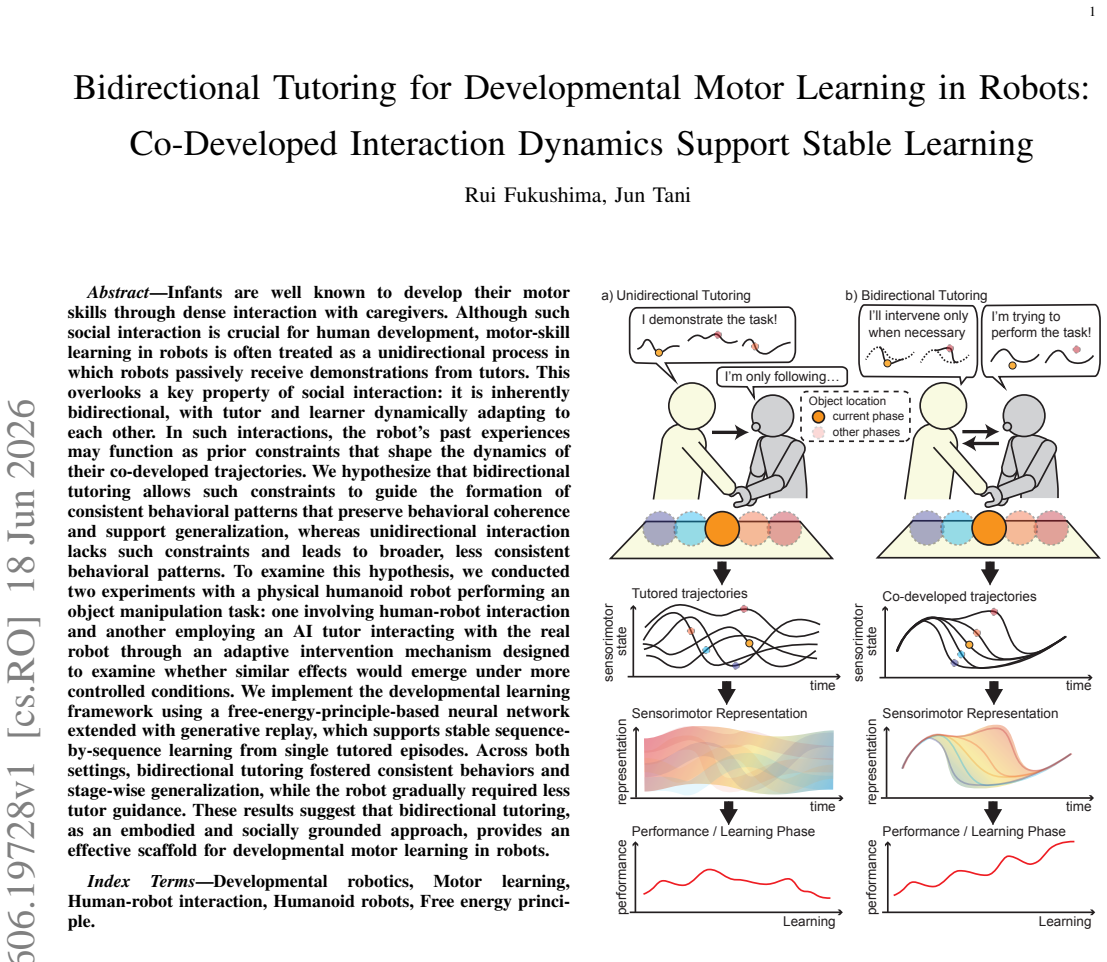
Bidirectional tutoring, the process in which tutor and robot mutually adapt so that the robot's accumulated experiences constrain the shared behavioral trajectories.
What would settle it
If bidirectional tutoring experiments produced the same behavioral inconsistency and sustained tutor dependence seen in unidirectional setups, the central claim would be falsified.
Extended reading notes
Core claim
The paper claims that bidirectional tutoring fosters consistent behaviors and stage-wise generalization in a robot's object manipulation task by allowing the robot's past experiences to act as prior constraints on co-developed interaction trajectories, implemented via a free-energy-principle-based neural network with generative replay that enables stable learning from single episodes, and this effect holds in both human-robot and AI-robot settings where the robot gradually requires less tutor guidance.
Load-bearing premise
The robot's past experiences function as prior constraints that shape the dynamics of their co-developed trajectories in bidirectional interaction.
Signed reviews
Editorial analysis
A structured set of objections, weighed in public.
Referee Report
Summary. The paper hypothesizes that bidirectional tutoring in robot motor learning supplies prior constraints from the robot's past experiences (via an FEP-based neural network with generative replay) that promote consistent behavioral patterns and stage-wise generalization, unlike unidirectional interaction. It tests this via two physical-robot experiments on an object-manipulation task—one with a human tutor and one with an AI tutor using an adaptive intervention mechanism—reporting that bidirectional conditions produced consistent behaviors, generalization across stages, and decreasing tutor guidance.
Significance. If the experimental claims hold with adequate quantitative support, the work would strengthen the case for socially grounded, bidirectional frameworks in developmental robotics and demonstrate a practical implementation of FEP plus generative replay for stable, single-episode sequence learning. The dual human/AI-tutor design is a positive feature for testing robustness under controlled conditions.
major comments (2)
- [Results/Discussion] Results and Discussion sections: the reported outcomes (consistent behaviors, stage-wise generalization, reduced tutor guidance) are described qualitatively at a high level with no quantitative metrics, error bars, statistical tests, or direct comparisons to unidirectional baselines. This prevents assessment of whether the data actually support the central hypothesis.
- [Methods] Methods, AI-tutor experiment: the adaptive intervention mechanism and how it operationalizes 'bidirectional' vs. 'unidirectional' conditions are not specified in sufficient detail (e.g., exact intervention rules, state representations, or replay buffer mechanics) to allow replication or to confirm that past experiences function as prior constraints as claimed in the abstract.
minor comments (1)
- [Abstract/Introduction] Abstract and introduction: the phrasing 'the robot gradually required less tutor guidance' should be accompanied by a precise operational definition of 'guidance' and how it was measured.
Simulated Author's Rebuttal
We thank the referee for the constructive feedback, which identifies key areas where additional rigor and detail will strengthen the manuscript. We respond point-by-point to the major comments below.
read point-by-point responses
-
Referee: [Results/Discussion] Results and Discussion sections: the reported outcomes (consistent behaviors, stage-wise generalization, reduced tutor guidance) are described qualitatively at a high level with no quantitative metrics, error bars, statistical tests, or direct comparisons to unidirectional baselines. This prevents assessment of whether the data actually support the central hypothesis.
Authors: We agree that the current Results and Discussion rely on qualitative descriptions without supporting quantitative analysis. In the revised version we will extract and report quantitative metrics from the existing trial data, including behavioral consistency (e.g., standard deviation of key trajectory features across episodes), stage-wise generalization success rates, and tutor-intervention counts per stage, each accompanied by error bars and appropriate statistical tests. Direct unidirectional baselines were not collected in the reported experiments; we will therefore add an explicit limitations paragraph explaining the design choice and its implications rather than fabricating comparisons. revision: partial
-
Referee: [Methods] Methods, AI-tutor experiment: the adaptive intervention mechanism and how it operationalizes 'bidirectional' vs. 'unidirectional' conditions are not specified in sufficient detail (e.g., exact intervention rules, state representations, or replay buffer mechanics) to allow replication or to confirm that past experiences function as prior constraints as claimed in the abstract.
Authors: We accept that the Methods section for the AI-tutor experiment currently lacks the granularity needed for replication. The revised manuscript will expand this section with the precise intervention rules (prediction-error thresholds and timing), the state representation fed to the tutor, and the generative-replay buffer update mechanics, thereby clarifying how bidirectional dynamics are realized and how past experiences operate as priors. revision: yes
Circularity Check
No significant circularity; empirical results from robot trials
full rationale
The paper advances a testable hypothesis about bidirectional tutoring via two physical robot experiments (human and AI tutor) and reports observed outcomes on consistency, generalization, and reduced guidance needs. The framework uses an FEP-based network with generative replay, but the central claims rest on experimental data rather than any derivation, equation, or fitted parameter that reduces to its own inputs by construction. No self-citation chain or ansatz is shown to be load-bearing for the reported results.
Assumptions & free parameters
assumptions (1)
- domain assumption Free-energy-principle-based neural network extended with generative replay supports stable sequence-by-sequence learning from single tutored episodes.
Cite this review
Pith. "Pith review of Bidirectional Tutoring for Developmental Motor Learning in Robots: Co-Developed Interaction Dynamics Support Stable Learning." pith.science (2026). https://pith.science/paper/36XJJW6R
@misc{pith2026260619728,
  author       = {Pith},
  title        = {Pith review of: Bidirectional Tutoring for Developmental Motor Learning in Robots: Co-Developed Interaction Dynamics Support Stable Learning},
  year         = {2026},
  howpublished = {\url{https://pith.science/paper/36XJJW6R}},
  note         = {Machine review of arXiv:2606.19728}
}
read the original abstract
Infants are well known to develop their motor skills through dense interaction with caregivers. Although such social interaction is crucial for human development, motor-skill learning in robots is often treated as a unidirectional process in which robots passively receive demonstrations from tutors. This overlooks a key property of social interaction: it is inherently bidirectional, with tutor and learner dynamically adapting to each other. In such interactions, the robot's past experiences may function as prior constraints that shape the dynamics of their co-developed trajectories. We hypothesize that bidirectional tutoring allows such constraints to guide the formation of consistent behavioral patterns that preserve behavioral coherence and support generalization, whereas unidirectional interaction lacks such constraints and leads to broader, less consistent behavioral patterns. To examine this hypothesis, we conducted two experiments with a physical humanoid robot performing an object manipulation task: one involving human-robot interaction and another employing an AI tutor interacting with the real robot through an adaptive intervention mechanism designed to examine whether similar effects would emerge under more controlled conditions. We implement the developmental learning framework using a free-energy-principle-based neural network extended with generative replay, which supports stable sequence-by-sequence learning from single tutored episodes. Across both settings, bidirectional tutoring fostered consistent behaviors and stage-wise generalization, while the robot gradually required less tutor guidance. These results suggest that bidirectional tutoring, as an embodied and socially grounded approach, provides an effective scaffold for developmental motor learning in robots.
Figures


Figures from the paper (10 more)


Reference graph
Works this paper leans on
-
[1]
Imitation of facial and manual gestures by human neonates,
A. N. Meltzoff and M. K. Moore, “Imitation of facial and manual gestures by human neonates,”Science, vol. 198, no. 4312, pp. 75–78, 1977
1977
-
[2]
J. M. PINE, “Tomasello, m., constructing a language: a usage-based theory of language acquisition. cambridge, ma: Harvard university press,
-
[3]
pp. 388. hardback,£ 29.95. isbn 0-674-01030-2.”Journal of Child Language, vol. 32, no. 3, pp. 697–702, 2005. 15
2005
-
[4]
Participatory sense-making: An enactive approach to social cognition,
H. De Jaegher and E. Di Paolo, “Participatory sense-making: An enactive approach to social cognition,”Phenomenology and the cognitive sciences, vol. 6, no. 4, pp. 485–507, 2007
2007
-
[5]
The role of tutoring in problem solving,
D. Wood, J. S. Bruner, and G. Ross, “The role of tutoring in problem solving,”Journal of child psychology and psychiatry, vol. 17, no. 2, pp. 89–100, 1976
1976
-
[6]
A. N. Meltzoff and W. Prinz,The imitative mind: Development, evolution and brain bases. Cambridge University Press, 2002, vol. 6
2002
-
[7]
Social situatedness of natural and artificial intelligence: Vygotsky and beyond,
J. Lindblom and T. Ziemke, “Social situatedness of natural and artificial intelligence: Vygotsky and beyond,”Adaptive Behavior, vol. 11, no. 2, pp. 79–96, 2003
2003
-
[8]
L. S. Vygotsky,Mind in society: The development of higher psycholog- ical processes. Harvard university press, 1978, vol. 86
1978
Show all 55 references
-
[9]
L. S. Vygotsky,Thought and language. MIT press, 2012, vol. 29
2012
-
[10]
Developmental robotics: a survey,
M. Lungarella, G. Metta, R. Pfeifer, and G. Sandini, “Developmental robotics: a survey,”Connection science, vol. 15, no. 4, pp. 151–190, 2003
2003
-
[11]
Cognitive developmental robotics: A survey,
M. Asada, K. Hosoda, Y . Kuniyoshi, H. Ishiguro, T. Inui, Y . Yoshikawa, M. Ogino, and C. Yoshida, “Cognitive developmental robotics: A survey,”IEEE transactions on autonomous mental development, vol. 1, no. 1, pp. 12–34, 2009
2009
-
[12]
From babies to robots: the contri- bution of developmental robotics to developmental psychology,
A. Cangelosi and M. Schlesinger, “From babies to robots: the contri- bution of developmental robotics to developmental psychology,”Child Development Perspectives, vol. 12, no. 3, pp. 183–188, 2018
2018
-
[13]
Staged development of robot skills: Behavior formation, affordance learning and imitation with motionese,
E. Ugur, Y . Nagai, E. Sahin, and E. Oztop, “Staged development of robot skills: Behavior formation, affordance learning and imitation with motionese,”IEEE Transactions on Autonomous Mental Development, vol. 7, no. 2, pp. 119–139, 2015
2015
-
[14]
Learning from demonstration,
S. Schaal, “Learning from demonstration,”Advances in neural informa- tion processing systems, vol. 9, 1996
1996
-
[15]
A survey of robot learning from demonstration,
B. D. Argall, S. Chernova, M. Veloso, and B. Browning, “A survey of robot learning from demonstration,”Robotics and autonomous systems, vol. 57, no. 5, pp. 469–483, 2009
2009
-
[16]
Is imitation learning the route to humanoid robots?
S. Schaal, “Is imitation learning the route to humanoid robots?”Trends in cognitive sciences, vol. 3, no. 6, pp. 233–242, 1999
1999
-
[17]
Physical human–robot interaction,
S. Haddadin and E. Croft, “Physical human–robot interaction,” in Springer handbook of robotics. Springer, 2016, pp. 1835–1874
2016
-
[18]
Learning to reproduce fluctuating time series by inferring their time-dependent stochastic properties: Application in robot learning via tutoring,
S. Murata, J. Namikawa, H. Arie, S. Sugano, and J. Tani, “Learning to reproduce fluctuating time series by inferring their time-dependent stochastic properties: Application in robot learning via tutoring,”IEEE Transactions on Autonomous Mental Development, vol. 5, no. 4, pp. 2...
2013
-
[19]
Learning and comfort in human– robot interaction: A review,
W. Wang, Y . Chen, R. Li, and Y . Jia, “Learning and comfort in human– robot interaction: A review,”Applied Sciences, vol. 9, no. 23, p. 5152, 2019
2019
-
[20]
Discriminative and adaptive imitation in uni-manual and bi-manual tasks,
A. G. Billard, S. Calinon, and F. Guenter, “Discriminative and adaptive imitation in uni-manual and bi-manual tasks,”Robotics and Autonomous Systems, vol. 54, no. 5, pp. 370–384, 2006
2006
-
[21]
Imitation learning of positional and force skills demonstrated via kinesthetic teaching and haptic input,
P. Kormushev, S. Calinon, and D. G. Caldwell, “Imitation learning of positional and force skills demonstrated via kinesthetic teaching and haptic input,”Advanced Robotics, vol. 25, no. 5, pp. 581–603, 2011
2011
-
[22]
Dynamic and interactive generation of object handling behaviors by a small humanoid robot using a dynamic neural network model,
M. Ito, K. Noda, Y . Hoshino, and J. Tani, “Dynamic and interactive generation of object handling behaviors by a small humanoid robot using a dynamic neural network model,”Neural Networks, vol. 19, no. 3, pp. 323–337, 2006
2006
-
[23]
Self-organization of behavioral primitives as multiple attractor dynamics: A robot experiment,
J. Tani and M. Ito, “Self-organization of behavioral primitives as multiple attractor dynamics: A robot experiment,”IEEE Transactions on Systems, Man, and Cybernetics-Part A: Systems and Humans, vol. 33, no. 4, pp. 481–488, 2003
2003
-
[24]
Generalization capability for imitation learning,
Y . Wang, “Generalization capability for imitation learning,”arXiv preprint arXiv:2504.18538, 2025
2025
-
[25]
Consistency matters: Defining demonstration data quality metrics in robot learning from demonstration,
M. Sakr, J. Zhang, H. M. V . d. Loos, D. Kuli ´c, and E. Croft, “Consistency matters: Defining demonstration data quality metrics in robot learning from demonstration,”ACM Transactions on Human-Robot Interaction, vol. 15, no. 2, pp. 1–31, 2025
2025
-
[26]
Behavior transformers: Cloningkmodes with one stone,
N. M. Shafiullah, Z. Cui, A. A. Altanzaya, and L. Pinto, “Behavior transformers: Cloningkmodes with one stone,”Advances in neural information processing systems, vol. 35, pp. 22 955–22 968, 2022
2022
-
[27]
The bliss (not the problem) of motor abundance (not redundancy),
M. L. Latash, “The bliss (not the problem) of motor abundance (not redundancy),”Experimental brain research, vol. 217, no. 1, pp. 1–5, 2012
2012
-
[28]
The role of execution noise in movement variability,
R. J. Van Beers, P. Haggard, and D. M. Wolpert, “The role of execution noise in movement variability,”Journal of neurophysiology, vol. 91, no. 2, pp. 1050–1063, 2004
2004
-
[29]
Temporal structure of motor variability is dynamically regulated and predicts motor learning ability,
H. G. Wu, Y . R. Miyamoto, L. N. G. Castro, B. P. ¨Olveczky, and M. A. Smith, “Temporal structure of motor variability is dynamically regulated and predicts motor learning ability,”Nature neuroscience, vol. 17, no. 2, pp. 312–321, 2014
2014
-
[30]
A theory of cortical responses,
K. Friston, “A theory of cortical responses,”Philosophical transactions of the Royal Society B: Biological sciences, vol. 360, no. 1456, pp. 815–836, 2005
2005
-
[31]
Clark,Surfing uncertainty: Prediction, action, and the embodied mind
A. Clark,Surfing uncertainty: Prediction, action, and the embodied mind. Oxford University Press, 2015
2015
-
[32]
Hohwy,The predictive mind
J. Hohwy,The predictive mind. OUP Oxford, 2013
2013
-
[33]
A novel predictive-coding-inspired variational rnn model for online prediction and recognition,
A. Ahmadi and J. Tani, “A novel predictive-coding-inspired variational rnn model for online prediction and recognition,”Neural computation, vol. 31, no. 11, pp. 2025–2074, 2019
2025
-
[34]
Deep active inference in physical human-robot interaction: Balancing explo- ration and goal-directed behavior,
J. Borojevic, G. W. Haddon-Hill, J. Sandoval, and S. Murata, “Deep active inference in physical human-robot interaction: Balancing explo- ration and goal-directed behavior,” in2026 IEEE/SICE International Symposium on System Integration (SII). IEEE, 2026, pp. 1504–1509
2026
-
[35]
Codevelopmental learning between human and humanoid robot using a dynamic neural- network model,
J. Tani, R. Nishimoto, J. Namikawa, and M. Ito, “Codevelopmental learning between human and humanoid robot using a dynamic neural- network model,”IEEE Transactions on Systems, Man, and Cybernetics, Part B (Cybernetics), vol. 38, no. 1, pp. 43–59, 2008
2008
-
[36]
Trajectories and keyframes for kinesthetic teaching: A human-robot interaction per- spective,
B. Akgun, M. Cakmak, J. W. Yoo, and A. L. Thomaz, “Trajectories and keyframes for kinesthetic teaching: A human-robot interaction per- spective,” inProceedings of the seventh annual ACM/IEEE international conference on Human-Robot Interaction, 2012, pp. 391–398
2012
-
[37]
Physical human-robot interaction: Mutual learning and adaptation,
S. Ikemoto, H. B. Amor, T. Minato, B. Jung, and H. Ishiguro, “Physical human-robot interaction: Mutual learning and adaptation,”IEEE robotics & automation magazine, vol. 19, no. 4, pp. 24–35, 2012
2012
-
[38]
Incremental learning of goal- directed actions in a dynamic environment by a robot using active inference,
T. Matsumoto, W. Ohata, and J. Tani, “Incremental learning of goal- directed actions in a dynamic environment by a robot using active inference,”Entropy, vol. 25, no. 11, p. 1506, 2023
2023
-
[39]
Human–robot kinaesthetic interac- tions based on the free-energy principle,
H. Sawada, W. Ohata, and J. Tani, “Human–robot kinaesthetic interac- tions based on the free-energy principle,”IEEE Transactions on Systems, Man, and Cybernetics: Systems, 2024
2024
-
[40]
A theory of adaptive pattern classifiers,
S. Amari, “A theory of adaptive pattern classifiers,”IEEE Transactions on Electronic Computers, no. 3, pp. 299–307, 2006
2006
-
[41]
Adam: A method for stochastic optimization,
D. P. Kingma and J. Ba, “Adam: A method for stochastic optimization,” arXiv preprint arXiv:1412.6980, 2014
2014 arXiv
-
[42]
Characterizing the sense of agency in human– robot interaction based on the free energy principle,
W. Ohata and J. Tani, “Characterizing the sense of agency in human– robot interaction based on the free energy principle,”npj Complexity, vol. 2, no. 1, p. 12, 2025
2025
-
[43]
An interpretation of the
J. Tani, “An interpretation of the ”self” from the dynamical systems per- spective: A constructivist approach,”Journal of Consciousness Studies, vol. 5, no. 5–6, pp. 516–542, 1998
1998
-
[44]
Catastrophic forgetting in connectionist networks: Causes, consequences and solutions,
R. French, “Catastrophic forgetting in connectionist networks: Causes, consequences and solutions,”Trends in Cognitive Sciences, vol. 3, no. 4, pp. 128–135, 1999
1999
-
[45]
Continual learning with deep generative replay,
H. Shin, J. K. Lee, J. Kim, and J. Kim, “Continual learning with deep generative replay,”Advances in neural information processing systems, vol. 30, 2017
2017
-
[46]
Catastrophic interference in connec- tionist networks: The sequential learning problem,
M. McCloskey and N. J. Cohen, “Catastrophic interference in connec- tionist networks: The sequential learning problem,” inPsychology of learning and motivation. Elsevier, 1989, vol. 24, pp. 109–165
1989
-
[47]
Catastrophic forgetting in connectionist networks,
R. M. French, “Catastrophic forgetting in connectionist networks,” Trends in cognitive sciences, vol. 3, no. 4, pp. 128–135, 1999
1999
-
[48]
R. S. Sutton, A. G. Bartoet al.,Reinforcement learning: An introduction. MIT press Cambridge, 1998, vol. 1, no. 1
1998
-
[49]
Off-policy policy gradient with state distribution correction,
Y . Liu, A. Swaminathan, A. Agarwal, and E. Brunskill, “Off-policy policy gradient with state distribution correction,”arXiv preprint arXiv:1904.08473, 2019
1904 arXiv
-
[50]
A reduction of imitation learning and structured prediction to no-regret online learning,
S. Ross, G. Gordon, and D. Bagnell, “A reduction of imitation learning and structured prediction to no-regret online learning,” inProceedings of the fourteenth international conference on artificial intelligence and statistics. JMLR Workshop and Conference Proceedings, 2011, p...
2011
-
[51]
A sensorimotor account of vision and visual consciousness,
J. K. O’regan and A. No ¨e, “A sensorimotor account of vision and visual consciousness,”Behavioral and brain sciences, vol. 24, no. 5, pp. 939– 973, 2001
2001
-
[52]
Socializing sensorimotor contingencies,
A. L ¨ubbert, F. G ¨oschl, H. Krause, T. R. Schneider, A. Maye, and A. K. Engel, “Socializing sensorimotor contingencies,”Frontiers in Human Neuroscience, vol. 15, p. 624610, 2021
2021
-
[53]
Sen- sorimotor contingencies as a key drive of development: from babies to robots,
L. Jacquey, G. Baldassarre, V . G. Santucci, and J. K. O’regan, “Sen- sorimotor contingencies as a key drive of development: from babies to robots,”Frontiers in neurorobotics, vol. 13, p. 98, 2019
2019
-
[54]
On the dynamics of small continuous-time recurrent neural networks,
R. D. Beer, “On the dynamics of small continuous-time recurrent neural networks,”Adaptive Behavior, vol. 3, no. 4, pp. 469–509, 1995
1995
-
[55]
Auto-encoding variational bayes,
D. P. Kingma and M. Welling, “Auto-encoding variational bayes,”arXiv preprint arXiv:1312.6114, 2013. 16 SUPPLEMENTARYMATERIAL A. Generation of AI-Tutor Training Trajectories The AI-tutor training trajectories were generated compu- tationally rather than recorded from human dem...
2013 arXiv
Reviewed June 26, 2026 · model on record in the stance chip above.
Discussion (0). Continue with ORCID to comment.