REVIEW 3 major objections 3 minor 37 references
Lossless-INR: Lossless Volumetric Implicit Neural Representations
T0 review · 3 major / 3 minor · reviewed 2026-08-01 · deepseek-v4-flash
Pith's one-line read Lossless-INR shows that a 3D volume can be stored exactly, not approximately, by an implicit neural network that predicts each voxel bit by bit.
desk verdict First lossless INR for 3D volumes, but the lossless guarantee is empirical on five smooth datasets; the 16^3 octree floor is unproven and the model is larger than the raw data. read the letter →
The pith
A machine-rendered reading of the paper's core claim, the machinery that carries it, and where it could break.
The reading
What carries the argument
The load-bearing identity is the bit-plane recomposition formula V(x,y,z) = 1/(2^B-1) * sum_i 2^i * Q(f_theta(x,y,z,i)), where Q quantizes the network output to {0,1}. The argument runs through three mechanisms: bit-plane decomposition converts voxel-value regression into per-bit classification; recursive octree partitioning subdivides any block that fails to reach BER 0, matching capacity to local complexity; and the ternary feature grid, with entries constrained to {-1,0,+1} plus a per-tensor scale, supplies a compact encoding that still permits exact fitting. The formula makes the goal unambiguous: losslessness reduces to driving the classification error on every bit to zero.
What would settle it
Take a 64^3 volume of independent random bits (or a block of cryptographic-hash values) and run Lossless-INR. If the algorithm cannot drive that block to BER 0 within the iteration budget even at minimum block size, then the lossless guarantee fails for high-entropy data; the paper reports only structured scientific volumes.
Extended reading notes
Core claim
The central claim is that exact recovery of a volumetric scalar field is a binary classification problem, not a regression problem. If every bit of every voxel is predicted correctly, the recomposed voxel value equals the original exactly; the paper proves this by construction with the bit-plane sum identity. To make zero bit error reachable, the method adaptively subdivides the volume into octree leaves until each leaf can be fit losslessly, and it parameterizes the hash-grid entries with ternary values so the stored model stays small. The reported result is BER 0 and infinite PSNR on engine, foot, MRI-woman, tooth, and vortex, including float32 data. The authors frame this as the first los
Load-bearing premise
The octree recursion assumes that every leaf block down to the minimum size of 16^3 can be fitted to zero bit error by the fixed-capacity ternary feature-grid network, with no fallback if a minimum-size block fails to converge.
Editorial extensions
If this is right
- All tested lossy INR baselines retain nonzero bit-error rate at the same model size, so per-bit classification is a necessary reformulation, not just a capacity increase.
- The method achieves BER 0 on uint8, uint16, and float32 volumes, indicating the classification framing is independent of data type and bit depth.
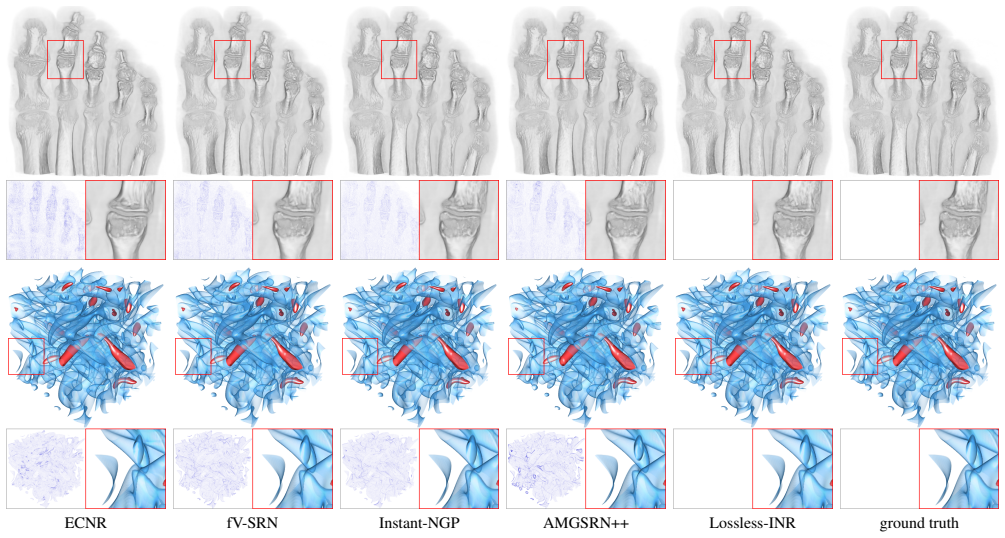
- Visualizations from Lossless-INR are pixel-identical to ground truth in CIELUV difference images, so rendering errors from representation are eliminated entirely.
- The rate-distortion analysis positions the lossless model size as the practical upper bound for lossy parameter budgets; beyond it, adding parameters to a lossy model is less useful than switching to the lossless formulation.
- The octree partitioning is necessary: ablations without it show high BER even with floating-point grids, confirming that adaptive subdivision is what makes zero error reachable.
Reading between the lines
- If the per-bit classification insight generalizes, it should apply to other exactness-critical signals—time-varying volumes, multivariate fields, or even geometry—by treating each channel or timestep as an additional bit-plane dimension; this is not tested in the paper.
- The octree's reliance on a fixed-capacity network at 16^3 blocks implies a testable capacity law: the minimum achievable leaf size likely grows with the entropy of the local signal, and there may be high-entropy blocks (e.g., pure noise) that cannot be fit losslessly; the paper gives no fallback for that case.
- The ternary grids plus per-tensor scale mean the stored weights are effectively small integers; entropy-coding those digits would likely shrink the model below its reported size, a step the paper mentions but does not take.
- Because the paper reports training time growing with block count, a natural extension is to parallelize block fitting or share the MLP decoder across blocks; the paper lists these as future work but does not evaluate them.
Editorial analysis
A structured set of objections, weighed in public.
Referee Report
Summary. The paper proposes Lossless-INR, an implicit neural representation for 3D volumetric data that aims for bit-exact reconstruction. The method decomposes each voxel value into binary bit-planes, reformulating fitting as per-bit binary classification. To make this tractable, it augments the network with an octree block-partitioning strategy that subdivides regions until each block can be fit with zero bit error, and a ternary feature-grid network whose grid entries are restricted to {-1,0,+1}. The authors report zero bit-error rate and infinite PSNR on five datasets (engine, foot, MRI-woman, tooth, vortex) at model sizes comparable to or larger than lossy baselines, and claim this is the first lossless INR for volumetric data. The paper also includes ablations showing that the ternary grid and octree partitioning are both necessary for lossless reconstruction in their framework.
Significance. If the method reliably achieves bit-exact reconstruction, it would be a notable advance for INR-based volume visualization, where even small errors can propagate through rendering and analysis. The paper's strengths include a concrete algorithmic recipe, reproducible training details, and a public code repository. The empirical demonstration of BER=0 on five datasets spanning uint8, uint16, and float32 is a meaningful result. However, the central 'lossless' claim is not yet established as a general property: the octree recursion has a hard floor at 16^3 with no fallback, the float32 bit-plane handling is unspecified, and the reported BER is a direct consequence of the early-stopping acceptance criterion rather than an independent prediction. These gaps need to be addressed before the lossless guarantee can be taken at face value.
major comments (3)
- [Sec. 3.2] The octree subdivision procedure assumes that every block, down to the minimum 16^3 size, can always be fit with zero bit error by the fixed-capacity ternary feature-grid network. The paper provides no capacity bound, no convergence guarantee, and no fallback if a minimum-size block fails (e.g., by storing raw bits for that block). The overall 'lossless' claim depends on this termination assumption. The empirical BER=0 on five datasets is encouraging, but it does not establish that the recursion always terminates; a high-entropy 16^3 block could exceed the network's memorization capacity. The authors should either prove a capacity bound, add a fallback mechanism, or at minimum report statistics on how many blocks reached each octree depth and whether any minimum-size blocks required retries or failed.
- [Sec. 3.1 / Table 1] Equation (2) defines reconstruction as V = (1/(2^B-1)) * sum 2^i Q(f_theta), which is the inverse of an unsigned integer bit-plane decomposition. The vortex dataset is float32. The paper does not specify how float32 values are decomposed into bit-planes or how the integer-weighted recomposition in Eq. (2) reconstructs a float. If the authors bit-cast float32 to uint32 before decomposition, Eq. (2) would produce a uint32 value, not the original float, unless an explicit cast is also applied; if they use IEEE-754 sign/exponent/mantissa planes, Eq. (2) is not the correct inverse. A precise description of the bit ordering and inverse mapping for float32 is required for the reported BER=0 on vortex to be interpretable.
- [Sec. 4.1 / Table 2] The zero BER values are by construction: a block is accepted as an octree leaf only when all bits are predicted correctly. Thus the headline 'BER=0' is the training criterion, not an independent quality metric. To substantiate the claim that the method 'can achieve' lossless representation generally, the paper should report block-level outcomes: the number of initial blocks, how many were accepted at each octree depth, how many minimum-size blocks failed (if any), and how the acceptance criterion interacts with the fixed 2,000-iteration budget. Without these data, the reader cannot distinguish a generally convergent algorithm from one that happened to work on the five chosen volumes.
minor comments (3)
- [Sec. 5 / App. B] The abstract and introduction describe the representation as 'compact,' but the reported model sizes are larger than the raw volumes (e.g., tooth: 12.5 MB vs ~1.6 MB raw; foot: 66.8 MB vs ~16.8 MB). The paper acknowledges this in Section 5 and Appendix B, but the framing should be adjusted in the abstract/introduction to avoid overstating storage efficiency.
- [Sec. 4.1] There is a repeated sentence: 'We assessed reconstruction quality using three complementary metrics' (or similar) appears twice in the same paragraph. The duplicate should be removed.
- [Appendix A] The table in Appendix A is labeled 'Table 1', duplicating the table number in the main text. It should be renumbered (e.g., Table A1) to avoid confusion.
Circularity Check
No significant circularity: zero BER mirrors the Sec. 3.2 acceptance rule, but the central claim is empirical convergence, not a fitted parameter relabeled as a prediction.
full rationale
Lossless-INR's derivation chain is empirical rather than definitional. Bit-plane decomposition (Eqs. 1-2) converts regression into per-bit classification; octree partitioning (Sec. 3.2) recursively subdivides blocks until each leaf satisfies zero bit error; the ternary grid (Sec. 3.3) reduces storage. None of these steps fits a parameter and then presents a dependent quantity as an independent prediction. The reported BER=0 does follow from the Sec. 3.2 acceptance criterion, so it is a verification that the stopping condition was reached on the training volumes rather than a held-out or predictive result; this weakens the evidentiary force of the tables but is not circular because the paper's core claim is that the fixed-capacity per-block network can be trained to zero error on the selected datasets, which is an empirical convergence outcome. The self-citations (ECNR, Meta-INR, etc.) appear in related work and baseline comparisons and are not load-bearing for the lossless mechanism; the bit-plane decomposition idea is attributed to external prior work [8], and the ternary parameterization cites external works [14,17]. The unproven assumption that every minimum-size 16^3 block can be fit losslessly is a correctness/robustness gap, not a circular step. Overall, the derivation is self-contained and no specific circular reduction can be exhibited.
Assumptions & free parameters
free parameters (6)
- Minimum leaf block size =
16^3
- Initial block size =
64^3
- Hash grid structure =
4 levels, 2^17 entries, 2-dim features, one 4D + four 3D grids
- MLP decoder size =
3 layers, 64 hidden units, full precision
- Optimization hyperparameters =
Adam, 2000 iters, batch 32000, LR 1e-2 to 1e-5 cosine
- Per-tensor ternary scale gamma =
mean |W| per grid
assumptions (5)
- standard math If every bit is classified correctly, Eq. 2 reconstructs the original value exactly.
- ad hoc to paper The ternary feature grid + MLP has sufficient capacity to fit any 16^3 block with zero bit error.
- ad hoc to paper The octree subdivision terminates with all leaves losslessly fit.
- domain assumption Float32 volumes are bit-decomposable and recomposable via Eq. 2.
- domain assumption Ternary rounding with Eq. 3 preserves the network's ability to reach zero training error.
Cite this review
Pith. "Pith review of Lossless-INR: Lossless Volumetric Implicit Neural Representations." pith.science (2026). https://pith.science/paper/37JRGQHC
@misc{pith2026260718150,
  author       = {Pith},
  title        = {Pith review of: Lossless-INR: Lossless Volumetric Implicit Neural Representations},
  year         = {2026},
  howpublished = {\url{https://pith.science/paper/37JRGQHC}},
  note         = {Machine review of arXiv:2607.18150}
}
read the original abstract
Implicit neural representation (INR) methods provide continuous coordinate-to-value mappings and integrate naturally with direct volume rendering, making them attractive for representing volumetric data. However, existing INR-based approaches for volumetric data are inherently lossy, and even small reconstruction errors can propagate through rendering and downstream analysis. In this work, we explore Lossless-INR, a lossless INR framework for 3D scientific volumetric data based on bit-plane decomposition. By decomposing each voxel value into binary bit-planes, we reformulate reconstruction as per-bit binary classification, so that exact recovery reduces to predicting every bit correctly. To make this optimization tractable while keeping the representation compact, we combine an octree block-partitioning strategy that adaptively subdivides complex regions with a ternary feature-grid network whose grid entries are parameterized by a ternary set of values. Experiments on diverse volumetric datasets show that this design can achieve zero bit-error rate and bit-exact reconstruction, enabling faithful rendering and downstream analysis with a compact representation. The code is available at https://github.com/TouKaienn/Lossless-INR.
Figures


Figures from the paper (3 more)


Reference graph
Works this paper leans on
-
[1]
K. Ai, K. Tang, and C. Wang. NLI4V olVis: Natural language interac- tion for volume visualization via LLM multi-agents and editable 3D gaussian splatting.IEEE Trans. Vis. Comput. Graph., 32(1):46–56,
-
[2]
Y .-T. Chen, H. Li, N. Shi, X. Luo, W. Xu, and H.-W. Shen. Ex- plorable INR: An implicit neural representation for ensemble simula- tion enabling efficient spatial and parameter exploration.IEEE Trans. Vis. Comput. Graph., 31(6):3758–3770, 2025. doi: 10.1109/TVCG.2025. 35670521
- [3]
-
[4]
J. Han, K. Tang, and C. Wang. MoE-INR: Implicit neural representation with mixture-of-experts for time-varying volumetric data compression. IEEE Trans. Vis. Comput. Graph., 32(1):254–264, 2026. doi: 10.1109/ TVCG.2025.36338931
arXiv 2026
- [5]
-
[6]
J. Han, H. Zheng, and C. Bi. KD-INR: Time-varying volumetric data compression via knowledge distillation-based implicit neural represen- tation.IEEE Trans. Vis. Comput. Graph., 30(10):6826–6838, 2024. doi:10.1109/TVCG.2023.33453731, 2
arXiv 2024
-
[7]
S. Han, H. Mao, and W. J. Dally. Deep compression: Compressing deep neural network with pruning, trained quantization and Huffman coding. InProc. ICLR, 2016. doi:10.48550/arXiv.1510.001494
-
[8]
W. K. Han, B. Lee, H. Cho, S. Im, and K. H. Jin. Towards lossless implicit neural representation via bit plane decomposition. InProc. IEEE/CVF CVPR, pp. 2269–2278, 2025. doi: 10.1109/CVPR52734.2025. 002171, 2
arXiv 2025
Show all 37 references
-
[9]
W. K. Han, B. Lee, S. H. Park, and K. H. Jin. ABCD: Arbitrary bitwise coefficient for de-quantization. InProc. IEEE/CVF CVPR, pp. 5876–5885, 2023. doi:10.1109/CVPR52729.2023.005691, 2
2023
-
[10]
Jacob, S
B. Jacob, S. Kligys, B. Chen, M. Zhu, M. Tang, A. G. Howard et al. Quantization and training of neural networks for efficient integer- arithmetic-only inference. InProc. IEEE/CVF CVPR, pp. 2704–2713,
-
[11]
S. Jeon, K. Tang, C. Wang, and W.-K. Jeong. Super-Gaussian: Inter- active scene editing for 3D Gaussian splatting and NLI-based volume visualization in virtual reality.IEEE Trans. Vis. Comput. Graph., 33(1),
-
[12]
Klacansky
P. Klacansky. Open SciVis datasets. https://klacansky.com/ open-scivis-datasets/, 2017. 3
2017
-
[13]
Y . Lu, K. Jiang, J. A. Levine, and M. Berger. Compressive neural representations of volumetric scalar fields.Comput. Graph. Forum, 40(3):135–146, 2021. doi:10.1111/cgf.142951, 2
2021 doi
- [14]
-
[15]
Müller, A
T. Müller, A. Evans, C. Schied, and A. Keller. Instant neural graphics primitives with a multiresolution hash encoding.ACM Trans. Graph., 41(4):102:1–102:15, 2022. doi:10.1145/3528223.35301271, 2, 3, 4
2022
-
[16]
Punnappurath and M
A. Punnappurath and M. S. Brown. A little bit more: Bitplane-wise bit- depth recovery.IEEE Trans. Pattern Anal. Mach. Intell., 44(12):9718– 9724, 2022. doi:10.1109/TPAMI.2021.31256921, 2
2022
-
[17]
Shin and J
S. Shin and J. Park. Binary radiance fields. InProc. NeurIPS, pp. 55919–55931, 2023. 3
2023
-
[18]
H. Son, J. Noh, S. Jeon, C. Wang, and W.-K. Jeong. MC-INR: Efficient encoding of multivariate scientific simulation data using meta-learning and clustered implicit neural representations. InProc. IEEE VIS (Short Papers), pp. 206–210, 2025. doi:10.1109/VIS60296.2025.000472
2025
-
[19]
K. Tang, K. Ai, J. Han, and C. Wang. TexGS-V olVis: Expressive scene editing for volume visualization via textured gaussian splatting.IEEE Trans. Vis. Comput. Graph., 32(1):933–943, 2026. doi: 10.1109/TVCG. 2025.36346432
2026
-
[20]
Tang and C
K. Tang and C. Wang. ECNR: Efficient compressive neural representa- tion of time-varying volumetric datasets. InProc. IEEE PacificVis, pp. 72–81, 2024. doi:10.1109/PACIFICVIS60374.2024.000171, 2, 3
2024
-
[21]
Tang and C
K. Tang and C. Wang. STSR-INR: Spatiotemporal super-resolution for multivariate time-varying volumetric data via implicit neural represen- tation.Comput. Graph., 119:103874, 2024. doi: 10.1016/j.cag.2024.01. 0011, 2
2024 doi
-
[22]
Tang and C
K. Tang and C. Wang. StyleRF-V olVis: Style transfer of neural radiance fields for expressive volume visualization.IEEE Trans. Vis. Comput. Graph., 31(1):613–623, 2025. doi:10.1109/TVCG.2024.34563421
2025
-
[23]
Tang and C
K. Tang and C. Wang. ECoNGS: Efficient compressive neural Gaussian splats for volume visualization.IEEE Trans. Vis. Comput. Graph., 33(1), 2027. Accepted. 2
2027
-
[24]
K. Tang, S. Yao, and C. Wang. iVR-GS: Inverse volume rendering for explorable visualization via editable 3D gaussian splatting.IEEE Trans. Vis. Comput. Graph., 31(6):3783–3795, 2025. doi: 10.1109/TVCG .2025.35671212
2025
-
[25]
Wang and J
C. Wang and J. Han. DL4SciVis: A state-of-the-art survey on deep learning for scientific visualization.IEEE Trans. Vis. Comput. Graph., 29(8):3714–3733, 2023. doi:10.1109/TVCG.2022.31678962
2023
-
[26]
Weiss, P
S. Weiss, P. Hermüller, and R. Westermann. Fast neural representations for direct volume rendering.Comput. Graph. Forum, 41(6):196–211,
-
[27]
Q. Wu, D. Bauer, M. J. Doyle, and K.-L. Ma. Interactive volume visual- ization via multi-resolution hash encoding based neural representation. IEEE Trans. Vis. Comput. Graph., 30(8):5404–5418, 2024. doi: 10. 1109/TVCG.2023.32931211, 2
2024
-
[28]
S. W. Wurster and H.-W. Shen. AMGSRN++: Improved adaptive SRN for scientific visualization. InProc. IEEE PacificVis, pp. 182–191,
-
[29]
S. W. Wurster, T. Xiong, H.-W. Shen, H. Guo, and T. Peterka. Adap- tively placed multi-grid scene representation networks for large-scale data visualization.IEEE Trans. Vis. Comput. Graph., 30(1):965–974,
-
[30]
M. Yang, K. Tang, and C. Wang. Meta-INR: Efficient encoding of volumetric data via meta-learning implicit neural representation. In Proc. IEEE PacificVis, pp. 246–251, 2025. doi:10.1109/PACIFICVIS64226 .2025.000301, 2, 4
2025
-
[31]
S. Yao, Y . Lu, and C. Wang. ViSNeRF: Efficient multidimensional neu- ral radiance field representation for visualization synthesis of dynamic volumetric scenes. InProc. IEEE PacificVis, pp. 235–245, 2025. doi: 10.1109/PacificVis64226.2025.000291
2025
-
[32]
Yao and C
S. Yao and C. Wang. ReV olVE: Neural reconstruction of volumes for visualization enhancement of direct volume rendering.Comput. Graph., 131:104295, 2025. doi:10.1016/j.cag.2025.1042951
2025
-
[33]
Yao and C
S. Yao and C. Wang. V olSegGS: Segmentation and tracking in dynamic volumetric scenes via deformable 3D Gaussians.IEEE Trans. Vis. Comput. Graph., 32(1):407–417, 2026. doi: 10.1109/TVCG.2025.3642516 2
2026
-
[34]
Zhang, P
R. Zhang, P. Isola, A. A. Efros, E. Shechtman, and O. Wang. The unreasonable effectiveness of deep features as a perceptual metric. In Proc. IEEE/CVF CVPR, pp. 586–595, 2018. doi: 10.1109/CVPR.2018. 000683 A COMPARING ONADDITIONALDATASETS Due to page limit, we do not include a...
2018 doi
-
[2018]
doi:10.1109/CVPR.2018.002864
2018
-
[2022]
doi:10.1111/cgf.145781, 2, 3
-
[2024]
doi:10.1109/TVCG.2023.33271941, 2
2023
Reviewed August 1, 2026 · model on record in the stance chip above.
Discussion (0). Continue with ORCID to comment.