REVIEW 4 major objections 5 minor 29 references
LOCC distinguishable orthogonal product states with least entanglement resource
T0 review · 4 major / 5 minor · reviewed 2026-08-14 · deepseek-v4-flash
Pith's one-line read The paper constructs four families of orthogonal product states that are indistinguishable by LOCC without entanglement, and proves that sharing one C^2⊗C^2 maximally entangled state (one ebit) makes every family perfectly distinguishable…
desk verdict A genuinely new set of LOCC-indistinguishable product-state families with one-ebit LOCC protocols, but the C^n⊗C^5 construction is ill-defined as printed and needs a major fix. read the letter →
The pith
A machine-rendered reading of the paper's core claim, the machinery that carries it, and where it could break.
The reading
What carries the argument
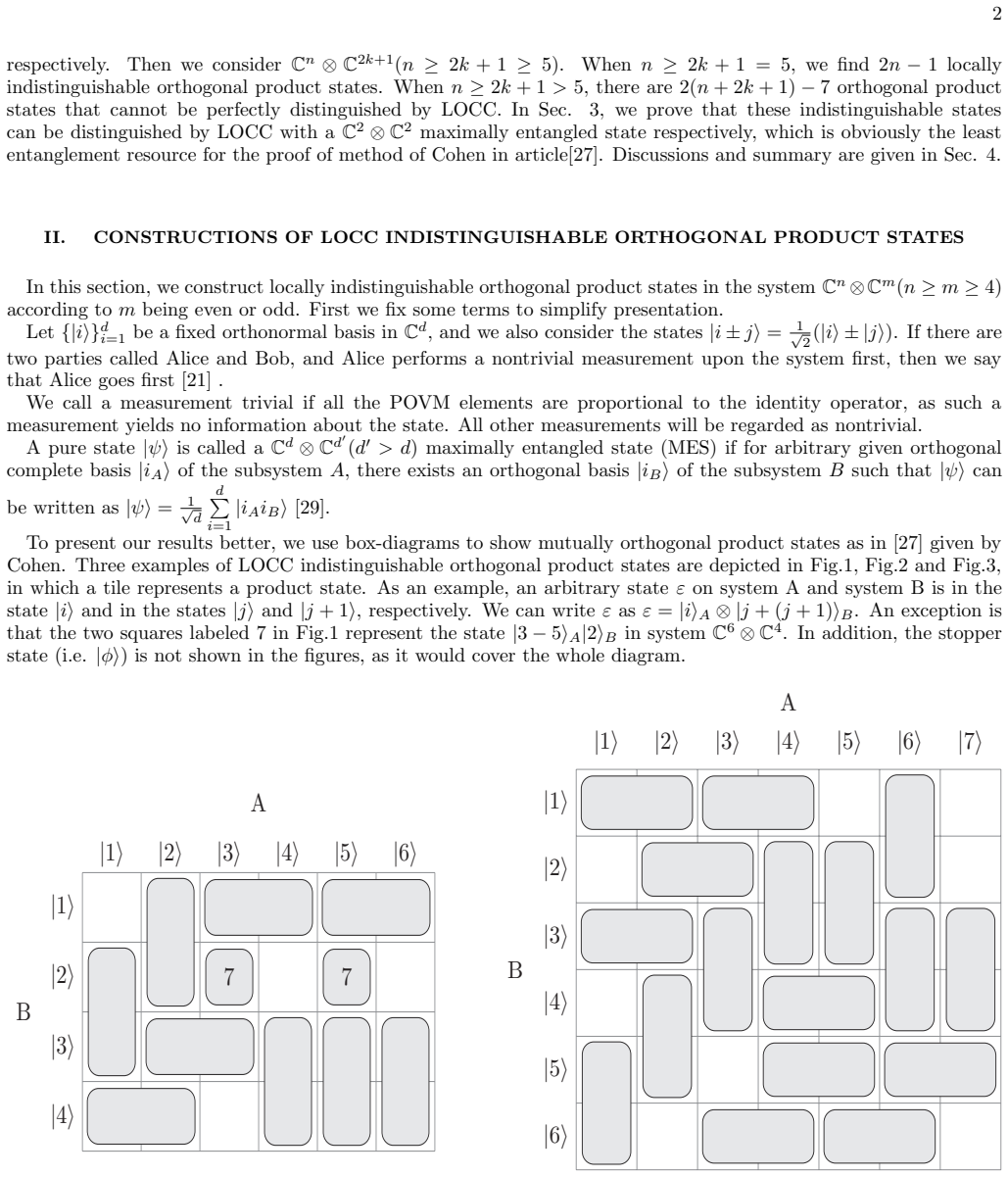
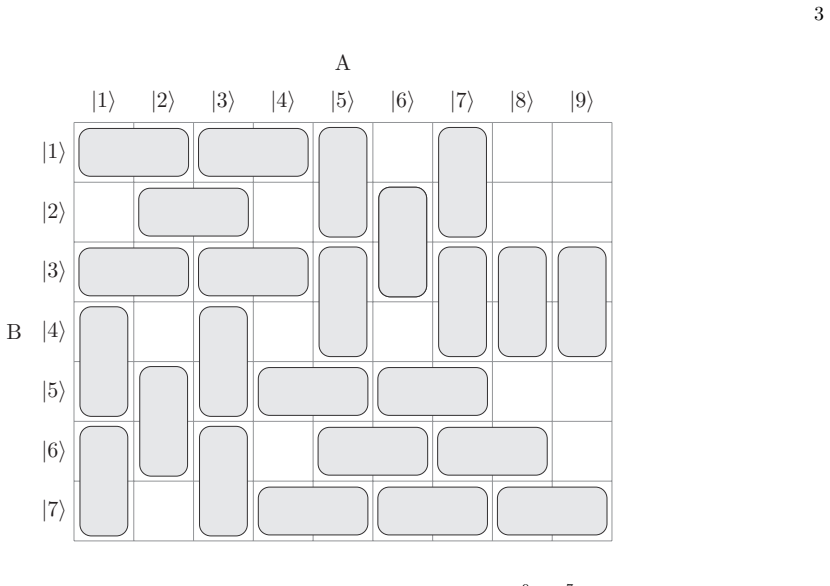
The constructions are tiling-like lists of product states built around a "stopper" state |φ⟩ = (|1⟩−|2⟩+⋯+(−1)^{n−1}|n⟩)_A ⊗ (|1⟩−|2⟩+⋯+(−1)^{m−1}|m⟩)_B, together with tile states of the form |i+(i+1)⟩_A ⊗ |j⟩_B and |i⟩_A ⊗ |j+(j+1)⟩_B. The load-bearing mechanism is the non-disturbing measurement lemma: to prove LOCC indistinguishability, the paper shows that any measurement operator preserving the orthogonality of the whole set must be a scalar matrix, forcing the measurement to be trivial. The distinguishing protocol uses Cohen's ancilla method: Alice and Bob share the two-qubit maximally entangled state (|00⟩+|11⟩)/√2, Alice performs a controlled two-outcome measurement that correlates the ancilla with the first-party state, and then a sequence of local projections separates the remaining states in each branch.
What would settle it
Compute all inner products among the states in Eq. (1) for n=6 in $C^{6}$⊗$C^{4}$: if any two states are not orthogonal or the number of distinct states is not 11, the central claim collapses. Also run the explicit protocol of Theorem 4 on this instance and check that at every branch the surviving states remain pairwise orthogonal; a branch with overlapping states would refute one-ebit sufficiency.
Extended reading notes
Core claim
The central claim is that the orthogonal product states listed in Eq. (1) (for C^n⊗$C^{4}$, n>4), Eq. (4) (for C^n⊗$C^{{2l}}$, n≥2l>4), and Eq. (9) (for C^n⊗$C^{{2k+1}}$, n≥2k+1≥5) are LOCC-indistinguishable without assistance, yet can be perfectly distinguished by LOCC when Alice and Bob share a suitable $C^{2}$⊗$C^{2}$ maximally entangled state. The indistinguishability proofs follow the Walgate–Hardy criterion: any first-party measurement that preserves mutual orthogonality of the listed states must have its POVM operator proportional to the identity, so neither Alice nor Bob can extract information by going first. The distinguishability protocols append the entangled ancilla and let Alice or Bob perform a controlled two-outcome measurement that splits the set into branches, after which the states in each branch are separated by further local projective measurements. The paper therefore establishes that one ebit of entanglement is an upper bound on the resource needed to distinguish each of these families.
Load-bearing premise
Everything rests on the listed states in Eqs. (1), (4), and (9) being pairwise orthogonal with exactly the stated cardinalities; the paper itself flags an un-integrated indexing correction in Eq. (1), so a reader must verify the lists before relying on the theorems.
Editorial extensions
If this is right
- Each of the four constructed families is LOCC-indistinguishable without assistance, so each is a new example of nonlocality without entanglement in dimensions C^n⊗C^m with m≥4.
- For each family, a single C^2⊗C^2 maximally entangled state is sufficient for perfect LOCC discrimination, so one ebit is an upper bound on the entanglement resource needed.
- The same protocol style works across even and odd Bob-side dimensions, indicating a uniform route from local indistinguishability to one-ebit-assisted distinguishability.
- Since the indistinguishable sets consist entirely of product states, the result shows that entanglement is required only as a discrimination resource, not as a property of the states themselves.
Reading between the lines
- The paper proves sufficiency, not necessity: the title's "least" is relative to Cohen's method, and nothing here shows that a Bell pair is required for these sets; a matching lower bound remains open.
- The alternating-sign stopper state appears to be the engine of indistinguishability, which suggests that other stopper-based tilings in higher dimensions should also be unlocked by one ebit.
- The indexing slip in Eq. (1) means a numerical implementation should regenerate the list from the corrected |ϕ7⟩=|3+4⟩_A|2⟩_B before testing the protocol.
- A natural testable extension is to ask whether the state counts 2n−1, 2(n+2l)−8, and 2(n+2k+1)−7 are minimal among product-state sets in these dimensions that require one ebit.
Signed reviews
Editorial analysis
A structured set of objections, weighed in public.
Referee Report
Summary. The paper constructs explicit families of orthogonal product states in bipartite systems C^n⊗C^4, C^n⊗C^5, C^n⊗C^{2l}, and C^n⊗C^{2k+1}, proves their LOCC indistinguishability without shared entanglement, and then presents LOCC protocols that perfectly distinguish each family when Alice and Bob share a C^2⊗C^2 maximally entangled state. The indistinguishability proofs follow the Walgate-Hardy criterion: any POVM element that preserves orthogonality of the set must be proportional to the identity. The distinguishing protocols use an auxiliary maximally entangled pair and sequential projective measurements. Theorems 1 and 4 treat the C^n⊗C^4 case in detail; Theorems 2, 3, 5, and 6 generalize to even and odd Bob dimensions.
Significance. If the constructions and protocols are correct, the paper would supply new explicit examples of 'nonlocality without entanglement' that can be resolved with a single ebit of entanglement, adding to the literature on entanglement as a resource for LOCC discrimination. The paper's main strengths are its constructive approach and its explicit one-ebit protocols. The C^n⊗C^4 case is worked out in sufficient detail to be checked line by line, and the use of the Walgate-Hardy criterion is standard and sound. However, the advertised C^n⊗C^5 family and the odd-dimension generalization currently suffer from undefined states and omitted proof cases, so the full claimed result is not yet established.
major comments (4)
- [II, Eq. (9)] For k=2, i.e. Bob dimension m=5, the states in Eq. (9) are not defined on the stated Hilbert space: |φ1> = |(k−2)+(k−1)>_A|k>_B = |0+1>_A|2>_B and |φ4> = |(k+2)>_A|(k−2)+(k−1)>_B = |4>_A|0+1>_B use a basis vector |0>, which does not exist in the {|i>}_{i=1}^d convention used throughout the paper; moreover |φ3> = |k>_A|(k+3)+(k+4)>_B = |2>_A|5+6>_B uses |6> in a five-dimensional Bob space, and |φ2> = |5+6>_A|4>_B uses |6> on Alice when n=5. Since Theorem 3 explicitly promises d=2(n−m)+9 locally indistinguishable states in C^n⊗C^5 for n≥5, this is not a cosmetic typo: the promised family is never exhibited, and the entanglement-assisted protocol in Theorem 6 cannot be applied to it. The construction for k=2 must be repaired before the main claim can be assessed.
- [II, note after Theorem 1] The author-added note that |ϕ_{n+1}> = |3−5>_A|2>_B in (1) 'should be' |ϕ_7> = |3+4>_A|2>_B is not integrated into the theorem. If the replacement is made literally, the Alice-first proof's deduction a33=a55 from ⟨φ|M_A^† M_A ⊗ I|ϕ_{n+1}>=0 no longer follows with the same vector, and the Bob-first proof's use of |ϕ_{n+1}> to obtain b12=b21=0 is likewise affected. As printed, the theorem contains an unresolved self-identified indexing inconsistency, and the proof does not correspond to a single unambiguous state list.
- [II, Theorems 2 and 3] The proofs of the even- and odd-dimension generalizations are only sketches. In Theorem 3, the Bob-first case is dismissed by 'the obvious symmetry when m=n' without showing that the set in (9) is invariant under exchanging Alice and Bob; for n>m the symmetry argument is not available at all. In Theorem 2, the Bob-first case is summarized as 'seen similarly' with only a sample computation. Since the Walgate-Hardy criterion requires ruling out a nontrivial first measurement by either party, the local-indistinguishability claim is incomplete without a full argument for the first-measuring party in each case.
- [II, state lists (1), (4), (9)] The paper asserts pairwise orthogonality and the stated cardinalities of the sets in (1), (4), and (9) but does not verify them. The indistinguishability proofs assume the Gram matrix of the original set is diagonal; if any two listed states overlapped, the displayed equations setting inner products to zero would not be valid. A concise orthogonality check, for example by listing disjoint-support arguments or a verification table, should be included for each family.
minor comments (5)
- [Title and Abstract] The title and abstract claim 'least entanglement resource,' but the paper proves only sufficiency of a C^2⊗C^2 maximally entangled state, not optimality. I suggest rephrasing to 'one-ebit resource' or 'minimal resource among the protocols considered' unless a lower bound is proved.
- [II, Eq. (2)] Several inner products in Eq. (2) suppress nonzero Bob-part overlaps, for example ⟨2+3|1+2⟩=1/2 and ⟨2+3|3⟩=1/√2. The conclusions aij=0 are still valid because these factors are nonzero, but the presentation should note this normalization explicitly.
- [II, Eq. (4) and Theorem 2 proof] The expression ⟨ψ_{l−l}| appears twice in the block after Eq. (6) and should be ⟨ψ_{l−1}|. Also, the indexing of the |ψ_{i+l}> states is inconsistent with the later use in Eq. (11), where the range begins at i=0; the notation should be harmonized so that every referenced state label is defined.
- [III, Theorem 6 proof, Eq. (14)] The notation |φ'_{1,4}> and |φ'_{2,3}> is undefined; it should be spelled out as separate states |φ'_1>, |φ'_4> and |φ'_2>, |φ'_3>, respectively, to match the definitions in (9).
- [III, Theorem 4 proof] There is a typographical error in the sentence introducing the projectors A3i: 'A3i = 2⟩a⟨2|⊗| 2 +i⟩A⟨2 +i|' is missing the initial vertical bar and should read 'A3i = |2⟩a⟨2|⊗| 2 +i⟩A⟨2 +i|'.
Circularity Check
No significant circularity found: the constructions and LOCC protocols are explicit, with conclusions not assumed as inputs.
full rationale
The paper does not contain fitted parameters, inverse definitions, or a load-bearing self-citation chain. Its central claims are explicit mathematical constructions: the state lists in Eqs. (1), (4), and (9) are displayed, and the LOCC-indistinguishability proofs proceed by direct matrix-element computations (e.g., Eqs. (2), (3), (5), (6), and the bullet list in Theorem 3) using the standard Walgate-Hardy criterion, not by assuming the target result. The distinguishability protocols in Theorems 4-6 give explicit Alice/Bob projectors after adding a C^2⊗C^2 maximally entangled state; the entangled state is an input resource, not a renamed version of the claimed conclusion. Cited works such as Cohen [27] and Zhang et al. [28] provide methods, but the present proofs do not reduce to those citations alone. The phrase 'least entanglement resource' is an unsupported optimality overclaim rather than a circular derivation. There are genuine correctness and completeness concerns: Eq. (9) appears ill-defined for k=2 (e.g., basis labels |5+6> outside C^5), and Theorem 3's Bob-first case is only justified by 'obvious symmetry when m=n' rather than shown; however, these are errors or gaps in proof, not instances of circularity. No step in the paper equates a prediction with an input by construction, and no fitted value is relabeled as a prediction. Accordingly, the appropriate circularity score is 0.
Assumptions & free parameters
assumptions (3)
- standard math Walgate-Hardy characterization: a set of orthogonal pure states is LOCC-indistinguishable if every possible first nontrivial measurement must be trivial because all non-disturbing measurement operators satisfy M^†M proportional to the identity.
- domain assumption The state lists in Eqs. (1), (4) and (9) are pairwise orthogonal product states with the claimed cardinalities.
- ad hoc to paper For m=n in Theorem 3, checking Alice-first is sufficient by the 'obvious symmetry' of the construction.
Cite this review
Pith. "Pith review of LOCC distinguishable orthogonal product states with least entanglement resource." pith.science (2026). https://pith.science/paper/37KHUXO5
@misc{pith2026190803434,
  author       = {Pith},
  title        = {Pith review of: LOCC distinguishable orthogonal product states with least entanglement resource},
  year         = {2026},
  howpublished = {\url{https://pith.science/paper/37KHUXO5}},
  note         = {Machine review of arXiv:1908.03434}
}
abstract
In this paper, we construct $2n-1$ locally indistinguishable orthogonal product states in $\mathbb{C}^n\otimes\mathbb{C}^{4}~(n>4)$ and $\mathbb{C}^n\otimes\mathbb{C}^{5}~(n\geq 5)$ respectively. Moreover, a set of locally indistinguishable orthogonal product states with $2(n+2l)-8$ elements in $\mathbb{C}^n\otimes\mathbb{C}^{2l}~(n\geq 2l>4)$ and a class of locally indistinguishable orthogonal product states with $2(n+2k+1)-7$ elements in $\mathbb{C}^n\otimes\mathbb{C}^{2k+1}~(n\geq 2k+1>5)$ are also constructed respectively. These classes of quantum states are then shown to be distinguishable by local operation and classical communication (LOCC) using a suitable $\mathbb{C}^2\otimes\mathbb{C}^2$ maximally entangled state respectively.
Figures
Reference graph
Works this paper leans on
- [1]
-
[2]
Gisin, G
N. Gisin, G. Ribordy, W. Tittel, and H. Zbinden, Rev. Mod. Phys. 74, 145 (2002)
2002
- [3]
- [4]
- [5]
-
[6]
Tian-Yin, W., Su-Juan, Q., Qiao-Yan, W., Fu-Chen, Z, (2008)
work page 2008
- [7]
- [8]
Show all 29 references
-
[9]
Nathanson, Journal of Mathematical Physics
M. Nathanson, Journal of Mathematical Physics. 46, 062103 (2005)
2005
-
[10]
Nathanson, Phys
M. Nathanson, Phys. Rev. A. 88, 062316 (2013)
2013
-
[11]
Ghosh, G
S. Ghosh, G. Kar, A. Roy, A. Sen (De), and U. Sen, Phys. Rev. Lett. 87, 277902 (2001)
2001
-
[12]
Cohen, Phys
S.M. Cohen, Phys. Rev. A. 75, 052313 (2007)
2007
-
[13]
R.Y. Duan, Y. Feng, Z.F. Ji, and M.S. Ying, Phys. Rev. Lett. 98, 230502 (2007)
2007
-
[14]
Bandyopadhyay, and J
S. Bandyopadhyay, and J. Walgate, J. phys. A: Math. Theor. 42, 072002 (2009)
2009
-
[15]
N.K. Yu, R.Y. Duan, and M.S. Ying, Phys. Rev. A. 84, 012304 (2011)
2011
-
[16]
Zhang, F
Z.C. Zhang, F. Gao, S.J. Qin, H.J. Zuo, and M.S. Ying, Quantum Inf. Process. 14, 3961-3969 (2015)
2015
-
[17]
Horodecki, A
M. Horodecki, A. Sen, and U. Sen, Phys. Rev. lett. 90, 047902 (2003)
2003
-
[18]
Feng, and Y
Y. Feng, and Y. Shi, IEEE Transactions on Information Theory. 55, 2799-2806 (2009)
2009
-
[19]
Zhang, Q.Y
Z.C. Zhang, Q.Y. Wen, and F. Gao, Quantum Inf. Process. 13, 795-804 (2014)
2014
-
[20]
Bennett, D.P
C.H. Bennett, D.P. DiVincenzo, C.A. Fuchs, T. Mor, E. Rains, P.W. Shor, J.A. Smolin, and W.K. Wootters, Phys. Rev. A. 59, 1070 (1999)
1999
-
[21]
Walgate, and L
J. Walgate, and L. Hardy, Phys. Rev. Lett. 89, 147901(2002)
2002
-
[22]
Zhang, F
Z.C. Zhang, F. Gao, G.J. Tian, T.Q. Cao, and Q.Y. Wen, Phys. Rev. A. 90, 022313 (2014)
2014
-
[23]
Zhang, F
Z.C. Zhang, F. Gao, S.J. Qin, Y.H. Yang, and Q.Y. Wen, Phys. Rev. A. 92, 012332 (2015)
2015
-
[24]
Wang, M.S
Y.L. Wang, M.S. Li, Z.J. Zheng, and S.M. Fei, Phys. Rev. A. 92, 032313 (2015)
2015
-
[25]
Zhang, F
Z.C. Zhang, F. Gao, Y. Cao, S.J. Qin, and Q.Y. Wen, Phys. Rev. A. 93, 012314 (2016)
2016
-
[26]
G.B. Xu, Y.H. Yang, Q.Y. Wen, S.J. Qin, and F. Gao, arXiv:1512.06485 (2015)
2015 arXiv
-
[27]
Cohen, Phys
S.M. Cohen, Phys. Rev. A. 77, 012304 (2008)
2008
-
[28]
Zhang, F
Z.C. Zhang, F. Gao, T.Q. Cao, S.J. Qin, and Q.Y. Wen, Sci. Rep. 6 (2016)
2016
-
[29]
Z.G. Li, M. Zhao, S.M. Li, H. Wang, and W.M. Liu, Quant. Inf. Comput 12, 1-2 (2012)
2012
Reviewed August 14, 2026 · model on record in the stance chip above.
Discussion (0). Continue with ORCID to comment.