REVIEW 4 major objections 5 minor 13 references
Prevention of Overfitting on Mesh-Structured Data Regressions with a Modified Laplace Operator
T0 review · 4 major / 5 minor · reviewed 2026-08-06 · deepseek-v4-flash
Pith's one-line read A modified Laplace operator, evaluated on a staggered mesh, serves as a surrogate test metric that lets mesh-structured regressions train on all data while reducing overfitting.
desk verdict The staggered-mesh diffusion-loss regularizer is a genuinely new idea, but the paper never shows it prevents overfitting: the reported metric is the very objective being minimized. read the letter →
The pith
A machine-rendered reading of the paper's core claim, the machinery that carries it, and where it could break.
The reading
What carries the argument
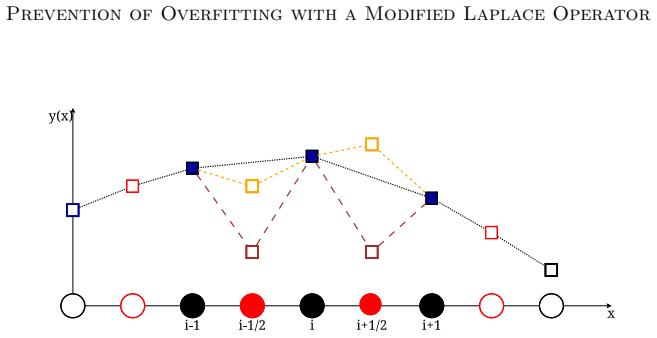
The key object is the modified Laplace operator used as a diffusion sensor. On the original mesh it is the normalized undivided Laplacian (Eq. 6); on the staggered mesh it is a normalized second-difference stencil across the cell-centered staggered nodes (Eq. 7). The staggering gives the sensor sensitivity to oscillations that occur in the interior of a training cell, which the training-point sensor cannot see because the regression exactly interpolates the training data. In multiple dimensions the paper uses a single cell-centered staggered mesh and evaluates the sensor along the center-crossing diagonals (Eqs. 8-10), an approximation that exactly recovers the coordinate Laplace operator in two dimensions.
What would settle it
Train the same Gaussian process on the same mesh twice, once with the diffusion-loss objective and once with log marginal likelihood, then evaluate both on an independent held-out set that was never used in training. If lower diffusion loss does not correspond to lower held-out error across several hyperparameter initializations, the diffusion metric is not a valid surrogate for generalization.
Extended reading notes
Core claim
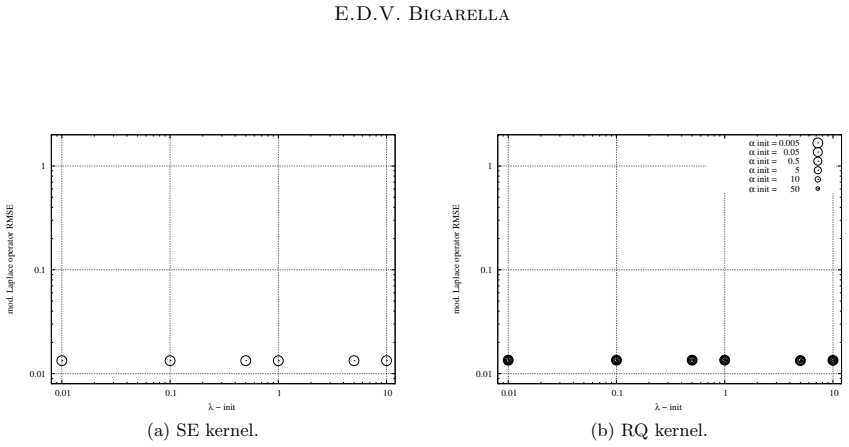
The central claim is that the loss of the Laplace-operator derivatives, computed on a staggered mesh, is a valid surrogate testing metric that allows training on the full dataset without held-out points. The proposed method defines a true label via the undivided Laplacian on the original training nodes (Eq. 6), defines a staggered-mesh sensor that averages the three possible three-point stencils (Eq. 7), and minimizes the combined loss L = RMSE_training + RMSE_diffusion (Eqs. 11-12) using the derivative-free COBYQA optimizer. The paper reports that this approach consistently achieves roughly three-fold lower diffusion losses than the best marginal-likelihood solutions, substantially reduces the dependence of final hyperparameters on initialization, and eliminates the 'ringing' artifacts observed with LML minimization. It also notes a trade-off: the training RMSE floor is 2.9e-4 with the diffusion method versus 1.3e-7 with LML, interpreted as the price paid for reduced overfitting.
Load-bearing premise
The staggered-mesh diffusion sensor's RMSE against the training-data sensor (Eq. 12) is a valid surrogate for generalization, so minimizing it reduces overfitting rather than merely smoothing the fit; the paper never shows an out-of-sample error.
Editorial extensions
If this is right
- If the surrogate claim holds, model training can use all available data points, which is advantageous when data are scarce and every point is valuable.
- Overfitting monitoring becomes a cheap diffusion computation on a staggered mesh, replacing repeated train/test splits and making hyperparameter search less sensitive to initialization.
- The diffusion-loss framework is presented as agnostic to the machine learning technique and extensible to unstructured meshes or graph Laplacians, potentially generalizing beyond Gaussian processes.
- The documented trade-off is a higher training RMSE than LML optimization; the weighting parameters in the combined loss (Eq. 11) would need tuning when exact data reproduction is required.
- The method does not fully resolve the RQ kernel's tendency to find local minima, though the final diffusion losses are close, so additional regularization or multi-start strategies may still be needed.
Reading between the lines
- The paper never reports an out-of-sample error; the reported improvement is on the same diffusion-loss objective that is minimized during training. A direct held-out comparison would be the natural next test of whether lower diffusion loss really implies better generalization.
- The diffusion-loss concept could act as a general-purpose regularizer for other regression models, potentially replacing or complementing weight decay or noise-variance tuning, since it penalizes curvature oscillations rather than magnitude.
- On non-uniform or unstructured data the proposed diagonal stencil would need adaptation; the paper's own suggestion of edge-centered staggering for graphs points toward a spectral-Laplacian version that could be tested on point clouds.
- A pragmatic extension would be to combine the diffusion loss with the log marginal likelihood in a multi-objective optimization, using the diffusion term as a safeguard against the LML's tendency to overfit fast-changing features.
Signed reviews
Editorial analysis
A structured set of objections, weighed in public.
Referee Report
Summary. The paper proposes a new regularization/objective term for Gaussian process regression on mesh-structured data. The idea is to compute a modified Laplace (diffusion) sensor on the original training mesh as a 'true label' and on a staggered mesh built from cell centers as a surrogate 'test' signal, then to include the RMSE between these two sensors in the training loss. Hyperparameters are optimized with the COBYQA derivative-free optimizer on a 3D electric-motor efficiency dataset. The paper reports that this diffusion-loss training reduces oscillation ('wiggling' and 'ringing') compared to log-marginal-likelihood training, lowers the final diffusion-loss value roughly threefold, and reduces sensitivity to initialization. The author argues that this removes the need to split data into training and test sets.
Significance. If the diffusion-loss surrogate were a valid proxy for generalization error, the method would be practically useful for mesh-structured, noiseless GP regression, where data are scarce and every point is valuable. The paper is transparent about limitations, releases code and data, and demonstrates the idea on a nontrivial engineering dataset. At present, however, the quantitative evidence is circular: the reported success metric is the same objective that is minimized during training, and no out-of-sample or ground-truth generalization measurement is provided. The contribution is therefore best viewed as a smoothing/regularization heuristic with an interesting mechanism, not yet as a validated overfitting-prevention method. The scaling inconsistencies between the equations and the released implementation also need to be resolved before the numerical results can be fully trusted.
major comments (4)
- [Section 3.2.3, Eq. (11)-(12), Fig. 11] The central claim that the diffusion-loss method 'prevents overfitting' is not supported by an independent performance metric. Eq. (11) defines the total loss L = beta1 * RMSE_training + beta2 * RMSE_diffusion, and RMSE_diffusion in Eq. (12) compares the Laplace sensor computed on the training data with the sensor computed on model predictions including staggered points. Fig. 11 plots exactly this minimized objective. A threefold reduction of this quantity relative to the LML solution shows only that the optimizer minimized its own target, not that generalization improved. The abstract's statement that testing does not require data splitting is a description of the surrogate, not evidence of its validity: the 'true label' is a transform of the training data itself. The paper needs either (a) an out-of-sample comparison on held-out points or on a second dataset with known ground truth, or (b) a theoretical argument linking the diffusion loss to a generalization bound. Until then, the observed smoothing in Fig. 9 is indistinguishable from a bias induced by the additional loss term, and the paper's own numbers (training RMSE floor 2.9e-4 versus 1.3e-7 for LML) show a clear fit-versus-smoothness trade-off.
- [Section 3.2.1 and Appendix A] There is an unresolved factor-of-three discrepancy between the staggered sensor formula and the released reference implementation. For Delta = 1, Eq. (7) gives a prefactor of 1/(3(Delta/2)^2) = 4/3, while the appendix's staggered branch sets gridspacing = 0.5 and delta = 3 * gridspacing**2 and then returns the sum divided by 3 * delta, yielding a prefactor of 4/9 times the summed diagonal terms. The original-mesh branch has an analogous discrepancy: Eq. (9) uses 1/Delta^2 per diagonal and Eq. (10) sums four diagonals, while the appendix divides the summed terms by delta = 3 for Delta = 1. Since RMSE_diffusion is the quantity being optimized, this normalization inconsistency changes the objective and makes the numerical values in Figs. 8 and 11 unreproducible as stated. The authors should either correct the equations, correct the code, or explicitly state which convention is used throughout.
- [Section 3.2.2, Eqs. (8)-(10)] The treatment of the multidimensional diagonal sensor needs clarification. The text states that for a uniform two-dimensional mesh the diagonal Laplace operator exactly recovers the same operator computed along coordinate directions. This is only true when the diagonal finite-difference stencil is normalized by the squared diagonal spacing (for example, 2*Delta^2 in 2D), which is not what Eqs. (8)-(10) show: they write 1/(3(Delta/2)^2) for the staggered sensor and 1/Delta^2 for the true label, then sum over the diagonals. With the written normalization, the resulting expression contains mixed second-derivative terms and a dimension-dependent overall factor. Because these sensors are called Laplace operators and serve as the 'true label' for entropy, the intended continuous operator should be stated precisely and the prefactors should be derived accordingly.
- [Section 3.2.3 and Section 5] The diffusion loss in Eq. (12) is computed only at interior mesh nodes, with n* = prod_i (n_i - 2), so it is blind to oscillations that occur within one mesh cell of the boundary. The paper acknowledges this in Section 5 as an open question, but the application domain has fast changes near the limits of the operating envelope (Section 4, Fig. 5), so boundary behavior is exactly where overfitting may matter most. A boundary-blind surrogate cannot support the general claim that testing does not require point splitting; the paper should quantify the fraction of excluded points and examine a case where boundary overfitting is present, or explicitly limit the claim to interior oscillations.
minor comments (5)
- [Figure 13] The label 'Log mod. Diff sion Operator' contains a typo; it should read 'Log mod. Diffusion Operator'.
- [Section 4.3] The statement that the noise-variance analogy was 'confirmed in experiments over this data (not shown)' is unverifiable; either include the experiment or remove the assertion.
- [Section 4] The variance is fixed to sigma = 0.15 after 'preliminary determination', but the procedure and its sensitivity are not reported; since sigma is a hyperparameter of the model, this choice should be documented or its influence on the conclusions shown.
- [Eq. (10)] The notation '4 sum_{p=1}' is nonstandard and should be written as sum_{p=1}^{4}.
- [Abstract and Section 1.1] The term 'entropy-in-features' is used throughout but never formally defined; the connection between the Laplace sensor and an entropy measure is asserted rather than derived.
Circularity Check
The quantitative evidence for overfitting prevention is the very diffusion-loss objective minimized during training, so the central success metric reduces by construction.
-
fitted input called prediction
[Section 3.2.3 (Eqs. 11-12) and Section 4.3 (Fig. 11)]
"L = β1 RMSEtraining + β2 RMSEdiffusion ... RMSEdiffusion = sqrt(1/n* Σ (∇ye − ∇̃ye)^2). The losses are minimized employing the COBYQA algorithm ... The proposed diffusion-loss method substantially decreases the dependency with initial parameters. Consistent 3-fold lower diffusion losses compared to those obtained with the most-preferred LML lengthscales are observed."
The metric used as evidence of success (final RMSEdiffusion, Fig. 11) is identical to the objective being minimized in Eqs. 11-12. Since hyperparameters are chosen by minimizing RMSEdiffusion, reporting that diffusion-loss training achieves lower RMSEdiffusion than LML-trained hyperparameters is reporting the optimized value of the fitted objective, not an independent measurement of generalization. The claim that this surrogate detects overfitting is the paper's assumption, not a result; no held-out error or out-of-sample quantity is reported. The observed smoothing is therefore the objective's own value, making the quantitative claim circular by construction.
full rationale
The paper's central quantitative claim — that the proposed method 'successfully reduce[s] the overfitting' — is supported by Fig. 11, which plots RMSEdiffusion after optimization. But RMSEdiffusion is exactly the term minimized in L = β1 RMSEtraining + β2 RMSEdiffusion (Eq. 11). Thus the 3-fold lower diffusion losses relative to LML are the optimizer achieving its own objective; they are not evidence that the staggered-mesh diffusion sensor is a valid proxy for generalization. The abstract's premise that 'testing does not require the splitting of points' rests entirely on this unvalidated surrogate equivalence. No out-of-sample test, cross-validation, or theoretical link between the diffusion loss and generalization error is provided. The paper does offer independent content: the method is a concrete deterministic regularizer on a Laplace-style sensor, it visibly reduces wiggling in Fig. 9, and it reduces sensitivity to initialization. But the load-bearing quantitative evidence for 'overfitting prevention' reduces to the fitted objective. Self-citations to the author's CFD background are not load-bearing here, so this is not a self-citation-chain case. The score is 6: partial circularity, because the headline success metric is the minimized objective while the method itself has independent algorithmic content.
Assumptions & free parameters
free parameters (3)
- sigma (kernel variance) =
0.15
- beta1, beta2 (loss weights) =
1, 1
- COBYQA initial search radius =
3
assumptions (4)
- domain assumption The training data are noiseless and must be reproduced exactly
- ad hoc to paper The staggered-mesh modified Laplace sensor is a faithful surrogate for generalization error
- domain assumption Uniform structured mesh and positive normalized outputs are available
- ad hoc to paper The diagonal stencil correctly approximates the Laplace operator with the paper's scaling
invented entities (2)
-
Modified Laplace diffusion sensor on staggered mesh (tilde-nabla)
-
'Entropy-in-features' true label
Cite this review
Pith. "Pith review of Prevention of Overfitting on Mesh-Structured Data Regressions with a Modified Laplace Operator." pith.science (2026). https://pith.science/paper/37MEGXER
@misc{pith2026250706631,
  author       = {Pith},
  title        = {Pith review of: Prevention of Overfitting on Mesh-Structured Data Regressions with a Modified Laplace Operator},
  year         = {2026},
  howpublished = {\url{https://pith.science/paper/37MEGXER}},
  note         = {Machine review of arXiv:2507.06631}
}
read the original abstract
This document reports on a method for detecting and preventing overfitting on data regressions, herein applied to mesh-like data structures. The mesh structure allows for the straightforward computation of the Laplace-operator second-order derivatives in a finite-difference fashion for noiseless data. Derivatives of the training data are computed on the original training mesh to serve as a true label of the entropy of the training data. Derivatives of the trained data are computed on a staggered mesh to identify oscillations in the interior of the original training mesh cells. The loss of the Laplace-operator derivatives is used for hyperparameter optimisation, achieving a reduction of unwanted oscillation through the minimisation of the entropy of the trained model. In this setup, testing does not require the splitting of points from the training data, and training is thus directly performed on all available training points. The Laplace operator applied to the trained data on a staggered mesh serves as a surrogate testing metric based on diffusion properties.
Figures


Figures from the paper (10 more)




Reference graph
Works this paper leans on
-
[5]
G.C. Cawley and N.L.C. Talbot. On over-fitting in model selec tion and subsequent selection bias in performance evaluation. Journal of Machine Learning Research , 11:2079–2107,
-
[6]
Meta-Learning Mean Functions for Gaussian Processes
URL https://arxiv.org/abs/1901.08098. Ian Goodfellow, Yoshua Bengio, and Aaron Courville. Deep Learning. MIT Press,
work page Pith review arXiv 1901
- [7]
-
[1995]
doi: 10.1137/0916069. G.C. Cawley and N.L.C. Talbot. Preventing over-fitting duri ng model selection via bayesian regularisation of the hyper-parameters. Journal of Machine Learning Research , 8:841– 861,
-
[2004]
Enda Dimitri Vieira Bigarella, Joao Luiz F
doi: 10.1590/S1678-58782004000300005. Enda Dimitri Vieira Bigarella, Joao Luiz F. Azevedo, and Leo nardo Costa Scalabrin. Cen- tered and upwind multigrid turbulent flow simulations of lau nch vehicle configurations. Journal of Spacecraft and Rockets , 44(1):52–65,
-
[2005]
URL http://hdl.handle.net/2027.42/76685. H.S. Tang, W.B. Dong, and A. Agrawal. A phenomenon of artifici al odd–even grid os- cillation and its presence in domain decomposition computa tion: Algebraic analysis and numerical illustration. Journal of Computational and Applied Mathematics , 333: 404–427,
work page 2027
-
[2006]
ISBN 9780262182539. Leonardo Scalabrin and Iain D. Boyd. Development of an unstr uctured Navier- Stokes solver for hypersonic nonequilibrium aerothermody namics. In 38th AIAA Thermophysics Conference , number AIAA-2005-5203. AIAA,
work page 2005
-
[2007]
doi: 10.2514/1.23843. Steven L. Brunton, J. Nathan Kutz, Krithika Manohar, Aleksa ndr Y. Aravkin, Kristi Morgansen, Jennifer Klemisch, Nicholas Goebel, Jam es Buttrick, Jeffrey Poskin, Agnes Blom-Schieber, Thomas Hogan, and Darren McDo nald. Data-driven aerospace engineering: Reframing the industry with machin e learning,
Show all 13 references
-
[2010]
URL https://arc.aiaa.org/doi/abs/10.2514/6.2010-5075
doi: 10.2514/6.2010-5075. URL https://arc.aiaa.org/doi/abs/10.2514/6.2010-5075. T. M. Ragonneau and Z. Zhang. COBYQA Version 1.1.2,
2010 doi
-
[2018]
doi: https://doi.org/10.1 016/j.cam.2017.10.017
ISSN 0377-0427. doi: https://doi.org/10.1 016/j.cam.2017.10.017. URL https://www.sciencedirect.com/science/article/pii/S0377042717305186. E Turkel and V N Vatsa. Effect of artificial viscosity on three-d imensional flow solutions. AIAA Journal , 32(1):39–45, Jan
2017
-
[2020]
Richard H
URL https://arxiv.org/abs/2008.10740. Richard H. Byrd, Peihuang Lu, Jorge Nocedal, and Ciyou Zhu. A limited memory algorithm for bound constrained optimization. SIAM Journal on Scientific Computing , 16(5):1190– 1208,
2008 arXiv
-
[2023]
Sergei Manzhos and Manabu Ihara
URL https://arxiv.org/abs/2202.11678. Sergei Manzhos and Manabu Ihara. Rectangularization of Gau ssian process regression for optimization of hyperparameters. Machine Learning with Applications , 13:2079–2107,
-
[2024]
doi: 10.1109/acce ss.2024.3402543
ISSN 2169-3536. doi: 10.1109/acce ss.2024.3402543. URL http://dx.doi.org/10.1109/ACCESS.2024.3402543. Sanae Lotfi, Pavel Izmailov, Gregory Benton, Micah Goldblum , and Andrew Gordon Wil- son. Bayesian model selection, the marginal likelihood, an d generalization,
2024
Reviewed August 6, 2026 · model on record in the stance chip above.
Discussion (0). Continue with ORCID to comment.