REVIEW 3 major objections 6 minor 59 references
BioKD: Selective Physiology-to-Video Knowledge Distillation via Reliability Gate for Emotion Recognition
T0 review · 3 major / 6 minor · reviewed 2026-08-07 · deepseek-v4-flash
Pith's one-line read Noisy physiological signals can safely train video-only emotion models, if a gate decides when to trust them.
desk verdict A well-analyzed distillation method with real new mechanics; the teacher-pretraining provenance and thin stats are the two things to fix before trusting the numbers. read the letter →
The pith
A machine-rendered reading of the paper's core claim, the machinery that carries it, and where it could break.
The reading
What carries the argument
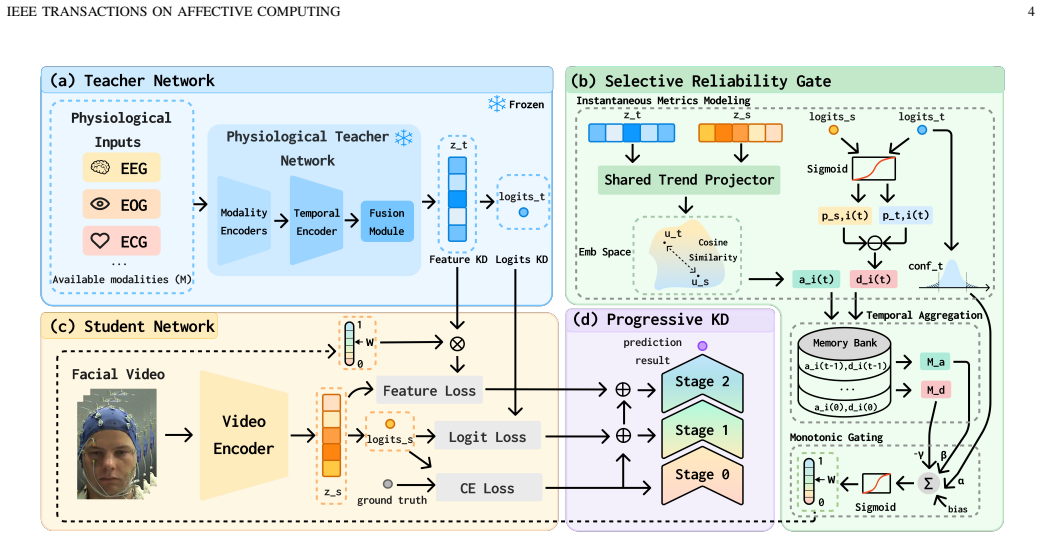
The load-bearing object is the Selective Reliability Gate, a closed loop that converts three instantaneous signals, feature agreement $a_i^{(t)}$ and prediction disagreement $d_i^{(t)}$ computed in a shared 128-dimensional projection space $\phi(\cdot)$, and the teacher's own confidence $\text{conf}_i^T$, into a per-sample distillation weight $w_i = \max\{\epsilon,\ \sigma(b + \text{Softplus}(\alpha)\,\text{conf}_i^T + \text{Softplus}(\beta)M_{\text{agree},i} - \text{Softplus}(\gamma)M_{\text{disag},i})\}$. The two relational cues are smoothed over time in a Consistency Memory Bank (exponential moving average with momentum 0.92) while confidence is used as an instantaneous saliency cue; the Softplus parameterization enforces that agreement and confidence can only raise the weight and persistent disagreement only lowers it, and the weight modulates feature distillation while a stop-gradient prevents the gate from trivially suppressing difficult samples. A mean-anchoring regularizer holding average gate activation near 0.4 prevents the gate from collapsing.
What would settle it
Retrain the EEG teacher strictly on the training split (subject-wise or trial-wise, as appropriate), leaving everything else unchanged, and rerun Tables II and III; if the BioKD gains over the video-only student shrink or vanish under a split-restricted teacher, the reported improvements came from leaked test information in the frozen teacher, whereas if the gains persist, the reliability gate is doing the work. A second check: corrupt a growing fraction of the teacher's label targets per subject and verify that gate weights fall and student accuracy degrades smoothly with the corruption level.
Extended reading notes
Core claim
BioKD's central claim is that physiology-to-video knowledge distillation should be selective: the student should imitate the physiological teacher only on samples where that teacher's supervision is credible. To measure credibility, the paper models teacher supervision as a clean signal plus sample-dependent distortion and demonstrates empirically that the teacher exhibits overconfident errors, meaning high confidence with substantial misclassification. The framework therefore couples three instantaneous cues, feature agreement, prediction disagreement, and teacher confidence, into a monotonic reliability score, accumulates the two relational cues in a consistency memory bank to smooth artifacts, and gates the feature distillation loss per sample with the resulting weight, while a progressive schedule (task-only, then logits, then gated feature alignment) prevents early-training instability. The authors report consistent gains across datasets, evaluation protocols, and student backbones, and show the gate marks teacher-correct samples more heavily (AUROC 0.70), corrects more overconfident teacher errors (39.5% versus 25.0% for the ungated student), and markedly improves calibration (ECE 0.089 versus 0.234). Deployment keeps only the video student, so the method adds zero inference-time overhead.
Load-bearing premise
The whole benchmark rests on the assumption that the pre-trained physiological teacher was trained without ever seeing the test subjects' recordings or labels, but the paper only says the teacher 'is initialized with pre-trained weights and remains frozen' and never documents its training split, so if that training touched test data, the supervision would leak test information and the reported gains in Tables II and III would not be real.
Editorial extensions
If this is right
- If the reliability gate does what the paper claims, any distillation setup with an untrustworthy teacher, not just physiology, can be made safe by gating on historical teacher–student agreement rather than on average teacher accuracy.
- Physiological sensing becomes a training-time-only requirement: deployed emotion recognition keeps video-only input, which is non-intrusive and needs no sensor synchronization.
- The student's calibration improves along with accuracy (ECE 0.089 versus 0.234), which matters for downstream uses where confidence thresholds are set by hand.
- The progressive schedule means the same student architecture can complete a warm-up phase before teacher influence begins, stabilizing distillation from noisy teachers.
- The benefit transfers across student backbones (MobileNetV2–GRU and VideoMAE both improve), suggesting the gain sits in the gating mechanism rather than in any particular video architecture.
Reading between the lines
- Read as a mechanism rather than a method, the gate is a candidate general cure for negative transfer: the same 'when can this teacher help this student?' question arises in capacity-gap and domain-shift distillation, so the paper's logic suggests the design should transfer there too, a claim the authors do not make.
- A testable extension the paper does not run: corrupt an increasing fraction of the teacher's label targets per subject and check that gate weights fall and student accuracy degrades gracefully; a gate that truly tracks reliability should shadow the corruption curve.
- The subject-wise numbers inherit a precondition the paper leaves undocumented, namely the frozen teacher's own pretraining split; confirming the teacher never saw test recordings is the check that would settle whether Tables II and III measure the gate or data leakage.
- Because entropy-only weighting underperforms the full gate, the distinctive ingredient appears to be the teacher–student disagreement term; isolating just the Softplus($\gamma$) penalty across disagreement levels would test that reading.
Editorial analysis
A structured set of objections, weighed in public.
Referee Report
Summary. The paper proposes BioKD, a knowledge-distillation framework in which a frozen physiological-signal teacher supervises a video-only student during training. A sample-wise reliability gate combines teacher confidence, smoothed teacher-student feature agreement, and prediction disagreement to weight a feature-distillation loss, and a progressive schedule (task-only, logit-level distillation, then gated feature-level distillation) is used. The student is deployed without the teacher, gate, or projection head. Experiments on DEAP and AMIGOS under trial-wise and subject-wise protocols report accuracy and F1 over three seeds, with component ablations, backbone generalization, calibration, and gate diagnostics.
Significance. If the reported gains are real, the contribution is practically relevant: it offers a deployable video-only emotion recognizer that exploits physiology during training without inference-time sensing. The paper's strengths include the clean separation of training-only memory/gate, evaluation on two datasets and two protocols, component ablations, the correctness-quadrant analysis with AUROC 0.7021, and the correction-rate analysis of overconfident teacher errors. However, the significance is conditional on resolving two issues: the undisclosed pretraining data of the physiological teacher, which creates a leakage risk for all distillation results, and the lack of statistical testing, since several headline gains are within one standard deviation of baselines.
major comments (3)
- [IV-A / Table I] The teacher's pretraining data are not specified: Section IV-A says only that the teacher "is initialized with pre-trained weights and remains frozen," and Table I marks the teacher "Frozen" without stating the training split, label source, or whether DEAP/AMIGOS recordings were used. Because the teacher's logits and features are the only channel of privileged supervision (Eqs. (14)-(15)), any overlap between teacher pretraining and test subjects (subject-wise) or test trials (trial-wise) would constitute test leakage and would invalidate Tables II and III. The teacher's mediocre standalone accuracy does not rule out partial memorization or subject-identity leakage. The manuscript must disclose the pretraining data and demonstrate disjointness from the evaluation splits.
- [IV-A / Tables II-III] All headline comparisons are based on three random seeds with no significance tests. For example, in Table III, DEAP subject-wise arousal BioKD is 65.29±9.16 vs. 56.43±9.24 for no-KD and 61.07±9.85 for EmotionKD; with n=3 per condition these differences are not established as significant. In Table II, several AMIGOS gains are also within one standard deviation. Without confidence intervals, paired tests, or more seeds, the claim of consistent improvement is not statistically substantiated. This is load-bearing because the abstract and Section IV-B emphasize consistent superiority over baselines.
- [III-C / IV-E1] The reliability gate is constructed from teacher-student agreement and disagreement, which are internal consistency signals rather than direct measures of teacher correctness. The paper's quadrant analysis is a reasonable first check, but the separation is modest: teacher-helpful samples receive mean gate 0.4274 vs. 0.4445 for both-correct, and the AUROC for teacher correctness is 0.7021, with no variance or significance reported. More importantly, the analysis uses an independently trained no-KD student, whereas during BioKD training the student is itself shaped by the gated distillation; gate weights from the actual training trajectory are not reported. The possibility that the gate suppresses teacher-correct but student-disagreeing supervision (the very samples distillation should help) is not fully resolved.
minor comments (6)
- [IV-C / Table IV] The header "LF eat" appears to be a typo for "L_Feat", and the abbreviations StageL, KD, LFeat, Gate, and Mem should be defined in the table caption or text.
- [IV-A] The label binarization "using a threshold of 5" should specify the original scale and state whether this matches the standard DEAP/AMIGOS binarization convention (e.g., 1-9 scale with threshold 5).
- [III-C / Eq. (8)] The bias term b and the Softplus parameters alpha, beta, and gamma in Eq. (8) are not described; the manuscript should state how they are initialized, whether they are learned, and whether they are included in the hyperparameter sensitivity analysis.
- [Table V] The "No gate" row in Table V is ambiguous: it should clarify whether logit-level distillation and the gate regularizer are still active, and whether this row corresponds to "Naïve Feature KD" in Table IV.
- [IV-F / Table XI] Table XI reports only accuracy with no F1 or standard deviation, making it difficult to assess the reliability of the teacher-modality comparisons; please add F1 and variability measures.
- [General] Providing code and trained-teacher checkpoints would substantially improve reproducibility, especially given the sensitivity of the results to the teacher's pretraining procedure.
Circularity Check
No significant circularity: BioKD's reliability gate is validated post-hoc against teacher correctness, and its distillation gains are empirical rather than forced by construction.
full rationale
BioKD's central empirical claim—that gate-weighted feature distillation improves a video-only student—is not forced by its equations. The gate weight w_i is defined from teacher confidence and smoothed teacher–student agreement/disagreement (Eqs. 8–9), and the distillation loss in Eq. 16 applies stop-gradient to w_i with mean anchoring in Eq. 10, so the gate cannot trivially minimize the loss by suppressing high-discrepancy samples. The correctness-quadrant analysis in Section IV-E1 is explicitly a post-hoc diagnostic: the paper states that ground-truth labels 'are used only for post-hoc analysis and do not directly supervise the gate,' so the reported AUROC 0.7021 for distinguishing teacher-correct from teacher-wrong samples is an empirical measurement, not a construction. The ablation table (Table IV) and comparison tables (Tables II and III) compare BioKD against student-only and naive KD baselines, and the gains are experimentally measured rather than derived from the definition of the gate. The undisclosed pretraining split of the frozen physiological teacher (Section IV-A only says it 'is initialized with pre-trained weights and remains frozen') is a legitimate data-leakage validity risk that could undermine the benchmark numbers, but it is not a circularity under the standard of exhibiting a specific equation or parameter that reduces to its own input. The self-citations [13] and [22] are contextual related-work mentions and are not load-bearing for the paper's central derivation. No step in the derivation chain is equivalent to its inputs by construction, so there is no significant circularity.
Assumptions & free parameters
free parameters (9)
- target mean gate activation rho =
0.4
- memory momentum m =
0.92
- minimum gate weight epsilon =
0.01
- stage transition epochs (E0, E1) =
(2, 5)
- loss coefficients lambda_l, lambda_f, lambda_g =
1.0 (default)
- distillation temperature tau =
not reported
- sliding window length and stride =
4 s window, 2 s stride
- label binarization threshold =
5
- optimizer settings =
Adam lr=3e-4, batch size 16, 10 epochs
assumptions (7)
- domain assumption DEAP and AMIGOS self-reported ratings are valid ground truth for valence and arousal.
- domain assumption Physiological and video signals are temporally aligned within each trial.
- ad hoc to paper The teacher output can be abstracted as clean supervision plus sample-dependent distortion (Eq. 1).
- domain assumption A shared projection head creates a comparable semantic space for teacher and student features.
- ad hoc to paper Monotonic combination of confidence, agreement, and disagreement yields a valid reliability score.
- ad hoc to paper Feature agreement and prediction disagreement should be temporally smoothed while teacher confidence should not.
- ad hoc to paper Early feature-level alignment harms a student that has not yet learned stable video representations.
Cite this review
Pith. "Pith review of BioKD: Selective Physiology-to-Video Knowledge Distillation via Reliability Gate for Emotion Recognition." pith.science (2026). https://pith.science/paper/37O74XCV
@misc{pith2026260806023,
  author       = {Pith},
  title        = {Pith review of: BioKD: Selective Physiology-to-Video Knowledge Distillation via Reliability Gate for Emotion Recognition},
  year         = {2026},
  howpublished = {\url{https://pith.science/paper/37O74XCV}},
  note         = {Machine review of arXiv:2608.06023}
}
read the original abstract
To address the limitations of video-based emotion recognition under ambiguous or socially masked behavioral cues, as well as the poor deployability of physiological signals, this paper proposes a reliability-aware physiology-to-video knowledge distillation framework, termed BioKD. The proposed framework leverages physiological signals as privileged information during training to guide a video-based student model in learning deep affective representations, while relying solely on non-intrusive video inputs at inference time. To cope with the high noise and instability of physiological teacher supervision caused by inter-subject variability, signal artifacts, and temporal inconsistency, BioKD incorporates a sample-wise reliability-aware gating mechanism together with a progressive distillation strategy. By adaptively regulating the strength of knowledge transfer, the framework suppresses negative transfer induced by unreliable physiological supervision and enables more stable cross-modal distillation. Experiments on DEAP and AMIGOS show that BioKD consistently outperforms representative baselines under both trial-wise and subject-wise evaluation protocols for valence and arousal recognition. For example, BioKD achieves 68.01\% on DEAP (trial-wise arousal) and 65.29\% under the more challenging subject-wise setting, demonstrating improved performance under a subject-independent evaluation setting. Further analyses show that BioKD effectively mitigates overconfident teacher errors and outperforms an entropy-only weighting strategy, confirming the importance of explicitly modeling supervision reliability. In addition, BioKD introduces no additional inference-time overhead relative to the same video student architecture and removes the need for physiological sensing and multimodal synchronization.
Figures


Figures from the paper (2 more)


Reference graph
Works this paper leans on
-
[1]
A review of affective computing: From unimodal analysis to multimodal fusion,
S. Poria, E. Cambria, R. Bajpai, and A. Hussain, “A review of affective computing: From unimodal analysis to multimodal fusion,”Information fusion, vol. 37, pp. 98–125, 2017
work page 2017
-
[2]
Human emotion recognition: Review of sensors and methods,
A. Dzedzickis, A. Kaklauskas, and V . Bucinskas, “Human emotion recognition: Review of sensors and methods,”Sensors, vol. 20, no. 3, p. 592, 2020
work page 2020
-
[3]
A survey on physiological signal-based emotion recognition,
Z. Ahmad and N. Khan, “A survey on physiological signal-based emotion recognition,”Bioengineering, vol. 9, no. 11, p. 688, 2022
work page 2022
-
[4]
Deep facial expression recognition: A survey,
S. Li and W. Deng, “Deep facial expression recognition: A survey,”IEEE transactions on affective computing, vol. 13, no. 3, pp. 1195–1215, 2020
work page 2020
-
[5]
Emotion recognition from body movement,
F. Ahmed, A. H. Bari, and M. L. Gavrilova, “Emotion recognition from body movement,”IEEE Access, vol. 8, pp. 11 761–11 781, 2019
work page 2019
-
[6]
Multimodal physiological signals from wearable sensors for affective computing: A systematic review,
F. Li and D. Zhang, “Multimodal physiological signals from wearable sensors for affective computing: A systematic review,”Intelligent Sports and Health, vol. 1, no. 4, pp. 210–222, 2025
work page 2025
-
[7]
Multimodal physiological signals fusion for online emotion recognition,
T. Pan, Y . Ye, H. Cai, S. Huang, Y . Yang, and G. Wang, “Multimodal physiological signals fusion for online emotion recognition,” inProceed- ings of the 31st ACM international conference on multimedia, 2023, pp. 5879–5888
work page 2023
-
[8]
Multimodal emotion recognition using visual, vocal and physiological signals: a review,
G. Udahemuka, K. Djouani, and A. M. Kurien, “Multimodal emotion recognition using visual, vocal and physiological signals: a review,” Applied Sciences, vol. 14, no. 17, p. 8071, 2024
2024
Show all 59 references
-
[9]
Emotional suppression: physiology, self-report, and expressive behavior
J. J. Gross and R. W. Levenson, “Emotional suppression: physiology, self-report, and expressive behavior.”Journal of personality and social psychology, vol. 64, no. 6, p. 970, 1993
1993
-
[10]
Toward an affect-sensitive multimodal human-computer interaction,
M. Pantic and L. J. Rothkrantz, “Toward an affect-sensitive multimodal human-computer interaction,”Proceedings of the IEEE, vol. 91, no. 9, pp. 1370–1390, 2003
2003
-
[11]
Deap: A database for emotion analysis; using physiological signals,
S. Koelstra, C. Muhl, M. Soleymani, J.-S. Lee, A. Yazdani, T. Ebrahimi, T. Pun, A. Nijholt, and I. Patras, “Deap: A database for emotion analysis; using physiological signals,”IEEE transactions on affective computing, vol. 3, no. 1, pp. 18–31, 2011
2011
-
[12]
Interaction between cognition, emotion, and the autonomic nervous system,
H. D. Critchley, J. Eccles, and S. N. Garfinkel, “Interaction between cognition, emotion, and the autonomic nervous system,” inHandbook of clinical neurology. Elsevier, 2013, vol. 117, pp. 59–77
2013
-
[13]
Hierarchical moe: Continuous multimodal emotion recognition with incomplete and asyn- chronous inputs,
Y . Zhu, L. Han, G. Jiang, P. Zhou, and Y . Wang, “Hierarchical moe: Continuous multimodal emotion recognition with incomplete and asyn- chronous inputs,”arXiv preprint arXiv:2508.02133, 2025
2025 arXiv
-
[14]
Phemonet: A multimodal network for physiological signals,
E. Lopez, A. Uncini, and D. Comminiello, “Phemonet: A multimodal network for physiological signals,” in2024 IEEE 8th Forum on Research and Technologies for Society and Industry Innovation (RTSI). IEEE, 2024, pp. 260–264
2024
-
[15]
A review of classification algorithms for eeg- based brain–computer interfaces: a 10 year update,
F. Lotte, L. Bougrain, A. Cichocki, M. Clerc, M. Congedo, A. Rako- tomamonjy, and F. Yger, “A review of classification algorithms for eeg- based brain–computer interfaces: a 10 year update,”Journal of neural engineering, vol. 15, no. 3, p. 031005, 2018
2018
-
[16]
Generalized alignment for multimodal physiological signal learning,
Y . Liu, Y . Yao, Z. Wang, J. Plested, and T. Gedeon, “Generalized alignment for multimodal physiological signal learning,” in2019 Inter- national Joint Conference on Neural Networks (IJCNN). IEEE, 2019, pp. 1–10
2019
-
[17]
Introducing wesad, a multimodal dataset for wearable stress and affect detection,
P. Schmidt, A. Reiss, R. Duerichen, C. Marberger, and K. Van Laer- hoven, “Introducing wesad, a multimodal dataset for wearable stress and affect detection,” inProceedings of the 20th ACM international conference on multimodal interaction, 2018, pp. 400–408
2018
-
[18]
Multimodal emotion recognition: A comprehensive review, trends, and challenges,
M. P. A. Ramaswamy and S. Palaniswamy, “Multimodal emotion recognition: A comprehensive review, trends, and challenges,”Wiley Interdisciplinary Reviews: Data Mining and Knowledge Discovery, vol. 14, no. 6, p. e1563, 2024
2024
-
[19]
Mvp: Multimodal emotion recognition based on video and physiological signals,
V . Strizhkova, H. Kachmar, H. Chaptoukaev, R. Kalandadze, N. Kukhilava, T. Tsmindashvili, N. Abo-Alzahab, M. A. Zuluaga, M. Balazia, A. Dantchevaet al., “Mvp: Multimodal emotion recognition based on video and physiological signals,” inEuropean Conference on Computer Vision. S...
2024
-
[20]
Recognition of emotions using multimodal physiological signals and an ensemble deep learning model,
Z. Yin, M. Zhao, Y . Wang, J. Yang, and J. Zhang, “Recognition of emotions using multimodal physiological signals and an ensemble deep learning model,”Computer methods and programs in biomedicine, vol. 140, pp. 93–110, 2017
2017
-
[21]
Learning using privileged information: Similarity control and knowledge transfer
V . Vapnik, R. Izmailovet al., “Learning using privileged information: Similarity control and knowledge transfer.”J. Mach. Learn. Res., vol. 16, no. 1, pp. 2023–2049, 2015
2023
-
[22]
Real-time cross-modal cybersickness prediction in virtual reality,
Y . Zhu, T. Li, and Y . Wang, “Real-time cross-modal cybersickness prediction in virtual reality,”arXiv preprint arXiv:2501.01212, 2025
2025 arXiv
-
[23]
Privileged knowledge distillation for dimensional emotion recognition in the wild,
M. H. Aslam, M. O. Zeeshan, M. Pedersoli, A. L. Koerich, S. Bacon, and E. Granger, “Privileged knowledge distillation for dimensional emotion recognition in the wild,” inProceedings of the IEEE/CVF conference on computer vision and pattern recognition, 2023, pp. 3338–3347
2023
-
[24]
Learning with side information through modality hallucination,
J. Hoffman, S. Gupta, and T. Darrell, “Learning with side information through modality hallucination,” inProceedings of the IEEE conference on computer vision and pattern recognition, 2016, pp. 826–834
2016
-
[25]
Datasets for automated affect and emotion recognition from cardiovascular signals using artificial intelligence—a systematic review,
P. Jemioło, D. Storman, M. Mamica, M. Szymkowski, W. ˙Zabicka, M. Wojtaszek-Główka, and A. Lig˛ eza, “Datasets for automated affect and emotion recognition from cardiovascular signals using artificial intelligence—a systematic review,”Sensors, vol. 22, no. 7, p. 2538, 2022
2022
-
[26]
Distilling the knowledge in a neural network,
G. Hinton, O. Vinyals, and J. Dean, “Distilling the knowledge in a neural network,”arXiv preprint arXiv:1503.02531, 2015
2015 arXiv
-
[27]
Improved knowledge distillation via teacher assis- tant,
S. I. Mirzadeh, M. Farajtabar, A. Li, N. Levine, A. Matsukawa, and H. Ghasemzadeh, “Improved knowledge distillation via teacher assis- tant,” inProceedings of the AAAI conference on artificial intelligence, vol. 34, 2020, pp. 5191–5198
2020
-
[28]
When does label smoothing help?
R. Müller, S. Kornblith, and G. E. Hinton, “When does label smoothing help?”Advances in neural information processing systems, vol. 32, 2019
2019
-
[29]
Your classifier is secretly an energy based model and you should treat it like one,
W. Grathwohl, K.-C. Wang, J.-H. Jacobsen, D. Duvenaud, M. Norouzi, and K. Swersky, “Your classifier is secretly an energy based model and you should treat it like one,”arXiv preprint arXiv:1912.03263, 2019
1912 arXiv
-
[30]
Knowledge distillation: A survey,
J. Gou, B. Yu, S. J. Maybank, and D. Tao, “Knowledge distillation: A survey,”International journal of computer vision, vol. 129, no. 6, pp. 1789–1819, 2021
2021
-
[31]
A comprehensive survey on knowledge distillation,
A. M. Mansourian, R. Ahmadi, M. Ghafouri, A. M. Babaei, E. B. Golezani, Z. Y . Ghamchi, V . Ramezanian, A. Taherian, K. Dinashi, A. Miriet al., “A comprehensive survey on knowledge distillation,” arXiv preprint arXiv:2503.12067, 2025
2025
-
[32]
A comprehensive review of multimodal emotion recognition: Techniques, challenges, and future directions,
Y . Wu, Q. Mi, and T. Gao, “A comprehensive review of multimodal emotion recognition: Techniques, challenges, and future directions,” Biomimetics, vol. 10, no. 7, p. 418, 2025
2025
-
[33]
A review of multimodal emotion recognition from datasets, preprocessing, features, and fusion methods,
B. Pan, K. Hirota, Z. Jia, and Y . Dai, “A review of multimodal emotion recognition from datasets, preprocessing, features, and fusion methods,” Neurocomputing, vol. 561, p. 126866, 2023
2023
-
[34]
Fitnets: Hints for thin deep nets. arxiv 2014,
A. Romero, N. Ballas, S. E. Kahou, A. Chassang, C. Gatta, and Y . Bengio, “Fitnets: Hints for thin deep nets. arxiv 2014,”arXiv preprint arXiv:1412.6550, 2014
2014 arXiv
-
[35]
Relational knowledge distilla- tion,
W. Park, D. Kim, Y . Lu, and M. Cho, “Relational knowledge distilla- tion,” inProceedings of the IEEE/CVF conference on computer vision and pattern recognition, 2019, pp. 3967–3976
2019
-
[36]
Paying more attention to attention: Improving the performance of convolutional neural networks via atten- tion transfer,
S. Zagoruyko and N. Komodakis, “Paying more attention to attention: Improving the performance of convolutional neural networks via atten- tion transfer,”arXiv preprint arXiv:1612.03928, 2016
2016 arXiv
-
[37]
Cross modal distillation for su- pervision transfer,
S. Gupta, J. Hoffman, and J. Malik, “Cross modal distillation for su- pervision transfer,” inProceedings of the IEEE conference on computer vision and pattern recognition, 2016, pp. 2827–2836
2016
-
[38]
Vision- language meets the skeleton: Progressively distillation with cross-modal knowledge for 3d action representation learning,
Y . Chen, T. He, J. Fu, L. Wang, J. Guo, T. Hu, and H. Cheng, “Vision- language meets the skeleton: Progressively distillation with cross-modal knowledge for 3d action representation learning,”IEEE Transactions on Multimedia, 2024
2024
-
[39]
Cross-modal knowledge distil- lation for enhanced unimodal emotion recognition,
Z. Jia, Y . Liu, H. Wang, and T. Jiang, “Cross-modal knowledge distil- lation for enhanced unimodal emotion recognition,”IEEE Transactions on Affective Computing, 2025
2025
-
[40]
Emotionkd: a cross-modal knowledge distillation framework for emotion recognition based on physiological signals,
Y . Liu, Z. Jia, and H. Wang, “Emotionkd: a cross-modal knowledge distillation framework for emotion recognition based on physiological signals,” inProceedings of the 31st ACM international conference on multimedia, 2023, pp. 6122–6131
2023
-
[41]
A transformer- based model with self-distillation for multimodal emotion recognition in conversations,
H. Ma, J. Wang, H. Lin, B. Zhang, Y . Zhang, and B. Xu, “A transformer- based model with self-distillation for multimodal emotion recognition in conversations,”IEEE Transactions on Multimedia, vol. 26, pp. 776–788, 2023
2023
-
[42]
Optimised knowledge distillation for efficient social media emotion recognition using distilbert and albert,
M. Hussain, C. Chen, M. Hussain, M. Anwar, M. Abaker, A. Ab- delmaboud, and I. Yamin, “Optimised knowledge distillation for efficient social media emotion recognition using distilbert and albert,”Scientific Reports, vol. 15, no. 1, p. 30104, 2025. IEEE TRANSACTIONS ON AFFECTIV...
2025
-
[43]
Eegnet: a compact convolutional neural network for eeg-based brain–computer interfaces,
V . J. Lawhern, A. J. Solon, N. R. Waytowich, S. M. Gordon, C. P. Hung, and B. J. Lance, “Eegnet: a compact convolutional neural network for eeg-based brain–computer interfaces,”Journal of neural engineering, vol. 15, no. 5, p. 056013, 2018
2018
-
[44]
From the lab to the wild: Affect modeling via privileged information,
K. Makantasis, K. Pinitas, A. Liapis, and G. N. Yannakakis, “From the lab to the wild: Affect modeling via privileged information,”IEEE Transactions on Affective Computing, vol. 15, no. 2, pp. 380–392, 2023
2023
-
[45]
On calibration of modern neural networks,
C. Guo, G. Pleiss, Y . Sun, and K. Q. Weinberger, “On calibration of modern neural networks,” inInternational conference on machine learning. PMLR, 2017, pp. 1321–1330
2017
-
[46]
A review, current challenges, and future possibilities on emotion recognition using machine learning and physiological signals
P. J. Bota, C. Wang, A. L. Fred, and H. P. Da Silva, “A review, current challenges, and future possibilities on emotion recognition using machine learning and physiological signals.”IEEE access, vol. 7, no. 99, pp. 140 990–141 020, 2019
2019
-
[47]
Be your own teacher: Improve the performance of convolutional neural networks via self distillation,
L. Zhang, J. Song, A. Gao, J. Chen, C. Bao, and K. Ma, “Be your own teacher: Improve the performance of convolutional neural networks via self distillation,” inProceedings of the IEEE/CVF international conference on computer vision, 2019, pp. 3713–3722
2019
-
[48]
Online multi-level contrastive representation distillation for cross-subject fnirs emotion recognition,
Z. Lai, C. Qing, J. Tan, W. Luo, and X. Xu, “Online multi-level contrastive representation distillation for cross-subject fnirs emotion recognition,” inProceedings of the 1st International Workshop on Brain- Computer Interfaces (BCI) for Multimedia Understanding, 2024, pp. 29–37
2024
-
[49]
Uncertainty-aware self-knowledge distillation,
Y . Yang, C. Wang, L. Gong, M. Wu, Z. Chen, Y . Gao, T. Wang, and X. Zhou, “Uncertainty-aware self-knowledge distillation,”IEEE Transactions on Circuits and Systems for Video Technology, 2024
2024
-
[50]
Emotion recog- nition for everyday life using physiological signals from wearables: A systematic literature review,
S. Saganowski, B. Perz, A. G. Polak, and P. Kazienko, “Emotion recog- nition for everyday life using physiological signals from wearables: A systematic literature review,”IEEE Transactions on Affective Computing, vol. 14, no. 3, pp. 1876–1897, 2022
2022
-
[51]
Visual-to-eeg cross-modal knowledge distillation for continuous emotion recognition,
S. Zhang, C. Tang, and C. Guan, “Visual-to-eeg cross-modal knowledge distillation for continuous emotion recognition,”Pattern Recognition, vol. 130, p. 108833, 2022
2022
-
[52]
Amigos: A dataset for affect, personality and mood research on individuals and groups,
J. A. Miranda-Correa, M. K. Abadi, N. Sebe, and I. Patras, “Amigos: A dataset for affect, personality and mood research on individuals and groups,”IEEE transactions on affective computing, vol. 12, no. 2, pp. 479–493, 2018
2018
-
[53]
Mobilenetv2: Inverted residuals and linear bottlenecks,
M. Sandler, A. Howard, M. Zhu, A. Zhmoginov, and L.-C. Chen, “Mobilenetv2: Inverted residuals and linear bottlenecks,” inProceedings of the IEEE conference on computer vision and pattern recognition, 2018, pp. 4510–4520
2018
-
[54]
Varia- tional information distillation for knowledge transfer,
S. Ahn, S. X. Hu, A. Damianou, N. D. Lawrence, and Z. Dai, “Varia- tional information distillation for knowledge transfer,” inProceedings of the IEEE/CVF conference on computer vision and pattern recognition, 2019, pp. 9163–9171
2019
-
[55]
C2kd: Bridging the modality gap for cross-modal knowledge distillation,
F. Huo, W. Xu, J. Guo, H. Wang, and S. Guo, “C2kd: Bridging the modality gap for cross-modal knowledge distillation,” inProceedings of the IEEE/CVF Conference on Computer Vision and Pattern Recognition, 2024, pp. 16 006–16 015
2024
-
[56]
A cross-modal densely guided knowledge distillation based on modality rebalancing strategy for enhanced unimodal emotion recognition,
S. Wu, H. Liang, Y . Zhang, Y . Chen, and Z. Jia, “A cross-modal densely guided knowledge distillation based on modality rebalancing strategy for enhanced unimodal emotion recognition,” inProceedings of the Thirty- Fourth International Joint Conference on Artificial Intelligen...
2025
-
[57]
Similarity-preserving knowledge distillation,
F. Tung and G. Mori, “Similarity-preserving knowledge distillation,” in Proceedings of the IEEE/CVF International Conference on Computer Vision, 2019, pp. 1365–1374
2019
-
[58]
Like what you like: Knowledge distill via neuron selectivity transfer,
Z. Huang and N. Wang, “Like what you like: Knowledge distill via neuron selectivity transfer,”arXiv preprint arXiv:1707.01219, 2017
2017 arXiv
-
[59]
Physio- logical noise: Definition, estimation, and characterization in complex biomedical signals,
A. Scarciglia, V . Catrambone, C. Bonanno, and G. Valenza, “Physio- logical noise: Definition, estimation, and characterization in complex biomedical signals,”IEEE Transactions on Biomedical Engineering, vol. 71, no. 1, pp. 45–55, 2023. VII. BIOGRAPHYSECTION Bojing Houis curre...
2023
Reviewed August 7, 2026 · model on record in the stance chip above.
Discussion (0). Continue with ORCID to comment.