REVIEW 1 major objections 6 minor 1 cited by
Fresh look at the LHC limits on vector leptoquarks
T0 review · 1 major / 6 minor · reviewed 2026-08-15 · deepseek-v4-flash
Pith's one-line read This paper argues that LHC limits on vector leptoquark masses and couplings strengthen substantially when single production, indirect t-channel exchange, and its interference with Standard Model Drell-Yan are added to pair production, and…
desk verdict Useful vLQ recasting with genuinely new QCD-QED pair production and per-species interference results, but the V2/eV2 exclusion curves rest on an EFT stand-in below the mass range where the paper validates it. read the letter →
The pith
A machine-rendered reading of the paper's core claim, the machinery that carries it, and where it could break.
The reading
What carries the argument
The argument is carried by a bookkeeping scheme that classifies every contribution to the dimuon-plus-jets final state by its order in $\alpha_s$, $\alpha_e$, and the leptoquark coupling $x$, so that the pair-production cross section is written as $\sigma_{PP}=\sigma^{200}+\sigma^{110}+\sigma^{020}+x^2(\sigma^{101}+\sigma^{011})+x^4\sigma^{002}$, with the QCD-QED mixed term $\sigma^{110}$ coming from gluon-photon fusion and carrying the model-independent mass-shift effect. Single production is split into two-body and three-body contributions, and the nonresonant contribution is split into indirect production and its interference with the Standard Model Drell-Yan background. The other load-bearing object is the effective-operator description obtained by integrating out the t-channel leptoquark, which turns the indirect and interference amplitudes into four-fermion operators and is used to obtain the $V_2$ and $\tilde V_2$ exclusion curves. The sign of the interference term, which is determined by the chiral structure of the leptoquark Yukawa coupling, decides whether the combined signal exceeds or falls below the pair-production-only expectation.
What would settle it
Compute the $V_2$ and $\tilde V_2$ indirect and interference cross sections with the full t-channel propagator, without integrating the leptoquark out, at masses of 2, 2.5, and 3 TeV for first-generation couplings, and compare the resulting 95% CL exclusion contours with the EFT-based curves; a shift larger than the analysis's stated uncertainties would move the claimed excluded regions.
Extended reading notes
Core claim
The central claim, stated in the paper's own terms, is that a systematic combination of all vLQ production mechanisms that yield dimuon-plus-dijet events gives markedly stronger 95% CL exclusion limits in the mass-coupling plane than the pair-production-only analyses that dominate the literature, and that including the QCD-QED mixed pair-production channel shifts the model-independent mass limits by hundreds of GeV for high-charge species. The five species considered are $U_1$, $\tilde U_1$, $V_2$, $\tilde V_2$, and $U_3$. The interference of indirect production with Standard Model Drell-Yan can be constructive or destructive: for example, $U_1$ and $V_2$ with $L$-$R$-type couplings subtract from the background, while $\tilde U_1$ and certain $V_2$ couplings add to it, so the size of the limit improvement depends on the species and on the chirality of the coupling. In the high-mass regime the indirect and interference contributions dominate, and the limits obtained by integrating out the t-channel leptoquark coincide with the full-theory limits for $M_{\rm LQ}\gtrsim 3$-$4$ TeV for couplings to first- and second-generation quarks. At large coupling $x\simeq\sqrt{4\pi}$ the extrapolated maximum mass exclusions reach tens of TeV for several couplings.
Load-bearing premise
The load-bearing premise is that the effective-operator approximation used for the $V_2$ and $\tilde V_2$ indirect and interference contributions is accurate down to the lowest masses at which limits are drawn (about 2 TeV), even though the paper's own comparison shows the EFT and the full theory agree only around 3-4 TeV for first- and second-generation couplings.
Editorial extensions
If this is right
- Nominal model-independent 95% CL mass limits rise by up to a few hundred GeV once QCD-QED mixed pair production is included; the largest shifts occur for the highest-charge species, with photon-PDF uncertainties quoted as large as or larger than the shift.
- Because indirect production and its interference fall off more slowly with mass than resonant production, the high-mass dimuon tail sets coupling limits out to several TeV; extrapolating the coupling to the perturbative boundary $x\simeq\sqrt{4\pi}$ gives maximum mass exclusions of tens of TeV for some couplings.
- The direction of the improvement is set by the interference sign: destructively interfering species such as $U_1$ and $V_2$ gain most from the dimuon-tail analysis, while constructively interfering species such as $\tilde U_1$ keep the direct-search limits as the stronger constraint.
- For first- and second-generation quark couplings the effective-operator and full-theory exclusions agree once $M_{\rm LQ}\gtrsim 3$-$4$ TeV, so the EFT-based curves are reliable in that high-mass region; the matching mass moves higher for third-generation couplings.
Reading between the lines
- If the EFT matching scale is a genuine validity boundary, then the $V_2$ and $\tilde V_2$ exclusion curves below about 3-4 TeV should be recomputed with the full t-channel propagator before being used for model-building; the paper identifies this limitation but does not fully resolve it.
- The same count-every-topology logic should transfer to other coloured mediators with dilepton-plus-jets signatures; the sign of their interference with Standard Model Drell-Yan would determine whether combined searches improve or degrade the limit.
- The reported sensitivity of the QCD-QED mass shift to the photon PDF suggests that a better-determined photon PDF, or a PDF set that includes data-driven constraints, would either confirm or shrink the improved limits; this can be tested with existing LHC data.
- The tens-of-TeV extrapolated limits at $x\simeq\sqrt{4\pi}$ should be interpreted with a dedicated perturbative-unitarity check per coupling; without it those numbers are kinematic bounds rather than rigorous exclusions.
Signed reviews
Editorial analysis
A structured set of objections, weighed in public.
Referee Report
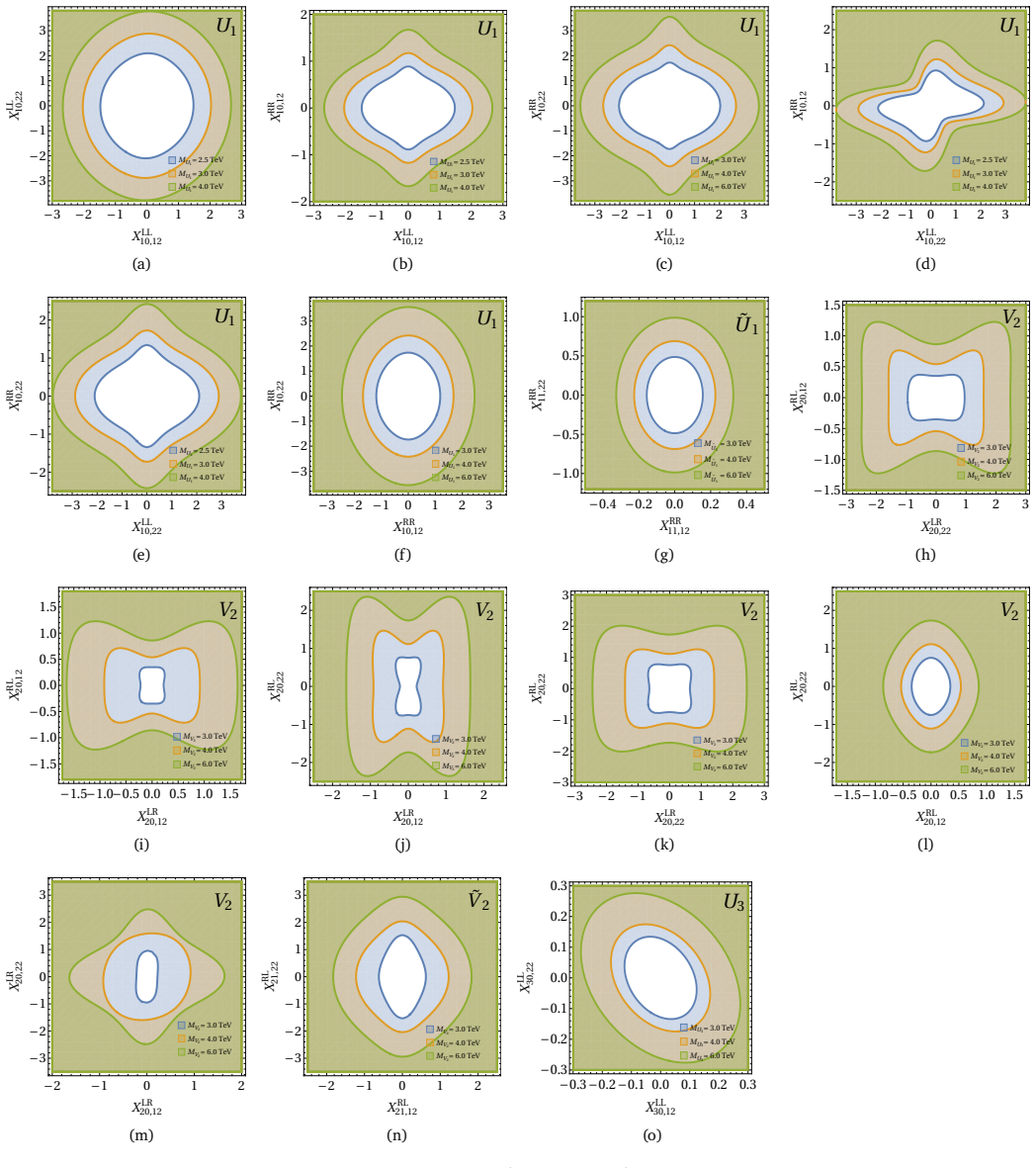
Summary. The paper presents updated LHC exclusion limits on vector leptoquarks (U1, eU1, V2, eV2, U3) by recasting existing ATLAS and CMS searches in dimuon-plus-jets and high-mass dimuon channels. The authors combine four production mechanisms: pair production (PP), single production (SP), t-channel indirect production (IP), and indirect interference with the SM Drell-Yan background (II). They report model-independent mass limits in Table III, coupling exclusions in the mass-coupling plane in Figs. 4 and 6, two-coupling exclusions in Fig. 5, and a comparison of the full vLQ theory with an effective-operator description in Fig. 7. A distinctive feature is the inclusion of QCD-QED mixed pair production, which shifts mass limits appreciably for highly charged species, and the use of the dimuon tail to constrain couplings at large mass. For V2 and eV2, the IP and II contributions are computed in an effective-operator approximation because the full-theory interference evaluation in MadGraph fails with the authors' FeynRules models; this is stated transparently in Sec. IVF and footnote 2.
Significance. If the results are taken at face value, the paper provides the most complete current recast of LHC limits for vector leptoquarks, systematically combining all leading production channels and validating the dimuon-tail limits against the recent CMS non-resonant search. The explicit treatment of interference sign and the demonstration that QCD-QED mixed pair production strengthens model-independent mass limits for high-charge species are useful and clearly presented. The paper is also commendably transparent about its main technical limitation, the effective-operator workaround for V2/eV2. However, because that approximation is validated only in a mass range that does not cover the full extent of the presented contours, the central claim that the limits account for all relevant production mechanisms is not uniformly supported.
major comments (1)
- The V2 and eV2 IP and II contributions are obtained by integrating out the t-channel leptoquark and using the dimension-six operators of Table IV, as stated in Sec. IVF and footnote 2. The paper's own validation in Fig. 7 is performed only for U1 and eU1, and it shows that the full theory and the EFT agree only for M_lq ≳ 3-4 TeV. The V2/eV2 exclusion contours, however, are presented down to 2 TeV (and to 1 TeV in some panels, e.g., the lower edge of the PP-only comparison), with no full-theory cross-check for these species. Since IP and II dominate the high-coupling tails of the limits, the V2/eV2 boundaries below roughly 3-4 TeV rest on an unvalidated approximation; if the EFT overestimates or underestimates the interference there, the excluded regions would shift. I recommend either computing the full-theory IP and II for V2/eV2 with an independent matrix-element implementation or analytic expressions for benchmark masses, or restricting the asterisked IP*/II* contours and the associated exclusion statements to the validated mass range and showing only PP+SP below it.
minor comments (6)
- [Table III] The table heading says 'model-independent mass exclusion limits on various sLQ models', but the table lists vLQ species; this should be corrected to vLQ.
- [Fig. 7] The caption states that the exclusion limits from the effective-operator approach and the full theory are compared, but it does not mention that the comparison is shown only for U1 and eU1; please state explicitly that no full-theory validation is shown for V2 and eV2.
- [Sec. IVF] The sentence 'This would give us a reasonable estimation of the exclusion limits for those vLQs, especially when they couple to the first and second generation quarks, for M_lq ≳ 3-4 TeV' should be reconciled with the figure ranges; the contours extend well below 3 TeV, so the reader cannot tell which parts of the curves are claimed to be reliable.
- [Eq. (6)] The notation 'Nobs(M_lq)/Lexp = sigma_obs(M_lq) x epsilon_exp(M_lq)' should clarify that sigma_obs is the observed upper limit on the cross section times efficiency and that the equality with the sum over topologies holds at the boundary; the current presentation is slightly ambiguous.
- [Sec. II] The text following Eq. (2) defines the barred quantities as evaluated at x=1, but it does not explicitly state whether a common coupling x is assumed for all contributing couplings in the PP expressions; please clarify the convention, especially for channels in which different couplings enter.
- [Table V] The format of the table columns is confusing: each row lists 'x Limit' three times without clear column headers. Please restructure the table so that each coupling and its extrapolated limit are labeled unambiguously.
Circularity Check
No significant circularity: the exclusion limits are anchored to external ATLAS and CMS data, and the authors' self-citations are methodological tools rather than load-bearing inputs.
full rationale
The derivation chain is self-contained in the relevant sense. All exclusion limits are obtained by equating signal yields to observed ATLAS/CMS upper limits (Eq. (6), using the ATLAS µµjj bound [58] and CMS dimuon spectra [68]), so the final numbers are anchored to external data, not to the authors' own outputs. The self-citations [29,36,37,55] supply recasting methodology, the FeynRules/UFO implementation, and the chi-squared procedure; these are tools whose results are cross-checked by the authors ('we have verified that both yield similar bounds') and against the external CMS search [69] ('Our exclusion limits derived from the high-pT dimuon searches agree well with their results'), so they are not load-bearing in a circular way. The paper's own limitations, such as the EFT workaround for V2/eV2 in Sec. IVF and footnote 2 ('we bypassed the problem by taking an effective-operator approach'), the stated validity only for M_lq ≳ 3-4 TeV, and the large NNPDF photon-PDF uncertainty ('the limits can vary significantly'), are genuine approximation and validity concerns that belong under correctness risk, not circularity. None of the paper's equations reduce a predicted quantity to a fitted input by construction.
Assumptions & free parameters
free parameters (2)
- kappa (anomalous gluon coupling) =
0 and 1 (benchmark values)
- Nobs mass anchor =
2 TeV
assumptions (5)
- domain assumption SM gauge symmetry and conserved baryon/lepton number restrict vLQ interactions to the Yukawa list in Table I.
- domain assumption The vLQ mass basis is aligned with down-type quarks (down-aligned scenario).
- domain assumption The Delphes-based detector simulation with tuned analysis cuts reproduces the ATLAS muon-muon-jet selection of Ref. [58].
- ad hoc to paper For V2 and eV2, the t-channel vLQ exchange can be integrated out to four-fermion operators over the full mass range of the presented limits.
- domain assumption Initial state partons are described by NNPDF PDFs including the photon PDF.
Cite this review
Pith. "Pith review of Fresh look at the LHC limits on vector leptoquarks." pith.science (2026). https://pith.science/paper/37PNUGZL
@misc{pith2026250718295,
  author       = {Pith},
  title        = {Pith review of: Fresh look at the LHC limits on vector leptoquarks},
  year         = {2026},
  howpublished = {\url{https://pith.science/paper/37PNUGZL}},
  note         = {Machine review of arXiv:2507.18295}
}
read the original abstract
Vector leptoquarks (vLQs) are popular candidates for searching for physics beyond the Standard Model. In this paper, we present updated exclusion limits on various vLQ species, accounting for all the relevant production mechanisms at the LHC. In particular, we highlight the critical role of indirect production and its interference with the Standard Model Drell-Yan process. This interference can be constructive or destructive, depending on the specific quantum numbers of the vLQ, and significantly impacts the sensitivity of current searches. Furthermore, we demonstrate that including QCD-QED mixed pair production channels leads to a noticeable shift in model-independent mass limits. Additionally, we examine the validity of the full theory with vLQs and corresponding effective operators in the high mass regime. Overall, our analysis yields a substantial improvement in the exclusion limits on vLQs compared to the existing results in the literature.
Figures


Figures from the paper (4 more)



Forward citations
Cited by 1 Pith paper
-
Vectorlike $\tau$ production through leptoquarks
Leptoquark decays can dominate the production of heavy vectorlike tau partners at the LHC, offering new mono- and di-lepton search channels.
Reference graph
Works this paper leans on
-
[1]
Lepton Number as the Fourth Color,
Jogesh C. Pati and Abdus Salam, “Lepton Number as the Fourth Color,” Phys. Rev. D10, 275–289 (1974), [Erratum: Phys.Rev.D 11, 703–703 (1975)]
work page 1974
-
[2]
Unity of All Elementary Par- ticle Forces,
H. Georgi and S. L. Glashow, “Unity of All Elementary Par- ticle Forces,” Phys. Rev. Lett.32, 438–441 (1974)
work page 1974
-
[3]
Unified Interac- tions of Leptons and Hadrons,
Harald Fritzsch and Peter Minkowski, “Unified Interac- tions of Leptons and Hadrons,” Annals Phys.93, 193–266 (1975)
work page 1975
-
[4]
Technicolor,
Edward Farhi and Leonard Susskind, “Technicolor,” Phys. Rept.74, 277 (1981)
1981
-
[5]
Another contribution in the 3BSP processes arises when a vLQ is produced along with a lepton-jet pair from an off-shell vLQ, i.e.,pp→ ℓqℓ∗ q→ ℓqℓj. This process occurs at one higher order inαx than the six PPsub-categoriesandhasadifferentkinematicsthan that of the PP process. To obtain the total SP contribution to theℓℓjj final state, we follow the method...
work page 1989
-
[6]
Barbara Schrempp and Fridger Schrempp, “LIGHT LEPTO- QUARKS,” Phys. Lett. B153, 101–107 (1985)
work page 1985
-
[7]
Jose Wudka, “COMPOSITE LEPTOQUARKS,” Phys. Lett. B 167, 337–342 (1986)
work page 1986
-
[8]
R-parity violating supersymmetry,
R. Barbieret al., “R-parity violating supersymmetry,” Phys. Rept.420, 1–202 (2005), arXiv:hep-ph/0406039
arXiv 2005
Show all 75 references
-
[9]
Physics of leptoquarks in precision experiments and at particle colliders,
I. Doršner, S. Fajfer, A. Greljo, J. F. Kamenik, and N. Košnik, “Physics of leptoquarks in precision experiments and at particle colliders,” Phys. Rept.641, 1–68 (2016), arXiv:1603.04993 [hep-ph]
2016 arXiv
-
[10]
Exploring mixed lepton-quark interac- tions in non-resonant leptoquark production at the LHC,
João Gonçalves, António P. Morais, António Onofre, and Roman Pasechnik, “Exploring mixed lepton-quark interac- tions in non-resonant leptoquark production at the LHC,” JHEP 11, 147 (2023), arXiv:2306.15460 [hep-ph]. 12
2023 arXiv
-
[11]
b→cτ ¯ν anomaly from a minimal com- posite S1 leptoquark,
Leandro Da Rold, “b→cτ ¯ν anomaly from a minimal com- posite S1 leptoquark,” (2023), arXiv:2311.04062 [hep- ph]
2023 arXiv
-
[12]
ATLAS Public Results,
“ATLAS Public Results,”https://twiki.cern.ch/twiki/ bin/view/AtlasPublic
-
[13]
CMS Exotica Public Physics Results,
“CMS Exotica Public Physics Results,” https: //twiki.cern.ch/twiki/bin/view/CMSPublic/ PhysicsResultsEXO
-
[14]
Leptoquark pair production in hadronic interactions,
Johannes Blumlein, Edward Boos, and Alexander Kryukov, “Leptoquark pair production in hadronic interactions,” Z. Phys. C76, 137–153 (1997), arXiv:hep-ph/9610408
1997 arXiv
-
[15]
Corner- ing Scalar Leptoquarks at LHC,
Ilja Dorsner, Svjetlana Fajfer, and Admir Greljo, “Corner- ing Scalar Leptoquarks at LHC,” JHEP 10, 154 (2014), arXiv:1406.4831 [hep-ph]
2014 arXiv
-
[16]
The leptoquark Hunter’s guide: Pair production,
Bastian Diaz, Martin Schmaltz, and Yi-Ming Zhong, “The leptoquark Hunter’s guide: Pair production,” JHEP10, 097 (2017), arXiv:1706.05033 [hep-ph]
2017 arXiv
-
[17]
Searching for Lepto- quarks at IceCube and the LHC,
Ujjal Kumar Dey, Deepak Kar, Manimala Mitra, Michael Spannowsky, and Aaron C. Vincent, “Searching for Lepto- quarks at IceCube and the LHC,” Phys. Rev. D98, 035014 (2018), arXiv:1709.02009 [hep-ph]
2018 arXiv
-
[18]
Revisiting scalar leptoquark at the LHC,
Priyotosh Bandyopadhyay and Rusa Mandal, “Revisiting scalar leptoquark at the LHC,” Eur. Phys. J. C 78, 491 (2018), arXiv:1801.04253 [hep-ph]
2018 arXiv
-
[19]
The leptoquark Hunter’s guide: large coupling,
Martin Schmaltz and Yi-Ming Zhong, “The leptoquark Hunter’s guide: large coupling,” JHEP 01, 132 (2019), arXiv:1810.10017 [hep-ph]
2019 arXiv
-
[20]
Enhancing scalar productions with lepto- quarks at the LHC,
Arvind Bhaskar, Debottam Das, Bibhabasu De, and Sub- hadip Mitra, “Enhancing scalar productions with lepto- quarks at the LHC,” Phys. Rev. D 102, 035002 (2020), arXiv:2002.12571 [hep-ph]
2020 arXiv
-
[21]
Lepton-Quark Fu- sion at Hadron Colliders, precisely,
Admir Greljo and Nudzeim Selimovic, “Lepton-Quark Fu- sion at Hadron Colliders, precisely,” JHEP03, 279 (2021), arXiv:2012.02092 [hep-ph]
2021 arXiv
-
[22]
Novel Lep- toquark Pair Production at LHC,
Ilja Doršner, Svjetlana Fajfer, and Ajla Lejlić, “Novel Lep- toquark Pair Production at LHC,” JHEP 05, 167 (2021), arXiv:2103.11702 [hep-ph]
2021 arXiv
-
[23]
Com- bined constraints on first generation leptoquarks,
Andreas Crivellin, Dario Müller, and Luc Schnell, “Com- bined constraints on first generation leptoquarks,” Phys. Rev. D103, 115023 (2021), [Addendum: Phys.Rev.D 104, 055020 (2021)], arXiv:2104.06417 [hep-ph]
2021 arXiv
-
[24]
Distinguishingsignaturesofscalar leptoquarks at hadron and muon colliders,
Priyotosh Bandyopadhyay, Anirban Karan, Rusa Mandal, andSnehashisParashar,“Distinguishingsignaturesofscalar leptoquarks at hadron and muon colliders,” Eur. Phys. J. C 82, 916 (2022), arXiv:2108.06506 [hep-ph]
2022 arXiv
-
[25]
Leptoquark- assisted singlet-mediated di-Higgs production at the LHC,
Arvind Bhaskar, Debottam Das, Bibhabasu De, Subhadip Mitra,ArunaKumarNayak, andCyrinNeeraj,“Leptoquark- assisted singlet-mediated di-Higgs production at the LHC,” Phys. Lett. B833, 137341 (2022), arXiv:2205.12210 [hep- ph]
2022 arXiv
-
[26]
Phenomenology of scalar leptoquarks at the LHC in explaining the ra- diative neutrino masses, muon g-2, and lepton flavor vi- olating observables,
Snehashis Parashar, Anirban Karan, Avnish, Priyotosh Bandyopadhyay, and Kirtiman Ghosh, “Phenomenology of scalar leptoquarks at the LHC in explaining the ra- diative neutrino masses, muon g-2, and lepton flavor vi- olating observables,” Phys. Rev. D 106, 095040 (2022), arXiv:2...
2022 arXiv
-
[27]
Precise probing and discrimination of third- generation scalar leptoquarks,
Anupam Ghosh, Partha Konar, Debashis Saha, and Satya- jit Seth, “Precise probing and discrimination of third- generation scalar leptoquarks,” Phys. Rev. D108, 035030 (2023), arXiv:2304.02890 [hep-ph]
2023 arXiv
-
[28]
On the sensitivity reach of LQ pro- duction with preferential couplings to third generation fermions at the LHC,
A. Flórez, J. Jones-Pérez, A. Gurrola, C. Rodriguez, and J. Peñuela Parra, “On the sensitivity reach of LQ pro- duction with preferential couplings to third generation fermions at the LHC,” Eur. Phys. J. C 83, 1023 (2023), arXiv:2307.11070 [hep-ph]
2023 arXiv
-
[29]
LHC Study of Third-Generation Scalar Leptoquarks with Machine- LearnedLikelihoods,
Ernesto Arganda, Daniel A. Díaz, Andres D. Perez, Rosa M. Sandá Seoane, and Alejandro Szynkman, “LHC Study of Third-Generation Scalar Leptoquarks with Machine- LearnedLikelihoods,” (2023),arXiv:2309.05407[hep-ph]
2023 arXiv
-
[30]
Fresh look at the LHC limits on scalar leptoquarks,
Arvind Bhaskar, Arijit Das, Tanumoy Mandal, Subhadip Mi- tra, and Rachit Sharma, “Fresh look at the LHC limits on scalar leptoquarks,” Phys. Rev. D109, 055018 (2024), arXiv:2312.09855 [hep-ph]
2024 arXiv
-
[31]
Gravitationalwaves from color restoration in a leptoquark model of radiative neutrino masses,
Mårten Bertenstam, Marco Finetti, António P. Morais, Ro- manPasechnik, andJohanRathsman,“Gravitationalwaves from color restoration in a leptoquark model of radiative neutrino masses,” (2025), arXiv:2501.01286 [hep-ph]
2025 arXiv
-
[32]
Jet substructure probe on scalar lepto- quark models via top polarization,
Anupam Ghosh, Partha Konar, Tousik Samui, and Ritesh K. Singh, “Jet substructure probe on scalar lepto- quark models via top polarization,” JHEP07, 145 (2025), arXiv:2505.16328 [hep-ph]
2025 arXiv
-
[33]
New physics explanations of aµ in light of the FNAL muong− 2 measurement,
Peter Athron, Csaba Balázs, Douglas H. J. Jacob, Wojciech Kotlarski, Dominik Stöckinger, and Hyejung Stöckinger- Kim, “New physics explanations of aµ in light of the FNAL muong− 2 measurement,” JHEP 09, 080 (2021), arXiv:2104.03691 [hep-ph]
2021 arXiv
-
[34]
Measurement of the anoma- lousprecessionfrequencyofthemuonintheFermilabMuon g− 2 Experiment,
T. Albahriet al. (Muon g-2), “Measurement of the anoma- lousprecessionfrequencyofthemuonintheFermilabMuon g− 2 Experiment,” Phys. Rev. D 103, 072002 (2021), arXiv:2104.03247 [hep-ex]
2021
-
[35]
MeasurementofthePositiveMuon Anomalous Magnetic Moment to0.46ppm,
B.Abi et al.(Muong-2),“MeasurementofthePositiveMuon Anomalous Magnetic Moment to0.46ppm,” Phys. Rev. Lett. 126, 141801 (2021), arXiv:2104.03281 [hep-ex]
2021
-
[36]
Measurement of the Pos- itive Muon Anomalous Magnetic Moment to 0.20 ppm,
D. P. Aguillardet al. (Muon g-2), “Measurement of the Pos- itive Muon Anomalous Magnetic Moment to 0.20 ppm,” Phys. Rev. Lett. 131, 161802 (2023), arXiv:2308.06230 [hep-ex]
2023
-
[37]
Sin- gle Productions of Colored Particles at the LHC: An Ex- ample with Scalar Leptoquarks,
Tanumoy Mandal, Subhadip Mitra, and Satyajit Seth, “Sin- gle Productions of Colored Particles at the LHC: An Ex- ample with Scalar Leptoquarks,” JHEP 07, 028 (2015), arXiv:1503.04689 [hep-ph]
2015 arXiv
-
[38]
RD(∗) motivatedS1 leptoquark scenarios: Impact of inter- ference on the exclusion limits from LHC data,
Tanumoy Mandal, Subhadip Mitra, and Swapnil Raz, “RD(∗) motivatedS1 leptoquark scenarios: Impact of inter- ference on the exclusion limits from LHC data,” Phys. Rev. D 99, 055028 (2019), arXiv:1811.03561 [hep-ph]
2019 arXiv
-
[39]
Addressing the RD(∗) anomalies with an S1 leptoquark from SO(10) grand unification,
Ufuk Aydemir, Tanumoy Mandal, and Subhadip Mitra, “Addressing the RD(∗) anomalies with an S1 leptoquark from SO(10) grand unification,” Phys. Rev. D101, 015011 (2020), arXiv:1902.08108 [hep-ph]
2020 arXiv
-
[40]
Hunting for scalar leptoquarks with boosted tops and light leptons,
Kushagra Chandak, Tanumoy Mandal, and Subhadip Mi- tra, “Hunting for scalar leptoquarks with boosted tops and light leptons,” Phys. Rev. D 100, 075019 (2019), arXiv:1907.11194 [hep-ph]
2019 arXiv
-
[41]
Precise limits on the charge-2/3 U1 vector leptoquark,
Arvind Bhaskar, Diganta Das, Tanumoy Mandal, Subhadip Mitra, and Cyrin Neeraj, “Precise limits on the charge-2/3 U1 vector leptoquark,” Phys. Rev. D104, 035016 (2021), arXiv:2101.12069 [hep-ph]
2021 arXiv
-
[42]
Improving third-generation leptoquark searches with combined signals and boosted top quarks,
Arvind Bhaskar, Tanumoy Mandal, Subhadip Mitra, and Mohit Sharma, “Improving third-generation leptoquark searches with combined signals and boosted top quarks,” Phys. Rev. D104, 075037 (2021), arXiv:2106.07605 [hep- ph]
2021 arXiv
-
[43]
Combined explanation of W-mass, 13 muon g-2, RK(*) and RD(*) anomalies in a singlet-triplet scalarleptoquarkmodel,
Arvind Bhaskar, Anirudhan A. Madathil, Tanumoy Mandal, and Subhadip Mitra, “Combined explanation of W-mass, 13 muon g-2, RK(*) and RD(*) anomalies in a singlet-triplet scalarleptoquarkmodel,”Phys.Rev.D 106,115009(2022), arXiv:2204.09031 [hep-ph]
2022 arXiv
-
[44]
An economical model for B-flavour and aµ anomalies from SO(10) grand unification,
Ufuk Aydemir, Tanumoy Mandal, Subhadip Mitra, and Shoaib Munir, “An economical model for B-flavour and aµ anomalies from SO(10) grand unification,” (2022), arXiv:2209.04705 [hep-ph]
2022 arXiv
-
[45]
Boosted top quark inspired leptoquark searches at the muon collider,
Arvind Bhaskar and Manimala Mitra, “Boosted top quark inspired leptoquark searches at the muon collider,” Phys. Lett. B868, 139656 (2025), arXiv:2409.15992 [hep-ph]
2025 arXiv
-
[46]
Collider signatures of a scalar leptoquark and vectorlike lepton in light of muon anomaly,
Nivedita Ghosh, Santosh Kumar Rai, and Tousik Samui, “Collider signatures of a scalar leptoquark and vectorlike lepton in light of muon anomaly,” Phys. Rev. D107, 035028 (2023), arXiv:2206.11718 [hep-ph]
2023 arXiv
-
[47]
Right-handed neutrino pair production via second- generation leptoquarks,
Arvind Bhaskar, Yash Chaurasia, Kuldeep Deka, Tanu- moy Mandal, Subhadip Mitra, and Ananya Mukher- jee, “Right-handed neutrino pair production via second- generation leptoquarks,” Phys. Lett. B843, 138039 (2023), arXiv:2301.11889 [hep-ph]
2023 arXiv
-
[48]
Right-handed neutrino production through first-generation leptoquarks,
Gokul Duraikandan, Rishabh Khanna, Tanumoy Man- dal, Subhadip Mitra, and Rachit Sharma, “Right-handed neutrino production through first-generation leptoquarks,” Phys. Rev. D111, 075032 (2025), arXiv:2412.19751 [hep- ph]
2025 arXiv
-
[49]
Leptoquark-induced CLFV decays with a light SM-singlet scalar,
Bibhabasu De, “Leptoquark-induced CLFV decays with a light SM-singlet scalar,” Phys. Lett. B855, 138784 (2024), arXiv:2405.06970 [hep-ph]
2024 arXiv
-
[50]
Dark Matter Induced Proton Decays,
Ranjeet Kumar and Rahul Srivastava, “Dark Matter Induced Proton Decays,” (2025), arXiv:2506.04370 [hep-ph]
2025 arXiv
-
[51]
Leptoquark summary plot for scalar or vec- tor models , Tech. Rep. (CERN, Geneva, 2024) https://cds.cern.ch/record/2903898/files/ATL-PHYS- PUB-2024-012.pdf
2024
-
[52]
CMS Exotica Summary plots for 13 TeV data: Leptoquark summary plot,
“CMS Exotica Summary plots for 13 TeV data: Leptoquark summary plot,” https://twiki.cern.ch/twiki/pub/ CMSPublic/SummaryPlotsEXO13TeV/barplot_QE_QMU_ QTAU_QNU_2025March.pdf (2025)
2025
-
[53]
ProbingColorOctet Electrons at the LHC,
TanumoyMandalandSubhadipMitra,“ProbingColorOctet Electrons at the LHC,” Phys. Rev. D87, 095008 (2013), arXiv:1211.6394 [hep-ph]
2013 arXiv
-
[54]
Probing Compositeness with the CMSeejj andeej Data,
Tanumoy Mandal, Subhadip Mitra, and Satyajit Seth, “Probing Compositeness with the CMSeejj andeej Data,” Phys. Lett. B 758, 219–225 (2016), arXiv:1602.01273 [hep-ph]
2016 arXiv
-
[55]
Vector leptoquark contributions to lepton dipole moments,
Arvind Bhaskar, Diganta Das, Soumyadip Kundu, Anirud- han A. Madathil, Tanumoy Mandal, and Subhadip Mitra, “Vector leptoquark contributions to lepton dipole moments,” Phys. Rev. D 111, 015045 (2025), arXiv:2408.11798 [hep-ph]
2025 arXiv
-
[56]
TooLQit: Leptoquark Models and Limits,
Arvind Bhaskar, Yash Chaurasia, Arijit Das, Atirek Kumar, Tanumoy Mandal, Subhadip Mitra, Cyrin Neeraj, and Rachit Sharma, “TooLQit: Leptoquark Models and Limits,” (2024), arXiv:2412.19729 [hep-ph]
2024 arXiv
-
[57]
Leptoquark production at high energye+e− colliders,
J. Blümlein and E. Boos, “Leptoquark production at high energye+e− colliders,” Nucl. Phys. B Proc. Suppl.37, 181– 192 (1994)
1994
-
[58]
Fresh look at the lhc limits on scalar leptoquarks,
Arvind Bhaskar, Arijit Das, Tanumoy Mandal, Subhadip Mi- tra, and Rachit Sharma, “Fresh look at the lhc limits on scalar leptoquarks,” Phys. Rev. D109, 055018 (2024)
2024
-
[59]
Search for pairs of scalar lep- toquarks decaying into quarks and electrons or muons in√s = 13 TeVpp collisions with the ATLAS detector,
Georges Aadet al. (ATLAS), “Search for pairs of scalar lep- toquarks decaying into quarks and electrons or muons in√s = 13 TeVpp collisions with the ATLAS detector,” JHEP 10, 112 (2020), arXiv:2006.05872 [hep-ex]
2020 arXiv
-
[60]
Search for pair production of second-generation leptoquarks at√s = 13 TeV,
Albert M Sirunyanet al. (CMS), “Search for pair production of second-generation leptoquarks at√s = 13 TeV,” Phys. Rev. D99, 032014 (2019), arXiv:1808.05082 [hep-ex]
2019 arXiv
-
[61]
FeynRules 2.0 - A complete toolboxfortree-levelphenomenology,
Adam Alloul, Neil D. Christensen, Céline Degrande, Claude Duhr, and Benjamin Fuks, “FeynRules 2.0 - A complete toolboxfortree-levelphenomenology,”Comput.Phys.Com- mun. 185, 2250–2300 (2014), arXiv:1310.1921 [hep-ph]
2014 arXiv
-
[62]
UFO - The Universal FeynRules Output,
Celine Degrande, Claude Duhr, Benjamin Fuks, David Grellscheid, Olivier Mattelaer, and Thomas Reiter, “UFO - The Universal FeynRules Output,” Comput. Phys. Commun. 183, 1201–1214 (2012), arXiv:1108.2040 [hep-ph]
2012 arXiv
-
[63]
The automated computation of tree-level and next-to- leading order differential cross sections, and their match- ing to parton shower simulations,
J. Alwall, R. Frederix, S. Frixione, V. Hirschi, F. Maltoni, O.Mattelaer,H.S.Shao,T.Stelzer,P.Torrielli, andM.Zaro, “The automated computation of tree-level and next-to- leading order differential cross sections, and their match- ing to parton shower simulations,” JHEP07, 079 ...
2014 arXiv
-
[64]
An open-source machine learning framework for global analyses of parton distribu- tions,
Richard D. Ballet al. (NNPDF), “An open-source machine learning framework for global analyses of parton distribu- tions,” Eur. Phys. J. C81, 958 (2021), arXiv:2109.02671 [hep-ph]
2021 arXiv
-
[65]
A comprehensive guide to the physics and usage of PYTHIA 8.3,
Christian Bierlich et al. , “A comprehensive guide to the physics and usage of PYTHIA 8.3,” (2022), 10.21468/Sci- PostPhysCodeb.8, arXiv:2203.11601 [hep-ph]
2022 arXiv
-
[66]
DELPHES 3, A modular framework for fast simulation of a generic collider experiment,
J. de Favereau, C. Delaere, P. Demin, A. Giammanco, V. Lemaître, A. Mertens, and M. Selvaggi (DELPHES 3), “DELPHES 3, A modular framework for fast simulation of a generic collider experiment,” JHEP02, 057 (2014), arXiv:1307.6346 [hep-ex]
2014 arXiv
-
[67]
The anti-kt jet clustering algorithm,
Matteo Cacciari, Gavin P. Salam, and Gregory Soyez, “The anti-kt jet clustering algorithm,” JHEP 04, 063 (2008), arXiv:0802.1189 [hep-ph]
2008 arXiv
-
[68]
FastJet User Manual,
Matteo Cacciari, Gavin P. Salam, and Gregory Soyez, “FastJet User Manual,” Eur. Phys. J. C72, 1896 (2012), arXiv:1111.6097 [hep-ph]
2012 arXiv
-
[69]
Search for resonant and nonresonant new phenomena in high-mass dilepton final states at √s = 13 TeV,
Albert M Sirunyan et al. (CMS), “Search for resonant and nonresonant new phenomena in high-mass dilepton final states at √s = 13 TeV,” JHEP 07, 208 (2021), arXiv:2103.02708 [hep-ex]
2021 arXiv
-
[70]
Search for t-channel scalar and vector leptoquark exchange in the high-mass dimuon and dielectron spectra in proton-proton collisions at√s = 13 TeV,
Aram Hayrapetyan et al. (CMS), “Search for t-channel scalar and vector leptoquark exchange in the high-mass dimuon and dielectron spectra in proton-proton collisions at√s = 13 TeV,” (2025), arXiv:2503.20023 [hep-ex]
2025
-
[71]
Searchforpairproduction ofscalarandvectorleptoquarksdecayingtomuonsandbot- tom quarks in proton-proton collisions at s=13 TeV,
AramHayrapetyan et al.(CMS),“Searchforpairproduction ofscalarandvectorleptoquarksdecayingtomuonsandbot- tom quarks in proton-proton collisions at s=13 TeV,” Phys. Rev. D109, 112003 (2024), arXiv:2402.08668 [hep-ex]
2024 arXiv
-
[72]
Inclusivenonresonantmul- tilepton probes of new phenomena at√s=13 TeV,
ArmenTumasyan et al.(CMS),“Inclusivenonresonantmul- tilepton probes of new phenomena at√s=13 TeV,” Phys. Rev. D105, 112007 (2022), arXiv:2202.08676 [hep-ex]
2022 arXiv
-
[73]
Perturbative unitarity constraints on generic Yukawa interactions,
Lukas Allwicher, Pere Arnan, Daniele Barducci, and Marco Nardecchia, “Perturbative unitarity constraints on generic Yukawa interactions,” JHEP 10, 129 (2021), arXiv:2108.00013 [hep-ph]
2021 arXiv
-
[74]
On the EFT validity for Drell–Yan tails at the LHC,
Lukas Allwicher, Darius A. Faroughy, Matheus Martines, Ol- cyr Sumensari, and Felix Wilsch, “On the EFT validity for Drell–Yan tails at the LHC,” Eur. Phys. J. C85, 463 (2025), arXiv:2412.14162 [hep-ph]
2025 arXiv
-
[75]
SMEFT ATLAS: The Landscape Beyond the Standard Model,
Jason Aebischer, Andrzej J. Buras, and Jacky Kumar, “SMEFT ATLAS: The Landscape Beyond the Standard Model,” (2025), arXiv:2507.05926 [hep-ph]. 14
2025
Reviewed August 15, 2026 · model on record in the stance chip above.
Discussion (0). Continue with ORCID to comment.