REVIEW 4 major objections 6 minor 46 references
What Limits Virtual Agent Application? OmniBench: A Scalable Multi-Dimensional Benchmark for Essential Virtual Agent Capabilities
T0 review · 4 major / 6 minor · reviewed 2026-08-07 · deepseek-v4-flash
Pith's one-line read OmniBench auto-generates 36,076 graph-structured virtual-agent tasks with controllable complexity, evaluates ten capabilities, and shows that fine-tuning on its graph trajectories improves agents on external benchmarks.
desk verdict A serious benchmark artifact with a real but addressable validity gap: the load-bearing LLM-synthesized evaluators are only indirectly validated. read the letter →
The pith
A machine-rendered reading of the paper's core claim, the machinery that carries it, and where it could break.
The reading
What carries the argument
The task graph $G=(S,R)$ has nodes as subtasks with explicit input and output resource lists, and edges as dependencies formed when one subtask's output matches another's input. Five complexity dimensions are read directly from graph topology: edge count (dependency), node count (instruction), number of application categories (knowledge), depth (hierarchy), and width (branch), each binned into easy, medium, or hard. A bottom-up synthesis pipeline explores 49 applications to propose subtasks, iteratively synthesizes trajectories and evaluation functions through cross-verification, composes subtasks into graphs under extracted task intents, and validates that the summarized instruction preserves the graph's dependency structure. The evaluator tracks each node as Completed, Evaluating, or Waiting, and defines Coverage Rate as depth-weighted progress and Logical Consistency as the agent's coherence score divided by the maximum coherence over all topological orders.
What would settle it
Take a random sample of tasks across all 20 scenarios, have independent human annotators score agent trajectories with the same rubric, and compare their scores against OmniEval's Coverage Rate and Logical Consistency on a sample larger than the reported 50 trajectories; also manually audit a few hundred synthesized evaluation functions by replaying subtask executions. If agreement drops far below the reported correlation, or if the evaluation functions systematically accept unfinished subtasks, the benchmark's scores and the graph-versus-chain gap would not be reliable.
Extended reading notes
Core claim
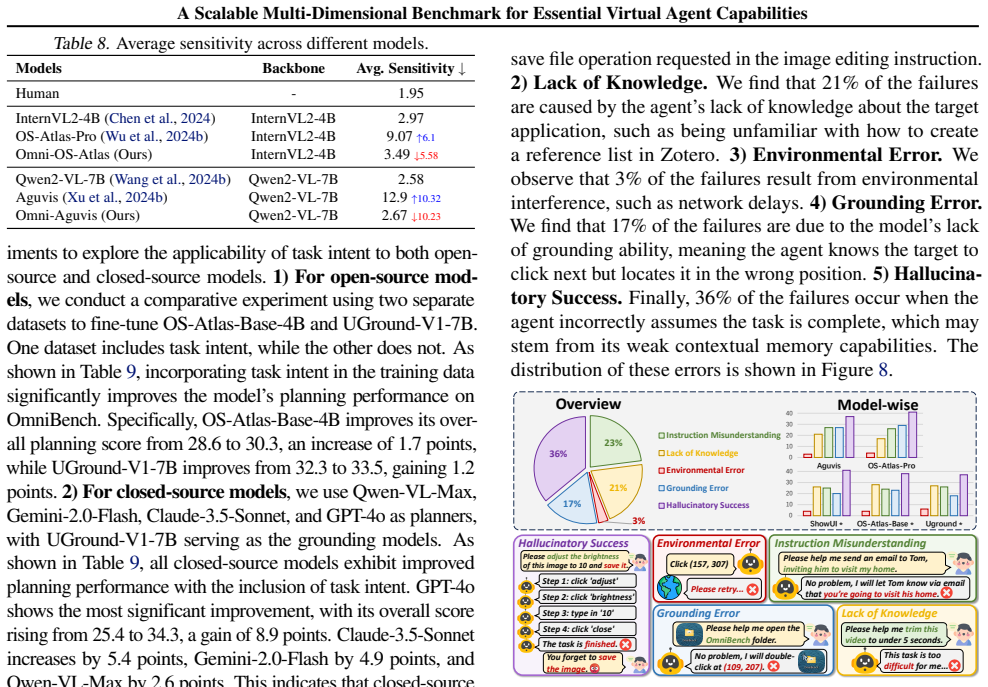
The paper's central claim is that representing a GUI task as a directed acyclic graph of subtasks, instead of a linear step sequence, makes task complexity composable and measurable, and that this representation is not just a benchmarking device: training on graph-structured trajectories transfers to external benchmarks, improving AndroidControl and OmniAct success rates over the original OS-Atlas and UGround models. A second claim is that mainstream agents collapse in the presence of graph structure: even GPT-4o reaches only 20.5% on graph-structured tasks while humans reach 80.1%, and instruction-order sensitivity drops after graph-trajectory fine-tuning. The paper also reports that adding task intent to prompts raises planning scores by up to 8.9 points for a closed-source model, and that the weakest capabilities across all agents are Subtask Identification and Long Instruction Following.
Load-bearing premise
The evaluation functions synthesized by a code LLM from the 11 hand-designed APIs must correctly judge when each subtask is completed, and the 90.7% human acceptance rate measured on sampled tasks must generalize to the full set of 36,076 tasks.
Editorial extensions
If this is right
- If OmniBench's pipeline is right, future GUI-agent benchmarks can be produced at scale without manual trajectory annotation, with task complexity dialed in before synthesis.
- Fine-tuning with graph-structured trajectories should be added to the GUI-agent training recipe, since it transfers to external benchmarks like AndroidControl and OmniAct.
- Task intent becomes a cheap, plug-and-play lever: adding it to prompts improves planning scores by up to 8.9 points for closed-source models and around 1.2-1.7 points in fine-tuning.
- Graph-structured tasks are a harder and more diagnostic test than chain-structured tasks, since even strong agents lose roughly 15 points when the same nodes and edges are arranged non-linearly.
- The capability profiles, especially weak Subtask Identification and Long Instruction Following, give concrete targets for the next generation of virtual agents.
Reading between the lines
- The reusable core of this work is probably the 11 system-level APIs plus the cross-verification protocol, not the 36k task count; a smaller benchmark with audited evaluation functions could be nearly as informative.
- The expression-order sensitivity result implies that future agent leaderboards should randomize instruction phrasing, otherwise rankings may reflect prompt order rather than agent ability.
- The graph-versus-chain performance gap suggests that real-world office workflows, which are naturally parallel and branching, may be systematically underrepresented by datasets built from linear demonstrations.
- A testable extension is to use the five-dimensional complexity decomposition as a diagnostic protocol for comparing agents before and after interventions such as long-context training or reinforcement learning.
Editorial analysis
A structured set of objections, weighed in public.
Referee Report
Summary. The paper introduces OmniBench, a graph-structured virtual-agent benchmark built with an automated bottom-up synthesis pipeline. It claims to generate 36,076 tasks across 20 scenarios and 49 applications, with five controllable complexity dimensions and ten capability-oriented test dimensions. The companion OmniEval framework scores agents with two graph-based metrics, Coverage Rate (CR) and Logical Consistency (LC), using subtask evaluation functions automatically synthesized by a code LLM from 11 hand-designed system-level APIs. The paper reports a 90.7% human acceptance rate on sampled tasks, a 50-trajectory correlation between OmniEval and human evaluation, and evaluations of 12 models including humans, open/closed-source MLLMs, and GUI agents. It also fine-tunes OS-Atlas and UGround on graph-structured trajectories and reports small improvements on AndroidControl and OmniAct, and concludes that graph-structured training data is more efficient than manually annotated data.
Significance. If the central claims hold, OmniBench would be a useful and timely resource: the automatic synthesis pipeline is described in enough detail to be reproducible, the graph-based metrics are a genuine step beyond binary success-rate evaluation, and the multidimensional capability breakdown addresses a real gap in virtual-agent benchmarking. The manuscript's strengths include the detailed appendix with prompts and data schemas, the inclusion of a human-acceptance quality check, and an explicit human-correlation validation of the proposed metrics. However, the validity of every OmniBench score depends on the correctness of the synthesized per-subtask evaluation functions, and that assumption is not directly validated. In addition, the headline claim about training efficiency relative to manual annotation is not supported by the experiments as presented. These issues are addressable in revision, but they are load-bearing for the paper's main conclusions.
major comments (4)
- [Section 3.2 / Appendix B.2 / C.3] The correctness of the Code-LLM-synthesized subtask evaluation functions is the load-bearing input to every CR and LC score, but the evidence presented does not validate those functions directly. Table 3 measures human acceptance of sampled task graphs, not evaluator verdicts; Figure 5 correlates OmniEval with human scores on only 50 whole trajectories, which can agree in aggregate even with large per-subtask errors; and Appendix B.2's cross-verification loop uses trajectories produced by the same model family (Claude-3.5-Sonnet and GPT-4o) that is later evaluated, so trajectories and evaluators can co-adapt to shared blind spots. I request a direct per-subtask audit: sample evaluation functions, run them on agent trajectories spanning clear successes and failures, and compare each verdict with human judgment, reporting per-subtask precision/recall and inter-annotator agreement. Without this, the rankings in Tables 4 and 5 and the chain-vs-graph comparison in Figure 7 are not secured.
- [Abstract / Section 5.3 (Tables 6 and 7)] The claim that training on graph-structured data 'can more efficiently guide agents compared to manually annotated data' is not demonstrated by the experiments. Tables 6 and 7 compare Omni-OS-Atlas and Omni-UGround with the original OS-Atlas and UGround checkpoints; those baselines are not a matched manual-annotation training condition, so the comparison is confounded by dataset, recipe, and data quantity. I ask for a controlled experiment that fine-tunes the same backbone on (a) OmniBench graph-structured trajectories and (b) an equivalent amount of manually annotated or chain-structured trajectories, with the same budget and hyperparameters, or the claim should be removed or weakened.
- [Tables 6 and 7] The reported external-benchmark improvements are small: average success-rate gains of 0.46 and 0.73 points for Omni-OS-Atlas and 0.40 and 0.30 for Omni-UGround, and some individual metrics decrease (e.g., AndroidControl-Low Grounding for OS-Atlas falls from 83.76 to 83.51 in Table 6). No confidence intervals, multiple seeds, or significance tests are reported. These magnitudes are within typical run-to-run variation for fine-tuned agents, so the conclusion that graph-structured trajectories 'significantly enhance' action reasoning is not yet supported. Please report means and variances over repeated runs or a significance test.
- [Section 4.2 / Table 12] The construction of the 10 capability test sets needs clarification. The table constrains combinations of complexity dimensions, but it is not stated whether a task satisfying several hard constraints (e.g., hard Dependency plus hard Hierarchy plus hard Branch) is assigned to multiple capability sets, nor how many tasks each set contains. Some assignments are also counterintuitive: 'Long Instruction Following' is constrained on Hierarchy and Branch but not on Instruction complexity. Without a disjoint-assignment rule and per-capability task counts, the capability-wise scores in Table 4 are difficult to interpret as measuring distinct capabilities.
minor comments (6)
- [Section 3.4 / Figure 3] The figure legend contains the typo 'Defendency'; also, the label 'Branching' should be aligned with the term 'Branch Complexity' used in the text.
- [Section 4.1] The maximum number of steps N in the graph evaluator is never specified; please state the default value and whether the results are sensitive to it.
- [Table 12 / Appendix D.1] Please state in the main text that empty stars in Table 12 mean 'unconstrained', not 'low', since the caption alone is easy to misread.
- [Figure 7] The y-axis label reads 'accuracy', while the surrounding text and Section 4 use Coverage Rate; clarify which metric is plotted and whether the human value of 80.1 is CR or SR.
- [Section 2] The claim that OmniBench is 'the only scalable benchmark' should be qualified by a precise definition of 'scalable', since CRAB and TASKBENCH also use graph structures.
- [Section 3.2 / Appendix C.2] Minor copyedits: 'rule-based, The synthesis' should be 'rule-based, the synthesis', and Appendix C.2's example contains 'new a Text Document'.
Circularity Check
No significant circularity: central claims rest on external transfer and independent human checks; the same-source evaluator risk is a validity concern, not a definitional reduction.
full rationale
OmniBench's load-bearing claims are (i) that the synthesized 36k-task graph dataset is usable for agent evaluation, (ii) that OmniEval's CR/LC scores align with human judgment, and (iii) that fine-tuning on OmniBench trajectories transfers to external benchmarks such as AndroidControl and OmniAct. None of these reduces to the paper's own inputs by construction. The subtask evaluation functions are generated from 11 predefined APIs by Claude-3.5-Sonnet, but the paper does not define an agent's score as the output of those functions in a way that makes the benchmark's conclusions tautological; the functions are checked against sampled human acceptance ratings and a 50-trajectory correlation with human scores (Figure 5). The graph-versus-chain comparison, the capability rankings, and the complexity-level tables are downstream of those evaluator verdicts rather than fitted parameters renamed as predictions. No parameter is fitted to the target result, and no uniqueness theorem from the authors' prior work is invoked to force the graph-based design. Self-citations appear in the bibliography and related-work discussion, but they are not load-bearing for the central empirical claims. The main non-circular validity risk is that LLM-synthesized evaluation functions may not perfectly capture semantic subtask completion, and the human-acceptance and correlation checks are based on samples; that is a correctness concern, not circularity.
Assumptions & free parameters
free parameters (4)
- Complexity level thresholds =
Easy/Medium/Hard: edges <=1, 2-3, >=4; nodes <=2, 3-4, >=5; app categories <=1, 2-3, >=4; depth <=2, 3-4, >=5; width…
- Depth-based weight in Coverage Rate =
w(s_i) = d(s_i) / sum_j d(s_j)
- Maximum steps N in graph evaluator =
Not reported
- Set of 11 system-level APIs =
11 hand-designed APIs (check_mouse_clicks, check_keyboard_types, check_file_exists, check_text_exists_via_ocr, etc.)
assumptions (5)
- domain assumption Real-world digital tasks can be modeled as DAGs of subtasks with typed input and output resources.
- domain assumption Advanced MLLMs can generate correct, diverse subtask trajectories and execution traces.
- domain assumption Code-LLM-composed evaluation functions built from 11 hand-designed APIs correctly decide subtask completion.
- domain assumption GPT-4o's consistency validator can infer the true dependency structure from a task instruction.
- domain assumption Human acceptance by three trained annotators on sampled tasks generalizes to the full 36k dataset.
Cite this review
Pith. "Pith review of What Limits Virtual Agent Application? OmniBench: A Scalable Multi-Dimensional Benchmark for Essential Virtual Agent Capabilities." pith.science (2026). https://pith.science/paper/37SVAJFU
@misc{pith2026250608933,
  author       = {Pith},
  title        = {Pith review of: What Limits Virtual Agent Application? OmniBench: A Scalable Multi-Dimensional Benchmark for Essential Virtual Agent Capabilities},
  year         = {2026},
  howpublished = {\url{https://pith.science/paper/37SVAJFU}},
  note         = {Machine review of arXiv:2506.08933}
}
read the original abstract
As multimodal large language models (MLLMs) advance, MLLM-based virtual agents have demonstrated remarkable performance. However, existing benchmarks face significant limitations, including uncontrollable task complexity, extensive manual annotation with limited scenarios, and a lack of multidimensional evaluation. In response to these challenges, we introduce OmniBench, a self-generating, cross-platform, graph-based benchmark with an automated pipeline for synthesizing tasks of controllable complexity through subtask composition. To evaluate the diverse capabilities of virtual agents on the graph, we further present OmniEval, a multidimensional evaluation framework that includes subtask-level evaluation, graph-based metrics, and comprehensive tests across 10 capabilities. Our synthesized dataset contains 36k graph-structured tasks across 20 scenarios, achieving a 91\% human acceptance rate. Training on our graph-structured data shows that it can more efficiently guide agents compared to manually annotated data. We conduct multidimensional evaluations for various open-source and closed-source models, revealing their performance across various capabilities and paving the way for future advancements. Our project is available at https://omni-bench.github.io/.
Figures


Figures from the paper (8 more)




Reference graph
Works this paper leans on
-
[1]
Qwen-vl: A versatile vision-language model for understanding, localization, text reading, and beyond
Bai, J., Bai, S., Yang, S., Wang, S., Tan, S., Wang, P., Lin, J., Zhou, C., and Zhou, J. Qwen-vl: A versatile vision-language model for understanding, localization, text reading, and beyond. arXiv preprint arXiv:2308.12966, 2023
arXiv 2023
-
[2]
Burns, A., Arsan, D., Agrawal, S., Kumar, R., Saenko, K., and Plummer, B. A. A dataset for interactive vision-language navigation with unknown command feasibility. In European Conference on Computer Vision, pp.\ 312--328. Springer, 2022
work page 2022
-
[3]
Cao, R., Lei, F., Wu, H., Chen, J., Fu, Y., Gao, H., Xiong, X., Zhang, H., Mao, Y., Hu, W., et al. Spider2-v: How far are multimodal agents from automating data science and engineering workflows? arXiv preprint arXiv:2407.10956, 2024
arXiv 2024
-
[4]
Internvl: Scaling up vision foundation models and aligning for generic visual-linguistic tasks
Chen, Z., Wu, J., Wang, W., Su, W., Chen, G., Xing, S., Zhong, M., Zhang, Q., Zhu, X., Lu, L., et al. Internvl: Scaling up vision foundation models and aligning for generic visual-linguistic tasks. In Proceedings of the IEEE/CVF Conference on Computer Vision and Pattern Recognition, pp.\ 24185--24198, 2024
work page 2024
-
[5]
Seeclick: Harnessing gui grounding for advanced visual gui agents
Cheng, K., Sun, Q., Chu, Y., Xu, F., Li, Y., Zhang, J., and Wu, Z. Seeclick: Harnessing gui grounding for advanced visual gui agents. arXiv preprint arXiv:2401.10935, 2024
arXiv 2024
-
[6]
Mind2web: Towards a generalist agent for the web
Deng, X., Gu, Y., Zheng, B., Chen, S., Stevens, S., Wang, B., Sun, H., and Su, Y. Mind2web: Towards a generalist agent for the web. Advances in Neural Information Processing Systems, 36, 2024
work page 2024
-
[7]
Dysen-vdm: Empowering dynamics-aware text-to-video diffusion with llms
Fei, H., Wu, S., Ji, W., Zhang, H., and Chua, T.-S. Dysen-vdm: Empowering dynamics-aware text-to-video diffusion with llms. In Proceedings of the IEEE/CVF Conference on Computer Vision and Pattern Recognition, pp.\ 7641--7653, 2024 a
work page 2024
-
[8]
Video-of-thought: Step-by-step video reasoning from perception to cognition
Fei, H., Wu, S., Ji, W., Zhang, H., Zhang, M., Lee, M.-L., and Hsu, W. Video-of-thought: Step-by-step video reasoning from perception to cognition. In Proceedings of the International Conference on Machine Learning, 2024 b
work page 2024
Show all 46 references
-
[9]
Vitron: A unified pixel-level vision llm for understanding, generating, segmenting, editing
Fei, H., Wu, S., Zhang, H., Chua, T.-S., and Yan, S. Vitron: A unified pixel-level vision llm for understanding, generating, segmenting, editing. 2024 c
2024
-
[10]
Enhancing video-language representations with structural spatio-temporal alignment
Fei, H., Wu, S., Zhang, M., Zhang, M., Chua, T.-S., and Yan, S. Enhancing video-language representations with structural spatio-temporal alignment. IEEE Transactions on Pattern Analysis and Machine Intelligence, 2024 d
2024
-
[11]
Generalist virtual agents: A survey on autonomous agents across digital platforms
Gao, M., Bu, W., Miao, B., Wu, Y., Li, Y., Li, J., Tang, S., Wu, Q., Zhuang, Y., and Wang, M. Generalist virtual agents: A survey on autonomous agents across digital platforms. arXiv preprint arXiv:2411.10943, 2024 a
2024 arXiv
-
[12]
De-fine: Decomposing and refining visual programs with auto-feedback
Gao, M., Li, J., Fei, H., Pang, L., Ji, W., Wang, G., Lv, Z., Zhang, W., Tang, S., and Zhuang, Y. De-fine: Decomposing and refining visual programs with auto-feedback. In Proceedings of the 32nd ACM International Conference on Multimedia, MM '24, pp.\ 7649–7657, New York, NY, ...
2024
-
[13]
Benchmarking multimodal cot reward model stepwise by visual program, 2025
Gao, M., Liu, X., Yue, Z., Wu, Y., Chen, S., Li, J., Tang, S., Wu, F., Chua, T.-S., and Zhuang, Y. Benchmarking multimodal cot reward model stepwise by visual program, 2025. URL https://arxiv.org/abs/2504.06606
2025 arXiv
-
[14]
Iris: Breaking gui complexity with adaptive focus and self-refining
Ge, Z., Li, J., Pang, X., Gao, M., Pan, K., Lin, W., Fei, H., Zhang, W., Tang, S., and Zhuang, Y. Iris: Breaking gui complexity with adaptive focus and self-refining. arXiv preprint arXiv:2412.10342, 2024
2024 arXiv
-
[15]
Navigating the digital world as humans do: Universal visual grounding for gui agents
Gou, B., Wang, R., Zheng, B., Xie, Y., Chang, C., Shu, Y., Sun, H., and Su, Y. Navigating the digital world as humans do: Universal visual grounding for gui agents. arXiv preprint arXiv:2410.05243, 2024
2024 arXiv
-
[16]
Cogagent: A visual language model for gui agents
Hong, W., Wang, W., Lv, Q., Xu, J., Yu, W., Ji, J., Wang, Y., Wang, Z., Dong, Y., Ding, M., et al. Cogagent: A visual language model for gui agents. In Proceedings of the IEEE/CVF Conference on Computer Vision and Pattern Recognition, pp.\ 14281--14290, 2024
2024
-
[17]
Hu, S., Ouyang, M., Gao, D., and Shou, M. Z. The dawn of gui agent: A preliminary case study with claude 3.5 computer use. arXiv preprint arXiv:2411.10323, 2024
2024 arXiv
-
[18]
P., Perelman, A., Ramesh, A., Clark, A., Ostrow, A., Welihinda, A., Hayes, A., Radford, A., et al
Hurst, A., Lerer, A., Goucher, A. P., Perelman, A., Ramesh, A., Clark, A., Ostrow, A., Welihinda, A., Hayes, A., Radford, A., et al. Gpt-4o system card. arXiv preprint arXiv:2410.21276, 2024
2024 arXiv
-
[19]
P., Russak, M., Koh, J
Kapoor, R., Butala, Y. P., Russak, M., Koh, J. Y., Kamble, K., AlShikh, W., and Salakhutdinov, R. Omniact: A dataset and benchmark for enabling multimodal generalist autonomous agents for desktop and web. In European Conference on Computer Vision, pp.\ 161--178. Springer, 2025
2025
-
[20]
Y., Lo, R., Jang, L., Duvvur, V., Lim, M
Koh, J. Y., Lo, R., Jang, L., Duvvur, V., Lim, M. C., Huang, P.-Y., Neubig, G., Zhou, S., Salakhutdinov, R., and Fried, D. Visualwebarena: Evaluating multimodal agents on realistic visual web tasks. arXiv preprint arXiv:2401.13649, 2024
2024 arXiv
-
[21]
Li, J., Wang, X., Tang, S., Shi, H., Wu, F., Zhuang, Y., and Wang, W. Y. Unsupervised reinforcement learning of transferable meta-skills for embodied navigation. In Proceedings of the IEEE/CVF Conference on Computer Vision and Pattern Recognition, pp.\ 12123--12132, 2020 a
2020
-
[22]
Fine-grained semantically aligned vision-language pre-training
Li, J., He, X., Wei, L., Qian, L., Zhu, L., Xie, L., Zhuang, Y., Tian, Q., and Tang, S. Fine-grained semantically aligned vision-language pre-training. Advances in neural information processing systems, 35: 0 7290--7303, 2022
2022
-
[23]
Fine-tuning multimodal llms to follow zero-shot demonstrative instructions
Li, J., Pan, K., Ge, Z., Gao, M., Ji, W., Zhang, W., Chua, T.-S., Tang, S., Zhang, H., and Zhuang, Y. Fine-tuning multimodal llms to follow zero-shot demonstrative instructions. In The Twelfth International Conference on Learning Representations, 2023 a
2023
-
[24]
Variational cross-graph reasoning and adaptive structured semantics learning for compositional temporal grounding
Li, J., Tang, S., Zhu, L., Zhang, W., Yang, Y., Chua, T.-S., Wu, F., and Zhuang, Y. Variational cross-graph reasoning and adaptive structured semantics learning for compositional temporal grounding. IEEE Transactions on Pattern Analysis and Machine Intelligence, 45 0 (10): 0 1...
2023
-
[25]
Mapping natural language instructions to mobile ui action sequences
Li, Y., He, J., Zhou, X., Zhang, Y., and Baldridge, J. Mapping natural language instructions to mobile ui action sequences. arXiv preprint arXiv:2005.03776, 2020 b
2005 arXiv
-
[26]
Q., Li, L., Gao, D., Yang, Z., Wu, S., Bai, Z., Lei, W., Wang, L., and Shou, M
Lin, K. Q., Li, L., Gao, D., Yang, Z., Wu, S., Bai, Z., Lei, W., Wang, L., and Shou, M. Z. Showui: One vision-language-action model for gui visual agent. arXiv preprint arXiv:2411.17465, 2024
2024 arXiv
-
[27]
Gui odyssey: A comprehensive dataset for cross-app gui navigation on mobile devices
Lu, Q., Shao, W., Liu, Z., Meng, F., Li, B., Chen, B., Huang, S., Zhang, K., Qiao, Y., and Luo, P. Gui odyssey: A comprehensive dataset for cross-app gui navigation on mobile devices. arXiv preprint arXiv:2406.08451, 2024
2024 arXiv
-
[28]
Boosting virtual agent learning and reasoning: A step-wise, multi-dimensional, and generalist reward model with benchmark, 2025
Miao, B., Wu, Y., Gao, M., Yu, Q., Bu, W., Zhang, W., Li, Y., Tang, S., Chua, T.-S., and Li, J. Boosting virtual agent learning and reasoning: A step-wise, multi-dimensional, and generalist reward model with benchmark, 2025. URL https://arxiv.org/abs/2503.18665
2025 arXiv
-
[29]
Self-supervised meta-prompt learning with meta-gradient regularization for few-shot generalization
Pan, K., Li, J., Song, H., Lin, J., Liu, X., and Tang, S. Self-supervised meta-prompt learning with meta-gradient regularization for few-shot generalization. arXiv preprint arXiv:2303.12314, 2023
2023 arXiv
-
[30]
Towards unified multimodal editing with enhanced knowledge collaboration
Pan, K., Fan, Z., Li, J., Yu, Q., Fei, H., Tang, S., Hong, R., Zhang, H., and Sun, Q. Towards unified multimodal editing with enhanced knowledge collaboration. Advances in Neural Information Processing Systems, 37: 0 110290--110314, 2024 a
2024
-
[31]
I3: I ntent-i ntrospective retrieval conditioned on i nstructions
Pan, K., Li, J., Wang, W., Fei, H., Song, H., Ji, W., Lin, J., Liu, X., Chua, T.-S., and Tang, S. I3: I ntent-i ntrospective retrieval conditioned on i nstructions. In Proceedings of the 47th International ACM SIGIR Conference on Research and Development in Information Retriev...
2024
-
[32]
Auto-encoding morph-tokens for multimodal llm
Pan, K., Tang, S., Li, J., Fan, Z., Chow, W., Yan, S., Chua, T.-S., Zhuang, Y., and Zhang, H. Auto-encoding morph-tokens for multimodal llm. arXiv preprint arXiv:2405.01926, 2024 c
2024 arXiv
-
[33]
Generative multimodal pretraining with discrete diffusion timestep tokens
Pan, K., Lin, W., Yue, Z., Ao, T., Jia, L., Zhao, W., Li, J., Tang, S., and Zhang, H. Generative multimodal pretraining with discrete diffusion timestep tokens. arXiv preprint arXiv:2504.14666, 2025 a
2025 arXiv
-
[34]
Unlocking aha moments via reinforcement learning: Advancing collaborative visual comprehension and generation
Pan, K., Wu, Y., Bu, W., Shen, K., Li, J., Wang, Y., Li, Y., Tang, S., Xiao, J., Wu, F., et al. Unlocking aha moments via reinforcement learning: Advancing collaborative visual comprehension and generation. arXiv preprint arXiv:2506.01480, 2025 b
2025
-
[35]
Androidinthewild: A large-scale dataset for android device control
Rawles, C., Li, A., Rodriguez, D., Riva, O., and Lillicrap, T. Androidinthewild: A large-scale dataset for android device control. Advances in Neural Information Processing Systems, 36, 2024
2024
-
[36]
Scribeagent: Towards specialized web agents using production-scale workflow data
Shen, J., Jain, A., Xiao, Z., Amlekar, I., Hadji, M., Podolny, A., and Talwalkar, A. Scribeagent: Towards specialized web agents using production-scale workflow data. arXiv preprint arXiv:2411.15004, 2024
2024 arXiv
-
[37]
Taskbench: Benchmarking large language models for task automation
Shen, Y., Song, K., Tan, X., Zhang, W., Ren, K., Yuan, S., Lu, W., Li, D., and Zhuang, Y. Taskbench: Benchmarking large language models for task automation. arXiv preprint arXiv:2311.18760, 2023
2023 arXiv
-
[38]
Mobileagentbench: An efficient and user-friendly benchmark for mobile llm agents
Wang, L., Deng, Y., Zha, Y., Mao, G., Wang, Q., Min, T., Chen, W., and Chen, S. Mobileagentbench: An efficient and user-friendly benchmark for mobile llm agents. arXiv preprint arXiv:2406.08184, 2024 a
2024 arXiv
-
[39]
Qwen2-vl: Enhancing vision-language model's perception of the world at any resolution
Wang, P., Bai, S., Tan, S., Wang, S., Fan, Z., Bai, J., Chen, K., Liu, X., Wang, J., Ge, W., Fan, Y., Dang, K., Du, M., Ren, X., Men, R., Liu, D., Zhou, C., Zhou, J., and Lin, J. Qwen2-vl: Enhancing vision-language model's perception of the world at any resolution. arXiv prepr...
2024 arXiv
-
[40]
NE x T - GPT : Any-to-any multimodal LLM
Wu, S., Fei, H., Qu, L., Ji, W., and Chua, T.-S. NE x T - GPT : Any-to-any multimodal LLM . In Proceedings of the International Conference on Machine Learning, pp.\ 53366--53397, 2024 a
2024
-
[41]
P., et al
Wu, Z., Wu, Z., Xu, F., Wang, Y., Sun, Q., Jia, C., Cheng, K., Ding, Z., Chen, L., Liang, P. P., et al. Os-atlas: A foundation action model for generalist gui agents. arXiv preprint arXiv:2410.23218, 2024 b
2024 arXiv
-
[42]
J., Cheng, Z., Shin, D., Lei, F., et al
Xie, T., Zhang, D., Chen, J., Li, X., Zhao, S., Cao, R., Hua, T. J., Cheng, Z., Shin, D., Lei, F., et al. Osworld: Benchmarking multimodal agents for open-ended tasks in real computer environments. arXiv preprint arXiv:2404.07972, 2024
2024 arXiv
-
[43]
Crab: Cross-environment agent benchmark for multimodal language model agents
Xu, T., Chen, L., Wu, D.-J., Chen, Y., Zhang, Z., Yao, X., Xie, Z., Chen, Y., Liu, S., Qian, B., et al. Crab: Cross-environment agent benchmark for multimodal language model agents. arXiv preprint arXiv:2407.01511, 2024 a
2024 arXiv
-
[44]
Aguvis: Unified pure vision agents for autonomous gui interaction
Xu, Y., Wang, Z., Wang, J., Lu, D., Xie, T., Saha, A., Sahoo, D., Yu, T., and Xiong, C. Aguvis: Unified pure vision agents for autonomous gui interaction. arXiv preprint arXiv:2412.04454, 2024 b
2024 arXiv
-
[45]
Webshop: Towards scalable real-world web interaction with grounded language agents
Yao, S., Chen, H., Yang, J., and Narasimhan, K. Webshop: Towards scalable real-world web interaction with grounded language agents. Advances in Neural Information Processing Systems, 35: 0 20744--20757, 2022
2022
-
[46]
F., Zhu, H., Zhou, X., Lo, R., Sridhar, A., Cheng, X., Ou, T., Bisk, Y., Fried, D., et al
Zhou, S., Xu, F. F., Zhu, H., Zhou, X., Lo, R., Sridhar, A., Cheng, X., Ou, T., Bisk, Y., Fried, D., et al. Webarena: A realistic web environment for building autonomous agents. arXiv preprint arXiv:2307.13854, 2023
2023 arXiv
Reviewed August 7, 2026 · model on record in the stance chip above.
Discussion (0). Sign in to comment.