REVIEW 4 major objections 5 minor 88 references
Aggregation via Separation: Boosting Facial Landmark Detector with Semi-Supervised Style Translation
T0 review · 4 major / 5 minor · reviewed 2026-08-14 · deepseek-v4-flash
Pith's one-line read Style-augmented semi-supervised training beats fully supervised facial landmark detection by re-rendering each face geometry with other images' styles.
desk verdict Useful augmentation idea and benchmark, but the missing equal-data control means the reported gains may just be from 9x more training samples. read the letter →
The pith
A machine-rendered reading of the paper's core claim, the machinery that carries it, and where it could break.
The reading
What carries the argument
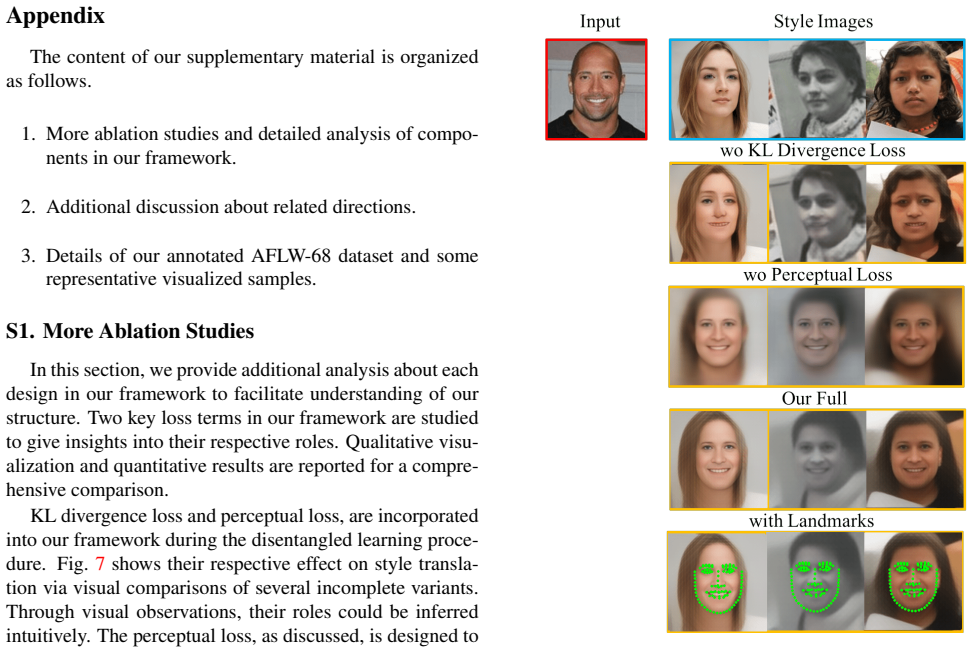
The load-bearing engine is a two-branch conditional variational auto-encoder: $E_{\mathrm{style}}$ maps an image and its landmark heatmap to a compact style code $z$, $E_{\mathrm{struct}}$ maps landmark heatmaps to a structure representation, and $D_{\mathrm{render}}$ re-renders the image from both. The KL divergence term against a unit Gaussian prior pushes $z$ toward carrying no structure information, the perceptual loss on deep convolutional features improves visual quality, and skip connections from $E_{\mathrm{struct}}$ to $D_{\mathrm{render}}$ keep geometry explicit. The central identity is the style-translation equation $x_{ij} = D_{\mathrm{render}}(E_{\mathrm{style}}(x_j, y_i), E_{\mathrm{struct}}(y_i))$, which converts the dataset into $n^2$ potential training pairs, of which the paper samples $k$ per geometry.
What would settle it
Measure structure leakage directly: render many style-translated images $x_{ij}$ and run a landmark detector on them; if predicted landmarks drift systematically away from $y_i$ and toward the geometry of the style-source image $x_j$, then the style code carries geometry and the augmentation is partly injecting wrong labels.
Extended reading notes
Core claim
The paper's central claim is that every face image $x$ can be modeled as a sample from a conditional distribution $p(x|y,z)$, where $y$ is the facial geometry encoded as landmark heatmaps and $z$ is a style code capturing all non-geometric factors. A conditional variational auto-encoder with a structure encoder, a style encoder, and a renderer is trained with KL regularization and perceptual reconstruction loss so that $z$ is encouraged to carry no structure information. Style translation then combines the structure code of image $i$ with the style code of image $j$ via $x_{ij} = D_{\mathrm{render}}(E_{\mathrm{style}}(x_j, y_i), E_{\mathrm{struct}}(y_i))$. The paper argues that these re-rendered images preserve $y_i$ faithfully, so they can be added to the training set with the original landmarks as labels. With $k=8$ styles sampled per landmark, the semi-supervised detectors outperform their fully supervised counterparts by large margins, including 4.39% NME on WFLW with a SAN backbone and 3.86% on 300W.
Load-bearing premise
The entire method depends on the learned style code containing no facial geometry at all, so that swapping styles never moves the landmarks; the paper supports this only with visual examples, not with a numerical disentanglement check.
Editorial extensions
If this is right
- Any landmark detector, from a light baseline network to stronger SAN and LAB baselines, reports gains when style-augmented synthetic samples are added to its training set.
- With only half the labeled training data, style augmentation lets a strong baseline reach results comparable to or better than previous fully supervised state-of-the-art methods on 300W and WFLW.
- The number of sampled styles per geometry has a sweet spot near $k=8$; larger $k$ makes the model overfit to synthetic texture and hurts performance.
- The gains are not confined to one benchmark: the paper reports improvements on occlusion-heavy COFW and large-pose AFLW as well as on WFLW and 300W.
Reading between the lines
- If the disentanglement is as clean as claimed, the same augmentation recipe should transfer to other keypoint-labeling tasks such as human pose estimation or hand keypoints, wherever 'content' can be defined by geometry and 'style' by appearance.
- A direct numerical check is missing: measure whether predicted landmarks drift when one geometry is rendered with many different styles. Such a test would separate genuine geometry-preserving augmentation from label noise caused by structure leakage.
- The large gains at low data fractions point to a practical use for expensive annotation regimes, but they also mean the disentangler's quality under data scarcity is the bottleneck that future work should target.
Signed reviews
Editorial analysis
A structured set of objections, weighed in public.
Referee Report
Summary. The paper proposes a semi-supervised framework for facial landmark detection based on disentangling each face image into a structure code (derived from landmark heatmaps) and a style code (lighting, texture, occlusion, etc.), then re-rendering the same structure under styles sampled from other training images. The augmented synthetic images, together with the original labels, are used to train landmark detectors. The authors report consistent gains over baselines on WFLW, 300W, COFW, and AFLW, including a new state-of-the-art result on WFLW (4.39% NME), and they provide ablations showing that the KL divergence and perceptual losses contribute to the performance. They also release the code and a re-annotated 68-point AFLW dataset.
Significance. If the central mechanism is validated, the paper offers a novel and potentially general augmentation perspective for landmark detection and similar structured prediction tasks. The strengths are explicit: the approach is evaluated on four benchmarks with multiple backbones; the gains are consistent; the code is public; and the new AFLW-68 annotation is a useful resource. The ablations in the appendix (Table 7) indicate that both the KL term and the perceptual loss matter. However, the headline causal claim—that style-translated synthetic samples, rather than merely additional training data, are responsible for the gains—is not yet established because the experiments lack a control for data volume and compute, and the hyperparameter k is selected on a test set. These issues are fixable with additional experiments, so the work is promising but needs revision before the central claim is supported.
major comments (4)
- [Section 3.2 and Section 4.2, Tables 1–5] The experiments do not isolate the effect of style translation from the effect of simply training on more data. With k=8, every 'Ours' model is trained on 9x as many images as the baseline (one original plus eight style-translated versions), while the baselines in Tables 1–5 are trained only on the original set. The reported gains could therefore be an artifact of increased data volume or compute rather than of style translation. The manuscript needs an equal-data or equal-compute control, such as training the baseline on the same number of effective samples by repeating each real image k times, training for 9x epochs on the original data, or matching the total number of gradient steps while holding the data distribution fixed. Without such a control, the abstract's statement that 'these augmented synthetic samples' outperform fully-supervised training is not a causal claim supported by the evidence.
- [Section 4.4.2, Table 6] The augmentation factor k is selected directly on the WFLW test set. The headline NME of 4.39% in Table 1 uses k=8, and Table 6 reports the test-set NME for k=0,2,4,8,16,32, with k=8 chosen as the best value. This is test-set tuning and inflates the reported improvement over baselines, which are not tuned in the same way. The authors should select k using a validation split or cross-validation and report the corresponding test-set numbers; they should also state explicitly which k was used for each reported result.
- [Section 3.1 and Eq. (4)] The disentanglement of the style code z is not verified quantitatively. The paper argues that the KL divergence and skip connections prevent Estyle from encoding structure information, and it provides visual examples in Figures 3 and 7, but there is no numerical measure of structure preservation or style-code leakage. This matters because Eq. (4) assumes that x_ij = D_render(E_style(x_j, y_i), E_struct(y_i)) preserves the landmark geometry y_i exactly. If z leaks structure information, the synthetic images carry incorrect labels, and the augmentation would inject label noise. The manuscript should include a quantitative disentanglement metric (e.g., landmark distance between the input and re-rendered image, or a consistency check by running a landmark detector on synthetic images) or otherwise demonstrate that the synthetic labels are reliable.
- [Section 4.4.1, Tables 4 and 5] The limited-data study has the same data-volume asymmetry as the main experiments. At each PCT, 'Ours' trains on the real images plus k synthetic versions of them, while the baseline sees only the real images; the relative gains are therefore partly explained by the baseline being undertrained at small PCT. The large improvements at low data percentages (e.g., +42.71% on 300W at 10% in Table 4) may reflect this asymmetry rather than a property of style-based augmentation. The equal-data and equal-compute controls requested above should also be applied to the limited-data setting before drawing conclusions about the method's behavior under scarce supervision.
minor comments (5)
- [Section 4.2] The text says the baseline models are trained 'with the same affine augmentation' as the augmented models, but it does not specify whether the total number of training iterations, learning-rate schedule, and batch composition are also matched. Please clarify these settings so that the comparison is unambiguous.
- [Appendix, Table 7] The baseline NME reported in Table 7 (8.49) appears inconsistent with the Res-18 baseline NME in Table 1 (6.09). If these numbers come from different settings (e.g., a different backbone or a different training configuration), this should be stated explicitly so the ablation is interpretable.
- [Eq. (2)] The loss expression has mismatched parentheses: '-KL(q_φ(z|x,y))||p_θ(z|y))' is not well-formed. Please rewrite the KL term in conventional notation, e.g., D_KL(q_φ(z|x,y) || p_θ(z|y)).
- [References] Several references lack years or venues (e.g., [14], [52], [57]), and the reference list would benefit from a consistency pass.
- [Table 6] The table header 'Number' should be labeled as the style augmentation factor k, and the row '0' should be identified as the baseline without style augmentation.
Circularity Check
No circularity: the style-translation augmentation pipeline is an empirical recipe whose gains are measured, not derived from its own inputs.
full rationale
The paper's central claim is empirical: synthetic images produced by re-rendering structure y_i with style code from another face improve downstream landmark detection. The generation equation x_ij = D_render(E_style(x_j, y_i), E_struct(y_i)) uses the original landmarks y_i as the training label for the synthetic image, but this is a data-generation choice, not a derivation that assumes the detector's output. The disentanglement of style and structure is learned through a reconstruction objective and KL regularization, and the facial landmark detector is an independent network trained on the resulting augmented set. No fitted parameter is renamed as a prediction: Table 6 varies k and reports test NME, but choosing k from the test-set curve is test-set selection, not an equivalence-by-construction reduction. The cited baselines LAB [69] and SAN [15] are used as external comparison frameworks and backbones; although LAB includes coauthors of this paper, no load-bearing argument depends on that citation. Concerns about missing data-volume controls, possible style-code leakage of structure, and test-set hyperparameter selection are external-validity and evaluation-protocol issues, not circular derivation. The paper is self-contained as an empirical study, so the circularity score is 0.
Assumptions & free parameters
free parameters (2)
- k, number of random styles sampled per landmark during augmentation =
8
- KL divergence loss weight relative to perceptual loss =
not stated (implicitly 1)
assumptions (4)
- domain assumption Face images factor into an independent style latent space and a structure space, whose Cartesian product captures all image variation (p(x|y,z)).
- domain assumption KL divergence to a unit Gaussian plus skip connections prevents the style encoder from encoding structure-related information.
- domain assumption Perceptual loss with VGG-19 (Eq. 3) is a suitable reconstruction objective for preserving style while reconstructing faces.
- standard math The standard VAE ELBO derivation applies to the conditional model p(x|y,z).
invented entities (1)
-
Style latent code z
Cite this review
Pith. "Pith review of Aggregation via Separation: Boosting Facial Landmark Detector with Semi-Supervised Style Translation." pith.science (2026). https://pith.science/paper/3A5C3W6J
@misc{pith2026190806440,
  author       = {Pith},
  title        = {Pith review of: Aggregation via Separation: Boosting Facial Landmark Detector with Semi-Supervised Style Translation},
  year         = {2026},
  howpublished = {\url{https://pith.science/paper/3A5C3W6J}},
  note         = {Machine review of arXiv:1908.06440}
}
read the original abstract
Facial landmark detection, or face alignment, is a fundamental task that has been extensively studied. In this paper, we investigate a new perspective of facial landmark detection and demonstrate it leads to further notable improvement. Given that any face images can be factored into space of style that captures lighting, texture and image environment, and a style-invariant structure space, our key idea is to leverage disentangled style and shape space of each individual to augment existing structures via style translation. With these augmented synthetic samples, our semi-supervised model surprisingly outperforms the fully-supervised one by a large margin. Extensive experiments verify the effectiveness of our idea with state-of-the-art results on WFLW, 300W, COFW, and AFLW datasets. Our proposed structure is general and could be assembled into any face alignment frameworks. The code is made publicly available at https://github.com/thesouthfrog/stylealign.
Figures


Figures from the paper (6 more)




Reference graph
Works this paper leans on
-
[1]
Data augmentation generative adversarial networks, 2018
Anthreas Antoniou, Amos Storkey, and Harrison Edwards. Data augmentation generative adversarial networks, 2018. 12
2018
-
[2]
Synthesizing images of humans in unseen poses
Guha Balakrishnan, Amy Zhao, Adrian V Dalca, Fredo Du- rand, and John Guttag. Synthesizing images of humans in unseen poses. In CVPR, 2018. 2
2018
-
[3]
Mutual information neural estimation
Mohamed Ishmael Belghazi, Aristide Baratin, Sai Rajesh- war, Sherjil Ozair, Yoshua Bengio, Devon Hjelm, and Aaron Courville. Mutual information neural estimation. In ICML,
-
[4]
Localizing parts of faces using a consensus of exemplars
Peter N Belhumeur, David W Jacobs, David J Kriegman, and Neeraj Kumar. Localizing parts of faces using a consensus of exemplars. IEEE transactions on pattern analysis and machine intelligence, 35(12):2930–2940, 2013. 5, 13
2013
-
[5]
Convolutional aggregation of local evidence for large pose face alignment
Adrian Bulat and Georgios Tzimiropoulos. Convolutional aggregation of local evidence for large pose face alignment
-
[6]
How far are we from solving the 2d & 3d face alignment problem?(and a dataset of 230,000 3d facial landmarks)
Adrian Bulat and Georgios Tzimiropoulos. How far are we from solving the 2d & 3d face alignment problem?(and a dataset of 230,000 3d facial landmarks). In ICCV, 2017. 1
2017
-
[7]
Robust face landmark estimation under occlusion
Xavier P Burgos-Artizzu, Pietro Perona, and Piotr Doll ´ar. Robust face landmark estimation under occlusion. In CVPR,
-
[8]
Face alignment by explicit shape regression
Xudong Cao, Yichen Wei, Fang Wen, and Jian Sun. Face alignment by explicit shape regression. IJCV, 2014. 2, 6
2014
Show all 88 references
-
[9]
Joint cascade face detection and alignment
Dong Chen, Shaoqing Ren, Yichen Wei, Xudong Cao, and Jian Sun. Joint cascade face detection and alignment. In ECCV, 2014. 2
2014
-
[10]
Infogan: Interpretable rep- resentation learning by information maximizing generative adversarial nets
Xi Chen, Yan Duan, Rein Houthooft, John Schulman, Ilya Sutskever, and Pieter Abbeel. Infogan: Interpretable rep- resentation learning by information maximizing generative adversarial nets. In NIPS, 2016. 1, 2
2016
-
[11]
Active appearance models
Timothy F Cootes, Gareth J Edwards, and Christopher J Tay- lor. Active appearance models. IEEE Transactions on Pat- tern Analysis & Machine Intelligence , 2001. 2
2001
-
[12]
Feature detection and tracking with constrained local models
David Cristinacce and Timothy F Cootes. Feature detection and tracking with constrained local models. In Bmvc, 2006. 2
2006
-
[13]
Joint multi-view face alignment in the wild
Jiankang Deng, George Trigeorgis, Yuxiang Zhou, and Ste- fanos Zafeiriou. Joint multi-view face alignment in the wild. arXiv preprint arXiv:1708.06023, 2017. 2
2017 arXiv
-
[14]
Unsuper- vised visual representation learning by context prediction
Carl Doersch, Abhinav Gupta, and Alexei A Efros. Unsuper- vised visual representation learning by context prediction. In ICCV. 2
-
[15]
Style aggregated network for facial landmark detection
Xuanyi Dong, Yan Yan, Wanli Ouyang, and Yi Yang. Style aggregated network for facial landmark detection. In CVPR,
-
[16]
A varia- tional u-net for conditional appearance and shape generation
Patrick Esser, Ekaterina Sutter, and Bj ¨orn Ommer. A varia- tional u-net for conditional appearance and shape generation. In CVPR, 2018. 1, 2
2018
-
[17]
Joint 3d face reconstruction and dense alignment with position map regression network
Yao Feng, Fan Wu, Xiaohu Shao, Yanfeng Wang, and Xi Zhou. Joint 3d face reconstruction and dense alignment with position map regression network. In ECCV, 2018. 1
2018
-
[18]
Cascaded collaborative regression for robust facial landmark detection trained using a mix- ture of synthetic and real images with dynamic weighting
Zhen-Hua Feng, Guosheng Hu, Josef Kittler, William Christ- mas, and Xiao-Jun Wu. Cascaded collaborative regression for robust facial landmark detection trained using a mix- ture of synthetic and real images with dynamic weighting. IEEE Transactions on Image Processing, 24(11):...
-
[19]
Wing loss for robust facial landmark localisation with convolutional neural networks
Zhen-Hua Feng, Josef Kittler, Muhammad Awais, Patrik Hu- ber, and Xiao-Jun Wu. Wing loss for robust facial landmark localisation with convolutional neural networks. In CVPR,
-
[20]
Learning invariance from transformation se- quences
Peter F ¨oldi´ak. Learning invariance from transformation se- quences. Neural Computation, 3(2):194–200, 1991. 2
1991
-
[21]
Im- age style transfer using convolutional neural networks
Leon A Gatys, Alexander S Ecker, and Matthias Bethge. Im- age style transfer using convolutional neural networks. In CVPR, 2016. 1, 2, 13
2016
-
[22]
Occlusion co- herence: Localizing occluded faces with a hierarchical de- formable part model
Golnaz Ghiasi and Charless C Fowlkes. Occlusion co- herence: Localizing occluded faces with a hierarchical de- formable part model. In CVPR, 2014. 5, 13
2014
-
[23]
Multi-pie
Ralph Gross, Iain Matthews, Jeffrey Cohn, Takeo Kanade, and Simon Baker. Multi-pie. Image and Vision Computing , 28(5):807–813, 2010. 13
2010
-
[24]
Identity mappings in deep residual networks
Kaiming He, Xiangyu Zhang, Shaoqing Ren, and Jian Sun. Identity mappings in deep residual networks. In ECCV,
-
[25]
beta-vae: Learning basic visual con- cepts with a constrained variational framework
Irina Higgins, Loic Matthey, Arka Pal, Christopher Burgess, Xavier Glorot, Matthew Botvinick, Shakir Mohamed, and Alexander Lerchner. beta-vae: Learning basic visual con- cepts with a constrained variational framework. In ICLR,
-
[26]
Improving landmark localization with semi-supervised learning
Sina Honari, Pavlo Molchanov, Stephen Tyree, Pascal Vin- cent, Christopher Pal, and Jan Kautz. Improving landmark localization with semi-supervised learning. In CVPR, 2018. 2, 6
2018
-
[27]
Recombinator networks: Learning coarse-to-fine feature aggregation
Sina Honari, Jason Yosinski, Pascal Vincent, and Christo- pher Pal. Recombinator networks: Learning coarse-to-fine feature aggregation. In CVPR, 2016. 6
2016
-
[28]
Multimodal unsupervised image-to-image translation
Xun Huang, Ming-Yu Liu, Serge Belongie, and Jan Kautz. Multimodal unsupervised image-to-image translation. In ECCV, 2018. 2
2018
-
[29]
Image-to-image translation with conditional adver- sarial networks
Phillip Isola, Jun-Yan Zhu, Tinghui Zhou, and Alexei A Efros. Image-to-image translation with conditional adver- sarial networks. In CVPR, 2017. 2
2017
-
[30]
Perceptual losses for real-time style transfer and super-resolution
Justin Johnson, Alexandre Alahi, and Li Fei-Fei. Perceptual losses for real-time style transfer and super-resolution. In ECCV, 2016. 1, 4
2016
-
[31]
Pose- invariant face alignment with a single cnn
Amin Jourabloo, Mao Ye, Xiaoming Liu, and Liu Ren. Pose- invariant face alignment with a single cnn. In CVPR, 2017. 1, 5, 6
2017
-
[32]
An active illumination and appearance (aia) model for face alignment
Fatih Kahraman, Muhittin Gokmen, Sune Darkner, and Ras- mus Larsen. An active illumination and appearance (aia) model for face alignment. In CVPR, 2007. 2
2007
-
[33]
Synergy between face alignment and tracking via discriminative global consensus optimization
Muhammad Haris Khan, John McDonagh, and Georgios Tz- imiropoulos. Synergy between face alignment and tracking via discriminative global consensus optimization. In ICCV,
-
[34]
Adam: A method for stochastic optimization
Diederik P Kingma and Jimmy Ba. Adam: A method for stochastic optimization. arXiv preprint arXiv:1412.6980 ,
-
[35]
Auto-encoding varia- tional bayes
Diederik P Kingma and Max Welling. Auto-encoding varia- tional bayes. arXiv preprint arXiv:1312.6114, 2013. 2
2013 arXiv
-
[36]
Annotated facial landmarks in the wild: A large- scale, real-world database for facial landmark localization
Martin Koestinger, Paul Wohlhart, Peter M Roth, and Horst Bischof. Annotated facial landmarks in the wild: A large- scale, real-world database for facial landmark localization. In ICCV workshops. IEEE, 2011. 1, 2, 5, 7, 13
2011
-
[37]
Disentangling 3d pose in a dendritic cnn for unconstrained 2d face alignment
Amit Kumar and Rama Chellappa. Disentangling 3d pose in a dendritic cnn for unconstrained 2d face alignment. In CVPR, 2018. 1, 5, 6
2018
-
[38]
Learning representations for automatic colorization
Gustav Larsson, Michael Maire, and Gregory Shakhnarovich. Learning representations for automatic colorization. In ECCV, 2016. 2
2016
-
[39]
Colorization as a proxy task for visual understanding
Gustav Larsson, Michael Maire, and Gregory Shakhnarovich. Colorization as a proxy task for visual understanding. In CVPR, 2017. 2
2017
-
[40]
Learning hierarchical invariant spatio-temporal features for action recognition with independent subspace analysis
Quoc V Le, Will Y Zou, Serena Y Yeung, and Andrew Y Ng. Learning hierarchical invariant spatio-temporal features for action recognition with independent subspace analysis
-
[41]
Interactive facial feature localization
Vuong Le, Jonathan Brandt, Zhe Lin, Lubomir Bourdev, and Thomas S Huang. Interactive facial feature localization. In ECCV, 2012. 5, 13
2012
-
[42]
Diverse image-to-image translation via disentangled representations
Hsin-Ying Lee, Hung-Yu Tseng, Jia-Bin Huang, Maneesh Singh, and Ming-Hsuan Yang. Diverse image-to-image translation via disentangled representations. In ECCV, 2018. 1, 2
2018
-
[43]
Unsupervised image-to-image translation networks
Ming-Yu Liu, Thomas Breuel, and Jan Kautz. Unsupervised image-to-image translation networks. In NIPS, 2017. 2
2017
-
[44]
Sphereface: Deep hypersphere embedding for face recognition
Weiyang Liu, Yandong Wen, Zhiding Yu, Ming Li, Bhiksha Raj, and Le Song. Sphereface: Deep hypersphere embedding for face recognition. In ICCV, 2017. 1
2017
-
[45]
A deep regression architecture with two-stage re-initialization for high performance facial landmark detec- tion
Jiangjing Lv, Xiaohu Shao, Junliang Xing, Cheng Cheng, and Xi Zhou. A deep regression architecture with two-stage re-initialization for high performance facial landmark detec- tion. In CVPR, 2017. 2, 6
2017
-
[46]
Pose guided person image genera- tion
Liqian Ma, Xu Jia, Qianru Sun, Bernt Schiele, Tinne Tuyte- laars, and Luc Van Gool. Pose guided person image genera- tion. In NIPS, 2017. 2
2017
-
[47]
Active appearance models revisited
Iain Matthews and Simon Baker. Active appearance models revisited. IJCV. 2
-
[48]
Robust facial landmark detection via a fully-convolutional local- global context network
Daniel Merget, Matthias Rock, and Gerhard Rigoll. Robust facial landmark detection via a fully-convolutional local- global context network. In CVPR, 2018. 2
2018
-
[49]
Xm2vtsdb: The extended m2vts database
Kieron Messer, Jiri Matas, Josef Kittler, Juergen Luettin, and Gilbert Maitre. Xm2vtsdb: The extended m2vts database. In Second international conference on audio and video-based biometric person authentication , volume 964, pages 965– 966, 1999. 5, 13
1999
-
[50]
Direct shape regression net- works for end-to-end face alignment
Xin Miao, Xiantong Zhen, Xianglong Liu, Cheng Deng, Vas- silis Athitsos, and Heng Huang. Direct shape regression net- works for end-to-end face alignment. In CVPR. 2
-
[51]
Stacked hour- glass networks for human pose estimation
Alejandro Newell, Kaiyu Yang, and Jia Deng. Stacked hour- glass networks for human pose estimation. In ECCV, 2016. 2
2016
-
[52]
A recurrent encoder-decoder for sequential face alignment
Xi Peng, Rogerio S Feris, Xiaoyu Wang, and DN Metaxs. A recurrent encoder-decoder for sequential face alignment. In ECCV. 2
-
[53]
Unsupervised person image syn- thesis in arbitrary poses
Albert Pumarola, Antonio Agudo, Alberto Sanfeliu, and Francesc Moreno-Noguer. Unsupervised person image syn- thesis in arbitrary poses. In CVPR, 2018. 2
2018
-
[54]
Face detection, pose es- timation, and landmark localization in the wild
Deva Ramanan and Xiangxin Zhu. Face detection, pose es- timation, and landmark localization in the wild. In CVPR,
-
[55]
Face alignment at 3000 fps via regressing local binary features
Shaoqing Ren, Xudong Cao, Yichen Wei, and Jian Sun. Face alignment at 3000 fps via regressing local binary features. In CVPR, 2014. 5, 6
2014
-
[56]
300 faces in-the-wild challenge: The first facial landmark localization challenge
Christos Sagonas, Georgios Tzimiropoulos, Stefanos Zafeiriou, and Maja Pantic. 300 faces in-the-wild challenge: The first facial landmark localization challenge. In ICCV Workshops, 2013. 1, 2, 5, 13
2013
-
[57]
A nonlinear discrimina- tive approach to aam fitting
Jason Saragih and Roland Goecke. A nonlinear discrimina- tive approach to aam fitting. In ICCV, 2007. 2
2007
-
[58]
The first facial landmark tracking in-the-wild challenge: Benchmark and results
Jie Shen, Stefanos Zafeiriou, Grigoris G Chrysos, Jean Kos- saifi, Georgios Tzimiropoulos, and Maja Pantic. The first facial landmark tracking in-the-wild challenge: Benchmark and results. In CVPR Workshops, 2015. 5
2015
-
[59]
Unsupervised learning of invariant features using video
David Stavens and Sebastian Thrun. Unsupervised learning of invariant features using video. In CVPR, 2010. 2
2010
-
[60]
Convolutional learning of spatio-temporal features
Graham W Taylor, Rob Fergus, Yann LeCun, and Christoph Bregler. Convolutional learning of spatio-temporal features. In ECCV, 2010. 2
2010
-
[61]
Face2face: Real-time face capture and reenactment of rgb videos
Justus Thies, Michael Zollhofer, Marc Stamminger, Chris- tian Theobalt, and Matthias Nießner. Face2face: Real-time face capture and reenactment of rgb videos. In CVPR, 2016. 1
2016
-
[62]
Disentangled repre- sentation learning gan for pose-invariant face recognition
Luan Tran, Xi Yin, and Xiaoming Liu. Disentangled repre- sentation learning gan for pose-invariant face recognition. In CVPR, 2017. 1
2017
-
[63]
Mnemonic descent method: A recurrent process applied for end-to-end face alignment
George Trigeorgis, Patrick Snape, Mihalis A Nico- laou, Epameinondas Antonakos, and Stefanos Zafeiriou. Mnemonic descent method: A recurrent process applied for end-to-end face alignment. In CVPR, 2016. 2, 5
2016
-
[64]
Robust face alignment using a mixture of invariant experts
Oncel Tuzel, Tim K Marks, and Salil Tambe. Robust face alignment using a mixture of invariant experts. In ECCV,
-
[65]
A deeply-initialized coarse-to-fine ensemble of regression trees for face alignment
Roberto Valle, Jose M Buenaposada, Antonio Valdes, and Luis Baumela. A deeply-initialized coarse-to-fine ensemble of regression trees for face alignment. In ECCV, 2018. 6
2018
-
[66]
Unsupervised learning of visual representations using videos
Xiaolong Wang and Abhinav Gupta. Unsupervised learning of visual representations using videos. In CVPR, 2015. 2
2015
-
[67]
Convolutional pose machines
Shih-En Wei, Varun Ramakrishna, Takeo Kanade, and Yaser Sheikh. Convolutional pose machines. In CVPR, 2016. 2
2016
-
[68]
Slow feature analysis: Unsupervised learning of invariances
Laurenz Wiskott and Terrence J Sejnowski. Slow feature analysis: Unsupervised learning of invariances. Neural com- putation, 14(4):715–770, 2002. 2
2002
-
[69]
Look at boundary: A boundary-aware face alignment algorithm
Wayne Wu, Chen Qian, Shuo Yang, Quan Wang, Yici Cai, and Qiang Zhou. Look at boundary: A boundary-aware face alignment algorithm. In CVPR, 2018. 1, 2, 4, 5, 6, 7, 12
2018
-
[70]
Leveraging intra and inter- dataset variations for robust face alignment
Wayne Wu and Shuo Yang. Leveraging intra and inter- dataset variations for robust face alignment. In CVPR, 2017. 5
2017
-
[71]
Recurrent 3d- 2d dual learning for large-pose facial landmark detection
Shengtao Xiao, Jiashi Feng, Luoqi Liu, Xuecheng Nie, Wei Wang, Shuicheng Yan, and Ashraf Kassim. Recurrent 3d- 2d dual learning for large-pose facial landmark detection. In ICCV, 2017. 5, 6
2017
-
[72]
Robust facial land- mark detection via recurrent attentive-refinement networks
Shengtao Xiao, Jiashi Feng, Junliang Xing, Hanjiang Lai, Shuicheng Yan, and Ashraf Kassim. Robust facial land- mark detection via recurrent attentive-refinement networks. In ECCV, 2016. 2, 6
2016
-
[73]
Global supervised descent method
Xuehan Xiong and Fernando De la Torre. Global supervised descent method. In CVPR, 2015. 2, 6
2015
-
[74]
Wider face: A face detection benchmark
Shuo Yang, Ping Luo, Chen-Change Loy, and Xiaoou Tang. Wider face: A face detection benchmark. In CVPR, 2016. 5
2016
-
[75]
The menpo facial landmark localisation challenge: A step towards the solution
Stefanos Zafeiriou, George Trigeorgis, Grigorios Chrysos, Jiankang Deng, and Jie Shen. The menpo facial landmark localisation challenge: A step towards the solution. In CVPR Workshops, 2017. 2
2017
-
[76]
Taskonomy: Disentangling task transfer learning
Amir R Zamir, Alexander Sax, William Shen, Leonidas J Guibas, Jitendra Malik, and Silvio Savarese. Taskonomy: Disentangling task transfer learning. In CVPR, 2018. 2
2018
-
[77]
Coarse-to-fine auto-encoder networks (cfan) for real-time face alignment
Jie Zhang, Shiguang Shan, Meina Kan, and Xilin Chen. Coarse-to-fine auto-encoder networks (cfan) for real-time face alignment. In ECCV, 2014. 6
2014
-
[78]
Colorful image colorization
Richard Zhang, Phillip Isola, and Alexei A Efros. Colorful image colorization. In ECCV, 2016. 2
2016
-
[79]
Split-brain autoencoders: Unsupervised learning by cross-channel pre- diction
Richard Zhang, Phillip Isola, and Alexei A Efros. Split-brain autoencoders: Unsupervised learning by cross-channel pre- diction. In CVPR, 2017. 2
2017
-
[80]
Learning deep representation for face alignment with auxiliary attributes
Zhanpeng Zhang, Ping Luo, Chen Change Loy, and Xiaoou Tang. Learning deep representation for face alignment with auxiliary attributes. IEEE transactions on pattern analysis and machine intelligence, 2016. 2, 6
2016
-
[81]
Unpaired image-to-image translation using cycle- consistent adversarial networks
Jun-Yan Zhu, Taesung Park, Phillip Isola, and Alexei A Efros. Unpaired image-to-image translation using cycle- consistent adversarial networks. In ICCV, 2017. 4
2017
-
[82]
Face alignment by coarse-to-fine shape searching
Shizhan Zhu, Cheng Li, Chen Change Loy, and Xiaoou Tang. Face alignment by coarse-to-fine shape searching. In CVPR, 2015. 2, 5, 6
2015
-
[83]
Unconstrained face alignment via cascaded compo- sitional learning
Shizhan Zhu, Cheng Li, Chen-Change Loy, and Xiaoou Tang. Unconstrained face alignment via cascaded compo- sitional learning. In CVPR, 2016. 2, 5
2016
-
[84]
Face alignment across large poses: A 3d solu- tion
Xiangyu Zhu, Zhen Lei, Xiaoming Liu, Hailin Shi, and Stan Z Li. Face alignment across large poses: A 3d solu- tion. In CVPR, 2016. 6
2016
-
[85]
Deep learning of invariant features via simulated fixations in video
Will Zou, Shenghuo Zhu, Kai Yu, and Andrew Y Ng. Deep learning of invariant features via simulated fixations in video. In NIPS, 2012. 2 Appendix The content of our supplementary material is organized as follows
2012
-
[86]
More ablation studies and detailed analysis of compo- nents in our framework
-
[87]
Additional discussion about related directions
-
[88]
over-smoothness
Details of our annotated AFLW-68 dataset and some representative visualized samples. S1. More Ablation Studies In this section, we provide additional analysis about each design in our framework to facilitate understanding of our structure. Two key loss terms in our framework a...
Reviewed August 14, 2026 · model on record in the stance chip above.
Discussion (0). Continue with ORCID to comment.