Pulsed Infrared Emission from Magnetar 4U 0142+61 Detected by JWST
Pith reviewed 2026-06-30 07:19 UTC · model grok-4.3
The pith
JWST detects pulsed infrared emission from magnetar 4U 0142+61 at 4.08 microns with a peak that aligns with its hard X-ray pulses.
A machine-rendered reading of the paper's core claim, the machinery that carries it, and where it could break.
Core claim
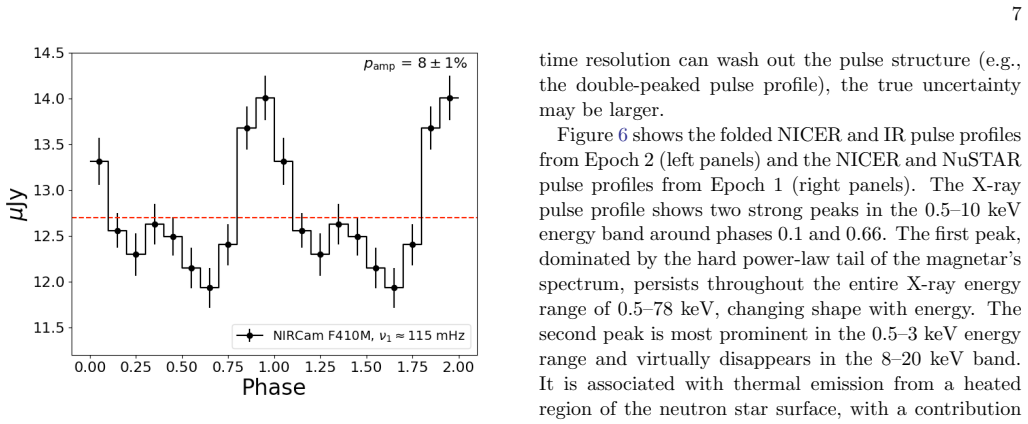
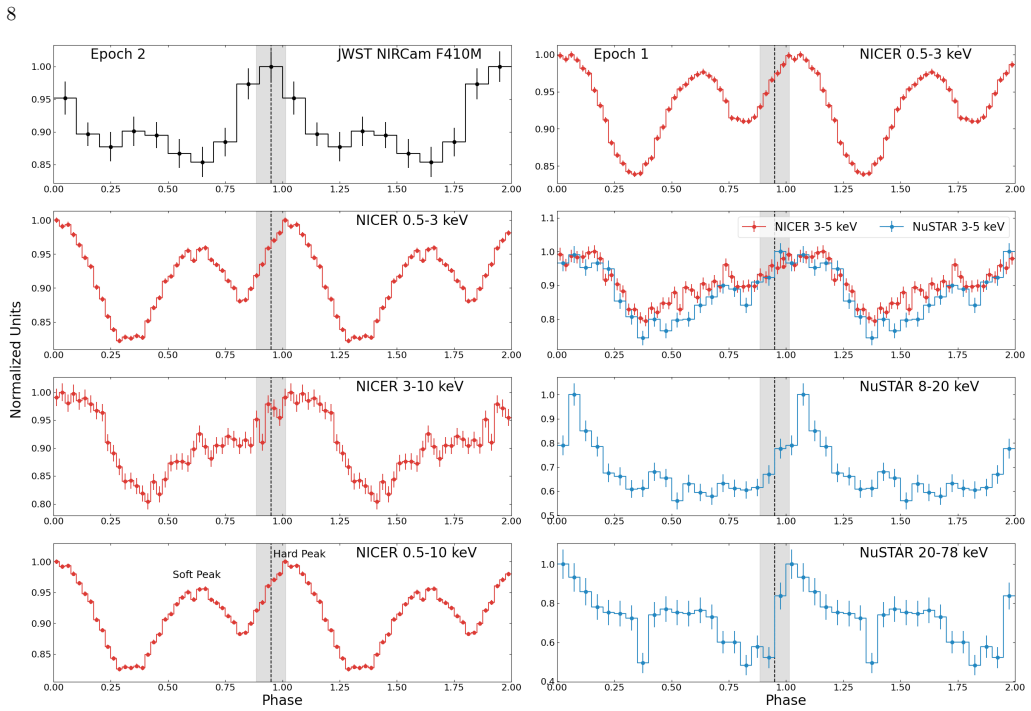
In a 33-minute JWST NIRCam timing-mode observation, the team recorded f_ν = 22.9 ± 0.6 μJy at 4.08 μm and extracted a pulse profile with one peak per rotation at the magnetar spin frequency. The infrared peak coincides with the hard X-ray peak, while the soft X-ray peak is offset, indicating that the pulsed infrared emission originates in the same magnetospheric region responsible for the hard X-rays.
What carries the argument
Phase comparison of the NIRCam-derived infrared pulse profile against archival NICER soft X-ray and NuSTAR hard X-ray profiles to establish spatial coincidence of the emission sites.
If this is right
- Pulsed infrared emission must be produced inside the magnetosphere together with the hard X-rays.
- Magnetar emission models are required to generate radiation that remains pulsed from hard X-rays down to at least 4 μm.
- The lower limit of 10 percent on the pulsed fraction constrains the beaming or viewing geometry of the infrared component.
- Infrared timing observations can now be used to map magnetospheric structure independently of X-ray absorption.
Where Pith is reading between the lines
- If the phase alignment persists across multiple epochs, it would further rule out a fallback-disk origin for the infrared light.
- Similar JWST timing observations of other magnetars could reveal whether infrared pulsations are common or tied to specific magnetic-field strengths.
- The detection implies that infrared data may eventually help separate magnetospheric from surface or crustal contributions in magnetar spectra.
Load-bearing premise
The 115 mHz signal detected in the infrared time series is astrophysical pulsation from the magnetar and the observed phase alignment with hard X-rays indicates they share the same physical emission region.
What would settle it
A later JWST or ground-based infrared observation that either fails to recover significant power at the magnetar spin frequency or places the infrared peak at a different rotational phase from the hard X-ray peak would falsify the shared magnetospheric origin.
Figures
read the original abstract
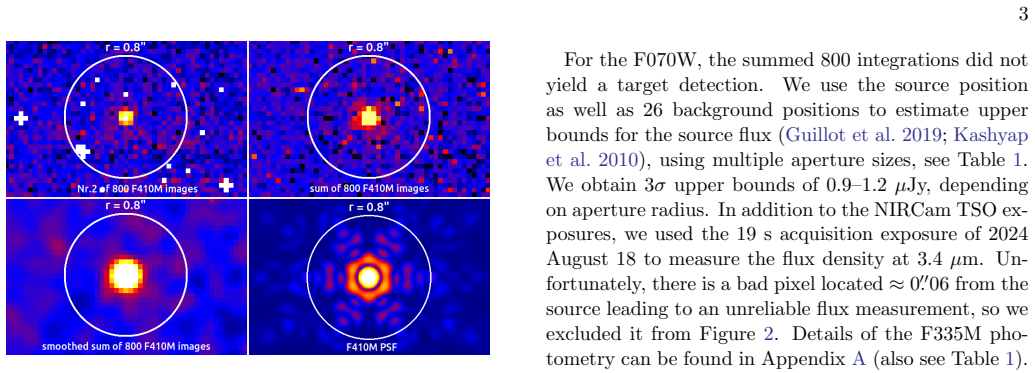
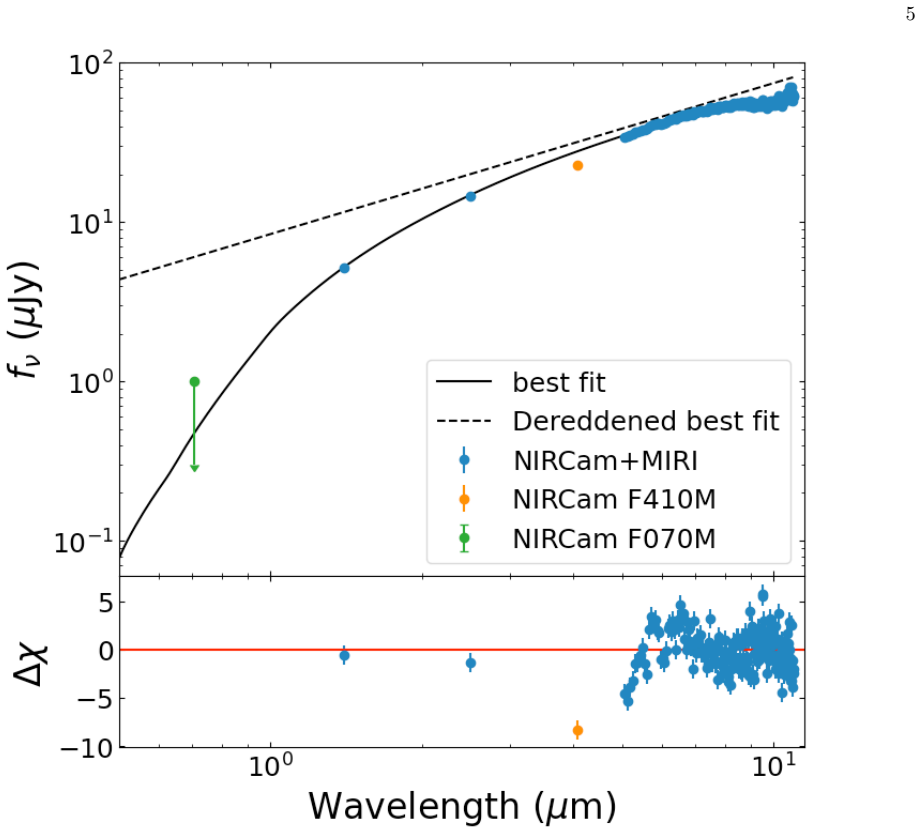
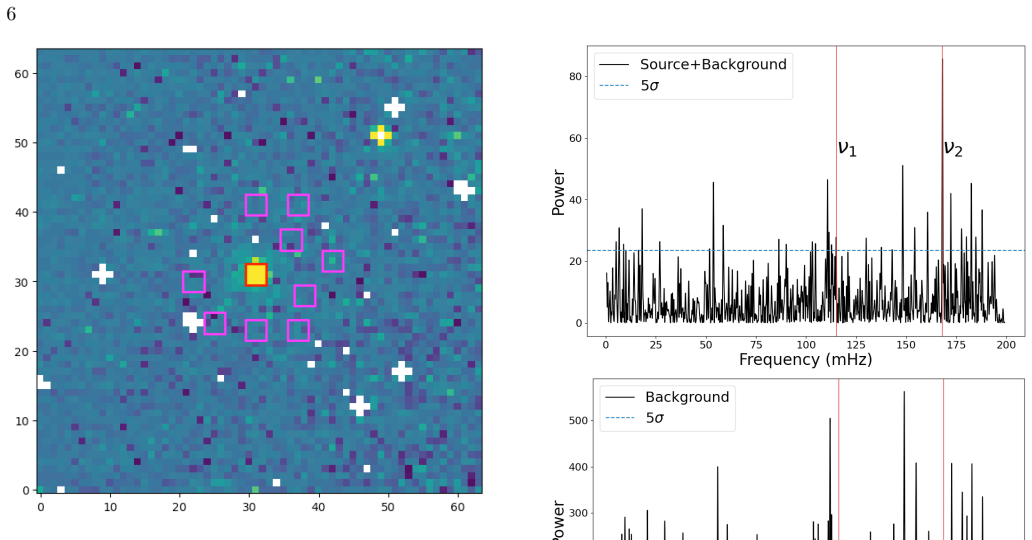
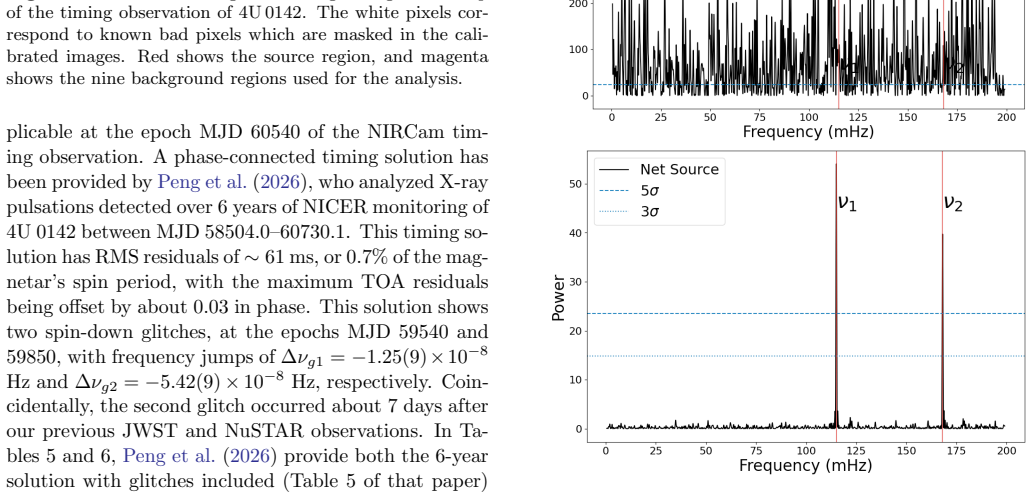
We report on a JWST observation of the magnetar 4U 0142+61 on 2024 August 18 with the Near-Infrared Camera (NIRCam). NIRCam observed the magnetar for 33~min in timing mode, providing a time resolution of 2.5~s. In the F410M filter (pivot wavelength 4.08 $\mu$m), we measured the flux density $f_\nu = 22.9\pm0.6$ $\mu$Jy and detected pulsations at a frequency of $115.059\pm0.035$ mHz, in agreement with the magnetar's spin period at the epoch of the JWST observation. The observed pulse profile has one peak per period (although this may be due to the poor time resolution), with a lower limit on the pulsed fraction of about 10\%. We compare the IR pulse profile to the NICER and NuSTAR X-ray pulse profiles and find that the IR peak overlaps with the hard X-ray peak, suggesting a magnetospheric origin for the pulsed IR emission.
Editorial analysis
A structured set of objections, weighed in public.
Referee Report
Summary. The manuscript reports a JWST NIRCam timing-mode observation of magnetar 4U 0142+61 lasting 33 min with 2.5 s sampling in the F410M filter. It measures a flux density of 22.9 ± 0.6 μJy and claims detection of pulsations at 115.059 ± 0.035 mHz, matching the known spin period. The single-peaked IR profile is compared to NICER and NuSTAR X-ray profiles, with the IR peak overlapping the hard X-ray peak; this overlap is interpreted as evidence for a magnetospheric origin of the pulsed IR emission. A lower limit of ~10% is placed on the pulsed fraction.
Significance. If the pulsation detection is statistically robust, the result would constitute the first reported pulsed infrared emission from any magnetar. This would directly constrain the location and mechanism of IR emission relative to the hard X-ray component in the magnetosphere, complementing existing X-ray timing data. The JWST timing-mode measurement itself is technically novel for this source class.
major comments (3)
- [Abstract] Abstract: the central claim of a pulsation detection at 115.059 ± 0.035 mHz supplies a formal frequency uncertainty but reports neither peak power, S/N ratio, false-alarm probability, nor the details of the periodicity search (targeted vs. blind, frequency window, number of trials). With only ~226 cycles sampled at 2.5 s cadence, these quantities are required to establish that the signal is not a noise fluctuation or instrumental artifact; their absence is load-bearing for the detection claim.
- [Abstract] Abstract, final sentence: the inference that the IR peak overlap with the hard X-ray peak indicates a shared magnetospheric origin rests on a single-epoch alignment. No quantitative test of phase coincidence (e.g., cross-correlation significance or Monte-Carlo phase randomization) is described, weakening the origin argument.
- [Abstract] Abstract: the stated lower limit of ~10% on the pulsed fraction does not specify how the limit was derived after accounting for the 2.5 s time resolution and possible aliasing; without this calculation the robustness of the limit cannot be assessed.
minor comments (1)
- [Abstract] The parenthetical remark that the single peak 'may be due to the poor time resolution' is appropriate but should be quantified in the main text by showing the expected smearing of a narrower pulse under 2.5 s binning.
Simulated Author's Rebuttal
We thank the referee for their insightful comments, which have helped us improve the presentation of our results. We provide point-by-point responses to the major comments below.
read point-by-point responses
-
Referee: [Abstract] Abstract: the central claim of a pulsation detection at 115.059 ± 0.035 mHz supplies a formal frequency uncertainty but reports neither peak power, S/N ratio, false-alarm probability, nor the details of the periodicity search (targeted vs. blind, frequency window, number of trials). With only ~226 cycles sampled at 2.5 s cadence, these quantities are required to establish that the signal is not a noise fluctuation or instrumental artifact; their absence is load-bearing for the detection claim.
Authors: We agree that the abstract should include these key statistical measures to support the detection claim. In the revised manuscript, we have incorporated the peak power, S/N ratio, and false-alarm probability into the abstract. The periodicity search was targeted at the known spin frequency, using a narrow frequency window consistent with the spin-down rate, and the number of trials has been accounted for in the FAP. Expanded details are provided in the methods section. revision: yes
-
Referee: [Abstract] Abstract, final sentence: the inference that the IR peak overlap with the hard X-ray peak indicates a shared magnetospheric origin rests on a single-epoch alignment. No quantitative test of phase coincidence (e.g., cross-correlation significance or Monte-Carlo phase randomization) is described, weakening the origin argument.
Authors: We recognize that a quantitative assessment of the phase coincidence would strengthen the interpretation. We have added a Monte Carlo phase randomization test in the revised manuscript to evaluate the significance of the observed alignment between the IR and hard X-ray peaks, demonstrating that the overlap is statistically significant. revision: yes
-
Referee: [Abstract] Abstract: the stated lower limit of ~10% on the pulsed fraction does not specify how the limit was derived after accounting for the 2.5 s time resolution and possible aliasing; without this calculation the robustness of the limit cannot be assessed.
Authors: We have revised the manuscript to explicitly describe the derivation of the pulsed fraction lower limit, including the effects of the 2.5 s sampling time and aliasing considerations. The limit is obtained by simulating the expected modulation for different intrinsic pulsed fractions folded with the instrument response. revision: yes
Circularity Check
No significant circularity; direct observational result compared to external prior period
full rationale
The paper reports a JWST flux measurement (f_ν = 22.9±0.6 μJy) and a detected frequency (115.059±0.035 mHz) that is stated to agree with the independently known spin period from prior X-ray data. No model is fitted to derive the period, no prediction is made from a subset of the same data, and no self-citation chain or ansatz is invoked to justify the central claims. The phase-overlap comparison with X-ray profiles is a post-detection interpretation, not a derivation that reduces to the inputs by construction. The result is self-contained against external benchmarks (known spin period).
Axiom & Free-Parameter Ledger
axioms (1)
- domain assumption The magnetar's spin frequency is independently and accurately known from prior X-ray observations at the epoch of the JWST visit.
Reference graph
Works this paper leans on
-
[1]
G., Shibanov, Y., et al.\ 2022, , 924, 128
Abramkin, V., Pavlov, G. G., Shibanov, Y., et al.\ 2022, , 924, 128. doi:10.3847/1538-4357/ac3a6f
-
[2]
Archibald, R. F., Kaspi, V. M., Scholz, P., et al.\ 2017, , 834, 2, 163. doi:10.3847/1538-4357/834/2/163
-
[3]
Astropy Collaboration, Price-Whelan, A. M., Lim, P. L., et al.\ 2022, , 935, 2, 167. doi:10.3847/1538-4357/ac7c74
work page internal anchor Pith review doi:10.3847/1538-4357/ac7c74 2022
-
[4]
Astropy Collaboration, Price-Whelan, A. M., Sip o cz, B. M., et al.\ 2018, , 156, 3, 123. doi:10.3847/1538-3881/aabc4f
-
[5]
Astropy Collaboration, Robitaille, T. P., Tollerud, E. J., et al.\ 2013, , 558, A33. doi:10.1051/0004-6361/201322068
-
[6]
Bushouse, H., Eisenhamer, J., Dencheva, N., et al.\ 2025, Zenodo, 1.20.2. doi:10.5281/zenodo.17515973
-
[7]
Chu, C.-Y., Hu, C.-P., Enoto, T., et al.\ 2026, , 284, 1, 25. doi:10.3847/1538-4365/ae5655
-
[8]
Dhillon, V. S., Marsh, T. R., Hulleman, F., et al.\ 2005, , 363, 609. doi:10.1111/j.1365-2966.2005.09465.x
-
[9]
Dhillon, V. S., Marsh, T. R., Littlefair, S. P., et al.\ 2009, , 394, 1, L112. doi:10.1111/j.1745-3933.2009.00623.x
-
[10]
2011, MNRAS, 414, L60, doi: 10.1111/j.1745-3933.2011.01056.x van Son, L
Dhillon, V. S., Marsh, T. R., Littlefair, S. P., et al.\ 2011, , The first observation of optical pulsations from a soft gamma repeater: SGR 0501+4516, 416, 1, L16. doi:10.1111/j.1745-3933.2011.01088.x
-
[11]
Dib, R. & Kaspi, V. M.\ 2014, , 784, 37. doi:10.1088/0004-637X/784/1/37
-
[12]
Durant, M. & van Kerkwijk, M. H.\ 2006, , 652, 576. doi:10.1086/507605
-
[13]
Ertan, \" U ., & Cheng, K. S.\ 2004, , 605, 840. doi:10.1086/382502
-
[14]
Ertan, \"U ., Erkut, M. H., Ek s i, K. Y., et al.\ 2007, , 657, 1, 441. doi:10.1086/510303
-
[15]
Gavriil, F. P., Dib, R., & Kaspi, V. M.\ 2008, 40 Years of Pulsars: Millisecond Pulsars, Magnetars and More, 983, 234. doi:10.1063/1.2900150
-
[16]
C., Arzoumanian, Z., Adkins, P
Gendreau, K. C., Arzoumanian, Z., Adkins, P. W., et al.\ 2016, , The Neutron star Interior Composition Explorer (NICER): design and development, 9905, 99051H. doi:10.1117/12.2231304
-
[17]
G., Reyes, C., et al.\ 2019, , 874, 2, 175
Guillot, S., Pavlov, G. G., Reyes, C., et al.\ 2019, , 874, 2, 175. doi:10.3847/1538-4357/ab0f38
-
[18]
G., et al.\ 2021, , 923, 2, 249
Hare, J., Volkov, I., Pavlov, G. G., et al.\ 2021, , 923, 2, 249. doi:10.3847/1538-4357/ac30e2
-
[19]
G., Posselt, B., et al.\ 2024, , 972, 176
Hare, J., Pavlov, G. G., Posselt, B., et al.\ 2024, , 972, 176. doi:10.3847/1538-4357/ad5ce5
-
[20]
Harrison, F. A., Craig, W. W., Christensen, F. E., et al.\ 2013, , 770, 103. doi:10.1088/0004-637X/770/2/103
-
[21]
Hulleman, F., van Kerkwijk, M. H., & Kulkarni, S. R.\ 2004, , 416, 1037. doi:10.1051/0004-6361:20031756
-
[22]
Kashyap, V. L., van Dyk, D. A., Connors, A., et al.\ 2010, , 719, 1, 900. doi:10.1088/0004-637X/719/1/900
-
[23]
Kaspi, V. M. & Beloborodov, A. M.\ 2017, , 55, 1, 261. doi:10.1146/annurev-astro-081915-023329
-
[24]
& Martin, C.\ 2002, , 417, 527
Kern, B. & Martin, C.\ 2002, , 417, 527. doi:10.1038/417527a
-
[25]
Luo, J., Ransom, S., Demorest, P., et al.\ 2021, , 911, 1, 45. doi:10.3847/1538-4357/abe62f
-
[26]
Mu \ n oz-Darias, T., de Ugarte Postigo, A., & Casares, J.\ 2016, , 458, L114. doi:10.1093/mnrasl/slw024
-
[27]
Olausen, S. A. & Kaspi, V. M.\ 2014, , 212, 6. doi:10.1088/0067-0049/212/1/6
-
[28]
G., Kargaltsev, O., Hare, J., & Posselt, B
Pavlov, G. G., Kargaltsev, O., Hare, J., & Posselt, B. 2021, JWST Proposal. Cycle 1, ID. \#2635
2021
-
[29]
Peng, H.-L., Weng, S.-S., Ge, M.-Y., et al.\ 2026, , 999, 1, 85. doi:10.3847/1538-4357/ae4007
-
[30]
Rieke, M. J., Kelly, D. M., Misselt, K., et al.\ 2023, , 135, 028001. doi:10.1088/1538-3873/acac53
-
[31]
Shaw, A. W., Kaplan, D. L., Gandhi, P., et al.\ 2025, , 169, 1, 21. doi:10.3847/1538-3881/ad8eb1
-
[32]
Susobhanan, A., Kaplan, D. L., Archibald, A. M., et al.\ 2024, , 971, 2, 150. doi:10.3847/1538-4357/ad59f7
-
[33]
P., Hasc \"o et, R., Yang, C., et al.\ 2015, , 808, 32
Tendulkar, S. P., Hasc \"o et, R., Yang, C., et al.\ 2015, , 808, 32. doi:10.1088/0004-637X/808/1/32
-
[34]
VanderPlas, J. T.\ 2018, , 236, 1, 16. doi:10.3847/1538-4365/aab766
work page internal anchor Pith review doi:10.3847/1538-4365/aab766 2018
-
[35]
Wang, Z., Chakrabarty, D., & Kaplan, D. L.\ 2006, , 440, 772. doi:10.1038/nature04669
-
[36]
doi:10.1007/978-3-642-17251-9\_26
Zane, S., Nobili, L., & Turolla, R.\ 2011, High-Energy Emission from Pulsars and their Systems, 21, 329. doi:10.1007/978-3-642-17251-9\_26
discussion (0)
Sign in with ORCID, Apple, or X to comment. Anyone can read and Pith papers without signing in.