REVIEW 3 major objections 5 minor 57 references
Boosting quantum efficiency by reducing complexity
T0 review · 3 major / 5 minor · reviewed 2026-08-07 · deepseek-v4-flash
Pith's one-line read Removing most couplings from a chaotic quantum charger makes the battery store energy more efficiently, with a ~10% efficiency boost near the chaos threshold for ten cells.
desk verdict Sparse SYK batteries are a sensible new combination, but the headline efficiency boost rests on an underspecified half-battery ergotropy computation that must be pinned down before the ~10% claim is trusted. read the letter →
The pith
A machine-rendered reading of the paper's core claim, the machinery that carries it, and where it could break.
The reading
What carries the argument
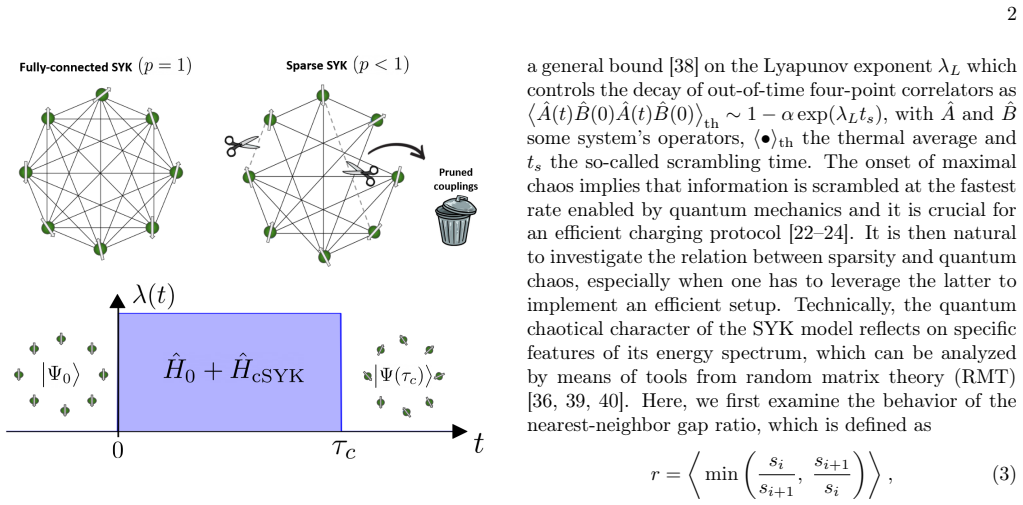
The central object is the sparsified complex Sachdev-Ye-Kitaev Hamiltonian, mapped by a Jordan-Wigner transformation onto $N$ spin-$1/2$ cells with charging Hamiltonian $\hat{H}_0 = \omega_0 \sum_i \sigma_i^y$ and interaction term the sparse cSYK Hamiltonian. The argument is carried by the sparsity parameter $p$ and the chaos threshold $p_2$, defined as the value where the nearest-neighbor gap ratio $r$ drops below $99\%$ of its fully connected value; the spectral form factor confirms that the dip-ramp-plateau structure vanishes around the same point. The performance figures of merit are the stored energy $E_N(\tau_c)$ and the battery efficiency $e = \mathcal{E}_{N/2}/E_{N/2}$, where $\mathcal{E}$ is the ergotropy, the maximum work extractable by cyclic unitary operations, evaluated on half of the battery.
What would settle it
Recompute the efficiency for $N=10$ with an explicitly defined partial trace over half the cells, for example tracing out cells $N/2+1,\dots,N$, at $p$ near $p_2$; if the efficiency no longer exceeds the $p=1$ value by about $10\%$, the quantitative claim is not stable.
Extended reading notes
Core claim
The central claim is that, as long as chaos is not completely broken, reducing the complexity of the SYK charger by increasing its sparsity can boost battery efficiency. Concretely, the paper studies the complex SYK model with each random Gaussian coupling retained with probability $p$ and rescaled by $J^2 \to J^2/p$, and it identifies a critical sparsity $p_2$ below which nearest-neighbor level repulsion and the spectral form factor ramp disappear. For $N=10$, approaching $p_2$ from above raises the half-battery efficiency by about $10\%$ relative to the fully connected case, while the stored energy barely changes down to $p \simeq p_2$; larger batteries, which are normally the least efficient, gain the most from sparsification. The underlying reason, the paper argues, is that pruning reduces interference between interaction terms while retaining the level repulsion and spectral rigidity that make the system a fast scrambler.
Load-bearing premise
The quantitative result rests on an unspecified operational choice: how the half of the battery entering the efficiency is defined and how the reduced density matrix of that half is obtained, since the paper only says it stops the energy sum at $N/2$.
Editorial extensions
If this is right
- Experimental realizations of SYK chargers can prune most couplings—thousands of lasers or extreme magnetic fields are not required—and still store the same energy, with higher extraction efficiency.
- The efficiency gain from sparsification grows with battery size in the simulated range, so larger SYK batteries, normally the least efficient, benefit most from operating near $p_2$.
- The stored energy saturates around the chaos threshold $p_2$, giving a concrete design target: tune sparsity as low as possible without crossing into the non-chaotic regime.
- The sparse model retains fast scrambling, so the charging-time advantage of SYK batteries survives the reduction in complexity.
- Below $p_2$, performance drops sharply, so reducing complexity only helps while chaos persists—sparsity is not a free lunch.
Reading between the lines
- The paper's efficiency is computed on half of the battery without specifying the partial trace; testing alternative definitions (tracing out the second half versus a random half, or using the global state's passive energy) would show whether the ~10% boost is an artifact of that choice.
- If reduced interference is the mechanism, the same sparsity-efficiency peak should appear in other all-to-all random chargers, such as random quantum circuits with connectivity pruning; this is a direct, testable extension.
- The critical sparsity $p_2$ shrinks quickly with $N$ (0.1263, 0.0279, 0.0097 for $N=6,8,10$), so in larger batteries the window of beneficial sparsity may become impractical to target; a finite-size scaling study would clarify how the boost scales.
- A sharper statement would connect the efficiency peak to entanglement or spectral statistics quantitatively, for example by checking whether the peak tracks $p_2$ or another transition marker.
Editorial analysis
A structured set of objections, weighed in public.
Referee Report
Summary. The manuscript studies the sparse complex Sachdev-Ye-Kitaev (cSYK) model as a charger for a quantum battery. It first verifies that spectral chaos diagnostics, namely the nearest-neighbor gap ratio and the spectral form factor, survive down to a critical sparsity p2, and then computes battery figures of merit: stored energy (Eq. 8) and efficiency defined as half-battery ergotropy over half-battery stored energy (Eq. 9). The central claim is that as p approaches p2 from above, the battery efficiency is enhanced, with a reported ~10% boost for N=10, before efficiency degrades once chaos is broken. The paper argues this illustrates a trade-off between complexity and battery performance.
Significance. If the reported effect is genuine, it is a notable and practically relevant result: reducing the number of interaction terms in an SYK charger could not only ease experimental implementation but also improve energy extraction, which is a nontrivial and counterintuitive outcome. The manuscript has clear strengths: the chaos diagnostics are standard, the disorder averaging is described, statistical errors are stated to be smaller than the marker sizes, and the battery figures of merit are based on established definitions of stored energy and ergotropy. No free parameter is fitted to produce the efficiency curve; the p2 threshold is presented as a heuristic. The main quantitative claim, however, depends on technical details of the half-battery ergotropy computation that are not specified in the current text, and the paper does not state at which time tau_c the efficiency is evaluated. These gaps are load-bearing for the central conclusion.
major comments (3)
- [§3, Eq. (9)] The half-battery ergotropy is not operationally defined. For a subsystem consisting of the first N/2 cells, the standard ergotropy of Eq. (10) must be computed from the reduced density matrix rho_A = Tr_B |Psi><Psi|, with the passive state determined with respect to the restricted local Hamiltonian H_A. The text instead says only that one 'stop[s] the sum at N/2' when defining E(t). If the authors evaluated Tr[H_A |Psi><Psi|] on the global pure state, then the result is not an ergotropy but a truncated energy expectation value, and it can substantially overestimate extractable work when the two halves are entangled. Since the SYK dynamics generates strong entanglement, this distinction can change the quantitative efficiency values and could explain the reported ~10% boost near p2. Please state explicitly whether the reduced density matrix is used, define the passive state computation for that reduced state, and, preferably, provide a robustness check against alternative (e.g., full-system) definitions of the extractable work.
- [Fig. 6] The efficiency e(tau_c) is a time-dependent quantity, but the paper never specifies at which charging time tau_c the data in Fig. 6 are evaluated. Different choices, such as the time of maximum stored energy, a fixed time for all p, or times after the charging pulse, can lead to different efficiency-versus-p behavior. This matters because the stored energy curves in Fig. 5 vary non-trivially with tau_c and p. Please state the exact tau_c protocol used for each sparsity value and justify that the reported efficiency boost is not an artifact of the chosen time.
- [§2, Fig. 2] The definition of p2 as the value where the gap ratio drops below 99% of its fully connected value is somewhat arbitrary, and the manuscript does not test how sensitive the qualitative conclusion is to this threshold choice. Since the paper's central narrative is 'as long as chaos is not completely broken,' it would strengthen the argument to show that the efficiency peak around p2 is robust to reasonable alternative definitions of the chaos-breaking threshold (e.g., 90% or 95% of the fully connected value).
minor comments (5)
- [Abstract] The phrase 'we explore how the robustness of this setup' is ungrammatical; it should be 'we explore the robustness of this setup'.
- [Eq. (9)] Equation (9) appears to use the same symbol in the numerator and denominator; presumably one quantity is the ergotropy (e.g., script E) and the other is the stored energy (E). Please fix the notation to avoid ambiguity.
- [§3] The text says 'for our later purposed'; this should be 'for our later purposes'.
- [Experimental considerations] The Kullback-Leibler divergence D_KL is introduced but never used in the rest of the paper; either use it to quantify sparseness of the experimental implementation or remove it.
- [Code availability] The statement that all codes are available 'upon reasonable request' limits reproducibility. I recommend depositing the numerical code and processed data in a public repository, especially because the central efficiency computation is not fully specified in the text.
Circularity Check
No significant circularity: the efficiency curves are computed directly from the sparse SYK Hamiltonian and standard ergotropy definitions, not fitted to the claimed boost.
full rationale
The paper's central derivation chain is self-contained numerically: it defines the sparse cSYK Hamiltonian by retaining couplings with probability p and rescaling J^2 -> J^2/p, evolves the battery state under Eq. (5), and evaluates stored energy Eq. (8), ergotropy Eq. (10), and efficiency Eq. (9) directly from the evolved state. No free parameter is fitted to the efficiency data. The critical sparsity p2 is defined independently from the nearest-neighbor gap ratio in Eq. (3), following the external reference [36], and from the spectral form factor Eq. (4); it is not extracted from battery figures of merit. The observation that stored energy saturates near p2 and that efficiency improves as p approaches p2 from above is a numerical result, not an input. The paper does cite prior work on SYK quantum batteries [22-24] for motivation and comparison, but the quantitative claims in Figs. 5 and 6 are computed by the authors with explicit disorder averaging and exact dynamics, not imported from those citations. The half-battery ergotropy computation contains an underspecified operational detail, namely how the reduced state of half the battery is obtained when restricting H0 to N/2 cells, but this is a reproducibility or correctness ambiguity rather than a circular reduction: truncating a local sum in the expectation value is not equivalent to defining the efficiency in terms of itself. No equation in the paper is shown to reduce to its own input by construction, and no fitted parameter is renamed as a prediction. Therefore the paper does not exhibit circular reasoning.
Assumptions & free parameters
free parameters (2)
- p2 threshold =
99% of r(p=1)
- Number of disorder realizations N_dis =
1000 (N=6), 500 (N=8), 150 (N=10)
assumptions (4)
- domain assumption Sparse SYK with coupling rescaling J^2 -> J^2/p preserves chaotic properties up to the critical p2.
- standard math Jordan-Wigner transformation maps the complex SYK model to a spin-1/2 system.
- ad hoc to paper Ergotropy of the half battery is computed by restricting H0 to N/2 cells, with the rest of the system traced out.
- domain assumption Quantum chaos markers (gap ratio, SFF) indicate fast scrambling relevant for efficient charging.
Cite this review
Pith. "Pith review of Boosting quantum efficiency by reducing complexity." pith.science (2026). https://pith.science/paper/3AXFDRQ6
@misc{pith2026250517679,
  author       = {Pith},
  title        = {Pith review of: Boosting quantum efficiency by reducing complexity},
  year         = {2026},
  howpublished = {\url{https://pith.science/paper/3AXFDRQ6}},
  note         = {Machine review of arXiv:2505.17679}
}
read the original abstract
In the context of energy storage at the nanoscale, exploring the notion of \textit{quantum advantage} implies walking on the thin line at the boundary between quantum mechanics and thermodynamics, which underpins our conventional understanding of battery devices. With no classical analogue, the Sachdev-Ye-Kitaev (SYK) model has emerged in the last years as a promising platform to boost charging and storage efficiency thanks to its highly-entangling dynamics. Here, we explore how the robustness of this setup by considering the sparse version of the SYK model, showing that, as long as chaos is not completely broken, reducing its complexity may lead to more efficient quantum batteries.
Figures


Figures from the paper (3 more)


Reference graph
Works this paper leans on
-
[1]
A.Saggion, R.Faraldo,andM.Pierno,Thermodynamics: Fundamental Principles and Applications, UNITEXT for Physics (Springer International Publishing, 2019)
work page 2019
-
[2]
H. S. Leff and A. F. Rex, eds.,Maxwell’s Demon: En- tropy, Information, Computing(Princeton University Press, 1990)
work page 1990
-
[3]
N.Halpern,Quantum Steampunk: The Physics of Yester- day’s Tomorrow(Johns Hopkins University Press, 2022)
work page 2022
-
[4]
G.KurizkiandA.Kofman,Thermodynamics and Control of Open Quantum Systems(Cambridge University Press, 2022)
work page 2022
-
[5]
P. Strasberg,Quantum Stochastic Thermodynamics: Foundations and Selected Applications, Oxford Graduate Texts (Oxford University Press, 2024)
work page 2024
-
[6]
Role of disor- der in work extraction and energy storage for Sachdev- Ye-Kitaev quantum batteries
where, by approachingp 2 from above, efficiency can be boosted by∼10%. Remarkably, while bigger cSYK batteries are in principle less convenient for energy ex- traction, at the same time they seem to be more posi- tively affected by an increased sparsity, when compared to smaller implementations (N= 6andN= 8in Fig. 6). Finally, as we approach the critical ...
work page 2024
-
[7]
Alicki and M
R. Alicki and M. Fannes, Entanglement boost for ex- tractable work from ensembles of quantum batteries, Phys. Rev. E87, 042123 (2013)
2013
-
[8]
F. C. Binder, S. Vinjanampathy, K. Modi, and J. Goold, Quantacell: powerfulchargingofquantumbatteries,New Journal of Physics17, 075015 (2015)
work page 2015
Show all 57 references
-
[9]
Ferraro, M
D. Ferraro, M. Campisi, G. M. Andolina, V. Pellegrini, and M. Polini, High-power collective charging of a solid- state quantum battery, Phys. Rev. Lett.120, 117702 (2018)
2018
-
[10]
G. M. Andolina, D. Farina, A. Mari, V. Pellegrini, V. Giovannetti, and M. Polini, Charger-mediated energy transfer in exactly solvable models for quantum batteries, Phys. Rev. B98, 205423 (2018)
2018
-
[11]
J. Liu, D. Segal, and G. Hanna, Loss-free excitonic quan- tum battery, The Journal of Physical Chemistry C123, 18303 (2019)
2019
-
[12]
Rossini, G
D. Rossini, G. M. Andolina, and M. Polini, Many-body localized quantum batteries, Phys. Rev. B100, 115142 (2019)
2019
-
[13]
J. Q. Quach, K. E. McGhee, L. Ganzer, D. M. Rouse, B.W.Lovett, E.M.Gauger, J.Keeling, G.Cerullo, D.G. Lidzey, and T. Virgili, Superabsorption in an organic mi- crocavity: Toward a quantum battery, Science Advances 8, eabk3160 (2022)
2022
-
[14]
Ahmadi, P
B. Ahmadi, P. Mazurek, P. Horodecki, and S. Barzanjeh, Nonreciprocal quantum batteries, Phys. Rev. Lett.132, 210402 (2024)
2024
-
[15]
Campaioli, S
F. Campaioli, S. Gherardini, J. Q. Quach, M. Polini, and G. M. Andolina, Colloquium: Quantum batteries, Rev. Mod. Phys.96, 031001 (2024)
2024
-
[16]
Acín, Entanglement generation is not necessary for optimal work extraction, Phys
K.V.Hovhannisyan, M.Perarnau-Llobet, M.Huber,and A. Acín, Entanglement generation is not necessary for optimal work extraction, Phys. Rev. Lett.111, 240401 (2013)
2013
-
[17]
Caravelli, G
F. Caravelli, G. Coulter-De Wit, L. P. García-Pintos, and A. Hamma, Random quantum batteries, Phys. Rev. Res. 2, 023095 (2020)
2020
-
[18]
Sachdev and J
S. Sachdev and J. Ye, Gapless spin-fluid ground state in a random quantum heisenberg magnet, Phys. Rev. Lett. 70, 3339 (1993)
1993
-
[19]
Kitaev, A simple model of quantum hologra- phy (part 1),https://online.kitp.ucsb.edu/online/ entangled15/kitaev/(2015), talk at KITP, University of California, Santa Barbara]
A. Kitaev, A simple model of quantum hologra- phy (part 1),https://online.kitp.ucsb.edu/online/ entangled15/kitaev/(2015), talk at KITP, University of California, Santa Barbara]
2015
-
[20]
Kitaev, A simple model of quantum hologra- phy (part 2),https://online.kitp.ucsb.edu/online/ entangled15/kitaev2/(2015), talk at KITP, University of California, Santa Barbara
A. Kitaev, A simple model of quantum hologra- phy (part 2),https://online.kitp.ucsb.edu/online/ entangled15/kitaev2/(2015), talk at KITP, University of California, Santa Barbara
2015
-
[21]
Sachdev, Bekenstein-hawking entropy and strange metals, Phys
S. Sachdev, Bekenstein-hawking entropy and strange metals, Phys. Rev. X5, 041025 (2015)
2015
-
[22]
Y. Gu, A. Kitaev, S. Sachdev, and G. Tarnopolsky, Notes on the complex sachdev-ye-kitaev model, Journal of High Energy Physics2020, 10.1007/jhep02(2020)157 (2020)
2020 doi
-
[23]
R.Belyansky, P.Bienias, Y.A.Kharkov, A.V.Gorshkov, and B.Swingle, Minimal model forfast scrambling, Phys- ical Review Letters125, 10.1103/physrevlett.125.130601 (2020)
2020 doi
-
[24]
Rossini, G
D. Rossini, G. M. Andolina, D. Rosa, M. Carrega, and M. Polini, Quantum advantage in the charging process of sachdev-ye-kitaevbatteries,Phys.Rev.Lett.125,236402 (2020)
2020
-
[25]
D. Rosa, D. Rossini, G. M. Andolina, M. Polini, and M. Carrega, Ultra-stable charging of fast-scrambling syk quantum batteries, Journal of High Energy Physics 2020, 10.1007/jhep11(2020)067 (2020)
2020 doi
-
[26]
Danshita, M
I. Danshita, M. Hanada, and M. Tezuka, Creating and probing the sachdev–ye–kitaev model with ultracold gases: Towards experimental studies of quantum gravity, Progress of Theoretical and Experimental Physics2017, 10.1093/ptep/ptx108 (2017)
2017 doi
-
[27]
A. Chen, R. Ilan, F. de Juan, D. I. Pikulin, and M. Franz, Quantum holography in a graphene flake with an irregu- lar boundary, Phys. Rev. Lett.121, 036403 (2018)
2018
-
[28]
O. Can, E. M. Nica, and M. Franz, Charge transport in graphene-based mesoscopic realizations of sachdev-ye- kitaev models, Phys. Rev. B99, 045419 (2019)
2019
-
[29]
Uhrich, S
P. Uhrich, S. Bandyopadhyay, N. Sauerwein, J. Sonner, J.-P. Brantut, and P. Hauke, A cavity quantum elec- trodynamics implementation of the sachdev–ye–kitaev model (2023), arXiv:2303.11343 [quant-ph]
2023 arXiv
-
[30]
Sauerwein, P
R.Baumgartner, P.Pelliconi, S.Bandyopadhyay, F.Orsi, N. Sauerwein, P. Hauke, J.-P. Brantut, and J. Sonner, Quantum simulation of the sachdev-ye-kitaev model us- ing time-dependent disorder in optical cavities (2024), arXiv:2411.17802 [quant-ph]
2024
-
[31]
Bettaque and B
V. Bettaque and B. Swingle, Nora: A tensor network ansatz for volume-law entangled equilibrium states of highly connected hamiltonians, Quantum8, 1362 (2024)
2024
-
[32]
Fu and S
W. Fu and S. Sachdev, Numerical study of fermion and boson models with infinite-range random interactions, Phys. Rev. B94, 035135 (2016)
2016
-
[33]
C. Liu, X. Chen, and L. Balents, Quantum entanglement of the sachdev-ye-kitaev models, Phys. Rev. B97, 245126 (2018)
2018
-
[34]
Zhang, Quantum entanglement in the sachdev-ye- kitaev model and its generalizations, Frontiers of Physics 17, 43201 (2022)
P. Zhang, Quantum entanglement in the sachdev-ye- kitaev model and its generalizations, Frontiers of Physics 17, 43201 (2022)
2022
-
[35]
S.Xu, L.Susskind, Y.Su,andB.Swingle,Asparsemodel of quantum holography (2020), arXiv:2008.02303 [cond- mat.str-el]
2020 arXiv
-
[36]
A. M. García-García, Y. Jia, D. Rosa, and J. J. Verbaarschot, Sparse sachdev-ye-kitaev model, quan- tum chaos, and gravity duals, Physical Review D103, 10.1103/physrevd.103.106002 (2021)
2021 doi
-
[37]
Orman, H
P. Orman, H. Gharibyan, and J. Preskill, Quantum chaos in the sparse syk model, Journal of High Energy Physics 2025(2025)
2025
-
[38]
García-Álvarez, I
L. García-Álvarez, I. L. Egusquiza, L. Lamata, A. del Campo, J. Sonner, and E. Solano, Digital quantum sim- 7 ulation of minimalAdS/CFT, Phys. Rev. Lett.119, 040501 (2017)
2017
-
[39]
Maldacena, S
J. Maldacena, S. H. Shenker, and D. Stanford, A bound on chaos, Journal of High Energy Physics2016, 10.1007/jhep08(2016)106 (2016)
2016 doi
-
[40]
T. Guhr, A. Müller–Groeling, and H. A. Weidenmüller, Random-matrix theories in quantum physics: common concepts, Physics Reports299, 189–425 (1998)
1998
-
[41]
D’Alessio, Y
L. D’Alessio, Y. Kafri, A. Polkovnikov, and M. Rigol, From quantum chaos and eigenstate thermalization to statistical mechanics and thermodynamics, Advances in Physics65, 239–362 (2016)
2016
-
[42]
Sonner and M
J. Sonner and M. Vielma, Eigenstate thermalization in the sachdev-ye-kitaev model, Journal of High Energy Physics2017, 10.1007/jhep11(2017)149 (2017)
2017 doi
-
[43]
P. Saad, S. H. Shenker, and D. Stanford, A semiclassical rampinsykandingravity(2019),arXiv:1806.06840[hep- th]
2019 arXiv
-
[44]
S. A. Hartnoll, A. Lucas, and S. Sachdev, Holographic quantum matter (2018), arXiv:1612.07324 [hep-th]
2018 arXiv
-
[45]
Eberlein, V
A. Eberlein, V. Kasper, S. Sachdev, and J. Steinberg, Quantum quench of the sachdev-ye-kitaev model, Phys. Rev. B96, 205123 (2017)
2017
-
[46]
R. H. Dicke, Coherence in spontaneous radiation pro- cesses, Phys. Rev.93, 99 (1954)
1954
-
[47]
P.Kirton, M.M.Roses, J.Keeling,andE.G.DallaTorre, Introduction to the dicke model: From equilibrium to nonequilibrium, and vice versa, Advanced Quantum Technologies2, 10.1002/qute.201800043 (2018)
2018 doi
-
[48]
Dukelsky, G
J. Dukelsky, G. G. Dussel, C. Esebbag, and S. Pittel, Exactly solvable models for atom-molecule hamiltonians, Phys. Rev. Lett.93, 050403 (2004)
2004
-
[49]
Sträter, O
C. Sträter, O. Tsyplyatyev, and A. Faribault, Nonequi- librum dynamics in the strongly excited inhomogeneous dicke model, Phys. Rev. B86, 195101 (2012)
2012
-
[50]
A.E.Allahverdyan, R.Balian,andT.M.Nieuwenhuizen, Maximal work extraction from finite quantum systems, Europhysics Letters67, 565 (2004)
2004
-
[51]
Tirone, R
S. Tirone, R. Salvia, and V. Giovannetti, Quan- tum energy lines and the optimal output ergotropy problem, Physical Review Letters127, 10.1103/phys- revlett.127.210601 (2021)
2021 doi
-
[52]
Touil, B
A. Touil, B. Çakmak, and S. Deffner, Ergotropy from quantum and classical correlations, Journal of Physics A: Mathematical and Theoretical55, 025301 (2021)
2021
-
[53]
Lenard, Thermodynamical proof of the Gibbs formula forelementaryquantumsystems,J.Statist.Phys.19,575 (1978)
A. Lenard, Thermodynamical proof of the Gibbs formula forelementaryquantumsystems,J.Statist.Phys.19,575 (1978)
1978
-
[54]
Brzezińska, Y
M. Brzezińska, Y. Guan, O. V. Yazyev, S. Sachdev, and A. Kruchkov, Engineering syk interactions in disordered graphene flakes under realistic experimental conditions, Phys. Rev. Lett.131, 036503 (2023)
2023
-
[55]
Johansson, P
J. Johansson, P. Nation, and F. Nori, Qutip: An open- source python framework for the dynamics of open quan- tum systems, Computer Physics Communications183, 1760 (2012)
2012
-
[56]
Johansson, P
J. Johansson, P. Nation, and F. Nori, Qutip 2: A python framework for the dynamics of open quantum systems, Computer Physics Communications184, 1234 (2013)
2013
-
[57]
Lambert, E
N. Lambert, E. Giguère, P. Menczel, B. Li, P. Hopf, G. Suárez, M. Gali, J. Lishman, R. Gadhvi, R. Agar- wal, A. Galicia, N. Shammah, P. Nation, J. R. Johans- son, S. Ahmed, S. Cross, A. Pitchford, and F. Nori, Qutip 5: The quantum toolbox in python (2024), arXiv:2412.04705 [quant-ph]
2024 arXiv
Reviewed August 7, 2026 · model on record in the stance chip above.
Discussion (0). Sign in to comment.