Internal constitution of the outer crust of non-accreted neutron stars and magnetars
Pith reviewed 2026-06-27 15:17 UTC · model grok-4.3
The pith
The magcrust program calculates the outer crust composition of magnetars across all relevant magnetic field strengths with only a few percent error.
A machine-rendered reading of the paper's core claim, the machinery that carries it, and where it could break.
Core claim
Magcrust extends iterative methods to the intermediate magnetic field strengths typical of observed magnetars by computing layer transitions via approximate equilibrium conditions and estimating abundances and depths from approximate Einstein equation solutions, with relative deviations from exact transition properties remaining within a few percent across 17 nuclear mass tables and 1300 field strengths.
What carries the argument
The magcrust program that solves approximate equilibrium conditions at crustal layer interfaces and uses approximate general relativity solutions to estimate nuclear abundances and layer depths.
If this is right
- Supports systematic calculations, sensitivity analyses, uncertainty quantification, and ensemble studies of magnetar crusts.
- Supplies crustal composition data needed for simulations of r-process nucleosynthesis in giant flare ejecta.
- Reproduces crustal compositions accurately for a broad range of nuclear mass tables and magnetic field strengths from 10^13 to 10^16 G.
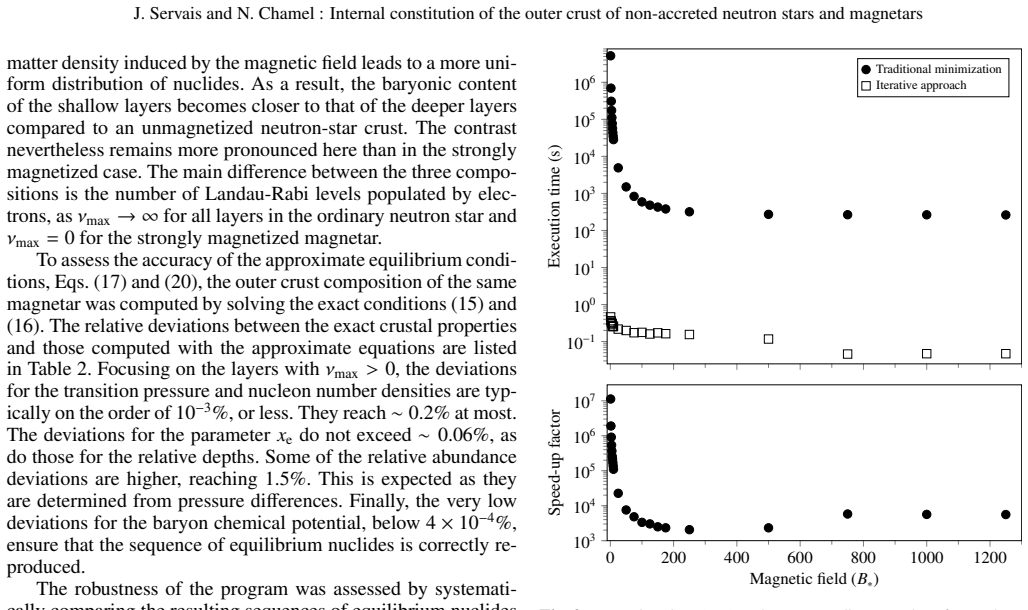
- Reduces computation times by factors between one thousand and ten million compared to traditional detailed approaches.
Where Pith is reading between the lines
- The speed gain could allow incorporation of magnetar crust models into larger-scale astrophysical simulations that previously omitted magnetic field effects.
- Similar approximation strategies might be tested for inner crust or core properties in magnetars.
- Running the program over many mass tables could help quantify how nuclear physics uncertainties affect predictions for magnetar observables.
Load-bearing premise
Approximate equilibrium conditions at layer interfaces together with approximate solutions of Einstein's equations are sufficient to reproduce accurate nuclear abundances and layer depths.
What would settle it
A test case where the relative deviation in transition properties exceeds a few percent for a magnetic field strength between 10^13 and 10^16 G or for one of the 17 nuclear mass tables would show the approximations do not hold.
Figures
read the original abstract
Context. Determining the internal constitution of the outer crust of magnetars is important for interpreting several of their astrophysical manifestations. In particular, the crustal composition is a key input for simulations of r-process nucleosynthesis in giant flare ejecta. However, traditional methods are computationally expensive, limiting their use in large-scale studies. Although faster iterative approaches exist, they are restricted to unmagnetized matter and strongly quantizing magnetic fields, leaving the intermediate field strengths characteristic of observed magnetars without an efficient treatment. Aims. We developed the program magcrust to extend these existing iterative approaches, enabling the rapid computation of the outer-crust composition of cold, non-accreted magnetars over the full range of the magnetic-field strengths inferred for these objects. Methods. Transitions between adjacent crustal layers are computed by solving approximate equilibrium conditions at the interface. Nuclear abundances and layer depths are estimated from approximate solutions of Einstein's equations of general relativity. Results. The performance and accuracy of the program were assessed against detailed numerical calculations. Relative deviations from exact transition properties remain within a few percent, and crustal compositions are well reproduced across 17 nuclear mass tables and 1300 magnetic-field strengths from 1E13 to 1E16 G. Computation times are reduced by factors of 1E3-1E7 compared to traditional approaches. Conclusions. This program provides a robust and efficient tool for determining the stratification of magnetars' outer crust over the full range of astrophysically relevant magnetic-field strengths. Its computational speed makes it well suited to systematic calculations, including sensitivity analyses, uncertainty quantification, and ensemble studies.
Editorial analysis
A structured set of objections, weighed in public.
Referee Report
Summary. The manuscript introduces the magcrust program, which extends existing iterative methods to compute the outer-crust composition and layer structure of cold, non-accreted magnetars across the full astrophysically relevant range of magnetic fields (10^13 to 10^16 G). It employs approximate equilibrium conditions at layer interfaces together with approximate solutions of Einstein's equations to estimate nuclear abundances and depths. Validation against detailed numerical calculations is reported to yield relative deviations within a few percent for transition properties and compositions, across 17 nuclear mass tables and 1300 field strengths, while achieving speed-ups of 10^3–10^7.
Significance. If the reported accuracy holds, magcrust supplies a practical tool for large-scale parameter studies, sensitivity analyses, and ensemble modeling of magnetar crusts that were previously limited by computational cost. This is particularly relevant for inputs to r-process nucleosynthesis simulations in giant-flare ejecta and for interpreting magnetar observational manifestations. The breadth of the validation (multiple mass tables and the full B range) is a positive feature.
major comments (2)
- [Methods] Methods paragraph: the claim that approximate interface equilibrium conditions plus approximate GR solutions suffice for few-percent accuracy is load-bearing; the manuscript must explicitly state the precise form of these approximations (e.g., which terms in the chemical-potential or pressure-balance equations are retained or neglected) and demonstrate that the validation against detailed calculations covers the regimes where the neglected terms are largest.
- [Results] Results section: while overall deviations are stated to remain within a few percent, the manuscript should report the maximum and median deviations separately for the low-, intermediate-, and high-B regimes (or provide a figure/table of deviation versus B) to confirm that no systematic degradation occurs near the boundaries of the tested range.
minor comments (2)
- Abstract and Methods: the 17 nuclear mass tables should be listed with their references so that readers can reproduce the validation set.
- The manuscript should clarify whether the approximate GR solutions are applied uniformly or whether a switch to exact solutions is made at any density threshold.
Simulated Author's Rebuttal
We thank the referee for their positive assessment and constructive comments, which will improve the clarity and completeness of the manuscript. We address each major comment below.
read point-by-point responses
-
Referee: [Methods] Methods paragraph: the claim that approximate interface equilibrium conditions plus approximate GR solutions suffice for few-percent accuracy is load-bearing; the manuscript must explicitly state the precise form of these approximations (e.g., which terms in the chemical-potential or pressure-balance equations are retained or neglected) and demonstrate that the validation against detailed calculations covers the regimes where the neglected terms are largest.
Authors: We agree that the precise forms of the approximations are central to the accuracy claims and should be stated explicitly. In the revised manuscript we will expand the Methods section to specify exactly which terms in the chemical-potential and pressure-balance equations are retained or neglected. We will also add a short discussion (with supporting references to the validation data) showing that the 1300-field-strength test set spans the regimes in which the neglected terms reach their largest relative size. revision: yes
-
Referee: [Results] Results section: while overall deviations are stated to remain within a few percent, the manuscript should report the maximum and median deviations separately for the low-, intermediate-, and high-B regimes (or provide a figure/table of deviation versus B) to confirm that no systematic degradation occurs near the boundaries of the tested range.
Authors: We will revise the Results section to report maximum and median relative deviations separately for the low-B (10^13–10^14 G), intermediate-B (10^14–10^15 G), and high-B (10^15–10^16 G) intervals. We will also include a supplementary figure of deviation versus B (or a compact table) to demonstrate the lack of systematic increase near the range boundaries. revision: yes
Circularity Check
No significant circularity identified
full rationale
The paper introduces the new program magcrust implementing approximate interface equilibrium conditions and approximate GR solutions to compute outer-crust composition across a wide B-field range. It reports explicit validation of these approximations by direct numerical comparison to detailed calculations, with relative deviations quantified as remaining within a few percent over 17 mass tables and 1300 field strengths. No load-bearing step reduces by construction to a fitted parameter, self-citation, or renamed input; the performance claims rest on the reported external benchmarks rather than internal redefinition. This is the expected non-finding for an approximation-validation study.
Axiom & Free-Parameter Ledger
axioms (2)
- domain assumption Approximate equilibrium conditions at the interface between adjacent crustal layers are sufficient to determine transitions
- domain assumption Approximate solutions of Einstein's equations of general relativity suffice to estimate nuclear abundances and layer depths
Reference graph
Works this paper leans on
-
[1]
Afanasjev, A. V . & Agbemava, S. E. 2016, Phys. Rev. C, 93, 054310
2016
-
[2]
V ., Agbemava, S
Afanasjev, A. V ., Agbemava, S. E., Ray, D., & Ring, P. 2015, Phys. Rev. C, 91, 014324
2015
-
[3]
E., Afanasjev, A
Agbemava, S. E., Afanasjev, A. V ., Ray, D., & Ring, P. 2014, Phys. Rev. C, 89, 054320 Anti´c, S., Stone, J. R., Miller, J. C., et al. 2020, Phys. Rev. C, 102, 065801
2014
-
[4]
2007, Phys
Arnould, M., Goriely, S., & Takahashi, K. 2007, Phys. Rep., 450, 97
2007
-
[5]
Baiko, D. A. 2009, Phys. Rev. E, 80, 046405
2009
-
[6]
Baiko, D. A. & Chugunov, A. I. 2018, MNRAS, 480, 5511
2018
-
[7]
A., Potekhin, A
Baiko, D. A., Potekhin, A. Y ., & Yakovlev, D. G. 2001, Phys. Rev. E, 64, 057402
2001
-
[8]
P., Roca-Maza, X., & Colò, G
Basilico, D., Arteaga, D. P., Roca-Maza, X., & Colò, G. 2015, Phys. Rev. C, 92, 035802
2015
-
[9]
1971, ApJ, 170, 299
Baym, G., Pethick, C., & Sutherland, P. 1971, ApJ, 170, 299
1971
-
[10]
Beloborodov, A. M. & Li, X. 2016, ApJ, 833, 261
2016
-
[11]
2025, ApJ, 980, 211
Beniamini, P., Wadiasingh, Z., Trigg, A., et al. 2025, ApJ, 980, 211
2025
-
[12]
& Chamel, N
Blaschke, D. & Chamel, N. 2018, in Astrophysics and Space Science Library, V ol. 457, The Physics and Astrophysics of Neutron Stars, ed. L. Rezzolla, P. Pizzochero, D. I. Jones, N. Rea, & I. Vidaña (Springer, Cham), 337–400
2018
-
[13]
& Vandenberghe, L
Boyd, S. & Vandenberghe, L. 2004, Convex Optimization (Cambridge Univer- sity Press, Cambridge)
2004
-
[14]
A., & Metzger, B
Cehula, J., Thompson, T. A., & Metzger, B. D. 2024, MNRAS, 528, 5323
2024
-
[15]
& Fantina, A
Chamel, N. & Fantina, A. F. 2015, Phys. Rev. D, 92, 023008
2015
-
[16]
& Fantina, A
Chamel, N. & Fantina, A. F. 2016, Phys. Rev. C, 94, 065802
2016
-
[17]
& Fantina, A
Chamel, N. & Fantina, A. F. 2022, Universe, 8, 328
2022
-
[18]
F., Pearson, J
Chamel, N., Fantina, A. F., Pearson, J. M., & Goriely, S. 2017, in European Physical Journal Web of Conferences, V ol. 137, XIIth Quark Confinement and the Hadron Spectrum (EDP), 09001
2017
-
[19]
F., Suleiman, L., Zdunik, J.-L., & Haensel, P
Chamel, N., Fantina, A. F., Suleiman, L., Zdunik, J.-L., & Haensel, P. 2021, Universe, 7, 193
2021
-
[20]
L., Mihailov, L
Chamel, N., Pavlov, R. L., Mihailov, L. M., et al. 2012, Phys. Rev. C, 86, 055804
2012
-
[21]
2019, Phys
Chatterjee, D., Novak, J., & Oertel, M. 2019, Phys. Rev. C, 99, 055811
2019
-
[22]
Cooper, R. L. & Kaplan, D. L. 2010, ApJ, 708, L80 De Grandis, D., Turolla, R., Wood, T. S., et al. 2020, ApJ, 903, 40
2010
-
[23]
Dib, C. O. & Espinosa, O. 2001, Nuclear Physics B, 612, 492
2001
-
[24]
Duncan, R. C. & Thompson, C. 1992, ApJ, 392, L9
1992
-
[25]
2012, Nature, 486, 509
Erler, J., Birge, N., Kortelainen, M., et al. 2012, Nature, 486, 509
2012
-
[26]
F., De Ridder, S., Chamel, N., & Gulminelli, F
Fantina, A. F., De Ridder, S., Chamel, N., & Gulminelli, F. 2020, A&A, 633, A149
2020
-
[27]
O., Pais, H., Dexheimer, V ., Providência, C., & Schramm, S
Gomes, R. O., Pais, H., Dexheimer, V ., Providência, C., & Schramm, S. 2019, A&A, 627, A61
2019
-
[28]
Goriely, S., Chamel, N., Janka, H.-T., & Pearson, J. M. 2011, A&A, 531, A78
2011
-
[29]
Goriely, S., Chamel, N., & Pearson, J. M. 2016, Phys. Rev. C, 93, 034337
2016
-
[30]
N., Sánchez-Fernández, A., et al
Grams, G., Shchechilin, N. N., Sánchez-Fernández, A., et al. 2025, European Physical Journal A, 61, 35 Article number, page 8 of 9 J. Servais and N. Chamel : Internal constitution of the outer crust of non-accreted neutron stars and magnetars
2025
-
[31]
2024, Atomic Data and Nuclear Data Tables, 158, 101661
Guo, P., Cao, X., Chen, K., et al. 2024, Atomic Data and Nuclear Data Tables, 158, 101661
2024
-
[32]
K., Thorne, K
Harrison, B. K., Thorne, K. S., Wakano, M., & Wheeler, J. A. 1965, Gravita- tion Theory and Gravitational Collapse (The University of Chicago Press, Chicago)
1965
-
[33]
Harrison, B. K. & Wheeler, J. A. 1958, Onzième Conseil de Physique Solvay (Stoops, Bruxelles, Belgium)
1958
-
[34]
J., Audi, G., Wang, M., et al
Huang, W. J., Audi, G., Wang, M., et al. 2017, Chinese Physics C, 41, 030002
2017
-
[35]
J., Wang, M., Kondev, F
Huang, W. J., Wang, M., Kondev, F. G., Audi, G., & Naimi, S. 2021, Chinese Physics C, 45, 030002
2021
-
[36]
& Chen, Y .-j
Jiang, W. & Chen, Y .-j. 2024, Chinese Physics C, 48, 074103
2024
-
[37]
2025, Journal of Physics G Nuclear Physics, 52, 085201
Jiang, W., Chen, Y .-j., & Guo, Y . 2025, Journal of Physics G Nuclear Physics, 52, 085201
2025
-
[38]
Kozhberov, A. A. 2016, Ap&SS, 361, 256
2016
-
[39]
2013, International Journal of Mass Spectrometry, 349-350, 63
Kreim, S., Hempel, M., Lunney, D., & Schaffner-Bielich, J. 2013, International Journal of Mass Spectrometry, 349-350, 63
2013
-
[40]
& Shapiro, S
Lai, D. & Shapiro, S. L. 1991, ApJ, 383, 745
1991
-
[41]
M., & Thibault, C
Lunney, D., Pearson, J. M., & Thibault, C. 2003, Reviews of Modern Physics, 75, 1021 Möller, P., Sierk, A. J., Ichikawa, T., & Sagawa, H. 2016, Atomic Data and Nu- clear Data Tables, 109, 1
2003
-
[42]
D., Chamel, N., Stoyanov, Z
Mutafchieva, Y . D., Chamel, N., Stoyanov, Z. K., Pearson, J. M., & Mihailov, L. M. 2019, Phys. Rev. C, 99, 055805
2019
-
[43]
Niu, Z. M. & Liang, H. Z. 2022, Phys. Rev. C, 106, L021303
2022
-
[44]
C., Kumar, A., Sharma, M
Parmar, V ., Das, H. C., Kumar, A., Sharma, M. K., & Patra, S. K. 2022, Phys. Rev. D, 105, 043017
2022
-
[45]
C., Sharma, M
Parmar, V ., Das, H. C., Sharma, M. K., & Patra, S. K. 2023, Phys. Rev. D, 107, 043022
2023
-
[46]
2020, Phys
Pastore, A., Neill, D., Powell, H., Medler, K., & Barton, C. 2020, Phys. Rev. C, 101, 035804
2020
-
[47]
D., Goldberg, J
Patel, A., Metzger, B. D., Goldberg, J. A., et al. 2025b, ApJ, 985, 234 Peña Arteaga, D., Grasso, M., Khan, E., & Ring, P. 2011, Phys. Rev. C, 84, 045806
2011
-
[48]
M., Chamel, N., Potekhin, A
Pearson, J. M., Chamel, N., Potekhin, A. Y ., et al. 2018, MNRAS, 481, 2994
2018
-
[49]
M., Goriely, S., & Chamel, N
Pearson, J. M., Goriely, S., & Chamel, N. 2011, Phys. Rev. C, 83, 065810
2011
-
[50]
& De Grandis, D
Rea, N. & De Grandis, D. 2026, in Encyclopedia of Astrophysics, V ol. 3
2026
-
[51]
Salpeter, E. E. 1961, ApJ, 134, 669
1961
-
[52]
& Chamel, N
Servais, J. & Chamel, N. 2026, Internal constitution of the outer crust of nonac- creted neutron stars and magnetars (version 1.0.0)
2026
-
[53]
K., Centelles, M., Viñas, X., Baldo, M., & Burgio, G
Sharma, B. K., Centelles, M., Viñas, X., Baldo, M., & Burgio, G. F. 2015, A&A, 584, A103
2015
-
[54]
& Pastore, A
Shelley, M. & Pastore, A. 2021, Universe, 7, 131
2021
-
[55]
2016, Phys
Stein, M., Maruhn, J., Sedrakian, A., & Reinhard, P.-G. 2016, Phys. Rev. C, 94, 035802
2016
-
[56]
J., Newell, D
Tiesinga, E., Mohr, P. J., Newell, D. B., & Taylor, B. N. 2021, Reviews of Mod- ern Physics, 93, 025010
2021
-
[57]
1971, A&A, 14, 451
Tondeur, F. 1971, A&A, 14, 451
1971
-
[58]
Utama, R., Piekarewicz, J., & Prosper, H. B. 2016, Phys. Rev. C, 93, 014311 Viganò, D., Rea, N., Pons, J. A., et al. 2013, MNRAS, 434, 123
2016
-
[59]
G., et al
Wang, M., Audi, G., Kondev, F. G., et al. 2017, Chinese Physics C, 41, 030003
2017
-
[60]
J., Kondev, F
Wang, M., Huang, W. J., Kondev, F. G., Audi, G., & Naimi, S. 2021, Chinese Physics C, 45, 030003
2021
-
[61]
Welker, A., Althubiti, N. A. S., Atanasov, D., et al. 2017, Phys. Rev. Lett., 119, 192502
2017
-
[62]
N., Beck, D., Blaum, K., et al
Wolf, R. N., Beck, D., Blaum, K., et al. 2013, Phys. Rev. Lett., 110, 041101
2013
-
[63]
A., & Wang, M
Yamaguchi, T., Koura, H., Litvinov, Y . A., & Wang, M. 2021, Progress in Particle and Nuclear Physics, 120, 103882
2021
-
[64]
2022, Atomic Data and Nuclear Data Tables, 144, 101488 Article number, page 9 of 9
Zhang, K., Cheoun, M.-K., Choi, Y .-B., et al. 2022, Atomic Data and Nuclear Data Tables, 144, 101488 Article number, page 9 of 9
2022
discussion (0)
Sign in with ORCID, Apple, or X to comment. Anyone can read and Pith papers without signing in.