REVIEW 1 major objections 1 minor 1 cited by
Anisotropic damping of the spin fluctuations in doped La2-xSrxCuO4 studied by resonant inelastic x-ray scattering
T0 review · 1 major / 1 minor · reviewed 2026-08-14 · deepseek-v4-flash
Pith's one-line read This paper uses high-resolution resonant inelastic x-ray scattering on three compositions of La2-xSrxCuO4 to show that the spin-fluctuation damping rises with doping, is strongest along the (h,h) direction, and peaks near (0.2,0.2), while…
desk verdict A solid, careful RIXS paper whose 2D damping map is a clear new result, but whose absolute susceptibility normalization rests on an unquantified cancellation that should be downgraded or fixed. read the letter →
The pith
A machine-rendered reading of the paper's core claim, the machinery that carries it, and where it could break.
The reading
What carries the argument
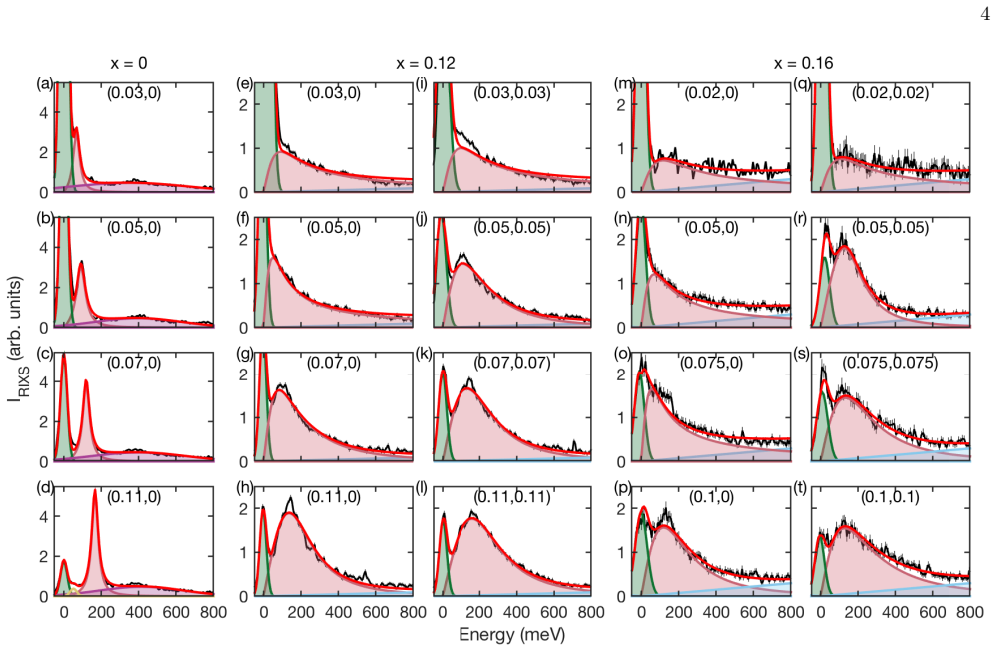
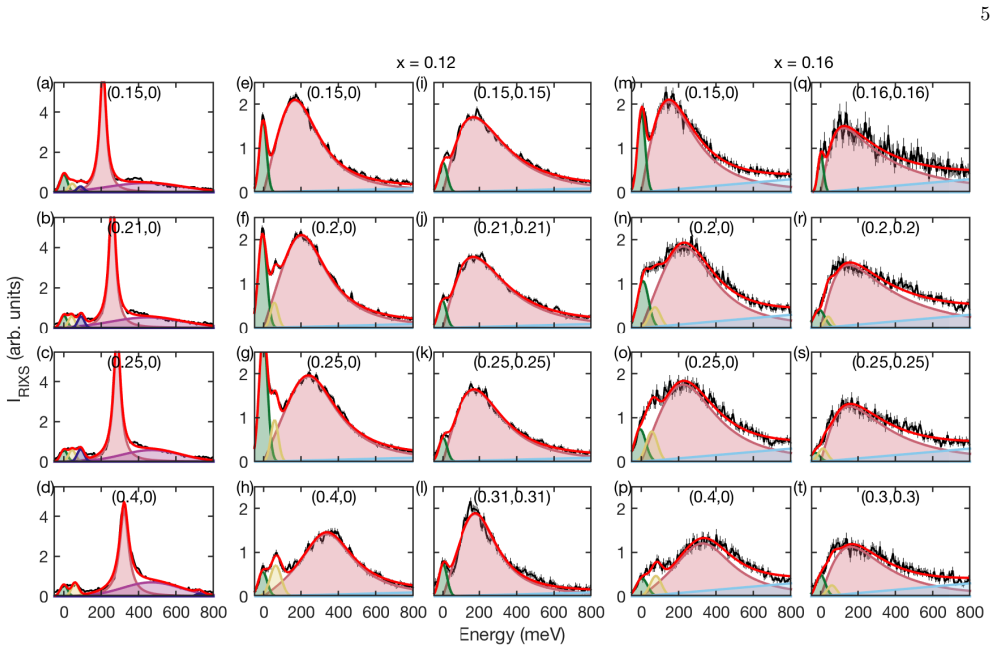
The central object is the damped harmonic oscillator (DHO) susceptibility $$\chi''(Q,\omega)=\chi'(Q)\frac{\omega_0(Q)^2\gamma(Q)\omega}{[\$omega^{2}$-\omega_0(Q)^2]^2+\$omega^{2}$\gamma(Q)^2},$$ which is fit to every spectrum after removing elastic, phonon, multimagnon, and background components, yielding the undamped pole frequency $\omega_0(Q)$, the damping $\gamma(Q)$, and the zero-frequency susceptibility $\chi'(Q)$. The second load-bearing device is the normalization ratio (Eq. 7) $$\langle\chi'_{\mathrm{LSCO}}(Q)\rangle=\chi'^{\mathrm{RIXS}}_{\mathrm{LSCO}}(Q)\frac{\$phi^{{\mathrm{LCO}}$}_{\mathrm{SWT}}(Q)}{\$phi^{{\mathrm{LCO}}$}_{\mathrm{RIXS}}(Q)},$$ which rescales the RIXS-derived susceptibilities of the doped crystals by the ratio of the spin-wave pole weight of La2CuO4 from inelastic neutron scattering to the pole weight measured by RIXS, cancelling the RIXS prefactor and self-absorption if those are doping-independent.
What would settle it
Measure the same doped crystal with RIXS and inelastic neutron scattering over a common energy window, for example 0-260 meV at $Q=(1/2,0)$, and compare the energy-integrated pole weights; if the RIXS-to-INS ratio changes with doping, the cancellation assumed in Eq. 7 is wrong and the reported $\chi'(Q)$ magnitudes and anisotropy are biased.
Extended reading notes
Core claim
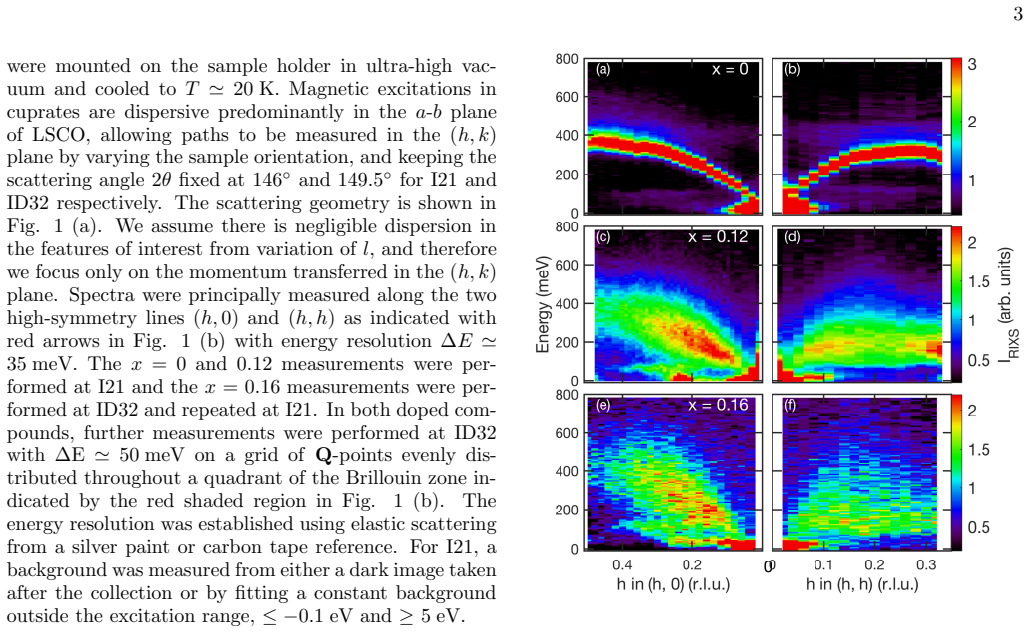
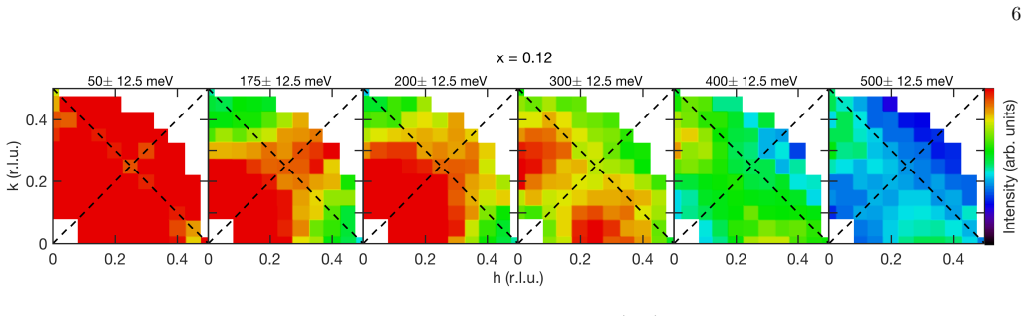
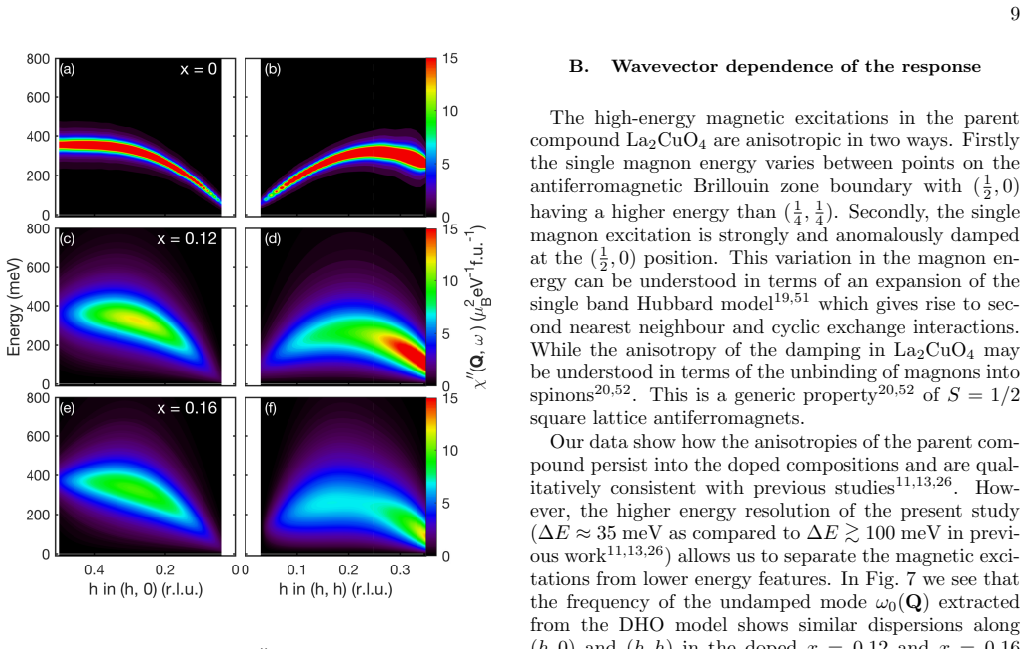
On its own terms, the discovery is that the magnetic response of doped La2-xSrxCuO4 is well described by the damped harmonic oscillator form $\chi''(Q,\omega)=\chi'(Q)\omega_0(Q)^2\gamma(Q)\omega/[\omega^2-\omega_0(Q)^2]^2+\omega^2\gamma(Q)^2$; the fitted damping $\gamma(Q)$ grows from the parent compound to $x=0.16$, is larger along $(h,h)$ than along $(h,0)$, and peaks near $(0.2,0.2)$ instead of $(1/4,1/4)$. The same fits, normalized to the parent compound through Eq. 7, give $\chi'(Q)$ for $x=0.12$ and $0.16$ that is about four times larger at $(1/4,1/4)$ than at $(1/2,0)$ and that increases rapidly along $(h,h)$ toward $(1/2,1/2)$. The paper therefore claims that the strongest magnetic excitations, and the ones predicted to favour superconductive pairing, occur toward the antiferromagnetic wavevector $(1/2,1/2)$, in agreement with inelastic neutron scattering, and that the doping evolution of high-energy RIXS intensity is consistent with neutron measurements.
Load-bearing premise
The load-bearing premise is that the RIXS cross-section prefactor $f(\epsilon,\epsilon',k,k')$ and the dd-excitation normalization $g$ are the same in doped and undoped La2-xSrxCuO4, so they cancel in Eq. 7, and that the fitted damped-oscillator response is essentially pure magnetic; if either fails, the reported absolute values and anisotropy of $\chi'(Q)$ are biased.
Editorial extensions
If this is right
- The validated DHO description means a three-parameter lineshape ($\omega_0$, $\gamma$, $\chi'$) captures the high-energy magnetic response across most of the Brillouin zone, so future RIXS maps can be compared compactly across dopings and compositions.
- The damping $\gamma(Q)$ increases with hole doping and is largest along $(h,h)$, peaking near $(0.2,0.2)$; this puts the dissipative part of the spin response away from the antiferromagnetic zone-boundary symmetry point.
- The zero-frequency susceptibility $\chi'(Q)$ is about four times larger at $(1/4,1/4)$ than at $(1/2,0)$ and rises steeply toward $(1/2,1/2)$, placing the pairing-relevant magnetic weight of spin-fluctuation theories at the antiferromagnetic wavevector for both $x=0.12$ and $x=0.16$.
- The consistency of the doping evolution of high-energy intensity between RIXS and neutron scattering means RIXS can extend magnetic response measurements to higher energies and to samples where neutron backgrounds are prohibitive.
Reading between the lines
- Editorially, if the damping peak near $(0.2,0.2)$ is set by quasiparticle band structure, the same peak should be reproduced by a random-phase-approximation susceptibility computed from a tight-binding model with parameters fixed by angle-resolved photoemission, making the peak position a sharp test.
- Editorially, the same normalization strategy could be applied to other cuprate families with a well-characterized parent antiferromagnet; a similar rise of $\chi'(Q)$ toward the antiferromagnetic wavevector would indicate the pairing-weight conclusion is generic.
- Editorially, a direct test of the paper's central assumption is to measure a doped crystal with both RIXS and neutrons over an overlapping energy window; close agreement of the integrated pole weights would confirm the prefactor cancellation, while disagreement would revise the absolute $\chi'(Q)$ scale.
- Editorially, a polarization-analyzed RIXS measurement on the same compositions could isolate the residual charge weight and test whether the reported $\chi'(Q)$ enhancement at $(1/4,1/4)$ survives a stricter magnetic-only extraction.
Signed reviews
Editorial analysis
A structured set of objections, weighed in public.
Referee Report
Summary. The paper reports high-resolution Cu L3-edge RIXS measurements of the spin fluctuations in La2-xSrxCuO4 for x = 0, 0.12, and 0.16, with mappings along (h,0), (h,h), and over a 2D quadrant of the Brillouin zone. The authors model the magnetic response with a damped harmonic oscillator (DHO) and extract the undamped frequency omega0(Q), damping gamma(Q), and a wavevector-dependent susceptibility chi'_RIXS(Q). They find that gamma(Q) increases with doping, is anisotropic, largest along (h,h), and peaks near (0.2,0.2) rather than at (1/4,1/4). Using a new normalization procedure, Eq. (7), they multiply the doped chi'_RIXS by the ratio of the La2CuO4 spin-wave response from neutron scattering to the RIXS response of the parent compound, obtaining absolute chi'(Q) for the doped compositions. These absolute values are reported in Fig. 8 and Table I and show chi'(Q) much larger at (1/4,1/4) than at (1/2,0), increasing along (h,h) toward (1/2,1/2). The results are compared with prior RIXS, INS, and determinantal quantum Monte Carlo calculations.
Significance. If the results hold, the paper provides a comprehensive, high-resolution picture of the wavevector-dependent damping and zero-frequency susceptibility of spin fluctuations in doped LSCO, quantities directly relevant to spin-fluctuation-mediated pairing theories. The damping anisotropy and its peak near (0.2,0.2) are line-shape results that survive the authors' self-absorption correction, and the 2D maps in Fig. 6 are a useful addition to the literature. The new normalization procedure in Eq. (7) is an interesting attempt to bridge RIXS and INS, and the authors are appropriately careful in comparing their chi'(Q) with the finite-energy-range INS integrals. However, the central quantitative claim for absolute chi'(Q) rests on a cancellation of the RIXS prefactor f and the dd-excitation normalization g between doped and undoped compounds that is asserted but not quantitatively demonstrated in the manuscript or supplement. The reader's concern about a doping-dependent systematic in the absolute values and Q-anisotropy is therefore directly relevant to the paper's main new quantitative result.
major comments (1)
- [Sec. V] The summary repeats the main claims but does not mention the caveats that the absolute normalization depends on the f/g cancellation and the 18% charge contribution. A sentence acknowledging these limitations in the conclusions would help readers interpret the reported chi'(Q) values appropriately.
minor comments (1)
- [Sec. IV C] The text 'chi'(Q) = 1.8 +/- 0.6 mu_B^2 eV^-1 f.u.^-1 in LSCO x = 0.16 at (1/2,0)' should specify whether this is the value from Fig. 8(c) or from a separate integration, and what uncertainty sources are included in the quoted error.
Circularity Check
No significant circularity: the DHO parameters are openly fitted to the RIXS spectra, and the absolute χ′(Q) scale is anchored to independent INS data on La2CuO4 rather than being derived from the claimed result.
full rationale
The paper's central outputs are (i) DHO parameters ω0(Q) and γ(Q) extracted by fitting the RIXS spectra (Secs. II D 2 and III B), and (ii) an absolute χ′(Q) obtained by a two-step calibration: first fitting χ′_RIXS from the DHO model, then multiplying by the ratio φLCO_SWT/φLCO_RIXS from Eq. 7. Neither step is disguised as a prediction: the text states 'Fitting our RIXS data to the DHO response function in Eqn. 2, allows the wavevector-dependent susceptibility χ′(Q) to be estimated', and Eq. 7 is explicitly a normalisation 'to remove the effects of f(ε,ε′,k,k′)'. The reference numerator φLCO_SWT comes from the independent INS fit of Headings et al. (Ref. 20) to La2CuO4 spin waves; it does not use any present RIXS data, so the absolute scale is anchored externally. The denominator φLCO_RIXS is measured on the same parent compound, and the doped χ′_LSCO_RIXS is an independent measured input; the ratio does not reduce to the doped result by construction. The main caveat—'We assume f(ε,ε′,k,k′) is the same for doped and undoped compounds' and 'We have verified that this is approximately the case' without showing the verification—is a transferability/systematic-error assumption, not a circular definition; the authors also state the anisotropy persists under dd-normalisation alone. The damping peak near (0.2,0.2) survives the self-absorption test in the supplement, whose scope is lineshape rather than absolute scale. Self-citations (Refs. 16, 20, 21, 23) provide independent neutron benchmarks rather than importing a conclusion identical to the RIXS result. Hence no circular step is exhibited; score 0.
Assumptions & free parameters
free parameters (5)
- DHO undamped pole frequency omega0(Q) =
Varies with Q; e.g., about 356 meV at Q=(1/2,0) for x=0 and about 396 meV for x=0.16
- DHO damping parameter gamma(Q) =
Varies with Q; peaks near (0.2,0.2); increases with doping
- DHO amplitude chi'_RIXS(Q) =
Varies with Q; Table I gives absolute chi'(Q) values after normalization, e.g., 7.1 to 9.6 mu_B^2 eV^-1 f.u.^-1 for…
- ODHO relaxation rate Gamma in overdamped region =
Used at small |Q| where omega0^2 < gamma^2/4
- Fixed linear low-energy background for doped compositions =
Not quoted; fixed from low-Q spectra
assumptions (7)
- domain assumption RIXS magnetic intensity is proportional to S(Q,omega), with slowly Q-varying prefactors that can be divided out.
- domain assumption The RIXS prefactor f(epsilon,epsilon',k,k') and dd-excitation normalization g are the same for doped and undoped LSCO, so they cancel in Eq. 7.
- domain assumption The DHO response contains only magnetic contributions; residual charge scattering is partially accounted for by background and multimagnon fits.
- domain assumption Linear spin-wave theory with parameters from Headings et al. describes La2CuO4 spin waves.
- domain assumption RIXS is equally sensitive to all three susceptibility components, so the measured average is chi = (2/3) chi_perp.
- domain assumption Negligible dispersion of the measured excitations along l.
- standard math The fluctuation-dissipation relation with Bose factor n(omega)+1 connects S(Q,omega) and chi''(Q,omega).
Cite this review
Pith. "Pith review of Anisotropic damping of the spin fluctuations in doped La2-xSrxCuO4 studied by resonant inelastic x-ray scattering." pith.science (2026). https://pith.science/paper/3B3UWT2H
@misc{pith2026190803086,
  author       = {Pith},
  title        = {Pith review of: Anisotropic damping of the spin fluctuations in doped La2-xSrxCuO4 studied by resonant inelastic x-ray scattering},
  year         = {2026},
  howpublished = {\url{https://pith.science/paper/3B3UWT2H}},
  note         = {Machine review of arXiv:1908.03086}
}
read the original abstract
We report high-resolution resonant inelastic x-ray scattering (RIXS) measurements of the collective spin fluctuations in three compositions of the superconducting cuprate system La2-xSrxCuO4. We have mapped out the excitations throughout much of the 2-D (h,k) Brillouin zone. The spin fluctuations in La2-xSrxCuO4 are found to be fairly well-described by a damped harmonic oscillator model, thus our data allows us to determine the full wavevector dependence of the damping parameter. This parameter increases with doping and is largest along the (h, h) line, where it is peaked near (0.2,0.2). We have used a new procedure to determine the absolute wavevector-dependent susceptibility for the doped compositions La2-xSrxCuO4 (x=0.12,0.16) by normalising our data to La2CuO4 measurements made with inelastic neutron scattering (INS). We find that the evolution with doping of the intensity of high-energy excitations measured by RIXS and INS is consistent. For the doped compositions, the wavevector-dependent susceptibility is much larger at (1/4,1/4) than at (1/2,0). It increases rapidly along the (h,h) line towards the antiferromagnetic wavevector of the parent compound (1/2,1/2). Thus, the strongest magnetic excitations, and those predicted to favour superconductive pairing, occur towards the (1/2,1/2) position as observed by INS.
Figures

Figures from the paper (7 more)




Forward citations
Cited by 1 Pith paper
-
The foot, the fan, and the cuprate phase diagram: Fermi-volume-changing quantum phase transitions
The paper attributes the cuprate 'foot' to a disordered spin-density-wave transition and the 'fan' to a disorder-tuned FL-to-FL* Fermi-volume-changing transition described by a two-dimensional Yukawa-SYK model.
Reference graph
Works this paper leans on
-
[1]
Data processing In order to carry out a quantitative analysis of the data, we follow recent practice 6,7,13,26,33,35 and assume that the magnetic intensity observed in RIXS is pro- portional to the spin-spin dynamical structure factor S(Q,ω ) which is used to interpret neutron scattering experiments36. S(Q,ω ) is, in turn, proportional to χ′′(Q,ω ) multip...
-
[2]
position as observed by INS. I. INTRODUCTION The origin of high temperature superconductivity (HTS) in doped layered cuprate materials remains a sub- ject of intense interest in both experimental and theoreti- cal research, despite over 30 years of activity. It is widely believed that the magnetic degrees of freedom and in par- ticular spin fluctuations ar...
-
[3]
positions and χ′′(Q,ω ) is small near Γ and largest near M. INS measurements15,19,20 throughout the Brillouin zone have shown that the magnetic excitations can be fairly well- described as spin waves derived from a Heisenberg model with next-nearest neighbour interactions including a ring exchange. As expected, they are strongest near the AF wavevector Q=( 1 2, 1
-
[4]
than at ( 1 2, 0). It increases rapidly along the ( h,h ) line towards the antiferromagnetic wavevector of the parent compound ( 1 2, 1 2). Thus, the strongest magnetic excitations, and those predicted to favour superconductive pairing, occur towards the ( 1 2, 1
-
[5]
and show anomalously strong damping at the X or ( 1 2, 0) position10,20,22. For superconducting compositions in LSCO, INS shows that the strongest response 16,21,23–25 occurs near Q=( 1 2, 1
-
[7]
Damped harmonic oscillator model A damped harmonic oscillator (DHO) model may be used to describe a given spin-wave mode with wave vector 4 FIG. 3. Examples of fitted RIXS spectra from LCO and LSCO x = 0.12 (performed at I21 at DLS) and x = 0.16 (performed at ID32 at the ESRF). Showing data in the low Q regime from high symmetry directions (h, 0), (h,h ). ...
-
[8]
(4) Using the DHO function (Eqn. 2) to analyse all of the data allows a consistent model to be applied to the un- derdamped and overdamped regimes. This is useful when comparing excitations from undoped and doped compo- sitions. In particular, γ/2>ω 0 is allowed in this model, however, beyond critical damping,γ/2 =ω0, the shape of the response function ev...
-
[9]
is unaffected. C. Estimate of the absolute wavevector-dependent susceptibility Fitting our RIXS data to the DHO response function in Eqn. 2, allows the wavevector-dependent susceptibility χ′(Q) to be estimated, where χ′(Q) =χ′(Q,ω = 0) = 1 π ∫ ∞ −∞ χ′′(Q,ω ) ω dω. (6) In this section, we estimate χ′(Q) in the superconduc- tors we have investigated by using...
Show all 13 references
-
[10]
A new result from this work is the extent of the varia- tion ofγ(Q) andω0(Q) across the Brillouin zone in doped LSCO
it increases from 298± 27 meV to 313 ± 30 meV. A new result from this work is the extent of the varia- tion ofγ(Q) andω0(Q) across the Brillouin zone in doped LSCO. Significantly, the damping is seen to increase in the underdoped compound, x = 0.12 and again in the optimally-do...
-
[11]
This arises because of the smaller ω0(Q) at ( 1 4, 1
than at (1 2, 0). This arises because of the smaller ω0(Q) at ( 1 4, 1
-
[12]
which shifts spectral weight to lower energy. 10 FIG. 10. Comparison of χ′′(Q) modelled from the RIXS pa- rameters and calculations in DQMC by Huang et al. 47. Show- ing our modelled spectra from the x = 0.12 compound (solid green line) compared to calculations at x = 0.1 (das...
-
[13]
Both of these positions are on the antiferromagnetic zone boundary of the parent compound
than at ( 1 2, 0). Both of these positions are on the antiferromagnetic zone boundary of the parent compound. The wavevector-dependent susceptibility in- creases rapidly along the ( h,h ) line towards the antifer- romagnetic wavevector of the parent compound ( 1 2, 1 2). Thus ...
-
[14]
A spin fluctuation model for d-wave superconductivity,
position. Our quantitative determination of the wavevector-dependent susceptibility will be useful in testing magnetic mediated theories of high-temperature superconductivity1,2. Appendix A: Linear spin-wave theory calculations The magnetic excitations can be modelled in LCO w...
2012 arXiv
Reviewed August 14, 2026 · model on record in the stance chip above.
Discussion (0). Continue with ORCID to comment.