REVIEW 7 major objections 14 references
Lagrange points of the restricted three-body problem in spaces of constant curvature
T0 review · 7 major / 0 minor · reviewed 2026-08-01 · deepseek-v4-flash
Pith's one-line read Positive curvature forces new Lagrange-type equilibria in the curved three-body problem and stabilizes the classical triangular points.
desk verdict Solid rigorous progress on the curved restricted three-body problem, but the introduction overclaims what Section 8 actually proves about stabilization of the triangular equilibria. read the letter →
The pith
A machine-rendered reading of the paper's core claim, the machinery that carries it, and where it could break.
The reading
What carries the argument
The central object is the amended potential V_{κ,μ} on the unit sphere (or pseudosphere), obtained by rescaling the curved problem; its critical points are in one-to-one correspondence with relative equilibria. The load-bearing identity is the index balance #maxima + #minima − #saddles = −2, derived from the classical index theorem for vector fields on a sphere after extending the gradient field over the four singular points (the two primaries and their antipodes). A second piece of machinery is the 'triangular-balanced configuration' condition sin(d₁) = Λ sin(d₂) (with a hyperbolic analogue for negative curvature), expressed in distance coordinates, which reduces the search for triangular e
What would settle it
A direct numerical count of all nondegenerate critical points of V_{κ,μ} on the sphere for a fixed μ ∈ (0,1) and κ ∈ (0,π²/4) that does not yield exactly #maxima + #minima − #saddles = −2 would refute the topological theorem; equivalently, a numerical continuation showing that E2, E3, or A1 persists (rather than unbinding to infinite distance) as κ → 0+ would falsify the corollary that new equilibria must appear and then disappear when the space flattens.
Extended reading notes
Core claim
On its own terms, the discovery is that the relative equilibria (the curved analogues of the Lagrange points) are governed by a topological balance condition: for fixed mass ratio μ ∈ (0,1) and curvature 0 < κ < π²/4, every nondegenerate critical point of the amended potential V_{κ,μ} obeys #maxima + #minima − #saddles = −2. The balance follows from the index theorem for vector fields on the sphere, with the two primaries and their antipodal points acting as four additional sources and sinks after the gradient flow is extended. The immediate corollary, that new relative equilibria must exist for small positive curvature, is made constructive: for small μ these are shown to be the collinear p
Load-bearing premise
The primaries are assumed to move on the acute circular relative-equilibrium branch of the two-body problem that connects smoothly to the planar circular solution, with their mutual distance fixed to 1; the other (obtuse) branch on the sphere is excluded, so the classification and the count apply only to that branch.
Editorial extensions
If this is right
- For small positive curvature and small mass ratio, the curved restricted three-body problem has exactly six collinear relative equilibria: the continuations of L1, L2, L3 plus the new points E2, E3, A1; as κ → 0+ the new ones escape to infinite distance from the rotation center.
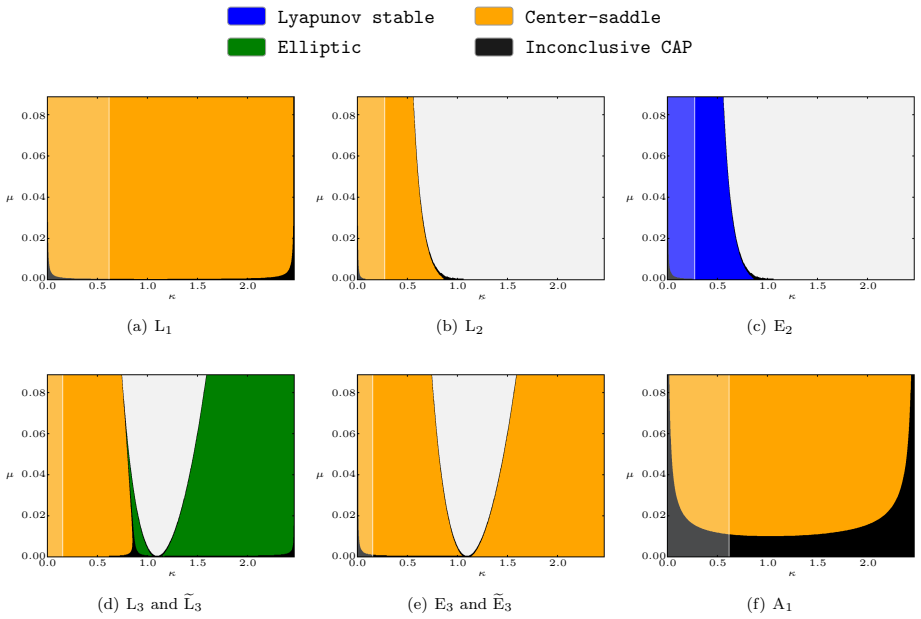
- The new collinear point E2 is a local minimum of the potential and hence Lyapunov stable, while L1, L2, L3, E3, and A1 are saddle-type (center–saddles) in the proven parameter ranges.
- For sufficiently small positive curvature, the only triangular relative equilibria are the continuations of L4 and L5, for every mass ratio μ ∈ (0,1).
- Positive curvature stabilizes L4 and L5: the interval of mass ratios for which they are linearly (gyroscopically) stable is strictly larger than in the planar problem; negative curvature destabilizes them.
- Asymptotic expansions as κ → 0 and μ → 0 determine the locations of all collinear equilibria, showing which ones converge to the planar Lagrange points and which ones diverge.
Reading between the lines
- An immediate extension the authors leave implicit: the same index-balance argument should apply to the obtuse branch of the two-body problem on the sphere, yielding a separate count; completing that analysis would give a truly complete classification of relative equilibria on the sphere rather than only on the acute branch.
- The index-balance identity is independent of the specific gravitational potential as long as the amended potential has the same attracting/repelling behavior at the four singular points; any interaction law with the same singularity structure on the sphere should obey the same −2 constraint, suggesting the count is geometric, not dynamical.
- The stabilizing effect of positive curvature on L4 and L5 suggests a testable physical analogue: in a slightly curved model of a Sun–planet–massless-satellite system, the stability window for the triangular points should broaden relative to the Euclidean estimate; numerical integration of the full curved equations would settle whether the gyroscopic stabilization persists nonlinearly.
Editorial analysis
A structured set of objections, weighed in public.
Referee Report
Summary. The paper formulates the restricted three-body problem on surfaces of constant curvature as an autonomous two-degree-of-freedom Lagrangian system whose only parameters are the mass ratio μ and the curvature κ, with the Riemannian distance between the primaries normalized to 1. For κ>0, the authors prove a Poincaré–Hopf balance relation for the critical points of the amended potential V_{κ,μ} (Theorem 4.1), which forces the existence of new relative equilibria beyond the continuations of L1,...,L5. They then give analytic existence and stability results for these equilibria for small μ and small κ>0 (Theorems 5.2, 6.2, 7.2), computer-assisted proofs (CAPs) on the parameter region P_{μ_T}, asymptotic expansions as κ→0 (Theorems 9.1 and 9.2), and numerical bifurcation analyses. Several full classifications are stated as Conjectures 5.6, 6.4, 7.4, and 8.1.
Significance. If the main results hold, the paper makes a valuable contribution to the curved N-body problem: it gives a rigorous topological explanation for the appearance of new relative equilibria in positive curvature, proves analytic continuation and stability for several branches, and supplies reproducible, machine-checked CAPs with cited code. The stability criteria in Propositions 4.11 and 4.12 are derived, not fitted, and the asymptotic expansions sharpen previous numerical observations. The main advertised conclusion—that positive curvature stabilizes L4 and L5—is, however, only partially supported by the rigorous results: the analytic theorems do not cover the triangular equilibria, and the CAPs are restricted to a subregion and are inconclusive near κ=0 and near bifurcations. This gap must be addressed before the stabilization claim can be accepted as proven.
major comments (7)
- [§6, Theorem 6.2] The Introduction states that Section 8 'prove[s] that positive curvature has a stabilizing effect for L4 and L5', and §1.1 repeats this claim. But Section 8 contains no analytic stability theorem for triangular RE. It offers CAPs on a subregion of P_{μ_T} (Fig. 15(a),(c)), explicitly inconclusive near κ=0 and near bifurcations, numerical panels, and Conjecture 8.1. There is no rigorous proof that the elliptic/gyroscopically-stabilized region extends to all κ>0 for any fixed μ, nor a quantitative statement as κ→0. The abstract's weaker language ('indicates') is appropriate; the Introduction's 'prove' is not. Please either strengthen the proof or revise the claim to 'provide CAP-verified and numerical evidence'.
- [§1.2, §5.3–5.5, §6.2–6.3] Theorem 6.2 asserts existence of exactly two triangular RE for sufficiently small κ>0, but gives no explicit κ* and no dependence on μ. The proof in Appendix B.2 also does not produce a constructive bound. As a result, the theorem cannot be combined with the CAPs (which are validated only for κ≥5.075×10^{-5}) to prove that the 'two triangular RE' found by CAPs are continuations of L4 and L5; this identification is left as a conjecture (see the discussion after Fig. 10). Since this identification is used in the stability conclusions of Section 8, the missing quantitative threshold is load-bearing for the claimed stabilization story.
- [Remark 2.3] The paper consistently distinguishes proved results from conjectures, which is commendable. However, the abstract and introduction describe the work as providing classification results for the curved R3BP, while the full classification in the main parameter region P_{μ_T} rests on Conjectures 5.6, 6.4, 7.4, and 8.1. Remark 5.7 explicitly admits that the existence proofs for parts of P_{μ_T} and the bifurcation curves are missing. This is not a flaw in the proven theorems, but the manuscript should state more prominently, in the abstract and introduction, that the complete classification in P_{μ_T} is partly conjectural, with rigorous results covering a substantial subregion.
- [Appendix C.2] All positive-curvature results assume the primaries move on the acute circular relative-equilibrium branch, with the obtuse branch explicitly excluded. This is a legitimate scope choice, and it is clearly flagged in Remark 2.3. Nevertheless, because the abstract's 'spaces of constant curvature' could be read as covering the whole sphere, the limitation should be echoed in the abstract or the opening of the introduction. The current phrasing in §1.2 mentions the acute-angle restriction only in a parenthetical about circular motions.
- [Footnotes 3 and 10] In the first paragraph of Appendix C.2, the text refers to 'Propositions 4.3.1 or 4.15'. Proposition 4.3.1 does not exist; the intended references are presumably Proposition 4.11 (collinear) and Proposition 4.12 or 4.15 (triangular). This typo should be corrected, along with the surrounding cross-reference style.
- [§1.3, §2.3, §5.4] The abuse of notation V_{\kappa,\mu} to denote potentials on both M^\pm and S_\kappa is used heavily; in Eq. (3.9) the potential is defined on the rescaled space, but in later sections the same symbol is used for the physical potential. This is not a mathematical error but makes the text harder to follow; a short notational remark would help.
- There are several typographical issues: 'whlie' in §1.3, 'attaraction' in §2.3, and 'F or' at the start of items in Conjectures 5.6, 6.4, 7.4, and 8.1. The reference [2] also has a doubled slash in the URL. These do not affect the mathematics but should be cleaned up.
Circularity Check
No circular step satisfies the quote-and-reduction test; the derivation is self-contained from the explicit Lagrangian and potential, with only upstream two-body self-citations used as modelling input.
full rationale
The central derivation chain is not circular. The amended potential V_{κ,μ} is obtained by explicit substitution from the Lagrangian (3.8)-(3.9), and RE are characterized as critical points (Prop. 3.1, Appendix A). The collinear and triangular existence conditions (4.8), (4.21) are computed derivatives; Theorems 5.2 and 6.2 are proved by root counting and sign/concavity estimates in Appendices B.1-B.2; and the stability statements follow from linearization and the Hessian/eigenvalue criteria of Propositions 4.11-4.12 and Appendix A, not from fitted values. Theorem 4.1's Poincaré-Hopf balance uses the stated limits (4.2) of the same explicit potential, and Corollary 4.2 derives the existence of additional RE from that index count rather than assuming them. The CAPs use interval arithmetic to enclose true values, are explicitly inconclusive near κ=0 and near bifurcations, and the paper openly labels unproved parts as Conjectures 5.6, 6.4, 7.4, 8.1 and Remark 5.7. Citations to the authors' own prior two-body work [8,17,18] supply the circular-orbit input for the primaries, but the paper reproduces the explicit formulas (2.9)-(2.12) and notes they can be verified by direct calculation; this is an upstream modelling premise, not a recycled conclusion of the restricted-problem results. The exclusion of the obtuse two-body branch is an explicit scope limitation (Remark 2.3), not a self-citation used to forbid alternatives. The Introduction's claim that Sec. 8 'prove[s]' positive-curvature stabilization is stronger than the CAP-verified subregion plus numerical evidence and Conjecture 8.1, but that is an overclaim/correctness risk, not circularity.
Assumptions & free parameters
assumptions (5)
- domain assumption Primaries move on the acute circular RE branch of the curved two-body problem with distance normalized to 1; the obtuse branch is excluded.
- domain assumption Gravitational interaction is modeled by the generalized cot_κ potential (2.7) with singularities at collision and, for κ>0, antipodal points.
- standard math Poincaré-Hopf index theorem applies to the extended gradient vector field X on S², with the four singularities contributing index +1 each.
- domain assumption All critical points of V_{κ,μ} are non-degenerate in the regions where the topological count is applied.
- domain assumption Interval arithmetic with directed rounding gives guaranteed enclosures, and the CAP code faithfully implements the paper's formulas.
Cite this review
Pith. "Pith review of Lagrange points of the restricted three-body problem in spaces of constant curvature." pith.science (2026). https://pith.science/paper/3BEVTGTF
@misc{pith2026260719148,
  author       = {Pith},
  title        = {Pith review of: Lagrange points of the restricted three-body problem in spaces of constant curvature},
  year         = {2026},
  howpublished = {\url{https://pith.science/paper/3BEVTGTF}},
  note         = {Machine review of arXiv:2607.19148}
}
abstract
We continue the study initiated by Kilin ({\em Reg. Chaot. Dyn.} 4, (1999)) and by Mart\'inez and Sim\'o ({\em Celest. Mech. Dynam. Astronom.} 128, (2017)) on the classification and stability of the relative equilibria of the restricted three-body problem in two-dimensional spaces of constant curvature, which generalize the classical Lagrange points of the planar problem. After formulating the problem as an autonomous Lagrangian system with two degrees of freedom, whose only parameters are the curvature $\kappa$ and the mass ratio $\mu$ of the primaries, we establish several classification results for the case $\kappa>0$ by combining analytical methods with computer-assisted proofs. These results provide rigorous confirmation of phenomena for which previously only numerical evidence was available. We also provide topological explanations for the qualitative differences between the behavior of relative equilibria in positive curvature and that observed in the planar and negative-curvature cases. Our analysis focuses on the regime of small $\mu$ and indicates that positive curvature has a stabilizing effect on the triangular equilibria $\Ll_4$ and $\Ll_5$, whereas negative curvature appears to have the opposite effect.
Figures


Figures from the paper (13 more)




Reference graph
Works this paper leans on
-
[1]
Lagrange points of the restricted three-body problem in spaces with constant curvature
[1]Andrade, J., P ´erez-Chavela, E., and Vidal, C.The restricted three body problem on surfaces of constant curvature.J. Differential Equations 265, 9 (2018), 4486–4529. [2]Ayala, M., Barrera-Anzaldo, C., and Garc ´ıa-Naranjo, L. C.Support codes for “Lagrange points of the restricted three-body problem in spaces with constant curvature”.https://github.com...
2018
-
[6]
V., Garc ´ıa-Naranjo, L
67 [8]Borisov, A. V., Garc ´ıa-Naranjo, L. C., Mamaev, I. S., and Montaldi, J.Reduction and relative equilibria for the two-body problem on spaces of constant curvature.Celestial Mech. Dynam. Astronom. 130, 6 (2018), Paper No. 43,
2018
-
[11]
M.On the stability of Lagrange’s periodic solutions of the restricted three-body problem.Dokl
[26]Leontovi ˇc, A. M.On the stability of Lagrange’s periodic solutions of the restricted three-body problem.Dokl. Akad. Nauk SSSR 143, 3 (1962), 525–528. 68 [27]Maciejewski, A. J., and Przybylska, M.Non-integrability of restricted two body problems in constant curvature spaces.Regul. Chaotic Dyn. 8, 4 (2003), 413–430. [28]Markeev, A. P.On the stability o...
1962
-
[20]
C., Marrero, J
[17]Garc ´ıa-Naranjo, L. C., Marrero, J. C., P ´erez-Chavela, E., and Rodr ´ıguez-Olmos, M. Classification and stability of relative equilibria for the two-body problem in the hyperbolic space of dimension 2.J. Differential Equations 260, 7 (2016), 6375–6404. [18]Garc ´ıa-Naranjo, L. C., and Montaldi, J.Attracting and Repelling 2-Body Problems on a Family...
2016
-
[36]
V., and Mamaev, I
[9]Borisov, A. V., and Mamaev, I. S.The restricted two-body problem in constant curvature spaces. Celestial Mech. Dynam. Astronom. 96, 1 (2006), 1–17. [10]Borisov, A. V., Mamaev, I. S., and Bizyaev, I. A.The Spatial Problem of 2 Bodies on a Sphere. Reduction and Stochasticity.Regul. Chaotic Dyn. 21, 5 (2016), 556–580. [11]Cari ˜nena, J. F., Ra ˜nada, M. F...
2006
-
[64]
An asymptotic formula.Adv
[4]Baldom ´a, I., Giralt, M., and Guardia, M.Breakdown of homoclinic orbits toL 3 in the RPC3BP (II). An asymptotic formula.Adv. Math. 430(2023), Paper No. 109218,
2023
-
[72]
Chaotic Dyn
[5]Benettin, G., F ass`o, F., and Guzzo, M.Nekhoroshev-stability ofL 4 andL 5 in the spatial restricted three-body problem.Regul. Chaotic Dyn. 3(1998), 56–72. [6]Bezanson, J., Edelman, A., Karpinski, S., and Shah, V. B.Julia: A Fresh Approach to Numerical Computing.SIAM Rev. 59, 1 (2017), 65–98. [7]Bolotin, S.Chaotic dynamics for the two-body problem on a...
1998
-
[1959]
Chaotic Dyn
[15]Fujiwara, T., and P ´erez-Chavela, E.Continuations and Bifurcations of Relative Equilibria for the Positively Curved Three-Body Problem.Regul. Chaotic Dyn. 29, 6 (2024), 803–824. [16]Fujiwara, T., and P ´erez-Chavela, E.Mass-Independent Shapes for Relative Equilibria in the Two-Dimensional Positively Curved Three-Body Problem.J. Nonlinear Sci. 34, 5 (...
2024
Show all 14 references
-
[1974]
[22]Jackman, C.Secular Dynamics for Curved Two-Body Problems.J. Dynam. Differential Equations 35, 1 (2023), 623–640. [23]Kilin, A. A.Libration Points in SpacesS 2 andL 2.Regul. Chaotic Dyn. 4, 1 (1999), 91–103. [24]Kozlov, V. i. V., and Harin, A. O.Kepler’s problem in constant...
2023
-
[1997]
M.Oscillatory motions for the restricted planar circular three body problem.Invent
[20]Guardia, M., Mart ´ın, P., and Seara, T. M.Oscillatory motions for the restricted planar circular three body problem.Invent. Math. 203, 2 (2016), 417–492. [21]Guillemin, V., and Pollack, A.Differential Topology. Prentice-Hall, Inc., Englewood Cliffs, NJ,
2016
-
[2011]
Nonlinear Sci
[38]Zhu, S.The Schubart Orbits in the Curved Three-Body Problem with Two Equal Masses.J. Nonlinear Sci. 34, 6 (2024), Paper No. 109,
2024
-
[2014]
V.Nonintegrability of the two-body problem in constant curvature spaces.J
[35]Shchepetilov, A. V.Nonintegrability of the two-body problem in constant curvature spaces.J. Phys. A 39, 20 (2006), 5787–5806. [36]Szebehely, V.Theory of Orbits, the Restricted Problem of Three Bodies. Academic Press, New York,
2006
-
[2017]
In Recent Trends in Dynamical Systems, vol
[31]Montaldi, J., and Tokieda, T.Deformation of Geometry and Bifurcations of Vortex Rings. In Recent Trends in Dynamical Systems, vol. 35 ofSpringer Proc. Math. Stat.Springer, Basel, 2013, pp. 335–370. [32]Moore, R. E.Interval Analysis. Prentice-Hall Inc., Englewood Cliffs, N.J.,
2013
-
[2026]
Complex singularities and the inner equation.Adv
[3]Baldom ´a, I., Giralt, M., and Guardia, M.Breakdown of homoclinic orbits toL 3 in the RPC3BP (I). Complex singularities and the inner equation.Adv. Math. 408(2022), Paper No. 108562,
2022
Reviewed August 1, 2026 · model on record in the stance chip above.
Discussion (0). Continue with ORCID to comment.