Lepton Flavour violation in muon decays
Pith reviewed 2026-05-25 15:56 UTC · model grok-4.3
The pith
Four experiments are preparing to search for lepton flavour violation in muon decays with 1-4 orders of magnitude better sensitivity.
A machine-rendered reading of the paper's core claim, the machinery that carries it, and where it could break.
Core claim
Four dedicated experiments are in an advanced state of preparation to improve the current sensitivities by 1-4 orders of magnitude for the charged lepton flavour violating processes μ→eγ, μ→e conversion and μ→eee. These muon decays are considered to have the largest discovery potential among possible processes in most Standard Model extensions, although past searches have found no evidence.
What carries the argument
The three muon decay channels μ→eγ, μ→e conversion, and μ→eee, which act as sensitive probes for physics beyond the Standard Model.
If this is right
- Tighter experimental limits or a positive signal would directly constrain or reveal new physics models that allow lepton flavour violation.
- Improved reach on these channels would test predictions from supersymmetry, extra dimensions, and other Standard Model extensions at higher scales.
- Successful operation would demonstrate the viability of new detector technologies developed for rare-event searches in intense muon beams.
- Results would complement and cross-check limits obtained from other lepton flavour violation searches in tau and electron channels.
Where Pith is reading between the lines
- A null result at the new sensitivities would further suppress the allowed parameter space for models that link neutrino mass generation to charged lepton flavour violation.
- The experimental techniques developed here could be adapted to search for other rare processes such as muon-to-positron conversion in different nuclear targets.
- Long-term operation of these facilities might enable precision measurements of Standard Model processes that serve as backgrounds to the flavour-violating signals.
Load-bearing premise
The four experiments will achieve their projected sensitivity goals without major unforeseen technical, funding or scheduling setbacks.
What would settle it
Public data showing that any of the four experiments falls short of its stated sensitivity target by more than a factor of ten within the planned schedule.
Figures


read the original abstract
The search for lepton flavour violation in charged lepton decays is highly sensitive to physics beyond the Standard Model. Among the possible processes, $\mu$-decays are considered to have the largest discovery potential in most of the standard model extensions. Many searches has been performed in the past, however no evidence has been found so far. Four dedicated experiments are in advanced state of preparation to improve the current associated sensibilities by 1-4 order of magnitudes for the charged lepton flavour violating processes $\mu\rightarrow \rm{e}\gamma$, $\mu\rightarrow \rm{e}$ conversion and $\mu\rightarrow \rm{eee}$. In this paper I present physics motivations, experimental challenges and construction status of the experiments, which are the studying above mentioned processes.
Editorial analysis
A structured set of objections, weighed in public.
Referee Report
Summary. The manuscript is a review summarizing the physics motivations for searching charged lepton flavour violation (LFV) in muon decays, the associated experimental challenges, and the construction status of four dedicated experiments targeting the processes μ→eγ, μ→e conversion, and μ→eee. It states that these experiments are in an advanced state of preparation and are expected to improve current experimental sensitivities by 1–4 orders of magnitude, with no evidence for LFV found in prior searches.
Significance. If the status and projection statements are accurate, the review provides a compact, field-oriented overview of ongoing LFV searches that can serve as a useful entry point for researchers. The paper does not advance new theoretical derivations, data, or model-dependent predictions, so its value lies in synthesis rather than novelty.
minor comments (2)
- Abstract: grammatical issues include 'Many searches has been performed' (should be 'have') and 'sensibilities' (should be 'sensitivities'). The final sentence contains awkward phrasing ('which are the studying above mentioned processes').
- The manuscript should include explicit citations or references for the quoted sensitivity projections and experiment timelines to allow readers to verify the 1–4 order-of-magnitude claims.
Simulated Author's Rebuttal
We thank the referee for their assessment of our review manuscript. The report recommends minor revision but lists no specific major comments requiring point-by-point response. We will verify and update any experimental status or sensitivity projections for accuracy in the revised version.
Circularity Check
No significant circularity
full rationale
The manuscript is a descriptive review of LFV muon decay searches. It contains no derivations, equations, fitted parameters, predictions, or model-dependent results. The sole forward-looking statement (four experiments in preparation to improve sensitivity by 1-4 orders of magnitude) is a factual summary of stated experimental goals, not a load-bearing claim derived from any internal construction or self-citation. No steps meet the criteria for circularity.
Axiom & Free-Parameter Ledger
axioms (1)
- domain assumption Lepton flavour violation can occur at observable rates in Standard Model extensions
Reference graph
Works this paper leans on
-
[1]
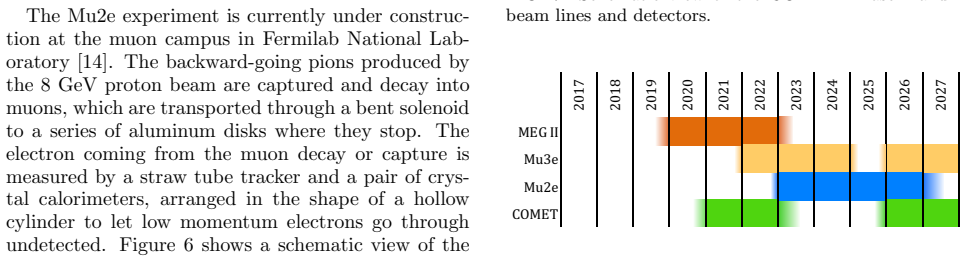
The µ→ e in Mu2e The Mu2e experiment is currently under construc- tion at the muon campus in Fermilab National Lab- oratory [14]. The backward-going pions produced by the 8 GeV proton beam are captured and decay into muons, which are transported through a bent solenoid to a series of aluminum disks where they stop. The electron coming from the muon decay ...
work page 2023
-
[2]
COMET will operate in two stages, Phase-I and Phase-II that are schematically reported in Figure 7
The µ→ e in COMET The COMET (COherent Muon-to-Electron Tran- sition) experiment is in construction at the Japanese Proton Accelerator Research Center (J-PARC) [15]. COMET will operate in two stages, Phase-I and Phase-II that are schematically reported in Figure 7. Phase-I has a sensitivity goal of 2 × 10⁻¹⁵ and will help to understand some of the novel ex...
work page 2017
-
[3]
Charged lepton flavour violation: An experimental and theoretical introduc- tion
L. Calibbi and G. Signorelli, “Charged lepton flavour violation: An experimental and theoretical introduc- tion”, La Riv. Nuovo Cim. 41(2018) no.2 71-174 T ueB1501100 Flavor Physics and CP Violation Conference, Victoria BC, 2019 5 TABLE I: Present and future sensitivities in the cLFV in the muon sector. Process Present F uture µ→ eγ 4.2×10⁻¹³ 6×10⁻¹⁴ µ→ e ...
work page 2018
-
[4]
Lepton Flavour Violation Experiments
F. Cei and D. Nicolo, “Lepton Flavour Violation Experiments”, Adv. High Energy Phys. 2014 (2014) 282915
work page 2014
-
[5]
Flavour violating muon de- cays
T. Mori and W. Ootani, “Flavour violating muon de- cays”, Progress in Particle and Nuclear Physics 79 (2014) 57-94
work page 2014
-
[6]
Charged lepton flavour violation: An Experimenter’s Guide
R. H. Bernstein and P. S. Cooper, “Charged lepton flavour violation: An Experimenter’s Guide”,Phys. Rept. 532 (2013) 27-64
work page 2013
-
[7]
Muon decay and physics beyond the standard model
Y. Kuno and Y. Okada, “Muon decay and physics beyond the standard model”, Rev. Mod. Phys., 73 (2001) 151
work page 2001
-
[8]
Complementarity in lepton-flavour violating muon decay experiments
A. Crivellin, S. Davidson, G. M. Pruna and A. Signer “Complementarity in lepton-flavour violating decay experiments”, arXiv:1611.03409
work page internal anchor Pith review Pith/arXiv arXiv
-
[9]
The de- sign of the MEG II experiment
A. M. Baldini et al. (MEG Collaboration), “The de- sign of the MEG II experiment”, Eur. Phys. C78 (2018) no.5, 380
work page 2018
-
[10]
Search for the lepton flavour violating decay µ+→ e+γ with the full dataset of the MEG experiment
A. M. Baldini et al. (MEG II Collaboration), “Search for the lepton flavour violating decay µ+→ e+γ with the full dataset of the MEG experiment”, Eur. Phys. C76 (2016) no.8, 434
work page 2016
-
[11]
N. Berger et al. (Mu3e Collaboration), “The Mu3e Experiment”, Nucl. Phys. Proc. Suppl., 248 (2014) 365
work page 2014
-
[12]
Search for the Decay mu+ → e+e-e+
U.. Bellgardt et al. (SINDRUM Collabora- tion),“Search for the Decay mu+ → e+e-e+”, Nucl. Phys. B. 299 (1988) 1
work page 1988
-
[13]
Target studies for Surface Muon Pro- duction
F. Berg et al. , “Target studies for Surface Muon Pro- duction”, Phys. Rev. Acc. Beams, 19 (2016) 024701
work page 2016
-
[14]
W. Honecker et al. (SINDRUM II Collaboration), Phys. Rev. Lett. 76 (1996) 200
work page 1996
-
[15]
J. Kaulard et al. (SINDRUM II Collaboration), Phys. Lett. B 422 (1998) 334
work page 1998
-
[16]
L. Bartoszec et al. (Mu2e collaboration), “Mu2e tech- nical design report”, arXiv:1501.05241
work page internal anchor Pith review Pith/arXiv arXiv
-
[17]
COMET Collaboration, COMET Phase-I technical design report, http://comet.kek.jp/Documents files/IPNS-Review- 2014.pdf T ueB1501100
work page 2014
discussion (0)
Sign in with ORCID, Apple, or X to comment. Anyone can read and Pith papers without signing in.