REVIEW 5 major objections 6 minor 41 references
Communication Efficient Cooperative Edge AI via Event-Triggered Computation Offloading
T0 review · 5 major / 6 minor · reviewed 2026-08-10 · deepseek-v4-flash
Pith's one-line read A channel-adaptive, event-triggered co-inference framework with dual-threshold early exiting classifies rare events more accurately than existing edge-inference approaches while transmitting far less data.
desk verdict Sensible dual-threshold early-exit/offloading architecture and suggestive experiments, but the optimization theory is invalid as written — the central strong-convexity and convergence claims do not hold. read the letter →
The pith
A machine-rendered reading of the paper's core claim, the machinery that carries it, and where it could break.
The reading
What carries the argument
The load-bearing mechanism is the dual-threshold multi-exit confidence detector. At each exit block $n$ the Softmax tail-confidence $C^{\mathrm{tail}}_n(m)$ is compared with a lower threshold $\beta_\ell$ and an upper threshold $\beta_u$; the paper encodes the resulting head/tail decisions as asymptotic indicator functions built from logistic functions $\sigma(y) = 1/(1+e^{-\alpha y})$ with $\alpha \to \infty$, so that products of these sigmoids select the first block at which the event exits. These indicators convert event counts (miss probability, false-alarm probability, offloading probability, energy) into differentiable functions of the thresholds, which is what allows the optimization. The second piece is the proximal-point penalty method: adding a proximal term and quadratic penalties for the data-volume and energy constraints makes the objective strongly convex with explicit smoothness and convexity parameters, enabling accelerated gradient updates and a lookup table of optimal thresholds indexed by SNR.
What would settle it
Compute the Hessian of the indicator functions in Eqs. (5) and (8) using the finite logistic function with $\alpha \to \infty$: if the second derivative exceeds the constant $k^2$ used in Lemma 2, the Lipschitz, weak-convexity, and strong-convexity claims do not follow. A simpler check: run Algorithm 1 on a fixed dataset and compare its optimized thresholds to an exhaustive grid search over $(\beta_\ell, \beta_u)$ under the same constraints; any significant gap in objective value would show the algorithm is not finding the claimed optimum.
Extended reading notes
Core claim
On the paper's own terms, the central discovery is that a dual-threshold early-exit detector, rather than a single confidence threshold, resolves the conflict between missing rare tail events and wasting communication on frequent head events. The device's intermediate classifiers output a tail-confidence score; scores below $\beta_\ell$ are labeled head and stop, scores above $\beta_u$ are labeled tail and are offloaded, and scores between the two continue through deeper blocks. The paper derives indicators for correct head/tail detection with these thresholds, defines the offloading probability as a function of them, and formulates the end-to-end tail-classification accuracy maximization under data-volume and energy constraints. It then asserts that the non-convex problem becomes an equivalent strongly convex proximal-penalty problem, giving a convergence rate that improves with SNR, and that the resulting optimal policy has threshold-based structure: no offloading below an SNR feasibility bound, and an SNR-dependent number of offloaded events above it. Experiments with real medical datasets and two CNN families are presented as evidence that this mechanism beats single-threshold and terminal detection in tail-class accuracy while reducing computation and communication.
Load-bearing premise
The guarantees depend on the threshold decision functions being smooth with small bounded first and second derivatives, yet the paper defines them as infinitely sharp step functions, which have no such bounds.
Editorial extensions
If this is right
- Events that are confidently head can stop at shallow blocks locally, so most normal traffic never consumes uplink bandwidth; only rare, uncertain events trigger offloading.
- The SNR feasibility condition gives an explicit channel requirement: below it, no event should be offloaded, because transmission energy would break the budget.
- Above the feasibility SNR, the optimal offloading policy is threshold-based: the number of offloaded events is set by the available energy, data rate, and optimized confidence thresholds.
- Higher SNR improves the convergence rate of the online threshold optimization, so the algorithm adapts faster when the channel is good.
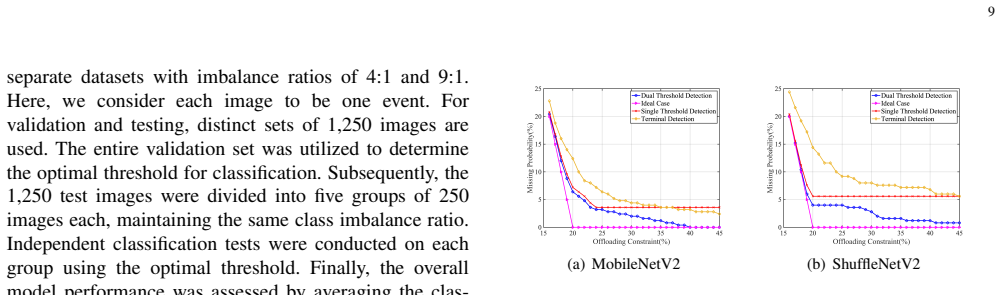
- On medical retinal datasets, the dual-threshold scheme lowers tail-event miss probability and raises tail-class accuracy compared with single-threshold early exiting and terminal detection under the same offloading and energy constraints.
Reading between the lines
- Editorial inference: the same dual-threshold logic could be applied to multi-class long-tail problems, with per-class upper and lower thresholds, though the paper only demonstrates binary head/tail detection.
- Editorial inference: because the analysis models decision functions as infinitely sharp step functions while the proofs require bounded derivatives, a robustness check with finite-$\alpha$ sigmoids, or with the actual neural network confidences, would show whether the convergence guarantees survive outside the idealization.
- Editorial inference: the tradeoff between miss probability and offloading probability resembles selective prediction; connecting the thresholds to conformal prediction could provide distribution-free coverage guarantees for rare-event detection.
Signed reviews
Editorial analysis
A structured set of objections, weighed in public.
Referee Report
Summary. The manuscript proposes an event-triggered edge co-inference framework for rare-event classification. A lightweight on-device CNN with early-exit blocks applies two confidence thresholds (βℓ and βu) so that head events are resolved locally while tail events are offloaded to an edge server for refined multi-class classification. The authors formulate a constrained optimization problem (P1) for choosing the thresholds, claim that the non-convex objective can be transformed into an equivalent strongly convex problem, and present an online proximal-gradient algorithm. Experiments on retinal images compare the dual-threshold detector with single-threshold, terminal-detection, and ideal-case schemes under different class-imbalance ratios, energy budgets, and SNR conditions.
Significance. If the theoretical core were valid, the paper would be a useful practical contribution: it couples early exiting with channel-adaptive offloading in a way that targets rare events, and it validates the architecture on real medical data with multiple CNN backbones and sensible baselines. The experimental design includes separate validation and held-out test sets, five test groups, and comparisons with three baselines, which are strengths of the empirical part. However, the optimization analysis is the load-bearing part of the contribution, and the current proofs do not establish the claimed guarantees. The experimental comparison is suggestive but cannot repair the analytical core, and no code or data are provided to support independent reproduction.
major comments (5)
- [Section IV-A, Eq. (6); Appendix A] Eq. (6) defines σ(y) = 1/(1+e^{-α y}) with α→∞, so the indicator functions in Eqs. (5), (7), and (8) are Heaviside step functions, which are not differentiable and not Lipschitz. Yet Appendix A proves Lemma 2 using the bounds |σ(x)|≤1, |σ'(x)|≤1/4, and |σ''(x)|≤√3/6, which hold only for the α=1 logistic function. For finite α the derivative bounds scale as α/4 and α²√3/6, and they diverge as α→∞. Consequently, the Lipschitz constants in Lemmas 2–4, the strong-convexity parameters in Proposition 1, and the convergence rate in Remark 1 are not established for the model actually defined in the paper.
- [Appendix C, Eq. (50)] The passage from gradient Lipschitzness to weak convexity is not demonstrated. Eq. (50) is the standard one-sided upper quadratic bound; weak convexity requires the lower quadratic bound f(y) ≥ f(x) + ⟨∇f(x), y−x⟩ − (γ/2)||y−x||². Since the proof relies only on the displayed upper bound, the claimed weak-convexity of facc in Lemma 4, and hence the strong-convexity parameter η in Proposition 1, is unsupported unless the lower-bound argument is supplied explicitly.
- [Section V-B3, Proposition 2, Eqs. (30)–(31)] Proposition 2 is not a consequence of the optimization problem P1. Eq. (31) merely counts how many events can be offloaded with the residual energy budget at the current transmission rate, and Eq. (30) restates the feasibility condition of Lemma 1. Neither formula uses the data-volume constraint θ, the offloading probability Poff, or the accuracy trade-off in P1, so labeling this the 'optimal offloading policy' is not justified. At most it is an energy-feasibility bound on the number of offloadable events.
- [Section V-B2, Algorithm 1, Eq. (24)] The paper claims that the original non-convex problem is transformed into an equivalent strongly convex one, but no equivalence theorem is given. The proximal-penalty function (24) is not shown to have the same solution set as P1, and the output selection in Algorithm 1 (line 16, minimizing ||β^{t+1} − β^t|| across iterations) is not accompanied by any convergence or feasibility guarantee for the original constraints (20)–(21). Thus the optimality of the proposed online algorithm is unproven even under the strong-convexity assumptions.
- [Section VI, Figs. 4–7] The experimental section reports average accuracies without error bars, confidence intervals, or significance tests, despite the five-group test protocol described in Section VI-A. The claimed superiority of the dual-threshold mechanism over the baselines is therefore not statistically quantified. In addition, the single-threshold baseline is dropped from the imbalanced-ratio comparison in Section VI-C, and the 'ideal case' is an upper bound rather than a fair baseline, which limits the strength of the comparison.
minor comments (6)
- [Eq. (3) vs. Eq. (22) and Section VI-A] The logarithm base in the data-rate expression is inconsistent: Eq. (3) writes log(1+SNR), while Lemma 1, Eq. (22), and the experimental settings use log₂(1+SNR). Please make the base explicit and consistent throughout.
- [Algorithm 1, line 8] The function fmiss(β) appears in the definition of ft but is never defined; the objective in P1 is facc(βℓ, βu). Please clarify whether fmiss is meant to be 1 − facc or a different loss.
- [Lemma 2 and Appendix A] The constant k (and hence k²) in the Lipschitz constant γ is never defined in the main text or in Appendix A, so the numerical value of γ cannot be evaluated.
- [Proposition 1, Eqs. (25)–(28)] The symbol B is used both for the bandwidth and for the constant defined in Eq. (28), which is confusing; please use a different symbol for one of these quantities.
- [Throughout] There are numerous typographical and grammatical errors, including 'refered', 'early existing', 'trade-off indicates a trade-off', 'adaptes', and 'purposed'. A careful proofreading pass is needed.
- [Eq. (15)] The expression for facc(βℓ, βu) is written in a confusing way because it contains M · M/Mtail without simplification; please state the final form explicitly and define Ptail before using it.
Circularity Check
One self-definitional step: Proposition 2's 'optimal offloading policy' is the energy-budget constraint rewritten; the central empirical comparison is held-out and not circular.
-
self definitional
[Section V-B-3, Proposition 2, Eqs. (30)-(31), with Eqs. (16)-(18), (21)]
"Proposition 2. (Threshold based Offloading Policy). Given (β∗ℓ , β∗u ) is the optimal solution stored in the lookup table ... the co-inference system's optimal offloading policy has the following structure: ... 2) The system offloads Moff events based on different channel conditions, specifically: M∗off = floor( B (ξ − M · Eloc (β∗ℓ , β∗u )) log(1 +SNR) / (PtrD) ), SNR ≥ 2^{ PtrD / (B (ξ − M · S^{mem}_1 ϱ)) } − 1."
Substituting (16)-(18) into the energy constraint (21) gives M·Etotal = M·Eloc + Moff·PtrD/(B log(1+SNR)) ≤ ξ, where Moff = Σ_n I_tail^n is the number of offloaded events. Rearranging gives exactly Moff ≤ B(ξ − M·Eloc)log(1+SNR)/(PtrD), and the floor of this bound is precisely Eq. (31). Thus the 'optimal offloading policy' is the energy-budget constraint rewritten: it does not depend on the accuracy objective facc, it contains no rule for which events to offload, and its optimality is not established by any optimization argument. The claimed threshold-based structure is therefore a restatement of the constraint, not a derived prediction.
full rationale
The paper's headline empirical claim, that the dual-threshold event-triggered framework improves rare-event accuracy and reduces communication overhead, is supported by held-out test evaluations on real medical datasets with separate validation-set threshold tuning, so it is not circular in the core experimental sense. The main circularity-like defect is Proposition 2: the 'optimal offloading policy' formula is obtained by solving the energy constraint (21) for the number of offloaded events; it is an algebraic restatement of the budget, not a consequence of optimizing the accuracy function. This makes one theoretical contribution self-definitional, though the overall system claim retains independent experimental content. I did not find load-bearing self-citations: references to the authors' prior work are background or architectural context, and the dual-threshold idea is credited to an external source [34]. Two non-circularity correctness concerns should nevertheless be weighed: Appendix C infers weak convexity from Nesterov's upper quadratic bound, which does not imply the required lower bound, and Appendix A uses the α=1 logistic derivative bounds while Eq. (6) defines the logistic function with α→∞, so the stated Lipschitz constants and convergence guarantees are not established. These are mathematical gaps, not circular reductions, but they further weaken the theoretical framing of the threshold optimization.
Assumptions & free parameters
free parameters (3)
- βℓ (lower confidence threshold) =
chosen on validation set
- βu (upper confidence threshold) =
chosen on validation set
- Proximal parameter λ and penalty parameters κ, ρ =
not specified
assumptions (4)
- ad hoc to paper σ(y)=1/(1+e^{-αy}) with α→∞ is treated as a smooth function with bounded derivatives in the Lipschitz analysis
- domain assumption Intermediate classifiers produce well-calibrated confidence scores that follow the assumed head/tail distributions
- domain assumption Energy consumption is dominated by memory access and follows Eq. (1) from [18]
- domain assumption Perfect CSI and Shannon-rate transmission with Rtr = B log(1+SNR)
Cite this review
Pith. "Pith review of Communication Efficient Cooperative Edge AI via Event-Triggered Computation Offloading." pith.science (2026). https://pith.science/paper/3BS7IKJO
@misc{pith2026250102001,
  author       = {Pith},
  title        = {Pith review of: Communication Efficient Cooperative Edge AI via Event-Triggered Computation Offloading},
  year         = {2026},
  howpublished = {\url{https://pith.science/paper/3BS7IKJO}},
  note         = {Machine review of arXiv:2501.02001}
}
read the original abstract
Rare events, despite their infrequency, often carry critical information and require immediate attentions in mission-critical applications such as autonomous driving, healthcare, and industrial automation. The data-intensive nature of these tasks and their need for prompt responses, combined with designing edge AI (or edge inference), pose significant challenges in systems and techniques. Existing edge inference approaches often suffer from communication bottlenecks due to high-dimensional data transmission and fail to provide timely responses to rare events, limiting their effectiveness for mission-critical applications in the sixth-generation (6G) mobile networks. To overcome these challenges, we propose a channel-adaptive, event-triggered edge-inference framework that prioritizes efficient rare-event processing. Central to this framework is a dual-threshold, multi-exit architecture, which enables early local inference for rare events detected locally while offloading more complex rare events to edge servers for detailed classification. To further enhance the system's performance, we developed a channel-adaptive offloading policy paired with an online algorithm to dynamically determine the optimal confidence thresholds for controlling offloading decisions. The associated optimization problem is solved by reformulating the original non-convex function into an equivalent strongly convex one. Using deep neural network classifiers and real medical datasets, our experiments demonstrate that the proposed framework not only achieves superior rare-event classification accuracy, but also effectively reduces communication overhead, as opposed to existing edge-inference approaches.
Figures


Figures from the paper (2 more)


Reference graph
Works this paper leans on
-
[1]
Integrated sensing and communications: Toward dual-functional wire- less networks for 6g and beyond,
F. Liu, Y . Cui, C. Masouros, J. Xu, T. X. Han, Y . C. Eldar, and S. Buzzi, “Integrated sensing and communications: Toward dual-functional wire- less networks for 6g and beyond,” IEEE J. Sel. Areas Commun., vol. 40, no. 6, pp. 1728–1767, 2022
2022
-
[2]
Knowledge-based ultra-low-latency semantic communications for robotic edge intelligence,
Q. Zeng, Z. Wang, Y . Zhou, H. Wu, L. Yang, and K. Huang, “Knowledge-based ultra-low-latency semantic communications for robotic edge intelligence,” IEEE Trans. Commun. , 2024
work page 2024
-
[3]
Spectrum breathing: Protecting over-the-air federated learning against interference,
Z. Wang, K. Huang, and Y . C. Eldar, “Spectrum breathing: Protecting over-the-air federated learning against interference,” IEEE Trans. Wire- less Commun., 2024
2024
-
[4]
Edge ai: On-demand acceler- ating deep neural network inference via edge computing,
E. Li, L. Zeng, Z. Zhou, and X. Chen, “Edge ai: On-demand acceler- ating deep neural network inference via edge computing,” IEEE Trans. Wireless Commun., vol. 19, no. 1, pp. 447–457, 2019
work page 2019
-
[5]
Optimal model placement and online model splitting for device-edge co-inference,
J. Yan, S. Bi, and Y .-J. A. Zhang, “Optimal model placement and online model splitting for device-edge co-inference,” IEEE Trans. Wireless Commun., vol. 21, no. 10, pp. 8354–8367, 2022
work page 2022
-
[6]
Ultra- low-latency edge inference for distributed sensing,
Z. Wang, A. E. Kalør, Y . Zhou, P. Popovski, and K. Huang, “Ultra- low-latency edge inference for distributed sensing,” arXiv preprint arXiv:2407.13360, 2024
arXiv 2024
-
[7]
Wireless channel adaptive dnn split inference for resource-constrained edge devices,
J. Lee, H. Lee, and W. Choi, “Wireless channel adaptive dnn split inference for resource-constrained edge devices,” IEEE Commun. Lett. , vol. 27, no. 6, pp. 1520–1524, 2023
work page 2023
-
[8]
Bottlenet++: An end-to-end approach for feature compression in device-edge co-inference systems,
J. Shao and J. Zhang, “Bottlenet++: An end-to-end approach for feature compression in device-edge co-inference systems,” in IEEE Int. Conf. on Commun. Workshops (ICC Workshops) . IEEE, 2020, pp. 1–6
work page 2020
Show all 41 references
-
[9]
Joint device-edge inference over wireless links with pruning,
M. Jankowski, D. G ¨und¨uz, and K. Mikolajczyk, “Joint device-edge inference over wireless links with pruning,” in IEEE Int. Workshop Signal Process. Adv. Wireless Commun. (SPAWC) . IEEE, 2020, pp. 1–5
2020
-
[10]
Task- oriented sensing, computation, and communication integration for multi- device edge ai,
D. Wen, P. Liu, G. Zhu, Y . Shi, J. Xu, Y . C. Eldar, and S. Cui, “Task- oriented sensing, computation, and communication integration for multi- device edge ai,” IEEE Trans. Wireless Commun. , 2023
2023
-
[11]
Task-oriented over-the-air computation for multi-device edge ai,
D. Wen, X. Jiao, P. Liu, G. Zhu, Y . Shi, and K. Huang, “Task-oriented over-the-air computation for multi-device edge ai,” IEEE Trans. Wireless Commun., 2023
2023
-
[12]
Resource allocation for multiuser edge inference with batching and early exiting,
Z. Liu, Q. Lan, and K. Huang, “Resource allocation for multiuser edge inference with batching and early exiting,” IEEE J. Sel. Areas Commun., vol. 41, no. 4, pp. 1186–1200, 2023
2023
-
[13]
A survey on mobile edge computing: The communication perspective,
Y . Mao, C. You, J. Zhang, K. Huang, and K. B. Letaief, “A survey on mobile edge computing: The communication perspective,” IEEE Commun. Surv. Tut, vol. 19, no. 4, pp. 2322–2358, 2017
2017
-
[14]
Optimal task offloading and resource allocation in mobile-edge computing with inter-user task dependency,
J. Yan, S. Bi, Y . J. Zhang, and M. Tao, “Optimal task offloading and resource allocation in mobile-edge computing with inter-user task dependency,” IEEE Trans. Wireless Commun. , vol. 19, no. 1, pp. 235– 250, 2019
2019
-
[15]
Asynchronous mobile-edge computation offloading: Energy-efficient resource management,
C. You, Y . Zeng, R. Zhang, and K. Huang, “Asynchronous mobile-edge computation offloading: Energy-efficient resource management,” IEEE Trans. Wireless Commun., vol. 17, no. 11, pp. 7590–7605, 2018
2018
-
[16]
Joint optimization of transmission and computation resources for satellite and high altitude platform assisted edge computing,
C. Ding, J.-B. Wang, H. Zhang, M. Lin, and G. Y . Li, “Joint optimization of transmission and computation resources for satellite and high altitude platform assisted edge computing,” IEEE Trans. Wireless Commun. , vol. 21, no. 2, pp. 1362–1377, 2021
2021
-
[17]
Mobile-edge com- puting: Partial computation offloading using dynamic voltage scaling,
Y . Wang, M. Sheng, X. Wang, L. Wang, and J. Li, “Mobile-edge com- puting: Partial computation offloading using dynamic voltage scaling,” IEEE Trans. Commun. , vol. 64, no. 10, pp. 4268–4282, 2016
2016
-
[18]
Dynamic computation offloading for mobile-edge computing with energy harvesting devices,
Y . Mao, J. Zhang, and K. B. Letaief, “Dynamic computation offloading for mobile-edge computing with energy harvesting devices,” IEEE J. Sel. Areas Commun. , vol. 34, no. 12, pp. 3590–3605, 2016
2016
-
[19]
Joint offloading and trajectory design for uav-enabled mobile edge computing systems,
Q. Hu, Y . Cai, G. Yu, Z. Qin, M. Zhao, and G. Y . Li, “Joint offloading and trajectory design for uav-enabled mobile edge computing systems,” IEEE Int. Things J. , vol. 6, no. 2, pp. 1879–1892, 2018
2018
-
[20]
Fast and secure computational offload- ing with lagrange coded mobile edge computing,
A. Asheralieva and D. Niyato, “Fast and secure computational offload- ing with lagrange coded mobile edge computing,” IEEE Trans. Veh. Technol., vol. 70, no. 5, pp. 4924–4942, 2021
2021
-
[21]
Joint computation and communication cooperation for energy-efficient mobile edge comput- ing,
X. Cao, F. Wang, J. Xu, R. Zhang, and S. Cui, “Joint computation and communication cooperation for energy-efficient mobile edge comput- ing,” IEEE Int. Things J. , vol. 6, no. 3, pp. 4188–4200, 2018
2018
-
[22]
Massive connectivity with massive mimo—part i: Device activity detection and channel estimation,
L. Liu and W. Yu, “Massive connectivity with massive mimo—part i: Device activity detection and channel estimation,” IEEE Trans. Signal Process., vol. 66, no. 11, pp. 2933–2946, 2018
2018
-
[23]
Sparse representation for wireless communications: A compressive sensing approach,
Z. Qin, J. Fan, Y . Liu, Y . Gao, and G. Y . Li, “Sparse representation for wireless communications: A compressive sensing approach,” IEEE Signal Process. Mag. , vol. 35, no. 3, pp. 40–58, 2018
2018
-
[24]
Sparse signal processing for grant-free massive connectivity: A future paradigm for random access protocols in the internet of things,
L. Liu, E. G. Larsson, W. Yu, P. Popovski, C. Stefanovic, and E. De Car- valho, “Sparse signal processing for grant-free massive connectivity: A future paradigm for random access protocols in the internet of things,” IEEE Signal Process. Mag. , vol. 35, no. 5, pp. 88–99, 2018
2018
-
[25]
Sensing and communication co-design for status update in multiaccess wireless networks,
F. Peng, Z. Jiang, S. Zhou, Z. Niu, and S. Zhang, “Sensing and communication co-design for status update in multiaccess wireless networks,” IEEE Trans. Mobile Comput. , 2021
2021
-
[26]
Adaptive anomaly detection for internet of things in hierarchical edge computing: A contextual-bandit approach,
M. V . Ngo, T. Luo, and T. Q. Quek, “Adaptive anomaly detection for internet of things in hierarchical edge computing: A contextual-bandit approach,” ACM Trans. Int. of Things , vol. 3, no. 1, pp. 1–23, 2021
2021
-
[27]
Spatiotemporal models for data-anomaly detection in dynamic environmental monitoring cam- paigns,
E. W. Dereszynski and T. G. Dietterich, “Spatiotemporal models for data-anomaly detection in dynamic environmental monitoring cam- paigns,” ACM Trans. Sensor Netw. (TOSN) , vol. 8, no. 1, pp. 1–36, 2011
2011
-
[28]
Pushing ai to wireless network edge: An overview on integrated sensing, communication, and computation towards 6g,
G. Zhu, Z. Lyu, X. Jiao, P. Liu, M. Chen, J. Xu, S. Cui, and P. Zhang, “Pushing ai to wireless network edge: An overview on integrated sensing, communication, and computation towards 6g,” Science China Inf. Sciences, vol. 66, no. 3, p. 130301, 2023
2023
-
[29]
End to end learning for self-driving cars,
M. Bojarski, D. Del Testa, D. Dworakowski, B. Firner, B. Flepp, P. Goyal, L. D. Jackel, M. Monfort, U. Muller, J. Zhang et al. , “End to end learning for self-driving cars,” arXiv preprint arXiv:1604.07316 , 2016
2016 arXiv
-
[30]
Branchynet: Fast inference via early exiting from deep neural networks,
S. Teerapittayanon, B. McDanel, and H.-T. Kung, “Branchynet: Fast inference via early exiting from deep neural networks,” in Int. Conf. Pattern Recognit. (ICPR). IEEE, 2016, pp. 2464–2469
2016
-
[31]
Shufflenet v2: Practical guidelines for efficient cnn architecture design,
N. Ma, X. Zhang, H.-T. Zheng, and J. Sun, “Shufflenet v2: Practical guidelines for efficient cnn architecture design,” in Proc. of the Eur. Conf. Comput. Vision (ECCV) , 2018, pp. 116–131
2018
-
[32]
Mo- bilenetv2: Inverted residuals and linear bottlenecks,
M. Sandler, A. Howard, M. Zhu, A. Zhmoginov, and L.-C. Chen, “Mo- bilenetv2: Inverted residuals and linear bottlenecks,” in Proc. IEEE/CVF Conf. Comput. Vision Pattern Recogn.(CVPR) , 2018, pp. 4510–4520
2018
-
[33]
Deep long-tailed learning: A survey,
Y . Zhang, B. Kang, B. Hooi, S. Yan, and J. Feng, “Deep long-tailed learning: A survey,” arXiv preprint arXiv:2110.04596 , 2021
2021 arXiv
-
[34]
Bayesian ann classifier for ecg arrhythmia diagnostic system: A comparison study,
D. Gao, M. Madden, D. Chambers, and G. Lyons, “Bayesian ann classifier for ecg arrhythmia diagnostic system: A comparison study,” in Proc. IEEE Int. Joint Conf. Neural Netw. , vol. 4. IEEE, 2005, pp. 2383–2388
2005
-
[35]
Learning-based branch-and-bound for non- convex complex modulus constrained problems with applications in wireless communications,
Z. Zhang and M. Tao, “Learning-based branch-and-bound for non- convex complex modulus constrained problems with applications in wireless communications,” IEEE Trans. Wireless Commun. , vol. 21, no. 6, pp. 3752–3763, 2021
2021
-
[36]
Empowering adaptive early-exit inference with latency awareness,
X. Tan, H. Li, L. Wang, X. Huang, and Z. Xu, “Empowering adaptive early-exit inference with latency awareness,” in Proc. AAAI Conf. Artif. Intell., vol. 35, no. 11, 2021, pp. 9825–9833
2021
-
[37]
Complexity of an inexact proximal- point penalty method for constrained smooth non-convex optimization,
Q. Lin, R. Ma, and Y . Xu, “Complexity of an inexact proximal- point penalty method for constrained smooth non-convex optimization,” Computational optimization and applications , vol. 82, no. 1, pp. 175– 224, 2022
2022
-
[38]
Imagenet training in minutes,
Y . You, Z. Zhang, C.-J. Hsieh, J. Demmel, and K. Keutzer, “Imagenet training in minutes,” in Proc. of the 47th Int. Conf. on Parallel Process., 2018, pp. 1–10
2018
-
[39]
Code-free deep learning for multi-modality medical image classification,
E. Korot, Z. Guan, D. Ferraz, S. K. Wagner, G. Zhang, X. Liu, L. Faes, N. Pontikos, S. G. Finlayson, H. Khalid et al., “Code-free deep learning for multi-modality medical image classification,” Nature Machine Intell., vol. 3, no. 4, pp. 288–298, 2021
2021
-
[40]
Imagenet classification with deep convolutional neural networks,
A. Krizhevsky, I. Sutskever, and G. E. Hinton, “Imagenet classification with deep convolutional neural networks,”Adv. Neural Inf. Process. Syst. (NIPS), vol. 25, 2012
2012
-
[41]
Nesterov et al
Y . Nesterov et al. , Lectures on convex optimization . Springer, 2018, vol. 137
2018
Reviewed August 10, 2026 · model on record in the stance chip above.
Discussion (0). Continue with ORCID to comment.