REVIEW 4 major objections 4 minor 1 cited by
MEgoHand: Multimodal Egocentric Hand-Object Interaction Motion Generation
T0 review · 4 major / 4 minor · reviewed 2026-08-07 · deepseek-v4-flash
Pith's one-line read MEgoHand generates egocentric hand-object motion from RGB, text, and an initial pose, with no 3D object model needed.
desk verdict The main result is promising, but the depth-supervision story and the metric reporting need fixing before the SOTA claim is credible. read the letter →
The pith
A machine-rendered reading of the paper's core claim, the machinery that carries it, and where it could break.
The reading
What carries the argument
The load-bearing mechanism is the two-level architecture. The 'cerebrum' combines a vision-language model (a frozen language backbone with a trainable vision encoder) with a monocular metric depth estimator, so that semantic task understanding and 3D hand-object spatial reasoning are fused into one embedding. The 'cerebellum' is a diffusion-transformer (DiT) conditional flow-matching policy that, conditioned on that embedding and the initial hand parameters, generates a trunk of MANO hand parameters; Temporal Orthogonal Filtering then averages overlapping predictions and projects the wrist rotation onto $\mathrm{SO}(3)$ by SVD. A second, data-side mechanism is the curation pipeline: an Inverse MANO Retargeting Network converts joint-only annotations into MANO parameters, and a Virtual RGB-D Renderer synthesizes aligned depth maps for datasets without real depth, producing the unified 3.35-million-frame corpus.
What would settle it
Retrain the depth encoder from scratch on real sensor depth from a depth-equipped egocentric dataset and compare joint position error and mean rotation error on the same cross-domain test sets against a model trained only on rendered depth. If the rendered-depth model does not match or beat the real-depth model, the central mechanism is falsified.
Extended reading notes
Core claim
The central claim is that a vision-language model augmented with monocular metric depth can supply enough motion priors and spatial grounding to condition a flow-matching policy that produces accurate, temporally stable hand-object interaction trajectories. MEgoHand encodes the text and the RGB frame with a vision-language model, fuses the visual features with a depth map from a pretrained monocular estimator, and feeds the fused embedding together with the initial MANO parameters into a diffusion-transformer flow-matching generator. The generator predicts future MANO parameters in the camera frame, and a Temporal Orthogonal Filtering step smooths overlapping predictions and projects the wrist rotation onto $\mathrm{SO}(3)$ via SVD. The paper also claims that this object-agnostic design transfers zero-shot to unseen articulated-object and real-world manipulation datasets, with Procrustes-aligned joint and vertex errors of 0.424 cm and 0.409 cm, corresponding to 71.2% and 71.9% relative improvements over the strongest baseline.
Load-bearing premise
The load-bearing premise is that depth maps rendered from object and hand meshes by the Virtual RGB-D Renderer capture the hand-object spatial relationships needed for training, so depth supervision learned on synthetic data transfers to real egocentric scenes; the paper's no-depth-supervision ablation uses those same synthetic labels, so it does not test real sensor depth, and if rendered depth is systematically biased the claimed cross-domain spatial reasoning collapses.
Editorial extensions
If this is right
- AR/VR avatars and robot policies can be driven directly from an egocentric RGB stream, a text command, and a one-frame hand pose, removing 3D object models and contact-map generation from the deployment pipeline.
- Joint-only egocentric datasets, annotated with hand keypoints rather than MANO parameters, become usable training data through the Inverse MANO Retargeting Network, increasing the supply of interaction demonstrations.
- Datasets without depth sensors can still provide spatial supervision through the Virtual RGB-D Renderer, so the unified corpus can grow without new hardware capture.
- On articulated-object and real-world household test sets, the reported 33.9% and 29.8% joint-position-error improvements over the strongest baseline indicate that the representation transfers to unseen objects and scenes, not just to held-out instances of training categories.
Reading between the lines
- The paper does not test real sensor depth against rendered depth, but a direct comparison—training the depth encoder on real depth from depth-equipped datasets and measuring cross-domain errors—would isolate any bias in the Virtual RGB-D Renderer.
- The paper limits itself to right-hand motion, but because perception is object-agnostic and output is MANO parameters, the same architecture should extend to bimanual interaction by doubling the hand representation and retraining.
- The large rotation-error reduction implies finger articulation benefits most from VLM semantics plus depth contact cues; an ablation that removes depth only in the finger-joint head would confirm which component carries that gain.
- Temporal Orthogonal Filtering averages overlapping predictions, which should reduce jitter but may also damp fast intentional movements; a user study on perceived naturalness for slow versus fast manipulations would test that trade-off.
Editorial analysis
A structured set of objections, weighed in public.
Referee Report
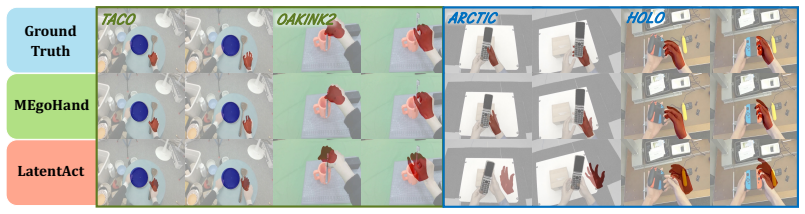
Summary. The paper proposes MEgoHand, a multimodal framework for egocentric hand-object motion generation conditioned on an RGB frame, a text instruction, and an initial MANO hand pose. The architecture couples a frozen VLM (Eagle-2) with a trainable vision encoder and a ResNet-50 depth encoder fed by UniDepthV2 metric depth, and a DiT-based flow-matching head that predicts a length-l MANO trunk. Temporal Orthogonal Filtering averages overlapping chunk predictions and projects wrist rotations onto SO(3). To unify training data, the authors introduce an Inverse MANO Retargeting Network for joint-position-only datasets and a Virtual RGB-D Renderer for datasets without real depth, curating 3.35M frames from six training datasets. Experiments report large improvements over LatentAct and LatentAct-Diff on five in-domain datasets (Table 1) and two cross-domain datasets (Table 2), with ablations in Table 3. The central claim is that MEgoHand achieves state-of-the-art performance and object-agnostic cross-domain spatial reasoning.
Significance. If the reported results hold, MEgoHand is a practically useful object-agnostic generator: it does not require 3D object models, uses a standard conditional flow-matching objective (Eq. 2), and is evaluated against an external baseline on held-out ARCTIC and HOLO data. The dataset curation pipeline is substantial, and the paper's strengths include the explicit problem formulation, the clear modality ablations, and the use of an external baseline in the central comparison. However, confidence in the headline spatial-reasoning claim is limited by two data-provenance issues: depth supervision for HOT3D, OakInk2, and ARCTIC is synthetic z-buffer rendering, and ARCTIC depth is reported as rendered in advance (Appendix A.5), which threatens the zero-shot claim. The absence of error bars and the mislabeled headline metrics further reduce the strength of the quantitative claims. If the synthetic-depth concern is resolved and the metrics are corrected, the contribution would be solid for a computer vision venue.
major comments (4)
- [Abstract and Section 1] The abstract and introduction state that MEgoHand reduces 'wrist translation error (86.9%) and joint rotation error (34.1%)', but Table 1 shows the opposite mapping: MRE decreases from 0.937 to 0.123 radians (86.9%) and MWTE decreases from 7.221 to 4.756 cm (34.1%). Please correct the attribution so that the 86.9% reduction is assigned to joint rotation error and the 34.1% reduction to wrist translation error.
- [Section 4, Appendix A.5, Table 3] The depth encoder is trained with an MSE loss that aligns its representation with depth maps produced by the Virtual RGB-D Renderer for HOT3D, OakInk2, and ARCTIC, and Appendix A.5 states that ARCTIC depth is rendered 'in advance'. Since ARCTIC is presented as a zero-shot cross-domain test set in Section 5.3, the paper must state explicitly whether any rendered ARCTIC frame was used for pretraining, finetuning, or validation of the depth encoder, the VLM, or any other component; if any such frame was used, the ARCTIC results in Table 2 are not zero-shot. In addition, the 'no depth supervision' ablation in Table 3 removes the depth MSE loss but leaves the rest of the rendered-depth pipeline intact, so it tests only whether some depth supervision helps, not whether real sensor depth or monocular estimates transfer. The claim in Section 5.4(b) that this is 'real depth supervision' is inaccurate for HOT3D, OakInk2, and ARCTIC. Please add an ablation with real sensor depth on a dataset that has it (e.g., H2O, HOI4D, or FPHA) or with UniDepthV2 estimates as supervision targets, and provide the exact provenance of every ARCTIC depth frame used anywhere in training.
- [Section 5.1] FPHA is listed as a training dataset and described as re-annotated using the authors' own Inverse MANO Retargeting Network and 'exclusive for evaluation', yet FPHA does not appear in any results table. If FPHA is used only for evaluation, its ground-truth MANO parameters are produced by the same retargeting method used to build the unified corpus, and the retargeting network is pretrained on TACO and OakInk2 (Section 4); this creates a risk of circular evaluation on that dataset. Please either include FPHA results in the main tables, remove FPHA from the evaluation list, or validate the retargeting network quantitatively against datasets with native MANO annotations before using its outputs as ground truth.
- [Tables 1-3] All quantitative results are reported without standard deviations or the number of seeds. Several ablation differences are small (e.g., the ARCTIC relative-depth row differs from the full model by 0.206 cm MPJPE, and the HOLO relative-depth row is within 0.104 cm), so without variance estimates it is not possible to determine whether these differences are meaningful. Please report means and standard deviations over at least three seeds, or otherwise justify that the observed differences exceed run-to-run variability.
minor comments (4)
- [Appendix A.5] The dataset list refers to 'TACA' in the bullet for TACO; this should be 'TACO'.
- [Table 3] The ARCTIC and HOLO rows for the 'relative depth' variant lack spacing between numbers (e.g., '7.5641.1217.4851.0916.082'), which makes the table hard to read; please reformat.
- [Abstract] The phrase 'limiting generalization to novel objects, which restricts their generalizability to novel objects' is redundant and should be simplified.
- [General] The paper does not state a release plan for code, models, or the curated 3.35M-frame dataset; given that dataset curation is a central contribution, a release statement or a detailed appendix with exact processing commands would improve reproducibility.
Circularity Check
No demonstrated circularity: the headline SOTA numbers are measured against external baselines and held-out ground-truth MANO annotations; the self-generated depth and retargeting pre-processing does not force the reported results.
full rationale
The central reductions in Table 1 and the zero-shot results in Table 2 are evaluated on held-out splits of five datasets and on the full ARCTIC test set plus a 10% HOLO partition, with external ground-truth MANO annotations and external LatentAct baselines; no equation in the paper reduces the predicted motion metrics to the model's training labels by construction. The depth encoder is trained with MSE against depth maps that, for HOT3D/OakInk2/ARCTIC, are synthesized by the authors' own Virtual RGB-D Renderer from object/hand meshes (Section 4), and Section 5.4(b) calls this 'real depth supervision.' That label is an overstatement, and the ablation removes only this self-rendered loss, so the 'depth supervision is necessary' conclusion is weaker than claimed; however, the in-domain and cross-domain motion metrics themselves use independent annotations, so this is a terminology/provenance weakness rather than a circular prediction. Appendix A.5 states that ARCTIC is rendered 'in advance' even though ARCTIC is a zero-shot test set; the Section 5.1 training list excludes ARCTIC, so as written this is an ambiguity requiring clarification, not a demonstrated contamination. FPHA is re-annotated by the authors' Inverse MANO Retargeting Network, but FPHA results do not appear in the reported tables, so that self-generated annotation chain is not load-bearing for the claimed SOTA. The self-citations in the introduction and related work ([27], [41], [44]) are contextual and do not carry the derivation. No Eq. X = Eq. Y reduction, no fitted parameter renamed as a prediction, and no load-bearing uniqueness theorem are present.
Assumptions & free parameters
free parameters (3)
- Prediction trunk size l =
16
- Integration step count for flow matching =
10 (delta = 0.1)
- Inverse MANO retargeting loss weights =
w1 = 4.0, w2 = 5.0
assumptions (6)
- standard math Flow matching with the linear path q(H_tau|H)=N(tau H, (1-tau)^2 I) and vector field u=epsilon-H is a valid generative model for hand MANO trajectories.
- domain assumption The MANO hand model parameterizes the hand sufficiently for egocentric interaction generation.
- domain assumption UniDepthV2 supplies reliable metric depth for egocentric RGB frames in the target datasets.
- ad hoc to paper Virtual z-buffer rendered depth from known object and hand meshes is a valid substitute for real depth in depth-encoder training.
- ad hoc to paper The inverse MANO retargeting network, pretrained on 10K pairs from TACO and OakInk2, generalizes to new datasets such as FPHA.
- domain assumption An accurate initial MANO hand pose h_k is available as input.
Cite this review
Pith. "Pith review of MEgoHand: Multimodal Egocentric Hand-Object Interaction Motion Generation." pith.science (2026). https://pith.science/paper/3CPL3GUK
@misc{pith2026250516602,
  author       = {Pith},
  title        = {Pith review of: MEgoHand: Multimodal Egocentric Hand-Object Interaction Motion Generation},
  year         = {2026},
  howpublished = {\url{https://pith.science/paper/3CPL3GUK}},
  note         = {Machine review of arXiv:2505.16602}
}
read the original abstract
Egocentric hand-object motion generation is crucial for immersive AR/VR and robotic imitation but remains challenging due to unstable viewpoints, self-occlusions, perspective distortion, and noisy ego-motion. Existing methods rely on predefined 3D object priors, limiting generalization to novel objects, which restricts their generalizability to novel objects. Meanwhile, recent multimodal approaches suffer from ambiguous generation from abstract textual cues, intricate pipelines for modeling 3D hand-object correlation, and compounding errors in open-loop prediction. We propose MEgoHand, a multimodal framework that synthesizes physically plausible hand-object interactions from egocentric RGB, text, and initial hand pose. MEgoHand introduces a bi-level architecture: a high-level "cerebrum" leverages a vision language model (VLM) to infer motion priors from visual-textual context and a monocular depth estimator for object-agnostic spatial reasoning, while a low-level DiT-based flow-matching policy generates fine-grained trajectories with temporal orthogonal filtering to enhance stability. To address dataset inconsistency, we design a dataset curation paradigm with an Inverse MANO Retargeting Network and Virtual RGB-D Renderer, curating a unified dataset of 3.35M RGB-D frames, 24K interactions, and 1.2K objects. Extensive experiments across five in-domain and two cross-domain datasets demonstrate the effectiveness of MEgoHand, achieving substantial reductions in wrist translation error (86.9%) and joint rotation error (34.1%), highlighting its capacity to accurately model fine-grained hand joint structures and generalize robustly across diverse scenarios.
Figures


Figures from the paper (7 more)


Forward citations
Cited by 1 Pith paper
-
Being-H0: Vision-Language-Action Pretraining from Large-Scale Human Videos
A dexterous VLA pretrained on a 2.5M-instance human hand motion dataset transfers skills to a real robot hand, outperforming baselines in manipulation tasks.
Reference graph
Works this paper leans on
-
[1]
Loubna Ben Allal, Anton Lozhkov, Elie Bakouch, Gabriel Martín Blázquez, Guilherme Penedo, Lewis Tunstall, Andrés Marafioti, Hynek Kydlíˇcek, Agustín Piqueres Lajarín, Vaibhav Srivastav, et al. Smollm2: When smol goes big–data-centric training of a small language model.arXiv preprint arXiv:2502.02737, 2025
arXiv 2025
-
[2]
Hot3d: Hand and object tracking in 3d from egocentric multi-view videos.CVPR, 2025
Prithviraj Banerjee, Sindi Shkodrani, Pierre Moulon, Shreyas Hampali, Shangchen Han, Fan Zhang, Linguang Zhang, Jade Fountain, Edward Miller, Selen Basol, Richard Newcombe, Robert Wang, Jakob Julian Engel, and Tomas Hodan. Hot3d: Hand and object tracking in 3d from egocentric multi-view videos.CVPR, 2025
work page 2025
-
[3]
Chen Bao, Jiarui Xu, Xiaolong Wang, Abhinav Gupta, and Homanga Bharadhwaj. Hand- sonvlm: Vision-language models for hand-object interaction prediction.arXiv preprint arXiv:2412.13187, 2024
arXiv 2024
-
[4]
Johan Bjorck, Fernando Castañeda, Nikita Cherniadev, Xingye Da, Runyu Ding, Linxi Fan, Yu Fang, Dieter Fox, Fengyuan Hu, Spencer Huang, et al. Gr00t n1: An open foundation model for generalist humanoid robots.arXiv preprint arXiv:2503.14734, 2025
arXiv 2025
-
[5]
Lerobot: State-of-the-art machine learning for real-world robotics in pytorch, 2024
Remi Cadene, Simon Alibert, Alexander Soare, Quentin Gallouedec, Adil Zouitine, and Thomas Wolf. Lerobot: State-of-the-art machine learning for real-world robotics in pytorch, 2024
2024
-
[6]
Text2hoi: Text-guided 3d motion generation for hand-object interaction
Junuk Cha, Jihyeon Kim, Jae Shin Yoon, and Seungryul Baek. Text2hoi: Text-guided 3d motion generation for hand-object interaction. InProceedings of the IEEE/CVF Conference on Computer Vision and Pattern Recognition, pages 1577–1585, 2024
work page 2024
-
[7]
Ning Cheng, Qiqi Dong, Zhen Zhang, Li Wang, Xiaojing Chen, and Cheng Wang. Egocentric processing of items in spines, dendrites, and somas in the retrosplenial cortex.Neuron, 112(4): 646–660, 2024
work page 2024
-
[8]
Diffh2o: Diffusion-based synthesis of hand-object interactions from textual descriptions
Sammy Christen, Shreyas Hampali, Fadime Sener, Edoardo Remelli, Tomas Hodan, Eric Sauser, Shugao Ma, and Bugra Tekin. Diffh2o: Diffusion-based synthesis of hand-object interactions from textual descriptions. InSIGGRAPH Asia 2024 Conference Papers, pages 1–11, 2024
2024
Show all 46 references
-
[9]
Imagenet: A large- scale hierarchical image database
Jia Deng, Wei Dong, Richard Socher, Li-Jia Li, Kai Li, and Li Fei-Fei. Imagenet: A large- scale hierarchical image database. In2009 IEEE conference on computer vision and pattern recognition, pages 248–255. Ieee, 2009
2009
-
[10]
Hamba: Single-view 3d hand reconstruction with graph-guided bi-scanning mamba
Haoye Dong, Aviral Chharia, Wenbo Gou, Francisco Vicente Carrasco, and Fernando D De la Torre. Hamba: Single-view 3d hand reconstruction with graph-guided bi-scanning mamba. Advances in Neural Information Processing Systems, 37:2127–2160, 2024
2024
-
[11]
Hmp: Hand motion priors for pose and shape estimation from video
Enes Duran, Muhammed Kocabas, Vasileios Choutas, Zicong Fan, and Michael J Black. Hmp: Hand motion priors for pose and shape estimation from video. InProceedings of the IEEE/CVF Winter Conference on Applications of Computer Vision, pages 6353–6363, 2024
2024
-
[12]
Black, and Otmar Hilliges
Zicong Fan, Omid Taheri, Dimitrios Tzionas, Muhammed Kocabas, Manuel Kaufmann, Michael J. Black, and Otmar Hilliges. Arctic: A dataset for dexterous bimanual hand-object manipulation. InProceedings IEEE Conference on Computer Vision and Pattern Recognition (CVPR), 2023
2023
-
[13]
Hold: Category-agnostic 3d reconstruction of interacting hands and objects from video
Zicong Fan, Maria Parelli, Maria Eleni Kadoglou, Xu Chen, Muhammed Kocabas, Michael J Black, and Otmar Hilliges. Hold: Category-agnostic 3d reconstruction of interacting hands and objects from video. InProceedings of the IEEE/CVF Conference on Computer Vision and Pattern Recog...
2024
-
[14]
Deformer: Dy- namic fusion transformer for robust hand pose estimation
Qichen Fu, Xingyu Liu, Ran Xu, Juan Carlos Niebles, and Kris M Kitani. Deformer: Dy- namic fusion transformer for robust hand pose estimation. InProceedings of the IEEE/CVF International Conference on Computer Vision, pages 23600–23611, 2023
2023
-
[15]
First-person hand action benchmark with rgb-d videos and 3d hand pose annotations
Guillermo Garcia-Hernando, Shanxin Yuan, Seungryul Baek, and Tae-Kyun Kim. First-person hand action benchmark with rgb-d videos and 3d hand pose annotations. InProceedings of Computer Vision and Pattern Recognition (CVPR), 2018. 11
2018
-
[16]
Sight: Single-image conditioned generation of hand trajectories for hand- object interaction.arXiv preprint arXiv:2503.22869, 2025
Alexey Gavryushin, Florian Redhardt, Gaia Di Lorenzo, Luc Van Gool, Marc Pollefeys, Kaichun Mo, and Xi Wang. Sight: Single-image conditioned generation of hand trajectories for hand- object interaction.arXiv preprint arXiv:2503.22869, 2025
2025 arXiv
-
[17]
Ego4d: Around the world in 3,000 hours of egocentric video
Kristen Grauman, Andrew Westbury, Eugene Byrne, Zachary Chavis, Antonino Furnari, Rohit Girdhar, Jackson Hamburger, Hao Jiang, Miao Liu, Xingyu Liu, et al. Ego4d: Around the world in 3,000 hours of egocentric video. InProceedings of the IEEE/CVF conference on computer vision a...
2022
-
[18]
Deep residual learning for image recognition
Kaiming He, Xiangyu Zhang, Shaoqing Ren, and Jian Sun. Deep residual learning for image recognition. InProceedings of the IEEE conference on computer vision and pattern recognition, pages 770–778, 2016
2016
-
[19]
H2o: Two hands manipulating objects for first person interaction recognition
Taein Kwon, Bugra Tekin, Jan Stühmer, Federica Bogo, and Marc Pollefeys. H2o: Two hands manipulating objects for first person interaction recognition. InProceedings of the IEEE/CVF International Conference on Computer Vision (ICCV), pages 10138–10148, October 2021
2021
-
[20]
Ego-exo: Transferring visual representations from third-person to first-person videos
Yanghao Li, Hanzi Mao, Ross Girshick, and Kaiming He. Ego-exo: Transferring visual representations from third-person to first-person videos. InCVPR, pages 6943–6953, 2022
2022
-
[21]
Eagle 2: Building post-training data strategies from scratch for frontier vision-language models.arXiv preprint arXiv:2501.14818, 2025
Zhiqi Li, Guo Chen, Shilong Liu, Shihao Wang, Vibashan VS, Yishen Ji, Shiyi Lan, Hao Zhang, Yilin Zhao, Subhashree Radhakrishnan, et al. Eagle 2: Building post-training data strategies from scratch for frontier vision-language models.arXiv preprint arXiv:2501.14818, 2025
2025 arXiv
-
[22]
Simhand: Mining similar hands for large-scale 3d hand pose pre- training.arXiv preprint arXiv:2502.15251, 2025
Nie Lin, Takehiko Ohkawa, Yifei Huang, Mingfang Zhang, Minjie Cai, Ming Li, Ryosuke Furuta, and Yoichi Sato. Simhand: Mining similar hands for large-scale 3d hand pose pre- training.arXiv preprint arXiv:2502.15251, 2025
2025 arXiv
-
[23]
Flow matching for generative modeling.arXiv preprint arXiv:2210.02747, 2022
Yaron Lipman, Ricky TQ Chen, Heli Ben-Hamu, Maximilian Nickel, and Matt Le. Flow matching for generative modeling.arXiv preprint arXiv:2210.02747, 2022
2022 arXiv
-
[24]
Rectified flow: A marginal preserving approach to optimal transport.arXiv preprint arXiv:2209.14577, 2022
Qiang Liu. Rectified flow: A marginal preserving approach to optimal transport.arXiv preprint arXiv:2209.14577, 2022
2022 arXiv
-
[25]
Taco: Benchmarking generalizable bimanual tool-action-object understanding.arXiv preprint arXiv:2401.08399, 2024
Yun Liu, Haolin Yang, Xu Si, Ling Liu, Zipeng Li, Yuxiang Zhang, Yebin Liu, and Li Yi. Taco: Benchmarking generalizable bimanual tool-action-object understanding.arXiv preprint arXiv:2401.08399, 2024
2024 arXiv
-
[26]
Hoi4d: A 4d egocentric dataset for category-level human-object interaction
Yunze Liu, Yun Liu, Che Jiang, Kangbo Lyu, Weikang Wan, Hao Shen, Boqiang Liang, Zhoujie Fu, He Wang, and Li Yi. Hoi4d: A 4d egocentric dataset for category-level human-object interaction. InProceedings of the IEEE/CVF Conference on Computer Vision and Pattern Recognition (CVP...
2022
-
[27]
Pre-trained visual dynamics representations for efficient policy learning
Hao Luo, Bohan Zhou, and Zongqing Lu. Pre-trained visual dynamics representations for efficient policy learning. InEuropean Conference on Computer Vision, pages 249–267. Springer, 2024
2024
-
[28]
Reconstructing hands in 3d with transformers
Georgios Pavlakos, Dandan Shan, Ilija Radosavovic, Angjoo Kanazawa, David Fouhey, and Jitendra Malik. Reconstructing hands in 3d with transformers. InProceedings of the IEEE/CVF Conference on Computer Vision and Pattern Recognition, pages 9826–9836, 2024
2024
-
[29]
Unidepthv2: Universal monocular metric depth estimation made simpler
Luigi Piccinelli, Christos Sakaridis, Yung-Hsu Yang, Mattia Segu, Siyuan Li, Wim Abbeloos, and Luc Van Gool. Unidepthv2: Universal monocular metric depth estimation made simpler. arXiv preprint arXiv:2502.20110, 2025
2025 arXiv
-
[30]
An outlook into the future of egocentric vision.International Journal of Computer Vision, 132(11):4880–4936, 2024
Chiara Plizzari, Gabriele Goletto, Antonino Furnari, Siddhant Bansal, Francesco Ragusa, Giovanni Maria Farinella, Dima Damen, and Tatiana Tommasi. An outlook into the future of egocentric vision.International Journal of Computer Vision, 132(11):4880–4936, 2024
2024
-
[31]
How do i do that? synthesizing 3d hand motion and contacts for everyday interactions.arXiv preprint arXiv:2504.12284, 2025
Aayush Prakash, Benjamin Lundell, Dmitry Andreychuk, David Forsyth, Saurabh Gupta, and Harpreet Sawhney. How do i do that? synthesizing 3d hand motion and contacts for everyday interactions.arXiv preprint arXiv:2504.12284, 2025. Preprint. 12
2025 arXiv
-
[32]
Embodied hands: Modeling and capturing hands and bodies together.arXiv preprint arXiv:2201.02610, 2022
Javier Romero, Dimitrios Tzionas, and Michael J Black. Embodied hands: Modeling and capturing hands and bodies together.arXiv preprint arXiv:2201.02610, 2022
2022 arXiv
-
[33]
Real-time single image and video super-resolution using an efficient sub-pixel convolutional neural network
Wenzhe Shi, Jose Caballero, Ferenc Huszár, Johannes Totz, Andrew P Aitken, Rob Bishop, Daniel Rueckert, and Zehan Wang. Real-time single image and video super-resolution using an efficient sub-pixel convolutional neural network. InProceedings of the IEEE conference on computer...
2016
-
[34]
Macs: Mass conditioned 3d hand and object motion synthesis
Soshi Shimada, Franziska Mueller, Jan Bednarik, Bardia Doosti, Bernd Bickel, Danhang Tang, Vladislav Golyanik, Jonathan Taylor, Christian Theobalt, and Thabo Beeler. Macs: Mass conditioned 3d hand and object motion synthesis. In2024 International Conference on 3D Vision (3DV),...
2024
-
[35]
Grip: Generating interaction poses using spatial cues and latent consistency
Omid Taheri, Yi Zhou, Dimitrios Tzionas, Yang Zhou, Duygu Ceylan, Soren Pirk, and Michael J Black. Grip: Generating interaction poses using spatial cues and latent consistency. In2024 International Conference on 3D Vision (3DV), pages 933–943. IEEE, 2024
2024
-
[36]
Siglip 2: Multilingual vision-language encoders with improved semantic understanding, localization, and dense features.arXiv preprint arXiv:2502.14786, 2025
Michael Tschannen, Alexey Gritsenko, Xiao Wang, Muhammad Ferjad Naeem, Ibrahim Alab- dulmohsin, Nikhil Parthasarathy, Talfan Evans, Lucas Beyer, Ye Xia, Basil Mustafa, et al. Siglip 2: Multilingual vision-language encoders with improved semantic understanding, localization, an...
2025 arXiv
-
[37]
Holoassist: an egocentric human interaction dataset for interactive ai assistants in the real world
Xin Wang, Taein Kwon, Mahdi Rad, Bowen Pan, Ishani Chakraborty, Sean Andrist, Dan Bohus, Ashley Feniello, Bugra Tekin, Felipe Vieira Frujeri, et al. Holoassist: an egocentric human interaction dataset for interactive ai assistants in the real world. InProceedings of the IEEE/C...
2023
-
[38]
Improving indoor wayfinding with ar-enabled egocentric cues: A comparative study.Advanced Engineering Informatics, 59:102265, 2024
Fang Xu, Tianyu Zhou, Hengxu You, and Jing Du. Improving indoor wayfinding with ar-enabled egocentric cues: A comparative study.Advanced Engineering Informatics, 59:102265, 2024
2024
-
[39]
G-hop: Generative hand-object prior for interaction reconstruction and grasp synthesis
Yufei Ye, Abhinav Gupta, Kris Kitani, and Shubham Tulsiani. G-hop: Generative hand-object prior for interaction reconstruction and grasp synthesis. InProceedings of the IEEE Conference on Computer Vision and Pattern Recognition (CVPR), 2024
2024
-
[40]
Predicting 4d hand trajectory from monocular videos.arXiv preprint arXiv:2501.08329, 2025
Yufei Ye, Yao Feng, Omid Taheri, Haiwen Feng, Shubham Tulsiani, and Michael J Black. Predicting 4d hand trajectory from monocular videos.arXiv preprint arXiv:2501.08329, 2025
2025 arXiv
-
[41]
Cross-embodiment dexterous grasping with reinforcement learning.arXiv preprint arXiv:2410.02479, 2024
Haoqi Yuan, Bohan Zhou, Yuhui Fu, and Zongqing Lu. Cross-embodiment dexterous grasping with reinforcement learning.arXiv preprint arXiv:2410.02479, 2024
2024 arXiv
-
[42]
Oakink2: A dataset of bimanual hands-object manipulation in complex task completion
Xinyu Zhan, Lixin Yang, Yifei Zhao, Kangrui Mao, Hanlin Xu, Zenan Lin, Kailin Li, and Cewu Lu. Oakink2: A dataset of bimanual hands-object manipulation in complex task completion. In Proceedings of the IEEE/CVF Conference on Computer Vision and Pattern Recognition, pages 445–456, 2024
2024
-
[43]
Hawor: World- space hand motion reconstruction from egocentric videos.arXiv preprint arXiv:2501.02973, 2025
Jinglei Zhang, Jiankang Deng, Chao Ma, and Rolandos Alexandros Potamias. Hawor: World- space hand motion reconstruction from egocentric videos.arXiv preprint arXiv:2501.02973, 2025
2025 arXiv
-
[44]
Learning diverse bimanual dexterous manipulation skills from human demonstrations.arXiv preprint arXiv:2410.02477, 2024
Bohan Zhou, Haoqi Yuan, Yuhui Fu, and Zongqing Lu. Learning diverse bimanual dexterous manipulation skills from human demonstrations.arXiv preprint arXiv:2410.02477, 2024
2024 arXiv
-
[45]
Gears: Local geometry-aware hand-object interaction synthesis
Keyang Zhou, Bharat Lal Bhatnagar, Jan Eric Lenssen, and Gerard Pons-Moll. Gears: Local geometry-aware hand-object interaction synthesis. InProceedings of the IEEE/CVF Conference on Computer Vision and Pattern Recognition, pages 20634–20643, 2024
2024
-
[46]
noisy actions
Yi Zhou, Connelly Barnes, Jingwan Lu, Jimei Yang, and Hao Li. On the continuity of rotation representations in neural networks. InProceedings of the IEEE/CVF conference on computer vision and pattern recognition, pages 5745–5753, 2019. 13 Appendix A Implementation Details A.1 ...
2019
Reviewed August 7, 2026 · model on record in the stance chip above.
Discussion (0). Continue with ORCID to comment.