CNN-Based Classifier for Automated Identification of Magnetic States in Spin Dynamics Simulations
Pith reviewed 2026-05-22 05:27 UTC · model grok-4.3
The pith
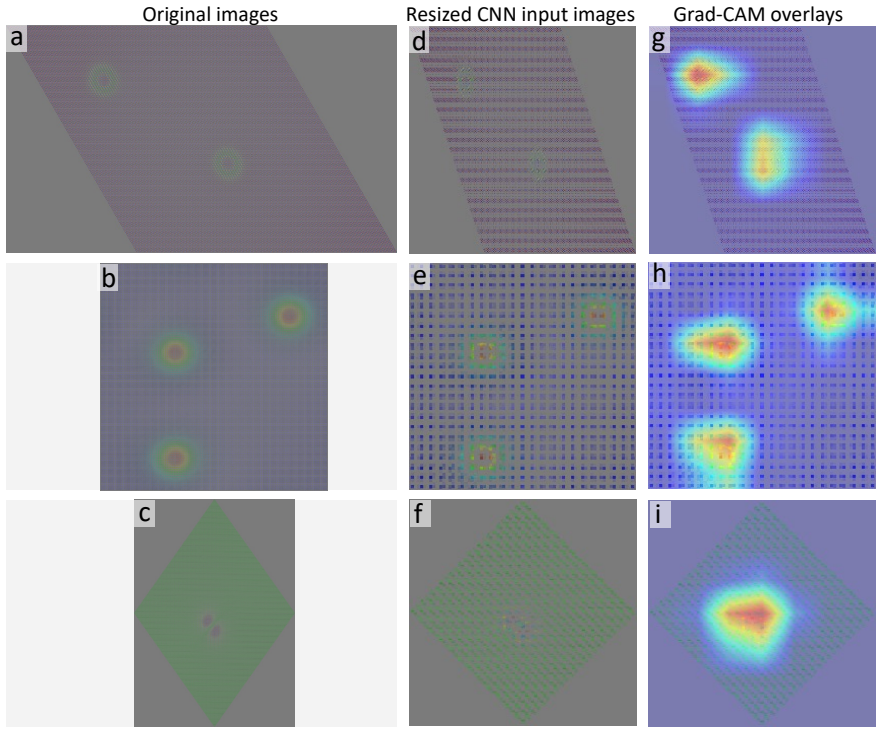
A convolutional neural network classifies nine magnetic states including AFM skyrmions from rendered spin simulation images.
A machine-rendered reading of the paper's core claim, the machinery that carries it, and where it could break.
Core claim
An EfficientNetV1B0 CNN trained on RGB visualizations of atomistic spin dynamics simulations generated by the Spirit code can classify nine distinct magnetic states, covering both ferromagnetic and antiferromagnetic spin textures including AFM skyrmions and AFM stripe domains.
What carries the argument
EfficientNetV1B0 CNN that ingests RGB images of spin configurations rendered by VFRendering and assigns them to one of nine magnetic state labels.
If this is right
- Large volumes of spin-dynamics output can be labeled automatically instead of by manual review.
- Complex antiferromagnetic textures become routinely identifiable without requiring topology-specific handcrafted descriptors.
- The pipeline integrates directly with existing simulation codes to produce labeled datasets for further study.
- Researchers gain a scalable way to screen for desired magnetic states across parameter sweeps.
Where Pith is reading between the lines
- The same image-based approach might transfer to experimental images from techniques such as Lorentz transmission electron microscopy if domain contrast is comparable.
- Extending the model to time-series of configurations could track state transitions during dynamical evolution.
- Anomaly detection variants could flag previously unseen spin textures in unexplored material parameter spaces.
Load-bearing premise
The RGB images produced from the Spirit simulations contain enough consistent visual features to let the CNN learn distinctions among the nine states that hold beyond the specific simulation runs and rendering choices.
What would settle it
Run the trained model on a fresh set of Spirit simulations that use different material parameters or visualization settings and measure whether classification accuracy remains high; a sharp drop would falsify the claim that the images supply generalizable features.
Figures



read the original abstract
The identification and classification of different magnetic states are essential for understanding the complex behavior of magnetic systems. Traditional approaches that rely on handcrafted features or manual inspection often fall short, particularly when dealing with subtle or topologically complex spin textures. In this study, we present an automated deep learning model that employs an EfficientNetV1B0 Convolutional Neural Network to classify nine distinct magnetic states, including both ferromagnetic (FM) and antiferromagnetic (AFM) spin textures such as AFM skyrmions and AFM stripe domains. The spin configurations are generated through atomistic spin dynamics simulations using the Spirit code, then visualized with VFRendering to produce RGB images, which serve as inputs to the classification model.
Editorial analysis
A structured set of objections, weighed in public.
Referee Report
Summary. The manuscript presents an automated deep learning pipeline that uses an EfficientNetV1B0 CNN to classify nine magnetic states (including FM and AFM textures such as AFM skyrmions and AFM stripe domains) from atomistic spin-dynamics configurations generated by the Spirit code and rendered as RGB images via VFRendering.
Significance. If the classification performance is shown to be robust and generalizable, the work would provide a practical tool for high-throughput analysis of complex spin textures in magnetic materials simulations, reducing dependence on manual inspection or handcrafted features. The choice of established open-source simulation and visualization packages is a constructive element.
major comments (2)
- Abstract: the pipeline is described but no accuracy, precision, recall, F1 scores, confusion matrices, or baseline comparisons are reported, leaving the central claim that the model successfully classifies the nine states without quantitative support.
- Methods/Results (dataset and evaluation sections): no information is supplied on the number of images per class, the ranges of physical parameters (temperature, magnetic field, DMI strength) used to generate configurations, or the train/test partitioning strategy, so it is impossible to determine whether reported performance reflects intrinsic spin-texture features or simulation/rendering artifacts.
minor comments (1)
- The abstract and title would benefit from explicitly stating the nine class labels and the total number of images used.
Simulated Author's Rebuttal
We thank the referee for the constructive comments, which help strengthen the manuscript. We agree that the abstract should include quantitative performance metrics and that the Methods and Results sections require explicit details on dataset composition, parameter ranges, and evaluation protocol to ensure reproducibility and to demonstrate that classification relies on intrinsic spin-texture features rather than rendering artifacts. We address each point below and will revise the manuscript accordingly.
read point-by-point responses
-
Referee: Abstract: the pipeline is described but no accuracy, precision, recall, F1 scores, confusion matrices, or baseline comparisons are reported, leaving the central claim that the model successfully classifies the nine states without quantitative support.
Authors: We acknowledge that the current abstract focuses on the pipeline description without numerical results. In the revised version we will insert the key performance figures obtained on the held-out test set (overall accuracy, per-class precision/recall/F1, and a brief reference to the confusion matrix) together with a short statement on the baseline comparison against a handcrafted-feature SVM. These values are already computed and reported in the Results section; their inclusion in the abstract will directly support the central claim. revision: yes
-
Referee: Methods/Results (dataset and evaluation sections): no information is supplied on the number of images per class, the ranges of physical parameters (temperature, magnetic field, DMI strength) used to generate configurations, or the train/test partitioning strategy, so it is impossible to determine whether reported performance reflects intrinsic spin-texture features or simulation/rendering artifacts.
Authors: We agree that these details are essential. The revised Methods section will state the exact number of images per class (balanced at 1200 images each), the parameter ranges explored in the Spirit simulations (temperature 0–300 K, external field 0–5 T, DMI strength 0–2 mJ m⁻²), and the evaluation protocol (80/20 train/test split with 5-fold cross-validation and no overlap between training and test configurations). These additions will make clear that the reported accuracy arises from diverse physical spin textures rather than fixed rendering choices. revision: yes
Circularity Check
No circularity: empirical CNN application to simulation images is self-contained
full rationale
The paper generates spin configurations using the Spirit code, renders them as RGB images via VFRendering, and applies an off-the-shelf EfficientNetV1B0 CNN to classify nine magnetic states. No mathematical derivations, equations, fitted parameters renamed as predictions, or self-citation chains appear in the described workflow. The central claim is a straightforward empirical demonstration of classification performance on the produced dataset, with no load-bearing step that reduces by construction to the inputs or prior author work. This is the expected honest outcome for an applied ML paper without theoretical derivation.
Axiom & Free-Parameter Ledger
axioms (2)
- domain assumption Simulated spin configurations visualized as RGB images preserve the topological and symmetry features needed to distinguish the nine magnetic states.
- domain assumption EfficientNetV1B0 pre-trained on ImageNet transfers effectively to this scientific image domain without major domain adaptation.
Lean theorems connected to this paper
-
IndisputableMonolith/Foundation/RealityFromDistinction.leanreality_from_one_distinction unclear?
unclearRelation between the paper passage and the cited Recognition theorem.
we present an automated deep learning model that employs an EfficientNetV1B0 Convolutional Neural Network to classify nine distinct magnetic states... spin configurations are generated through atomistic spin dynamics simulations using the Spirit code, then visualized with VFRendering to produce RGB images
-
IndisputableMonolith/Cost/FunctionalEquation.leanwashburn_uniqueness_aczel unclear?
unclearRelation between the paper passage and the cited Recognition theorem.
Evaluation results show that the proposed model achieves an accuracy and F1-score of 99%
What do these tags mean?
- matches
- The paper's claim is directly supported by a theorem in the formal canon.
- supports
- The theorem supports part of the paper's argument, but the paper may add assumptions or extra steps.
- extends
- The paper goes beyond the formal theorem; the theorem is a base layer rather than the whole result.
- uses
- The paper appears to rely on the theorem as machinery.
- contradicts
- The paper's claim conflicts with a theorem or certificate in the canon.
- unclear
- Pith found a possible connection, but the passage is too broad, indirect, or ambiguous to say the theorem truly supports the claim.
Reference graph
Works this paper leans on
-
[1]
Carleo, G. & Troyer, M. Solving the quantum many-body problem with artificial neural net- works.Science355, 602–606 (2017)
work page 2017
-
[2]
Rem, B. S.et al.Identifying quantum phase transitions using artificial neural networks on experimental data.Nat. Phys.15, 917–920 (2019)
work page 2019
-
[3]
Discovering phase transitions with unsupervised learning.Phys
Wang, L. Discovering phase transitions with unsupervised learning.Phys. Rev. B94, 195105 (2016)
work page 2016
-
[4]
Van Nieuwenburg, E. P., Liu, Y .-H. & Huber, S. D. Learning phase transitions by confusion. Nat. Phys.13, 435–439 (2017)
work page 2017
-
[5]
Broecker, P., Carrasquilla, J., Melko, R. G. & Trebst, S. Machine learning quantum phases of matter beyond the fermion sign problem.Sci. Rep.7, 8823 (2017)
work page 2017
-
[6]
Ch’ng, K., Carrasquilla, J., Melko, R. G. & Khatami, E. Machine learning phases of strongly correlated fermions.Phys. Rev. X7, 031038 (2017)
work page 2017
-
[7]
Zhang, Y ., Melko, R. G. & Kim, E.-A. Machine learningZ 2 quantum spin liquids with quasi- particle statistics.Phys. Rev. B96, 245119 (2017)
work page 2017
-
[8]
Zhang, Y . & Kim, E.-A. Quantum loop topography for machine learning.Phys. Rev. Lett.118, 216401 (2017)
work page 2017
-
[9]
Carrasquilla, J. & Melko, R. G. Machine learning phases of matter.Nat. Phys.13, 431–434 (2017). 25
work page 2017
-
[10]
Iakovlev, I., Sotnikov, O. & Mazurenko, V . Supervised learning approach for recognizing magnetic skyrmion phases.Phys. Rev. B98, 174411 (2018)
work page 2018
-
[11]
M ¨uhlbauer, S.et al.Skyrmion lattice in a chiral magnet.Science323, 915 (2009)
work page 2009
-
[12]
Romming, N.et al.Writing and deleting single magnetic skyrmions.Science341, 636 (2013)
work page 2013
- [13]
-
[14]
G ¨obel, B., Mertig, I. & Tretiakov, O. A. Beyond skyrmions: Review and perspectives of alternative magnetic quasiparticles.Phys. Rep.(2020)
work page 2020
- [15]
-
[16]
Fert, A., Cros, V . & Sampaio, J. Skyrmions on the track.Nat. Nanotechnol.8, 152 (2013)
work page 2013
-
[17]
Cort ´es-Ortu˜no, D.et al.Thermal stability and topological protection of skyrmions in nan- otracks.Sci. Rep.7, 4060 (2017)
work page 2017
-
[18]
Nanotechnol.11, 444–448 (2016)
Moreau-Luchaire, C.et al.Additive interfacial chiral interaction in multilayers for stabi- lization of small individual skyrmions at room temperature.Nat. Nanotechnol.11, 444–448 (2016)
work page 2016
-
[19]
Nanoscale magnetic skyrmions in metallic films and multilayers: a new twist for spintronics.Nat
Wiesendanger, R. Nanoscale magnetic skyrmions in metallic films and multilayers: a new twist for spintronics.Nat. Rev. Mater.1, 1–11 (2016). 26
work page 2016
- [20]
-
[21]
Puebla, J., Kim, J., Kondou, K. & Otani, Y . Spintronic devices for energy-efficient data storage and energy harvesting.Commun. Mater.1, 24 (2020)
work page 2020
-
[22]
M.et al.Skyrmion-based artificial synapses for neuromorphic computing.Nat
Song, K. M.et al.Skyrmion-based artificial synapses for neuromorphic computing.Nat. Electron.3, 148–155 (2020)
work page 2020
-
[23]
Yokouchi, T.et al.Pattern recognition with neuromorphic computing using magnetic field– induced dynamics of skyrmions.Sci. Adv.8, eabq5652 (2022)
work page 2022
-
[24]
Parkin, S. S. P., Hayashi, M. & Thomas, L. Magnetic domain-wall racetrack memory.Science 320, 190–194 (2008)
work page 2008
-
[25]
Spethmann, J., Gr ¨unebohm, M., Wiesendanger, R., von Bergmann, K. & Kubetzka, A. Dis- covery and characterization of a new type of domain wall in a row-wise antiferromagnet.Nat. Commun.12, 3488 (2021)
work page 2021
-
[26]
Ma, C.et al.Electric field-induced creation and directional motion of domain walls and skyrmion bubbles.Nano Lett.19, 353–361 (2018)
work page 2018
-
[27]
Grebenchuk, S.et al.Topological spin textures in an insulating van der Waals ferromagnet. Adv. Mater.36, 2311949 (2024)
work page 2024
-
[28]
G ¨obel, B., Mook, A., Henk, J., Mertig, I. & Tretiakov, O. A. Magnetic bimerons as skyrmion analogues in in-plane magnets.Phys. Rev. B99, 060407 (2019). 27
work page 2019
-
[29]
Compact merons and skyrmions in thin chiral magnetic films.Phys
Ezawa, M. Compact merons and skyrmions in thin chiral magnetic films.Phys. Rev. B83, 100408 (2011)
work page 2011
-
[30]
Capriotti, L., Trumper, A. E. & Sorella, S. Long-range N´eel order in the triangular Heisenberg model.Phys. Rev. Lett.82, 3899 (1999)
work page 1999
-
[31]
White, S. R. & Chernyshev, A. Ne ´el order in square and triangular lattice Heisenberg models. Phys. Rev. Lett.99, 127004 (2007)
work page 2007
-
[32]
Gu, J.et al.Recent advances in convolutional neural networks.Pattern Recognit.77, 354–377 (2018)
work page 2018
-
[33]
Tan, M. & Le, Q. Efficientnet: Rethinking model scaling for convolutional neural networks. InInternational conference on machine learning, 6105–6114 (PMLR, 2019)
work page 2019
-
[34]
Tan, M. & Le, Q. EfficientNetV2: Smaller models and faster training. InInternational con- ference on machine learning, 10096–10106 (PMLR, 2021)
work page 2021
- [35]
-
[36]
MobileNets: Efficient Convolutional Neural Networks for Mobile Vision Applications
Howard, A. G.et al.MobileNets: Efficient convolutional neural networks for mobile vision applications.arXiv preprint arXiv:1704.04861(2017). 28
work page internal anchor Pith review Pith/arXiv arXiv 2017
-
[37]
Sandler, M., Howard, A., Zhu, M., Zhmoginov, A. & Chen, L.-C. MobileNetV2: Inverted residuals and linear bottlenecks. InProceedings of the IEEE conference on computer vision and pattern recognition, 4510–4520 (2018)
work page 2018
-
[38]
Alia, A., Maree, M., Chraibi, M. & Seyfried, A. A novel V oronoi-based convolutional neural network framework for pushing person detection in crowd videos.Complex Intell. Syst.10, 5005–5031 (2024)
work page 2024
-
[39]
Alia, A., Maree, M. & Chraibi, M. A hybrid deep learning and visualization framework for pushing behavior detection in pedestrian dynamics.Sensors22, 4040 (2022)
work page 2022
-
[40]
Wang, D.et al.Machine learning magnetic parameters from spin configurations.Adv. Sci.7, 2000566 (2020)
work page 2020
-
[41]
G ´omez Albarrac´ın, F. A. & Rosales, H. D. Machine learning techniques to construct detailed phase diagrams for skyrmion systems.Phys. Rev. B105, 214423 (2022)
work page 2022
-
[42]
Araz, J. Y ., Criado, J. C. & Spannowsky, M. Identifying magnetic antiskyrmions while they form with convolutional neural networks.J. Magn. Magn. Mater.563, 169806 (2022)
work page 2022
-
[44]
Cimen, M., Onel, A. C., Yarımbıyık, A. E., Arikan, M. & Tulum, G. Skyr-net: Deep learning approach for image classification of magnetic structures.J. Magn. Magn. Mater.621, 172912 (2025). 29
work page 2025
-
[45]
Salcedo-Gallo, J., Galindo-Gonz ´alez, C. & Restrepo-Parra, E. Deep learning approach for image classification of magnetic phases in chiral magnets.J. Magn. Magn. Mater.501, 166482 (2020)
work page 2020
-
[46]
Jang, Y ., Kim, C. H. & Go, A. Classification of magnetic order from electronic structure by using machine learning.Sci. Rep.13, 12445 (2023)
work page 2023
-
[47]
A.et al.Machine learning magnetism classifiers from atomic coordinates.Iscience 25(2022)
Merker, H. A.et al.Machine learning magnetism classifiers from atomic coordinates.Iscience 25(2022)
work page 2022
-
[48]
Saini, S., Shukla, A. K., Nehete, H., Bindal, N. & Kaushik, B. K. Machine learning-based prediction of antiferromagnetic skyrmion formation.IEEE Trans. Electron Devices71, 2774– 2780 (2024)
work page 2024
-
[49]
Hasib, F. I., Swarna, N. F. & Alam, M. A. Classification of different magnetic structures from image data using deep neural networks. In2021 IEEE Asia-Pacific Conference on Computer Science and Data Engineering (CSDE), 1–6 (IEEE, 2021)
work page 2021
-
[50]
Bokul, S., Shukur, S. S. M. A., Ahmed, S., Bhowmick, T. K. & Alam, M. A. Classification of non-topological magnetic configurations using machine learning. In2020 IEEE Asia-Pacific Conference on Computer Science and Data Engineering (CSDE), 1–5 (IEEE, 2020)
work page 2020
-
[51]
Gomonay, O., Jungwirth, T. & Sinova, J. High antiferromagnetic domain wall velocity induced by N´eel spin-orbit torques.Phys. Rev. Lett.117, 017202 (2016)
work page 2016
-
[52]
Jungwirth, T., Marti, X., Wadley, P. & Wunderlich, J. Antiferromagnetic spintronics.Nat. Nanotechnol.11, 231–241 (2016). 30
work page 2016
-
[53]
Baltz, V .et al.Antiferromagnetic spintronics.Rev. Mod. Phys.90, 015005 (2018)
work page 2018
-
[54]
Aldarawsheh, A.et al.Emergence of zero-field non-synthetic single and interchained antifer- romagnetic skyrmions in thin films.Nat. Commun.13, 7369 (2022)
work page 2022
-
[55]
Aldarawsheh, A., Sallermann, M., Abusaa, M. & Lounis, S. A spin model for intrinsic anti- ferromagnetic skyrmions on a triangular lattice.Front. Phys.11, 1175317 (2023)
work page 2023
-
[56]
VFRendering: Python script for visualizing spin textures
Puerling, T. VFRendering: Python script for visualizing spin textures. https://iffgit.fz-juelich.de/puerling1/VFRendering/-/blob/ 6ec84d9e308d7c97e8dd9563943f11c5e9132aa7/render.py(2023)
work page 2023
- [57]
-
[58]
Younesi, A.et al.A comprehensive survey of convolutions in deep learning: Applications, challenges, and future trends.IEEE Access12, 41180–41218 (2024)
work page 2024
-
[59]
Yamashita, R., Nishio, M., Do, R. K. G. & Togashi, K. Convolutional neural networks: an overview and application in radiology.Insights Imaging9, 611–629 (2018)
work page 2018
-
[60]
Szegedy, C., Ioffe, S., Vanhoucke, V . & Alemi, A. Inception-v4, inception-resnet and the im- pact of residual connections on learning. InProceedings of the AAAI Conference on Artificial Intelligence, vol. 31(1) (2017). 31
work page 2017
-
[61]
Huang, G., Liu, Z., Van Der Maaten, L. & Weinberger, K. Q. Densely connected convolutional networks. InProceedings of the IEEE conference on computer vision and pattern recognition, 4700–4708 (2017)
work page 2017
-
[62]
InProceedings of the IEEE/CVF international conference on computer vision, 1314–1324 (2019)
Howard, A.et al.Searching for MobileNetV3. InProceedings of the IEEE/CVF international conference on computer vision, 1314–1324 (2019)
work page 2019
-
[63]
Xception: Deep learning with depthwise separable convolutions
Chollet, F. Xception: Deep learning with depthwise separable convolutions. InProceedings of the IEEE conference on computer vision and pattern recognition, 1251–1258 (2017)
work page 2017
-
[64]
Ramachandran, P., Zoph, B. & Le, Q. V . Searching for activation functions.arXiv preprint arXiv:1710.05941(2017)
work page internal anchor Pith review Pith/arXiv arXiv 2017
- [65]
-
[66]
P.et al.Spirit: Multifunctional framework for atomistic spin simulations.Phys
M ¨uller, G. P.et al.Spirit: Multifunctional framework for atomistic spin simulations.Phys. Rev. B99, 224414 (2019)
work page 2019
- [67]
-
[68]
Brown, L. D., Cai, T. T. & DasGupta, A. Interval estimation for a binomial proportion.Sta- tistical science16, 101–133 (2001). 32
work page 2001
-
[69]
R.et al.Grad-cam: Visual explanations from deep networks via gradient-based localization
Selvaraju, R. R.et al.Grad-cam: Visual explanations from deep networks via gradient-based localization. InProceedings of the IEEE international conference on computer vision, 618– 626 (2017)
work page 2017
-
[70]
Vansteenkiste, A.et al.The design and verification of MuMax3.AIP Adv.4(2014). 33
work page 2014
discussion (0)
Sign in with ORCID, Apple, or X to comment. Anyone can read and Pith papers without signing in.