REVIEW 3 major objections 4 minor 29 references
A Universal Vehicle-Trailer Navigation System with Neural Kinematics and Online Residual Learning
T0 review · 3 major / 4 minor · reviewed 2026-08-06 · deepseek-v4-flash
Pith's one-line read A single navigation system can tow castor-wheeled trolleys, flight cases, suitcases, and even a wheelless box to their destinations with no per-trailer calibration, by pairing a neural trailer model with an online-learned residual inside…
desk verdict A practical trailer-towing system that works in real demos, but the evidence is thinner than the claims: the 0.3s memory assumption is unvalidated and the weighting cutoff is chosen on the same curves used for evaluation. read the letter →
The pith
A machine-rendered reading of the paper's core claim, the machinery that carries it, and where it could break.
The reading
What carries the argument
The load-bearing object is the hybrid state-update equation $x_{k+1}=f(x_{k-n_f:k}, u_{k-n_f:k}) + e(x_{k-n_f:k}, u_{k-n_f:k})$ of Section IV-B. The nominal part $f$ applies the Ackermann nonholonomic update for the vehicle and uses a small 64-32-16 MLP $f^\omega$ for the trailer yaw rate; the residual part $e$ uses a 32-16 MLP $e^\omega$ trained online on a sliding window of 200 time steps. These networks are trained with a rolling-prediction loss over the full $N$-step horizon so that errors do not accumulate during MPC rollouts. The second mechanism is the weighted model combination in constraint (6d), $\lambda_e(k) = s_e \cdot \max(1 - k/n_c, 0)$, which activates the residual only when its past $n_e$-step rolling MSE beats the nominal model's by the threshold $\epsilon = 0.5$ and lets its influence decay to zero at $n_c = 15$. This is the mechanism that keeps long-horizon planning trustworthy.
What would settle it
One direct test is to fix the vehicle at a constant hitch angle and steering input, perturb the trailer laterally, and watch whether the one-step-ahead trailer yaw-rate prediction error of the nominal model falls toward zero as the online residual trains; if the error stays large, or if recovery requires a history longer than $n_f = 3$ frames, the model constraint (6d) is not valid. A second test would be to run the same controller on a trailer with strongly nonlinear castor dynamics (for instance, a four-castor platform with asymmetric loading) and check whether the 30-step rolling prediction of $\omega_\zeta$ stays stable across repeated trials.
Extended reading notes
Core claim
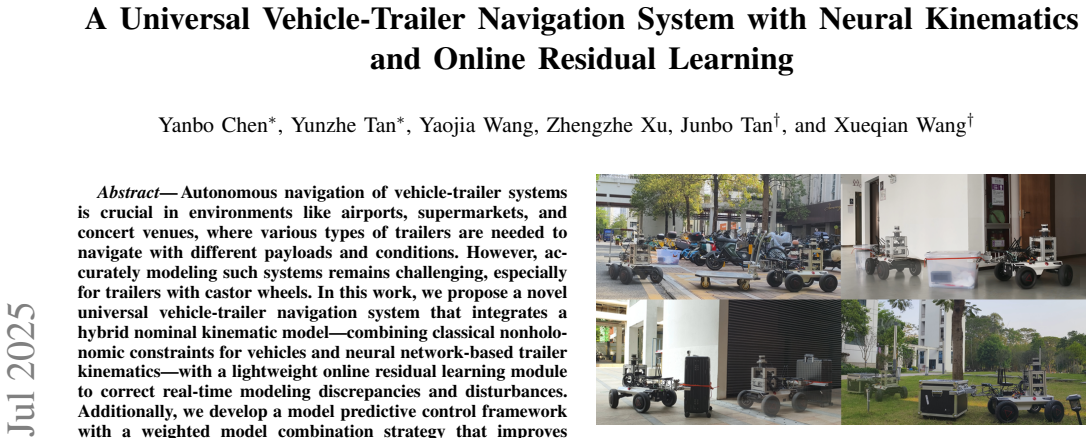
The central discovery is that the part of a vehicle-trailer system that resists first-principles modeling—the trailer yaw rate $\omega_\zeta$, especially for castor-wheel trailers—can be represented as a hybrid update $x_{k+1}=f(x_{k-n_f:k}, u_{k-n_f:k}) + e(x_{k-n_f:k}, u_{k-n_f:k})$, where the nominal model $f$ keeps exact nonholonomic kinematics for the vehicle and a small multilayer perceptron $f^\omega$ predicts the trailer yaw rate, while the residual $e^\omega$ is retrained online from the most recent 200 time steps. The historical window of $n_f = 3$ frames is the device that lets unmeasured castor-wheel angles, payloads, and surface conditions enter the model implicitly. Within MPC the residual is gated by a binary switch on its rolling prediction error relative to the nominal model, and its influence decays linearly to zero over 15 steps, so it corrects near-term error without poisoning longer-horizon rollouts. On the paper's own evidence, this scheme generalizes to trailer types and payloads outside the training set, and the real-world demonstrations show the same unchanged system delivering four different trailers to their destinations while avoiding obstacles.
Load-bearing premise
The argument rests on the premise that the trailer yaw rate $\omega_\zeta$ is a deterministic function of the last three frames of hitch angle, trailer yaw rate, and control inputs, so that this short history implicitly encodes unmeasured castor-wheel states, payloads, and surface conditions; the paper does not separately validate that premise.
Editorial extensions
If this is right
- A single pre-trained nominal trailer model transfers to trailer types never seen in training, with the online residual network absorbing the extra error during turns and on rough terrain.
- The weighted combination prevents the online residual—which is reliable only on short horizons—from making multi-second predictions worse, so the MPC can plan safely over its full 30-step horizon.
- In the paper's trajectory-tracking experiments, the weighted-model MPC roughly halves mean trailer tracking error compared with using the nominal model alone (0.16 m to 0.06 m for the platform trolley; 0.22 m to 0.16 m for the flight case).
- Deploying the system on a new trailer reduces to hitching it up and running the same code, with no parameter file, calibration routine, or manual reconfiguration.
Reading between the lines
- Beyond the paper: if short-horizon history really does encode the hidden trailer state, the same split—exact model for the towing body, learned function for the unmeasured appendage—should transfer to other articulated towing tasks, such as airport baggage carts, shopping carts with swiveling wheels, or boat trailers.
- Beyond the paper: the online residual could be read as an implicit system-identification signal; logging its output during operation might reveal effective trailer parameters (caster trail, effective wheelbase) that could eventually replace the black-box correction with a physical model.
- Beyond the paper: the binary residual switch and the empirically chosen cutoff $n_c = 15$ could be made continuous or uncertainty-aware; a probabilistic reliability estimate would likely behave better under disturbances that arrive at variable frequencies.
- Beyond the paper: a testable extension would be to record the residual's prediction error under sudden payload shifts and see whether the system's recovery time scales with the 200-step training window, which would reveal whether online learning speed is the true bottleneck.
Signed reviews
Editorial analysis
A structured set of objections, weighed in public.
Referee Report
Summary. The paper proposes a universal vehicle-trailer navigation system combining a hybrid nominal kinematic model (classical nonholonomic vehicle kinematics plus a neural-network trailer yaw-rate model), an online-learned residual kinematic model, and a model predictive control (MPC) framework with a time-decaying weighted model combination. The nominal model is pre-trained with a multi-step rolling loss; the residual network is trained online on a recent 200-step window; the MPC uses the weighted model, obstacle-avoidance constraints, and input-rate penalties. Experiments evaluate multi-step prediction error for six trailer/payload conditions, trajectory tracking for two trailers, and a full autonomous navigation demonstration with four trailer types. The central claim is that the system adapts to diverse trailers, payloads, and disturbances without per-trailer calibration.
Significance. If the claims hold, the paper makes a useful practical contribution to logistics and service robotics: a single navigation system that can tow castor-wheel trailers, flight cases, suitcases, and non-rolling loads without per-trailer model tuning. The hybrid modeling idea, the rolling-prediction training loss, and the online residual with a decaying influence in MPC are all reasonable and well motivated. The real-world demonstrations across four trailer types and several payload conditions are a strength, and the paper reports concrete quantitative prediction and tracking results. However, the evidence is not yet as strong as the paper's 'robust performance without manual tuning' claim, because the key experiments are single-run, the cutoff step nc is selected from the same data used for evaluation, and the central finite-memory kinematic assumption is not separately validated. These issues are localizable and fixable, so the manuscript is promising but needs revision.
major comments (3)
- [Sec. IV-B, Eqs. (4)-(5)] The load-bearing modeling assumption is that the trailer yaw rate ω_ζ at step k+1 is a deterministic function of the last nf+1 = 4 frames of θ, ω_ζ, and u. The residual network e^ω receives exactly the same inputs, so it cannot recover information that is absent from that 0.3 s window. The paper states that this history 'implicitly encode[s] unmeasured dynamic states and unknown parameters,' but no experiment varies nf, no caster-wheel state or slip state is measured, and no test is reported for maneuvers where slower hidden states (e.g., caster-wheel orientation or payload shift) might dominate. If the true kinematics require longer memory or variables outside {θ, ω_ζ, v, δ}, then both the nominal and residual networks are unidentifiable and the MPC model constraint (6d) can propagate systematically wrong trailer yaw-rate predictions over the 30-step horizon. I would like to see a validation that varies nf (e.g., 1, 3, 5, 10) and reports rolling-prediction RMSE, or direct evidence that the chosen coordinates and history are sufficient for the tested trailers.
- [Sec. VI-C.1, Fig. 6] The cutoff step nc = 15 is selected from the same evaluation curves used to demonstrate the advantage of the weighted model. The text says 'the intersection between the unweighted combination and the nominal model occurs after 15 steps, which justifies our choice of nc = 15.' Because nc appears directly in the weighting function λ_e(k) of Eq. (7), the comparison in Fig. 6 and the subsequently reported tracking improvements in Table I are in-sample with respect to this parameter. The claim that the weighted model improves long-horizon prediction needs an independent evaluation: either a hold-out set for selecting nc, a sensitivity study reporting performance for a range of nc, or a clear statement that the reported numbers are a demonstration of the mechanism rather than an unbiased comparison.
- [Sec. VI, Table I and Figs. 8-10] The experimental evidence for the central robustness claim is based on single runs. Table I reports mean and standard deviation of tracking error, but the standard deviation appears to be computed over time within one trajectory, not over repeated trials; there are no multiple runs, confidence intervals, or statistical tests. Likewise, each trailer type in the autonomous transportation demonstration (Fig. 8) is shown for one run. The claim of 'robust performance without manual tuning or trailer-specific calibration' requires at least a small number of repeated trials per condition, or an explicit statement that the demonstration is a feasibility study. Without such evidence, it is difficult to distinguish genuine robustness from favorable conditions in a particular run.
minor comments (4)
- [Sec. IV-B, Eq. (3)] There is an inconsistency in the notation for the control history: Eq. (3) writes u_{k-nf:k}, while the following text says u_{k-nf+1:k}. Please align the notation with the definition used in Eq. (4) and with the actual input history length.
- [Sec. IV-B.3] The description of online residual training says the model is trained using 'state sequence x_{k-nt:k} and control sequence u_{t-nt:t}'; the subscript 't' in the control sequence appears to be a typo for 'k'.
- [Sec. VI-C.1, Fig. 6] The y-axis label in Fig. 6 is 'Error (rad/s)' and the caption says RMSE of ω_ζ, while the training-loss description in Sec. IV-B.3 uses MSE. Please make the units and the loss/error terminology consistent throughout.
- [Sec. V-C.3, Eq. (11)] The sentence 'the diagonal entries scale with σ_w' is vague; please specify the exact functional dependence of Q_du on σ_w, and state whether this scaling is applied only to the input-rate penalty or also to the input penalty.
Circularity Check
No meaningful circularity: the neural kinematics are fitted and evaluated against real vehicle-trailer data, and the MPC uses the learned model prospectively; only the residual cutoff nc=15 is justified post hoc on the same evaluation curves.
-
fitted input called prediction
[Sec. VI-B (hyperparameter setting) and Sec. VI-C.1 (Fig. 6 discussion)]
"The residual kinematic network consists of two hidden layers ... and set ϵ = 0.5, nc = 15 to calculate se and λe(k) in (7). ... Furthermore, the intersection between the unweighted combination and the nominal model occurs after 15 steps, which justifies our choice of nc = 15."
The cutoff nc=15 is declared in the experiment setup before the model evaluation, and then the same evaluation section uses the observed intersection of the unweighted-combination and nominal error curves to justify that value. Thus the reported long-horizon behavior of the weighted model in Fig. 6 is partly by construction: the point at which the residual is switched off was chosen from the very curves that demonstrate its effectiveness. This is a mild tuning/evaluation coupling rather than a derivation that assumes the central conclusion; the subsequent navigation and tracking experiments are separate evidence.
full rationale
The paper's central derivation is a supervised hybrid kinematic model: f^omega is an MLP trained on collected trajectories, e^omega is an online residual trained on the most recent 200 steps, and MPC rolls these models forward. Prediction of trailer yaw rate is a fit to measured data, not a conclusion read out of the model's own assumptions. The claimed universal behavior is tested on untrained trailer types (suitcase, wheelless box) and varying payloads in real-world demonstrations, which are external to the training set and therefore provide independent content. There is no load-bearing self-citation: the only author-overlapping reference appears in related work and is not used to justify the kinematics, the residual law, or the uniqueness of the modeling choice. The main soft spot is the unvalidated finite-memory Markov assumption (nf=3) for trailer yaw rate, but that is a correctness/identifiability risk, not circularity, because the system could fail without the prediction reducing to its input. The one circularity-adjacent item is the post-hoc selection of nc=15 from the same error curves used to evaluate the weighted model; this affects the long-horizon weighting claim in Fig. 6 but does not by itself force the successful navigation results. Overall score 2 reflects this minor coupling with otherwise independent experimental grounding.
Assumptions & free parameters
free parameters (6)
- cutoff step nc =
15
- history length nf =
3
- online training window nt =
200
- model evaluation window ne =
15
- residual activation threshold epsilon =
0.5
- MPC cost weights =
not reported
assumptions (3)
- standard math Ackermann nonholonomic vehicle model
- domain assumption Planar 2D motion assumption
- domain assumption Finite-history sufficiency
Cite this review
Pith. "Pith review of A Universal Vehicle-Trailer Navigation System with Neural Kinematics and Online Residual Learning." pith.science (2026). https://pith.science/paper/3CUO6JOC
@misc{pith2026250715607,
  author       = {Pith},
  title        = {Pith review of: A Universal Vehicle-Trailer Navigation System with Neural Kinematics and Online Residual Learning},
  year         = {2026},
  howpublished = {\url{https://pith.science/paper/3CUO6JOC}},
  note         = {Machine review of arXiv:2507.15607}
}
read the original abstract
Autonomous navigation of vehicle-trailer systems is crucial in environments like airports, supermarkets, and concert venues, where various types of trailers are needed to navigate with different payloads and conditions. However, accurately modeling such systems remains challenging, especially for trailers with castor wheels. In this work, we propose a novel universal vehicle-trailer navigation system that integrates a hybrid nominal kinematic model--combining classical nonholonomic constraints for vehicles and neural network-based trailer kinematics--with a lightweight online residual learning module to correct real-time modeling discrepancies and disturbances. Additionally, we develop a model predictive control framework with a weighted model combination strategy that improves long-horizon prediction accuracy and ensures safer motion planning. Our approach is validated through extensive real-world experiments involving multiple trailer types and varying payload conditions, demonstrating robust performance without manual tuning or trailer-specific calibration.
Figures


Figures from the paper (7 more)





Reference graph
Works this paper leans on
-
[1]
Back driving assistant for passenger cars with trailer,
C. Lundquist, W. Reinelt, and O. Enqvist, “Back driving assistant for passenger cars with trailer,” SAE Technical Paper, 2006
work page 2006
-
[2]
Reversing the general one-trailer system: Asymptotic curvature stabilization and path tracking,
M. Werling, P. Reinisch, M. Heidingsfeld, and K. Gresser, “Reversing the general one-trailer system: Asymptotic curvature stabilization and path tracking,” IEEE Transactions on intelligent transportation systems, vol. 15, no. 2, pp. 627–636, 2013
work page 2013
-
[3]
Y . Zhang, A. Khajepour, and M. Ataei, “A universal and reconfig- urable stability control methodology for articulated vehicles with any configurations,” IEEE transactions on vehicular technology , vol. 69, no. 4, pp. 3748–3759, 2020
work page 2020
-
[4]
A. Xiao, H. Luan, Z. Zhao, Y . Hong, J. Zhao, W. Chen, J. Wang, and M. Q.-H. Meng, “Robotic autonomous trolley collection with progressive perception and nonlinear model predictive control,” in 2022 International Conference on Robotics and Automation (ICRA) . IEEE, 2022, pp. 4480–4486
work page 2022
-
[5]
J. Wang and M. Q.-H. Meng, “Real-time decision making and path planning for robotic autonomous luggage trolley collection at air- ports,” IEEE Transactions on Systems, Man, and Cybernetics: Systems , vol. 52, no. 4, pp. 2174–2183, 2021
work page 2021
-
[6]
Learning quadrotor dynamics using neural network for flight control,
S. Bansal, A. K. Akametalu, F. J. Jiang, F. Laine, and C. J. Tomlin, “Learning quadrotor dynamics using neural network for flight control,” in 2016 IEEE 55th Conference on Decision and Control (CDC) . IEEE, 2016, pp. 4653–4660
work page 2016
-
[7]
Learning agile and dynamic motor skills for legged robots,
J. Hwangbo, J. Lee, A. Dosovitskiy, D. Bellicoso, V . Tsounis, V . Koltun, and M. Hutter, “Learning agile and dynamic motor skills for legged robots,” Science Robotics, vol. 4, no. 26, p. eaau5872, 2019
work page 2019
-
[8]
Neural network vehicle models for high-performance automated driving,
N. A. Spielberg, M. Brown, N. R. Kapania, J. C. Kegelman, and J. C. Gerdes, “Neural network vehicle models for high-performance automated driving,” Science robotics , vol. 4, no. 28, p. eaaw1975, 2019
work page 2019
Show all 29 references
-
[9]
Disturbance-observer-based control and related methods—an overview,
W.-H. Chen, J. Yang, L. Guo, and S. Li, “Disturbance-observer-based control and related methods—an overview,” IEEE Transactions on Industrial Electronics, vol. 63, no. 2, pp. 1083–1095, 2016
2016
-
[10]
Robust trajectory tracking control of an autonomous tractor-trailer considering model parameter uncertainties and disturbances,
E. Lu, J. Xue, T. Chen, and S. Jiang, “Robust trajectory tracking control of an autonomous tractor-trailer considering model parameter uncertainties and disturbances,” Agriculture, vol. 13, no. 4, p. 869, 2023
2023
-
[11]
System identification—a survey,
K. J. ˚Astr¨om and P. Eykhoff, “System identification—a survey,” Automatica, vol. 7, no. 2, pp. 123–162, 1971
1971
-
[12]
Scalable parametric-identification procedure for kinematics of automated n-trailer vehicles,
M. M. Michałek, “Scalable parametric-identification procedure for kinematics of automated n-trailer vehicles,” IEEE Transactions on V ehicular Technology, vol. 73, no. 6, pp. 7758–7770, 2024
2024
-
[13]
A review on vehicle- trailer state and parameter estimation,
A. H. Korayem, A. Khajepour, and B. Fidan, “A review on vehicle- trailer state and parameter estimation,” IEEE Transactions on intelli- gent transportation systems , vol. 23, no. 7, pp. 5993–6010, 2021
2021
-
[14]
Online learning of unknown dynamics for model-based controllers in legged locomotion,
Y . Sun, W. L. Ubellacker, W.-L. Ma, X. Zhang, C. Wang, N. V . Csomay-Shanklin, M. Tomizuka, K. Sreenath, and A. D. Ames, “Online learning of unknown dynamics for model-based controllers in legged locomotion,” IEEE Robotics and Automation Letters , vol. 6, no. 4, pp. 8442–8449, 2021
2021
-
[15]
Adaptive model predictive control with data-driven error model for quadrupedal locomotion,
X. Zeng, H. Zhang, L. Yue, Z. Song, L. Zhang, and Y .-H. Liu, “Adaptive model predictive control with data-driven error model for quadrupedal locomotion,” in 2024 IEEE International Conference on Robotics and Automation (ICRA) . IEEE, 2024, pp. 5731–5737
2024
-
[16]
Learning model predictive control with error dynamics regression for autonomous racing,
H. Xue, E. L. Zhu, J. M. Dolan, and F. Borrelli, “Learning model predictive control with error dynamics regression for autonomous racing,” in 2024 IEEE International Conference on Robotics and Automation (ICRA) . IEEE, 2024, pp. 13 250–13 256
2024
-
[17]
Knode-mpc: A knowledge- based data-driven predictive control framework for aerial robots,
K. Y . Chee, T. Z. Jiahao, and M. A. Hsieh, “Knode-mpc: A knowledge- based data-driven predictive control framework for aerial robots,” IEEE Robotics and Automation Letters , vol. 7, no. 2, pp. 2819–2826, 2022
2022
-
[18]
Neural network model predictive motion control applied to automated driving with unknown friction,
N. A. Spielberg, M. Brown, and J. C. Gerdes, “Neural network model predictive motion control applied to automated driving with unknown friction,” IEEE Transactions on Control Systems Technology , vol. 30, no. 5, pp. 1934–1945, 2021
1934
-
[19]
Dynamic control barrier function-based model predictive control to safety-critical obstacle-avoidance of mobile robot,
Z. Jian, Z. Yan, X. Lei, Z. Lu, B. Lan, X. Wang, and B. Liang, “Dynamic control barrier function-based model predictive control to safety-critical obstacle-avoidance of mobile robot,” in 2023 IEEE International Conference on Robotics and Automation (ICRA) , 2023, pp. 3679–3685
2023
-
[20]
Enhancing feasibility and safety of nonlinear model predictive control with discrete-time control barrier functions,
J. Zeng, Z. Li, and K. Sreenath, “Enhancing feasibility and safety of nonlinear model predictive control with discrete-time control barrier functions,” in 2021 60th IEEE Conference on Decision and Control (CDC). IEEE, 2021, pp. 6137–6144
2021
-
[21]
Quadruped guidance robot for the visually impaired: A comfort-based approach,
Y . Chen, Z. Xu, Z. Jian, G. Tang, L. Yang, A. Xiao, X. Wang, and B. Liang, “Quadruped guidance robot for the visually impaired: A comfort-based approach,” in 2023 IEEE International Conference on Robotics and Automation (ICRA) . IEEE, 2023, pp. 12 078–12 084
2023
-
[22]
Configuration-aware model pre- dictive motion planning for tractor–trailer mobile robot,
N. Ito, H. Okuda, and T. Suzuki, “Configuration-aware model pre- dictive motion planning for tractor–trailer mobile robot,” Advanced Robotics, vol. 37, no. 5, pp. 329–343, 2023
2023
-
[23]
Mpc-based motion planning for autonomous truck-trailer maneuvering,
M. Bos, B. Vandewal, W. Decr ´e, and J. Swevers, “Mpc-based motion planning for autonomous truck-trailer maneuvering,” IF AC- PapersOnLine, vol. 56, no. 2, pp. 4877–4882, 2023
2023
-
[24]
Real-time neural mpc: Deep learning model predictive control for quadrotors and agile robotic platforms,
T. Salzmann, E. Kaufmann, J. Arrizabalaga, M. Pavone, D. Scara- muzza, and M. Ryll, “Real-time neural mpc: Deep learning model predictive control for quadrotors and agile robotic platforms,” IEEE Robotics and Automation Letters , vol. 8, no. 4, pp. 2397–2404, 2023
2023
-
[25]
Npc: Neural predictive control for fuel-efficient autonomous trucks,
J. Ren, J. Xiang, H. Gao, J. Zhang, Y . Ren, Y . Ma, Y . Wu, R. Yang, and W. Li, “Npc: Neural predictive control for fuel-efficient autonomous trucks,” in 2024 IEEE International Conference on Robotics and Automation (ICRA) . IEEE, 2024, pp. 14 251–14 257
2024
-
[26]
Direct lidar-inertial odome- try: Lightweight lio with continuous-time motion correction,
K. Chen, R. Nemiroff, and B. T. Lopez, “Direct lidar-inertial odome- try: Lightweight lio with continuous-time motion correction,” in 2023 IEEE international conference on robotics and automation (ICRA) . IEEE, 2023, pp. 3983–3989
2023
-
[27]
A density-based algorithm for discovering clusters in large spatial databases with noise,
M. Ester, H.-P. Kriegel, J. Sander, X. Xu et al. , “A density-based algorithm for discovering clusters in large spatial databases with noise,” in kdd, vol. 96, no. 34, 1996, pp. 226–231
1996
-
[28]
Path planning for autonomous vehicles in unknown semi-structured environments,
D. Dolgov, S. Thrun, M. Montemerlo, and J. Diebel, “Path planning for autonomous vehicles in unknown semi-structured environments,” The international journal of robotics research , vol. 29, no. 5, pp. 485– 501, 2010
2010
-
[29]
acados – a modular open-source framework for fast embedded optimal control,
R. Verschueren, G. Frison, D. Kouzoupis, J. Frey, N. van Duijkeren, A. Zanelli, B. Novoselnik, T. Albin, R. Quirynen, and M. Diehl, “acados – a modular open-source framework for fast embedded optimal control,” Mathematical Programming Computation , 2021
2021
Reviewed August 6, 2026 · model on record in the stance chip above.
Discussion (0). Continue with ORCID to comment.