REVIEW 4 major objections 5 minor 39 references
Aspects of Dynamical Simulations, Emphasizing Nos\'e and Nos\'e-Hoover Dynamics and the Compressible Baker Map
T0 review · 4 major / 5 minor · reviewed 2026-08-14 · deepseek-v4-flash
Pith's one-line read For one thermostatted harmonic oscillator, the same physical states can appear to expand, remain incompressible, or contract, depending on which phase-space coordinates carry the dynamics.
desk verdict A useful pedagogical review whose central paradox is a coordinate/volume-form artifact; it deserves a serious referee but needs a revision that engages the metric formalism. read the letter →
The pith
A machine-rendered reading of the paper's core claim, the machinery that carries it, and where it could break.
The reading
What carries the argument
The machine that carries the argument is the identity $s=f(q,p,\zeta)$, which identifies Nosé's time-scaling factor with the stationary probability density in the extended phase space. From that identity the paper constructs and compares three vector fields for the same oscillator: the time-scaled Hamiltonian field, Dettmann's zero-Hamiltonian field, and the reduced three-dimensional feedback field. The identity does the work because it turns the formal divergence of each vector field into a statement about the same physical density, so the only way the three divergences can differ is through the choice of phase-space coordinates. The paper also uses this identity to derive the stationary Gaussian distribution and to convert phase-space strain rate into probability density.
What would settle it
Take the paper's sample periodic orbit with $(q,p,s,\zeta)=(0,0.46627,0.30082,0)$, evolve it under each of the three sets of motion equations, and measure the time-integrated logarithmic strain of a small comoving element over one period after rescaling time to a common clock. If the three descriptions are equivalent, these integrated rates must agree; if they disagree even after the rescaling, the apparent paradox reflects a real dynamical difference rather than a coordinate artifact.
Extended reading notes
Core claim
The central claim, stated in the abstract and argued in Section VI, is that thermostated harmonic-oscillator dynamics can be simultaneously expanding, incompressible, or contracting, depending on the chosen phase space. Using the one-dimensional harmonic oscillator with a single friction variable $\zeta$, the paper writes the same physical motion in three forms: Dettmann's zero-Hamiltonian four-dimensional flow in $(q,p,s,\zeta)$, whose constraint $H_D=0$ makes the four-dimensional divergence vanish; Nosé's time-scaled Hamiltonian flow, where the $s$ equation contributes a local expansion $\partial \dot s/\partial s=\zeta$; and the three-dimensional Nosé-Hoover feedback equations, where the momentum-axis compression $\partial \dot p/\partial p=-\zeta$ contracts the phase volume. All three share the same stationary Gaussian density and the same trajectories; the difference is only in how the extra time-scaling variable is treated. The paper concludes that expansion, incompressibility, and compression are all found for exactly the same phase-space states.
Load-bearing premise
The argument presupposes that the time-scaling variable can be treated as an independent coordinate in all three descriptions and that comparing the three flows' local volume changes is meaningful; if one fixes a single way of measuring distances in phase space from the start, the apparent contradiction dissolves.
Editorial extensions
If this is right
- If the central claim is right, applying Liouville's theorem to a thermostatted or time-scaled dynamics requires first specifying the phase-space measure; 'the' compression rate is not an intrinsic property of the physics.
- The identity $s=f$ gives a practical numerical diagnostic: the running time-scaling factor along a trajectory can be read as the local Gibbs weight, letting one check canonical sampling without a separate histogram or Monte Carlo run.
- Reported Lyapunov sums and entropy-production rates for thermostatted systems are coordinate-dependent in the same way, so comparisons across formulations should be made only after fixing a common measure.
- Since Dettmann's zero-Hamiltonian construction is not limited to the oscillator, the same three-way divergence ambiguity should appear in many-body Nosé-type dynamics as well.
Reading between the lines
- A natural next step would be to place all three formulations in a single metric or contact structure: with one fixed invariant volume form, the apparent contradiction should collapse to one physical compression rate, which would sharpen the paper's lesson.
- The paper's caveat that apparent fractal dimension depends on mesh choice suggests a parallel coordinate-dependence in dimension estimates for other time-rescaled thermostatted flows; a random-walk or ensemble model may define a mesh-independent analogue.
- A testable extension is to repeat the three-description comparison for the quartic oscillator or a small thermostatted chain; if the $s=f$ identity still holds there, the paradox is generic rather than special to the harmonic case.
Signed reviews
Editorial analysis
A structured set of objections, weighed in public.
Referee Report
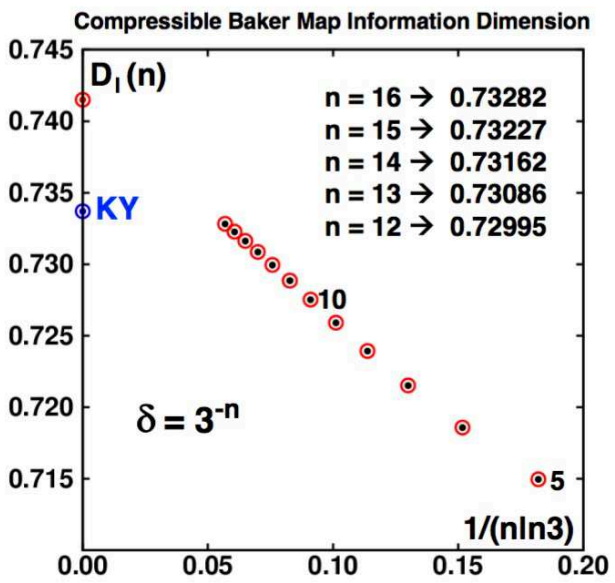
Summary. The paper reviews the Nosé, Nosé-Hoover, and Dettmann thermostat formulations for the harmonic oscillator and presents, in Section VI, a 'paradox' in which three phase-space descriptions of the same oscillator yield phase-space compressibilities of +ζ, 0, and −ζ. The paper also includes pedagogical Monte Carlo examples, a discussion of ergodicity and Lyapunov instability, numerical studies of the nonequilibrium Galton Board, and a detailed analysis of a time-reversible compressible Baker Map, including information-dimension estimates. The central claim in the abstract is that thermostated harmonic oscillator dynamics can be simultaneously expanding, incompressible, or contracting depending on the chosen phase space.
Significance. The paper contains useful pedagogical material and some carefully executed numerical experiments, especially the Baker Map information-dimension study and the comparison of thermostat variants. The direct divergence calculations in Section VI are arithmetically correct, and the paper explicitly flags the paradox as 'wrongly, of course' in the introduction to that section. However, the paper never supplies the standard resolution: a divergence is only defined after fixing both a vector field and a volume form, and the three descriptions in Section VI extend the same on-shell dynamics differently off the constraint surface, or reduce to a lower-dimensional projection. Because the central claim of the abstract is this apparent simultaneity, and because the text leaves it as an unresolved paradox rather than a resolved artifact, the manuscript's main message is currently under-specified. If the authors engage the non-Hamiltonian metric formalism and explicitly explain the coordinate/volume-form dependence, the paper would become a valuable pedagogical cautionary tale.
major comments (4)
- [Section VI and Abstract] The central claim that the oscillator dynamics can be simultaneously expanding, incompressible, and contracting is not invariant: a divergence is defined only after fixing a phase-space volume form. The three descriptions in Section VI are not the same vector field. In VI.A, ˙ζ is written as (p/s)^2−1, which is obtained from the Dettmann Hamiltonian by using the constraint H_D=0; in VI.B, the same Hamiltonian gives ˙ζ=−(1/2)[q^2−(p/s)^2+ln(s^2)+ζ^2]−1, which differs away from H_D=0. These two four-dimensional flows therefore have different off-constraint extensions, yet the text compares their divergences as if they described the same flow. The paper itself says in Section VI that the paradox is 'wrongly, of course,' but it never explains why; the standard non-Hamiltonian metric formalism (e.g., Tuckerman, Mundy, and Martyna; or the metric-tensor approach) resolves the apparent contradiction. This is load-bearing because the abstract's main claim is the paradox.
- [Section VI.C] The comparison of the 3D divergence −ζ with the 4D divergences +ζ and 0 is not meaningful without a specification of how the 3D volume element is inherited from the 4D one. The statement 'all for exactly the same phase-space states' is imprecise: the 3D description is a projection of the 4D flow (with the coordinate s removed), and the volume form in 3D is not canonically determined by the 4D Hamiltonian volume. The paper should state explicitly that a divergence is always relative to a chosen volume form, and that the three labels are properties of the chosen representation, not of the physical oscillator flow.
- [Section V.B and Figure 7] The identification s = f(q,p,ζ) is established only on the constraint surface H_D=0 (or the equivalent relation s = exp{−[q^2+(p/s)^2+ζ^2]/2}), not as a global identity in the four-dimensional phase space. In Section VI and Figure 7, this identification is used to interpret the four-dimensional compression rate as the evolution of the phase-space density; this requires an explicit definition of the volume form and a projection, which the paper does not supply. The agreement shown in Figure 7 for a single trajectory is numerical evidence, not a derivation, and the text should say so.
- [Section VI.A] The sentence 'Exactly these same motion equations follow more simply from Dettmann's Hamiltonian, with no need of time scaling' is misleading. The equations in VI.A are the time-scaled Nosé flow after using H_D=0 to simplify ˙ζ; the actual Hamilton equations for Dettmann's Hamiltonian H_D are those written in VI.B. Calling the VI.A system 'Dettmann' conflates the Hamiltonian flow with a non-Hamiltonian extension and is directly responsible for the apparent expansion in that subsection. This labeling should be corrected.
minor comments (5)
- [Abstract] The phrase 'the chosen phase space' should be clarified as 'the chosen coordinate representation and volume form' to avoid implying that the physical dynamics itself is simultaneously expanding, incompressible, and contracting.
- [Section VIII.D] The two displayed definitions of the information dimension use inconsistent sign conventions: one line reads ⟨ln(p)⟩/ln(δ), and a later line reads D_I ≡ 1 + Σ p_i ln(p_i)/ln(1/δ). Please harmonize the notation and define all symbols.
- [Section X] The discussion of the continuum hypothesis and the cardinality of the continuum is tangential to the rest of the paper and could be removed or substantially shortened without affecting the main arguments.
- [Reference 16] The bibliographic entry for Sprott's 'Variants of the Nosé-Hoover Oscillator' is incomplete (listed as 'preprint, July 2019'); please provide the published journal reference and year.
- [Section VI.C] When stating that the three-dimensional phase-space volume shrinks, the text should explicitly identify the volume element as dq dp dζ with respect to which the divergence is computed, since the same symbol ζ is used in the four-dimensional and three-dimensional contexts.
Circularity Check
No circular reduction: the expansion/incompressibility/contraction labels in Section VI are direct computations from the displayed equations, and the paper itself calls the paradox "apparent" and "wrongly, of course."
full rationale
The paper's central claim is not a fitted prediction or a renamed input. In Section VI, each divergence is computed directly from the stated motion equations: VI.A has (∂sdot/∂s)=+ζ from the Dettmann/Nosé 4D form, VI.B has (∂sdot/∂s)+(∂ζdot/∂ζ)=ζ−ζ=0 from the Hamiltonian form with HD≡0, and VI.C has ∂pdot/∂p=−ζ from the 3D Nosé-Hoover form. No parameter is adjusted to produce these signs, and the differences are algebraic consequences of the different coordinate and extension choices. The identity s=f(q,p,ζ), taken from Dettmann's prior work and independently from Bond, Leimkuhler, and Laird, is used for interpretation and for the probability-density check in Figure 7, but it is not used to force the divergence comparison. The paper explicitly labels the three-description result as an "apparent" paradox and says "these suggest (wrongly, of course)" that the flow is simultaneously expanding, contracting, and incompressible. Remaining objections about coordinate and volume-form dependence are correctness or interpretation concerns rather than circular derivation; a pedagogical article with direct calculations and no fitted prediction warrants a zero circularity score.
Assumptions & free parameters
free parameters (3)
- 0532 model linear and cubic thermostat weights =
0.05 and 0.32
- Sprott signum thermostat coupling α =
1.618034 (golden ratio)
- Temperature gradient magnitude =
0.5
assumptions (4)
- standard math Liouville's theorem applies to continuous phase-space flows via the continuity equation
- domain assumption The canonical phase-space distribution for the harmonic oscillator is f = e^{-(q^2+p^2)/2}/(2π)
- domain assumption The time-scaling variable s equals the phase-space probability density f(q,p,ζ)
- domain assumption The Kaplan-Yorke conjecture gives the information dimension of the Baker Map attractor
Cite this review
Pith. "Pith review of Aspects of Dynamical Simulations, Emphasizing Nos\'e and Nos\'e-Hoover Dynamics and the Compressible Baker Map." pith.science (2026). https://pith.science/paper/3D2IMKOP
@misc{pith2026190804379,
  author       = {Pith},
  title        = {Pith review of: Aspects of Dynamical Simulations, Emphasizing Nos\'e and Nos\'e-Hoover Dynamics and the Compressible Baker Map},
  year         = {2026},
  howpublished = {\url{https://pith.science/paper/3D2IMKOP}},
  note         = {Machine review of arXiv:1908.04379}
}
read the original abstract
Aspects of the Nos\'e and Nos\'e-Hoover dynamics developed in 1983-1984 along with Dettmann's closely related dynamics of 1996, are considered. We emphasize paradoxes associated with Liouville's Theorem. Our account is pedagogical, focused on the harmonic oscillator for simplicity, though exactly the same ideas can be, and have been, applied to manybody systems. Nos\'e, Nos\'e-Hoover, and Dettmann flows were all developed in order to access Gibbs' canonical ensemble directly from molecular dynamics. Unlike Monte Carlo algorithms dynamical flow models are often not ergodic and so can fail to reproduce Gibbs' ensembles. Accordingly we include a discussion of ergodicity, the visiting of all relevant microstates corresponding to the desired ensemble. We consider Lyapunov instability too, the usual mechanism for phase-space mixing. We show that thermostated harmonic oscillator dynamics can be simultaneously expanding, incompressible, or contracting, depending upon the chosen "phase space". The fractal nature of nonequilibrium flows is also illustrated for two simple two-dimensional models, the hard-disk-based Galton Board and the time-reversible Baker Map. The simultaneous treatment of flows as one-dimensional and many-dimensional suggests some interesting topological problems for future investigations.
Figures


Figures from the paper (8 more)


Reference graph
Works this paper leans on
-
[1]
N. Metropolis, A. W. Rosenbluth, M. N. Rosenbluth, A. H. Teller, and E. Teller, ``Equation of State Calculations by Fast Computing Machines'', The Journal of Chemical Physics 21 , 1087-1092 (1953)
work page 1953
-
[2]
B. J. Alder and T. E. Wainwright, ``Molecular Motions'', Scientific American 201 , 113-126 (1959)
work page 1959
-
[3]
Nos\'e, ``A Unified Formulation of the Constant Temperature Molecular Dynamics Methods'', The Journal of Chemical Physics 81 , 511-519 (1984)
S. Nos\'e, ``A Unified Formulation of the Constant Temperature Molecular Dynamics Methods'', The Journal of Chemical Physics 81 , 511-519 (1984)
1984
-
[4]
Nos\'e, ``A Molecular Dynamics Method for Simulations in the Canonical Ensemble'', Molecular Physics 52 , 255-268 (1984)
S. Nos\'e, ``A Molecular Dynamics Method for Simulations in the Canonical Ensemble'', Molecular Physics 52 , 255-268 (1984)
1984
-
[5]
W. G. Hoover, ``Canonical Dynamics. Equilibrium Phase-Space Distributions'', Physical Review A 31 , 1695-1697 (1985)
1985
-
[6]
H. A. Posch, W. G. Hoover, and F. J. Vesely, ``Canonical Dynamics of the Nos\'e Oscillator: Stability, Order, and Chaos'', Physical Review A 33 , 4253-4265 (1986)
1986
-
[7]
W. G. Hoover, ``M\'ecanique de Non\'equilibre \`a la Californienne'', Physica A 240 , 1-11 (1997)
1997
-
[8]
S. D. Bond, B. J. Leimkuhler, and B. B. Laird, ``The Nos\'e-Poincar\'e Method for Constant Temperature Molecular Dynamics'', Journal of Computational Physics 151 , 114-134 (1999)
work page 1999
Show all 39 references
-
[9]
C. P. Dettmann and G. P. Morriss, ``Hamiltonian Reformulation and Pairing of Lyapunov Exponents for Nos\'e-Hoover Dynamics'', Physical Review E 55 , 3693-3696 (1997)
1997
-
[10]
Nos\'e, ``An Improved Symplectic Integrator for Nos\'e-Poincar\'e Thermostat'', Journal of the Physical Society of Japan 70 , 75-77 (2001)
S. Nos\'e, ``An Improved Symplectic Integrator for Nos\'e-Poincar\'e Thermostat'', Journal of the Physical Society of Japan 70 , 75-77 (2001)
2001
-
[11]
J. C. Sprott, ``Some Simple Chaotic Flows'', Physical Review E, 50 , 647-650 (1994)
1994
-
[12]
W. G. Hoover, `Remark on ``Some Simple Chaotic Flows''', Physical Review E 51 , 759-760 (1995)
1995
-
[13]
W. G. Hoover, page 31, Molecular Dynamics (Lecture Notes in Physics \# 258, Springer-Verlag, Berlin, 1986). A scanned copy of the book is available free at williamhoover.info
1986
-
[14]
Kusnezov, A
D. Kusnezov, A. Bulgac, and W. Bauer, ``Canonical Ensembles from Chaos'', Annals of Physics 204 , 155-185 (1990) and 214 , 180-218 (1992)
1990
-
[15]
Tapias, A
D. Tapias, A. Bravetti, and D. P. Sanders, ``Ergodicity of One-Dimensional Systems Coupled to the Logistic Thermostat'', Computational Methods in Science and Technology 23 , 11-18 (2017)
2017
-
[16]
J. C. Sprott, ``Variants of the Nos\'e-Hoover Oscillator'', European Physics Journal Special Topics Issue ``Special Chaotic Systems'' ( preprint, July 2019 ) following up J. C. Sprott, ``Ergodicity of One-Dimensional Oscillators with a Signum Thermostat'', Computational Method...
2018
-
[17]
W. G. Hoover, J. C. Sprott, and C. G. Hoover, ``A Tutorial: Adaptive Runge-Kutta Integration for Stiff Systems: Comparing the Nos\'e and Nos\'e-Hoover Oscillator Dynamics'', American Journal of Physics 84 , 786 (2016)
2016
-
[18]
Ford, ``The Fermi-Pasta-Ulam Problem: Paradox Turns Discovery'', Physics Reports 213 , 271-310 (1992)
J. Ford, ``The Fermi-Pasta-Ulam Problem: Paradox Turns Discovery'', Physics Reports 213 , 271-310 (1992)
1992
-
[19]
B. J. Alder and T. E. Wainwright, ``Phase Transition for a Hard Sphere System'', The Journal of Chemical Physics 27 , 1208-1209 (1957)
1957
-
[20]
W. W. Wood and J. D. Jacobson, ``Preliminary Results from a Recalculation of the Monte Carlo Equation of State of Hard Spheres'', The Journal of Chemical Physics 27 , 1207-1208 (1957)
1957
-
[21]
Wm. G. Hoover, Computational Statistical Mechanics (Studies in Modern Thermodynamics \# 10, Elsevier, Amsterdam, 1991). A scanned copy of the book is available free on the web at williamhoover.info
1991
-
[22]
M. A. M. Karlsen, ``The Early Years of Molecular Dynamics and Computers at UCRL, LRL, LLL, and LLNL'', pages 176-183 in Symposium in Honor of Dr Berni Alder's 90th Birthday , E. Schwegler, B. M. Rubenstein, and S. B. Libby, editors (Advances in the Computational Sciences, Worl...
2017
-
[23]
Engel, J
M. Engel, J. A. Anderson, S. C. Glotzer, M. Isobe, E. P. Bernard, and W. Krauth, ``Hard-Disk Equation of State: First-Order Liquid-Hexatic Transition in Two Dimensions with Three Simulation Methods'', Physical Review 87 , 042134 (2013)
2013
-
[24]
Moran, W
B. Moran, W. G. Hoover, and S. Bestiale, ``Diffusion in a Periodic Lorentz Gas'', Journal of Statistical Physics 48 , 709-726 (1987)
1987
-
[25]
B. L. Holian, W. G. Hoover, and H. A. Posch, ``Resolution of Loschmidt's Paradox: The Origin of Irreversible Behavior in Reversible Atomistic Dynamics'', Physical Review Letters 59 , 10-13 (1987)
1987
-
[26]
B. L. Holian, W. G. Hoover, B. Moran, and G. K. Straub, ``Shockwave Structure via Nonequilibrium Molecular Dynamics and Navier-Stokes Continuum Mechanics'', Physical Review A 22 , 2798-2808 (1980)
1980
-
[27]
J. C. Sprott, W. G. Hoover, and C. G. Hoover, ``Heat Conduction, and the Lack Thereof, in Time-Reversible Dynamical Systems: Generalized Nos\'e-Hoover Ooscillators with a Temperature Gradient'', Physical Review E 89 , 042914 (2014)
2014
-
[28]
Wang and X
L. Wang and X. S. Yang, ``The Coexistence of Invariant Tori and Topological Horseshoes in a Generalized Nos\'e-Hoover Oscillator'', International Journal of Bifurcation and Chaos 27 , 1750111 (2017)
2017
-
[29]
W. G. Hoover and B. L. Holian, ``Kinetic Moments Method for the Canonical Ensemble Distribution'', Physics Letters A 211 , 253-257 (1996)
1996
-
[30]
Wm. G. Hoover, C. G. Hoover, and F. Grond, ``Phase-Space Growth Rates, Local Lyapunov Spectra, and Symmetry Breaking for Time-Reversible Dissipative Oscillators'', Communications in Nonlinear Science and Numerical Simulation 13 , 1180-1193 (2008)
2008
-
[31]
W. G. Hoover, C. G. Hoover, and J. C. Sprott, ``Nonequilibrium Systems : Hard Disks and Harmonic Oscillators Near and Far From Equilibrium'', Molecular Simulation 42 , 1300-1316 (2016) = arXiv:1507.08302v4. The arXiv version is superior to the edited Molecular Simulation version
2016 arXiv
-
[32]
J. L. Kaplan and J. A. Yorke, ``Chaotic Behavior of Multidimensional Difference Equations'', pages 204-227 in Functional Differential Equations and the Approximation of Fixed Points , edited by H. O. Peitgen and H. O. Walther (Springer, Berlin, 1979)
1979
-
[33]
J. D. Farmer, E. Ott, and J. A. Yorke, ``The Dimension of Chaotic Attractors'', Physica D, 7 , 153-180 (1983)
1983
-
[34]
Wm. G. Hoover and H. A. Posch, ``Chaos and Irreversibility in Simple Model Systems'', Chaos 8 , 366-373 (1998)
1998
-
[35]
Kumi\^c\'ak, ``Irreversibility in a Simple Reversible Model'', Physical Review E 71
J. Kumi\^c\'ak, ``Irreversibility in a Simple Reversible Model'', Physical Review E 71 . 016115 (2005)
2005
-
[36]
W. G. Hoover, C. G. Tull (now Hoover), and H. A. Posch, ``Negative Lyapunov Exponents for Dissipative Systems'', Physics Letters A 131 , 211-215 (1988)
1988
-
[37]
Wm. G. Hoover, C. G. Hoover, H. A. Posch, and J. A. Codelli, ``The Second Law of Thermodynamics and Multifractal Distribution Functions: Bin Counting, Pair Correlations, and [ the Definite Failure of ] the Kaplan-Yorke Conjecture'', Communications in Nonlinear Science and Nume...
2005
-
[38]
Dellago and Wm
C. Dellago and Wm. G. Hoover, ``Finite-Precision Stationary States At and Away from Equilibrium'', Physical Review E 62 , 6275-6281 (2000). See the references to previous 1998 work of Grebogi, Lanford, Ott, and Yorke therein
2000
-
[39]
Wm. G. Hoover, H. A. Posch, K. Aoki, and D. Kusnezov, ``Remarks on Non-Hamiltonian Statistical Mechanics: Lyapunov Exponents and Phase-Space Dimensionality Loss'', Europhysics Letters 60 , 337-341 (2002)
2002
Reviewed August 14, 2026 · model on record in the stance chip above.
Discussion (0). Continue with ORCID to comment.