An Empirical Analysis of AI Slop in Music Streaming
Pith reviewed 2026-06-27 00:06 UTC · model grok-4.3
The pith
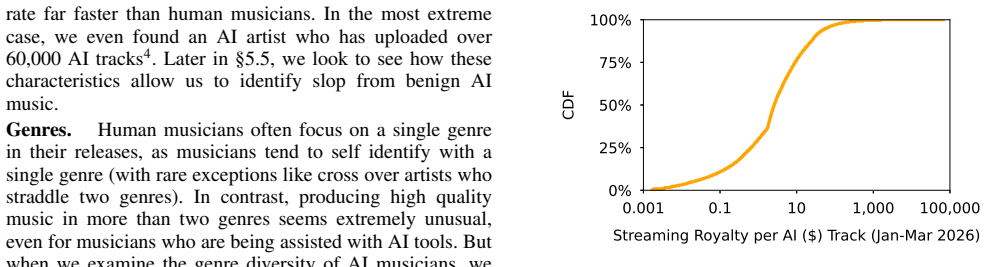
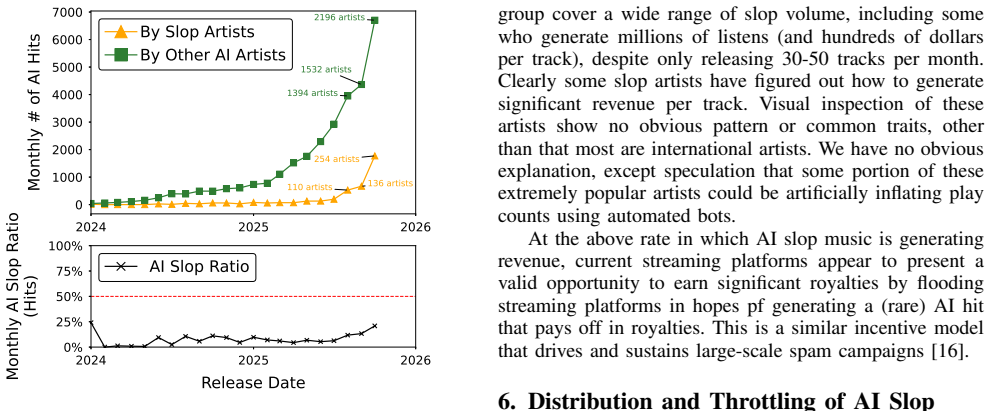
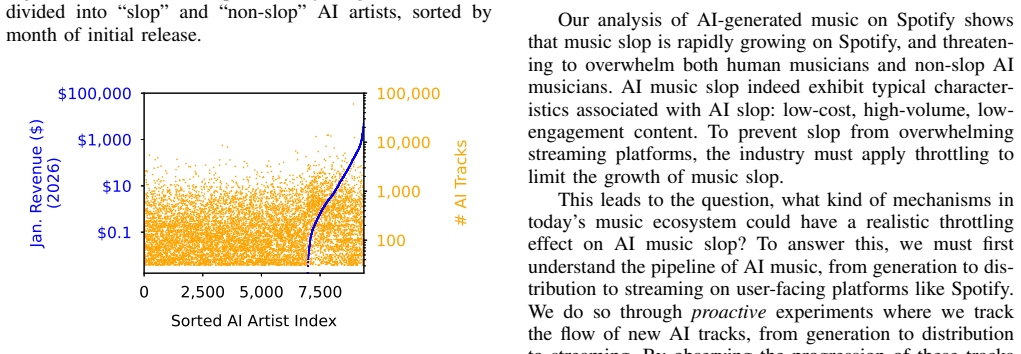
Over 93 percent of AI music on Spotify gets few plays and is rarely recommended.
A machine-rendered reading of the paper's core claim, the machinery that carries it, and where it could break.
Core claim
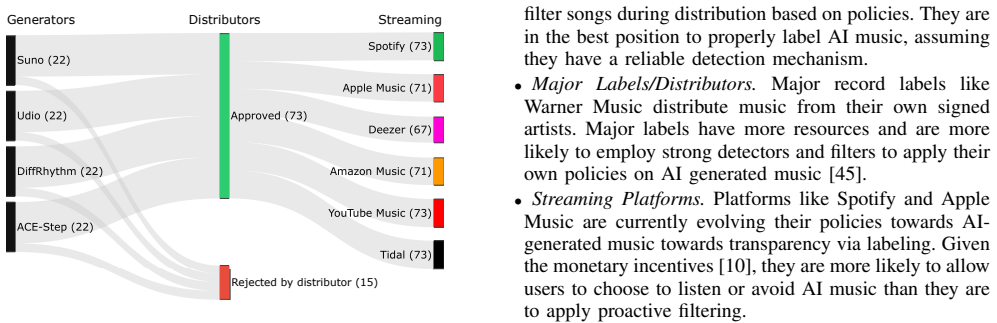
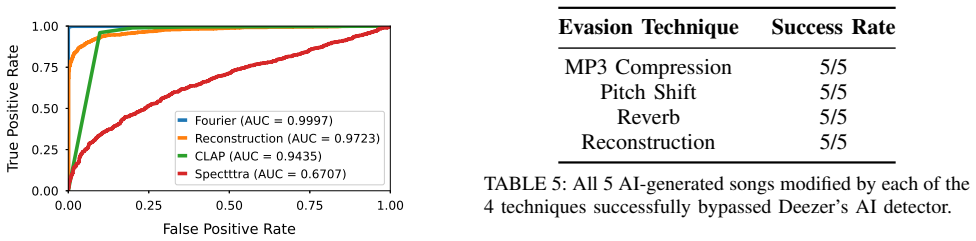
The paper shows that the overwhelming majority of AI music on Spotify receives few or no listener plays and is rarely recommended by the platform. Creators follow a spray-and-pray strategy by releasing high volumes across many genres. Publishing AI tracks through indie distributors proves straightforward because policies are inconsistent and weakly enforced. Existing detection tools for AI music lack both accuracy and robustness against new generators.
What carries the argument
Empirical measurement of plays, recommendations, and upload success for AI-identified tracks on Spotify combined with controlled publishing experiments through eleven distributors.
If this is right
- AI music currently shows little evidence of self-sustaining consumption on major platforms.
- Inconsistent distributor rules make it simple to upload large numbers of AI tracks.
- Detection tools cannot yet reliably separate AI music from human music at scale.
- Lower generation costs could tip the balance toward viable slop unless policies change.
Where Pith is reading between the lines
- Platforms may eventually need origin verification during upload to limit low-effort content.
- The same low-engagement pattern could appear in other AI-generated media if recommendation systems stay unchanged.
- Clear labeling requirements for AI content could give listeners a direct way to filter tracks.
Load-bearing premise
The method used to label tracks as AI-generated in the Spotify data is reliable and the low-engagement pattern holds for AI music beyond the sampled set.
What would settle it
A large collection of confirmed AI tracks that achieve high play counts and frequent recommendations, or a detection method that reveals many high-engagement tracks were misclassified as non-AI.
Figures

read the original abstract
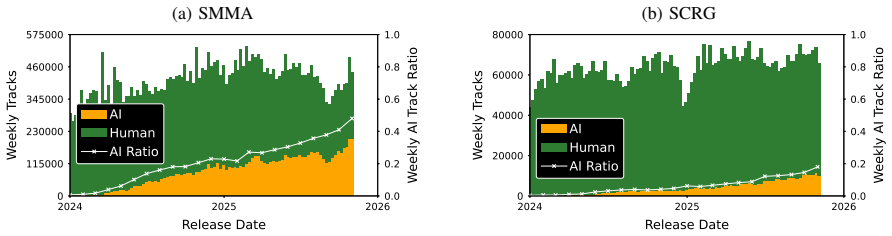
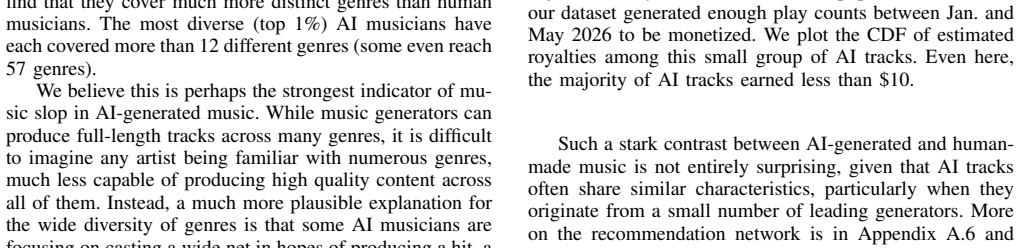
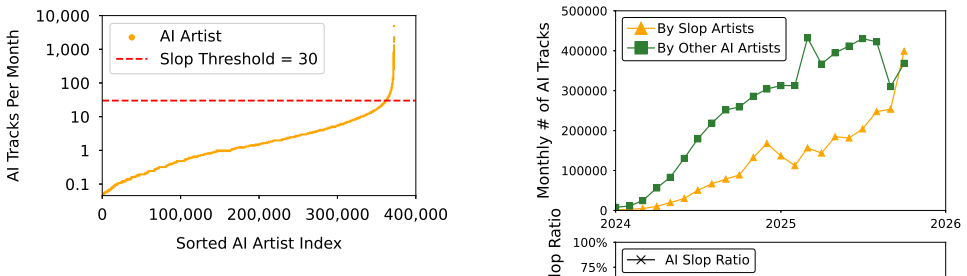
Generative AI models lower the bar for content creation, making it easy for any user to create professional-looking images, text and music with minimal effort. This has enabled a new cottage industry around creation of "AI slop" mass quantities of mediocre content produced to generate revenue, often through misrepresentation as human-authored content, or scams involving automated scripts and fake consumption. While there are obvious parallels between the AI-slop industry and "traditional" email spam networks, it might be too early to determine if AI slop generation can grow into a similar self-sustaining industry. In this paper, we look specifically at the music industry, and explore the question: Can we prevent AI music slop from growing into a self-sustaining shadow industry? To answer this question, we characterize the current state of AI slop in music, and its pipeline from generation, distribution, and consumption by users on streaming platforms. By examining growth and engagement on Spotify, we confirm that AI music exhibits AI slop characteristics: the overwhelming majority (93%) of AI music receive few, if any listener plays, and are rarely recommended. AI musicians "spray and pray," releasing large volumes of music across multiple genres in hopes of generating a hit. We also explore the AI slop pipeline by generating and publishing our own AI tracks onto streaming through 11 indie music distributors. We find distributors have inconsistent and largely unenforced policies on AI music, making it surprisingly easy to publish mass produced AI songs. Finally, we consider AI music detection, and find that current methods lack accuracy or robustness. As generation costs decrease, we believe slop generation in music will become self-sustainable, unless concrete steps are taken by the music industry. We consider and discuss potential mitigation methods based on our findings.
Editorial analysis
A structured set of objections, weighed in public.
Referee Report
Summary. The paper claims to characterize AI-generated 'slop' music on streaming platforms. It reports that 93% of AI music on Spotify receives few or no plays and is rarely recommended, that creators use a 'spray and pray' strategy of high-volume multi-genre releases, that experiments publishing AI tracks through 11 indie distributors reveal inconsistent and unenforced AI policies, and that existing detection methods lack accuracy or robustness. It concludes that decreasing generation costs risk making AI slop self-sustaining unless platforms and the industry take mitigation steps.
Significance. If the engagement statistics and distributor accessibility findings hold after proper validation, the work supplies useful observational and experimental data on the current scale and pipeline of AI content in music streaming. The direct experiment of generating and distributing original AI tracks is a concrete strength that grounds the claims about distribution ease. Such evidence could usefully inform platform design and policy discussions around generative content.
major comments (2)
- [Spotify analysis / results reporting the 93% figure] The central 93% low-engagement claim for AI music (stated in the abstract and used to support the self-sustainability conclusion) rests on an unidentified procedure for labeling tracks as AI-generated within the Spotify dataset. No sample sizes, labeling criteria, validation set, false-positive rate, or controls for confounders such as genre or release date are supplied, despite the paper's own later statement that current detection methods lack accuracy or robustness. This labeling step is load-bearing; without it the observed pattern cannot be attributed specifically to AI slop.
- [Distributor experiment] The experimental section on publishing through 11 distributors reports inconsistent policies but supplies no quantitative details on the number of tracks submitted, acceptance rates, or any post-publication engagement metrics that would allow readers to assess whether the published tracks exhibited the same low-engagement pattern claimed for the Spotify cohort.
minor comments (1)
- [Abstract] The abstract uses 'we confirm' for the 93% statistic; the manuscript should instead state that the figure is observed under the labeling method described in the methods section.
Simulated Author's Rebuttal
We thank the referee for the detailed and constructive report. The two major comments identify important gaps in methodological transparency and experimental reporting. We will revise the manuscript to address both points directly by adding the requested details and clarifications. No standing objections remain after these revisions.
read point-by-point responses
-
Referee: The central 93% low-engagement claim for AI music (stated in the abstract and used to support the self-sustainability conclusion) rests on an unidentified procedure for labeling tracks as AI-generated within the Spotify dataset. No sample sizes, labeling criteria, validation set, false-positive rate, or controls for confounders such as genre or release date are supplied, despite the paper's own later statement that current detection methods lack accuracy or robustness. This labeling step is load-bearing; without it the observed pattern cannot be attributed specifically to AI slop.
Authors: We agree the labeling procedure must be described in full. The current manuscript text does not supply sample sizes, explicit criteria, validation metrics, or confounder controls for the Spotify cohort. In the revision we will insert a new subsection (likely in Section 3 or 4) that details the data source, the exact heuristics or external tools used to label tracks as AI-generated, the total number of tracks examined, any manual validation performed, and an explicit discussion of limitations including false-positive risk and lack of genre/release-date controls. We will also cross-reference this with the later detection-methods section to highlight the inherent uncertainty. revision: yes
-
Referee: The experimental section on publishing through 11 distributors reports inconsistent policies but supplies no quantitative details on the number of tracks submitted, acceptance rates, or any post-publication engagement metrics that would allow readers to assess whether the published tracks exhibited the same low-engagement pattern claimed for the Spotify cohort.
Authors: We accept that the distributor experiment currently lacks the quantitative detail needed for reproducibility and comparison. The manuscript reports only qualitative outcomes. In the revised version we will add a table or subsection listing, for each of the 11 distributors: number of tracks submitted, acceptance/rejection outcomes, any stated policy language encountered, and available post-publication metrics (plays, saves, or algorithmic placement) for the accepted tracks. Where engagement data are unavailable we will state this explicitly. revision: yes
Circularity Check
No circularity: purely observational empirical study
full rationale
The paper performs data collection on Spotify, publishes its own AI tracks via distributors, and reports engagement statistics. No equations, derivations, fitted parameters, or predictions appear in the provided text. The 93% figure is a direct count from labeled data, not a reduction of any model output to its own inputs. No self-citations are invoked as load-bearing uniqueness theorems or ansatzes. The labeling accuracy concern raised by the skeptic is a methodological limitation, not a circularity pattern under the enumerated definitions.
Axiom & Free-Parameter Ledger
axioms (1)
- domain assumption Spotify listener plays and recommendation data accurately capture engagement with AI-generated music
Reference graph
Works this paper leans on
-
[1]
Drowning in slop,
M. Read, “Drowning in slop,” New York Magazine, Sep. 2024, https: //nymag.com/intelligencer/article/ai-generated-content-internet-onlin e-slop-spam.html
2024
-
[2]
Amazon is the world’s biggest online book marketplace. it’s filled with AI knockoffs,
C. Jones, “Amazon is the world’s biggest online book marketplace. it’s filled with AI knockoffs,” Rolling Stone, Oct. 2025, https://ww w.rollingstone.com/culture/culture-features/amazon-ai-book-knockof fs-1235450690/
2025
-
[3]
AI slop: How low-quality AI books are overwhelming libraries,
S. Palmer, “AI slop: How low-quality AI books are overwhelming libraries,” Fox 5 News, Feb. 2025, https://shellypalmer.com/2025/02 /ai-slop-how-low-quality-ai-books-are-overwhelming-libraries/
2025
-
[4]
AI-generated junk is flooding Etsy,
K. Tiffany, “AI-generated junk is flooding Etsy,” The Atlantic, Jun. 2023, https://www.theatlantic.com/technology/archive/2023/06/ai-c hatgpt-side-hustle/674415/
2023
-
[5]
Why is there so much AI slop now?
Toxicbunnyz, “Why is there so much AI slop now?” Reddit r/EtsyCommunity, Mar. 2026, https://www.reddit.com/r/EtsyCom munity/comments/1rg2n7e/why is there so much ai slop now/
2026
-
[6]
AI infiltration into the arts has fans seeing slop everywhere,
R. Salkowitz, “AI infiltration into the arts has fans seeing slop everywhere,” Forbes, Apr. 2026, https://www.forbes.com/sites/r obsalkowitz/2026/04/09/ai-infiltration-into-the-arts-has-fans-seein g-slop-everywhere/
2026
-
[7]
AI is driving a new surge of sham “books
Authors Guild, “AI is driving a new surge of sham “books” on Amazon,” Authors Guild News, Mar. 2024, https://authorsguild.o rg/news/ai-driving-new-surge-of-sham-books-on-amazon/
2024
-
[8]
Jorja Smith’s record label hits out at ‘AI clone’ song,
M. Savage, “Jorja Smith’s record label hits out at ‘AI clone’ song,” BBC, Dec. 2025, https://www.bbc.com/news/articles/cwyvjye18e9o
2025
-
[9]
AI country hit ‘Walk My Walk’ built on Blanco Brown’s sound sparks questions of attribution, ethics,
J. L. Jr., “AI country hit ‘Walk My Walk’ built on Blanco Brown’s sound sparks questions of attribution, ethics,” AP News, Nov. 2025, https://apnews.com/article/walk-my-walk-blanco-brown-2c9bbde6e 88434365640c50e2998cfe2
2025
-
[10]
Spotify publishes AI-generated songs from dead artists without permission,
E. Maiberg, “Spotify publishes AI-generated songs from dead artists without permission,” 404 Media, Jul. 2025, https://www.404media.c o/spotify-publishes-ai-generated-songs-from-dead-artists-without-p ermission/
2025
-
[11]
Over the past few months I have had countless comments alleging that my work is AI
M. Burnham, “Over the past few months I have had countless comments alleging that my work is AI.” Instagram, Jun. 2026, https://www.instagram.com/p/DZDc6BLjZ3e/
2026
-
[12]
Most consumers wary of fully AI-generated creative content: Exclusive survey,
A. Schomer, “Most consumers wary of fully AI-generated creative content: Exclusive survey,” Variety, Mar. 2025, https://variety.com/vi p/most-consumers-wary-of-fully-ai-generated-creative-content-sur vey-1236347518/
2025
-
[13]
Global music streaming market size, share, industry analysis report,
market.us, “Global music streaming market size, share, industry analysis report,” market.us report, Oct. 2025, https://market.us/re port/music-streaming-market/
2025
-
[14]
AI music is flooding Spotify, and subscribers are furious – here’s why music fans ‘no longer trust discover weekly’,
R. Davies, “AI music is flooding Spotify, and subscribers are furious – here’s why music fans ‘no longer trust discover weekly’,” Tech Radar, Jan. 2026, https://www.techradar.com/audio/spotify/ai-music -is-flooding-spotify-and-subscribers-are-furious-heres-why-music-f ans-no-longer-trust-discover-weekly
2026
-
[15]
Man charged with $10 million streaming music scam using AI-generated songs,
L. Katz, “Man charged with $10 million streaming music scam using AI-generated songs,” Forbes, Sep. 2024, https://www.forbes.com/sit es/lesliekatz/2024/09/08/man-charged-with-10-million-streaming-s cam-using-ai-generated-songs/
2024
-
[16]
Spamalytics: an empirical analysis of spam mar- keting conversion,
C. Kanichet al., “Spamalytics: an empirical analysis of spam mar- keting conversion,” inProc. of CCS, Oct. 2008
2008
-
[17]
Click trajectories: End-to-end analysis of the spam value chain,
K. Levchenkoet al., “Click trajectories: End-to-end analysis of the spam value chain,” inProc. of IEEE S&P, 2011
2011
-
[18]
Music streaming services stats (2026),
F. Duarte, “Music streaming services stats (2026),” Exploding Topics, Jan. 2026, https://explodingtopics.com/blog/music-streaming-stats
2026
-
[19]
About spotify,
Spotify, “About spotify,” Spotify Newsroom, June 2026, https://news room.spotify.com/company-info/
2026
-
[20]
The benefits of releasing your music across multiple streaming platforms,
Salif, “The benefits of releasing your music across multiple streaming platforms,” Nov. 2024, https://www.vampr.me/faq/the-benefits-of-rel easing-your-music-across-multiple-streaming-platforms/
2024
-
[21]
Getting music on Spotify,
Spotify, “Getting music on Spotify,” https://support.spotify.com/us/a rtists/article/getting-music-on-spotify/ (accessed Jun. 3, 2026)
2026
-
[22]
Is AI music allowed? 15 distributors and 9 DSP rules, mapped
MusicBen, “Is AI music allowed? 15 distributors and 9 DSP rules, mapped.” Substack, June 2026, https://stvdio.substack.com/p/is-ai-m usic-allowed-15-distributors
2026
-
[23]
The major record companies release around 3,900 tracks every day. Their problem? That’s a drop in the ocean
T. Ingham, “The major record companies release around 3,900 tracks every day. Their problem? That’s a drop in the ocean.” Music Business Worldwide, Mar. 2023, https://www.musicbusinessworldwide.com/r ecord-companies-3900-tracks-every-day-problem/
2023
-
[24]
Who we work with,
SubmitHub, “Who we work with,” https://www.submithub.com/ (accessed Jun. 3, 2026)
2026
-
[25]
Deezer launches world’s first AI tagging system for music streaming,
I. Morgan, “Deezer launches world’s first AI tagging system for music streaming,” Jun. 2025, https://newsroom-deezer.com/2025/06/deezer -launches-worlds-first-ai-tagging-system-for-music-streaming/
2025
-
[26]
20,000 AI-generated songs uploaded to Deezer every single day,
J. Koetsier, “20,000 AI-generated songs uploaded to Deezer every single day,” Forbes, Apr. 2025, https://www.forbes.com/sites/johnkoe tsier/2025/04/16/20000-ai-generated-songs-uploaded-to-deezer-eve ry-single-day/
2025
-
[27]
Deezer: AI-generated tracks now represent 44% of all new uploaded music,
J. Wendel, “Deezer: AI-generated tracks now represent 44% of all new uploaded music,” Apr. 2026, https://newsroom-deezer.com/2026 /04/ai-generated-tracks-represent-44-of-new-uploaded-music/
2026
-
[28]
Apple music launches AI transparency tags — but only if labels and distributors declare them,
M. Stassen, “Apple music launches AI transparency tags — but only if labels and distributors declare them,” Music Business Worldwide, March 2026, https://www.musicbusinessworldwide.com/apple-music -launches-ai-transparency-tags-but-only-if-labels-and-distributors-c hoose-to-declare-them/
2026
-
[29]
Spotify strengthens AI protections for artists, songwriters, and producers,
Spotify, “Spotify strengthens AI protections for artists, songwriters, and producers,” Sep. 2025, https://newsroom.spotify.com/2025-09-2 5/spotify-strengthens-ai-protections/
2025
-
[30]
Introducing verified by Spotify, a signal of authenticity and trust for the artists behind the music,
Spotify, “Introducing verified by Spotify, a signal of authenticity and trust for the artists behind the music,” Apr. 2026, https://newsroom.s potify.com/2026-04-30/verified-by-spotify-badge-artist-details/
2026
-
[31]
Jukebox: A Generative Model for Music
P. Dhariwalet al., “Jukebox: A generative model for music,”arXiv preprint arXiv:2005.00341, 2020
work page internal anchor Pith review Pith/arXiv arXiv 2005
-
[32]
Simple and controllable music generation,
J. Copetet al., “Simple and controllable music generation,” inProc. of NeurIPS, 2023
2023
-
[33]
Riffusion - Stable diffusion for real- time music generation,
S. Forsgren and H. Martiros, “Riffusion - Stable diffusion for real- time music generation,” HuggingFace, 2022, https://huggingface.co/r iffusion/riffusion-model-v1
2022
-
[34]
Stable audio open,
Z. Evanset al., “Stable audio open,” inProc of ICASSP, 2025
2025
-
[35]
N. Ziqianet al., “DiffRhythm: Blazingly fast and embarrassingly simple end-to-end full-length song generation with latent diffusion,” arXiv preprint arXiv:2503.01183, 2025
-
[36]
ACE-Step: A step towards music generation foundation model,
J. Gong, S. Zhao, S. Wang, S. Xu, and J. Guo, “ACE-Step: A step towards music generation foundation model,”arXiv preprint arXiv:2506.00045, 2025
-
[37]
Songgen: A single stage auto-regressive transformer for text-to-song generation,
Z. Liuet al., “Songgen: A single stage auto-regressive transformer for text-to-song generation,” inProc. of ICML, Jul. 2025
2025
-
[38]
Musika! fast infinite waveform music generation,
M. Pasini and J. Schl ¨uter, “Musika! fast infinite waveform music generation,” inProc. of ISMIR, Dec. 2022
2022
-
[39]
Top 20 companies in generative AI in music market 2025: strategic overview and future trends (2024-2035),
Spherical Insights, “Top 20 companies in generative AI in music market 2025: strategic overview and future trends (2024-2035),” Sep. 2025, https://www.sphericalinsights.com/blogs/top-20-companies-i n-generative-ai-in-music-market-2025-strategic-overview-and-futur e-trends-2024-2035
2025
-
[40]
3, 2026)
“Suno,” https://suno.com/ (accessed Jun. 3, 2026)
2026
-
[41]
AI music generator,
Udio, “AI music generator,” https://www.udio.com/ (accessed Jun. 3, 2026)
2026
-
[42]
Unleash your creativity make music with Boomy AI,
Boomy, “Unleash your creativity make music with Boomy AI,” https: //boomy.com/ (accessed Jun. 3, 2026)
2026
-
[43]
Your personal AI music generation assistant,
AIV A, “Your personal AI music generation assistant,” https://www. aiva.ai (accessed Jun. 3, 2026)
2026
-
[44]
100% Copyright-safe AI music generator,
Soundraw, “100% Copyright-safe AI music generator,” https://soun draw.io/ (accessed Jun. 3, 2026)
2026
-
[45]
UMG boss slams ‘exponential growth of AI slop’ on streaming services,
S. Dredge, “UMG boss slams ‘exponential growth of AI slop’ on streaming services,” Music Ally, Jan. 2026, https://musically.com/20 26/01/09/umg-boss-slams-exponential-growth-of-ai-slop-on-streami ng-services/
2026
-
[46]
AI-generated music detection and its challenges,
D. Afchar, G. Meseguer-Brocal, and R. Hennequin, “AI-generated music detection and its challenges,” inProc of ICASSP, 2025
2025
-
[47]
A Fourier explanation of AI-music artifacts,
D. Afchar, G. Meseguer-Brocal, K. Akesbi, and R. Hennequin, “A Fourier explanation of AI-music artifacts,” inProc. of ISMIR, Sep. 2025
2025
-
[48]
From audio deepfake detection to AI-generated music detection–a pathway and overview,
Y . Li, M. Milling, L. Specia, and B. W. Schuller, “From audio deepfake detection to AI-generated music detection–a pathway and overview,”arXiv preprint arXiv:2412.00571, 2024
-
[49]
Quicksilver - browser extension (Chrome),
ETCH, “Quicksilver - browser extension (Chrome),” https://www.et ch-humanity.org/etch-lab/quicksilver-plugin (accessed Jun. 3, 2026)
2026
-
[50]
SONICS: Synthetic or not - identifying counterfeit songs,
M. A. Rahmanet al., “SONICS: Synthetic or not - identifying counterfeit songs,” inProc. of ICLR, 2025
2025
-
[51]
The AI music arms race: On the detection of AI-generated music,
L. Vila, B. Sturm, L. Casini, and D. Dalmazzo, “The AI music arms race: On the detection of AI-generated music,”Transactions of the International Society for Music Information Retrieval, Jun. 2025
2025
-
[52]
AI song checker,
SubmitHub, “AI song checker,” https://www.submithub.com/ai-son g-checker (accessed Jun. 3, 2026)
2026
-
[53]
AI generated music detection,
Hive, “AI generated music detection,” https://docs.thehive.ai/docs/a i-generated-music-detection (accessed Jun. 3, 2026)
2026
-
[54]
MatchTune,
“MatchTune,” https://www.matchtune.com/ (accessed Jun. 3, 2026)
2026
-
[55]
AI music detector & checker,
BeatsToRapOn, “AI music detector & checker,” https://beatstorapon .com/ai-music-detector (accessed Jun. 3, 2026)
2026
-
[56]
FMA: A dataset for music analysis,
M. Defferrard, K. Benzi, P. Vandergheynst, and X. Bresson, “FMA: A dataset for music analysis,” inProc. of ISMIR, 2017
2017
-
[57]
MusicBrainz,
A. R. Stutzbach, “MusicBrainz,”Notes, 2011
2011
-
[58]
The million song dataset,
T. Bertin-Mahieux, D. P. Ellis, B. Whitman, and P. Lamere, “The million song dataset,” inProc. of ISMIR, Oct. 2011
2011
-
[59]
Activist group says it has scraped 86m music files from Spotify,
D. Milmo, “Activist group says it has scraped 86m music files from Spotify,” The Guardian, Dec. 2025, https://www.theguardian.com/te chnology/2025/dec/22/activist-group-says-it-has-scraped-86m-music -files-from-spotify
2025
-
[60]
Timbaland’s AI music project is a ghost in a misguided machine,
S. Pierce, “Timbaland’s AI music project is a ghost in a misguided machine,” NPR, Jun. 2025, https://www.npr.org/2025/06/17/nx-s1-5 431544/timbaland-ai-music-suno-stage-zero-tata-generative
2025
-
[61]
Famous pop stars and their views on music AI, from Grimes to Drake,
N. Reiff, “Famous pop stars and their views on music AI, from Grimes to Drake,” Decrypt, Aug. 2023, https://decrypt.co/resourc es/famous-pop-stars-and-their-views-on-music-ai-from-grimes-to-d rake
2023
-
[62]
An AI-generated band got 1m plays on Spotify. now music insiders say listeners should be warned,
L. Bakare, “An AI-generated band got 1m plays on Spotify. now music insiders say listeners should be warned,” The Guardian, Jul. 2025, https://www.theguardian.com/technology/2025/jul/14/an-ai-g enerated-band-got-1m-plays-on-spotify-now-music-insiders-say-lis teners-should-be-warned
2025
-
[63]
Track monetization eligibility,
Spotify, “Track monetization eligibility,” https://support.spotify.co m/us/artists/article/track-monetization-eligibility/ (accessed Jun. 3, 2026)
2026
-
[64]
What is phishing? everything you need to know to protect yourself from scammers,
D. Palmer, “What is phishing? everything you need to know to protect yourself from scammers,” ZDNet News, April 2023, https://www.zd net.com/article/what-is-phishing-how-to-protect-yourself-from-sca m-emails-and-more/
2023
-
[65]
Generalized user representations for large-scale recommendations and downstream tasks,
G. Fazelniaet al., “Generalized user representations for large-scale recommendations and downstream tasks,” inProc of RecSys, Sep. 2025
2025
-
[66]
Understanding Spotify royalties,
Spotify, “Understanding Spotify royalties,” https://support.spotify.co m/us/artists/article/understanding-spotify-royalties/ (accessed Jun. 3, 2026)
2026
-
[67]
From $11b in 2025 payouts to what we’re building for artists in 2026,
Spotify, “From $11b in 2025 payouts to what we’re building for artists in 2026,” Jan. 2026, https://newsroom.spotify.com/2026-01-28/2025 -music-industry-payouts-whats-next-for-artists/
2025
-
[68]
Black Forest Labs, “FLUX,” 2024, https://github.com/black-forest-l abs/flux
2024
-
[69]
High-resolution image synthesis with latent diffusion models,
R. Rombach, A. Blattmann, D. Lorenz, P. Esser, and B. Ommer, “High-resolution image synthesis with latent diffusion models,” in Proc. of CVPR, 2022
2022
-
[70]
Best music distribution companies in 2026 - full comparison chart,
A. Herstand, “Best music distribution companies in 2026 - full comparison chart,” Ari’s Take, 2026, https://aristake.com/digital -distribution-comparison/
2026
-
[71]
Topological fingerprints for audio identifica- tion,
W. Reise, X. Fern ´andez, M. Dominguez, H. A. Harrington, and M. Beguerisse-D ´ıaz, “Topological fingerprints for audio identifica- tion,”SIAM Journal on Mathematics of Data Science, 2024
2024
-
[72]
suno-307k,
sleeping-ai, “suno-307k,” HuggingFace, 2025, https://huggingface.co /datasets/sleeping-ai/suno-307K/tree/main
2025
-
[73]
udio-126k,
sleeping ai, “udio-126k,” HuggingFace, 2025, https://huggingface.co /datasets/sleeping-ai/Udio-126K
2025
-
[74]
Pharmaleaks: Understanding the business of online pharmaceutical affiliate programs,
D. McCoyet al., “Pharmaleaks: Understanding the business of online pharmaceutical affiliate programs,” inProc. of USENIX Security, 2012
2012
-
[75]
LLaMA: Open and Efficient Foundation Language Models
H. Touvronet al., “LLaMA: Open and efficient foundation language models,”arXiv preprint arXiv:2302.13971, 2023. Appendix A. A.1. Ethical Considerations Our study involves potential impact on several primary stakeholder groups. (1)Streaming platformsSpotify and Deezer. We used a public dataset of Spotify metadata in our analyses. We also used public APIs t...
work page internal anchor Pith review Pith/arXiv arXiv 2023
discussion (0)
Sign in with ORCID, Apple, or X to comment. Anyone can read and Pith papers without signing in.