REVIEW 3 major objections 5 minor 14 references
A QCD analysis for nuclear PDFs at NNLO
T0 review · 3 major / 5 minor · reviewed 2026-08-14 · deepseek-v4-flash
Pith's one-line read New nuclear PDFs match earlier extractions except one gluon shift.
desk verdict A solid proceedings write-up of a preliminary nPDF extraction whose quantitative claims outrun the presented evidence: no uncertainty bands, no chi-square values, and the key consistency statement is not evaluable as written. read the letter →
The pith
A machine-rendered reading of the paper's core claim, the machinery that carries it, and where it could break.
The reading
What carries the argument
The load-bearing object is the A-dependent parameterization $$x $f_i^{{p/A}}$(x,$Q_0^{2}$)=c_0(A)\,$x^{{c_1(A)}}$(1-x)^{c_2(A)}\left(1+c_3(A)x+c_4(A)$x^{2}$\right)$$ with $$c_k(A)=c_{k,0}+c_{k,1}\left(1-$A^{{-c_{k,2}}$}\right),$$ where the $c_{k,0}$ are fixed from the fitted proton PDFs and only $c_{k,1}$ and $c_{k,2}$ are free nuclear parameters. Bound-neutron PDFs follow by isospin symmetry, and the nuclear PDF is constructed as $(Z f^{p/A}+(A-Z) f^{n/A})/A$. This form reduces to the free proton at $A=1$. Around it, the analysis uses DGLAP evolution at NLO or NNLO with the corresponding splitting functions and structure-function coefficients, and a modified version of an open-source fitting tool that compares theory to absolute cross sections, cross-section ratios, and isoscalar-corrected data.
What would settle it
A future low-scale measurement of the nuclear gluon ratio $R_g = xg^{p/Pb}/xg^p$ at $x \gtrsim 0.2$ and $Q^2 \approx Q_0^2$ that follows the earlier nPDF sets rather than the TUJU19 large-$x$ enhancement, together with a re-fit showing that the discrepancy cannot be removed within uncertainties, would settle the claim.
Extended reading notes
Core claim
The central discovery is that a self-consistent simultaneous analysis of neutral-current and charged-current neutrino-nucleus DIS data can determine nuclear PDFs at NLO and NNLO, and that these PDFs agree with existing extractions in most regions. The only notable difference is in the gluon sector: at the initial scale, the ratio $R_g^{p/Pb}$ rises at large $x$ relative to earlier analyses, but after DGLAP evolution to higher $Q^2$ the difference disappears. The paper therefore claims TUJU19 is a valid alternative to existing nPDF sets, with the advantage of an internally fitted proton baseline and a common fit of neutrino-nucleus charged-current data together with neutral-current data.
Load-bearing premise
The nuclear modifications are assumed to be completely described by the A-dependent parameterization with proton coefficients fixed in advance, so if that functional form is too restrictive or the proton baseline is biased, the extracted nuclear PDFs shift.
Editorial extensions
If this is right
- The TUJU19 set provides NLO and NNLO nuclear PDFs that can be used for predictions of heavy-ion and future electron-ion collider observables.
- Charged-current neutrino-nucleus DIS data can be included in a common fit with neutral-current DIS data, reproducing both data types well at NLO and NNLO.
- Treating deuteron as a nucleus with nonzero nuclear effects gives a definite nuclear correction for deuterium-based measurements.
- The large-$x$ gluon difference from earlier extractions is confined to the initial scale and disappears after evolution, so the gluon is consistent with existing sets at higher scales.
- The modified open-source fitting tool can handle cross-section ratios and isoscalar corrections, enabling future nuclear PDF analyses of additional process types.
Reading between the lines
- A natural next test would be to add Drell-Yan data, which the authors plan; if the large-$x$ gluon difference persists there, it would indicate genuine nuclear dynamics rather than a parameterization artifact.
- Because the proton coefficients are fixed beforehand, the framework could be re-used to assess how sensitive the extracted nuclear PDFs are to the choice of proton baseline.
- Comparing TUJU19 to a fit where deuterium is treated as a free proton would quantify how much of the extracted nuclear effects are driven by the deuteron assumption.
- If a future electron-ion collider measures nuclear structure functions in the region where TUJU19 and earlier sets differ, the A-dependent form's flexibility can be tested directly against data.
Signed reviews
Editorial analysis
A structured set of objections, weighed in public.
Referee Report
Summary. This proceedings paper presents a new QCD analysis of nuclear parton distribution functions (nPDFs), dubbed TUJU19, performed at both NLO and NNLO using a modified version of the open-source xFitter framework. The authors first construct a free-proton baseline from HERA, BCDMS, and NMC data, then parameterize nuclear modifications through A-dependent coefficients of the form c_k(A) = c_{k,0} + c_{k,1}(1 - A^{-c_{k,2}}), fitting 16 nuclear parameters to neutral-current DIS and charged-current neutrino-nucleus DIS data. The paper shows representative data comparisons and compares TUJU19 central values with nCTEQ15 and EPPS16 at NLO. The central qualitative claim is that TUJU19 is consistent with existing nPDF sets except for a large-x gluon nuclear modification at the initial scale, with agreement restored at higher scales.
Significance. If fully validated, TUJU19 would provide a useful new nPDF set, notable for being based on an open-source fitting framework and for treating the proton baseline consistently with the nuclear fit. The explicit A-dependent parameterization and the inclusion of neutrino-nucleus charged-current data are positive aspects. The paper also demonstrates that NLO and NNLO fits give comparable descriptions of the included data, which is a useful consistency check. However, the quantitative support for these claims is currently missing: no uncertainty bands for TUJU19, no chi-square values, and no plot or table for the claimed higher-scale gluon agreement. The paper is therefore best viewed as a preliminary proceedings contribution whose central comparisons need further support to be fully assessed.
major comments (3)
- [Section 4, Figure 4] The central claim that TUJU19 central PDFs are 'mostly within the error bands' of nCTEQ15 and EPPS16 is not quantitatively supported, because TUJU19 is shown only as central values and the paper explicitly defers its own uncertainty bands to the companion publication [11]. A central value lying inside another set's error band is insufficient to establish consistency unless TUJU19's own uncertainties are also known; the significance of any difference depends on both sets' errors. Please either include TUJU19 uncertainty bands or reframe the comparison as a qualitative central-value check and clearly state that no quantitative consistency claim can yet be made.
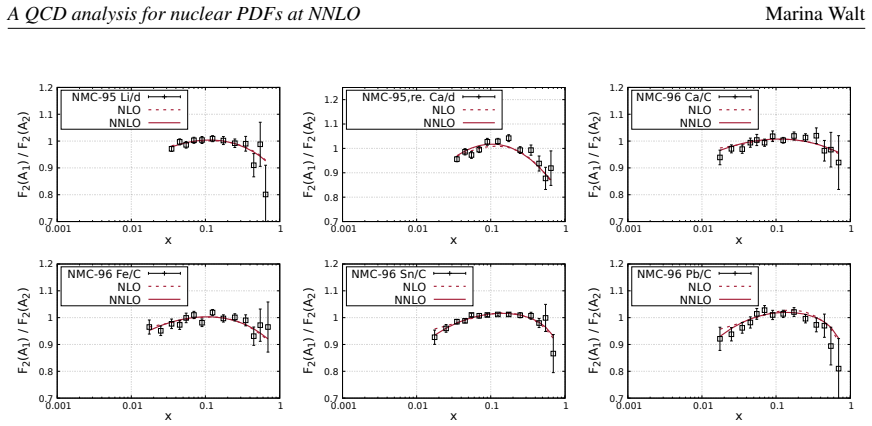
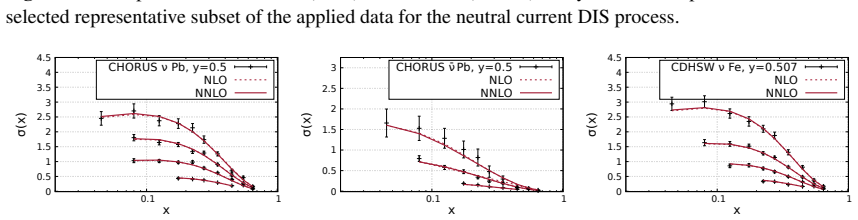
- [Section 4, Figures 2 and 3] The statement that 'the agreement of the calculated quantities with the measurements is very good at NLO and NNLO' is based only on a selected representative subset, with no chi-square values or pulls per data set. Since these are fitted data, good agreement with a few selected points does not quantify the fit quality. Please provide a table of chi-square or equivalent goodness-of-fit measures for the full data set, or explicitly restrict the claim to the displayed representative subset.
- [Section 4, last paragraph] The sentence 'agreement is found at higher scales' is not accompanied by any figure, table, or quantitative criterion in this paper. As written, it is an assertion about an unpublished comparison. Either show the higher-scale comparison or remove this statement or mark it as a forthcoming result, so that the reader can distinguish between demonstrated and deferred claims.
minor comments (5)
- [Abstract and text] The name of the fitting tool is written inconsistently as 'XFITTER' in the abstract and 'xFitter' in the main text; please standardize capitalization.
- [Figure 1 caption] The caption contains a typo: 'brakets' should be 'brackets'.
- [Section 4, Figure 1] The phrase 'the variance in the amplitude for the sea quark distributions is quite large' would be clearer as 'the variation in the amplitude'.
- [Section 2, Eq. (2.1)] The parameterization ansatz is written with the same symbols c0...c4 for both the proton and nuclear PDFs; please clarify that the nuclear coefficients are the A-dependent ones from Eq. (2.2), while the proton coefficients are the fixed c_{k,0} values, to avoid notational confusion.
- [Section 4, Figure 4] The comparison to nCTEQ15 and EPPS16 is shown only at NLO; the text does not comment on whether an analogous NNLO comparison was attempted. A sentence stating why only NLO is shown, or what the NNLO trend is, would help.
Circularity Check
No significant circularity: TUJU19 is an external-data QCD fit, and the only self-citation is to the companion paper for details and error bands.
full rationale
This paper is a standard nPDF extraction. The nuclear PDF parameters are fitted to neutral-current and charged-current DIS data, so the displayed agreement with the fitted data is a measure of fit quality, not a circular prediction. The comparison to nCTEQ15 and EPPS16 is an external benchmark against published sets, and the central-value ratios in Fig. 4 are not constructed from those sets' outputs. The proton baseline is determined from HERA, BCDMS, and NMC proton data rather than imported from the nuclear fit, and the A-dependent ansatz of Eq. (2.2) is explicitly taken from nCTEQ15 as a parameterization choice, not presented as a first-principles derivation. The only self-reference is to the companion paper [11], which is cited for 'complete information' and for the error bands and further uncertainty-analysis details. That self-citation is not load-bearing for the numerical extraction itself, although it does mean that the paper's claim that 'agreement is found at higher scales' is not documented in the present text and the TUJU19 uncertainty bands are absent from the central-value comparison. Those are evidential limitations and correctness risks, not instances of an output being equivalent to an input by construction. No equation or fitted parameter is renamed as a prediction, and no uniqueness or ansatz is smuggled in through a self-citation chain. The analysis is therefore essentially self-contained as a fit, with only a minor, non-load-bearing self-citation, consistent with a circularity score of 2.
Assumptions & free parameters
free parameters (3)
- Nuclear A-dependent coefficients c_{k,1}, c_{k,2} =
16 fitted parameters, values not given in this paper
- Proton baseline shape parameters c_i =
Fitted to HERA, BCDMS, NMC data, values not given
- Initial scale Q0^2 =
1.69 GeV^2
assumptions (7)
- standard math Collinear factorization separates perturbative partonic cross sections from non-perturbative PDFs.
- standard math DGLAP evolution at NLO and NNLO with known splitting functions.
- domain assumption Isospin symmetry relates bound neutron PDFs to bound proton PDFs.
- domain assumption Number and momentum sum rules constrain uv, dv, and sea normalizations.
- ad hoc to paper The sea quark ansatz \bar{u} = \bar{d} = s = \bar{s}.
- ad hoc to paper The A-dependent functional form of Eq. (2.2) adequately describes nuclear modifications.
- domain assumption Deuteron can be treated as a nucleus with non-negligible nuclear effects.
Cite this review
Pith. "Pith review of A QCD analysis for nuclear PDFs at NNLO." pith.science (2026). https://pith.science/paper/3DX75PUA
@misc{pith2026190804983,
  author       = {Pith},
  title        = {Pith review of: A QCD analysis for nuclear PDFs at NNLO},
  year         = {2026},
  howpublished = {\url{https://pith.science/paper/3DX75PUA}},
  note         = {Machine review of arXiv:1908.04983}
}
read the original abstract
A new QCD analysis for nuclear parton distribution functions (nPDFs) at next-to-leading order (NLO) and next-to-next-to-leading order (NNLO) is presented. The framework of the analysis, including the form of the parameterization as well as the included DIS data sets, are discussed. The results of this QCD analysis are compared to the existing nPDF sets and to the fitted data. The presented framework is based on an open-source tool, xFitter, which has been modified to be applicable also for a nuclear PDF analysis. The required modifications are covered as well. Finally, an outlook for the next developments of the QCD analysis for nuclear PDFs is given.
Figures

Figures from the paper (1 more)

Reference graph
Works this paper leans on
-
[11]
M. Walt, I. Helenius, W. V ogelsang, arXiv:1908.03355
work page Pith review arXiv 1908
-
[1]
Dainese et al., CERN Yellow Rep
A. Dainese et al., CERN Yellow Rep. (2017) no.3, 635-692 , arXiv:1605.01389
arXiv 2017
-
[2]
J. C. Collins, D. E. Soper, and G. F. Sterman, Adv. Ser. Direct. High Energy Phys.5(1989) 191, arXiv:hep−ph/0409313
arXiv 1989
- [3]
- [4]
-
[5]
J. A. M. Vermaseren, A. V ogt and S. Moch, Nucl.Phys. B724 (2005) 3−182
work page 2005
-
[6]
H. Abramowicz et al., Eur.Phys.J. C75 (2015) no.12, 580
work page 2015
- [7]
Show all 14 references
-
[8]
Zenaiev for the collaboration), PoS DIS2016 (2016) 033
xFitter team (O. Zenaiev for the collaboration), PoS DIS2016 (2016) 033
2016
-
[9]
Bertone et al.), PoS DIS2017 (2018) 203
xFitter Developers’ Team (V . Bertone et al.), PoS DIS2017 (2018) 203
2018
-
[10]
de Florian, R
D. de Florian, R. Sassot, P. Zurita, M. Stratmann, Phys.Rev. D85 (2012) 074028
2012
-
[12]
K. J. Eskola, P. Paakkinen, H. Paukkunen, C. A. Salgado, Eur.Phys.J. C77 (2017) no.3, 163
2017
-
[13]
Khanpour, S
H. Khanpour, S. A. Tehrani, Phys.Rev. D93 (2016) no.1, 014026
2016
-
[14]
R. A. Khalek, J. J. Ethier, J. Rojo, Eur.Phys.J. C79 (2019) no.6, 471. 5
2019
Reviewed August 14, 2026 · model on record in the stance chip above.
Discussion (0). Continue with ORCID to comment.