Absolutely maximally entangled pure states of multipartite quantum systems
Pith reviewed 2026-05-21 23:15 UTC · model grok-4.3
The pith
Absolutely maximally entangled states are surveyed through constructions including GHZ superpositions and orthogonal frequency squares, with analyses of reduced-state entanglement and local unitary classes.
A machine-rendered reading of the paper's core claim, the machinery that carries it, and where it could break.
Core claim
The paper presents an updated survey of techniques to generate absolutely maximally entangled (AME) pure states, including those beyond graph and stabilizer states. It contributes analyses of the degree of entanglement of reduced states obtained by partial trace of AME projectors, states obtained by a symmetric superposition of GHZ states, an orthogonal frequency square representation of the golden AME state, and an updated summary of the number of local unitary equivalence classes.
What carries the argument
Absolutely maximally entangled (AME) states, pure states of N parties such that for every bipartition at least one reduced density matrix is maximally mixed.
If this is right
- AME states support multi-user teleportation protocols because of their maximal correlations across any subsystems.
- These states provide resources for quantum error correction codes that protect against arbitrary errors on subsets of parties.
- Secret sharing schemes can be built using the property that information is distributed such that any proper subset reveals nothing.
- Reduced-state entanglement analysis reveals how AME states maintain high entanglement even after tracing out some parties.
- The updated list of local unitary equivalence classes helps classify distinct AME states up to local transformations.
Where Pith is reading between the lines
- The orthogonal frequency square representation may connect AME states to combinatorial designs that could generate new examples in higher dimensions.
- Symmetric GHZ superpositions might be generalized to other base states to produce AME states with additional symmetries.
- Knowing the number of equivalence classes could guide exhaustive searches for AME states when the local dimension and party number are small.
- These construction methods could be tested numerically for small N and d to check existence where analytic proofs are missing.
Load-bearing premise
The new analyses and constructions correctly produce states that satisfy the AME property of having at least one maximally mixed partial trace for every bipartition.
What would settle it
Explicit computation of all reduced density matrices for one of the constructed states, such as the golden AME state in its orthogonal frequency square form, showing a bipartition where neither partial trace is maximally mixed.
Figures


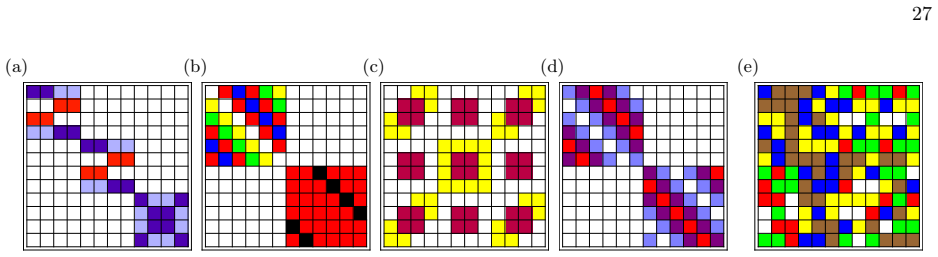


read the original abstract
Absolutely maximally entangled (AME) pure states of a system composed of $N$ parties are distinguished by the property that for any splitting at least one partial trace is maximally mixed. Due to maximal possible correlations between any two selected subsystems these states have numerous applications in various fields of quantum information processing including multi-user teleportation, quantum error correction and secret sharing. We present an updated survey of various techniques to generate such strongly entangled states, including those going beyond the standard construction of graph and stabilizer states. Our contribution includes, in particular, analysis of the degree of entanglement of reduced states obtained by partial trace of AME projectors, states obtained by a symmetric superposition of GHZ states, an orthogonal frequency square representation of the "golden" AME state and an updated summary of the number of local unitary equivalence classes.
Editorial analysis
A structured set of objections, weighed in public.
Referee Report
Summary. The manuscript surveys techniques for constructing absolutely maximally entangled (AME) pure states of N-party quantum systems, defined by the property that for any bipartition at least one partial trace is maximally mixed. It reviews standard graph and stabilizer constructions and presents new contributions including analysis of entanglement in reduced states obtained by partial trace of AME projectors, states formed by symmetric superpositions of GHZ states, an orthogonal frequency square representation of the 'golden' AME state, and an updated count of local unitary equivalence classes.
Significance. If the new constructions are shown to satisfy the full AME condition, the work provides a useful consolidation of existing methods alongside novel representations that could aid applications in quantum teleportation, error correction, and secret sharing. The updated equivalence class summary offers a current reference point for classification efforts in multipartite entanglement.
major comments (2)
- [Section on symmetric superpositions of GHZ states] Section on symmetric superpositions of GHZ states: the manuscript claims these states are AME but the provided analysis appears limited to selected bipartitions. The AME definition requires that for every possible splitting of the N parties at least one reduced state is maximally mixed; an exhaustive verification (or proof that it holds by symmetry) is needed to support this central claim for the new construction.
- [Section on orthogonal frequency square representation] Section on orthogonal frequency square representation of the golden AME state: the combinatorial representation is presented as generating an AME state, yet the text does not explicitly compute or prove that every bipartition yields a maximally mixed partial trace. If the verification relies only on equivalence to known AME states without direct check, the claim that this constitutes a new AME-generating technique is not fully load-bearing.
minor comments (2)
- [Abstract] Abstract: the phrase 'analysis of the degree of entanglement of reduced states obtained by partial trace of AME projectors' should specify whether this applies to general AME projectors or to particular examples, to avoid ambiguity.
- [Throughout] Notation: ensure uniform use of d for local dimension and N for number of parties across all sections and figures.
Simulated Author's Rebuttal
We thank the referee for the thorough review and valuable feedback on our manuscript. We address each major comment in detail below and will make revisions to improve the clarity and rigor of the new constructions presented.
read point-by-point responses
-
Referee: [Section on symmetric superpositions of GHZ states] Section on symmetric superpositions of GHZ states: the manuscript claims these states are AME but the provided analysis appears limited to selected bipartitions. The AME definition requires that for every possible splitting of the N parties at least one reduced state is maximally mixed; an exhaustive verification (or proof that it holds by symmetry) is needed to support this central claim for the new construction.
Authors: We appreciate the referee's concern regarding the completeness of the verification. In the manuscript, the symmetric superposition of GHZ states is analyzed for several bipartitions, and due to the high symmetry of the construction, the property is expected to hold generally. To strengthen this, we will revise the section to include a symmetry-based proof that demonstrates the AME condition for all bipartitions. This proof will show that the action of the symmetry group ensures equivalent reduced states for all relevant partitions. revision: yes
-
Referee: [Section on orthogonal frequency square representation] Section on orthogonal frequency square representation of the golden AME state: the combinatorial representation is presented as generating an AME state, yet the text does not explicitly compute or prove that every bipartition yields a maximally mixed partial trace. If the verification relies only on equivalence to known AME states without direct check, the claim that this constitutes a new AME-generating technique is not fully load-bearing.
Authors: We acknowledge that the current text could benefit from more explicit verification. The orthogonal frequency square representation is equivalent to the known golden AME state, which satisfies the AME property by definition. However, to make the claim more robust and to present it as a new generating technique, we will add in the revision a brief direct computation or reference to the verification for the bipartitions, clarifying that the combinatorial object directly encodes the state with the required properties. revision: partial
Circularity Check
No circularity: survey with independent new analyses
full rationale
The paper is an updated survey of AME state constructions drawing on standard literature for definitions and graph/stabilizer methods. New contributions (reduced-state entanglement analysis, symmetric GHZ superpositions, OFS representation of the golden AME state) are presented via direct constructions and calculations that do not reduce to self-citations, fitted parameters, or self-definitions by construction. Any prior author citations support background but are not load-bearing for the novel claims, which remain externally verifiable through explicit state checks. The derivation chain is self-contained.
Axiom & Free-Parameter Ledger
axioms (1)
- standard math Standard quantum postulates: pure states, partial trace, and maximal mixedness of reduced density matrices
Lean theorems connected to this paper
-
IndisputableMonolith.Constants, IndisputableMonolith.Foundationphi_golden_ratio, phi_fixed_point echoes?
echoesECHOES: this paper passage has the same mathematical shape or conceptual pattern as the Recognition theorem, but is not a direct formal dependency.
the matrix elements featured the golden mean φ as a ratio of two moduli of its entries... b = √φ/5^{1/4}, a = b/φ... superposition of these four OFS
-
IndisputableMonolith.Foundationrecognition lattices, ladder constants echoes?
echoesECHOES: this paper passage has the same mathematical shape or conceptual pattern as the Recognition theorem, but is not a direct formal dependency.
orthogonal frequency square representation of the 'golden' AME state... frequency squares... Latin squares
What do these tags mean?
- matches
- The paper's claim is directly supported by a theorem in the formal canon.
- supports
- The theorem supports part of the paper's argument, but the paper may add assumptions or extra steps.
- extends
- The paper goes beyond the formal theorem; the theorem is a base layer rather than the whole result.
- uses
- The paper appears to rely on the theorem as machinery.
- contradicts
- The paper's claim conflicts with a theorem or certificate in the canon.
- unclear
- Pith found a possible connection, but the passage is too broad, indirect, or ambiguous to say the theorem truly supports the claim.
Forward citations
Cited by 4 Pith papers
-
Twirled Perfect Tensor Networks: Computationally covariant holographic tensor networks
Twirled perfect tensor networks are introduced as a class satisfying computational covariance, bounding complexity by the Python's Lunch Conjecture exponent, and combining holographic features of perfect and random te...
-
Graph restricted tensors: building blocks for holographic networks
Graph-restricted tensors generalize 1-uniform states, dual-unitary operators and AME states, with exact analytic solutions for new examples motivated by holographic lattice models.
-
Graph-State Circuit Blocks control Entanglement and Scrambling Velocities
LC-inequivalent graph-state blocks in random Clifford circuits yield distinct entanglement velocities v_E and butterfly velocities v_B, correlated with internal entanglement distribution and graph connectivity.
-
Quantum Chaos and Quantum Information: Interactions and Implications
Quantum chaotic dynamics with positive entropy production universally links to von Neumann entropy and noise modeling in quantum information processing.
Reference graph
Works this paper leans on
-
[1]
This results from the application of Kempf-Ness theo- rem [116, 117] for 1-uniform states
Although, in the general case, for a given state |ψ⟩ its orbit of SLOCC-equivalent states is strictly larger than its LU orbit, these sets are equal when we restrict the orbit to AME states [115]. This results from the application of Kempf-Ness theo- rem [116, 117] for 1-uniform states. Consequently, since LU/LOCC/SLOCC sets coincide for AME states, for t...
-
[2]
Notice that indeed, the subspace spanned by the codewords {|0L⟩ , |1L⟩ , |2L⟩} is maximally entangled. In fact, this encoding can be used for so-calledquantum se- cret sharing[146]: a message can be encoded nonlo- cally among multiple users, in such a way that none of them is able to recover the information individu- ally with local operations. AME states...
work page 2026
-
[3]
Bell state|B⟩ = 1√ 2 |00⟩ + |11⟩ , which is LU-equivalent to graph states of the formA − B
-
[4]
generalized Bell state|Bd⟩ = 1√ d Pd−1 j=0 |jj ⟩, which is LU-equivalent to graph states of the formA − B 23
-
[5]
n-qubit GHZ state |GHZn⟩ = 1√ 2 |0⟩⊗n + |1⟩⊗n , which is LU-equivalent to graph states of the full graph form, which in turn are LU-equivalent to a star graph via local complementation [176]
-
[6]
Every edge represents a qudit CZ gate Eq
n-qudit GHZ state GHZd n E = 1√ d Pd−1 j=0 |j · · · j⟩, all of them are graph states, so LU-equivalent to stabilizer states ≡ Figure 10: The graphs corresponding to GHZ state ofN = 5 parties. Every edge represents a qudit CZ gate Eq. (C2) between corresponding qubits. N-partite GHZ state is equivalent to two graph states – the full graph and the star grap...
-
[7]
2-uniform states In the subsequent constructions, we will use the qudit controlled Z gate, which, depending on the dimension d, means the following unitary operation CZd = d−1X i=0 |i⟩ ⟨i|k ⊗ Z i l , (C2) acting between quditsk and l. Here, the quditZ gate is the standard clock operator, which in the compu- tational basis |k⟩ reads Z |k⟩ = ωk |k⟩ , (C3) w...
work page 2000
-
[8]
In particular, there exist two families of AME(5,d) states AME′(5, d) = 1 d d−1X i,j=0 |i, j, i ⊕ j, 2i ⊕ j, 3i ⊕ j⟩ , (C29) which is absolutely maximally entangled wheneverd is prime. The second family, which is AME for all dimensions d, reads AME′′(5, d) = 1√ d3 d−1X i,j,k=0 ω(3i+j)k |i, j, i ⊕ j, 2i ⊕ j ⊕ k, k⟩ . (C30) In both of the above equations,⊕ ...
-
[9]
3-uniform states • AME(6,2) state – was investigated by Borras et al. [27]. Making use of the notation of quantum orthogonal arrays, introduced while discussing 2-uniform states –see Eq. (C18)–, we can write the following equivalence |AME(6, 2)⟩ = |QOA(8, 3C + 2Q, 2, 3)⟩ = |MOQLC(2)⟩ , (C36) 31 where we define mutually orthogonal quantum Latin cube (MOQLC...
-
[10]
R. Horodecki, P. Horodecki, M. Horodecki, and K. Horodecki, Quantum entanglement, Rev. Mod. Phys. 81, 865 (2009)
work page 2009
-
[11]
I. Bengtsson and K. Życzkowski, Geometry of Quantum States: An Introduction to Quantum En- tanglement, II ed. (Cambridge University Press, 2017)
work page 2017
-
[12]
H. Carteret, N. Linden, S. Popescu, and A. Sud- bery,Multiparticleentanglement,Found.Phys. 29, 527 (1999)
work page 1999
-
[13]
C. H. Bennett, S. Popescu, D. Rohrlich, J. A. Smolin,andA.V.Thapliyal,Exactandasymptotic measures of multipartite pure-state entanglement, Phys. Rev. A63, 012307 (2000)
work page 2000
- [14]
-
[15]
M. Walter, D. Gross, and J. Eisert, Multi-partite entanglement (2017), 1612.02437
work page internal anchor Pith review Pith/arXiv arXiv 2017
-
[16]
A. K. Srivastava, G. Müller-Rigat, M. Lewenstein, and G. Rajchel-Mieldzioć, Introduction to quan- tum entanglement in many-body systems, inNew Trends and Platforms for Quantum Technologies (Springer Nature Switzerland, 2024) p. 225–285
work page 2024
-
[17]
Horodecki, Łukasz Rudnicki, and K
P. Horodecki, Łukasz Rudnicki, and K. Ży- czkowski, Multipartite entanglement (2024), 2409.04566
-
[18]
V. Coffman, J. Kundu, and W. K. Wootters, Dis- tributed entanglement, Phys. Rev. A 61, 052306 (2000)
work page 2000
-
[19]
W. Dür, G. Vidal, and J. I. Cirac, Three qubits can be entangled in two inequivalent ways, Phys. Rev. A 62, 062314 (2000)
work page 2000
-
[20]
V. Vedral and M. B. Plenio, Entanglement mea- suresandpurificationprocedures,Phys.Rev.A 57, 1619 (1998)
work page 1998
-
[21]
K. Życzkowski and I. Bengtsson, Relativity of pure states entanglement, Annals Phys.295, 115 (2002)
work page 2002
- [22]
-
[23]
L. Tamaryan, D. Park, and S. Tamaryan, Analytic expressions for geometric measure of three-qubit states, Phys. Rev. A77, 022325 (2008)
work page 2008
- [24]
-
[25]
D. A. Meyer and N. R. Wallach, Global entangle- ment in multiparticle systems, J. Math. Phys.43, 4273–4278 (2002)
work page 2002
- [26]
-
[27]
A. Acín, A. Andrianov, L. Costa, E. Jané, J. I. Latorre, and R. Tarrach, Generalized Schmidt de- composition and classification of three-quantum- bit states, Phys. Rev. Lett.85, 1560 (2000)
work page 2000
-
[28]
H. A. Carteret, A. Higuchi, and A. Sudbery, Mul- tipartite generalization of the schmidt decomposi- tion, J. Math. Phys.41, 7932 (2000)
work page 2000
-
[29]
A. J. Scott, Multipartite entanglement, quantum- error-correcting codes, and entangling power of quantum evolutions, Phys. Rev. A 69, 052330 (2004)
work page 2004
-
[30]
L. Arnaud and N. J. Cerf, Exploring pure quantum states with maximally mixed reductions, Phys. Rev. A 87, 012319 (2013)
work page 2013
- [31]
- [32]
- [33]
-
[34]
A. Higuchi and A. Sudbery, How entangled can two couples get?, Phys. Lett. A273, 213–217 (2000)
work page 2000
- [35]
- [36]
-
[37]
F. Huber and N. Wyderka, Table of AME states (http://www.tp.nt.uni-siegen.de/+fhuber/ ame.html, 2020)
work page 2020
-
[38]
D. Goyeneche, D. Alsina, J. I. Latorre, A. Riera, and K. Życzkowski, Absolutely maximally entan- gled states, combinatorial designs, and multiuni- tary matrices, Phys. Rev. A92, 032316 (2015)
work page 2015
-
[39]
F. Pastawski, B. Yoshida, D. Harlow, and J. Preskill, Holographic quantum error-correcting codes: toy models for the bulk/boundary corre- spondence, J. High Energy Phys.2015 (6), 149
work page 2015
-
[40]
A. Jahn, M. Gluza, F. Pastawski, and J. Eisert, Majorana dimers and holographic quantum error- correcting codes, Phys. Rev. Res.1, 033079 (2019)
work page 2019
-
[41]
A. Bhattacharyya, Z.-S. Gao, L.-Y. Hung, and S.- N. Liu, Exploring the tensor networks/AdS corre- spondence, J. High Energy Phys.2016 (8), 1
work page 2016
-
[42]
R. J. Harris, N. A. McMahon, G. K. Brennen, and T. M. Stace, Calderbank-Shor-Steane holographic quantum error-correcting codes, Phys. Rev. A98, 052301 (2018)
work page 2018
-
[43]
A. Jahn, Z. Zimborás, and J. Eisert, Tensor net- work models of AdS/qCFT, Quantum 6, 643 (2022)
work page 2022
-
[44]
R. Laflamme, C. Miquel, J. P. Paz, and W. H. Zurek, Perfect quantum error correcting code, Phys. Rev. Lett.77, 198 (1996)
work page 1996
-
[45]
Rains, Quantum codes of minimum distance 34 two, IEEE Trans
E. Rains, Quantum codes of minimum distance 34 two, IEEE Trans. Inf. Theory45, 266 (1999)
work page 1999
- [46]
-
[47]
P. Mazurek, M. Farkas, A. Grudka, M. Horodecki, and M. Studziński, Quantum error-correction codes and absolutely maximally entangled states, Phys. Rev. A101, 042305 (2020)
work page 2020
-
[48]
P. Zanardi, C. Zalka, and L. Faoro, Entangling power of quantum evolutions, Phys. Rev. A 62, 030301 (2000)
work page 2000
-
[49]
T. Linowski, G. Rajchel-Mieldzioć, and K. Ży- czkowski, Entangling power of multipartite unitary gates, J. Phys. A: Math. Theor.53, 125303 (2020)
work page 2020
-
[50]
S. A. Rather, A. Burchardt, W. Bruzda, G. Rajchel-Mieldzioć, A. Lakshminarayan, and K. Życzkowski, Thirty-six entangled officers of Eu- ler: Quantum solution to a classically impossible problem, Phys. Rev. Lett.128, 080507 (2022)
work page 2022
-
[51]
K. Życzkowski, W. Bruzda, G. Rajchel-Mieldzioć, A. Burchardt, S. Ahmad Rather, and A. Laksh- minarayan, 9 × 4 = 6 × 6: Understanding the quantum solution to Euler’s problem of 36 officers, J. Phys.: Conf. Series2448, 012003 (2023)
work page 2023
-
[52]
S. A. Rather, N. Ramadas, V. Kodiyalam, and A. Lakshminarayan, Absolutely maximally entan- gled state equivalence and the construction of infi- nitequantumsolutionstotheproblemof36officers of Euler, Phys. Rev. A108, 032412 (2023)
work page 2023
-
[53]
Quantum convolutional channels and multiparameter families of 2-unitary matrices
R. Bistroń, J. Czartowski, and K. Życzkowski, Quantum convolutional channels and mul- tiparameter families of 2-unitary matrices, arXiv:2312.17719 (2023)
work page internal anchor Pith review Pith/arXiv arXiv 2023
-
[54]
D. Gross and P. Goedicke, Thirty-six officers, arti- sanally entangled, arXiv:2504.15401 (2025)
-
[55]
Open Quantum Problems, IQOQI Vienna, https://oqp.iqoqi.oeaw.ac.at/open-quantum- problems
-
[56]
D. Goyeneche and K. Życzkowski, Genuinely mul- tipartite entangled states and orthogonal arrays, Phys. Rev. A90, 022316 (2014)
work page 2014
- [57]
- [58]
-
[59]
Y. Shen and L. Chen, Absolutely maximally en- tangled states in tripartite heterogeneous systems, Quantum Information Processing20, 111 (2021)
work page 2021
- [60]
-
[61]
S. A. Rather, Studies on dual unitary and maximally entangling gates from absolute maxi- mal entanglement to quantum Bernoulli circuits (2023), Ph.D. Thesis, IIT Madras, available from http://hdl.handle.net/10603/547745
work page 2023
-
[62]
K. Chen and L.-A. Wu, A matrix realignment method for recognizing entanglement, Quant. In- for. Comput. 3, 193 (2003)
work page 2003
-
[63]
Peres, Separability criterion for density matri- ces, Phys
A. Peres, Separability criterion for density matri- ces, Phys. Rev. Lett.77, 1413 (1996)
work page 1996
-
[64]
B. Bertini, P. Kos, and T. Prosen, Exact corre- lation functions for dual-unitary lattice models in 1 + 1 dimensions, Phys. Rev. Lett. 123, 210601 (2019)
work page 2019
-
[65]
J. Deschamps, I. Nechita, and C. Pellegrini, On someclassesofbipartiteunitaryoperators,J.Phys. A: Math. Theor.49, 335301 (2016)
work page 2016
-
[66]
G. Terry, Le probléme des 36 officiers, Compte Rendu de l’Association Française pour l’Avancement des Sciences2, 170 (1901)
work page 1901
-
[67]
R. C. Bose and S. S. Shrikhande, On the falsity of Euler’s conjecture about the non-existence of two orthogonal Latin squares of order 4t + 2, Proc. Nat. Acad. Sci.45, 734 (1959)
work page 1959
-
[68]
R. C. Bose, S. S. Shrikhande, and E. T. Parker, Further results on the construction of mutually or- thogonal Latin squares and the falsity of Euler’s conjecture, Can. J. Mathem.12, 189–203 (1960)
work page 1960
-
[69]
C. Colbourn and J. Dinitz, Mutually orthogonal Latin squares: A brief survey of constructions, J. Stat. Planning Inference95, 9 (2001)
work page 2001
-
[70]
E. T. Parker, Orthogonal Latin squares, Proc. Nat. Acad. Sci. 45, 859 (1959)
work page 1959
-
[71]
Zauner, Grundzüge einer nichtkommutativen Designtheorie (1999), PhD thesis, University of Vi- enna
G. Zauner, Grundzüge einer nichtkommutativen Designtheorie (1999), PhD thesis, University of Vi- enna
work page 1999
-
[72]
B. Musto and J. Vicary, Quantum Latin squares and unitary error bases, Quant. Inf. Comput.16, 1318 (2016)
work page 2016
-
[73]
T.BenoistandI.Nechita,Onbipartiteunitaryma- trices generating subalgebra-preserving quantum operations, Linear Algebra Appl.521, 70 (2017)
work page 2017
- [74]
-
[75]
Y. Zang, P. Facchi, and Z. Tian, Quantum combi- natorial designs and k-uniform states, J. Phys. A: Math. Theor. 54, 505204 (2021)
work page 2021
- [76]
-
[77]
D. Goyeneche, Z. Raissi, S. Di Martino, and K. Ży- czkowski, Entanglement and quantum combinato- rial designs, Phys. Rev. A97, 062326 (2018)
work page 2018
-
[78]
B. Musto and J. Vicary, Orthogonality for quan- tum Latin isometry squares, Electr. Proc. Theor. Comp. Sci. 287, 253–266 (2019)
work page 2019
- [79]
-
[80]
Rico, Absolutely maximally entangled states of small system sizes (2020)
A. Rico, Absolutely maximally entangled states of small system sizes (2020)
work page 2020
discussion (0)
Sign in with ORCID, Apple, or X to comment. Anyone can read and Pith papers without signing in.