REVIEW 4 major objections 4 minor 49 references
A Geometric Quantum Speed Limit: Theoretical Insights and Photonic Implementation
T0 review · 4 major / 4 minor · reviewed 2026-08-07 · deepseek-v4-flash
Pith's one-line read A new quantum speed limit based on the Bloch angle is a true lower bound on evolution time and is measurable without tomography.
desk verdict A correct but largely tautological Bloch-angle speed limit, useful mainly for the instantaneous velocity formula and the swap-test measurement; the saturation claim is unproved beyond qubits. read the letter →
The pith
A machine-rendered reading of the paper's core claim, the machinery that carries it, and where it could break.
The reading
What carries the argument
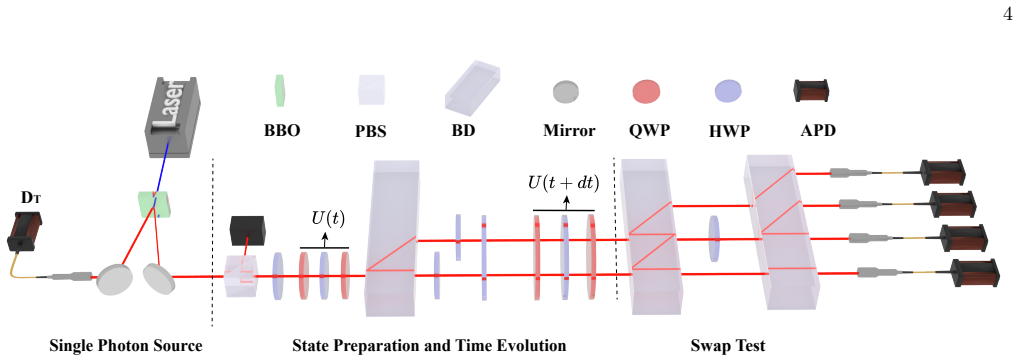
The central object is the instantaneous Bloch-angle velocity $v(t)$, which converts infinitesimal Bloch-angle increments into a path-length integral. The argument then runs through the triangle inequality for the Bloch angle and the geodesic equation $\ddot r=-\alpha^2 r$ for the Bloch vector; the latter encodes the condition under which the path length equals the distance and the bound saturates. The experimental enabler is the swap test: for two copies of the evolving state, the overlap $\operatorname{Tr}(\rho_{t_1}\rho_{t_2})$ equals $1-2p_A$, where $p_A$ is the probability of measuring the antisymmetric state, so the path length can be accumulated from such overlap measurements without tomography.
What would settle it
For a single qutrit with a constant Hamiltonian, take $r(t)=\cos(\alpha t)r(0)+\sin(\alpha t)r'$ with $|r'|=|r(0)|$ and $r'\cdot r(0)=0$, and compute the eigenvalues of the corresponding density matrix at intermediate times; finding any negative eigenvalue would show this geodesic leaves the physical state space and invalidate the saturation claim beyond qubits.
Extended reading notes
Core claim
For a unitary evolution $\rho_t$ with Bloch vector $r(t)$, the paper defines $v(t)=\lim_{dt\to 0}\Theta(\rho_t,\rho_{t+dt})/dt$ and then defines $\tau_\Theta$ as the solution of $\Theta(\rho_0,\rho_T)=\int_0^{\tau_\Theta} v(t)\,dt$. Because the triangle inequality gives $\Theta(\rho_0,\rho_T)\le \int_0^T v(t)\,dt$, the paper concludes $\tau_\Theta\le T$. It identifies the saturating condition with the geodesic equation $\ddot r=-\alpha^2 r$, whose qubit solutions are uniform rotations with the Bloch vector perpendicular to the rotation axis, and shows that under this condition $\tau_\Theta=T$. For time-independent Hamiltonians the velocity is constant, so both the new and the prior Bloch-angle QSL reduce to $\Theta/v(0)$; for the Landau-Zener model the velocity typically grows, making the new bound tighter. The paper further claims that the overlaps $\operatorname{Tr}(\rho_t\rho_{t+dt})$ can be obtained photonically by a swap test from the probability of the antisymmetric outcome, bypassing full quantum state tomography.
Load-bearing premise
The saturation result holds if the assumed geodesic equation for the Bloch vector stays within the set of physical states in all dimensions; the paper demonstrates that only for qubits.
Editorial extensions
If this is right
- The new bound can be computed without knowing the actual evolution time $T$, while the previously proposed Bloch-angle bound requires the average velocity over $[0,T]$.
- For accelerated dynamics, such as the Landau-Zener model, the new bound is typically tighter than the existing Bloch-angle QSL, as confirmed by numerical sampling over initial states and purity levels.
- The experimental protocol uses swap-test overlaps only, so it avoids full quantum state tomography and works for any dynamics for which the overlap can be measured.
- When the evolution path is a geodesic, the bound is tight: $\tau_\Theta=T$, giving a geometric criterion for when a given unitary dynamics is as fast as possible.
- Because the Bloch angle is robust under unital evolutions, the bound remains informative for mixed states where Bures-angle-based QSLs become loose.
Reading between the lines
- The bound is path-dependent, so it is best interpreted as a certificate for a known trajectory rather than a universal state-pair limit; two different evolutions between the same states can have different lower bounds.
- Extending the geodesic-saturation result beyond qubits requires verifying that the solution of $\ddot r=-\alpha^2 r$ stays within the set of physical Bloch vectors in dimensions $N>2$, which the paper does not demonstrate.
- The same integral construction could be transferred to open-system dynamics using the Lindblad velocity derived in Appendix A, yielding an experimentally measurable speed limit for nonunitary evolution.
- An online implementation could stop the evolution as soon as the accumulated swap-test path length reaches the target Bloch angle, turning the theoretical bound into a stopping rule.
Signed reviews
Editorial analysis
A structured set of objections, weighed in public.
Referee Report
Summary. This paper introduces a quantum speed limit based on the Bloch angle. For unitary dynamics it defines an instantaneous velocity v(t) in Eq. (5), the accumulated path length s(T)=∫_0^T v(t)dt, and a new bound τΘ as the time at which the accumulated path length reaches a target angle Θ, Eq. (8). Because Θ(ρ0,ρT)≤s(T) by Eq. (6) and v(t)≥0, the paper concludes τΘ≤T, with equality when the actual path is a geodesic. The authors also compare this bound with an existing Bloch-angle bound, analyze the Landau-Zener model, and report a photonic experiment in which swap-test measurements of Tr(ρ_t ρ_{t+dt}) are used to determine path lengths without full quantum state tomography.
Significance. The experimental demonstration is a genuine asset: direct swap-test measurement of the overlap is a practical way to determine path lengths for the implemented unitary qubit dynamics, and Eq. (10) correctly gives the overlap for qubits. The lower-bound inequality itself is correct, and the qubit saturation example is clean. However, the paper's central theoretical novelty is limited: τΘ≤T follows almost immediately from the definition of τΘ and the triangle inequality, and the claimed characterization of geodesics in Appendix B is only verified for a one-parameter family of curves and is not established for the physical state space when N>2. The general claims of applicability to arbitrary dynamics and higher-dimensional systems are not supported by the analytical or experimental arguments. With appropriate restrictions and revised claims the manuscript could be acceptable, but in its present form the main theoretical claims require substantial work.
major comments (4)
- [§II, Eq. (8)] The statement that τΘ≤T is a consequence of the definition of τΘ together with the triangle inequality and v(t)≥0: once Θ≤s(T) and s(t)=∫_0^t v(t)dt is nondecreasing, the solution of Θ=s(τ) trivially satisfies τ≤T. This is not an independent quantum speed limit in the sense of earlier bounds such as the Mandelstam-Tamm bound, which are constructed from initial and final state data and the Hamiltonian. The paper should either reposition the result as a trajectory-dependent bound that is useful for the experimental protocol, or prove a genuinely non-tautological property such as a bound on τΘ in terms of initial data alone.
- [Appendix B, Eqs. (B1)-(B5)] The geodesic equation r¨=−α²r is not derived; the authors only verify that the assumed solution (B2) saturates the inequality (6). This establishes sufficiency of that curve family, not that these curves are geodesics of the physical state space. For N>2 the generalized Bloch vector of a physical state satisfies positivity constraints beyond fixed norm (for example, a pure qutrit has Tr(ρ³)=1), and great circles in R^{N²−1} can leave the set of physical states at intermediate times. Therefore the saturation condition 'when the path connecting ρ0 and ρT follows a geodesic line, τΘ=T' is demonstrated only for qubits. Please restrict the saturation claim to N=2 or provide a derivation on the physical submanifold.
- [§II and Fig. 1(b)] The protocol claims to determine dΘ(ρ_t,ρ_{t+dt}) from the swap-test overlap Tr(ρ_t ρ_{t+dt}) alone, but Eq. (3) also requires Tr(ρ_t²) and Tr(ρ_{t+dt}²). For unitary dynamics these purities are constant and can be measured once, but the statement that the measurement framework 'is highly versatile and applicable to any type of dynamics' is not justified: for general non-unital dynamics the purities must be measured at every time step, and the overlap alone is insufficient. The experimental demonstration in this paper is for qubit unitary evolution, where this simplification is valid; the general claim should be qualified.
- [§III and Appendix D, Eq. (10)] Equation (10) relates Tr(ρ_{t1}ρ_{t2}) to the probability of the single anti-symmetric state |c⟩. This is exact only for qubits, where the anti-symmetric subspace is one-dimensional. For N>2 the anti-symmetric subspace has dimension N(N−1)/2>1, and measuring one anti-symmetric component does not give the full swap expectation value. The claims of applicability to higher-dimensional systems should be revised accordingly.
minor comments (4)
- [§II, Eq. (6)] The notation ∫_0^T Θ(ρ_t,ρ_{t+dt}) is informal; the integrand is not a function of dt as written. It would be clearer to write s(T)=∫_0^T v(t)dt with v(t)=Θ(ρ_t,ρ_{t+dt})/dt.
- [Figs. 4 and 5] The figures report experimental points without visible error bars or quantitative uncertainty estimates, and the time axis has no units. Please add error bars and specify the units and experimental parameters.
- [Fig. 3 caption] There is a typo: 'optial axis' should be 'optical axis'. Also, 'Schr¨ odinger' should be 'Schrödinger' in the text.
- [§III] The statement 'The results are in accord with the theoretical predictions within experimental errors' would be more informative with a quantitative measure of agreement, such as chi-squared values or maximum deviations.
Circularity Check
The new QSL's lower-bound property is installed by its defining integral equation: τΘ is defined as the hitting time of the cumulative speed integral, so τΘ≤T follows from monotonicity rather than from independent physics.
-
self definitional
[Section II, Eq. (8) and the following paragraph]
"our bound is defined as the solution of the integral equation: Θ = ∫_0^{τΘ} v(t)dt = ∫_0^{τΘ} Θ(ρt, ρt+dt). (8) ... Since Θ≤∫_0^T v(t)dt=s(T) and v(t) is non-negative, we conclude that τΘ in our definition is less than or equal to T."
Equation (8) defines τΘ as the time at which the cumulative integral of v(t) first reaches Θ. Because Eq. (6) gives s(T)≥Θ and v(t)≥0 makes the cumulative integral nondecreasing, the hitting time automatically satisfies τΘ≤T. The lower-bound property is therefore installed by the definition itself, not derived from initial- and final-state data or from any independent constraint on the dynamics. The only independent input is the pointwise velocity v(t); the advertised bound is just the hitting time of the accumulated path length.
-
self definitional
[Section II, immediately after Eq. (8)]
"Moreover, when the path connecting the initial state ρ0 and the final state ρT follows a geodesic line, τΘ=T."
This equality is also a direct consequence of the defining equation. On a geodesic, Eq. (6) is saturated, so the path length s(T) equals Θ. Since τΘ is defined as the time at which the cumulative integral reaches Θ, it must coincide with T. The saturation condition is thus a restatement of the definition under the geodesic assumption, not an independent derivation.
full rationale
The central definitional reduction is in Eq. (8): the new QSL is defined as the solution of Θ=∫_0^{τΘ} v(t)dt, and the claimed τΘ≤T follows immediately from monotonicity of the integral and the triangle inequality in Eq. (6). This is a self-definitional lower bound rather than an independently predicted speed limit. The saturation claim τΘ=T is likewise a restatement of the defining equation when the path length equals Θ. The paper's other components — the explicit formula for v(t) in Eq. (5), the Lindblad generalization in Appendix A, and the swap-test measurement — are not circular and are externally checkable. However, the geodesic claim in Appendix B is not circular but is a separate correctness gap: the authors verify only that the great-circle family r(t)=cos(αt)r(0)+sin(αt)r′ saturates Eq. (6), which proves sufficiency, not that all physical geodesics for N>2 have this form; the saturation condition is therefore unproved beyond qubits. No load-bearing self-citation or fitted-input-as-prediction pattern was found. Because the paper's headline lower-bound property itself reduces by construction, the circularity score is 6.
Assumptions & free parameters
assumptions (4)
- standard math The angular distance between Bloch vectors satisfies the triangle inequality, so the geodesic distance is no larger than any piecewise path length.
- domain assumption The time evolution of density matrices follows the von Neumann equation for closed systems and the Lindblad equation for open systems.
- domain assumption The generalized Bloch representation rho = I/N + (1/2) r . lambda with Tr(lambda_i lambda_j) = 2 delta_ij gives Eq. (3) for the Bloch angle.
- ad hoc to paper For N > 2, the solution of r-double-dot = -alpha^2 r remains an admissible unitary orbit of a quantum state.
Cite this review
Pith. "Pith review of A Geometric Quantum Speed Limit: Theoretical Insights and Photonic Implementation." pith.science (2026). https://pith.science/paper/3E2UDKKB
@misc{pith2026250600354,
  author       = {Pith},
  title        = {Pith review of: A Geometric Quantum Speed Limit: Theoretical Insights and Photonic Implementation},
  year         = {2026},
  howpublished = {\url{https://pith.science/paper/3E2UDKKB}},
  note         = {Machine review of arXiv:2506.00354}
}
read the original abstract
Quantum mechanics imposes a lower bound on the time required for a quantum system to reach certain given targets. In this paper, from a geometric perspective, we introduce a new quantum speed limit (QSL) based on the Bloch angle and derive the condition for it to saturate. Experimentally, we demonstrate the feasibility of measuring this QSL using a photonic system through direct Bloch angle measurements via a swap test, bypassing the need for comprehensive quantum state tomography. Compared to the existing Bloch-angle-based QSL mentioned in prior work, our QSL requires fewer computational and experimental resources and provides tighter constraints for specific dynamics. Our work underscores the Bloch angle's effectiveness in providing tighter and experimentally accessible QSLs and advances the understanding of quantum dynamics.
Figures


Figures from the paper (2 more)


Reference graph
Works this paper leans on
-
[38]
V. Giovannetti, S. Lloyd, and L. Maccone, Europhysics Letters62, 615 (2003)
work page 2003
-
[1]
and Tr(Htρt)2 = Tr(Hρ0)2, making the velocityv(t) constant according to Eq. (5) 4 State Preparation and Time Evolution Swap TestSingle Photon Source PBS BD Mirror HWP APDQWP DT BBO FIG. 3. Experimental setup for measurement of quantum speed limit. Photon pairs are generated through the parametric downconversion process by pumping beta-barium-borate (BBO) ...
work page 2000
-
[2]
Subsequently, a Hadamard gate is applied to the ancillary qubit, followed by a measurement. The probability of obtaining the out- come|1⟩is (1− |⟨ψ 1|ψ2⟩|2)/2, which directly yields the overlap of the two systems. 8 (a) (c) (b) (d) 1 3 4 5 6 0 2 0.0 0.5 1.0 1.5 2.0 2.5 3.0 1 3 4 5 6 0 2 1 3 4 5 6 0 2 1 3 4 5 6 0 2 0.0 0.5 1.0 1.5 2.0 2.5 3.00.0 0.5 1.0 1....
work page 2000
- [3]
-
[4]
J. D. Bekenstein, Phys. Rev. Lett.46, 623 (1981)
work page 1981
-
[5]
Deffner and E
S. Deffner and E. Lutz, Phys. Rev. Lett.105, 170402 (2010)
2010
- [6]
-
[7]
V. Mukherjee, W. Niedenzu, A. G. Kofman, and G. Kur- izki, Phys. Rev. E94, 062109 (2016)
work page 2016
Show all 49 references
-
[8]
F. C. Binder, S. Vinjanampathy, K. Modi, and J. Goold, New Journal of Physics17, 075015 (2015)
2015
-
[9]
Campaioli, F
F. Campaioli, F. A. Pollock, F. C. Binder, L. C´ eleri, J. Goold, S. Vinjanampathy, and K. Modi, Phys. Rev. Lett.118, 150601 (2017)
2017
-
[10]
Juli` a-Farr´ e, T
S. Juli` a-Farr´ e, T. Salamon, A. Riera, M. N. Bera, and M. Lewenstein, Phys. Rev. Res.2, 023113 (2020)
2020
-
[11]
Giovannetti, S
V. Giovannetti, S. Lloyd, and L. Maccone, Nature Pho- tonics5, 222 (2011)
2011
-
[12]
Caneva, M
T. Caneva, M. Murphy, T. Calarco, R. Fazio, S. Mon- tangero, V. Giovannetti, and G. E. Santoro, Phys. Rev. Lett.103, 240501 (2009)
2009
-
[13]
Lloyd and S
S. Lloyd and S. Montangero, Phys. Rev. Lett.113, 010502 (2014)
2014
-
[14]
G. C. Hegerfeldt, Phys. Rev. Lett.111, 260501 (2013)
2013
-
[15]
Carlini, A
A. Carlini, A. Hosoya, T. Koike, and Y. Okudaira, Phys. Rev. Lett.96, 060503 (2006)
2006
-
[16]
D. C. Brody and D. M. Meier, Phys. Rev. Lett.114, 100502 (2015)
2015
-
[17]
X. Wang, M. Allegra, K. Jacobs, S. Lloyd, C. Lupo, and M. Mohseni, Phys. Rev. Lett.114, 170501 (2015)
2015
-
[18]
Mandelstam, J
L. Mandelstam, J. Phys.(USSR)9, 249 (1945)
1945
-
[19]
Margolus and L
N. Margolus and L. B. Levitin, Physica D: Nonlinear Phenomena120, 188 (1998), proceedings of the Fourth Workshop on Physics and Consumption
1998
-
[20]
L. B. Levitin and T. Toffoli, Phys. Rev. Lett.103, 160502 (2009)
2009
-
[21]
Giovannetti, S
V. Giovannetti, S. Lloyd, and L. Maccone, Phys. Rev. A67, 052109 (2003)
2003
-
[22]
Giovannetti, S
V. Giovannetti, S. Lloyd, and L. Maccone, Journal of Optics B: Quantum and Semiclassical Optics6, S807 (2004)
2004
-
[23]
P. J. Jones and P. Kok, Phys. Rev. A82, 022107 (2010)
2010
-
[24]
Zwierz, Phys
M. Zwierz, Phys. Rev. A86, 016101 (2012)
2012
-
[25]
S. L. Braunstein and G. J. Milburn, Phys. Rev. A51, 1820 (1995)
1995
-
[26]
S. L. Braunstein, C. M. Caves, and G. Milburn, Annals of Physics247, 135 (1996)
1996
-
[27]
del Campo, I
A. del Campo, I. L. Egusquiza, M. B. Plenio, and S. F. Huelga, Phys. Rev. Lett.110, 050403 (2013)
2013
-
[28]
Deffner and E
S. Deffner and E. Lutz, Phys. Rev. Lett.111, 010402 (2013)
2013
-
[29]
M. M. Taddei, B. M. Escher, L. Davidovich, and R. L. de Matos Filho, Phys. Rev. Lett.110, 050402 (2013)
2013
-
[30]
Mondal, C
D. Mondal, C. Datta, and S. Sazim, Physics Letters A 380, 689 (2016)
2016
-
[31]
C. M. Bender, D. C. Brody, H. F. Jones, and B. K. Meister, Phys. Rev. Lett.98, 040403 (2007)
2007
-
[32]
Zheng, L
C. Zheng, L. Hao, and G. L. Long, Phil. Trans. R. Soc. A.371, 20120053 (2013)
2013
-
[33]
D. P. Pires, M. Cianciaruso, L. C. C´ eleri, G. Adesso, and D. O. Soares-Pinto, Phys. Rev. X6, 021031 (2016)
2016
-
[34]
Kakutani, Annals of Mathematics49, 214 (1948)
S. Kakutani, Annals of Mathematics49, 214 (1948)
1948
-
[35]
Bures, Transactions of the American Mathematical Society135, 199 (1969)
D. Bures, Transactions of the American Mathematical Society135, 199 (1969)
1969
-
[36]
Uhlmann, Reports on Mathematical Physics9, 273 (1976)
A. Uhlmann, Reports on Mathematical Physics9, 273 (1976)
1976
-
[37]
Jozsa, Journal of Modern Optics41, 2315 (1994)
R. Jozsa, Journal of Modern Optics41, 2315 (1994)
1994
-
[39]
Deffner and S
S. Deffner and S. Campbell, Journal of Physics A: Math- ematical and Theoretical50, 453001 (2017)
2017
-
[40]
Campaioli, F
F. Campaioli, F. A. Pollock, F. C. Binder, and K. Modi, Phys. Rev. Lett.120, 060409 (2018)
2018
-
[41]
Altepeter, E
J. Altepeter, E. Jeffrey, and P. Kwiat (Academic Press,
-
[42]
J. C. Garcia-Escartin and P. Chamorro-Posada, Phys. Rev. A87, 052330 (2013)
2013
-
[43]
Cincio, Y
L. Cincio, Y. Suba¸ sı, A. T. Sornborger, and P. J. Coles, New Journal of Physics20, 113022 (2018)
2018
-
[44]
H. Zhan, B. Wang, M. Mi, J. Xie, L. Xu, A. Zhang, and L. Zhang, Light: Science & Applications14, 83 (2025)
2025
-
[45]
M. A. Nielsen and I. L. Chuang,Quantum Computa- tion and Quantum Information: 10th Anniversary Edi- tion(Cambridge University Press, 2010)
2010
-
[46]
Mirkin, F
N. Mirkin, F. Toscano, and D. A. Wisniacki, Phys. Rev. A94, 052125 (2016)
2016
-
[47]
Buhrman, R
H. Buhrman, R. Cleve, J. Watrous, and R. de Wolf, Phys. Rev. Lett.87, 167902 (2001)
2001
-
[48]
Landau, Phys
L. Landau, Phys. Z. Sowjetunion2, 118 (1932)
1932
-
[49]
Zener, Proc
C. Zener, Proc. R. Soc. Lond. A137, 696 (1932)
1932
Reviewed August 7, 2026 · model on record in the stance chip above.
Discussion (0). Continue with ORCID to comment.