REVIEW 4 major objections 6 minor 46 references
Who Walks With You Matters: Perceiving Social Interactions with Groups for Pedestrian Trajectory Prediction
T0 review · 4 major / 6 minor · reviewed 2026-08-11 · deepseek-v4-flash
Pith's one-line read The paper claims that separating companions from strangers, by a long-term distance kernel and a human-like field of view, is what makes its GPCC model outperform uniform social pooling on pedestrian trajectory benchmarks.
desk verdict GPCC's real gain is on ETH-UCY only, and the group threshold is tuned on that dataset; the paper overclaims 'significant improvements across multiple datasets.' read the letter →
The pith
A machine-rendered reading of the paper's core claim, the machinery that carries it, and where it could break.
The reading
What carries the argument
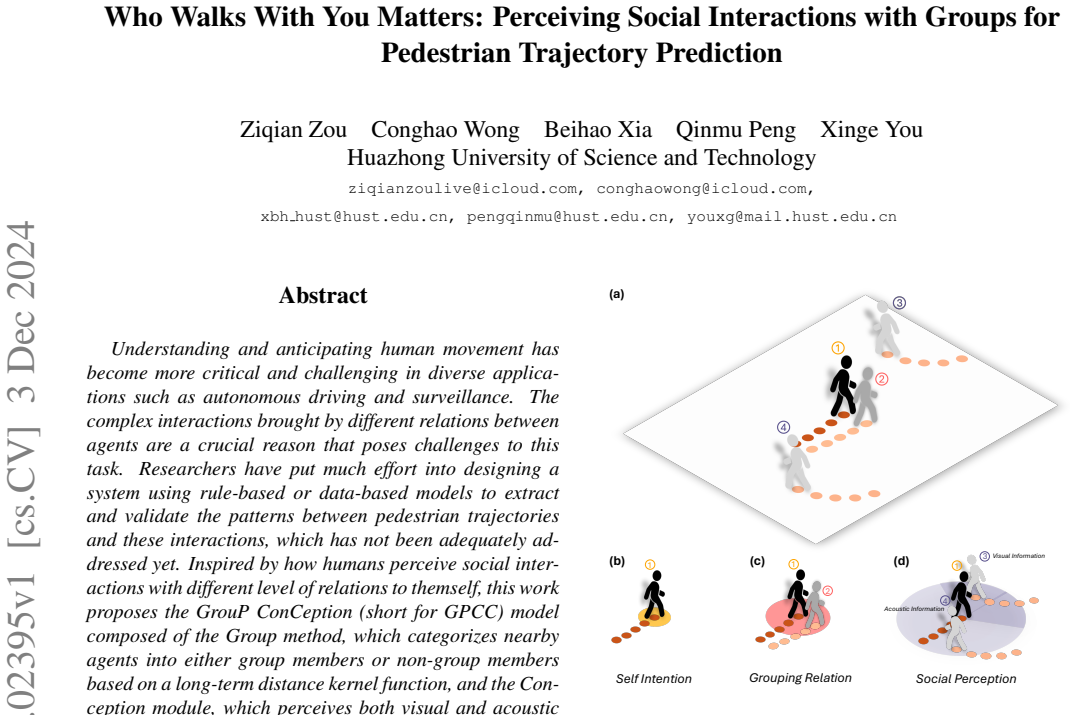
The load-bearing mechanism is the long-term distance kernel function $K(i,j)$, defined as $1$ when the sum of Euclidean distances between agents $i$ and $j$ over all observed frames is at most $d_m$ and $0$ otherwise; it partitions neighbors into the group set $\mathcal{N}^{group}$ and the rest. The second piece is the Conception module, which splits the surroundings into left, right, and rear partitions relative to the target's moving direction, averages distance, relative direction, and velocity over visible FOV agents and distance over rear agents, and encodes these averages into a perception feature. The fused feature $f^i = \tanh(W_{fuse} \operatorname{Concat}(f_{con}, f_{self}, f_{group}))$ carries all three factors into the Transformer backbone, so the identity of group members versus perceived strangers is the object that determines what the predictor attends to.
What would settle it
Run GPCC on ETH-UCY with $d_m$ swept from very small to very large while keeping the Conception module fixed; if no threshold yields the reported gap over the no-group ablation, then the long-term distance kernel is not doing the work credited to it. Separately, if inserting a synthetic stranger inside the FOV does not shift the predicted trajectory away from that stranger, the Conception module's claimed perceptual mechanism fails the intervention test the paper itself introduces.
Extended reading notes
Core claim
On the paper's own terms, the central discovery is that decomposing social influence into three factors, self-intention, long-term stable grouping relations, and in- or out-of-FOV perception of strangers, yields more accurate and more interpretable trajectory forecasts than the common uniform-pooling treatment of all neighbors. GrouP ConCeption (GPCC) computes group membership through a non-learned long-term distance kernel $K(i,j)$ that flags a neighbor as a group member when the sum of pairwise distances over the whole observation window stays below a manually set threshold $d_m=20$; group members' trajectories are encoded jointly with the target's trajectory, while non-members are summarized by partition-averaged distance, relative direction, and velocity inside a 180-degree FOV plus distance-only cues from the rear. The two streams plus the ego trajectory are fused and fed to a Transformer with a best-of-K multi-style generator, trained with plain $\ell^2$ loss. The paper reports that ablating the group and perception modules raises ETH-UCY FDE by about 58.6% over the full model, that removing only the Group method hurts more than removing both, and that intervention-style visualizations show the model shifting attention and contribution weights when a manual stranger or companion is inserted.
Load-bearing premise
The claim rests on the manual threshold $d_m=20$ in the long-term distance kernel: group membership is whatever falls within that distance sum, chosen once from ETH-UCY and applied unchanged elsewhere, so if that threshold is miscalibrated for a scene the Group method's benefit, and the paper's central improvement, collapses.
Editorial extensions
If this is right
- If the reported ablations hold, simply partitioning neighbors by a distance-based group kernel and FOV-based perception can lower prediction error on crowded pedestrian scenes by tens of percent relative to a uniform-interaction baseline.
- On the ETH-UCY ablation, disabling the Group method while keeping Conception gives the largest FDE increase (58.6%), implying that perception of strangers is beneficial only when group members are first separated out.
- The method transfers to heterogeneous scenes (SDD, NBA, nuScenes) with smaller or different gains, matching the intuition that group structure matters most where pedestrian groups exist and less for independent vehicles.
- The 180-degree FOV choice is justified by human vision physiology and is optimal on ETH-UCY, while a wider FOV helps on the NBA set, so the perception module's geometry should be tuned to the interaction field of the target domain.
- At 26 ms per batch of 100 targets on an M2 Max, the extra grouping and perception computations remain fast enough for low-latency applications such as autonomous driving.
Reading between the lines
- The fixed threshold $d_m=20$, chosen by inspecting ETH-UCY, is the clearest extension point: a per-scene or learned threshold could improve transfer, and the paper's own qualitative example (the mother being excluded when she lags) shows that cumulative distance alone cannot capture 'walks with you' semantics.
- Because grouping uses only summed distance, it cannot distinguish a companion walking slowly beside you from a stranger who happens to stay near you; adding heading coherence, relative velocity, or appearance-based cues would be a natural testable extension.
- The contribution-ratio and intervention visualizations suggest a counterfactual test: if a synthetic stranger is inserted, predicted paths should bend away from that stranger's motion, and if a synthetic companion is inserted, group feature weight should rise; running this at scale would turn the qualitative explainability claim into a falsifiable behavioral prediction.
- The Conception module's regional averaging discards per-agent identity; a learned attention over individual out-of-group agents might preserve the human-like FOV prior while recovering finer interactions the paper does not claim to capture.
Signed reviews
Editorial analysis
A structured set of objections, weighed in public.
Referee Report
Summary. The paper proposes GPCC, a pedestrian trajectory prediction model that augments a Transformer/MSN backbone with two hand-designed interaction modules: a Group method that classifies neighbors as group members via a hard threshold dm on summed pairwise distances over the observation window (Eq. 1), and a Conception module that encodes averaged visual (distance, direction, velocity) and 'acoustic' (rear-distance) cues in FOV partitions (Eqs. 4-10). The fused self/group/conception features are fed to the backbone (Eq. 11). The authors report competitive or state-of-the-art ADE/FDE on ETH-UCY, SDD, nuScenes, and NBA, and an ablation (Table 3) showing large drops on ETH-UCY when both modules are disabled. Qualitative analyses and 'intervention' visualizations are used to argue for explainability.
Significance. If the ETH-UCY result is reproducible, the paper contributes a simple inductive bias—hard grouping by long-term distance—and an interpretable FOV-based perception feature that can be plugged into other backbones; the public code release and the clean ablation design are strengths. However, the evidence for 'significant improvements across multiple datasets' is currently weak: on SDD the full model is indistinguishable from the no-module baseline (Table S4), and on nuScenes the Group method can slightly hurt (Table S3). The central claim therefore rests on a single dataset whose key threshold was manually chosen from that dataset (Supplementary D), so the breadth of the contribution is not yet established.
major comments (4)
- [Supplementary D, Eq. (1), Table 3] The threshold dm=20 is selected by inspecting the ETH-UCY family scene (Supplementary D, Fig. S3) and then used to produce the headline ETH-UCY numbers in Table 3. Because Eq. (1) is a hard binary threshold, the entire Group feature—and therefore much of the v0-v3 gap in Table 3—is controlled by this manually chosen scalar. Since zara1 is one of the leave-one-out test folds, this procedure is at best an optimistic estimate of the method's performance on ETH-UCY and provides no out-of-sample evidence for the grouping mechanism. The paper should either select dm on a validation split (or adapt it per dataset/scene) and report the sensitivity of Table 3 to dm, or clearly state that the reported ETH-UCY result is tuned on that dataset.
- [Tables S3 and S4; Abstract] The abstract's claim of 'significant improvements' across multiple datasets is not supported by the supplementary ablations. On SDD, disabling both modules (v3) gives 6.40/10.17 versus 6.39/10.17 for the full model, i.e., essentially no benefit; on nuScenes, removing only the Group method (v2) gives 1.34/2.95 (best-of-5) and 1.07/2.27 (best-of-10), compared with 1.33/2.94 and 1.08/2.27 for v0, so the Group method can slightly hurt; and on NBA, removing only Conception (v1) yields exactly the same numbers as v0 at both horizons. The large modular benefit appears only on ETH-UCY. The authors should either add per-dataset grouping/adaptation that yields consistent gains, or revise the abstract and framing to claim a dataset-specific improvement.
- [Sec. 4.3, Tables 3/S3/S4] All ablations are single runs with no error bars, confidence intervals, or significance tests. Some of the differences used to support the method—e.g., 6.39 vs 6.40 ADE on SDD, or 1.08 vs 1.07 ADE on nuScenes best-of-10—may be within seed-to-seed variation of stochastic trajectory prediction training. Please report multiple seeds (at least three) and, if the word 'significant' is retained, provide paired statistical tests.
- [Fig. 3 / Sec. 4.5] The qualitative analysis in Fig. 3 shows the Group method splitting the family in (a2) and excluding the mother in (e2)/(f2), which are precisely the failure modes of a fixed distance threshold. The text interprets these as 'aligned with human judgment,' but the model has no access to semantic group labels, and these examples illustrate that the grouping cue is noisy. The explainability claim should be tempered or supported by a quantitative grouping-quality metric (e.g., precision/recall against annotated group labels).
minor comments (6)
- [Sec. 3.3] The 'Acoustic Information Strategy' does not use sound; it is merely the distance of out-of-FOV agents. Please rename it or state clearly that this is a geometric proxy.
- [Secs. 1 and 3.1] 'Self-Intention' is described as an explicit goal or destination, but the implementation is only an encoder of the observed trajectory. Please align the terminology with the actual architecture.
- [Eq. (10)] The concatenation is written with '...'; specify the exact ordering of the right, left, and rear features.
- [Eq. (16)] The 'contribution ratio' is a post-hoc norm-based attribution; its interpretation as a causal contribution should be justified or softened.
- [Throughout] There are several typographical issues: 'emdedding' (Sec. 3.4), 'littl0' (Sec. 4.5), and 'EHT-UCY' (Table S5 caption) should be corrected.
- [Table 1] GPCC ties with SocialCircle on ETH-UCY (0.18/0.29); the text 'outperforms' should be made precise by naming the specific baselines it beats.
Circularity Check
No significant circularity: the predictive loop is held-out and the modules are empirical input features, not renamings of the target output.
full rationale
The paper's central claim is empirical predictive accuracy. The Group method assigns membership via the long-term distance kernel K(i,j) in Eq. (1) from observed coordinates; the Conception module computes hand-defined FOV statistics from observed positions; both feed a Transformer backbone (Eqs. 11-12) trained with an ℓ2 best-of-K loss against future trajectories (Eq. 13). The Table 3 results are therefore evaluated against held-out future positions, so the reported improvement is not equivalent to the inputs by construction. The only dataset-dependent hyperparameter is the group threshold dm=20, chosen "based on what we calculate among the ETH-UCY dataset" (Supplementary D). This is evaluation-set tuning and weakens the ETH-UCY evidence, but it is not circularity in the derivation sense: group assignment is one input feature, not the predicted quantity, and the threshold does not statistically force the ADE/FDE values. No load-bearing self-citation exists: the backbone MSN [38] and the intervention-experiment reference [40] are prior work by overlapping authors, but the claimed Group/Conception contribution is benchmarked against external methods with independent published results, and the self-citations are not used to forbid alternatives or define the target result. The paper's own limitation statement (Sec. 5) says the group-split accuracy relies on the observed sequence length, confirming the mechanism is an empirical heuristic rather than a self-referential construction. Overall, no specific circular reduction can be exhibited from the paper's equations.
Assumptions & free parameters
free parameters (2)
- dm (group distance threshold) =
20
- theta_FOV (perception field of view) =
180 degrees
assumptions (3)
- domain assumption Pedestrian group membership can be inferred from summed Euclidean distance over the observation window (Eq. 1).
- domain assumption Visual and acoustic perception of surrounding agents is adequately summarized by average distance, relative moving direction, and velocity in FOV partitions (Eqs. 6-9).
- standard math Transformer self-attention and the MSN multi-style trajectory generation module work as described in their source papers.
Cite this review
Pith. "Pith review of Who Walks With You Matters: Perceiving Social Interactions with Groups for Pedestrian Trajectory Prediction." pith.science (2026). https://pith.science/paper/3E3D46EM
@misc{pith2026241202395,
  author       = {Pith},
  title        = {Pith review of: Who Walks With You Matters: Perceiving Social Interactions with Groups for Pedestrian Trajectory Prediction},
  year         = {2026},
  howpublished = {\url{https://pith.science/paper/3E3D46EM}},
  note         = {Machine review of arXiv:2412.02395}
}
read the original abstract
Understanding and anticipating human movement has become more critical and challenging in diverse applications such as autonomous driving and surveillance. The complex interactions brought by different relations between agents are a crucial reason that poses challenges to this task. Researchers have put much effort into designing a system using rule-based or data-based models to extract and validate the patterns between pedestrian trajectories and these interactions, which has not been adequately addressed yet. Inspired by how humans perceive social interactions with different level of relations to themself, this work proposes the GrouP ConCeption (short for GPCC) model composed of the Group method, which categorizes nearby agents into either group members or non-group members based on a long-term distance kernel function, and the Conception module, which perceives both visual and acoustic information surrounding the target agent. Evaluated across multiple datasets, the GPCC model demonstrates significant improvements in trajectory prediction accuracy, validating its effectiveness in modeling both social and individual dynamics. The qualitative analysis also indicates that the GPCC framework successfully leverages grouping and perception cues human-like intuitively to validate the proposed model's explainability in pedestrian trajectory forecasting.
Figures


Figures from the paper (2 more)


Reference graph
Works this paper leans on
-
[1]
So- cial lstm: Human trajectory prediction in crowded spaces
Alexandre Alahi, Kratarth Goel, Vignesh Ramanathan, Alexandre Robicquet, Li Fei-Fei, and Silvio Savarese. So- cial lstm: Human trajectory prediction in crowded spaces. In Proceedings of the IEEE conference on computer vision and pattern recognition, pages 961–971, 2016. 4, 11
work page 2016
-
[2]
Learning pedestrian group representations for multi-modal trajectory prediction
Inhwan Bae, Jin-Hwi Park, and Hae-Gon Jeon. Learning pedestrian group representations for multi-modal trajectory prediction. In European Conference on Computer Vision , pages 270–289. Springer, 2022. 2, 5, 6
work page 2022
-
[3]
Can language beat numerical regression? language-based multimodal tra- jectory prediction
Inhwan Bae, Junoh Lee, and Hae-Gon Jeon. Can language beat numerical regression? language-based multimodal tra- jectory prediction. arXiv preprint arXiv:2403.18447, 2024. 6
arXiv 2024
-
[4]
Catarina Barata, Jacinto C. Nascimento, Jo ˜ao M. Lemos, and Jorge S. Marques. Sparse motion fields for trajectory predic- tion. Pattern Recognition, 110:107631, 2021. 2
work page 2021
-
[5]
nuscenes: A multi- modal dataset for autonomous driving
Holger Caesar, Varun Bankiti, Alex H Lang, Sourabh V ora, Venice Erin Liong, Qiang Xu, Anush Krishnan, Yu Pan, Gi- ancarlo Baldan, and Oscar Beijbom. nuscenes: A multi- modal dataset for autonomous driving. In Proceedings of the IEEE/CVF conference on computer vision and pattern recognition, pages 11621–11631, 2020. 4
2020
-
[6]
Spectral temporal graph neural network for multivariate time-series forecasting
Defu Cao, Yujing Wang, Juanyong Duan, Ce Zhang, Xia Zhu, Congrui Huang, Yunhai Tong, Bixiong Xu, Jing Bai, Jie Tong, et al. Spectral temporal graph neural network for multivariate time-series forecasting. Advances in Neural In- formation Processing Systems, 33:17766–17778, 2020. 2
work page 2020
-
[7]
Spectral temporal graph neural network for tra- jectory prediction
Defu Cao, Jiachen Li, Hengbo Ma, and Masayoshi Tomizuka. Spectral temporal graph neural network for tra- jectory prediction. In 2021 IEEE International Confer- ence on Robotics and Automation (ICRA), pages 1839–1845. IEEE, 2021. 6
work page 2021
-
[8]
Lg-traj: Llm guided pedestrian trajectory prediction
Pranav Singh Chib and Pravendra Singh. Lg-traj: Llm guided pedestrian trajectory prediction. arXiv preprint arXiv:2403.08032, 2024. 6
arXiv 2024
Show all 46 references
-
[9]
Recurrent aligned network for gen- eralized pedestrian trajectory prediction
Yonghao Dong, Le Wang, Sanping Zhou, Gang Hua, and Changyin Sun. Recurrent aligned network for gen- eralized pedestrian trajectory prediction. arXiv preprint arXiv:2403.05810, 2024. 6
2024 arXiv
-
[10]
Social gan: Socially acceptable tra- jectories with generative adversarial networks
Agrim Gupta, Justin Johnson, Li Fei-Fei, Silvio Savarese, and Alexandre Alahi. Social gan: Socially acceptable tra- jectories with generative adversarial networks. In Proceed- ings of the IEEE Conference on Computer Vision and Pattern Recognition, pages 2255–2264, 2018. 2, 4, 11
2018
-
[11]
Social force model for pedestrian dynamics
Dirk Helbing and Peter Molnar. Social force model for pedestrian dynamics. Physical review E, 51(5):4282, 1995. 2
1995
-
[12]
Higher-order relational reasoning for pedestrian trajectory prediction
Sungjune Kim, Hyung-gun Chi, Hyerin Lim, Karthik Ra- mani, Jinkyu Kim, and Sangpil Kim. Higher-order relational reasoning for pedestrian trajectory prediction. In Proceed- ings of the IEEE/CVF Conference on Computer Vision and Pattern Recognition, pages 15251–15260, 2024. 2, 6
2024
-
[13]
Human trajectory forecasting in crowds: A deep learning perspec- tive
Parth Kothari, Sven Kreiss, and Alexandre Alahi. Human trajectory forecasting in crowds: A deep learning perspec- tive. IEEE Transactions on Intelligent Transportation Sys- tems, 23(7):7386–7400, 2021. 2
2021
-
[14]
Muse- vae: Multi-scale vae for environment-aware long term tra- jectory prediction
Mihee Lee, Samuel S Sohn, Seonghyeon Moon, Sejong Yoon, Mubbasir Kapadia, and Vladimir Pavlovic. Muse- vae: Multi-scale vae for environment-aware long term tra- jectory prediction. In Proceedings of the IEEE/CVF Con- ference on Computer Vision and Pattern Recognition, pages 22...
2022
-
[15]
Crowds by example
Alon Lerner, Yiorgos Chrysanthou, and Dani Lischinski. Crowds by example. Computer Graphics Forum, 26(3):655– 664, 2007. 4
2007
-
[16]
Intention-interaction graph based hierarchical reasoning networks for human tra- jectory prediction
Cunyan Li, Hua Yang, and Jun Sun. Intention-interaction graph based hierarchical reasoning networks for human tra- jectory prediction. IEEE Transactions on Multimedia, 2022. 2
2022
-
[17]
Spatial-temporal consistency network for low-latency trajec- tory forecasting
Shijie Li, Yanying Zhou, Jinhui Yi, and Juergen Gall. Spatial-temporal consistency network for low-latency trajec- tory forecasting. In Proceedings of the IEEE/CVF Interna- tional Conference on Computer Vision (ICCV), pages 1940– 1949, 2021. 12
1940
-
[18]
Simaug: Learning robust representations from simulation for trajec- tory prediction
Junwei Liang, Lu Jiang, and Alexander Hauptmann. Simaug: Learning robust representations from simulation for trajec- tory prediction. In Proceedings of the European conference on computer vision (ECCV), 2020. 4
2020
-
[19]
Nba player movements
Kostya Linou, Dzmitryi Linou, and Martijn de Boer. Nba player movements. https://github.com/linouk23/NBA- Player-Movements, 2016. 4
2016
-
[20]
Uncertainty-aware pedestrian trajectory pre- diction via distributional diffusion
Yao Liu, Zesheng Ye, Rui Wang, Binghao Li, Quan Z Sheng, and Lina Yao. Uncertainty-aware pedestrian trajectory pre- diction via distributional diffusion. Knowledge-Based Sys- tems, page 111862, 2024. 6
2024
-
[21]
People tracking with human motion predictions from social forces
Matthias Luber, Johannes A Stork, Gian Diego Tipaldi, and Kai O Arras. People tracking with human motion predictions from social forces. In2010 IEEE international conference on robotics and automation, pages 464–469. IEEE, 2010. 2
2010
-
[22]
Fast inference and update of probabilistic density estimation on trajectory pre- diction
Takahiro Maeda and Norimichi Ukita. Fast inference and update of probabilistic density estimation on trajectory pre- diction. In Proceedings of the IEEE/CVF International Con- ference on Computer Vision, pages 9795–9805, 2023. 6
2023
-
[23]
From goals, waypoints & paths to long term hu- man trajectory forecasting
Karttikeya Mangalam, Yang An, Harshayu Girase, and Jiten- dra Malik. From goals, waypoints & paths to long term hu- man trajectory forecasting. In Proceedings of the IEEE/CVF International Conference on Computer Vision, pages 15233– 15242, 2021. 6, 11
2021
-
[24]
Ab- normal crowd behavior detection using social force model
Ramin Mehran, Alexis Oyama, and Mubarak Shah. Ab- normal crowd behavior detection using social force model. In 2009 IEEE Conference on Computer Vision and Pattern Recognition, pages 935–942. IEEE, 2009. 2
2009
-
[25]
Social-stgcnn: A social spatio-temporal graph convolutional neural network for human trajectory prediction
Abduallah Mohamed, Kun Qian, Mohamed Elhoseiny, and Christian Claudel. Social-stgcnn: A social spatio-temporal graph convolutional neural network for human trajectory prediction. In Proceedings of the IEEE/CVF Conference on Computer Vision and Pattern Recognition, pages 14424–...
2020
-
[26]
Human trajectory prediction in crowded scene using social-affinity long short-term memory.Pattern Recog- nition, 93:273–282, 2019
Zhao Pei, Xiaoning Qi, Yanning Zhang, Miao Ma, and Yee- Hong Yang. Human trajectory prediction in crowded scene using social-affinity long short-term memory.Pattern Recog- nition, 93:273–282, 2019. 2 9
2019
-
[27]
You’ll never walk alone: Modeling social be- havior for multi-target tracking
Stefano Pellegrini, Andreas Ess, Konrad Schindler, and Luc Van Gool. You’ll never walk alone: Modeling social be- havior for multi-target tracking. In 2009 IEEE 12th Inter- national Conference on Computer Vision , pages 261–268. IEEE, 2009. 2, 4
2009
-
[28]
Learning social etiquette: Human tra- jectory understanding in crowded scenes
Alexandre Robicquet, Amir Sadeghian, Alexandre Alahi, and Silvio Savarese. Learning social etiquette: Human tra- jectory understanding in crowded scenes. In European con- ference on computer vision, pages 549–565. Springer, 2016. 4
2016
-
[29]
Pedestrian 3d bounding box prediction
Saeed Saadatnejad, Yi Zhou Ju, and Alexandre Alahi. Pedestrian 3d bounding box prediction. arXiv preprint arXiv:2206.14195, 2022. 11
2022 arXiv
-
[30]
Trajectron++: Dynamically-feasible trajec- tory forecasting with heterogeneous data
Tim Salzmann, Boris Ivanovic, Punarjay Chakravarty, and Marco Pavone. Trajectron++: Dynamically-feasible trajec- tory forecasting with heterogeneous data. In Proceedings of the European conference on computer vision (ECCV), pages 683–700. Springer, 2020. 11
2020
-
[31]
Representing multimodal behaviors with mean location for pedestrian tra- jectory prediction
Liushuai Shi, Le Wang, Chengjiang Long, Sanping Zhou, Wei Tang, Nanning Zheng, and Gang Hua. Representing multimodal behaviors with mean location for pedestrian tra- jectory prediction. IEEE Transactions on Pattern Analysis and Machine Intelligence, 2023. 6
2023
-
[32]
Trajectory forecasting based on prior-aware directed graph convolutional neural network
Yuchao Su, Jie Du, Yuanman Li, Xia Li, Rongqin Liang, Zhongyun Hua, and Jiantao Zhou. Trajectory forecasting based on prior-aware directed graph convolutional neural network. IEEE Transactions on Intelligent Transportation Systems, pages 1–13, 2022. 2
2022
-
[33]
Attention is all you need
Ashish Vaswani, Noam Shazeer, Niki Parmar, Jakob Uszko- reit, Llion Jones, Aidan N Gomez, Łukasz Kaiser, and Illia Polosukhin. Attention is all you need. In Advances in neural information processing systems, pages 5998–6008, 2017. 4
2017
-
[34]
Model- ing cooperative navigation in dense human crowds
Anirudh Vemula, Katharina Muelling, and Jean Oh. Model- ing cooperative navigation in dense human crowds. In 2017 IEEE International Conference on Robotics and Automation (ICRA), pages 1685–1692. IEEE, 2017. 2
2017
-
[35]
Handbuch der physiologischen Optik
Hermann V on Helmholtz. Handbuch der physiologischen Optik. V oss, 1867. 12
-
[36]
Seem: a sequence entropy energy-based model for pedestrian trajectory all-then-one prediction
Dafeng Wang, Hongbo Liu, Naiyao Wang, Yiyang Wang, Hua Wang, and Sean Mcloone. Seem: a sequence entropy energy-based model for pedestrian trajectory all-then-one prediction. IEEE transactions on pattern analysis and ma- chine intelligence, 45(1):1070–1086, 2023. 6
2023
-
[37]
Another vertical view: A hierarchical network for hetero- geneous trajectory prediction via spectrums
Conghao Wong, Beihao Xia, Qinmu Peng, and Xinge You. Another vertical view: A hierarchical network for hetero- geneous trajectory prediction via spectrums. arXiv preprint arXiv:2304.05106, 2023. 11
2023 arXiv
-
[38]
Msn: multi-style network for trajectory predic- tion
Conghao Wong, Beihao Xia, Qinmu Peng, Wei Yuan, and Xinge You. Msn: multi-style network for trajectory predic- tion. IEEE Transactions on Intelligent Transportation Sys- tems, 24:9751 – 9766, 2023. 2, 4, 6
2023
-
[39]
Socialcircle: Learning the angle-based social in- teraction representation for pedestrian trajectory prediction
Conghao Wong, Beihao Xia, Ziqian Zou, Yulong Wang, and Xinge You. Socialcircle: Learning the angle-based social in- teraction representation for pedestrian trajectory prediction. In Proceedings of the IEEE/CVF Conference on Computer Vision and Pattern Recognition, pages 19005–...
2024
-
[40]
Socialcircle+: Learning the angle-based conditioned interac- tion representation for pedestrian trajectory prediction.arXiv preprint arXiv:2409.14984, 2024
Conghao Wong, Beihao Xia, Ziqian Zou, and Xinge You. Socialcircle+: Learning the angle-based conditioned interac- tion representation for pedestrian trajectory prediction.arXiv preprint arXiv:2409.14984, 2024. 8, 12
2024 arXiv
-
[41]
Groupnet: Multiscale hypergraph neural net- works for trajectory prediction with relational reasoning
Chenxin Xu, Maosen Li, Zhenyang Ni, Ya Zhang, and Si- heng Chen. Groupnet: Multiscale hypergraph neural net- works for trajectory prediction with relational reasoning. In Proceedings of the IEEE/CVF Conference on Computer Vi- sion and Pattern Recognition (CVPR) , pages 6498–6507,
-
[42]
Remember intentions: Retrospective-memory-based trajec- tory prediction
Chenxin Xu, Weibo Mao, Wenjun Zhang, and Siheng Chen. Remember intentions: Retrospective-memory-based trajec- tory prediction. In Proceedings of the IEEE/CVF Conference on Computer Vision and Pattern Recognition (CVPR), pages 6488–6497, 2022. 11
2022
-
[43]
Eqmo- tion: Equivariant multi-agent motion prediction with invari- ant interaction reasoning
Chenxin Xu, Robby T Tan, Yuhong Tan, Siheng Chen, Yu Guang Wang, Xinchao Wang, and Yanfeng Wang. Eqmo- tion: Equivariant multi-agent motion prediction with invari- ant interaction reasoning. In Proceedings of the IEEE/CVF Conference on Computer Vision and Pattern Recognition ,...
2023
-
[44]
Ye Yuan, Xinshuo Weng, Yanglan Ou, and Kris M. Kitani. Agentformer: Agent-aware transformers for socio-temporal multi-agent forecasting. In Proceedings of the IEEE/CVF International Conference on Computer Vision (ICCV), pages 9813–9823, 2021. 11
2021
-
[45]
Human tra- jectory prediction via neural social physics
Jiangbei Yue, Dinesh Manocha, and He Wang. Human tra- jectory prediction via neural social physics. In European Conference on Computer Vision , pages 376–394. Springer,
-
[46]
,𝑦!")|𝑡∈Ω#!
Pu Zhang, Jianru Xue, Pengfei Zhang, Nanning Zheng, and Wanli Ouyang. Social-aware pedestrian trajectory predic- tion via states refinement lstm. IEEE transactions on pattern analysis and machine intelligence , 44(5):2742–2759, 2022. 5 10 Who Walks With You Matters: Perceiving...
2016
Reviewed August 11, 2026 · model on record in the stance chip above.
Discussion (0). Continue with ORCID to comment.