REVIEW 1 major objections 4 minor 17 references
Enhanced excitation of a driven bistable system induced by spectrum degeneracy
T0 review · 1 major / 4 minor · reviewed 2026-08-14 · deepseek-v4-flash
Pith's one-line read This paper claims that at integer values of m = 2Δ/α, all quasiclassical states in the two outer phase-space regions become pairwise degenerate at once, so a driven bistable oscillator's stationary occupation jumps toward the…
desk verdict The closed-system degeneracy and tunneling/multi-photon equivalence are solid, but the open-system enhancement claim rests on an unchecked secular approximation and is likely wrong as stated. read the letter →
The pith
A machine-rendered reading of the paper's core claim, the machinery that carries it, and where it could break.
The reading
What carries the argument
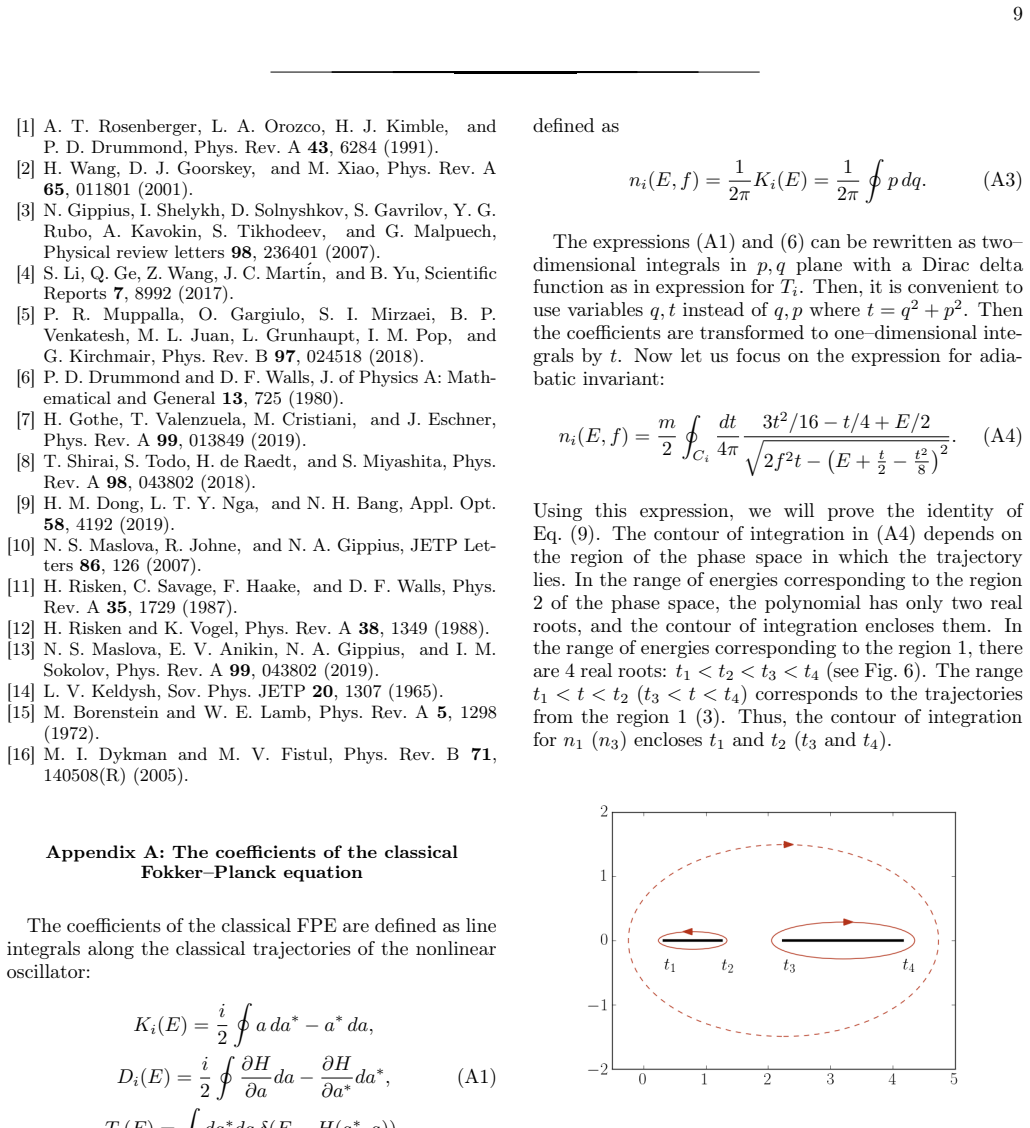
The load-bearing object is the adiabatic invariant $n_i(E,f) = \frac{1}{2\pi}\oint p\,dq$ of a classical trajectory in phase-space region $i$. The paper proves the identity $n_3(E,f)-n_1(E,f)=m$ by deforming the contour of the elliptic integral (A4) and picking up the residue at infinity; this makes every region-1/region-3 pair degenerate at the same integer $m$, so the whole band hybridizes simultaneously. On top of that, the two-level effective Hamiltonian with off-diagonal tunneling amplitude $\omega_R \sim e^{-S_{\mathrm{tunn}}(E)}$ supplies the critical quasienergy through $(1/(\pi\delta m))\,e^{-S_{\mathrm{tunn}}(E_c)}=1$. The same tunneling exponent is then matched, order by order, to the $(m-2n)$-photon perturbation amplitude, which is the mechanism that unifies tunneling and multi-photon transitions.
What would settle it
Numerically diagonalize the Hamiltonian (1) at a fixed integer $m$ (for example $m=30$, $\sqrt{\beta/\beta_{\mathrm{crit}}}=0.2$) and check whether every pair of quasienergies in $E_{\mathrm{sep}}<E<E_1$ is degenerate at the same $m$ and whether the splitting equals the multi-photon Rabi formula (C1); a single pair that anti-crosses at a non-integer $m$, or a dip in $P_1/P_2$ displaced from $\delta m=0$, would falsify the central identity.
Extended reading notes
Core claim
On its own terms, the paper's central discovery is that the degeneracy of the bistable driven oscillator's quasienergy levels is simultaneous, not accidental: for integer $m = 2\Delta/\alpha$, all quasiclassical states from phase-space regions 1 and 3 are pairwise degenerate for every $\beta$ in the bistability window, because the adiabatic invariants of the two regions differ by exactly $m$. The identity $n_3(E,f)-n_1(E,f)=m$ follows from a contour deformation of a single elliptic integral. With this identity, each pair of near-degenerate states is governed by an effective two-level Hamiltonian with tunneling amplitude $\omega_R(E) \sim e^{-S_{\mathrm{tunn}}(E)}$; the crossover between hybridized and localized eigenstates occurs at a critical quasienergy $E_c$ defined by $(1/(\pi\delta m))\,e^{-S_{\mathrm{tunn}}(E_c)}=1$. Below $E_c$, states are symmetric and antisymmetric superpositions; above $E_c$, each state belongs to one region. The paper claims this structure changes the stationary kinetics: the occupation of the high-amplitude state 2 rises sharply at integer $m$, the low-amplitude state 1 is exponentially suppressed, and the tunneling splitting between paired states equals the $(m-2n)$-photon Rabi frequency, identifying tunneling with multi-photon transitions.
Load-bearing premise
The whole construction rests on the identity $n_3(E,f)-n_1(E,f)=m$ being exact for all states in the bistable range, proved by contour deformation and supported by an operator extension to non-integer occupation numbers; if that identity is only approximate, the simultaneous anti-crossings and the sharp exponential dips in occupation are not quantitative.
Editorial extensions
If this is right
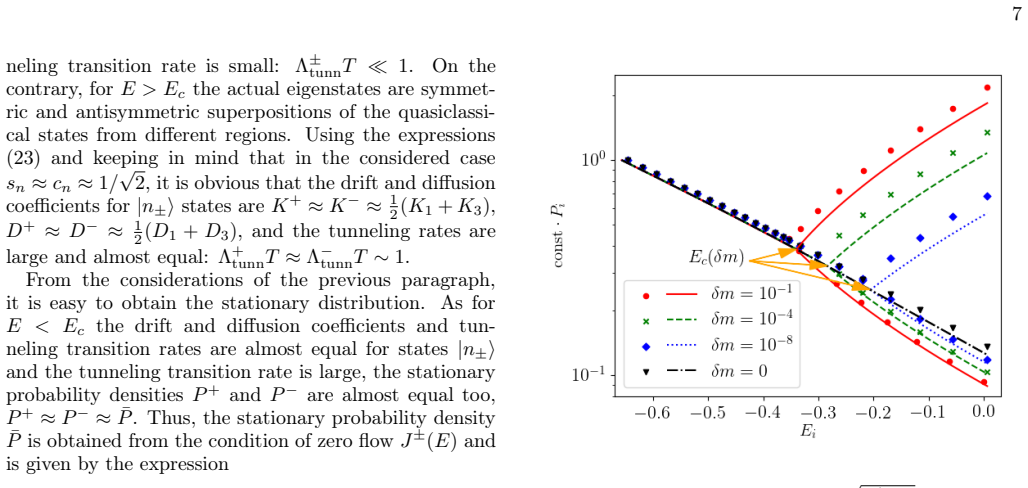
- At integer $m$, the stationary probability of the low-amplitude state drops exponentially, so the oscillator sits in the high-amplitude squeezed state; tuning $\delta m$ away from zero restores the usual distribution.
- Near degeneracy the kinetics is controlled by a critical quasienergy $E_c$: below $E_c$ the drift and diffusion coefficients are averaged over the two regions and the tunneling rate is large, while above $E_c$ the tunneling rate is exponentially small.
- The Keldysh parameter, the ratio of tunneling time to the classical period, is large ($\sim \ln(1/\beta)$) in the bistable region when the pumping is below the critical intensity, and it depends logarithmically on the field amplitude rather than as $1/f$.
- The $(m-2n)$-photon transition amplitude and the quasiclassical tunneling amplitude are the same quantity, so an $(m-2n)$-photon resonance and tunneling between phase-space regions are one effect, not two competing mechanisms.
- Level discreteness makes the occupation ratio $P_1(E_1)/P_2(E_2)$ develop steps whose logarithmic width equals the Keldysh parameter, so the degeneracy effect is observable as exponentially narrow dips in $m$.
Reading between the lines
- An extension the paper leaves implicit: because the dips in $P_1/P_2$ occur only at integer $m$ with exponentially small width in $\delta m$, the effect could serve as a sharp, field-tunable switch, where a small change in detuning toggles the system between low- and high-amplitude states.
- The contour identity may be a special case of a more general mechanism: any Hamiltonian whose unperturbed spectrum is quadratic in the number operator ($\epsilon_n \propto n(m-n)$) will have the same simultaneous-degeneracy structure under a linear driving term, so similar level pairing should appear in other integrable models.
- A directly testable prediction the paper does not spell out is that the upper-state occupation should peak exactly at $m = 2\Delta/\alpha$ integer, with a peak height that grows exponentially with $m$; a population-versus-detuning measurement at fixed nonlinearity could verify the effect without resolving individual levels.
Signed reviews
Editorial analysis
A structured set of objections, weighed in public.
Referee Report
Summary. The paper studies a resonantly driven single-mode Kerr oscillator coupled to a Markovian bath and examines the effect of quasienergy degeneracy on its nonequilibrium steady state. The main theoretical results are: (i) at integer m = 2Δ/α, the quasiclassical states from phase-space regions 1 and 3 can be paired with equal quasienergies, as follows from the identity n3 − n1 = m derived in Appendix A; (ii) the tunneling splitting between paired states equals the (m−2n)-photon transition amplitude, so tunneling and multi-photon transitions are the same effect; (iii) for m close to an integer there is a critical quasienergy Ec separating hybridized from localized eigenstates; and (iv) in the open system, this hybridization modifies the drift and diffusion coefficients and produces an exponential suppression of the low-amplitude state occupation at integer m, as shown in Figs. 4 and 5. The analytical results are compared with the numerical diagonalization of the Pauli transition matrix.
Significance. The closed-system analysis is attractive and has the character of a parameter-free derivation: the degeneracy condition, the tunneling action, and the multi-photon amplitude are computed from the Hamiltonian without fitted constants, and the Keldysh-parameter result (logarithmic dependence on the field amplitude) is a falsifiable prediction. The connection between tunneling and multi-photon transitions is demonstrated concretely, including the numerical prefactor in Appendix C. If the open-system enhancement survived a full master-equation treatment, it would be an important mechanism for controlling bistable-state populations in driven dissipative systems. However, as argued in Major Comment 1, the open-system prediction rests on an unverified and likely violated secular approximation, so the central "enhanced excitation" claim is not yet established.
major comments (1)
- [Sec. VI, Eqs. (4), (14), (21) and Fig. 5] The central open-system prediction of exponentially suppressed P1(E1) is obtained from a populations-only rate equation in the basis of the closed-system eigenstates |n±>. Such a Pauli master equation is valid only when the bath-induced rates are small compared with the level splittings that separate the basis states, including the doublet splitting 2ω_R between |n+> and |n->. The manuscript never states or checks this secular condition. For the parameters of Figs. 4 and 5 (m = 30, sqrt(β/βcrit) = 0.2, so β ≈ 0.0059), Eqs. (13) and (20) give ω_R/Δ ≈ β^{m/2−n}; the state closest to E1 has ω_R/Δ ≈ 10^{−33}. For any fixed damping γ/Δ larger than this, the doublet is not resolved, the bath localizes the system, and the correct steady state is close to the classical Fokker-Planck solution rather than to the hybridized P± solution. The numerical points in Fig. 5 are obtained by diagonalizing the same Pauli transition matrix (4), so they do not test this point. The exponential dips and the single-critical-energy picture of Sec. VI are therefore not established for an open system with finite damping. The authors should either solve the full Lindblad master equation including coherences, or state and verify the condition γ ≪ ω_R for every doublet contributing to the claimed effect.
minor comments (4)
- [Sec. III, Eq. (19)] The second-order perturbation correction appears to be missing a factor of 2. With ϵ_n = (α/2)n(n−m) and V = f(a + a†), a direct calculation gives δϵ_n^(2) = (2f^2/α)(m+1)/((m−2n)^2 − 1), not (f^2/α)(m+1)/((m−2n)^2 − 1). The symmetry under n → m−n is unaffected, but the displayed formula is wrong.
- [Introduction and Conclusions] The text repeatedly states that degeneracy occurs at integer or half-integer values of m, but the derivation in Sec. III applies only to integer m: the pairing ϵ_n = ϵ_{m−n} at f = 0 requires both n and m−n to be integers. No argument is given for the half-integer case, and Fig. 2 shows anti-crossings only at integer m. The half-integer claim should be either proved or removed.
- [Appendix B] The proof in Appendix B is presented as rigorous, but the operator T is defined through an infinite non-normal series and the extension of the boson Fock space to non-integer occupation numbers is formal; convergence and domain questions are not addressed. Since the quasiclassical identity (A5) and the numerical anti-crossings in Fig. 2 already support the degeneracy at integer m, the overstatement "rigorous proof" should be softened or the proof completed.
- [Throughout] There are repeated LaTeX typesetting artifacts, e.g., "/guillemotleft.cyrtunneling time/guillemotright.cyr" and "/guillemotleft.cyrnumbers of excitation quanta/guillemotright.cyr". These should be cleaned up before publication.
Circularity Check
No significant circularity: all load-bearing quantities are computed from the Hamiltonian and verified against direct master-equation numerics rather than fitted or defined into the result.
full rationale
The derivation chain is self-contained rather than circular. The degeneracy condition n3(E)-n1(E)=m is obtained from the contour-integral identity (A5) in Appendix A, and the quantum symmetry is argued independently in Appendix B; neither step presupposes the target occupation enhancement. The tunneling splitting in Eqs. (10)-(13) is computed from the quasiclassical action with no fitted parameters, and the multi-photon amplitude Eq. (C1) is independently evaluated by perturbation theory, so the claimed coincidence of tunneling and multi-photon transition amplitudes is a derived asymptotic identity rather than a renaming. The critical quasienergy Ec is defined by Eq. (18) from these independently computed tunneling splittings and the detuning scale, and it is not fitted to Fig. 5. The open-system kinetic prediction uses the rate equation (4) and the Fokker-Planck form; although the latter is imported from the authors' earlier work [13], it is a parameter-free weak-coupling, large-m approximation with stated assumptions that do not include the degeneracy-induced enhancement, and the numerical comparison in Figs. 4-5 solves the same underlying Pauli transition matrix, so no statistical forcing or fitted-input-as-prediction is present. The formal extension to non-integer occupation numbers in Appendix B is an unproved analytical device and may be a correctness concern, but it is not a circular reduction of the target result to its own inputs.
Assumptions & free parameters
assumptions (4)
- domain assumption Markovian white-noise bath correlations (Eq. 3) and the diagonal (secular) rate equation (Eq. 4) describe the weak-coupling kinetics.
- domain assumption The quasiclassical limit m >> 1 and the Bohr-Sommerfeld rule (Eq. 6) give the relevant quasienergy states and trajectories; the WKB tunneling action (Eqs. 10-11) gives the splitting.
- domain assumption The effective two-level Hamiltonian (Eq. 14) with a single tunneling amplitude per pair, and the smoothness of P+ and P- occupations in the gradient expansion, capture the kinetics across degeneracy.
- ad hoc to paper The extension of boson operators to non-integer occupation numbers nu with matrix elements sqrt(nu), and the intertwining operator T in Appendix B, are well-defined and prove the energy symmetry exactly.
Cite this review
Pith. "Pith review of Enhanced excitation of a driven bistable system induced by spectrum degeneracy." pith.science (2026). https://pith.science/paper/3EDPEEWB
@misc{pith2026190803275,
  author       = {Pith},
  title        = {Pith review of: Enhanced excitation of a driven bistable system induced by spectrum degeneracy},
  year         = {2026},
  howpublished = {\url{https://pith.science/paper/3EDPEEWB}},
  note         = {Machine review of arXiv:1908.03275}
}
read the original abstract
The non-equilibrium statistics and kinetics of a simple bistable system (resonantly driven nonlinear oscillator coupled to reservoir) have been investigated by means of master equation for the density matrix and quasiclassical Fokker-Planck equation in quasienergy space. We found out that the system's statistical and kinetic properties drastically change when the quasienergy states become nearly degenerate and the occupation of the most excited state is strongly enhanced. It has been revealed that in nearly degenerate case a new critical quasienergy parameter emerges. Below the critical quasienergy value the eigenstates are superpositions of the quasiclassical states from different phase space regions, while above this value the eigenstates correspond to only one particular region of the phase space. We have also generalized Keldysh theory for ionization of atoms in the electromagnetic field for bistable systems. It has been demonstrated that Keldysh parameter in bistability region is large when pumping intensity is smaller than the critical value. It has been shown by direct calculations that multi-photon transition amplitude coincides with the tunneling amplitude. So, multi-photon transitions and tunneling between the regions of the phase space are just the same effects. We also demonstrated that for bistable systems the Keldysh parameter logarithmically depends on the external field amplitude.
Figures


Figures from the paper (3 more)

Reference graph
Works this paper leans on
-
[1]
A. T. Rosenberger, L. A. Orozco, H. J. Kimble, and P. D. Drummond, Phys. Rev. A43, 6284 (1991)
work page 1991
-
[2]
H. Wang, D. J. Goorskey, and M. Xiao, Phys. Rev. A 65, 011801 (2001)
work page 2001
-
[3]
In principle, these values ofβ and m could be different for different pairsn,n′. However, a special feature of the Hamiltonian (1) is that the degeneracy of the quasiclassical states oc- curs exactly at integer values ofm for allβ in the region of bistability. Therefore at each integer value ofm all quasiclassical states from regions 1 and 3 can be grouped ...
-
[4]
N. Gippius, I. Shelykh, D. Solnyshkov, S. Gavrilov, Y. G. Rubo, A. Kavokin, S. Tikhodeev, and G. Malpuech, Physical review letters98, 236401 (2007)
work page 2007
-
[5]
S. Li, Q. Ge, Z. Wang, J. C. Mart´in, and B. Yu, Scientific Reports 7, 8992 (2017)
work page 2017
-
[6]
P. R. Muppalla, O. Gargiulo, S. I. Mirzaei, B. P. Venkatesh, M. L. Juan, L. Grunhaupt, I. M. Pop, and G. Kirchmair, Phys. Rev. B97, 024518 (2018)
work page 2018
-
[7]
P. D. Drummond and D. F. Walls, J. of Physics A: Math- ematical and General13, 725 (1980)
work page 1980
- [8]
Show all 17 references
-
[9]
Shirai, S
T. Shirai, S. Todo, H. de Raedt, and S. Miyashita, Phys. Rev. A98, 043802 (2018)
2018
-
[10]
H. M. Dong, L. T. Y. Nga, and N. H. Bang, Appl. Opt. 58, 4192 (2019)
2019
-
[11]
N. S. Maslova, R. Johne, and N. A. Gippius, JETP Let- ters 86, 126 (2007)
2007
-
[12]
Risken, C
H. Risken, C. Savage, F. Haake, and D. F. Walls, Phys. Rev. A35, 1729 (1987)
1987
-
[13]
Risken and K
H. Risken and K. Vogel, Phys. Rev. A38, 1349 (1988)
1988
-
[14]
N. S. Maslova, E. V. Anikin, N. A. Gippius, and I. M. Sokolov, Phys. Rev. A99, 043802 (2019)
2019
-
[15]
L. V. Keldysh, Sov. Phys. JETP20, 1307 (1965)
1965
-
[16]
Borenstein and W
M. Borenstein and W. E. Lamb, Phys. Rev. A5, 1298 (1972)
1972
-
[17]
M. I. Dykman and M. V. Fistul, Phys. Rev. B 71, 140508(R) (2005). Appendix A: The coefficients of the classical Fokker–Planck equation The coefficients of the classical FPE are defined as line integrals along the classical trajectories of the nonlinear oscillator: Ki(E) = i 2 ∮ ada...
2005
Reviewed August 14, 2026 · model on record in the stance chip above.
Discussion (0). Continue with ORCID to comment.