In-flight calibration of the Wide-field X-ray Telescope on board the Einstein Probe
Pith reviewed 2026-06-29 02:21 UTC · model grok-4.3
The pith
In-orbit calibration shows the Wide-field X-ray Telescope matches its ground performance across key metrics.
A machine-rendered reading of the paper's core claim, the machinery that carries it, and where it could break.
Core claim
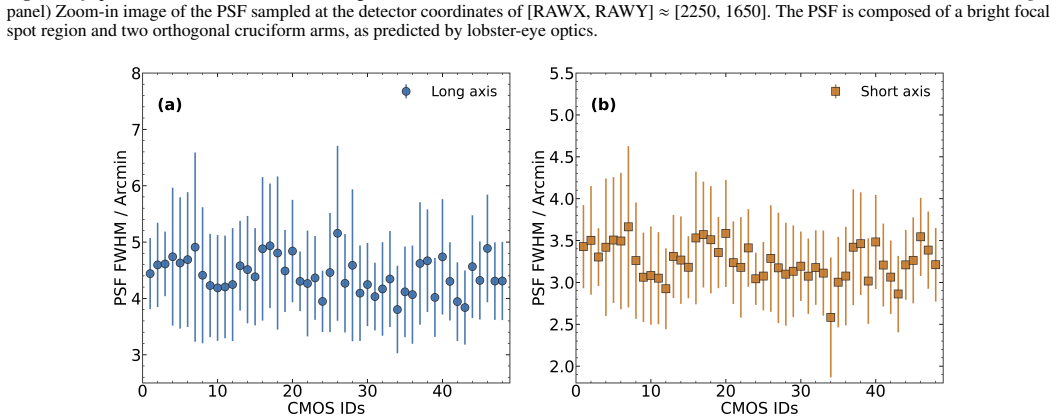
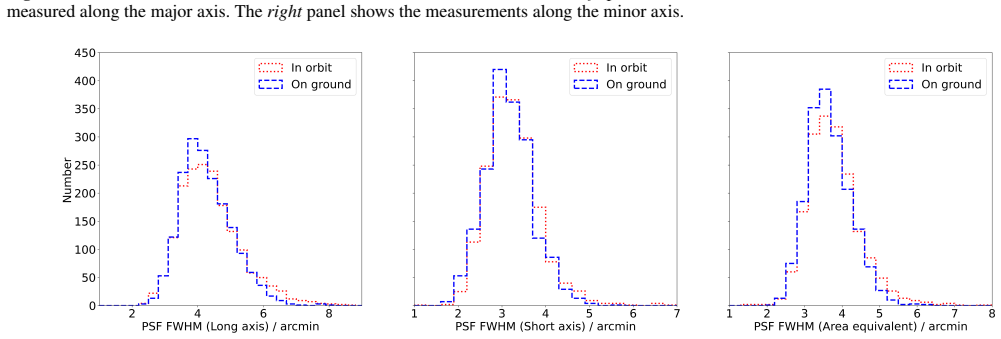
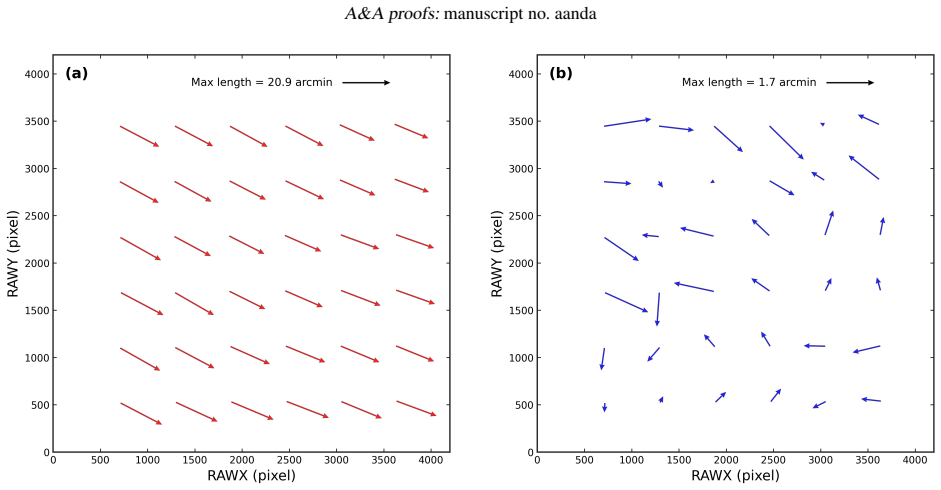
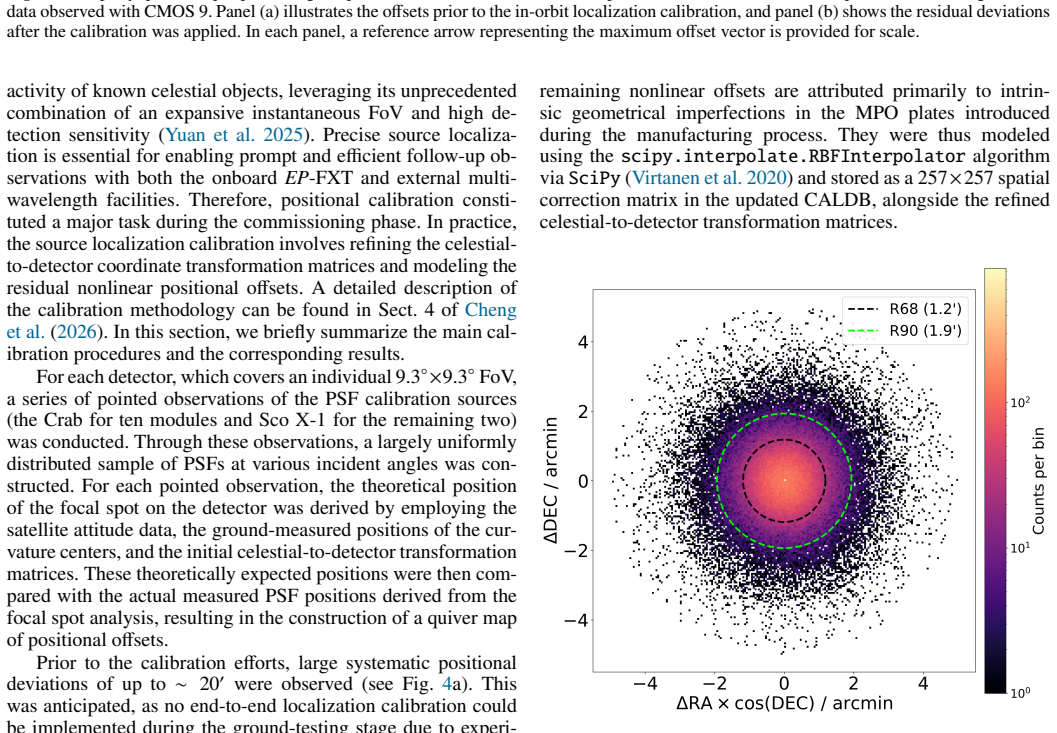
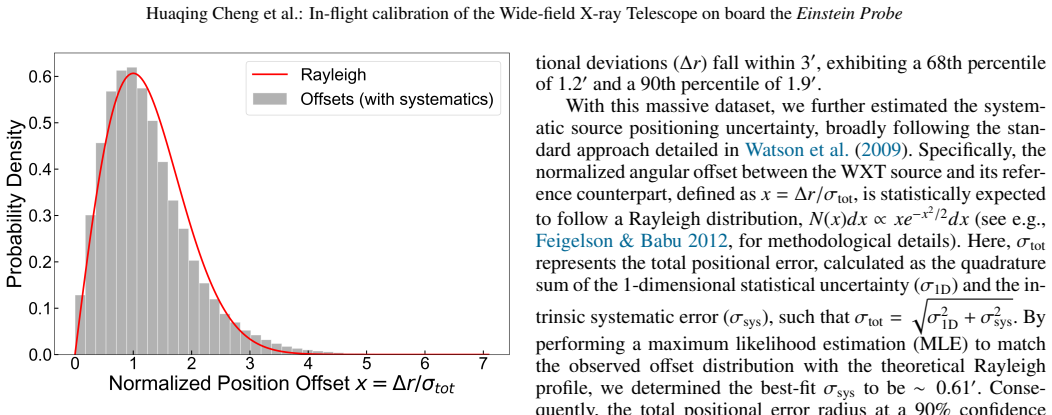
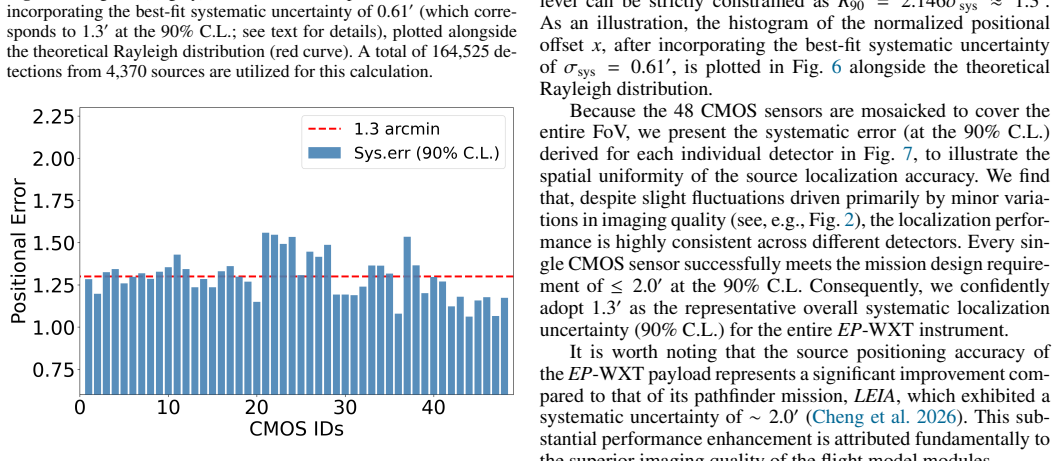
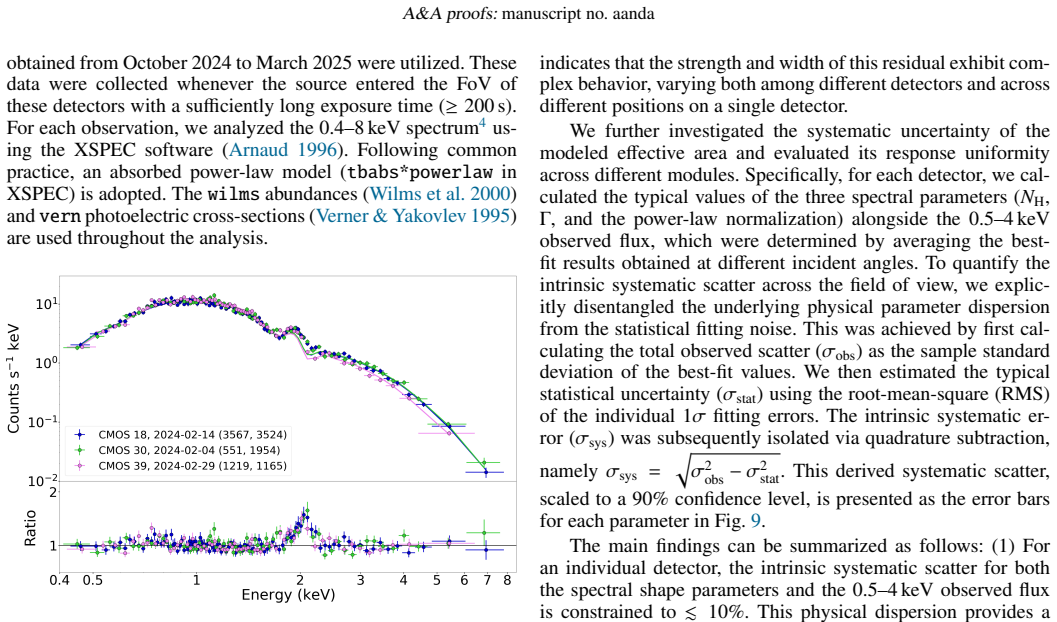
The in-orbit performance of the WXT agrees with prelaunch ground calibrations well. The spatial resolution, denoted by the full width at half maximum of the focal spot, typically ranges from 3 to 6 arcminutes across about 90 percent of the field of view, with a median of about 4.3 arcminutes. The post-calibration source positioning accuracy achieves 1.3 arcminutes at the 90 percent confidence level. The in-orbit effective area is consistent with model predictions and ground measurements, exhibiting an overall systematic uncertainty of less than or equal to 10 percent at 90 percent in the 0.5-4 keV band.
What carries the argument
Systematic observations of standard celestial sources to quantify focal-spot full width at half maximum, positioning offsets, and effective area across detector modules.
If this is right
- Data from the telescope can be processed with the updated calibration database for reliable scientific results.
- The instrument maintains the expected sensitivity for detecting and localizing transient X-ray events over most of its field of view.
- Long-term monitoring of the few modules showing low-energy degradation can track further changes without affecting the majority of observations.
Where Pith is reading between the lines
- Future wide-field X-ray instruments using similar optics may rely on the same source-based calibration approach to verify in-orbit behavior quickly after launch.
- The observed stability in energy scale from Cassiopeia A observations suggests the detectors can support spectroscopy of variable sources over multi-year missions.
Load-bearing premise
The spectral, flux, and spatial properties of the chosen standard celestial sources are known independently to sufficient precision and stability to serve as accurate references for the full field of view.
What would settle it
A measured effective area or median full width at half maximum that deviates from ground predictions by more than the reported 10 percent uncertainty across multiple modules would falsify the agreement claim.
Figures
read the original abstract
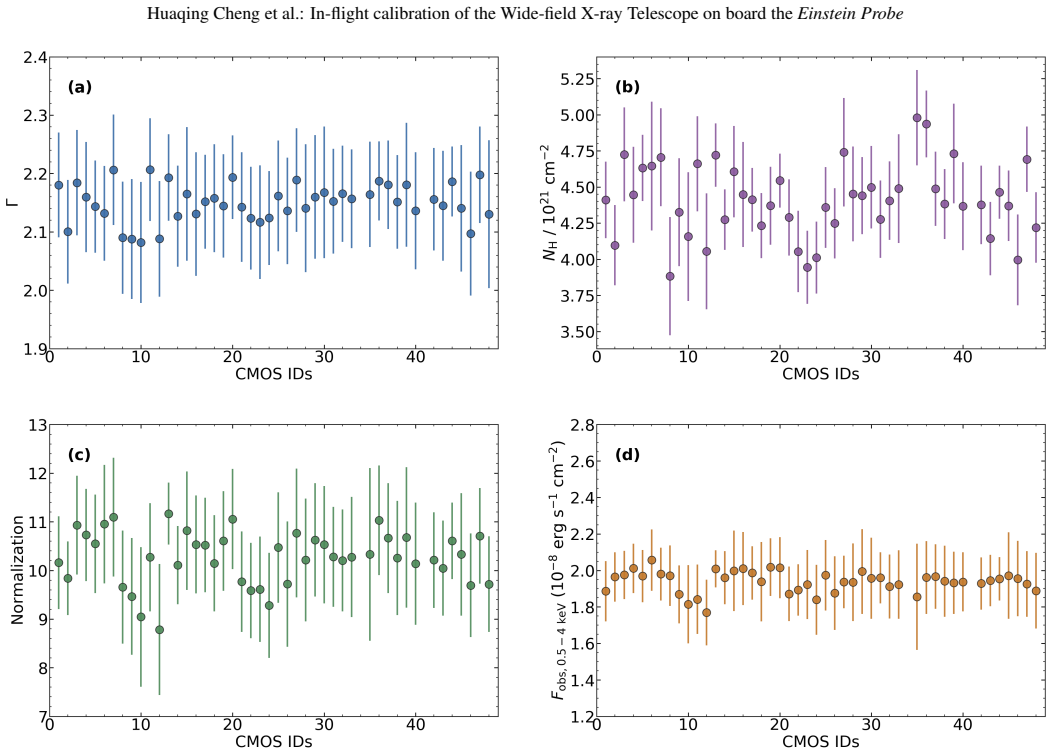
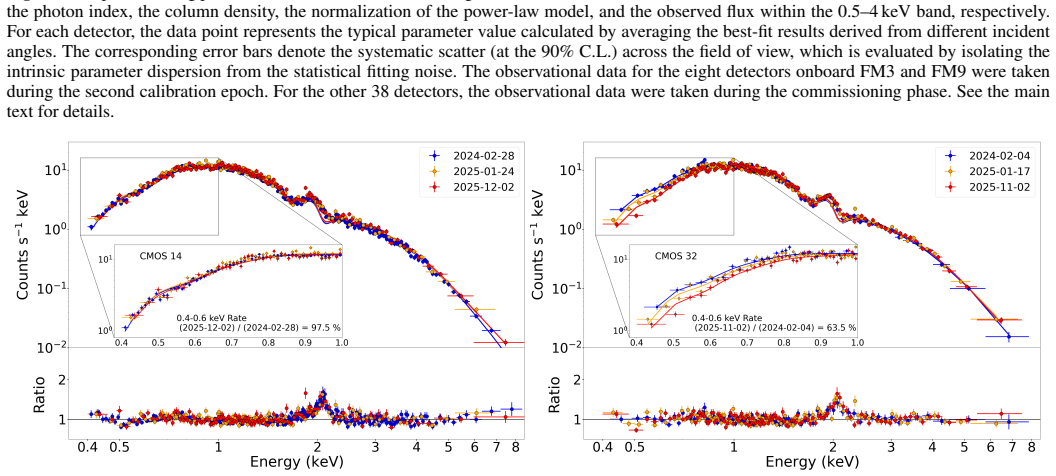
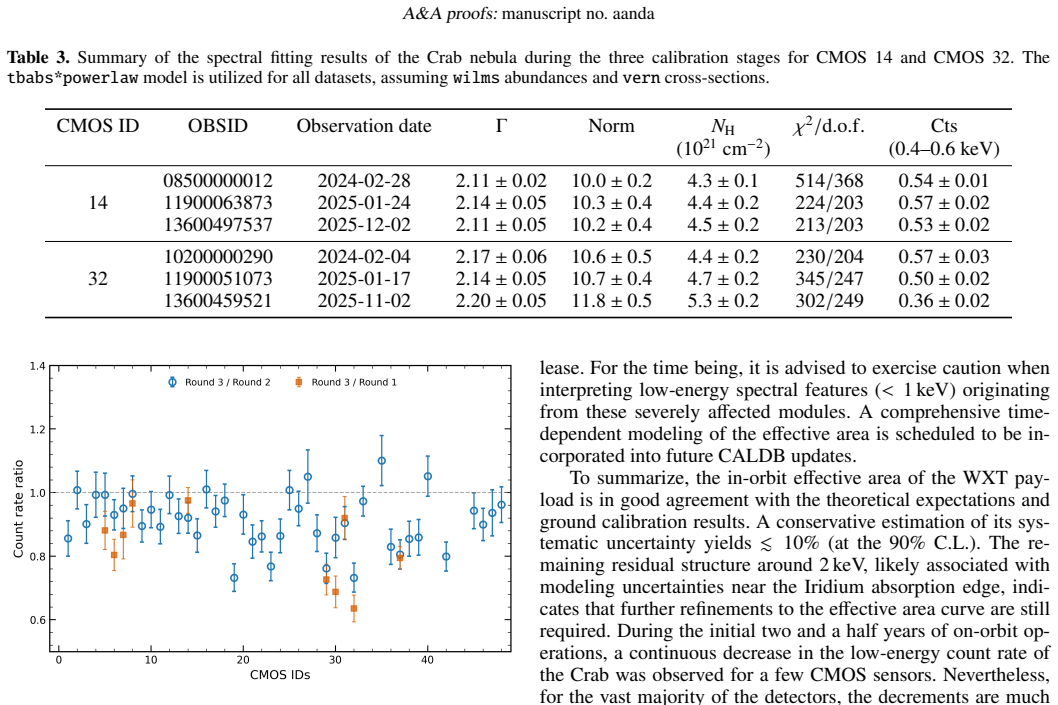
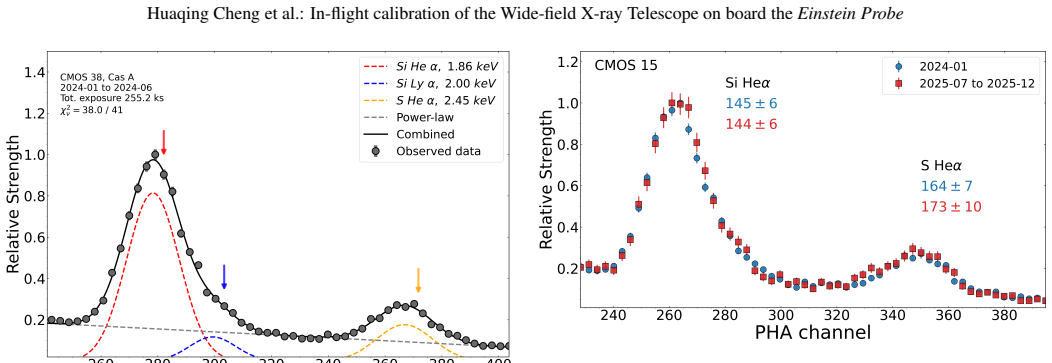
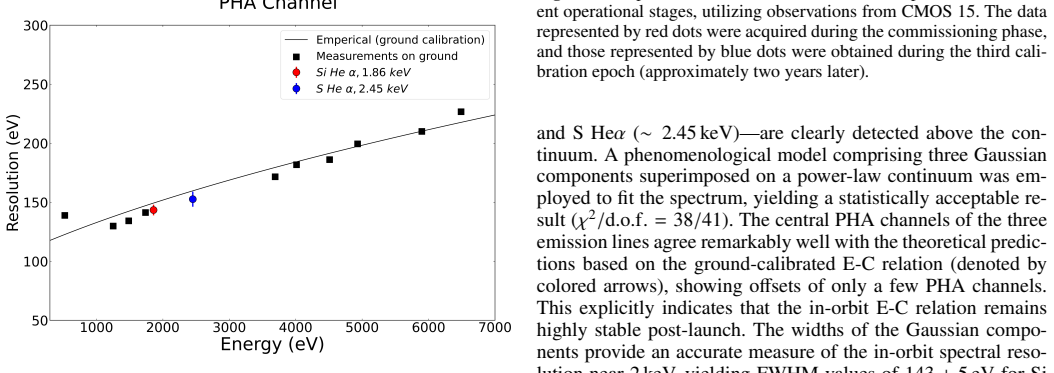
By utilizing novel lobster-eye optics, the Wide-field X-ray Telescope (WXT) onboard the Einstein Probe (EP) satellite achieves an unprecedented combination of a large instantaneous field-of-view (FoV) and high sensitivity for monitoring the dynamic X-ray sky. In this paper, we present the in-orbit calibration results of the WXT during its first two and a half years of operations. By conducting observations of standard celestial sources--including the Crab Nebula, Scorpius X-1, and Cassiopeia A--we systematically characterized key instrumental properties. Our analysis demonstrates that the in-orbit performance of the WXT agrees with prelaunch ground calibrations well. The spatial resolution, denoted by the full width at half maximum (FWHM) of the focal spot, typically ranges from $3'$ to $6'$ across $\sim$90% of the FoV, with a median of $\sim 4.3'$. The post-calibration source positioning accuracy achieves $1.3'$ (at the 90% confidence level). The in-orbit effective area is consistent with model predictions and ground measurements, exhibiting an overall systematic uncertainty of $\lesssim 10\%$ (90% C.L.) in the 0.5-4 keV band. While the vast majority of the detectors remain highly stable, a noticeable long-term degradation at the low-energy end ($\sim30\%$-$40\%$, 0.4-0.6 keV) is observed in a few specific modules. Furthermore, spectral evaluations using Cas A confirm the stability of the energy scale and spectral resolution of the focal-plane Complementary Metal-Oxide Semiconductor (CMOS) detectors. All derived calibration products have been incorporated into the WXT calibration database (CALDB). These results comprehensively verify the instrumental capabilities of the WXT, providing a solid foundation for the reliable analysis of scientific observations.
Editorial analysis
A structured set of objections, weighed in public.
Referee Report
Summary. The manuscript reports the in-flight calibration of the Wide-field X-ray Telescope (WXT) aboard the Einstein Probe, based on observations of the Crab Nebula, Sco X-1, and Cas A over the first 2.5 years of operations. It concludes that in-orbit performance matches pre-launch ground calibrations, with spatial resolution (FWHM) ranging from 3' to 6' across ~90% of the FoV (median ~4.3'), post-calibration source positioning accuracy of 1.3' (90% CL), and effective area consistent with models to ≲10% systematic uncertainty (90% CL) in the 0.5-4 keV band. A subset of modules shows long-term low-energy degradation (~30-40% in 0.4-0.6 keV), while energy scale and spectral resolution remain stable; all calibration products are incorporated into the WXT CALDB.
Significance. If the results hold, the work supplies a necessary end-to-end validation of an instrument whose large FoV and sensitivity are intended for time-domain X-ray astronomy. The quantitative agreement with independent ground calibrations, the explicit reporting of module-to-module variations, and the delivery of products to the public CALDB directly support reliable scientific use of the data. The reliance on multiple, independently characterized celestial standards across the field of view adds robustness to the claimed performance metrics.
minor comments (2)
- Abstract: the phrase 'typically ranges from 3' to 6'' would be clearer if accompanied by the fraction of the FoV or number of modules that satisfy the quoted bounds, rather than the ~90% figure alone.
- The manuscript states that spectral evaluations with Cas A confirm stability of the energy scale and resolution, but does not indicate the number of epochs or total exposure used for this check; adding this detail would allow readers to assess the statistical power of the stability claim.
Simulated Author's Rebuttal
We thank the referee for their positive review and recommendation to accept the manuscript. The assessment correctly highlights the robustness of the calibration results derived from multiple celestial standards and the public delivery of the CALDB products.
Circularity Check
No significant circularity
full rationale
The paper reports direct in-orbit measurements of WXT performance (FWHM, positioning accuracy, effective area) by observing standard celestial sources (Crab Nebula, Sco X-1, Cas A) whose spectral, spatial, and flux properties are taken as independently known. These observations are compared to pre-launch ground calibrations without any equation or step that reduces a claimed prediction to a fitted parameter from the same dataset, without self-definitional loops, and without load-bearing self-citations that justify uniqueness or an ansatz. The central claims rest on external benchmarks rather than internal construction, so the derivation chain is self-contained.
Axiom & Free-Parameter Ledger
axioms (1)
- domain assumption The spectral, flux, and spatial properties of the Crab Nebula, Sco X-1, and Cas A are known independently to sufficient precision and stability to serve as accurate references for characterizing the full field of view, energy response, and long-term behavior of every detector module.
Reference graph
Works this paper leans on
-
[1]
2006, in ESA Special Publication, V ol
Abbey, T., Carpenter, J., Read, A., et al. 2006, in ESA Special Publication, V ol. 604, The X-ray Universe 2005, ed. A. Wilson, 943
2006
-
[2]
Angel, J. R. P. 1979, ApJ, 233, 364
1979
-
[3]
Arnaud, K. A. 1996, in Astronomical Society of the Pacific Conference Series, V ol. 101, Astronomical Data Analysis Software and Systems V , ed. G. H. Jacoby & J. Barnes, 17
1996
-
[4]
D., Wells, A., Abbey, A
Carpenter, J. D., Wells, A., Abbey, A. F., & Ambrosi, R. M. 2008, A&A, 483, 941
2008
-
[5]
2024, Journal of Astronomical Telescopes, Instruments, and Systems, 10, 026001
Chen, M., Ling, Z., Liu, M., et al. 2024, Journal of Astronomical Telescopes, Instruments, and Systems, 10, 026001
2024
-
[6]
2020, in Society of Photo-Optical Instrumen- tation Engineers (SPIE) Conference Series, V ol
Chen, Y ., Cui, W., Han, D., et al. 2020, in Society of Photo-Optical Instrumen- tation Engineers (SPIE) Conference Series, V ol. 11444, Society of Photo- Optical Instrumentation Engineers (SPIE) Conference Series, 114445B
2020
-
[7]
2026, AIP Advances, 16, 015208
Chen, Y ., Li, Z., Wang, C., et al. 2026, AIP Advances, 16, 015208
2026
-
[8]
2024, Experimental Astronomy, 57, 10
Cheng, H., Ling, Z., Zhang, C., et al. 2024, Experimental Astronomy, 57, 10
2024
-
[9]
2026, A&A, 710, A208
Cheng, H., Pan, H.-W., Liu, Y ., et al. 2026, A&A, 710, A208
2026
-
[10]
Q., Zhao, Q
Cheng, H. Q., Zhao, Q. C., Tao, L., et al. 2025b, ApJ, 991, L41 Coti Zelati, F., Marino, A., Wang, Y . L., et al. 2026, ApJ, 1003, 224
2026
-
[11]
2026, arXiv e-prints, arXiv:2603.26213
Dai, C.-Y ., Quirola-Vásquez, J., Wang, Y .-H., et al. 2026, arXiv e-prints, arXiv:2603.26213
arXiv 2026
-
[12]
& Moorhead, A
Drolshagen, G. & Moorhead, A. V . 2019, in Meteoroids: Sources of Meteors on Earth and Beyond, ed. G. O. Ryabova, D. J. Asher, & M. D. Campbell-Brown, 255
2019
-
[13]
Feigelson, E. D. & Babu, G. J. 2012, Modern Statistical Methods for Astronomy
2012
-
[14]
W., Brunton, A
Fraser, G. W., Brunton, A. N., Lees, J. E., Pearson, J. F., & Feller, W. B. 1993, Nuclear Instruments and Methods in Physics Research A, 324, 404
1993
-
[15]
W., Lees, J
Fraser, G. W., Lees, J. E., Pearson, J. F., Sims, M. R., & Roxburgh, K. 1992, in Society of Photo-Optical Instrumentation Engineers (SPIE) Conference Se- ries, V ol. 1546, Multilayer and Grazing Incidence X-Ray/EUV Optics, ed. R. B. Hoover, 41–52
1992
-
[16]
E., Bautz, M
Grant, C. E., Bautz, M. W., Kissel, S. M., LaMarr, B., & Prigozhin, G. Y . 2005, in Society of Photo-Optical Instrumentation Engineers (SPIE) Conference Se- ries, V ol. 5898, UV , X-Ray, and Gamma-Ray Space Instrumentation for As- tronomy XIV , ed. O. H. W. Siegmund, 201–211
2005
-
[17]
E., Bautz, M
Grant, C. E., Bautz, M. W., Plucinsky, P. P., & Ford, P. G. 2024, in Society of Photo-Optical Instrumentation Engineers (SPIE) Conference Series, V ol. 13093, Space Telescopes and Instrumentation 2024: Ultraviolet to Gamma Ray, ed. J.-W. A. den Herder, S. Nikzad, & K. Nakazawa, 130931E
2024
-
[18]
2025, MNRAS, 542, 583
Haberl, F., Xu, Y ., Maitra, C., et al. 2025, MNRAS, 542, 583
2025
-
[19]
2013, X-ray CCDs, ed
Holland, A. 2013, X-ray CCDs, ed. M. C. E. Huber, A. Pauluhn, J. L. Culhane, J. G. Timothy, K. Wilhelm, & A. Zehnder (New York, NY: Springer New York), 443–453
2013
-
[20]
Huang, G. L., Zhao, Q. C., Tao, L., et al. 2026, arXiv e-prints, arXiv:2606.10566
Pith/arXiv arXiv 2026
-
[21]
Jiang, S.-Q., Xu, D., van Hoof, A. P. C., et al. 2025, arXiv e-prints, arXiv:2503.04306
arXiv 2025
- [22]
-
[23]
G., Abbey, A., Altieri, B., et al
Kirsch, M. G., Abbey, A., Altieri, B., et al. 2005, in UV , X-Ray, and Gamma-Ray Space Instrumentation for Astronomy XIV , ed. O. H. W. Siegmund, V ol. 5898 (SPIE), 58980S
2005
-
[24]
G., Briel, U
Kirsch, M. G., Briel, U. G., Burrows, D., et al. 2005, in Society of Photo-Optical Instrumentation Engineers (SPIE) Conference Series, V ol. 5898, UV , X-Ray, and Gamma-Ray Space Instrumentation for Astronomy XIV , ed. O. H. W. Siegmund, 22–33
2005
-
[25]
2026, Science Bulletin, 71, 538
Li, D., Zhang, W., Yang, J., et al. 2026, Science Bulletin, 71, 538
2026
-
[26]
2024, Optics Communications, 569, 130821
Li, L., Zhang, C., Wang, J., et al. 2024, Optics Communications, 569, 130821
2024
-
[27]
2022, PASP, 134, 115002
Li, L., Zhang, Y ., Ouyang, M., et al. 2022, PASP, 134, 115002
2022
- [28]
-
[29]
X., Sun, X
Ling, Z. X., Sun, X. J., Zhang, C., et al. 2023, Research in Astronomy and As- trophysics, 23, 095007
2023
-
[30]
Luo, B., Chen, X., Huang, J., Brandt, W. N., & Ni, Q. 2026, arXiv e-prints, arXiv:2606.09981
Pith/arXiv arXiv 2026
-
[31]
K., Forster, K., Grefenstette, B., Harrison, F
Madsen, K. K., Forster, K., Grefenstette, B., Harrison, F. A., & Miyasaka, H. 2022, Journal of Astronomical Telescopes, Instruments, and Systems, 8, 034003
2022
-
[32]
K., Harrison, F
Madsen, K. K., Harrison, F. A., Markwardt, C. B., et al. 2015, ApJS, 220, 8
2015
-
[33]
2025, ApJ, 980, 268
Mao, X., Liu, H.-Y ., Wang, S., et al. 2025, ApJ, 980, 268
2025
-
[34]
N., Coti Zelati, F., et al
Marino, A., Yang, H. N., Coti Zelati, F., et al. 2025, ApJ, 980, L36
2025
-
[35]
L., Tennant, A., Grant, C
Marshall, H. L., Tennant, A., Grant, C. E., et al. 2004, in Society of Photo- Optical Instrumentation Engineers (SPIE) Conference Series, V ol. 5165, X- Ray and Gamma-Ray Instrumentation for Astronomy XIII, ed. K. A. Flana- gan & O. H. W. Siegmund, 497–508
2004
-
[36]
2000, A&A, 361, 695
Massaro, E., Cusumano, G., Litterio, M., & Mineo, T. 2000, A&A, 361, 695
2000
-
[37]
2018, PASJ, 70, 21 O’Dell, S
Nakajima, H., Maeda, Y ., Uchida, H., et al. 2018, PASJ, 70, 21 O’Dell, S. L., Aldcroft, T. L., Blackwell, W. C., et al. 2007, in Society of Photo- Optical Instrumentation Engineers (SPIE) Conference Series, V ol. 6686, UV , X-Ray, and Gamma-Ray Space Instrumentation for Astronomy XV , ed. O. H. Siegmund, 668603
2018
-
[38]
P., Bogdan, A., & Marshall, H
Plucinsky, P. P., Bogdan, A., & Marshall, H. L. 2022, in Society of Photo-Optical Instrumentation Engineers (SPIE) Conference Series, V ol. 12181, Space Tele- scopes and Instrumentation 2022: Ultraviolet to Gamma Ray, ed. J.-W. A. den
2022
-
[39]
H., Angelini, L., & Harding, A
Pravdo, S. H., Angelini, L., & Harding, A. K. 1997, ApJ, 491, 808 Article number, page 12 of 13 Huaqing Cheng et al.: In-flight calibration of the Wide-field X-ray Telescope on board theEinstein Probe
1997
-
[40]
2023, in International Conference on Space Optics — ICSO 2022, ed
Rukdee, S., Burwitz, V ., Hartner, G., et al. 2023, in International Conference on Space Optics — ICSO 2022, ed. K. Minoglou, N. Karafolas, & B. Cugny, V ol. 12777, International Society for Optics and Photonics (SPIE), 127773F
2023
-
[41]
2023, in Society of Photo-Optical Instrumentation Engineers (SPIE) Conference Series, V ol
Rukdee, S., Burwitz, V ., Hartner, G., et al. 2023, in Society of Photo-Optical Instrumentation Engineers (SPIE) Conference Series, V ol. 12679, Optics for EUV , X-Ray, and Gamma-Ray Astronomy XI, ed. S. L. O’Dell, J. A. Gaskin, G. Pareschi, & D. Spiga, 1267910
2023
-
[42]
2025, arXiv e-prints, arXiv:2505.07665
Shu, X., Yang, L., Yang, H., et al. 2025, arXiv e-prints, arXiv:2505.07665
arXiv 2025
-
[43]
Srinivasaragavan, G. P., Li, D., Hall, X. J., et al. 2025, arXiv e-prints, arXiv:2512.10239 Strüder, L., Aschenbach, B., Bräuninger, H., et al. 2001, A&A, 375, L5
Pith/arXiv arXiv 2025
- [44]
-
[45]
W., Yang, J., et al
Sun, H., Wang, C. W., Yang, J., et al. 2025, National Science Review, 12, nwae401
2025
-
[46]
& Seward, F
Toor, A. & Seward, F. D. 1974, AJ, 79, 995
1974
-
[47]
Verner, D. A. & Yakovlev, D. G. 1995, A&AS, 109, 125
1995
-
[48]
E., et al
Virtanen, P., Gommers, R., Oliphant, T. E., et al. 2020, Nature Methods, 17, 261
2020
-
[49]
L., Coti Zelati, F., Parent, E., et al
Wang, Y . L., Coti Zelati, F., Parent, E., et al. 2026, arXiv e-prints, arXiv:2601.11784
Pith/arXiv arXiv 2026
-
[50]
G., Schröder, A
Watson, M. G., Schröder, A. C., Fyfe, D., et al. 2009, A&A, 493, 339
2009
-
[51]
C., Guainazzi, M., Jahoda, K., et al
Weisskopf, M. C., Guainazzi, M., Jahoda, K., et al. 2010, ApJ, 713, 912
2010
-
[52]
W., Brunton, A
Willingale, R., Fraser, G. W., Brunton, A. N., & Martin, A. P. 1998, Experimental Astronomy, 8, 281
1998
-
[53]
F., Martindale, A., et al
Willingale, R., Pearson, J. F., Martindale, A., et al. 2016, in Society of Photo- Optical Instrumentation Engineers (SPIE) Conference Series, V ol. 9905, Space Telescopes and Instrumentation 2016: Ultraviolet to Gamma Ray, ed. J.-W. A. den Herder, T. Takahashi, & M. Bautz, 99051Y
2016
-
[54]
2000, ApJ, 542, 914
Wilms, J., Allen, A., & McCray, R. 2000, ApJ, 542, 914
2000
-
[55]
2022, PASP, 134, 035006
Wu, Q., Jia, Z., Wang, W., et al. 2022, PASP, 134, 035006
2022
-
[56]
N., Maitra, C., Vasilopoulos, G., et al
Yang, H. N., Maitra, C., Vasilopoulos, G., et al. 2025, MNRAS, 536, 1357
2025
-
[57]
2022, PASP, 134, 065002
Yang, X., Zhang, C., Wang, W., et al. 2022, PASP, 134, 065002
2022
-
[58]
I., Fang, Y ., Zhang, B.-B., et al
Yin, Y .-H. I., Fang, Y ., Zhang, B.-B., et al. 2025, arXiv e-prints, arXiv:2506.00435
arXiv 2025
-
[59]
I., Zhang, B.-B., Yang, J., et al
Yin, Y .-H. I., Zhang, B.-B., Yang, J., et al. 2024, ApJ, 975, L27
2024
-
[60]
K., et al
Yuan, W., Amati, L., Cannizzo, J. K., et al. 2016, Space Sci. Rev., 202, 235
2016
-
[61]
2025, Science China Physics, Mechanics, and Astronomy, 68
Yuan, W., Dai, L., Feng, H., et al. 2025, Science China Physics, Mechanics, and Astronomy, 68
2025
-
[62]
2026, arXiv e-prints, arXiv:2606.10014
Yuan, W., Huang, Q.-J., Zhu, J.-P., et al. 2026, arXiv e-prints, arXiv:2606.10014
Pith/arXiv arXiv 2026
-
[63]
2022, The Einstein Probe Mission, ed
Yuan, W., Zhang, C., Chen, Y ., & Ling, Z. 2022, The Einstein Probe Mission, ed. C. Bambi & A. Santangelo (Singapore: Springer Nature Singapore), 1–30
2022
-
[64]
2018, in Society of Photo-Optical Instrumen- tation Engineers (SPIE) Conference Series, V ol
Yuan, W., Zhang, C., Ling, Z., et al. 2018, in Society of Photo-Optical Instrumen- tation Engineers (SPIE) Conference Series, V ol. 10699, Space Telescopes and Instrumentation 2018: Ultraviolet to Gamma Ray, ed. J.-W. A. den Herder, S. Nikzad, & K. Nakazawa, 1069925
2018
-
[65]
X., Sun, X
Zhang, C., Ling, Z. X., Sun, X. J., et al. 2022, ApJ, 941, L2
2022
-
[66]
2025, Science China Physics, Mechanics, and Astronomy, 68, 219511 Article number, page 13 of 13
Zhang, W., Yuan, W., Ling, Z., et al. 2025, Science China Physics, Mechanics, and Astronomy, 68, 219511 Article number, page 13 of 13
2025
discussion (0)
Sign in with ORCID, Apple, or X to comment. Anyone can read and Pith papers without signing in.